
Oyster HR is a global employment platform covering 180+ countries, strong in Europe and Asia, built around a clean product experience and a genuine commitment to distributed hiring.
Its published EOR rate is $699 per employee per month, dropping to $499 on annual billing via the Scale plan, with contractor management at $29 (free for up to 2 contractors), global payroll at $109, and payroll-only at $29.
Two things push teams to compare. Oyster requires roughly one month of gross salary as a deposit per employee, which is real working capital most competitors do not ask for, and its FX spread runs about 1 to 1.5% above mid-market.
Employer taxes, 13th-month pay, and FX commonly add 20 to 50% on top of base cost. This guide covers the 7 best Oyster HR alternatives in 2026.

| Platform | Best For | Pricing Model | Key Difference from Oyster HR |
|---|---|---|---|
| RemoFirst | Low entry price across a very wide country list. | EOR from $199/employee/mo; contractors free, $25/mo with payments. | The lowest published EOR rate here, delivered through in-country partners rather than owned entities. |
| WorkMotion | EOR, direct hiring, and contractors in one platform. | EOR from €499/employee/mo; direct hiring from €399; contractors from €29. | Its own subsidiary network across 160+ countries, with direct hiring as a second route. |
| Deel | The widest EOR footprint with published pricing. | From $599/employee/mo EOR; $49/contractor/mo; $29/employee/mo payroll. | A lower monthly headline rate with no salary deposit required to onboard. |
| Remote.com | Companies that want no third party in the compliance chain. | EOR $599/employee/mo annually ($699 monthly); contractors from $29. | 100% owned legal entities and no deposit, against Oyster’s thinner owned-entity coverage in some markets. |
| Second Talent | Sourcing and employing engineers in Asia in one engagement. | $3,000–$6,000/mo flat per engineer, employment included. | Supplies the engineer as well as the employment layer, with no salary deposit and no FX spread. |
| Rippling | Teams that want HR, IT, and finance in one system of record. | EOR $499–$599/employee/mo on top of a mandatory $35/mo + $8/user base. | Far deeper HR and IT tooling, but a compulsory base platform and quote-only EOR pricing. |
| Papaya Global | Finance-led teams that treat payroll as a payments problem. | EOR from $499/employee/mo; Payroll Plus from $29; payments from $3.50. | Licensed bank rails through JP Morgan and Citi, which materially changes FX handling. |
1. RemoFirst
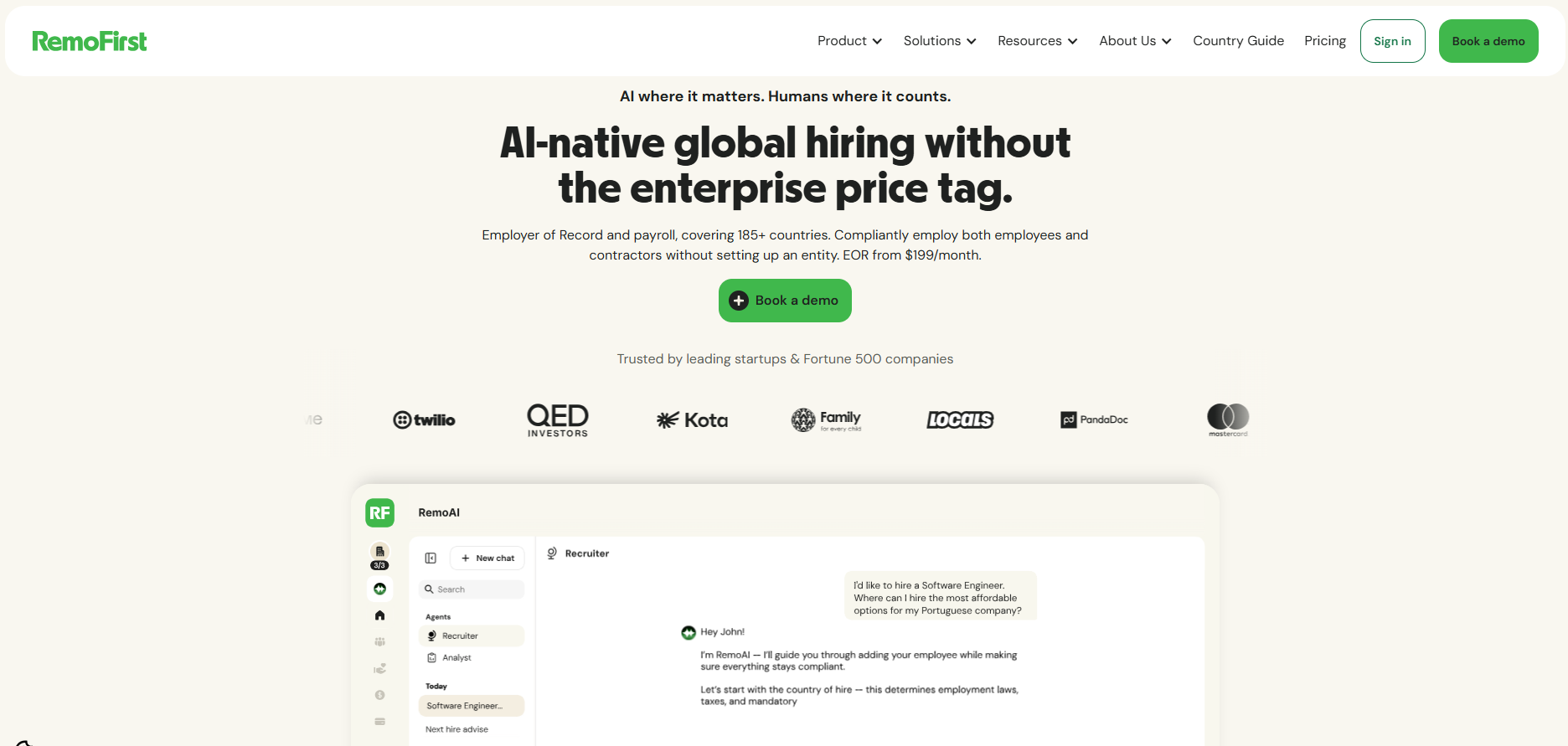
RemoFirst is the low-entry-price alternative with the widest published footprint: Employer of Record, payroll and global HR for employees and contractors across 185+ countries, with EOR advertised from $199 per employee per month against Oyster’s $499 annual rate.
It reaches that coverage through vetted in-country partners rather than its own entities, which is worth putting to legal before you sign. Its AI layer covers candidate matching and payroll error detection.
✅ Pros vs. Oyster HR
- Wider Published Coverage: 185+ countries, against Oyster’s 180+.
- Lowest Entry Price Here: EOR from $199 per employee per month.
- One Platform: International hiring, payroll, and global HR in one system, with visa support in 110+ countries.
❌ Cons vs. Oyster HR
- Partner Model: Employment runs through in-country partners rather than RemoFirst’s own entities.
- The Headline Is a Floor: The $199 rate varies with each country’s requirements, as every EOR’s does.
- Short Integration List: BambooHR, Workday, and ADP Workforce Now so far.
Best For
- Fast-growing teams hiring employees and contractors across many countries.
- Companies that want EOR coverage without creating local entities.
- Teams that also need visas, health benefits, or equipment for new hires.
Key Features
- Employer of Record, payroll and contractor management across 185+ countries.
- AI for candidate matching and payroll error detection.
- Visa and work permit support in 110+ countries, RemoHealth benefits and equipment provisioning.
Pricing Structure
- EOR from $199 per employee per month, varying with local country requirements.
- Contractor management free; $25 per contractor per month to process payments.
- Background checks and visas priced as separate add-ons.
2. WorkMotion
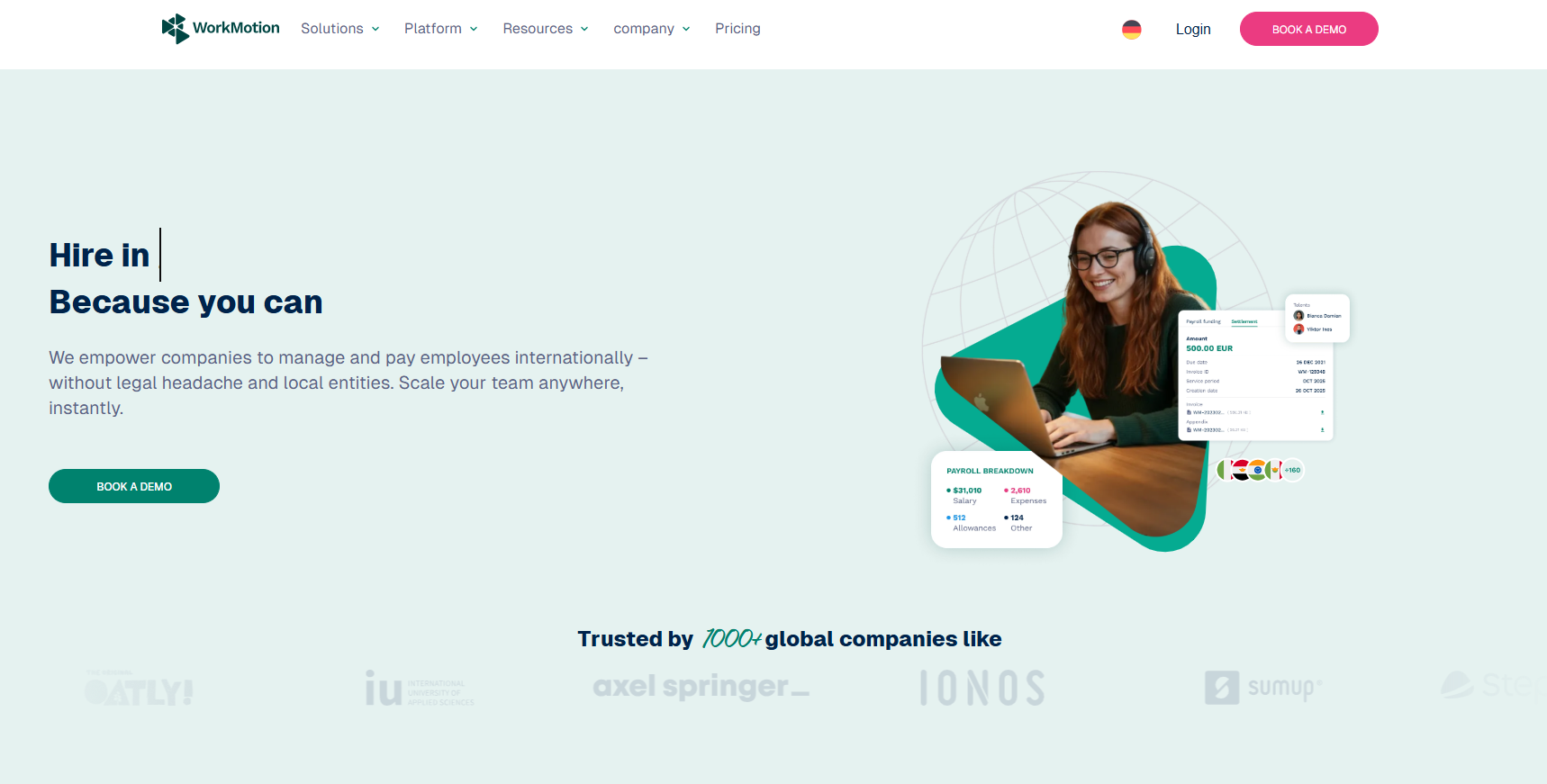
WorkMotion is a practical option for teams that want to hire internationally without opening local entities.
Its EOR handles compliant contracts, onboarding, payroll, taxes, social contributions, benefits, and offboarding across 160+ countries, and the same platform covers direct hiring and global contractors.
WorkMotion says it runs this through its own subsidiary network, and it publishes its rates: EOR from €499 per employee per month, close to Oyster’s $499 on annual billing.
✅ Pros vs. Oyster HR
- Own Entity Network: Hiring runs through WorkMotion’s own subsidiaries, by its account, rather than a partner chain.
- Three Ways to Hire: EOR, direct hiring from €399, and contractors from €29 on one platform.
- Built-In Recruiting: Synmatch AI sources and pre-screens candidates, free if you then hire through WorkMotion.
❌ Cons vs. Oyster HR
- Fewer Countries: 160+ against Oyster’s 180+.
- Priced in Euros: Published rates are in euros, so the dollar cost moves with the exchange rate.
- Starting Rates Only: Each price is a “starting at” figure; country costs come on top.
Best For
- Companies expanding into several countries without creating entities.
- Teams that need EOR, direct hiring, and contractor workflows in one platform.
- Buyers who want a published starting rate before talking to sales.
Key Features
- Employer of Record across 160+ countries with country-compliant contracts, payroll, taxes, benefits, and offboarding.
- Direct Hiring with real-time law monitoring and country-specific risk alerts.
- Contractor management with automated invoicing, tax support, and compliance safeguards.
- Synmatch AI for AI-sourced, pre-screened candidates.
Pricing Structure
- EOR from €499 per employee per month.
- Direct Hiring from €399 per employee per month.
- Contractor management from €29 per contractor per month.
- Synmatch AI recruiting free if you hire through WorkMotion EOR or Direct Hiring; otherwise 10% of gross annual starting salary.
3. Deel

Deel is the most direct like-for-like swap and typically the cheaper one on monthly billing: EOR from $599 per employee per month against Oyster’s $699, with no month-of-salary deposit to fund.
It covers 150+ countries for 35,000+ customers, processing roughly $22 billion in payroll a year, and passed $1.4 billion in annual recurring revenue.
Oyster still wins on published country count at 180+ and on contractor pricing at $29 against Deel’s $49. If your headcount is employees rather than contractors, Deel’s numbers usually come out ahead.
✅ Pros vs. Oyster HR
- Lower Monthly Rate: From $599 per employee per month against Oyster’s $699.
- No Salary Deposit: No working capital tied up per head.
- Larger Scale: 35,000+ customers and roughly $22 billion in annual payroll processed.
- Volume Discounts: Negotiated rates commonly fall to $400 to $500 at 20+ headcount.
❌ Cons vs. Oyster HR
- Fewer Countries: 150+ against Oyster’s 180+.
- Pricier Contractors: $49 per contractor per month against $29, with no free tier.
- Country Surcharges: Brazil, France, and India can add $50 to $150 per employee per month.
- Live Litigation Risk: Rippling’s espionage and racketeering claims survived dismissal in February 2026 and the Justice Department is reported to be investigating. Deel denies the claims and has countersued.
Best For
- Companies weighted toward employees rather than contractors.
- Teams that cannot tie up a month of salary per head as a deposit.
- Businesses scaling past 20 employees where volume discounts apply.
Key Features
- Employer of Record, contractor management, and global payroll across 150+ countries.
- 35,000+ customers, with roughly $22 billion in payroll processed annually.
- Automated compliance, localised contracts, and built-in tax document handling.
Pricing Structure
- EOR from $599 per employee per month, rising to about $899 on the enterprise tier.
- Contractor management from $49 per contractor per month; Contractor of Record around $325.
- Global payroll from $29 per employee per month.
- Negotiated rates commonly fall to $400 to $500 per employee at 20+ headcount.
4. Remote.com

Remote.com is the structural upgrade if entity ownership matters to you.
It operates through 100% owned legal entities in every country it serves, where Oyster’s owned-entity coverage is thinner in some markets despite the larger headline country count.
Remote also removes the friction Oyster adds: no deposit, no setup fees, no onboarding fees, and no contract minimums.
Pricing matches on annual billing at $599 per employee per month ($699 monthly) and contractor management is $29, the same as Oyster. The trade is coverage, at 80 to 90+ countries against 180+.
✅ Pros vs. Oyster HR
- Owned Entities Throughout: No partner in the compliance chain anywhere it operates.
- No Deposit: No month-of-salary working capital requirement.
- No Fees Around the Fee: No setup, onboarding, or contract minimums.
- Cheaper on Annual: $599 per employee per month against Oyster’s $699 list.
❌ Cons vs. Oyster HR
- Half the Country Count: 80 to 90+ against 180+.
- Weaker Asia Long Tail: Oyster reaches markets Remote’s owned-entity model does not.
- No Free Contractor Tier: Oyster covers up to 2 contractors at no cost.
- Monthly Billing Premium: $699 unless you commit annually.
Best For
- Companies where compliance liability is scrutinised and a partner-free chain matters.
- Teams that want to avoid deposits and setup fees entirely.
- Businesses hiring inside Remote’s owned-entity footprint.
Key Features
- 100% owned legal entities across 80 to 90+ countries.
- Five plans spanning EOR, global payroll, contractor management, Contractor of Record, and a free HRIS.
- No platform setup fees, onboarding fees, or contract minimums.
- No deposit required to begin an engagement.
Pricing Structure
- EOR at $599 per employee per month billed annually, or $699 billed monthly.
- Contractor management at $29 per active contractor per month; a Plus tier at $99.
- The EOR rate is the platform fee only; employer taxes and benefits layer on top.
5. Second Talent

Oyster gives you a well-designed way to employ someone once you have found them.
Second Talent gives you the engineer and the employment together, quoted as one flat monthly figure: $3,000 to $6,000 for a senior, covering sourcing, four-stage human vetting, and a managed Employer of Record handling local employment, payroll, tax, and exits.
There is no month-of-salary deposit to fund, no FX spread layered on payouts, and no per-seat platform charge. Engineers come from nine Asian markets including Vietnam, the Philippines, Indonesia and Singapore, covering GMT+5:30 to GMT+8.
✅ Pros vs. Oyster HR
- No Salary Deposit: Nothing equivalent to a month of gross salary held per employee.
- Sourcing Included: You get the candidates too, where Oyster expects you to arrive with them.
- No FX Spread: A flat monthly rate, rather than payouts marked up 1 to 1.5% above mid-market.
- One All-In Number: A single figure instead of platform fee plus salary plus employer taxes plus FX.
- AI-Native by Default: Engineers who build with Claude Code, Cursor and Copilot every day, with AI-tool fluency assessed during vetting rather than assumed from a CV.
- Self-Serve or Managed: Search and shortlist the vetted bench yourself in the Second Talent platform, or brief a recruiter and get a matched shortlist in 24 hours.
❌ Cons vs. Oyster HR
- Nine Markets, Not 180+: Oyster’s footprint is far wider.
- Engineering-First Roles: A limited non-technical bench; Oyster employs any function in any department.
- Not a Standalone EOR: If you have candidates and need only infrastructure, Oyster is the better tool.
- No Free Contractor Tier: Oyster covers up to 2 contractors at no cost.
Best For
- Teams that need engineers hired and employed, not just employed.
- Companies unwilling to tie up a month of salary per head as a deposit.
- Asia, EMEA, and US West Coast businesses that need Asia-hours overlap.
- Buyers who want one predictable number per engineer.
Key Features
- First matched shortlist in under 24 hours, with a written recommendation.
- Four-stage vetting: technical assessment, AI-native tooling, English at C1+, and a behavioural interview.
- Benches across full-stack, back-end, frontend, mobile, and data roles.
- A managed Employer of Record covering local employment, taxes, benefits, and exits.
- 92% talent retention across placements, with 200+ companies hiring through the platform.
Pricing Structure
- $3,000 to $6,000 per engineer per month, flat and all-in.
- Employment, payroll, and compliance included in the monthly rate.
- No deposit, no platform fee, and no fees until a hire is made.
6. Rippling

Rippling is the alternative when you want more than employment.
Alongside EOR and global payroll it runs a full HRIS plus device management, app provisioning, and corporate spend, so one onboarding workflow issues payroll, benefits, a laptop, and software access together. Oyster does not attempt that.
Its EOR floor is also lower at $499 to $599.
The catch is structural: the base platform at $35 per month plus $8 per user is compulsory before EOR can be bought at all, pricing is quote-only, and complex markets reach $800 to $1,200 per employee per month.
✅ Pros vs. Oyster HR
- Much Deeper Platform: HR, IT, and finance in one system, including device and app management.
- Lower EOR Floor: $499 to $599 in standard markets.
- Strong Automation: One workflow provisions payroll, benefits, hardware, and software access.
- Tool Consolidation: Replaces several separate systems.
❌ Cons vs. Oyster HR
- Mandatory Base Fee: You cannot buy EOR without the $35/mo plus $8/user platform underneath.
- Quote-Only Pricing: No published EOR rate, where Oyster lists $699 openly.
- Steep Complex Markets: $800 to $1,200 per employee per month.
- Narrower Coverage: A smaller country footprint than 180+.
Best For
- Companies consolidating HR, IT, and finance tooling rather than buying employment alone.
- Teams with meaningful device and app provisioning needs.
- Businesses hiring mostly in simpler markets, where the $499 floor applies.
Key Features
- A unified system of record spanning HR, IT, payroll, and corporate spend.
- Employer of Record and global payroll modules built on the core HRIS.
- Automated onboarding covering payroll, benefits, devices, and app access.
- Deep workflow automation and reporting across the employee lifecycle.
Pricing Structure
- Base HRIS platform at $35 per month plus $8 per user per month, and it is compulsory.
- EOR at $499 to $599 per employee per month in standard markets, quote-only.
- Complex markets run $800 to $1,200 per employee per month.
- Global payroll around $200 per employee per month.
7. Papaya Global

Papaya Global directly targets the cost Oyster buries in the fine print: FX.
Where Oyster’s spread runs roughly 1 to 1.5% above mid-market on every payout, Papaya is built payments-first, splitting into Workforce OS for employment management and Payment OS for moving money, with a payroll engine covering 160+ countries and 130+ currencies and bank rails running through JP Morgan and Citi.
For a distributed payroll of any size, that difference compounds. Watch its own pricing gap though: published EOR starts at $499 per employee per month, while third-party analyses commonly observe $650 to $770.
✅ Pros vs. Oyster HR
- Better FX Handling: Licensed bank rails through JP Morgan and Citi rather than a 1 to 1.5% spread.
- Most Currencies: 130+ supported, ahead of anything else here.
- Built for Finance Teams: Strong reporting, reconciliation, and audit trails.
- Granular Modules: Payments from $3.50 and contractor management from $5.
❌ Cons vs. Oyster HR
- Inconsistent Real-World Pricing: Published EOR starts at $499, but observed quotes commonly land at $650 to $770.
- Weaker HR Layer: Less depth in day-to-day HR workflow than Oyster’s product.
- Two-Part Complexity: The Workforce OS and Payment OS split takes longer to learn.
- Fewer Countries: 160+ against Oyster’s 180+.
Best For
- Finance-led organisations where FX and reconciliation costs are material.
- Companies paying across many currencies at scale.
- Teams that need audit-grade payment trails.
Key Features
- Workforce OS for employment management and Payment OS for global payments.
- A payroll engine spanning 160+ countries and 130+ currencies.
- Bank rails through JP Morgan and Citi rather than a generic payout provider.
- Employer of Record, Contractor of Record, and contractor management modules.
Pricing Structure
- Employer of Record published from $499 per employee per month; observed quotes commonly $650 to $770.
- Payroll Plus from around $29 per employee per month.
- Contractor of Record around $295, and contractor management from about $5.
- Workforce payments from roughly $2.50 to $3.50 per transaction.
How to Choose an Oyster HR Alternative in 2026
Oyster is a good product with two commercial characteristics worth pricing properly before you commit.
The deposit of roughly one month of gross salary per employee is working capital you cannot deploy elsewhere, and at ten hires that is a meaningful number. The FX spread of 1 to 1.5% above mid-market applies to every payout, forever.
Neither is hidden, but neither appears in the headline rate. So: if the deposit is the blocker, Deel and Remote.com both require none. If the entry price is the blocker, RemoFirst starts at $199.
If FX is the blocker, Papaya Global’s bank rails are the structural fix. If you want direct hiring alongside EOR, WorkMotion offers both. If entity ownership matters to legal, Remote.com owns every entity it operates through.
If you want more platform, Rippling adds HR, IT, and spend. And if the real gap is that you still have to find the engineers, Second Talent bundles sourcing with employment.
Model the Total, Not the Headline
- $699 per employee per month list, or $499 on annual billing via the Scale plan.
- Plus roughly one month of gross salary held as a deposit, per employee.
- Plus an FX spread of about 1 to 1.5% above mid-market on payouts.
- Plus employer taxes, 13th-month pay where applicable, and benefits, which commonly add 20 to 50%.
Oyster HR answers one question well: how do I employ someone in almost any country, on a clean modern platform, with a rate published on the page. If that is your question and the deposit is affordable, it is a solid choice.
If your question is about working capital, FX cost, entity structure, or finding the engineers in the first place, one of the seven alternatives above answers it better. Tell us what you need and we will send a shortlist in 24 hours →


