TL;DR: Arc.dev sells remote hires: freelancers at $15 to $110+ an hour, or a fee of 20% of the annual salary for a full-time hire. Turing’s homepage now sells AI training data and domain experts to AI labs, but its hiring pages still offer vetted engineers in 4 days with a 3-week risk-free trial, at prices it does not publish. Pick Arc for listed fees and a freelance or full-time choice, and Turing for a longer trial or AI work beyond hiring.
Turing raised $87 million at a $1.1 billion valuation in December 2021, and TechCrunch described a platform that could “source, evaluate, hire, onboard and then manage engineers”.
Today its homepage reads “Accelerate superintelligence”, and its developer hiring pages sit outside the main menu. Arc stayed a hiring marketplace. It took over the CodementorX hiring service in July 2019.
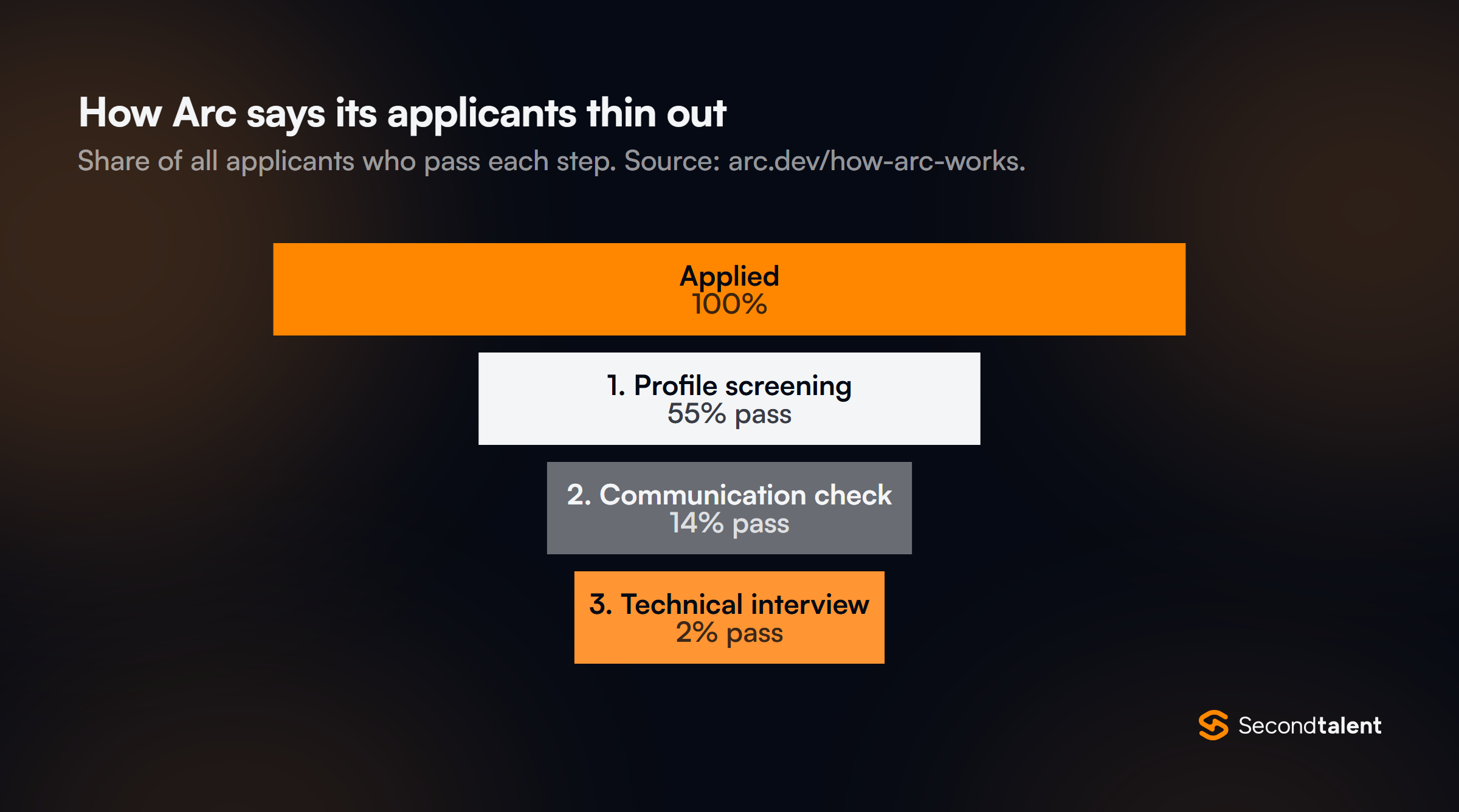
- 1Arc says only 2% of applicants pass its technical interview, after 55% clear the profile review.
- 2Arc gives freelance hires a trial of up to two weeks, and full-time hires a free replacement in the first three months.
- 3Turing says it turned a profit in 2024, as its revenue run rate “nearly triples” to $300 million.
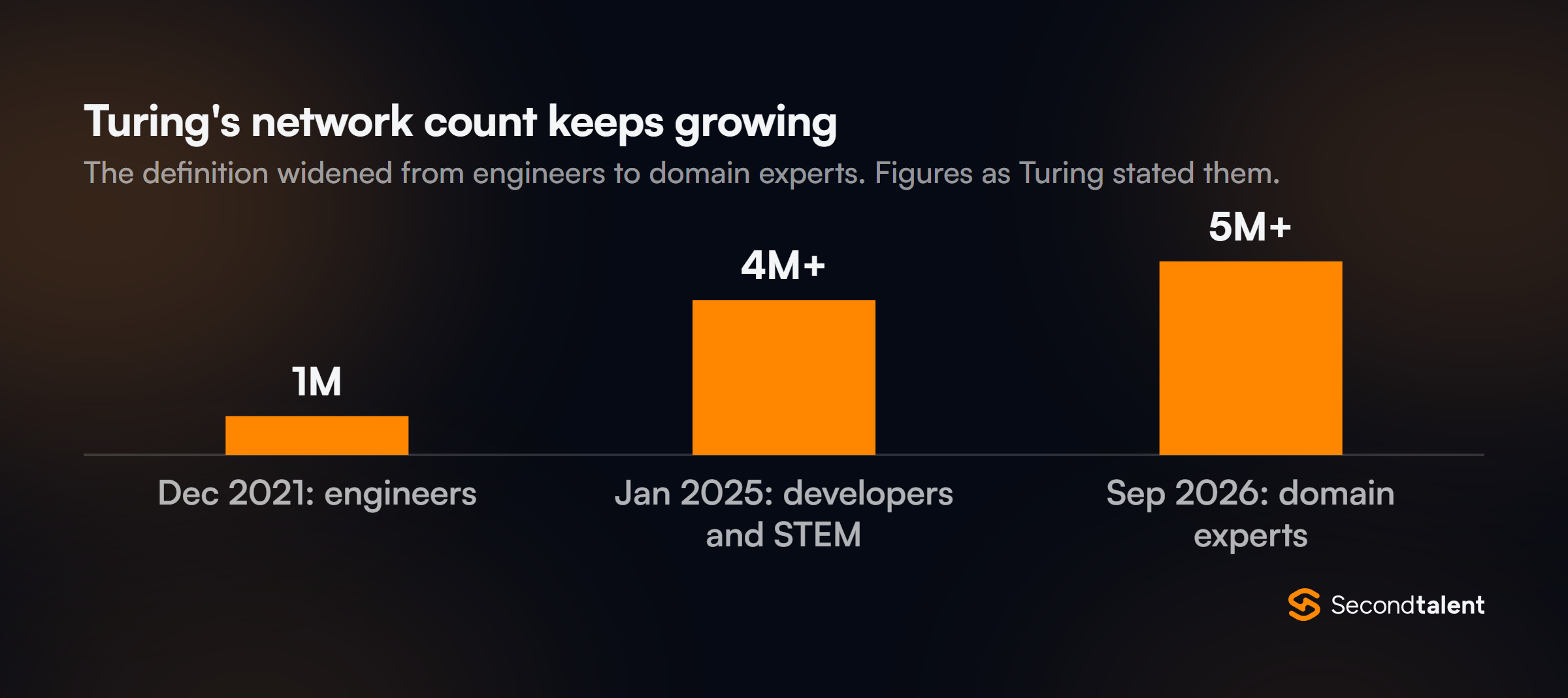
- 4Turing now counts 5M+ experts in 250+ fields, from doctors to physicists. In 2021 it counted 1 million engineers.
Turing or Arc.dev: which one should you use?
Use Arc if you want to hire a remote developer, designer or product manager and manage them yourself. It publishes its prices, screens candidates before you meet them, and backs both plans with a trial or a replacement.
Turing still places vetted remote engineers through its hiring pages, with a 3-week risk-free trial but no published rates.
Its main business is now elsewhere: training data and domain experts for AI labs, and its own engineers placed inside enterprise teams to build AI agents.
The table sets the two side by side on each company’s own pages, read on September 14, 2026. “Not published” means neither site gives a figure. For the wider field, see our Turing alternatives and Arc.dev alternatives pages.
| Turing | Arc.dev | |
|---|---|---|
| What it sells | Vetted remote engineers; training data, RL environments and experts for AI labs; embedded engineers for enterprises | Freelance and full-time remote hires |
| Main buyers | AI labs and Fortune 500 companies, plus teams hiring engineers | Companies hiring remote staff |
| Prices | Not published; quoted on request | $15 to $110+ an hour freelance; 20% of annual salary full-time |
| Screening | Skill tests plus a 57-question seniority check; “top 1%” claimed, no step pass rates | Three steps; 2% pass, on Arc’s figures |
| Speed claim | 4 days to fill most roles, “sometimes same day” | Freelance hire in 72 hours; full-time in about 14 days |
| If it fails | 3-week risk-free trial in the page hero; 14-day in one FAQ | Two-week freelance trial; free replacement for three months on full-time |
| Network claim | 3 million+ engineers applied; 5M+ experts in 250+ fields | 450,000 talent in 190 countries |
| Success claim | 97% engagement success rate | 800+ hires made |
| Revenue | $300 million run rate in 2024 | Not published |
What Turing sells now
Turing’s site now describes “two lines of business, one mission”. Frontier AI helps AI labs “train and improve models”.
Enterprise AI places forward-deployed engineers (FDEs) inside large companies to build AI agents, then runs those agents on the Turing Intelligence Platform.
The homepage counts 300+ RL environments, 1M+ curated tasks and work with 9 of 9 frontier labs.
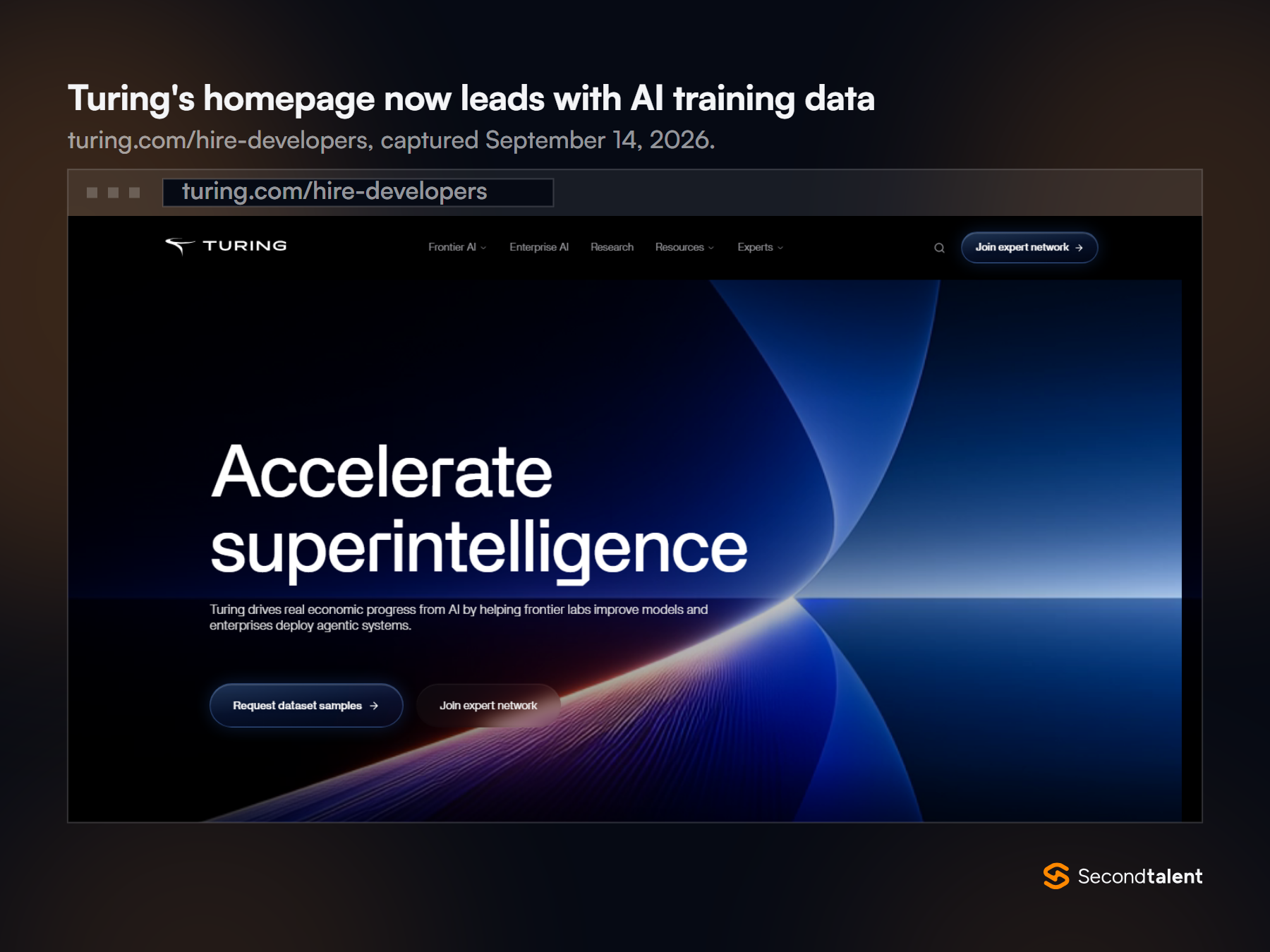
Developer hiring has moved off the front page rather than closed. The top bar lists Frontier AI, Enterprise AI, Research, Resources and Experts, and none of those headings points to a hiring page.
On Turing’s expert recruiting page, the “For Clients” link leads to Frontier AI. The four parts of the business:
- Frontier AI: datasets written by PhDs, RL environments where agents practise on real tools, benchmarks, and domain experts. The buyers are AI labs.
- Enterprise AI: FDEs who “come from frontier AI labs”, plus a platform Turing calls “the AI control plane for enterprise agents”. Turing’s enterprise page names banking, insurance and asset management as first use cases.
- Developer hiring: role pages such as AI engineers and Python developers offer “the top 1% of 3 million+ engineers who have applied to Turing”.
- Expert network: doctors, lawyers, physicists and software engineers who write and grade AI training tasks. Turing’s job board listed 217 open roles on September 14.
The newest piece is Turing Frontier, launched on April 9, 2026. It connects AI labs with verified US-based experts in fields such as finance, law, medicine and energy. Its CEO put the pitch this way in the launch release:
“AI labs need data that only the most elite professionals can provide and Turing Frontier delivers the most accomplished experts in their fields.”
Jonathan Siddharth, CEO and Founder of Turing, April 9, 2026
Turing the business: AI data now leads
The AI work has paid Turing well so far. In a January 2025 release, Turing said its annual revenue run rate “nearly triples” to $300 million and that it turned a profit in 2024.
Its CEO put the jump at “$100 to $300 million in ARR in a single year”. It named its customers as “the world’s leading AI labs and Fortune 500 companies”.
The 2021 round funded the old business. TechCrunch’s report named Johnson & Johnson, Coinbase, Rivian and Disney as clients of its Talent Cloud.
By the Series E, TechCrunch called Turing “a key coding provider for OpenAI and other LLM producers”. Investors priced that round when the run rate stood at $167 million.
The size of Turing’s network grew with the change, and so did the kind of person it counts. In 2021 it was engineers and developers. By 2025 Turing counted developers, data scientists and STEM professionals.
Its experts page now counts a pool of domain experts across 250+ fields.
Turing also recruits engineers for its own AI training projects. Its job board offers roles such as scientific coding in Python, LLM evaluation and full-stack code review, next to roles for dermatologists and business analysts.
How the two screen talent
Arc publishes pass rates. Of every 100 applicants, it says 55 get through the first step, a review of skills, training and work history. Only 14 clear the second, an English and remote-work check done by live interview or recorded video.
The technical interview, an hour with an expert or a pair programming session, leaves 2.
A fourth step, the final review, has no pass rate. Arc’s how it works page says the company keeps checking vetted talent after they start.
It also says Arc sources beyond job applicants: open source contributors, top Stack Overflow answerers, and the 350,000+ mentors on Codementor, the mentoring site Arc grew out of.
Turing publishes no pass rate. Its experts page describes screening that is “configured per project and client requirement”.
The building blocks are coding tests in 18-plus languages, sample AI training tasks, an AI video interview tuned to each person, and identity and anti-money-laundering checks. Human reviewers step in for complex or high-stakes roles.
Its developer hiring pages describe a different process. Every developer must clear tests on programming languages, data structures, algorithms, system design and frameworks.
An automated seniority test then asks 57 calibrated questions in 5 areas, from engineering excellence to communication. Turing gives the “top 1%” headline but no pass rate per step.
Arc also uses AI in its hiring. HireAI, its matching tool, does two jobs on the pricing page. It screens incoming applications and flags the top ones, and it finds and contacts matching candidates for your role.
What Arc charges, and what Turing publishes
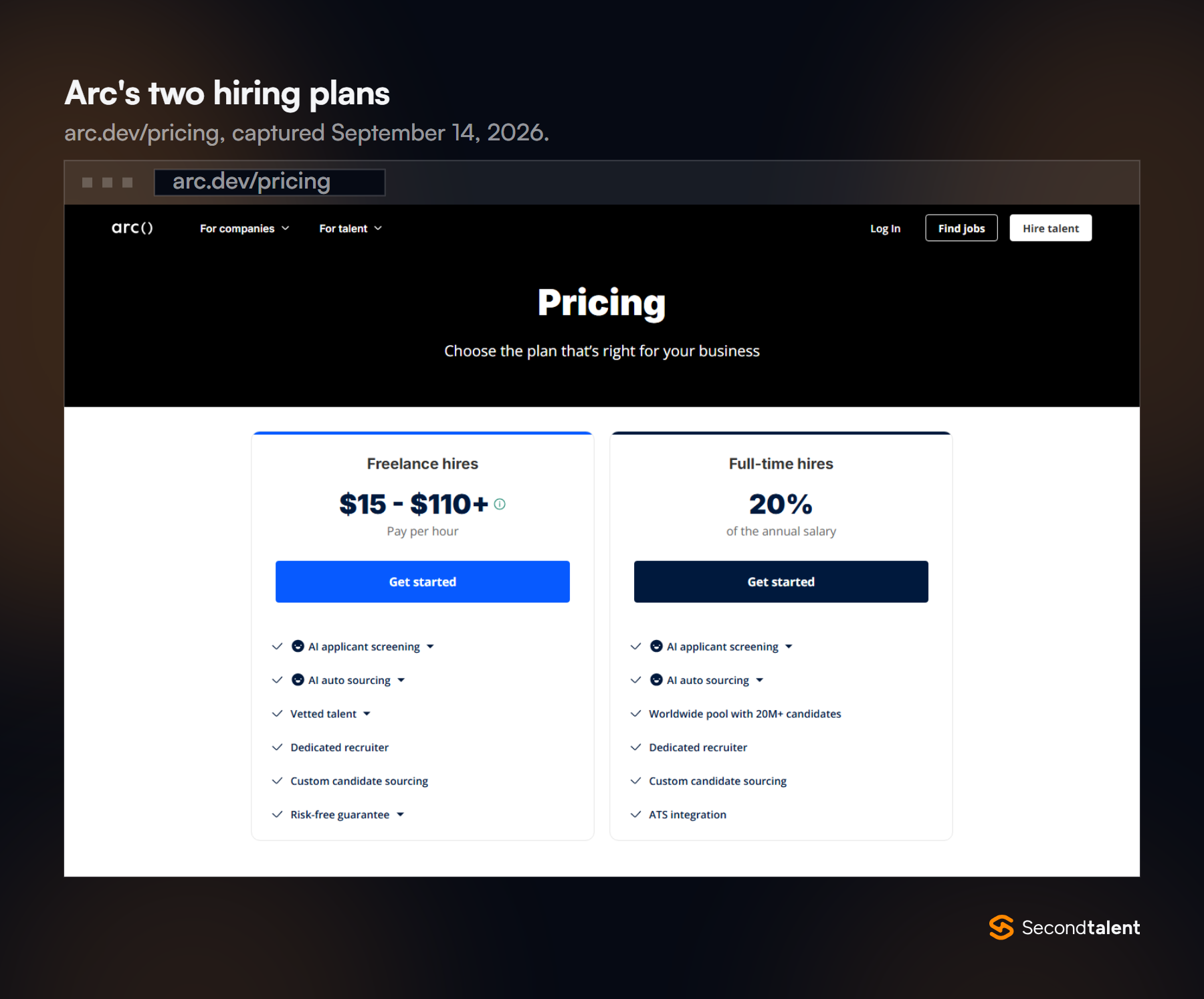
Arc prices its two plans in different units. Freelancers bill by the hour. For a full-time hire, you pay a one-off fee based on the hire’s annual salary, and only when you hire. Arc’s homepage puts it as “$0 until you hire”.
- Hourly rates shown as $15 to $110+
- Vetted talent who passed Arc’s communication and technical checks
- A dedicated recruiter and custom sourcing
- Risk-free trial of up to two weeks
- Fee of 20% of the annual salary, paid when you hire
- Search across a pool Arc puts at 20M+ candidates
- A dedicated recruiter and ATS integration
- Free replacement in the first three months
The full-time fee is easy to budget. On a $90,000 salary, the fee is $18,000, paid once on top of pay. Candidates set their expected annual salary, and Arc matches you with people inside the range you give.
Both plans are laid out on the pricing page.
Turing lists no prices on any page. Its Python hiring page says cost depends on experience, project complexity and location, and promises “unbeatable prices” without a figure.
Its enterprise page ends in a contact form, after which “a forward-deployed engineering lead will follow up with a scoping conversation”. Frontier AI buyers start by asking for dataset samples.
Hourly rates for Turing developers, common in older comparisons, have no source on turing.com today.
Arc’s rate explorer draws on the hourly rates of more than 20,000 vetted freelancers on Codementor. For a second view, our freelance developer rate index gives hourly rates by stack and region, set against US rates.
Network size: Arc gives three numbers
Arc does not give one size for its talent pool. The full-time plan on its pricing page mentions a “worldwide pool with 20M+ candidates”. The homepage says “450,000 talent in 190 countries”.
And the developer hiring page counts 277,632 “developers, engineers, programmers, coders, contractors, and tech experts ready to interview”.
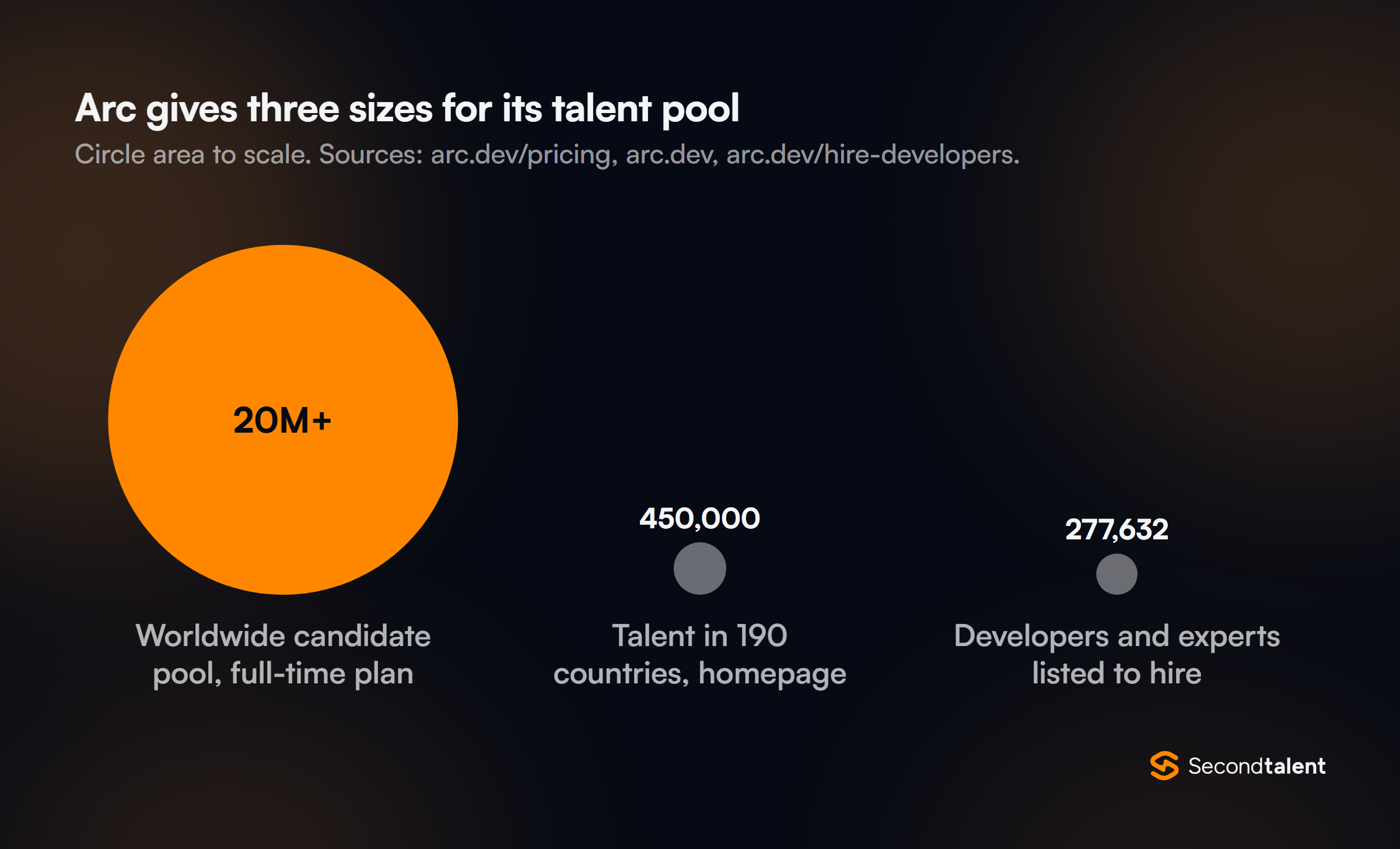
Arc does not define the three, but the pages give clues. The 20M+ figure sits on the full-time plan, next to HireAI’s sourcing, so it reads as the pool Arc can search and contact.
The 277,632 are profiles listed for hire, and the listings on that page include a motion designer as well as engineers.
Turing gives two counts: 3 million+ engineers who have applied, on its hiring pages, and a 5M+ expert pool for AI training work.
A case study on the experts page shows what the larger pool is for. A frontier lab asked for experts in more than 30 fields on a Wednesday afternoon.
Turing lined up 1,200-plus vetted experts that evening and delivered the work by Friday at noon.
Speed, and what happens when a hire fails
Arc sells speed against a slow baseline. Its how it works page sets its hiring time against 58 days for a typical hiring process, a figure it credits to Workable. The longest stage in that comparison is 21 days of interviews.
Arc’s own claims:
The homepage also claims savings of up to 58% against traditional hiring. It does not say which costs it compared.
If a hire fails, Arc’s terms depend on the plan. Freelance hires come with a “risk-free trial period of up to two weeks”. For full-time hires, Arc promises a free match with another person if you are unhappy in the first three months.
Arc also handles freelancer payments. Full-time hires can go on the payroll of what Arc calls “trusted EOR partners”.
Turing’s hiring pages offer a longer trial, though they disagree on its length. The page hero promises a 3-week risk-free trial, and the page titles say 21 days.
The AI engineer page FAQ explains the terms: keep the developer and you pay for the first 3 weeks, stop during the trial and you pay nothing.
The FAQ on the Python page calls it a 14-day trial. The same pages claim 4 days to fill most roles and a 97% engagement success rate, without defining success. Turing publishes no trial terms for its Frontier AI or Enterprise AI projects.
What you actually get from each
The two overlap on one product. Both will find you a vetted remote engineer who works for you: Arc with published fees, Turing with a quote and a longer trial. Beyond that they split.
Turing’s FDEs sit inside your engineering team, but they build agents and run them on Turing’s platform.
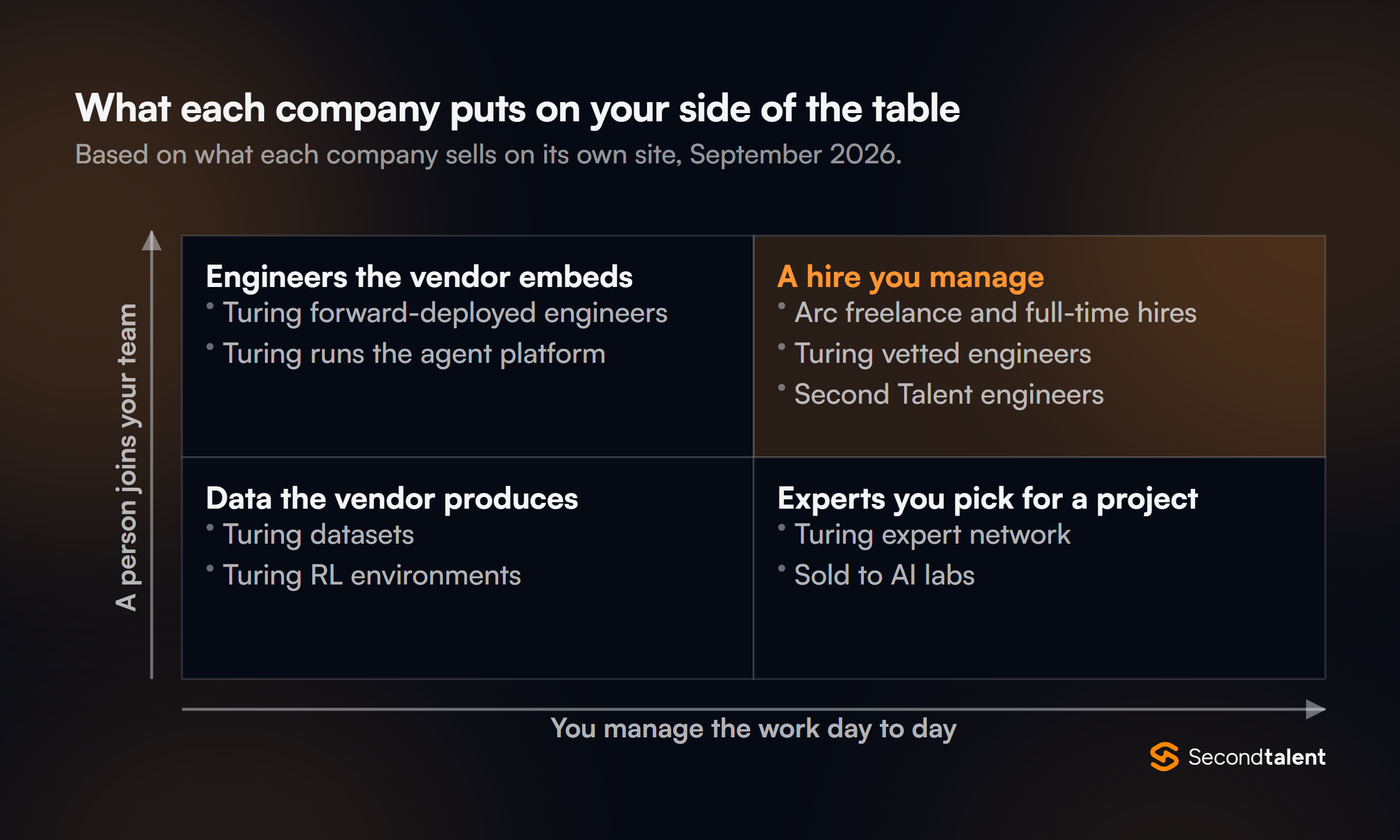
An AI lab gets little from Arc, which lists no dataset or evaluation service.
A startup that needs a React or Python developer can use either, but will only find Turing’s offer through a role page, since its menus lead to AI lab and enterprise work.
If you are weighing a contractor against an employee in a given country, our employer of record guides cover the rules market by market.
Full-time engineers in Asia with Second Talent
Arc and Turing find you an engineer on a trial. Second Talent vets engineers and employs them for you in nine Asian markets: Vietnam, the Philippines, Indonesia, Singapore, Malaysia, Thailand, Hong Kong, Taiwan and China.
The price is a flat $3,000 to $6,000 a month per engineer, all-in, covering sourcing, vetting and our managed EOR.
Our engineers pass four vetting stages: a technical assessment, an AI-native tooling check covering Claude Code, Cursor and Copilot, English at C1 or above, and a behavioural interview.
Search our talent directory yourself or send us a brief. We are engineering first, with a limited non-technical bench in design, sales development, data annotation and operations. Terms are on our pricing page.
Frequently asked questions
Can developers still work for Turing?
Yes, on remote AI training projects. Its job board lists coding, machine learning and data roles next to medical, legal and finance roles.
Is Arc the same company as Codementor?
They share a founder, Weiting Liu. Codementor launched in 2014 for coding mentorship, and announced Arc on July 31, 2019.
Does Arc help with hiring across borders?
Yes. Its Global teams option offers dedicated recruiters and LATAM and APAC market entry.
Related comparisons: Toptal vs Turing · Arc.dev vs Toptal · Toptal vs Upwork · Turing alternatives · Arc.dev alternatives