PeoplePerHour is the UK’s largest freelance marketplace and a significant platform for European buyers, weighted toward web, marketing, and design work through a mix of posted projects and fixed-price “Offers”.
There are no signup, search, or posting fees, and freelancers pay a sliding commission based on lifetime earnings per client: 20% on the first £250, 7.5% from £250 to £5,000, and 3.5% above £5,000.
That structure rewards long client relationships, which is its real strength.
The limits show up when you need engineering depth rather than web and marketing work, pre-vetted senior developers rather than an open bid pool, or a dedicated full-time hire rather than project-based freelancing.
This guide covers the 5 best PeoplePerHour alternatives in 2026.
| Platform | Best For | Pricing Model | Key Difference from PeoplePerHour |
|---|---|---|---|
| Second Talent | Dedicated full-time engineers from Asia, with EOR included. | Flat monthly per engineer ($3,000–$6,000/mo). $0 upfront. | Pre-vetted dedicated hires with employment handled, instead of an open marketplace you screen yourself. |
| Upwork | The same open-marketplace model at far greater scale. | Freelancers set rates; clients pay a 5% marketplace fee (3% for eligible US clients). | 18M+ freelancers across 180+ countries, against a UK and Europe-weighted pool. |
| Fiverr Pro | Packaged, fixed-price deliverables from vetted sellers. | 5.5% buyer service fee; Pro Advanced $129/mo. | A vetted Pro tier and productised gigs, rather than an open bidding process. |
| Toptal | Elite, globally sourced freelancers for critical projects. | $60–$150+/hr, specialists $200+; $500 deposit plus $79/mo. | Rigorous four-stage manual vetting and hand-matching, at a substantial premium. |
| CloudDevs | Nearshore LATAM developers on flexible weekly contracts. | Published hourly rates ($45–$75/hr). No fees until you hire. | Pre-vetted developers assigned in 24 hours at published rates, with no bidding at all. |
1. Second Talent

Second Talent is the alternative for teams that have outgrown project-based freelancing. PeoplePerHour works well for a defined piece of web or marketing work; it works poorly when you need an engineer embedded in your product for a year.
Second Talent places pre-vetted engineers from nine Asian markets as dedicated full-time hires on a flat monthly rate, at $3,000 to $6,000 for a senior, with employment, payroll, and compliance handled through a managed Employer of Record.
Coverage spans GMT+5:30 to GMT+8, which gives UK and European teams a solid working-hours overlap.
✅ Pros vs. PeoplePerHour
- Pre-Vetted, Not Self-Screened: Four vetting stages and 6 to 8 profiles shortlisted per role, instead of sifting bids yourself.
- Engineering Depth: A specialist software bench, where PeoplePerHour skews to web, marketing, and design.
- Dedicated Full-Time: One engineer on your team long-term rather than rotating project freelancers.
- Compliance Included: A managed Employer of Record handles employment and payroll.
- AI-Native by Default: Engineers who build with Claude Code, Cursor and Copilot every day, with AI-tool fluency assessed during vetting rather than assumed from a CV.
- Self-Serve or Managed: Search and shortlist the vetted bench yourself in the Second Talent platform, or brief a recruiter and get a matched shortlist in 24 hours.
❌ Cons vs. PeoplePerHour
- Not for Small Projects: A one-off logo or landing page fits a marketplace far better.
- Engineering-First: A limited non-technical bench, and no marketing or copywriting freelancers.
- Monthly Commitment: The unit is a month, not a task.
- Curated, Not Open: You search a vetted Asia bench in our platform, where PeoplePerHour opens its whole marketplace.
Best For
- Teams that keep rehiring freelancers for the same ongoing work and want continuity instead.
- Companies that need genuine engineering depth rather than generalist web skills.
- UK and European businesses that want a solid daily overlap at a substantially lower cost than local hiring.
Key Features
- First matched shortlist in under 24 hours, with a written recommendation.
- Four-stage vetting: technical assessment, AI-native tooling, English at C1+, and a behavioural interview.
- Benches across full-stack, backend, frontend, mobile, and data roles.
- 90-day, one-time replacement guarantee.
- 92% talent retention across placements, with 200+ companies hiring through the platform.
Pricing Structure
- $3,000 to $6,000 per engineer per month, flat and all-in.
- No deposit and no fees until a hire is made.
- Flat monthly billing per engineer with no long-term lock-in.
2. Upwork

Upwork runs the same open-marketplace model as PeoplePerHour at an entirely different scale.
In 2026 it lists more than 18 million registered freelancers across 180+ countries and 90+ service categories, serving roughly 785,000 active clients, with gross services volume above $4 billion a year.
If PeoplePerHour’s limitation for you is simply that the right person is not on it, particularly for specialised engineering work, Upwork is the direct upgrade.
Clients pay a 5% marketplace fee, or 3% for eligible US clients paying by checking account, plus a small contract initiation fee.
✅ Pros vs. PeoplePerHour
- Far Larger Pool: 18M+ freelancers across 180+ countries, well beyond a UK and Europe focus.
- Deeper Technical Talent: Substantially stronger engineering coverage.
- Expert-Vetted Tier: An optional pre-screened tier for higher-stakes work.
- Mature Protections: Escrow, milestones, and time-tracking built in.
❌ Cons vs. PeoplePerHour
- More Proposals to Sift: Greater scale means more screening work for you.
- Less UK-Centric: Fewer local buyers and sellers if UK proximity matters.
- Contract Initiation Fee: $0.99 to $14.99 per new contract on top of the marketplace fee.
- Still No Vetting: The base marketplace screens nobody for you.
Best For
- Businesses hiring across a wide variety of roles, both inside and outside of tech.
- Clients who found PeoplePerHour’s pool too shallow for a specialised brief.
- Teams with the time and expertise to run their own vetting.
Key Features
- A global marketplace of 18M+ freelancers in thousands of skill categories.
- A job posting and bidding system that drives competitive pricing.
- Built-in time-tracking and payment protection through milestones and escrow.
- An “Expert-Vetted” tier for pre-screened top-rated talent at a premium.
Pricing Structure
- Freelancers set their own rates; the platform average is around $39 per hour.
- Basic plan clients pay a 5% marketplace fee, or 3% for eligible US clients paying by checking account.
- A one-time contract initiation fee of $0.99 to $14.99 per new contract.
- Freelancers pay a variable 0 to 15% service fee, which replaced the flat 10% rate on 1 May 2025.
3. Fiverr Pro
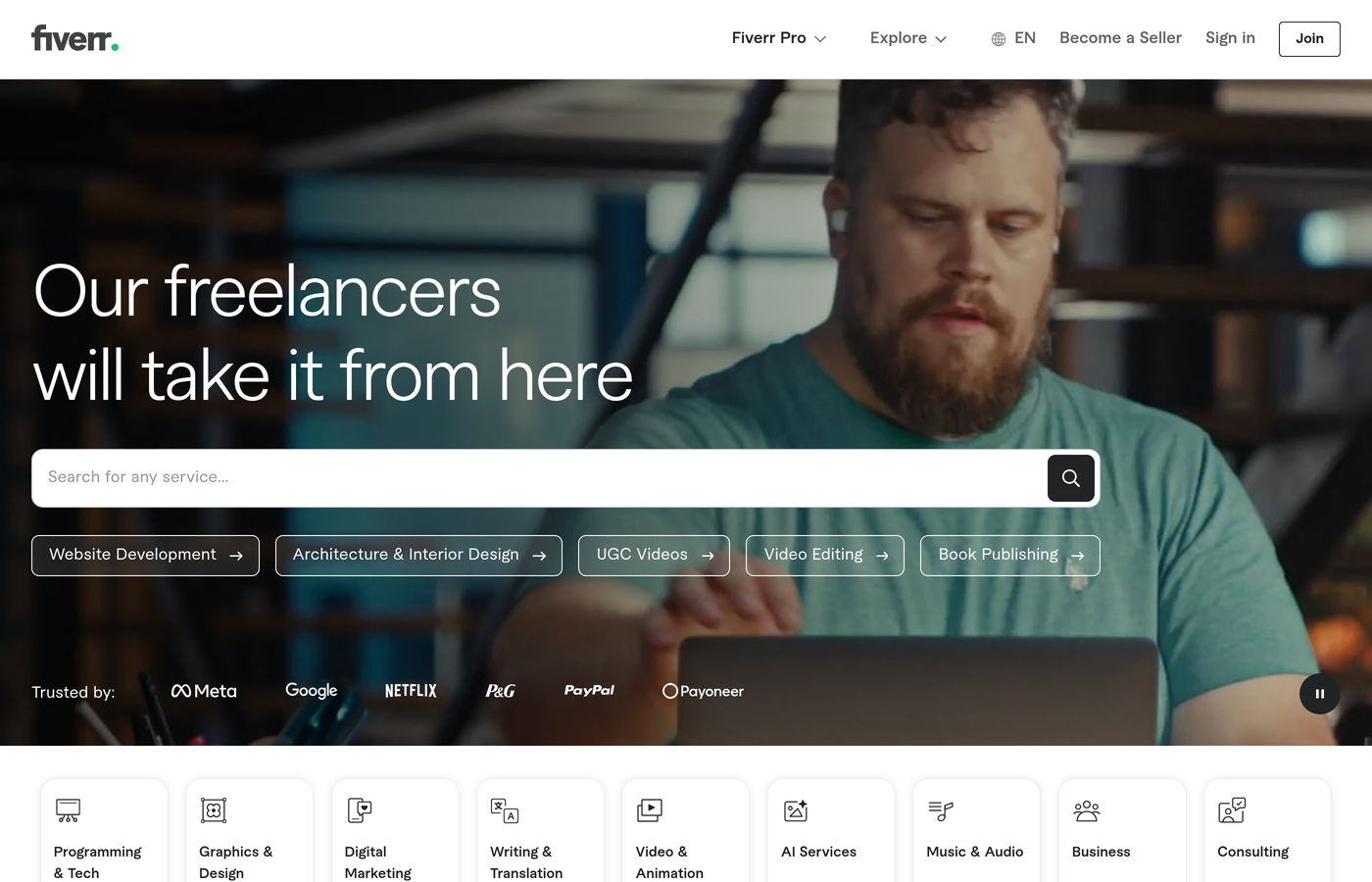
Fiverr is the closest match to PeoplePerHour’s fixed-price “Offers” model, and its Pro tier adds the vetting layer PeoplePerHour lacks.
You buy a defined deliverable at a stated price rather than running a bidding process, which removes most of the screening work.
Pro applications are accepted at roughly 8 to 12%, buyers pay a 5.5% service fee, and Pro Advanced runs $129 per month, with Pro Essential available to accounts spending $1,000 or more annually.
Budget 20 to 30% above the listed price once fees and add-ons land, and note a $3 small-order charge under $100.
✅ Pros vs. PeoplePerHour
- Vetted Tier Available: Pro screening accepts roughly 8 to 12% of applicants.
- No Bidding Process: Browse, compare, and order without writing a brief and waiting.
- Fixed Price Upfront: You buy an outcome at a known cost.
- Much Larger Catalogue: Far more sellers and productised services.
❌ Cons vs. PeoplePerHour
- Fee and Add-On Creep: Budget 20 to 30% above the listed price; a $3 charge applies under $100.
- Subscription for Advanced: Pro Advanced runs $129 per month.
- Weaker for Ongoing Work: Packaged gigs suit one-off deliverables, not continuous engagements.
- Outsourced Vetting: Part of the 2026 verification process is handled by third parties.
Best For
- Well-scoped, self-contained deliverables with a clear definition of done.
- Buyers who want a fixed price rather than an open-ended hourly commitment.
- Teams that need work started today without running a brief and shortlist.
Key Features
- A vetted Pro tier layered on the wider Fiverr marketplace.
- Packaged, fixed-price deliverables rather than hourly engagements.
- Team management, sourcing support, and structured payment options on business plans.
- Individual vetted freelancers rather than agencies.
Pricing Structure
- A 5.5% buyer service fee, plus a $3 small-order charge on orders under $100.
- Pro Advanced at $129 per month; Pro Essential available at spend of $1,000+ annually.
- Pro Enterprise on custom pricing.
- Budget roughly 20 to 30% above the listed gig price once fees and add-ons are included.
4. Toptal

Toptal sits at the opposite end of the market from PeoplePerHour.
Instead of an open pool you screen yourself, it markets the top 3% of applicants, vetted across four manual stages ending in a paid test project, then hand-matches you a candidate in under 24 hours.
For genuinely critical work where a mis-hire is expensive, that removes most of the risk PeoplePerHour leaves with you.
The cost is steep by comparison: $60 to $150+ per hour, specialists above $200, plus a $500 refundable deposit and a $79 per month platform fee before you see anyone.
✅ Pros vs. PeoplePerHour
- Rigorous Vetting: Four manual stages with a paid test project, versus none.
- Hand-Matched: Candidates selected for you in under 24 hours, with no bidding.
- Senior-Level Depth: A genuinely senior engineering bench.
- Strong Public Record: 4.8 stars across 2,300+ Trustpilot reviews.
❌ Cons vs. PeoplePerHour
- Far More Expensive: $60 to $150+ per hour against typical marketplace rates.
- Upfront Cost: A $500 deposit plus $79 per month, where PeoplePerHour charges buyers nothing to post.
- Overkill for Small Jobs: Not economic for a landing page or a logo.
- Minimum Commitments: Top developers often expect 20+ hours per week.
Best For
- Mission-critical projects where a bad hire costs more than the premium.
- Well-funded startups and enterprises building long-term remote teams.
- Buyers who want the vetting done for them rather than sifting proposals.
Key Features
- An exclusive network marketed as the top 3% of freelance talent worldwide.
- A personalised matching service where Toptal experts hand-pick candidates.
- A two-week risk-free trial, with hourly, part-time, and full-time engagements.
Pricing Structure
- Hourly rates of $60 to $150+, with highly specialised talent above $200.
- A $500 refundable deposit, credited against your first invoice.
- A $79 per month platform fee while actively searching.
5. CloudDevs

CloudDevs removes the bidding process entirely. Rather than posting a brief and waiting for proposals, you state what you need and a pre-vetted developer is assigned within 24 hours at published rates of $45 to $75 per hour.
It sources from Mexico, Brazil, Argentina, Colombia, and Peru from an advertised network of 500,000+, bills weekly with cancellation after any week, and charges nothing until you hire. There is a 7-day risk-free guarantee.
Its model changed in 2026 and now spans junior, mid, and senior tiers rather than senior only, which widens the budget range considerably.
✅ Pros vs. PeoplePerHour
- No Bidding At All: A pre-vetted developer assigned in 24 hours, with no proposals to sift.
- Published Rates: $45 to $75 per hour stated openly, so budgeting is predictable.
- Engineering Specialists: A software-only bench rather than a generalist marketplace.
- Risk-Free Trial: A 7-day guarantee with replacement or refund.
❌ Cons vs. PeoplePerHour
- Higher Floor: $45 per hour is above what a marketplace bid can reach.
- Tech Only: No marketing, copywriting, or design work.
- Americas Timezone: A LATAM bench suits US hours better than UK or European ones.
- Interview Friction: Reviews report delays and thin feedback during interviews.
Best For
- Buyers who want a vetted developer without running a hiring process.
- Teams that prefer published, predictable hourly pricing.
- US-hours businesses that need a developer working by tomorrow.
Key Features
- A network advertised at 500,000+ developers across five Latin American countries.
- Talent assigned within 24 hours, across junior, mid-level, and senior tiers.
- Three-stage vetting including a monitored live-coding challenge.
- A 7-day risk-free guarantee, and weekly billing with no lock-in.
Pricing Structure
- Published hourly rates of $45 to $75, averaging about $28 per hour junior and $58 per hour senior.
- Monthly equivalents of roughly $4,500 junior to $9,200 senior.
- All-inclusive rates with no fees until a hire is made.
How to Choose a PeoplePerHour Alternative in 2026
PeoplePerHour is strongest at what it was built for: UK and European buyers commissioning web, marketing, and design work from freelancers, with a commission structure that gets cheaper the longer a client relationship runs.
Teams leave for three reasons. If the issue is pool depth, particularly for specialised engineering, Upwork runs the same model across 18M+ freelancers.
If the issue is screening effort, that sifting bids and judging quality is work you do not want, then Fiverr Pro, Toptal, and CloudDevs all put a vetting layer in front of you at very different price points.
And if the issue is the engagement model, that you keep rehiring for what is really an ongoing role, then a dedicated monthly hire through Second Talent costs less than repeated project work and gives you continuity on the codebase.
The Signal to Switch
- You are rehiring for the same recurring work every month. That is a role, not a project.
- The briefs that attract the fewest good proposals are your most technical ones.
- You spend more time screening proposals than the work itself is worth.
- You need someone who knows the codebase, and each new freelancer starts from zero.
PeoplePerHour answers one question well: how do I find a UK or European freelancer for a defined piece of web, marketing, or design work without paying anything to post. If that is your question, it remains a solid marketplace.
If your question is about engineering depth, vetting, or converting recurring project work into a dedicated hire, one of the five alternatives above answers it better. Tell us what you need and we will send a shortlist in 24 hours →
Hiring contractors rather than employees changes the arithmetic. The freelance developer rate index prices 14 roles across nine regions, benchmarked against North America and sourced from published wage data.