Arc.dev is one of the broadest vetted-talent platforms available. It advertises roughly 450,000 engineers across 190 countries, markets a top 2% acceptance rate, and returns an AI-screened shortlist through its HireAI engine within 72 hours. It charges nothing to start searching, offers both contract and permanent placement, and claims savings of up to 58% versus local hiring. You will want an alternative when your constraint is something Arc’s breadth does not solve: deeper human vetting, a dedicated full-time hire rather than a contractor, employment and payroll handled for you, a specific timezone, or a lower total monthly cost.

Quick Comparison (Updated July 2026)
1. Second Talent

Second Talent inverts Arc.dev’s model. Where Arc gives you breadth, an AI shortlist from 450,000 profiles across 190 countries, and then steps back, Second Talent runs a narrow, human-led search and places one dedicated engineer full-time with employment handled underneath. It sources from nine Asian markets, covering GMT+5:30 to GMT+8. The cost comparison is the reason most teams switch: an Arc contractor at $80 per hour costs roughly $12,800 a month at full utilisation, where a dedicated Second Talent senior is $3,000 to $6,000 for the same month, with no permanent-placement fee to convert.
Pros
- Flat Monthly Pricing: $3,000-$6,000/mo per engineer, versus hourly billing that swings with utilisation.
- Human Vetting: Four stages and 6-8 profiles shortlisted per role, not an AI-generated shortlist.
- Faster First Match: Under 24 hours, against Arc.dev’s 72-hour HireAI shortlist.
- Employment Handled: A managed Employer of Record covers contracts, payroll, tax, and exits.
- No Conversion Fee: You are hiring a dedicated engineer already, so there is no 25%-of-salary placement charge.
- AI-Native by Default: Engineers who build with Claude Code, Cursor and Copilot every day, with AI-tool fluency assessed during vetting rather than assumed from a CV.
- Self-Serve or Managed: Search and shortlist the vetted bench yourself in the Second Talent platform, or brief a recruiter and get a matched shortlist in 24 hours.
Cons
- Narrower Geography: Nine Asian markets against Arc.dev’s 190 countries.
- Not for Short Gigs: A few weeks of help fits an hourly marketplace better.
- Asia Hours: Overlap with US Eastern teams is partial rather than full.
- Smaller Brand: Less name recognition in US procurement than Arc.dev or Toptal.
Best For
- Teams converting a long-running contractor into a permanent, dedicated engineer without paying a placement fee.
- Companies where total cost is the binding constraint and a 50-70% saving versus US salaries changes the roadmap.
- Asia, EMEA, and US West Coast businesses that need Asia-hours overlap.
- Buyers who want a human recruiter accountable for the shortlist rather than an AI ranking.
Key Features
- First matched shortlist in under 24 hours, with a written recommendation.
- Four-stage vetting: technical assessment, AI-native tooling, English at C1+, and a behavioural interview.
- Benches across full-stack, backend, frontend, mobile, and data roles.
- 30-day replacement guarantee, unlimited replacements.
- Optional managed Employer of Record across nine Asian markets.
- 92% talent retention across placements, with 200+ companies hiring through the platform.
Pricing Structure (2026)
- $3,000-$6,000/mo flat per engineer, all-in.
- Employment, payroll, tax and exits included in the monthly rate.
- No deposit and no fees until a hire is made.
- Flat monthly billing per engineer with no long-term lock-in.
- No permanent-placement or conversion fee.
2. Toptal

Toptal operates an exclusive network of elite freelance professionals, accepting only the top 3% of applicants through a rigorous four-stage manual screen. As a direct contrast to Arc.dev’s AI-first marketplace approach, Toptal is designed for companies where technical excellence is paramount and budget is secondary. Staff hand-match clients with pre-vetted candidates, which makes it the natural choice when an AI-generated shortlist has already failed you. It holds 4.8 stars across 2,300+ Trustpilot reviews and reports a 98% trial-to-hire success rate.
Pros
- Elite Talent: Four manual vetting stages and a top 3% acceptance claim, deeper than AI screening.
- Managed Matching: Toptal staff handle screening and shortlisting, saving client time.
- Flexible Billing: Supports hourly, part-time, or full-time engagements.
- Risk-Free Trial: A two-week test engagement gives confidence before committing.
- Strong Review Record: 4.8 stars across 2,300+ Trustpilot reviews.
Cons
- Premium Cost: Rates significantly higher than Arc.dev ($60-$200+/hr vs $15-$110/hr).
- Subscription + Deposit: $79/mo subscription plus a $500 refundable deposit required.
- Busy Talent: Top developers may expect a 20+ hrs/week minimum commitment.
- Markup: The platform adds a markup, reportedly up to 50%, on freelancer rates.
Best For
- Companies that require top-tier remote talent and are willing to pay premium rates.
- Mission-critical or complex projects where developer quality is paramount.
- Funded startups, scale-ups, and enterprises building long-term remote teams.
Key Features
- High-end talent network for software engineers, designers, and finance experts.
- Accepts only the top ~3% of applicants through rigorous screening.
- Hand-matches clients with candidates after a brief needs assessment.
- Engagements are flexible (hourly, part-time, or full-time) with a 2-week risk-free trial.
Pricing Structure (2026)
- $500 refundable deposit required to initiate a search (credited to first invoice).
- $79/month subscription fee while actively searching.
- Blended hourly rates typically $60-$150/hr for most roles.
- AI/ML specialists and consultants can command $200+/hr.
- Full-time developers cost $2,400-$6,000/week ($125k-$312k annually).
3. Turing

Turing is the closest philosophical match to Arc.dev, since both lead with AI-driven matching at scale. Turing’s pool is larger, at more than 3 million engineers, and its “Intelligent Talent Cloud” is built for long-term full-time contracts with a promised 4-hour daily overlap. The 2026 caveat is strategic: Turing raised a $111M Series E at a $2.2 billion valuation in March 2025 and has moved much of its focus toward supplying code and evaluation data to frontier AI labs, so developer staffing is now one line of business among several.
Pros
- Enormous Pool: 3M+ engineers, materially larger than Arc.dev’s 450,000.
- Niche Stack Depth: Strong AI, ML, and specialist coverage a smaller pool cannot match.
- Longer Trial: A 14-day risk-free window with a no-charge rematch.
- Built for Long Contracts: Optimised for stable 40-hour weekly engagements.
Cons
- Roughly Double Arc’s Rate: $100-$200/hr, with AI/ML specialists near $220/hr.
- No Public Rate Card: Pay and platform fee are bundled; reviews estimate a 50-55% margin.
- Timezone Concentration: The bench skews heavily to India.
- Divided Focus: The pivot toward AI-lab data work means staffing is no longer the sole priority.
Best For
- Companies hiring full-time remote developers for long-term, embedded roles.
- Businesses comfortable trusting a data-driven, AI-powered approach to vetting.
- Teams sourcing a very specific or niche technology skill set.
Key Features
- AI-powered vetting and matching from a 3M+ global network.
- Interview standards modelled on ex-FAANG hiring bars.
- A promised 4-hour daily overlap and a full hire in about 4 days.
- A 14-day risk-free trial with a no-charge rematch.
Pricing Structure (2026)
- Hourly rates of $100-$200 for mid to senior engineers.
- AI and ML specialists push toward $220/hr.
- Roughly $17,300-$34,600/mo at full-time utilisation.
- No upfront cost and no separate recruiting fee.
4. Upwork

Upwork trades Arc.dev’s curation for sheer volume. In 2026 it lists more than 18 million registered freelancers across 180+ countries and 90+ service categories, serving roughly 785,000 active clients, with gross services volume above $4 billion a year. There is no shortlist and no vetting: you post a job, manage proposals, and run your own interviews. That is the trade, maximum range in budget, skill, and contract length in exchange for owning the hiring process end to end.
Pros
- Unmatched Variety: 18M+ freelancers across every seniority level and 90+ categories.
- Full Budget Control: Bidding finds talent well below Arc.dev’s typical contract rates.
- Any Contract Length: A two-day task is as viable as a two-year engagement.
- Payment Protection: Built-in escrow, milestones, and time-tracking.
Cons
- No Pre-Vetting: You own the entire screening process, which is slow and inconsistent.
- Fee Stack: 5% client marketplace fee plus a $0.99-$14.99 contract initiation fee per contract.
- Variable Freelancer Fee: The flat 10% was replaced by a 0-15% variable fee on 1 May 2025.
- Timezone Roulette: No regional guarantee, so overlap is a filter you apply yourself.
Best For
- Businesses hiring across a wide variety of roles, both inside and outside of tech.
- Clients who have the time and in-house expertise to run their own vetting.
- Short, well-defined projects with tight budgets where a fixed-price contract fits.
Key Features
- A global marketplace of 18M+ freelancers in thousands of skill categories.
- A job posting and bidding system that drives competitive pricing.
- Built-in time-tracking and payment protection through milestones and escrow.
- An “Expert-Vetted” tier that surfaces pre-screened top-rated talent for a premium.
Pricing Structure (2026)
- Freelancers set their own rates; the platform average is around $39/hr.
- Basic plan clients pay a 5% marketplace fee, or 3% for eligible US clients paying by checking account.
- Business Plus clients pay 10%, or 8% with the same discount.
- A one-time contract initiation fee of $0.99-$14.99 per new contract.
- Freelancers pay a variable 0-15% service fee.
5. Andela

Andela started in Nigeria in 2014 as an engineering training network and became a global full-time remote marketplace sourcing from Africa and Latin America. Where Arc.dev places contractors quickly, Andela’s value is dedication: you are not sharing an engineer, and the model assumes a long-term embedded role. It made an AI-native move in January 2026, acquiring the technical-assessment firm Woven to vet engineers specifically for AI work. Speed is the trade-off, since senior loops often run 2 to 4 weeks against Arc’s 72-hour shortlist.
Pros
- Dedicated Engineers: Full-time and embedded, not shared across clients.
- Established Brand: Strong investor backing and enterprise credibility for procurement.
- AI-Specific Vetting: The 2026 Woven acquisition added assessment built for AI roles.
- Managed Compliance: Employment and compliance options are available.
Cons
- Slow Senior Loops: 2-4 weeks for senior roles, against Arc.dev’s 72 hours.
- No Published Pricing: Rates are quoted per role; third-party estimates are $20-$100/hr.
- Long Commitments: Multi-month minimums are common.
- Thin Review Volume: Very few public client reviews, so weigh them lightly.
Best For
- Companies building long-term teams that need engineers dedicated to one product.
- Enterprises that need a recognised brand for internal sign-off.
- Teams hiring for AI-adjacent roles that benefit from Woven-style assessment.
Key Features
- Full-time dedicated engineers sourced from Africa and Latin America.
- A stated 96% talent match success rate.
- Technical assessment strengthened by the January 2026 Woven acquisition.
- Managed compliance options for long-term engagements.
Pricing Structure (2026)
- Pricing is not published; quotes are per role.
- Third-party estimates put senior roles at $20-$100/hr.
- Roughly $6,000-$14,000/mo per engineer.
- Long-term commitments are usually required.
6. Lemon.io

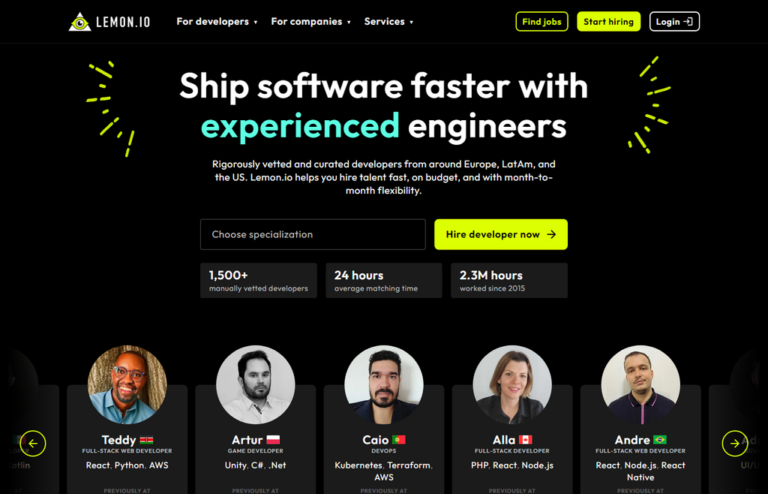
Lemon.io is the answer when Arc.dev’s AI shortlist keeps returning plausible but imprecise matches. Its vetting is entirely human: four stages covering resume, soft skills, English, and a live technical interview run by senior engineers, accepting about 1.2% of applicants and rejecting anyone with under five years in the required stack. The network changed in 2026 and now spans Europe, Latin America, and the US rather than Eastern Europe alone, with published rates tiered from $55 to $200+ per hour. The catch is the 160-hour minimum, a full month at full-time pace before work begins.
Pros
- Human Vetting Throughout: Four stages with a 1.2% acceptance rate, no AI screen.
- Wider Coverage: Europe, LatAm, and the US, not a single region.
- Fast Matching: Candidates typically within 24-48 hours.
- Excellent Reviews: 4.8 stars on Trustpilot, among the highest in this category.
- No Lock-In After Minimum: Month-to-month with no penalty to scale down or switch.
Cons
- 160-Hour Minimum: A full month must be committed upfront, ruling out short tasks.
- Higher Ceiling: Lead rates reach $200+/hr, above Arc.dev’s typical range.
- Upfront Deposit: Required before work starts, where Arc.dev is free to search.
- Freelance-First: Not built for dedicated full-time headcount.
Best For
- Startups that need reliably vetted engineers and can commit to a full month of work.
- Buyers who rank vetting depth above price and distrust AI-only screening.
- European teams that want core-hours overlap.
Key Features
- A curated network spanning Europe, Latin America, and the US.
- Four-stage human vetting: resume, soft skills, English, and live technical interview.
- Matching within 24-48 hours, with a dedicated manager and replacement guarantee.
- Month-to-month engagements after the minimum, with no long-term contract.
Pricing Structure (2026)
- Tiered hourly rates from $55 to $200+ depending on seniority and stack.
- A minimum engagement of 160 hours is mandatory.
- An upfront deposit is required before work commences.
- No penalty to scale down or switch developers after the minimum.
7. Gun.io

Gun.io is the domestic-talent alternative to Arc.dev’s global bench. It focuses on experienced US and Canada-based contract developers, screened by software and then reviewed by senior engineers, and reports that 70% of currently engaged developers have 10+ years of experience. That seniority concentration is the point, and so is the price: rates generally run $100 to $200+ per hour, roughly double Arc.dev’s typical contract range. It suits teams that need domestic contracting, full timezone overlap, or onshore requirements for compliance reasons.
Pros
- Deep Seniority: 70% of engaged developers have 10+ years of experience.
- Human Vetting: Screened by software then personally reviewed by senior developers.
- Full US Overlap: Domestic talent means complete working-hours alignment.
- Transparent Rate Display: Employers see the full rate upfront with no later add-ons.
- Flexible Structures: Pay-as-you-go, monthly retainers, or full-time placement.
Cons
- Highest Rates Here: $100-$200+/hr, roughly double Arc.dev’s contract range.
- Full-Time Fee: 20% of the negotiated first-year salary for permanent placements.
- Narrow Geography: US and Canada focus removes offshore cost savings entirely.
- Budget Complaints: Some users report unexpected cost increases and thin communication about overruns.
Best For
- Companies with onshore or domestic-contractor requirements.
- Teams that need complete US working-hours overlap, not partial.
- Longer-term contracts where deep seniority justifies a premium rate.
Key Features
- A curated network weighted toward senior US and Canada developers.
- Software screening followed by human review from senior engineers.
- Pay-as-you-go packages, monthly retainers, or a retained search team.
- Full rate visibility upfront, with no hidden platform additions.
Pricing Structure (2026)
- Developer rates generally $100-$200+/hr, inclusive of Gun.io’s fee.
- Custom pay-as-you-go packages and monthly retainer options.
- Full-time placements charged at 20% of the first year’s negotiated salary.
- Rates displayed in full to employers before engagement.
8. Revelo

Revelo covers the gap Arc.dev leaves open: employment. Arc places a contractor and steps back, leaving payroll, benefits, tax, and classification with you. Revelo advertises 400,000+ vetted developers across 18 Latin American countries and runs an Employer of Record underneath, so the engineer is properly employed without you opening an entity. Shortlists arrive within 72 hours, matching Arc’s speed, with an average of 14 days to hire overall. Its 2026 terms are competitive: you pay only if you hire, there is a 14-day risk-free trial, and the $500 non-refundable start fee older reviews mention has been dropped.
Pros
- Employment Handled: Payroll, benefits, taxes, and compliance managed across 18 countries.
- US Timezone Overlap: A LATAM bench aligned to US working hours by geography, not by promise.
- Same Shortlist Speed: Three to five pre-vetted candidates within 72 hours.
- Pay Only If You Hire: No start fee, plus a 14-day risk-free trial.
- Strong Ratings: G2 Leader for Summer 2026 at 4.7 out of 5.
Cons
- Higher All-In Monthly Cost: Full-time placements typically $8,000-$12,000/mo.
- No Published Rate Card: Quotes are per role, so comparison needs a sales conversation.
- Single Region: 18 LATAM countries against Arc.dev’s 190.
- Narrower Niches: Reviews note fewer specialisms than large global marketplaces.
Best For
- Companies that want nearshore engineers as employed headcount rather than contractors.
- Teams without a local entity that still need compliant employment in Latin America.
- US businesses where full same-day working-hours overlap is non-negotiable.
Key Features
- 400,000+ vetted developers across 18 Latin American countries.
- Identity-confirmed, skills-tested, human-screened shortlists of three to five candidates.
- Employer of Record covering payroll, benefits, taxes, and compliance.
- 72-hour shortlist and a 14-day average time to hire.
Pricing Structure (2026)
- Hourly rates of roughly $25-$105 depending on stack and seniority.
- Full-time placements typically $8,000-$12,000/mo all-in.
- You pay only if you hire, with a 14-day risk-free trial.
- Stated savings of 30-50% versus equivalent US hires.
9. Index.dev

Index.dev runs a vetted marketplace of Latin American and Eastern European engineers at $50 to $85 per hour, with a first shortlist in 24 to 48 hours, faster than Arc.dev’s 72. It offers both full-time contract and long-term freelance engagements. Two fair competitive notes: its vetting claim is inconsistent, with the homepage saying only 1% of engineers make it while other pages cite top 3% or top 5%, and the company pivoted hard toward AI talent by spinning off a separate AI-training network called MIND in early 2025.
Pros
- Faster Shortlist: 24-48 hours, against Arc.dev’s 72-hour HireAI turnaround.
- US and EU Overlap: A LATAM and Eastern European bench covers both windows.
- Mid-Market Pricing: $50-$85/hr with no hidden fees, per their site.
- Flexible Engagements: Full-time contract and long-term freelance both supported.
Cons
- Inconsistent Vetting Claim: 1%, 3%, and 5% all appear across its own pages.
- Divided Focus: The MIND spin-off shifted attention toward AI-training talent.
- No Asia Coverage: Asia-hours teams are not served.
- Thin Review Volume: 4.6 stars on Trustpilot, but across only around 28 reviews.
Best For
- Teams that want LATAM or Eastern European engineers without premium platform rates.
- Companies needing a shortlist faster than a 72-hour turnaround.
- Projects that may shift between contract and long-term freelance.
Key Features
- A vetted marketplace of LATAM and Eastern European engineers.
- First shortlist delivered in 24-48 hours.
- Full-time contract and long-term freelance engagement types.
- Transparent hourly pricing with no stated hidden fees.
Pricing Structure (2026)
- Hourly rates of $50-$85 depending on seniority and stack.
- From $50/hr with no hidden fees, per their site.
- No upfront platform subscription.
10. Proxify

Proxify was founded in Sweden in 2018 and weights its network toward Europe, though it now spans about 30 countries. It is the strongest fit when European core hours are the binding constraint, for Berlin, Stockholm, or Amsterdam-based teams that need real-time collaboration. Rates run $35 to $55 per hour, the lowest in this comparison outside Second Talent’s monthly model, with a 40-hour monthly minimum. It claims a 1 to 3% acceptance rate across resume, live coding, technical deep-dive, and English screens. One note on reviews: many blogs still repeat an old 4.8-star figure, but the current Trustpilot rating is 4.4 across roughly 298 reviews.
Pros
- Lowest Hourly Rates Here: $35-$55/hr, below Arc.dev’s typical contract range.
- Strict Vetting: A 1-3% acceptance rate across four human stages.
- European Core Hours: Real-time overlap for EU-based teams.
- Fast Shortlist: Pre-vetted developers in about 2 days.
- Admin Handled: Proxify manages HR and administrative tasks.
Cons
- 40-Hour Monthly Minimum: Short tasks are not supported.
- Limited Asia or LATAM Depth: Coverage is Europe-weighted.
- Occasional Specialist Mismatches: Reviews flag language or specialisation gaps.
- Outdated Ratings Circulating: The real Trustpilot figure is 4.4, not the 4.8 many blogs repeat.
Best For
- Budget-conscious teams wanting vetted talent at affordable rates.
- Companies that need European timezone coverage for real-time collaboration.
- Projects with at least 40 hours/month of ongoing work.
Key Features
- Pre-vetted developers delivered in an average of 2 days.
- Four-stage vetting with a stated 1-3% acceptance rate.
- Teams integrated in 2 weeks or less, across about 30 countries.
- Proxify handles HR and admin tasks.
- 500+ tech skills covered.
Pricing Structure (2026)
- Hourly rates of $35-$55, or roughly $5,600-$8,800/mo per engineer.
- Significantly more affordable than Toptal or Gun.io.
- 40-hour monthly minimum commitment.
- All expenses included; no hidden costs.
How to Choose an Arc.dev Alternative in 2026
Arc.dev’s strength is breadth: 450,000 engineers, 190 countries, an AI shortlist in 72 hours, and nothing to pay until you hire. Every alternative here beats it on exactly one narrower axis, so pick by the constraint that is actually binding. If you need deeper human vetting because AI shortlists keep returning near-misses, Lemon.io accepts 1.2%, Proxify 1 to 3%, and Toptal about 3%. If you need a dedicated full-time engineer rather than a contractor, Second Talent, Andela, and Revelo are built for it. If you need employment and payroll handled, only Revelo and Second Talent carry an Employer of Record. If timezone is binding, Gun.io covers US hours, Proxify covers European core hours, Revelo and Index.dev cover LATAM, and Second Talent covers GMT+5:30 to GMT+8. And if total cost is binding, compare monthly rather than hourly, because an $80 per hour contractor is about $12,800 a month while a dedicated Asia-based senior is $3,000 to $6,000.
The Signal to Switch
- Your AI-generated shortlists keep returning strong generalists instead of the specialist you asked for. That is a screening-method problem, and human vetting fixes it.
- You have paid a contractor close to 40 hours a week for more than two months. The work is steady now, and a dedicated monthly hire costs less.
- You are considering converting a contractor to permanent and facing a placement fee near a quarter of annual salary.
- Your finance team has flagged contractor classification risk, which means you need an Employer of Record rather than a marketplace.
Arc.dev answers one question well: how do I see a vetted shortlist from almost anywhere in the world, quickly, without paying to look. If that is your question, it remains a strong choice. If your question is about vetting depth, dedicated hires, employment compliance, timezone, or monthly cost, one of the ten alternatives above answers it better. Tell us what you need and we will send a shortlist in 24 hours →
Hiring contractors rather than employees changes the arithmetic. The freelance developer rate index prices 14 roles across nine regions, benchmarked against North America and sourced from published wage data.