TL;DR: A working guide to hiring both ways across Vietnam, the Philippines, Indonesia, Malaysia and Thailand. It covers which arrangement each piece of work needs, which market has the bench you are after, what an employee costs on top of salary in each country, the rules that decide whether your contractor is legally an employee, and the order to do it all in.
Every quarter a founder sends me two numbers and asks which is cheaper: a Manila contractor at a monthly rate, or a Manila engineer on a salary. The comparison is usually built wrong.
The salary side is missing the statutory employer contributions, which vary by more than ten times across the region. The contractor side is missing what happens if a labour inspector decides the contractor was an employee all along.
This guide walks the whole decision, in the order you actually face it. We employ across nine Asian markets at Second Talent, so the figures below are the same ones we price our own quotes from.
Five things that decide a Southeast Asia hire
- Settle employee or freelancer from how the work will run, not from which quote looks cheaper. Direction and duration decide it.
- Pick the market on the bench and the working hours you need. Talent depth varies far more across these five countries than employer cost does.
- Employer statutory cost is not a flat regional number. At an engineering salary it lands near 18.6% in Vietnam and 1.0% in Thailand, because three of the five markets stop charging at a ceiling.
- Since 1 July 2025, Vietnam applies compulsory social insurance to service, consulting and cooperation contracts where one party pays wages and directs the work.
- You need a legal employer in-country. That is your own entity, an employer of record, or a genuine contractor. Paying a foreign individual directly is not a fourth option.
What are you trying to settle right now?
Select your situation below.
Add the employer contributions for the market before you compare anything with a contractor rate. At an engineering salary that is about 19% in Vietnam and about 4% in the Philippines. Our rate card prices every role all-in. View the Southeast Asia rate card →
We hold vetted full-stack, backend, AI and DevOps engineers across the region and send a shortlist within 24 hours. Employment, payroll and statutory filings run through our own entities. Start hiring engineers →
If you direct the work day to day, a service contract will not hold in the Philippines or Vietnam. An employer of record holds the contract, runs the contributions and carries the compliance in Indonesia, Malaysia and seven other markets. Explore EOR →
Vietnam has the deepest AI and backend bench, the Philippines the strongest overlap with US hours, Indonesia the largest consumer-scale product experience. Salary bands for each sit in our index. Compare salary benchmarks →
What is the difference between a remote employee and a freelancer?
A remote employee has a legal employer who withholds their tax, pays statutory contributions on their behalf, and owes them notice and severance. A freelancer invoices you for work, handles their own tax and contributions, and can be stood down at the end of a contract.
Everything else follows from that. Employment brings mandatory benefits, a payroll registration and a termination process. A contractor engagement brings none of them, which is why the rate looks cheaper.
The distinction that matters in practice is that you do not get to pick. All five countries decide classification from how the work runs, and apply their own test whatever the agreement is called.
Which one does your work actually need?
Two questions settle it before cost comes into the conversation: how much you will direct the work, and how long it will run.
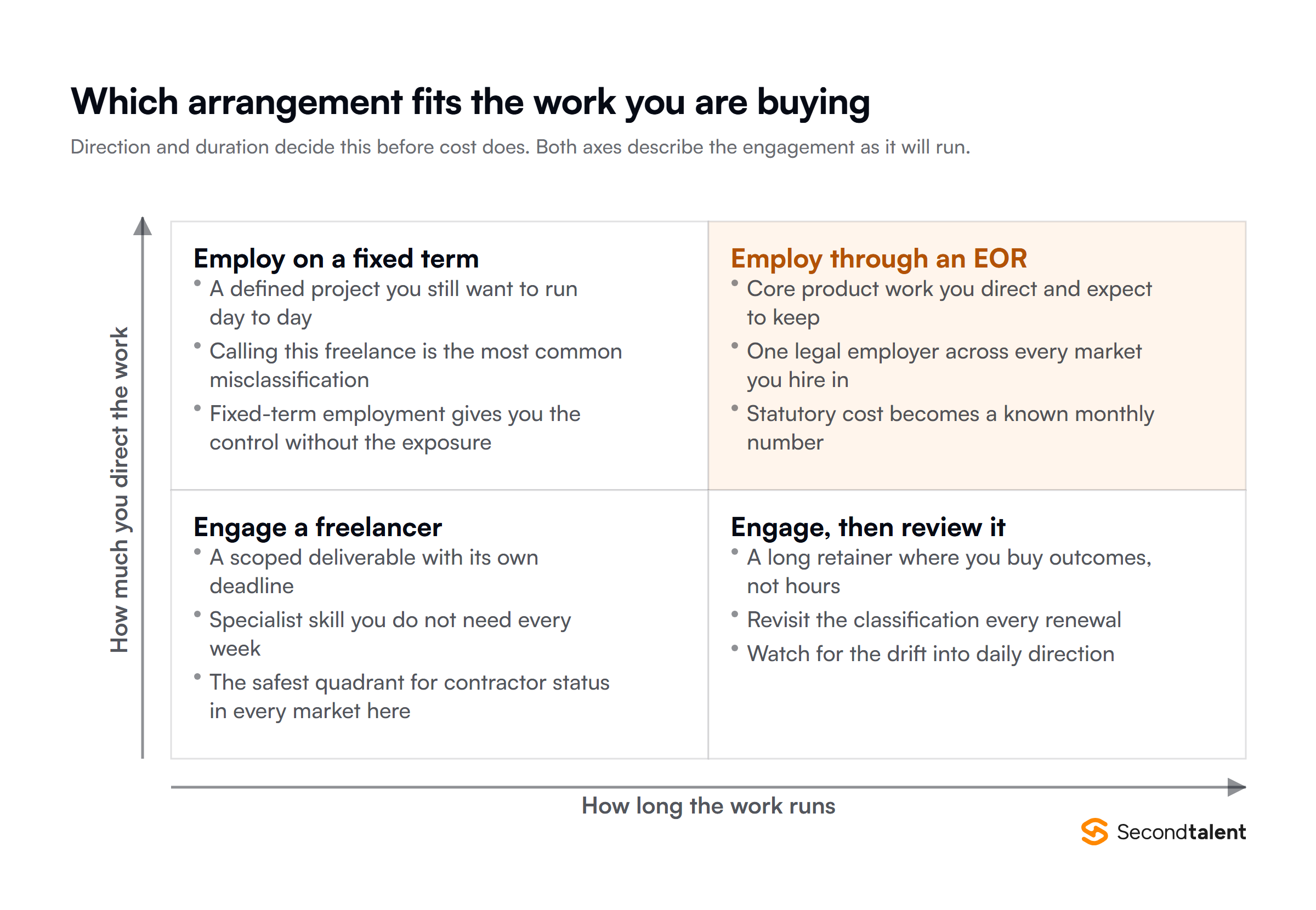
Hire an employee for core product work you direct day to day and expect to keep: roles that need deep knowledge of your systems, daily contact with the rest of the team, or access to anything proprietary. Long-running work with no end date belongs here too.
Engage a freelancer for a scoped deliverable with its own deadline, a specialist skill you do not need every week, a seasonal peak, or a market you want to test before committing headcount. A design system, a security audit, a data migration.
The quadrant people get wrong is the top left. A three-month project where you set the sprint, pick the stack and run the daily standup is directed work with an end date. Companies label it freelance because it is short, then fail every control test in the region. Fixed-term employment gives you the same control and none of the exposure.
Where should you hire? The five main markets
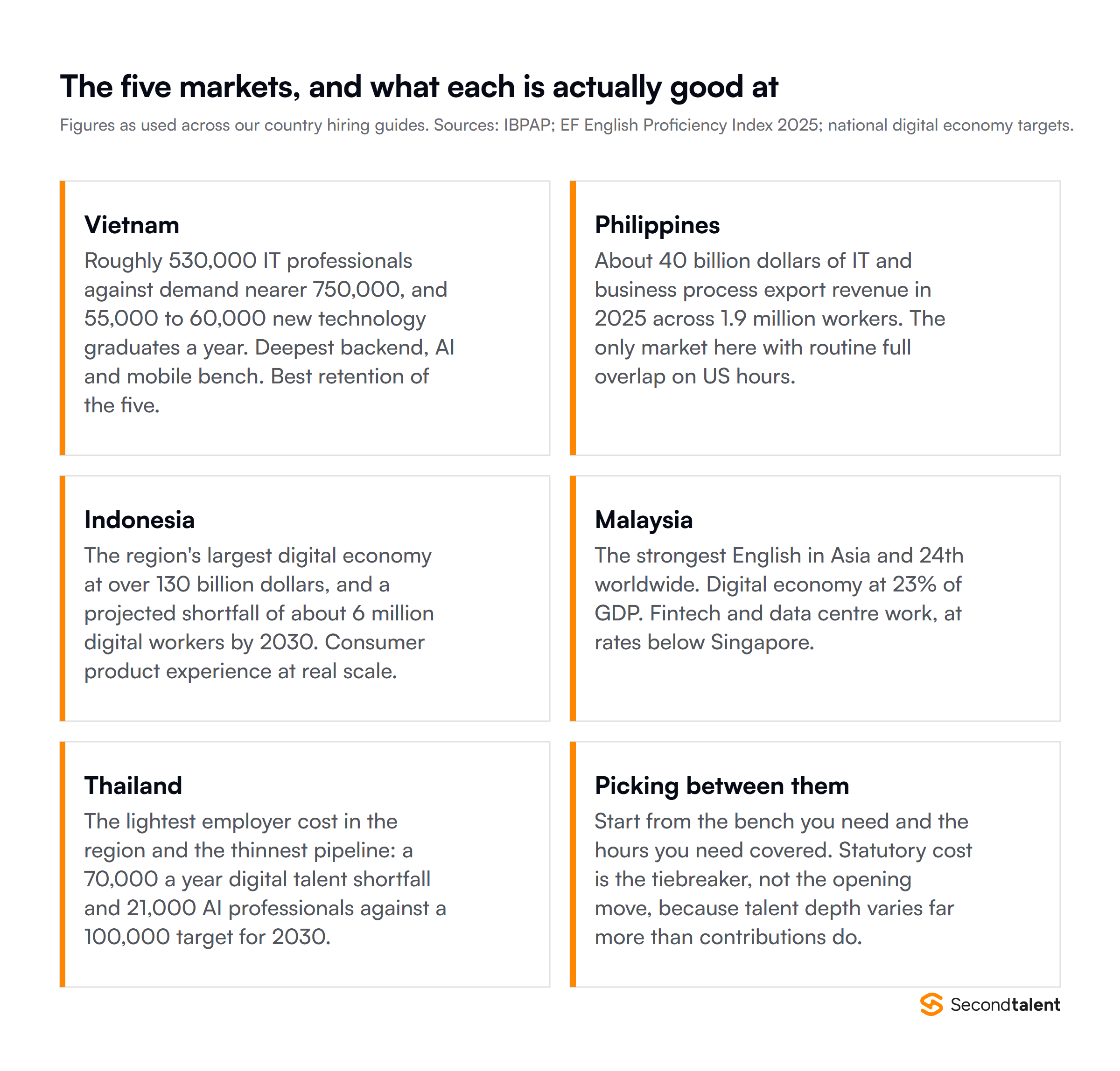
Pick on the bench you need and the hours you need covered, then check the statutory cost, because talent depth varies far more than contributions do.
Vietnam
The deepest backend, AI and mobile engineering bench of the five, and the best retention. Published estimates put the IT workforce at roughly 530,000 against projected demand nearer 750,000, with 55,000 to 60,000 new technology graduates a year. That gap is why good engineers are rarely on the market long, and why counteroffers are common.
Ho Chi Minh City is the largest and most expensive pool. Hanoi runs slightly cheaper with strong enterprise and backend experience. Da Nang generally lands 15% to 25% below Ho Chi Minh City. Vietnam also carries the highest statutory employer cost in this guide.
Philippines
The market to pick when you need working hours that overlap the United States. Industry body IBPAP reported about $40 billion in IT and business process export revenue for 2025 across 1.9 million workers, up from 1.82 million the year before, and projects roughly 1.97 million by the end of 2026.
Metro Manila holds the deepest pool and the highest rates. Cebu is the strongest secondary hub, usually 10% to 20% cheaper with lower attrition. Employer statutory cost here is capped in pesos, which makes it the cheapest of the five at senior salaries.
Indonesia
The region’s largest digital economy, and the widest gap between the talent it needs and the talent it produces. Government projections point to a shortfall of about six million digital workers by 2030. Engineers here have built consumer products at a scale most markets never see, which shows in mobile and high-traffic backend work.
Jakarta is the centre of capital and the highest rates. Bandung has a strong university pipeline and design-led product teams. Strong mid-level engineers get hired quickly, so a slow interview process loses them.
Malaysia
The compromise candidate: the strongest English in Asia, a serious fintech and data centre sector, and rates below Singapore without the thin senior pool of the cheaper markets. Kuala Lumpur carries most of the work.
Malaysia is also the one market here where employer cost keeps climbing with the package, because EPF has no salary ceiling. Budget for that on senior hires.
Thailand
The lightest employer cost in the region and the thinnest pipeline. Thailand runs an annual shortfall of about 70,000 digital workers, and has roughly 21,000 AI professionals against a national target of 100,000 by 2030. Design, creative and front-end work are the local strengths.
It is a viable first hire and a hard twentieth. English is the weakest of the five, so screen for it rather than assuming it.
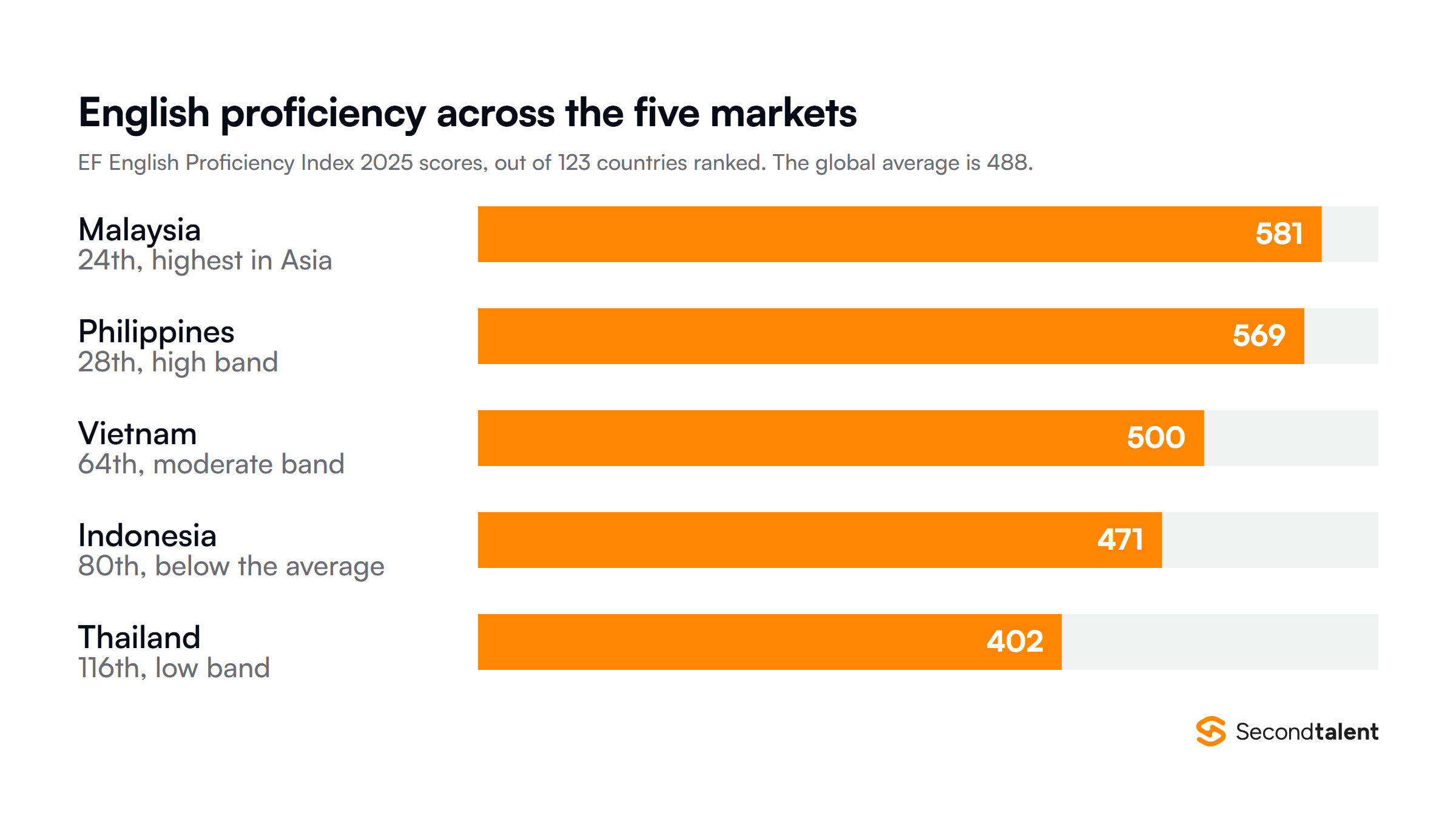
Those scores come from the 2025 EF English Proficiency Index, which ranks 123 countries against a global average of 488. Treat them as a starting prior rather than a verdict on an individual. Written English is generally more reliable than the score suggests, spoken fluency more variable. Run one unscripted conversation in the process and decide honestly whether the role needs it.
Our guide to sourcing engineering talent in Southeast Asia goes market by market on where candidates come from, and the piece on how global startups build remote teams here covers the operating side.
What does an employee cost on top of salary?
Between 1% and 19% of gross pay in these five markets, depending on whether that country caps its contributions.
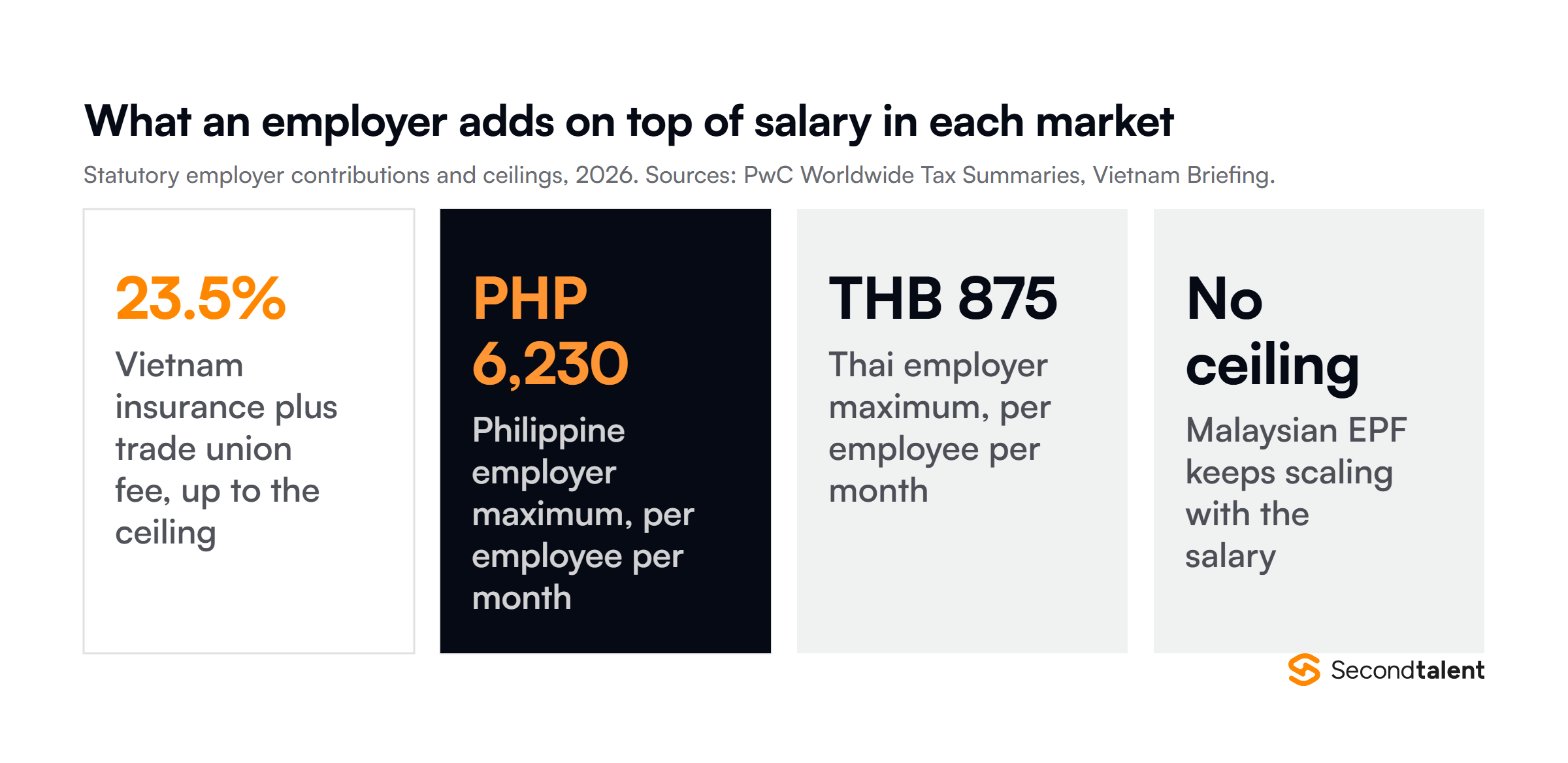
Vietnam charges the highest headline rate in the region. An employer pays 17.5% social insurance, 3% health insurance and 1% unemployment insurance. A compulsory 2% trade union fee sits on top of that, on the same salary base, whether or not a union exists at the company. The total is 23.5%.
Social and health contributions, and the trade union fee, all stop at 20 times the reference level. Vietnam Briefing puts that ceiling at VND 46.8 million of monthly pay. Unemployment insurance runs to a higher regional ceiling.
The Philippines does the opposite. SSS, PhilHealth and Pag-IBIG are all percentages, but each one hits a peso ceiling. PwC lists the employer maxima as PHP 2,000 for SSS plus PHP 1,500 for the mandatory provident fund, and PHP 30 for employees’ compensation. PhilHealth stops at PHP 2,500 and Pag-IBIG at PHP 200. The employer maximum lands near PHP 6,230 a month whatever the engineer earns.
Thailand is capped harder still. Employer social security is 5%, and the wage ceiling rose from THB 15,000 to THB 17,500 in January 2026, the first increase in three decades. The maximum an employer pays into the fund is now THB 875 a month, and a workmen compensation levy adds roughly THB 40 on top.
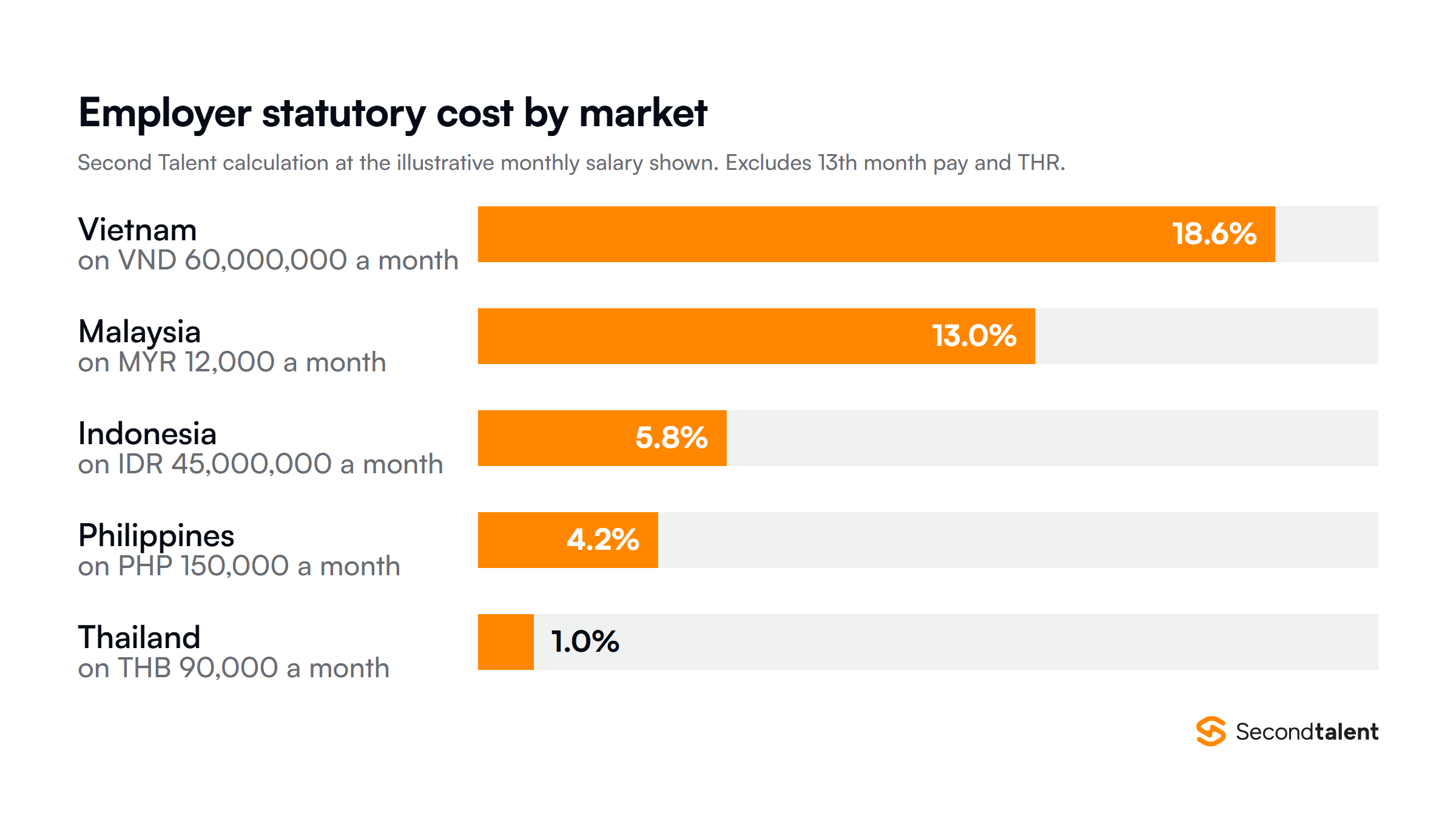
Those percentages are our own calculation at the illustrative salary shown against each market, not a figure any of the sources publish. The rates and ceilings behind them come from PwC Worldwide Tax Summaries, current for 2026.
Malaysia carries one more line we have left out of the chart because it depends on your headcount. An HRD Corp training levy of 1% of wages applies once a company employs 10 or more Malaysian staff, which would take the Malaysian figure to about 14%.
The ceiling is the whole story
A senior engineer in Bangkok on THB 90,000 a month costs the employer the same THB 875 in social security as a colleague on THB 20,000. In Kuala Lumpur, the same seniority jump adds real money every month, because Malaysian EPF has no salary ceiling at all. Cost per hire and cost per senior hire are two different rankings.
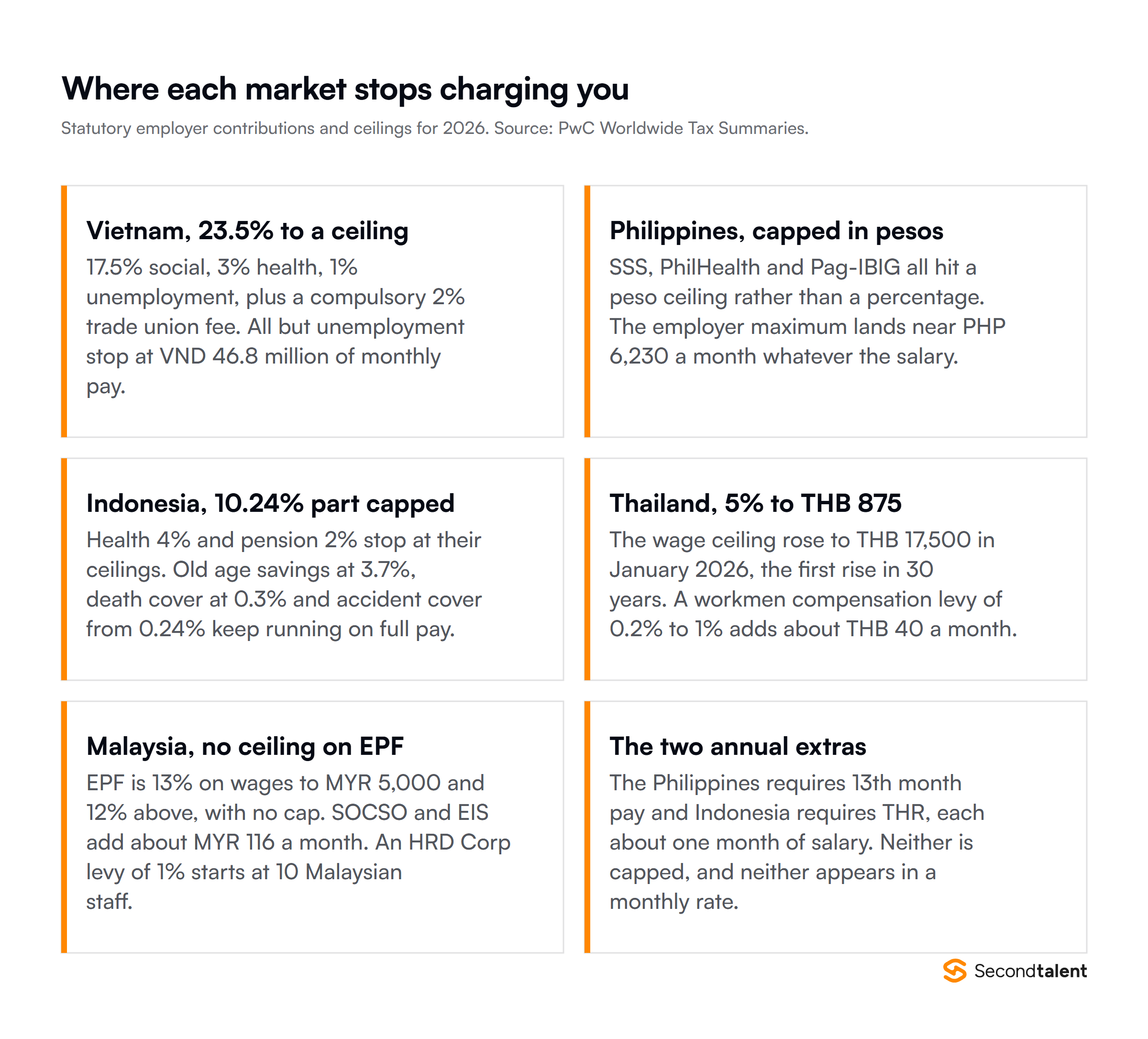
Two obligations sit outside all of this and catch people out. The Philippines requires 13th month pay and Indonesia requires THR, each worth about one month of salary a year. Neither is capped, and neither appears anywhere in a monthly contribution rate. Our country guides for the Philippines, Vietnam, Indonesia, Thailand and Malaysia carry the full filing calendar for each.
Why the freelancer rate is smaller than it looks
Because a competent freelancer has already priced their own contributions into the rate they quoted you.
A Vietnamese engineer invoicing as a contractor still pays personal income tax and still buys health cover. They get no 13th month, no severance and no paid leave. Anyone who has done that arithmetic raises their rate to cover it.
Your saving is the employer’s share alone. In three of these five markets, a ceiling holds that share to a small monthly figure.
Then there are the costs that only appear on the contractor side. Freelance marketplaces take a cut of every payment and cross-border transfer margins take another. Someone in your finance team reconciles a dozen individual invoices each month instead of one payroll file.
A freelancer wins on availability. You can start one in three days and stop in thirty, with no notice period and no severance calculation. That flexibility is worth paying for on work with an end date. It buys you nothing on work without one.
Legal and compliance: when is a contractor legally an employee?
When you direct how the work is done, pay a recurring wage rather than a fee, and the person has no business of their own. The contract’s title does not enter into it.
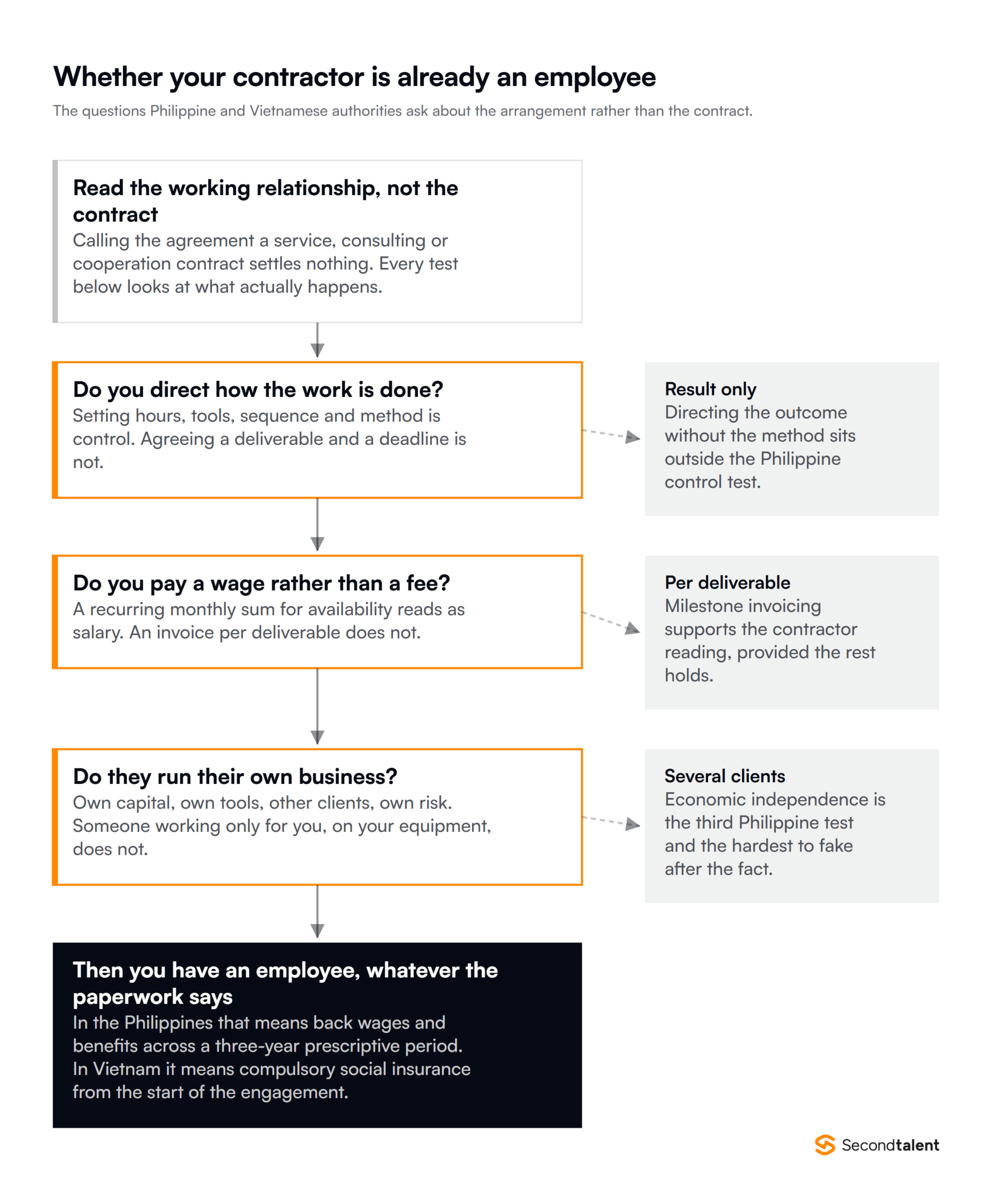
Philippine authorities run three tests: the four-fold test, the independent contractor test and the economic dependency test. ACCRALAW names the deciding factor as “the power to control the means and methods by which the work is accomplished, and not just the results”.
If the tests find an employment relationship, the same firm puts the exposure at back wages and benefits covering at least the three-year prescriptive period for money claims. Unpaid social security remittances follow. A foreign company can also be found to be doing business without a licence, which blocks it from suing in Philippine courts.
Vietnam went further in 2025. Social Insurance Law 41/2024/QH15 took effect on 1 July 2025. Russin and Vecchi report that agreements written as expert, service, consulting or cooperation contracts can carry compulsory social insurance. The conditions are wages paid for the work, and one party managing and supervising the other. Any arrangement of one month or longer that fits is inside the system.
Classification drifts, and nobody notices
The engagement that starts clean is a scoped project with milestone invoices. Eighteen months later the same person sits in your standup, uses your laptop, works your hours and bills the same amount every month. Nothing was signed to make that change, and the classification is now judged on the relationship as it stands. Review it at every renewal.
Four more compliance points apply whichever way you hire. Local rules often dictate the payment currency and method. Notice periods and severance differ sharply, and Thailand’s severance ladder reaches 400 days of wages at 20 years of service. Data protection regimes across the region are tightening. Foreign nationals need work permits, which is a separate process from employment.
How do you employ someone without a local entity?
Through an employer of record, which becomes the legal employer while the person works for you. The EOR holds the contract, runs payroll, pays the statutory contributions and files with the local authorities.
Registering an entity in any of these markets takes months, and needs local directors or resident officers depending on the country. It pays off once headcount in that market justifies the standing cost. Our employer of record guide for Asia covers the entity threshold in more detail, and the breakdown of what an EOR actually costs covers the fees providers bury.
Second Talent runs both sides of this. We source and vet the engineer, then employ them through our own entity in that market. The flat monthly rate has the statutory cost above already inside it.
Companies working with us report 50% to 70% payroll savings against a domestic hire. We hold a 92% talent retention rate across more than 200 clients.
How to run the hire, step by step
Five steps, in this order. The first two are the ones companies skip and later pay for.
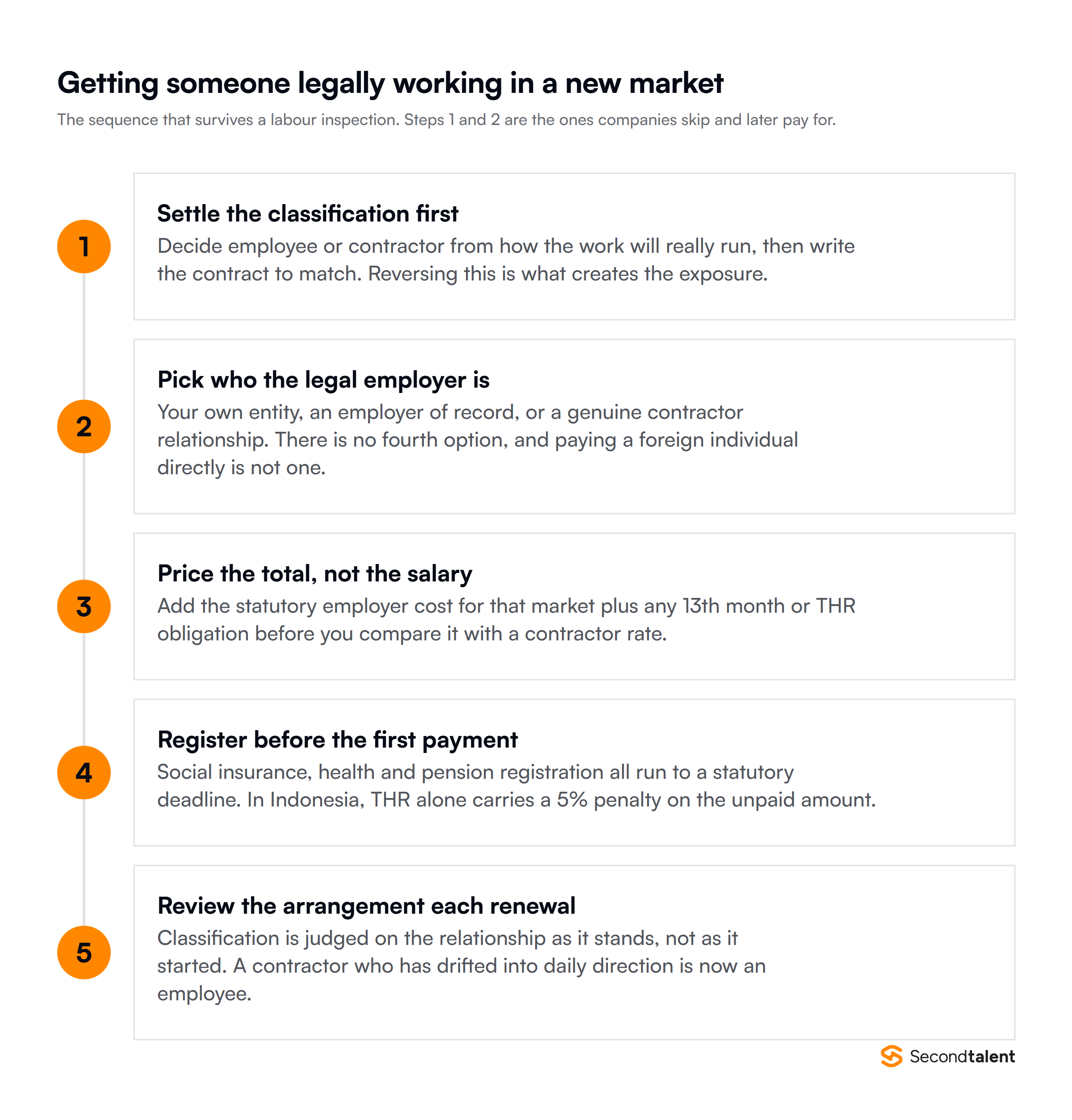
On timing, expect two to four weeks from brief to signed offer through a pre-vetted bench, and one to three days for a freelancer on a scoped brief. Building the pipeline yourself from job boards adds six to ten weeks, most of it in sourcing and screening.
How do you manage the team once they start?
Decide the overlap window before the offer goes out, and write it into the contract. Most of what people call remote management is downstream of that one number.
Southeast Asia sits at GMT+7 to GMT+8, which gives European teams a workable afternoon overlap and US teams a harder problem. The Philippines is the exception, where night-shift work aligned to US hours is an established norm rather than an imposition. Our overlap hours guide works through the practical windows.
Beyond that, three things do most of the work. Write decisions down, because a distributed team that relies on meetings loses the half of the day nobody shares. Give a new hire a real task in week one rather than a reading list. Plan around local holidays, which differ by country and, in Malaysia and Indonesia, by state or province.
For technical roles, judge the work rather than the CV. Our guide to evaluating engineering talent quality when hiring remotely covers what a useful assessment looks like, and hiring engineers when you are not technical covers the case where you cannot read the code yourself.
Get the shortlist and the total cost in one place
If the role is engineering, data or AI, you can skip the build-versus-buy exercise. Tell us what you are hiring for and we will send a vetted shortlist inside 24 hours. They are employed through our own entity, at a flat monthly rate with the statutory cost already inside it.
If you would rather price it yourself first, the developer rate card lists what each role costs by market and seniority. Cost to hire compares freelance, in-house and agency pricing for the same work.
Frequently asked questions
Is it cheaper to hire a freelancer or an employee in Southeast Asia?
At engineering salaries the gap is usually smaller than the rate cards suggest. Thailand and the Philippines both cap employer contributions, so the cost lands near 1% and 4.2% of pay. The employee premium in those two markets is modest. Vietnam at about 18.6% and Malaysia at about 13% are where the difference becomes real money.
Which Southeast Asian country is best for hiring developers?
Vietnam for backend, AI and mobile depth. The Philippines for English and US-hours overlap. Indonesia for consumer product experience at scale. Malaysia for fintech and the strongest English in Asia. Thailand for design and front-end work, and for the lightest employer cost. Start from the bench you need rather than the price list.
What happens if I misclassify an employee as a contractor?
In the Philippines you owe back wages and benefits covering at least the three-year prescriptive period for money claims, plus unpaid social security remittances. A foreign company can also be found to be doing business without a licence. In Vietnam the arrangement falls inside compulsory social insurance from the point it met the statutory definition.
Can I pay a Southeast Asian contractor directly from my home country?
Yes, provided the relationship is genuinely a contractor relationship under that country’s tests. Paying a person directly does not make them a contractor, and the payment method is not one of the factors any of these tests weigh. Settle the classification first, then pick the payment rail.
Do I need a local entity to hire an employee in Vietnam or the Philippines?
No, if you use an employer of record. The EOR is the legal employer, holds the contract and files the contributions, while the person works to your direction. You would set up your own entity once the headcount in that market justifies the standing cost of running one.
How long does it take to hire remotely in Southeast Asia?
Two to four weeks to a signed offer through a pre-vetted bench, and one to three days for a freelancer on a scoped brief. Registration is the variable, not recruitment: statutory enrolment runs to its own deadline in each market, and an EOR that is already registered removes that step.
Does 13th month pay apply to contractors?
No. Philippine 13th month pay and Indonesian THR are employment obligations, so a genuine contractor is outside both. If the engagement is later reclassified as employment, they come back into scope with everything else. That is part of why back-pay exposure runs higher than most rate comparisons assume.


![How to Hire Developers in Asia Remotely. How to Hire Developers in Asia Remotely from the USA [2026], by Second Talent.](https://www.secondtalent.com/wp-content/uploads/2026/09/hire-developers-in-asia-remotely-featured-v2-768x403.jpg)

![Workplace Diversity Statistics. Top 100+ Workplace Diversity Statistics [2026], by Second Talent.](https://www.secondtalent.com/wp-content/uploads/2026/09/workplace-diversity-statistics-featured-v2-768x403.jpg)