
TL;DR: Thailand has the lowest statutory employer cost in the region by a wide margin. The Social Security Fund caps at THB 875 a month per side, so employer contributions run about 1.8% at a mid-level salary and under 1% at a senior one. The counterweight sits at the other end: statutory severance climbs to 400 days of wages at twenty years of service. Two things changed recently, the SSF ceiling rose on 1 January 2026 and maternity leave extended to 120 days in December 2025.
We employ staff in Thailand through our own entity, so these are the numbers we run every month. This guide covers what you owe, what your employee takes home, and why a market that is cheap to hire into is expensive to leave.
Download the full guide as a PDF at the end, or read on.
What Employing Talent in Thailand Costs
Add under 2% to gross salary. The Social Security Fund takes 5% from each side but stops at a wage of THB 17,500 a month, and a small workmen’s compensation premium sits on top.
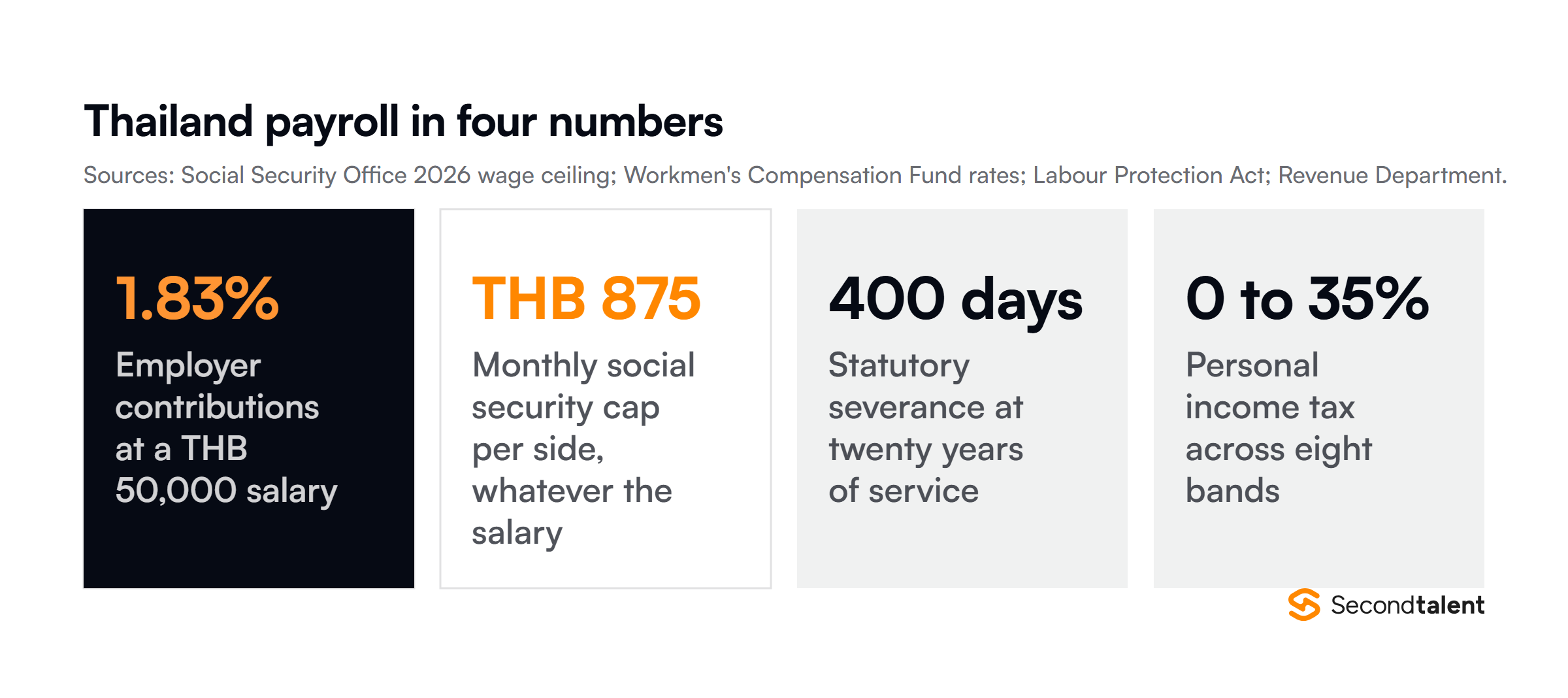
That cap is an absolute figure, so the percentage collapses as salary rises. A THB 50,000 hire carries 1.83%. A THB 150,000 hire carries 0.61%, and in cash terms both cost the employer the same THB 915 a month.
Nowhere else in the region is this low. Treat employer contributions in Thailand as a fixed line item rather than a percentage of payroll.
The Social Security Fund is Almost All of It
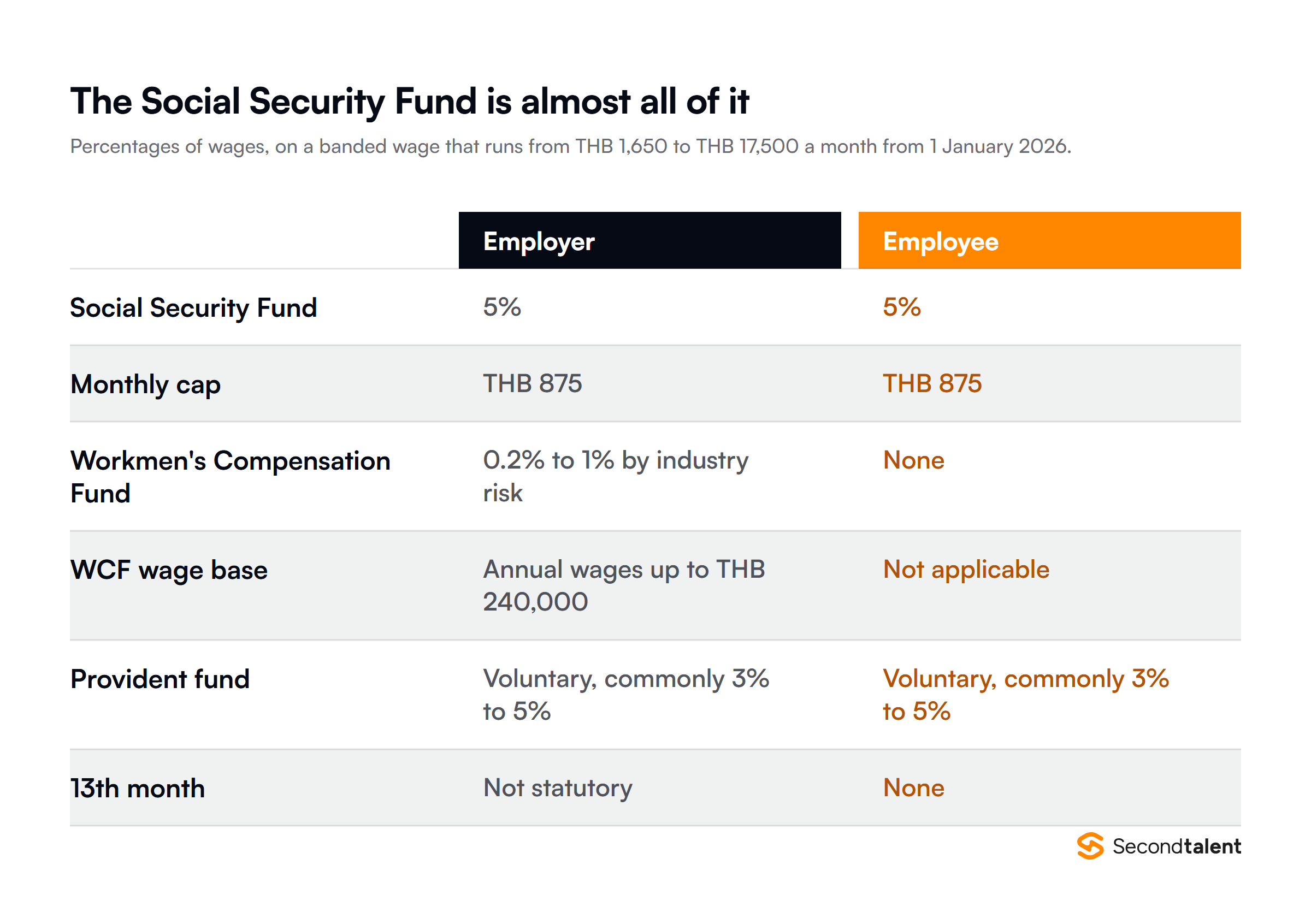
The Social Security Fund covers sickness, maternity, invalidity, death, child allowance, old age and unemployment. Both sides pay 5% on the same banded wage, and the government contributes separately.
The Workmen’s Compensation Fund is employer-only and priced by industry risk, from 0.2% for office work to 1% for hazardous sectors. It applies to annual wages up to THB 240,000 per employee, so it tops out near THB 480 a year for a low-risk employer.
The ceiling moved on 1 January 2026, and moves again twice
The SSF wage ceiling rose from THB 15,000 to THB 17,500, lifting the maximum contribution from THB 750 to THB 875 per side. It is a phased reform: THB 20,000 follows in 2029 and THB 23,000 in 2032. The floor stays at THB 1,650.
What a Hire Actually Costs
Two worked examples for a single employee with the personal allowance only, at a low-risk employer, using the 2026 ceiling.
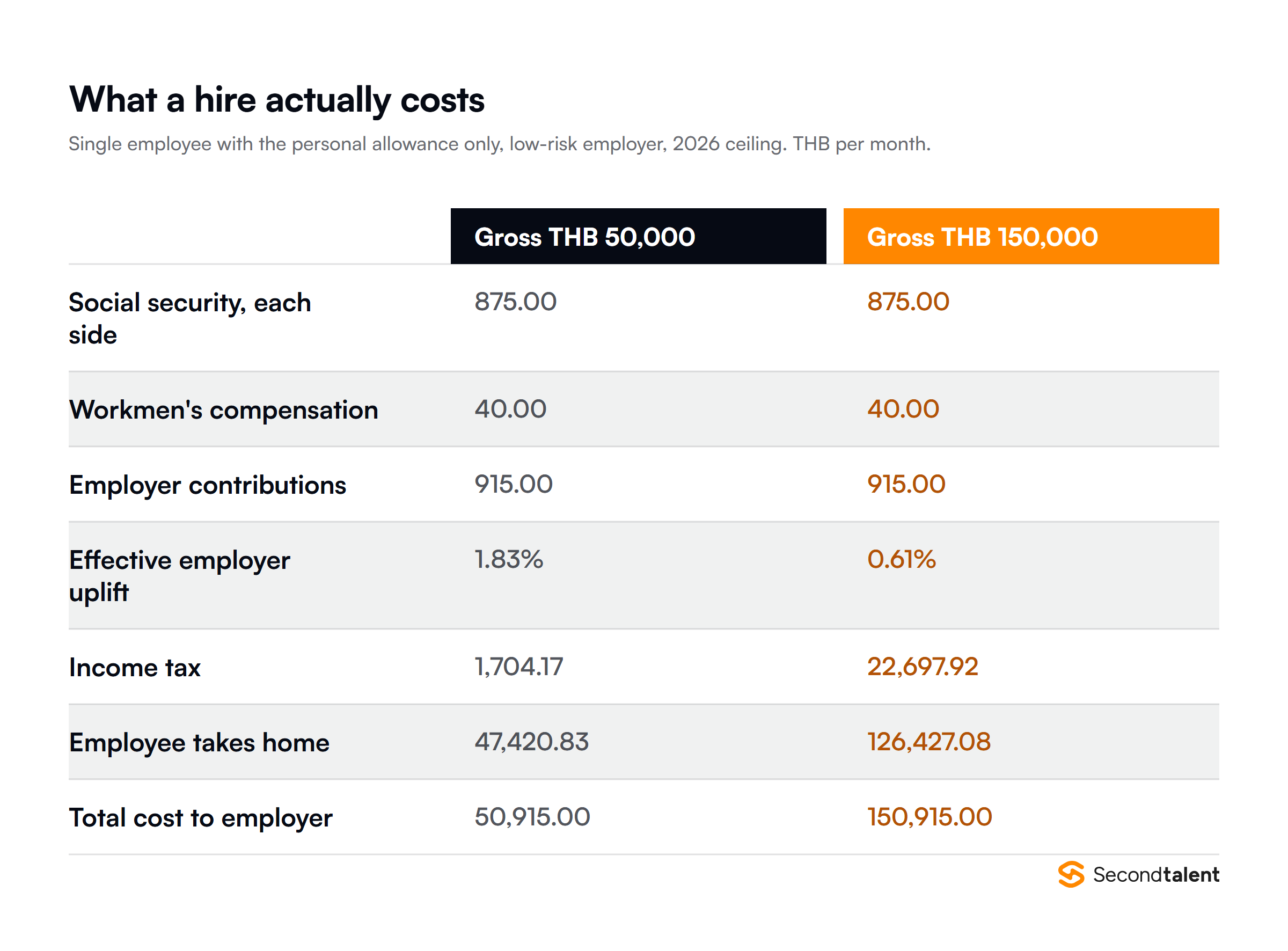
The employer line is identical in both columns. Every baht above THB 17,500 of salary carries no contribution at all, which is why the percentage looks so different while the cash does not move.
Our EOR cost calculator models the full stack, and the Thailand EOR guide covers what we handle on your behalf.
Severance Runs to 400 Days
This is where the money is. The Labour Protection Act sets a severance ladder that climbs steeply with service, and at the top it exceeds thirteen months of wages.
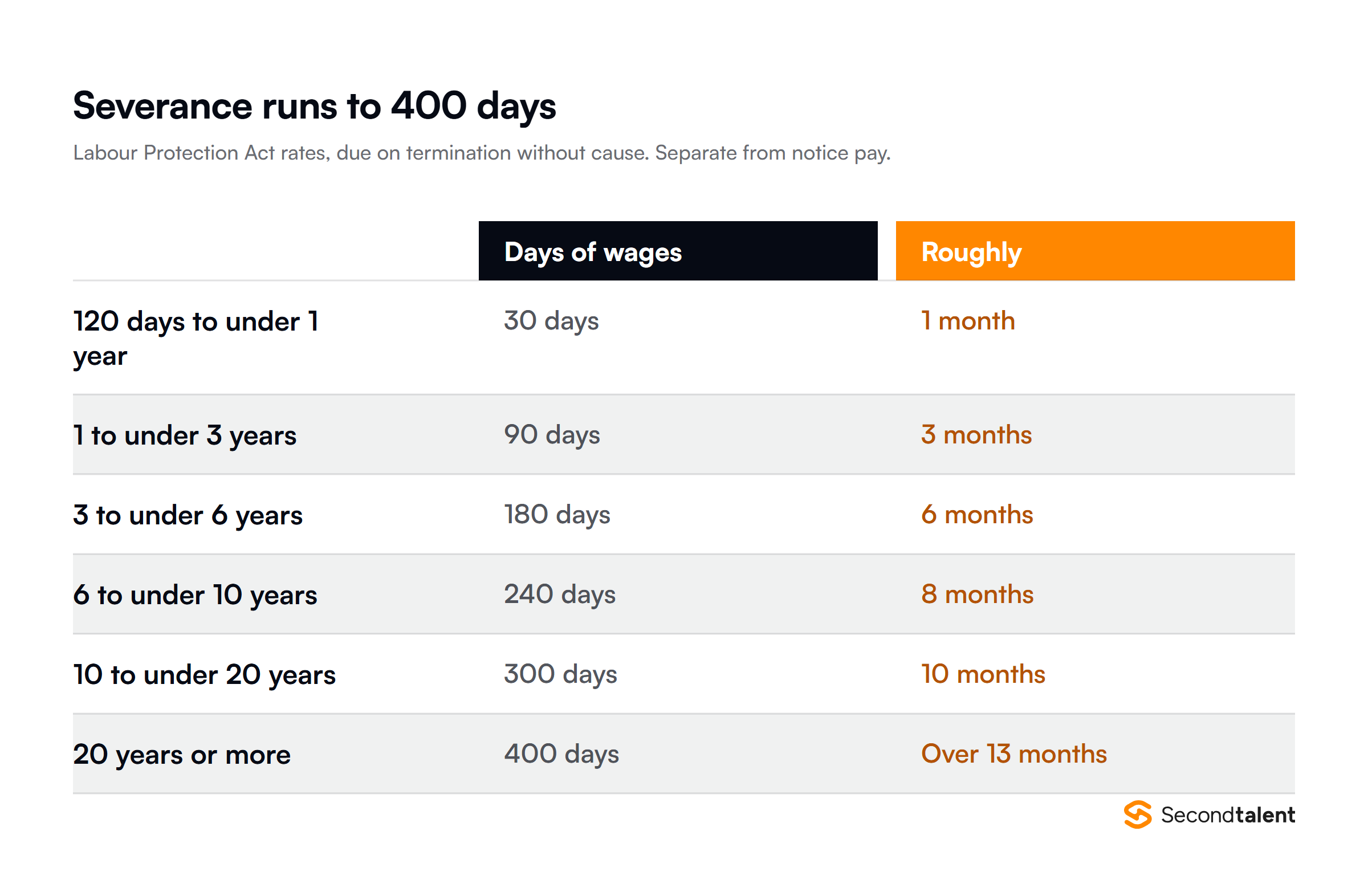
Severance is due on termination without cause, including redundancy. It is separate from notice, which must run to at least one pay period, and separate again from any payment in lieu.
The pattern to hold in mind is the inverse of the monthly cost. Thailand is the cheapest market in the region to employ someone and one of the more expensive to exit, so the liability builds quietly on a payroll that looks inexpensive.
Relocating an employee to a different workplace also triggers rights. Where a relocation materially affects an employee’s ordinary living, they may refuse and claim special severance at the same rates.
Provision for the ladder from the first hire. Ten employees averaging five years of service carry roughly six months of payroll in contingent severance, and none of it appears in the monthly cost that made Thailand look cheap in the first place.
Dismissal for serious cause removes the obligation, but the grounds are narrow and the burden sits with the employer. Poor performance on its own is not one of them, so plan exits as negotiated settlements rather than assuming cause will hold.
Income Tax
Residents pay progressive rates from 0% to 35% across eight bands. Residency turns on presence of 180 days or more in a calendar year, and non-residents pay the same progressive rates on Thai-sourced employment income.
| Annual net income (THB) | Rate |
|---|---|
| Up to 150,000 | Exempt |
| 150,001 to 300,000 | 5% |
| 300,001 to 500,000 | 10% |
| 500,001 to 750,000 | 15% |
| 750,001 to 1,000,000 | 20% |
| 1,000,001 to 2,000,000 | 25% |
| 2,000,001 to 5,000,000 | 30% |
| Over 5,000,000 | 35% |
The capped expense deduction matters more than it looks. It is worth THB 100,000 to everyone earning above THB 200,000 a year, which flattens its value across the whole professional range.
Employers withhold monthly and file an annual return. Employees with allowances beyond the standard set file their own return to claim them.
What Changed Recently
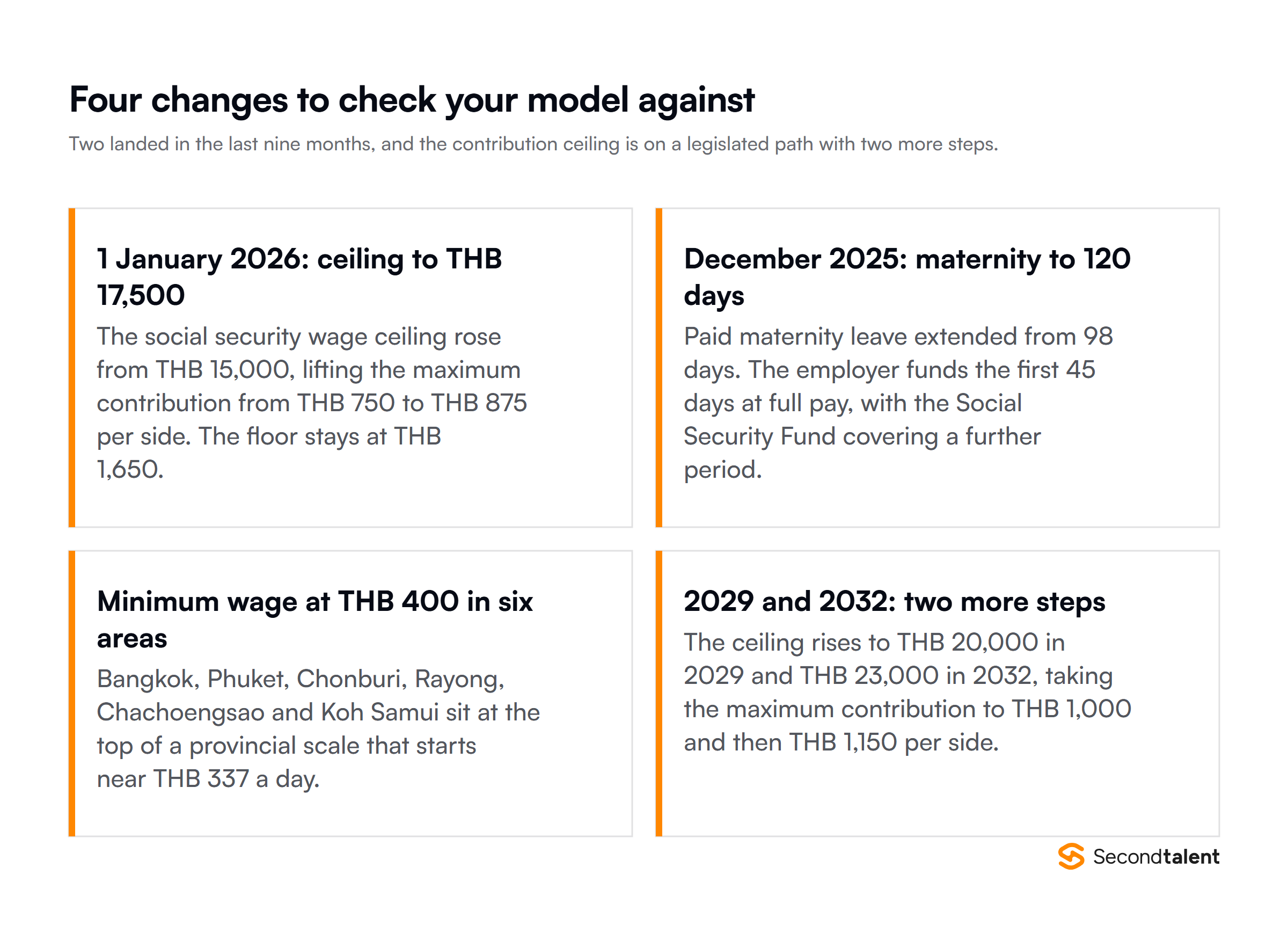
The maternity change is the one most likely to be missed. Paid leave rose from 98 to 120 days in December 2025, and the employer funds the first 45 days at full pay with the Social Security Fund covering a further period.
Minimum Wage Varies by Province
Thailand sets no national minimum. Provincial rates run from about THB 337 to THB 400 a day, with Bangkok, Phuket, Chonburi, Rayong, Chachoengsao and Koh Samui at the top of the scale.
The rate is daily rather than monthly, which matters when you calculate overtime, holiday pay and severance. Everything downstream is computed from the daily wage.
Check the rate for the province where the employee actually works, and note that some high-activity districts sit above their surrounding province.
Leave and Working Hours
- Annual leave: a minimum of 6 working days after one year of continuous service. The market standard for professional roles is 10 to 15, so the statutory floor is not a benchmark.
- Public holidays: at least 13 paid days a year, set by the employer from the official list.
- Sick leave: up to 30 days a year on full pay, with a medical certificate required from the third consecutive day.
- Maternity leave: 120 days, with the employer paying the first 45 days at full wages.
- Business leave: at least 3 days a year of paid leave for necessary personal business.
- Working hours: a maximum of 8 hours a day and 48 hours a week, with overtime at 1.5 times and holiday work at 2 or 3 times the hourly rate.
Sick leave is generous relative to the region and is separate from annual leave, so do not merge them into a single pool when you write the contract.
Employing Foreign Nationals
A foreign national needs a Non-Immigrant B visa and a work permit, both sponsored by the employer. The visa comes first, the permit follows, and the sequence cannot be reversed.
Two structural requirements catch foreign companies out. An ordinary Thai company generally needs four Thai employees for each work permit issued, and registered capital of THB 2 million per foreign worker.
Board of Investment promotion and the Smart Visa route relax both, which is why technology companies hiring several foreign staff usually pursue one of them rather than the standard route.
Registering As An Employer
Thailand has the most restrictive ownership rules of any market in this series, and that shapes the entity decision more than the payroll administration does.
- Company registration with the Department of Business Development, including memorandum, shareholders and directors.
- Tax identification with the Revenue Department, plus VAT registration once turnover passes THB 1.8 million a year.
- Social security registration within 30 days of employing your first worker, with each employee enrolled individually.
- Workmen’s Compensation Fund registration, which runs on its own annual premium cycle.
The Foreign Business Act restricts foreign majority ownership across many service activities. Companies commonly work around it through Board of Investment promotion, a Treaty of Amity structure for United States shareholders, or a licence, and each route has its own conditions.
That is why Thailand is one of the markets where an employer of record earns its keep for longer than the usual five to eight employees. The blocker is not payroll cost, it is the right to own the entity that employs the staff.
Benefits Beyond the Statutory Minimum
Because statutory contributions are so small, benefits do most of the competitive work in Thailand. What you add is what distinguishes an offer, since the legal floor distinguishes nothing.
- Private medical insurance: effectively expected for professional roles. Social security entitles the employee to treatment at one registered hospital, which is rarely the one they want.
- Provident fund: a voluntary employer-matched retirement scheme, typically 3% to 5% from each side. It carries tax advantages for both parties and is the standard senior retention tool.
- Annual bonus: not statutory, commonly one month, and often paid before Songkran or at year end. Once the practice is established it can become contractual.
- Additional annual leave: 10 to 15 days against the statutory 6, granted from the start rather than after a year.
The provident fund is the one worth structuring properly. Contributions are deductible for the employer and tax-advantaged for the employee, so it buys more retention per baht than the equivalent cash.
Running Payroll Each Month
- Pay wages at least monthly, on the date fixed in the contract.
- Withhold personal income tax and the employee’s 5% social security share at source.
- Remit social security contributions to the Social Security Office by the 15th of the following month.
- Remit withholding tax to the Revenue Department by the 7th of the following month, or the 15th if filing online.
- Pay the Workmen’s Compensation Fund premium annually, based on estimated wages, and reconcile after year end.
The two remittance deadlines differ, which is the most common administrative slip. Tax is due before social security, not with it.
Frequently Asked Questions
What is the total employer cost of hiring in Thailand?
Gross salary plus about THB 915 a month for a low-risk employer. That is 5% social security capped at THB 875, plus a small workmen’s compensation premium. As a percentage it is 1.83% at THB 50,000 and 0.61% at THB 150,000.
How much is severance in Thailand?
It scales with service, from 30 days of wages at 120 days of employment to 400 days at twenty years or more. Severance is due on termination without cause and is separate from notice pay.
Did the social security ceiling change in 2026?
Yes. From 1 January 2026 the wage ceiling rose from THB 15,000 to THB 17,500, taking the maximum contribution from THB 750 to THB 875 per side. Further increases are scheduled for 2029 and 2032.
Is 13th month pay required in Thailand?
No. Unlike the Philippines and Indonesia, Thailand does not mandate a thirteenth month. An annual bonus is common and often contractual, so check what your offer letters and handbook actually promise before treating it as discretionary.
Can I pay a Thai employee without a local entity?
Not directly. Social security registration and tax withholding both require a registered local employer, and only a Thai entity can sponsor a work permit. An employer of record in Thailand holds the contract on its own entity and handles the filings.
Our EOR versus entity calculator models the crossover, and our guide to EOR across APAC compares the statutory position market by market.
Key takeaways
- Employer contributions are about THB 915 a month, whatever the salary. Model them as a fixed line, not a percentage.
- The SSF ceiling rose to THB 17,500 on 1 January 2026, with further steps in 2029 and 2032.
- Severance climbs to 400 days of wages at twenty years. Cheap to employ, expensive to exit.
- Maternity leave extended to 120 days in December 2025, with the employer funding the first 45.
- Statutory annual leave is 6 days. The market pays 10 to 15, so budget to the market.
Download this guide as a PDF
The full Thailand payroll, benefits and tax guide, including the social security ceiling, the severance ladder, the income tax schedule, leave and work permit rules and both worked examples, formatted for sharing with your finance team.
Hiring in Thailand?
Second Talent employs staff in Thailand on our own entity and handles contracts, social security registration, withholding and the severance provision, so the rules above become our problem rather than yours. We also source the candidates. Tell us the role and we will come back with candidates and a full employment cost.
This guide is general information, current as at the date of publication, and is not tax or legal advice. The social security ceiling is on a legislated upward path and provincial wage rates move separately. Confirm your position with a qualified adviser before acting.

![How to Hire Developers in Asia Remotely. How to Hire Developers in Asia Remotely from the USA [2026], by Second Talent.](https://www.secondtalent.com/wp-content/uploads/2026/09/hire-developers-in-asia-remotely-featured-v2-768x403.jpg)
![AI Outsourcing in Singapore. Top 10 AI Outsourcing Companies in Singapore [2026], by Second Talent.](https://www.secondtalent.com/wp-content/uploads/2026/09/ai-outsourcing-companies-singapore-featured-v2-768x403.jpg)
![AI Outsourcing in India. Top 10 AI Outsourcing Companies in India [2026], by Second Talent.](https://www.secondtalent.com/wp-content/uploads/2026/09/ai-outsourcing-companies-india-featured-v2-768x403.jpg)
![AI Outsourcing in the Philippines. Top 10 AI Outsourcing Companies in the Philippines [2026], by Second Talent.](https://www.secondtalent.com/wp-content/uploads/2026/09/ai-outsourcing-companies-philippines-featured-v2-768x403.jpg)

![Software Development Outsourcing in Vietnam. Top 10 Software Development Outsourcing Companies in Vietnam [2026], by Second Talent.](https://www.secondtalent.com/wp-content/uploads/2026/09/software-development-outsourcing-companies-vietnam-featured-v2-768x403.jpg)