TL;DR: Indonesia’s BPJS contributions look light at roughly 9% of salary, and that number misleads. The religious holiday allowance, THR, is a statutory extra month rather than a customary bonus, which adds 8.33% and takes the real employer cost to about 17.5%. Severance is the heaviest in the region and can reach well over twenty months of salary for a long-tenured employee. Two of the four BPJS caps mean the percentage falls on senior salaries, not the cash.
We employ staff in Indonesia through our own entity, so these are the numbers we run every month. This guide covers what you owe, what your employee takes home, and the two obligations that turn a cheap-looking market into an expensive one if you budget for the headline rate alone.
Download the full guide as a PDF at the end, or read on.
What employing someone in Indonesia costs
Budget about 17.5% on top of gross salary. Roughly 9% is BPJS social security, and the remaining 8.33% is the accrual for THR, the extra month you must pay before the employee’s religious holiday.
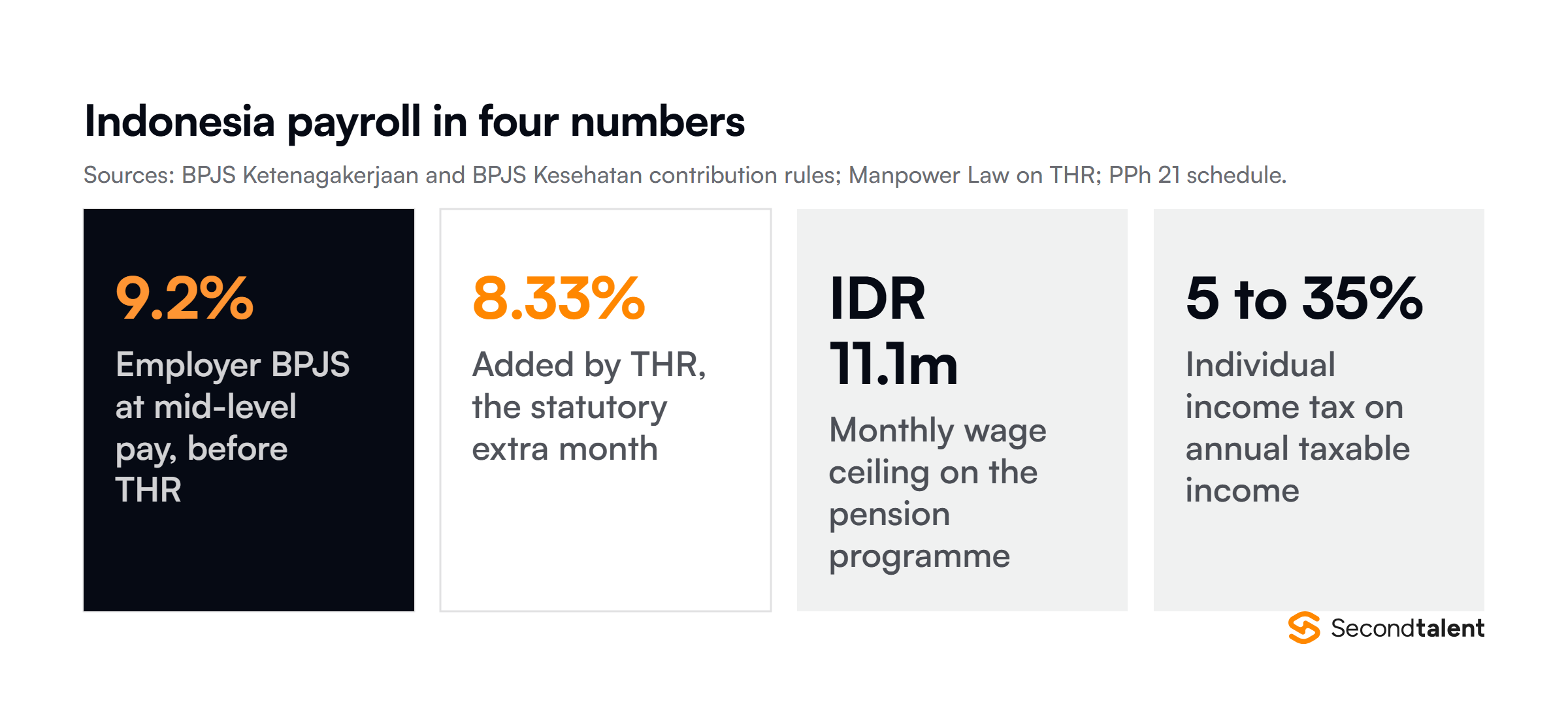
Most cost comparisons stop at the BPJS number and call Indonesia cheap. That is the single most common budgeting error in this market, because THR is written into law rather than left to custom.
Two of the programmes are capped and two are not, so the percentage drifts down as salary rises while the cash keeps climbing.
BPJS: two systems, five programmes
Indonesia runs social security through two separate bodies. BPJS Ketenagakerjaan covers employment programmes, and BPJS Kesehatan covers national health insurance. You register with both.
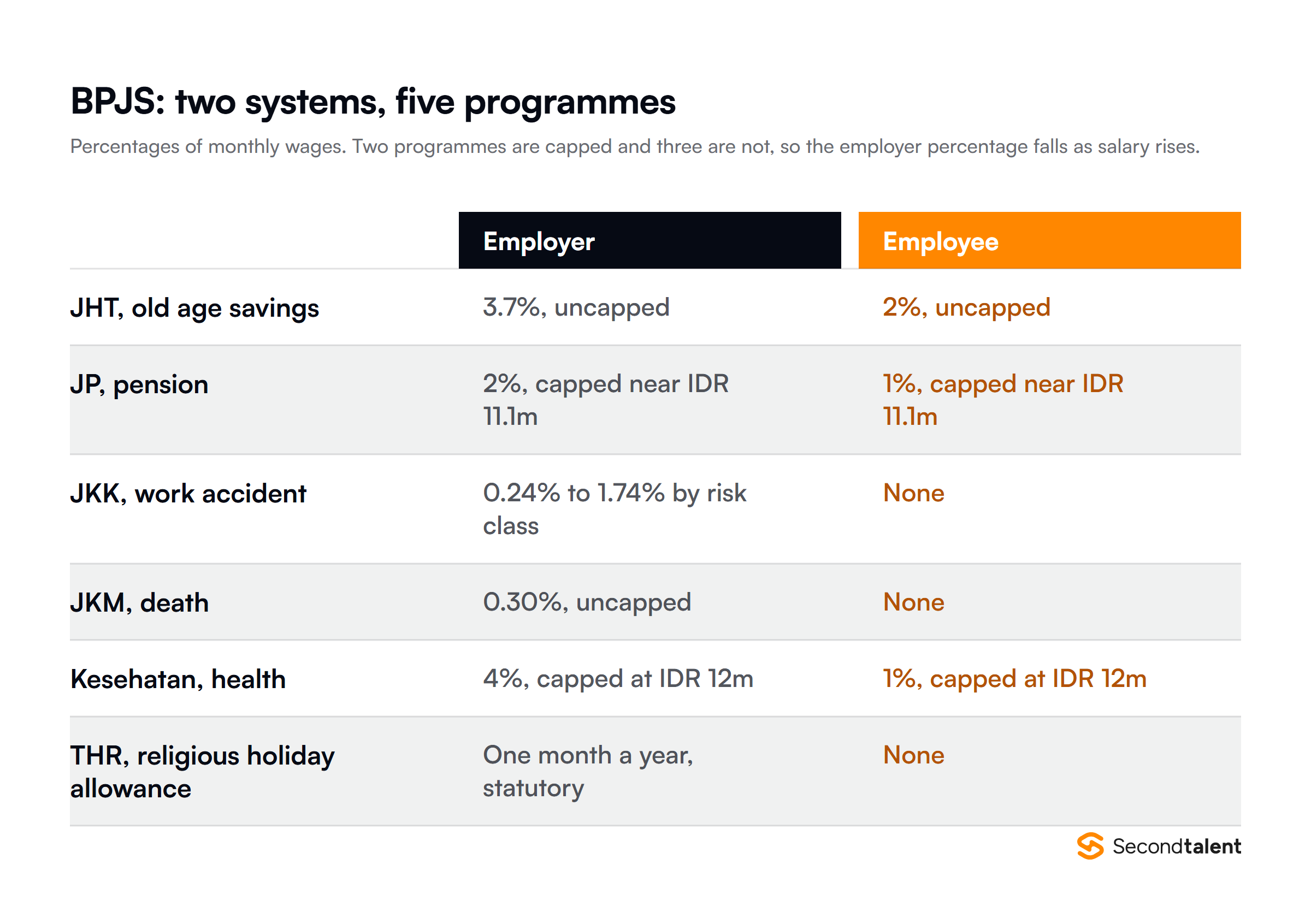
The pension programme caps at roughly IDR 11.1 million of monthly wages, a figure that moves each year, and health insurance caps at IDR 12 million. Old age savings, work accident and death cover apply to the full salary with no ceiling.
Work accident cover is priced by industry risk, from 0.24% for the lowest risk class to 1.74% for the highest. An office-based technology employer sits near the bottom of that range.
THR is a legal obligation, not a bonus
Tunjangan Hari Raya is the religious holiday allowance, and it is mandatory. An employee with 12 months of service receives one month’s salary. An employee with less receives a pro-rated amount from their first full month.
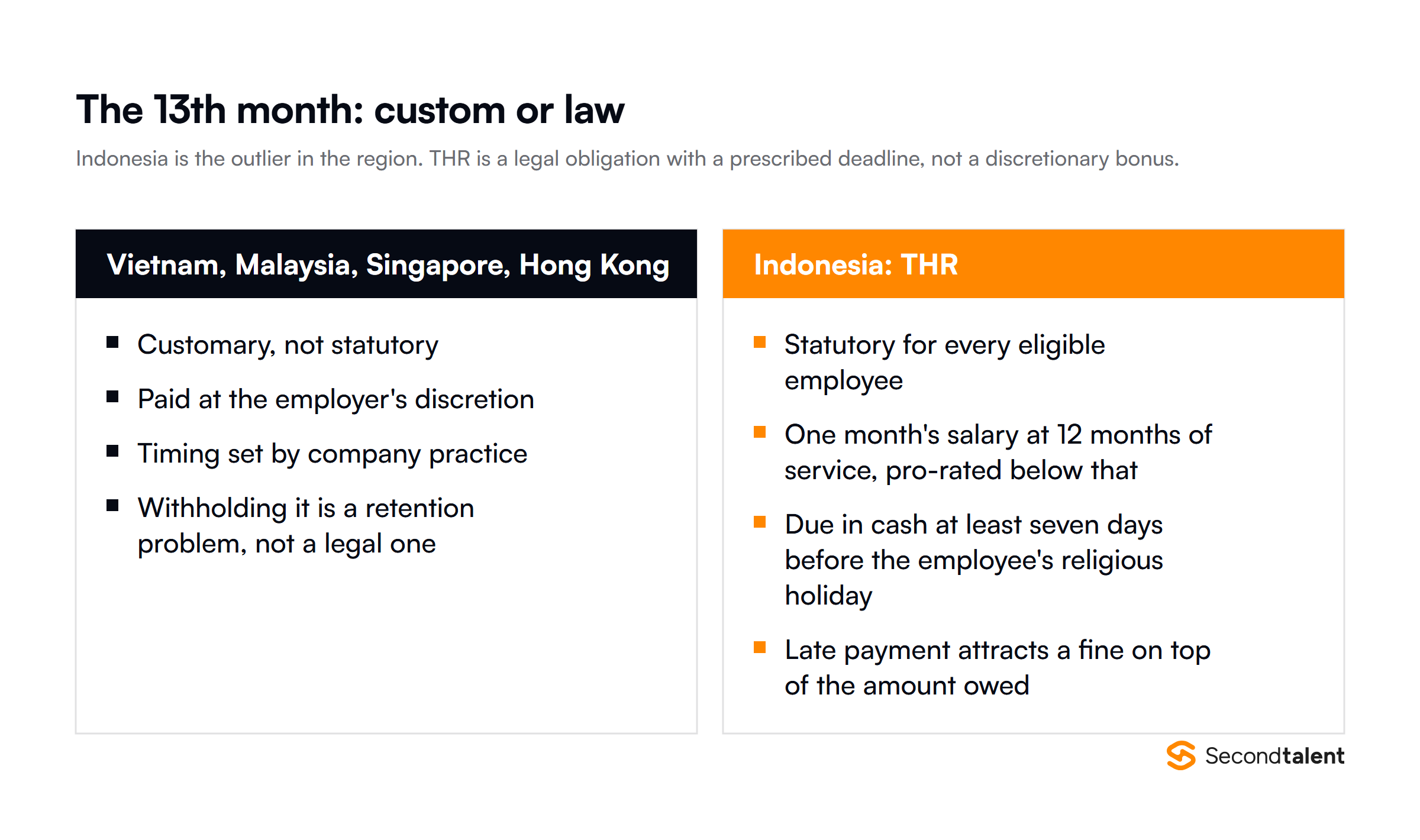
The timing is prescribed too. THR must be paid in cash no later than seven days before the relevant religious holiday, and it follows the employee’s own religion rather than a single company date.
Accrue THR monthly, do not fund it in March
Because the obligation is statutory and concentrated on one date, employers who treat it as a discretionary bonus meet a cash call worth a full month of payroll in a single week. Accrue 8.33% every month and the payment is already funded. Late payment attracts a fine on top of the amount owed.
What a hire actually costs
Two worked examples for a single employee with no dependants, at an office-based employer in the low work-accident risk class.
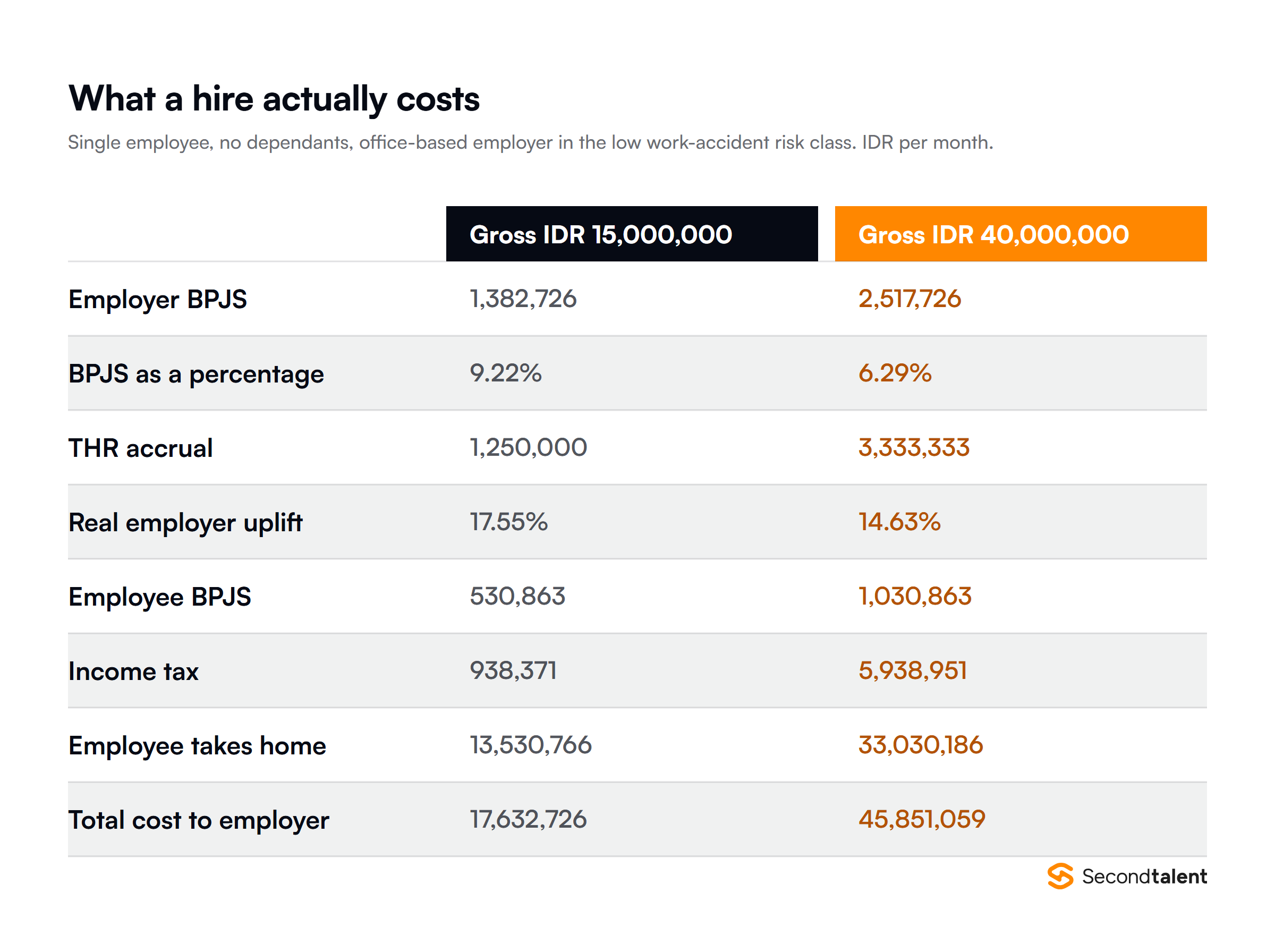
BPJS alone falls from 9.22% to 6.29% between the two salaries, because the pension and health caps bite. Add the THR accrual and the real employer uplift is 17.55% and 14.63%.
Our EOR cost calculator models the full stack, and the cost of hiring developers in Indonesia covers market salary levels to feed into it.
Income tax and the TER method
Residents pay progressive rates from 5% to 35% on annual taxable income. Monthly withholding uses a different mechanism from the annual calculation, which trips up payroll teams arriving from other markets.
| Annual taxable income (IDR) | Rate |
|---|---|
| Up to 60 million | 5% |
| 60 million to 250 million | 15% |
| 250 million to 500 million | 25% |
| 500 million to 5 billion | 30% |
| Over 5 billion | 35% |
For months one to eleven, withholding uses the TER method, a single average effective rate matched to the employee’s PTKP status and monthly gross. December then reconciles the year on the progressive rates above.
That makes December pay unusually variable. Employees who joined mid-year or received a large THR often see a materially different net in the final month, so warn them rather than field the query cold.
What changed recently
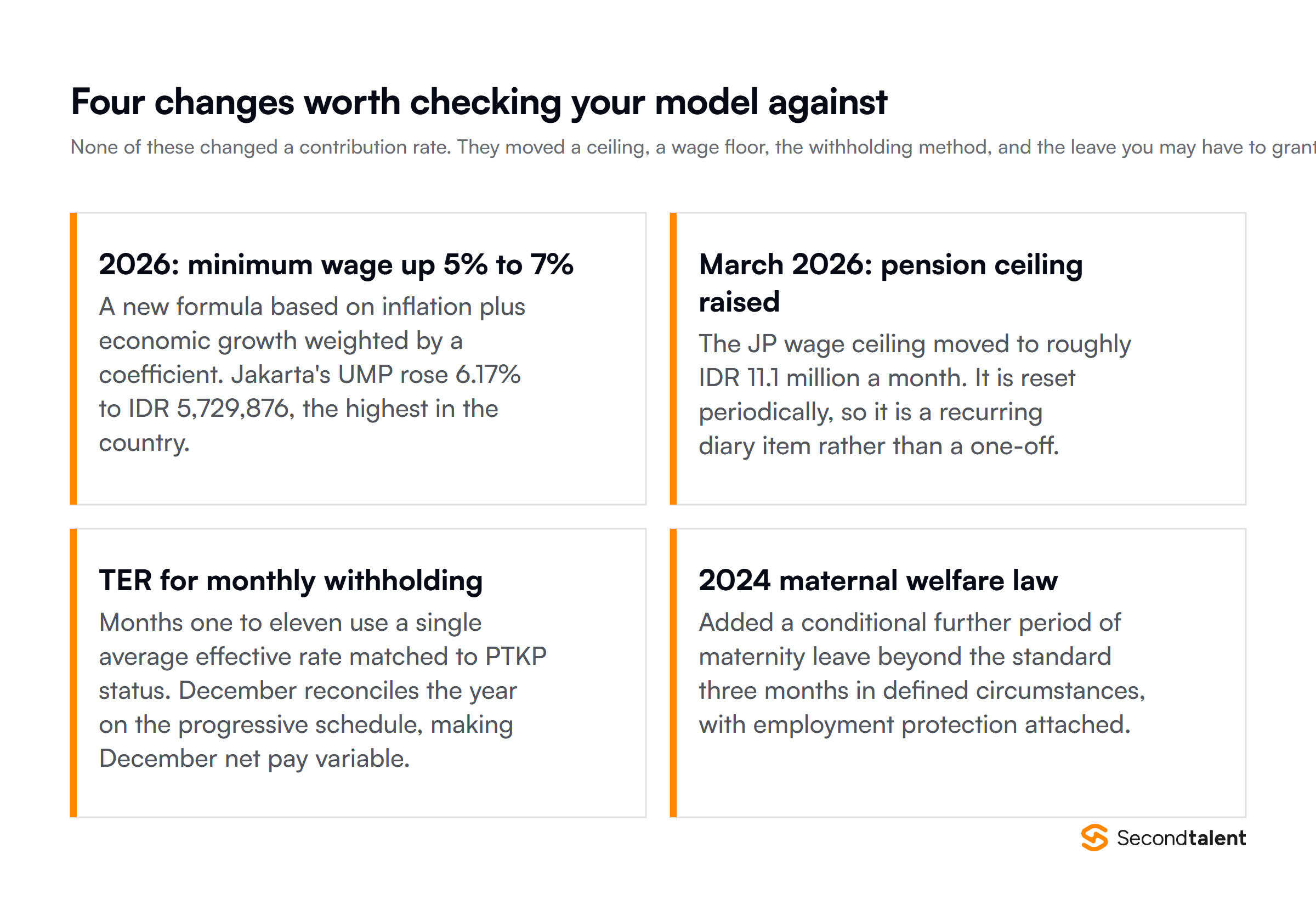
None of these changed a contribution rate. They moved a ceiling, a wage floor, the way you calculate monthly withholding, and the leave you may have to grant.
Benefits beyond the statutory minimum
BPJS Kesehatan gives access to the public system through a tiered referral process that professional candidates find slow. Private medical cover on top is standard for office roles in Jakarta.
- Private medical insurance: expected for professional and technical staff, and usually the first thing a candidate asks about after salary.
- Transport and meal allowances: near universal, often structured as fixed monthly allowances that form part of the THR calculation base.
- Prayer room and religious observance: practical rather than contractual, and worth getting right in an office of any size.
- Additional leave: the statutory 12 days is thin against regional practice, so many employers offer 14 to 18.
Check which allowances count as fixed. THR is calculated on basic salary plus fixed allowances, so a generous fixed transport allowance quietly raises your annual THR bill as well as monthly cost.
Minimum wage varies by province
Indonesia sets no national minimum. Each province publishes a UMP each year, and many districts set a higher UMK on top of it, so your obligation depends on where the employee actually works.
For 2026 the increase landed in the 5% to 7% range under a formula based on inflation plus economic growth weighted by a coefficient. Jakarta’s 2026 UMP is IDR 5,729,876, up 6.17% and the highest in the country.
Check the district figure, not just the provincial one. A Jakarta headline rate tells you nothing about an obligation in Bekasi or Karawang, where manufacturing districts often set higher floors.
Fixed-term or permanent: the PKWT decision
Indonesia recognises two contract types, and choosing between them changes both your flexibility and your cost. Getting the choice wrong can convert the contract by operation of law.
- PKWT, fixed term: permitted only for work that is temporary by nature, and limited to five years in total including extensions.
- PKWTT, indefinite: the default for ongoing roles, and the only contract type that may carry a probation period.
- Probation: a maximum of three months, and only under a PKWTT. A probation clause in a fixed-term contract is void.
- Compensation on expiry: a PKWT that runs its course still triggers a compensation payment scaled to length of service.
Using a fixed-term contract for a genuinely permanent role is the common mistake. If the work is not temporary in nature, the contract can be deemed indefinite from the start, which brings the full severance regime with it.
Severance is the heaviest in the region
Termination cost is the real reason Indonesia is not a cheap market. Three separate entitlements stack, and the multiplier applied to them depends on the reason for termination.
- Severance pay: scales with service up to a ceiling of nine months of wages.
- Service appreciation pay: a second entitlement for longer-tenured employees, scaling up to ten months.
- Compensation for entitlements: covering untaken annual leave, relocation costs and other accrued items.
- A multiplier then applies to the first two, running from half to double depending on the statutory ground for termination.
For a long-serving employee the total can pass twenty months of salary. The Job Creation Law reshaped the multipliers and added JKP, a job loss insurance benefit, but it did not make Indonesian termination cheap.
Indonesia also has no at-will employment. Termination needs a statutory ground and, where it is disputed, agreement or an industrial relations court decision.
Provision for this from the first hire rather than the first exit. A team of ten with several years of service each carries a contingent liability that will not appear anywhere in your monthly payroll cost, and it is the number that surprises finance when a restructure arrives.
Leave and public holidays
- Annual leave: 12 days after 12 months of continuous service, with at least six taken consecutively.
- Public holidays: set by joint ministerial decree each year, typically 16 to 17 days, plus collective leave days around Eid that most employers observe.
- Maternity leave: three months, normally split around the birth. The 2024 maternal and child welfare law added a conditional further period in defined circumstances.
- Paternity leave: two days at the birth.
- Sick leave: paid on a descending scale over twelve months, starting at full wages and stepping down.
The collective leave around Eid al-Fitr is the operational fact to plan around. Combined with THR falling due in the same period, it makes that month both the most expensive and the least productive of the year.
Employing foreign nationals
A foreign national needs an approved RPTKA manpower plan, a work permit and a limited stay permit before starting. The employer sponsors all three, and the role must appear on the approved plan.
Two obligations catch employers out. A compensation levy is payable per foreign worker per month, and each foreign hire must be paired with an Indonesian understudy for knowledge transfer.
Some positions are closed to foreign nationals entirely, human resources roles among them. Confirm the position is open before you make an offer rather than after.
Registering and running payroll
- Register the company with BPJS Ketenagakerjaan and BPJS Kesehatan separately, and enrol each employee under both.
- Obtain an NPWP tax number for the company, and ensure each employee holds their own.
- Pay salaries monthly in rupiah.
- Remit BPJS contributions and PPh 21 by the deadlines set for each, generally in the first half of the following month.
- Pay THR in cash at least seven days before the employee’s religious holiday.
- Reconcile PPh 21 in December on the progressive rates, and file the annual return.
Both BPJS registrations require a local entity, and neither can be outsourced to a payroll bureau acting alone. That is the practical reason most teams start on an employer of record.
Frequently asked questions
What is the total employer cost of hiring in Indonesia?
About 17.5% on top of gross salary at mid-level pay. Roughly 9.2% is BPJS social security and 8.33% is the accrual for the statutory THR month. The BPJS share falls on higher salaries because two programmes are capped.
Is the 13th month salary mandatory in Indonesia?
Yes. THR is a legal obligation, unlike the customary thirteenth month in Vietnam or Malaysia. Employees with 12 months of service receive a full month’s salary, shorter service is pro-rated, and payment is due at least seven days before the religious holiday.
How much is severance in Indonesia?
Severance pay scales to nine months of wages, service appreciation pay adds up to ten more, and a multiplier from half to double applies depending on the ground for termination. A long-serving employee can be owed more than twenty months in total.
What is the TER method for PPh 21?
A single average effective rate used for monthly withholding from January to November, matched to the employee’s PTKP status and monthly gross income. December reconciles the whole year on the progressive 5% to 35% schedule, which makes December net pay unusually variable.
Can I pay an Indonesian employee without a local entity?
Not directly. Both BPJS registrations and PPh 21 withholding require a registered local employer. An employer of record in Indonesia holds the contract on its own entity and handles the filings, THR and BPJS enrolment.
Our EOR versus entity calculator models the crossover. For the wider market picture, our comparison of the Philippines, Vietnam and Indonesia covers where each one fits.
Key takeaways
- Budget about 17.5%, not 9%. THR is statutory and adds a full month of salary each year.
- Accrue THR at 8.33% monthly. Funding it in the week it falls due is a cash call worth a month of payroll.
- Pension and health contributions are capped; old age savings, work accident and death cover are not.
- Severance stacks three entitlements and a multiplier, and can pass twenty months for long service.
- Minimum wage is provincial and often district-level. Check where the employee actually works.
Download this guide as a PDF
The full Indonesia payroll, benefits and tax guide, including the BPJS programmes and caps, THR rules, the income tax schedule and TER method, severance and both worked examples, formatted for sharing with your finance team.
Hiring in Indonesia?
Second Talent employs staff in Indonesia on our own entity and handles contracts, both BPJS registrations, PPh 21 withholding and THR, so the rules above become our problem rather than yours. We also source the candidates. Tell us the role and we will come back with candidates and a full employment cost.
This guide is general information, current as at the date of publication, and is not tax or legal advice. BPJS caps, minimum wages and the PPh 21 effective rate tables all move annually. Confirm your position with a qualified adviser before acting.




![Singapore AI Companies Leading Southeast Asia. Top 10 Singapore AI Companies Leading Southeast Asia [2026], by Second Talent.](https://www.secondtalent.com/wp-content/uploads/2026/09/singapore-ai-companies-featured-v2-768x403.jpg)
![AI Recruiting Tools. Top 7 AI Recruiting Tools in 2026 [Tried & Tested], by Second Talent.](https://www.secondtalent.com/wp-content/uploads/2026/09/top-ai-recruiting-tools-featured-v2-768x403.jpg)