
TL;DR: US companies hire developers in Asia as contractors, through an employer of record, or through their own local entity. Pay sits far below the US median of $135,980 for software developers: Philippine job ads for software engineers average ₱45,000 to ₱55,000 a month. The IRS does not withhold US tax on pay to a non-US developer who works outside the US.
In 2022 the Philippine Supreme Court ordered Lazada to reinstate five delivery riders with full backwages and 13th month pay, though their contracts said no employment existed.
Vietnam’s Labour Code takes the same line: the name on a contract does not decide what it is.
More than 200 companies hire through Second Talent, which acts as the legal employer in nine Asian markets and reports a 92% talent retention rate.
- 1Stack Overflow’s 2025 survey puts the median full-stack developer in India on $13,949 a year, against $138,000 in the US.
- 2The Philippines ranks 28th of 123 countries on the EF English Proficiency Index 2025. Vietnam ranks 64th and India 74th.
- 3A 9am standup in New York in summer starts at 9pm in Manila and 6:30pm in Bengaluru.
- 4North Korean IT workers using stolen or fake identities got remote jobs at more than 100 US companies in one scheme charged by the Justice Department in June 2025.
What Do Developers in Asia Earn Compared With the US?
A senior back-end developer in Vietnam earns a median VND 54.9 million a month, about $2,120, according to ITviec’s 2025 to 2026 IT salary report.
The US median for software developers was $135,980 a year in May 2025, or about $11,330 a month, on Bureau of Labor Statistics data.
No single survey prices developers across all of Asia, so each market below carries its own source. They measure different things, so read each card on its own terms rather than ranking them against each other.
At ExchangeRate-API mid-market rates on September 14, 2026, the Philippine range works out to about $720 to $880 a month and the Indonesian one to about $400 to $570.
JobStreet’s Philippine page shows where the money is: software engineer ads in Mandaluyong City average ₱100,000 a month, and Manila City ₱76,500. In Indonesia, South Jakarta leads at Rp 14 million.
The gap depends on the role
The Stack Overflow Developer Survey 2025 is the only one here that prints US and Indian medians side by side. Back-end developers in India earn the most of the four common roles relative to US peers.
Mobile developers earn the least: a median $10,462 against $170,000.
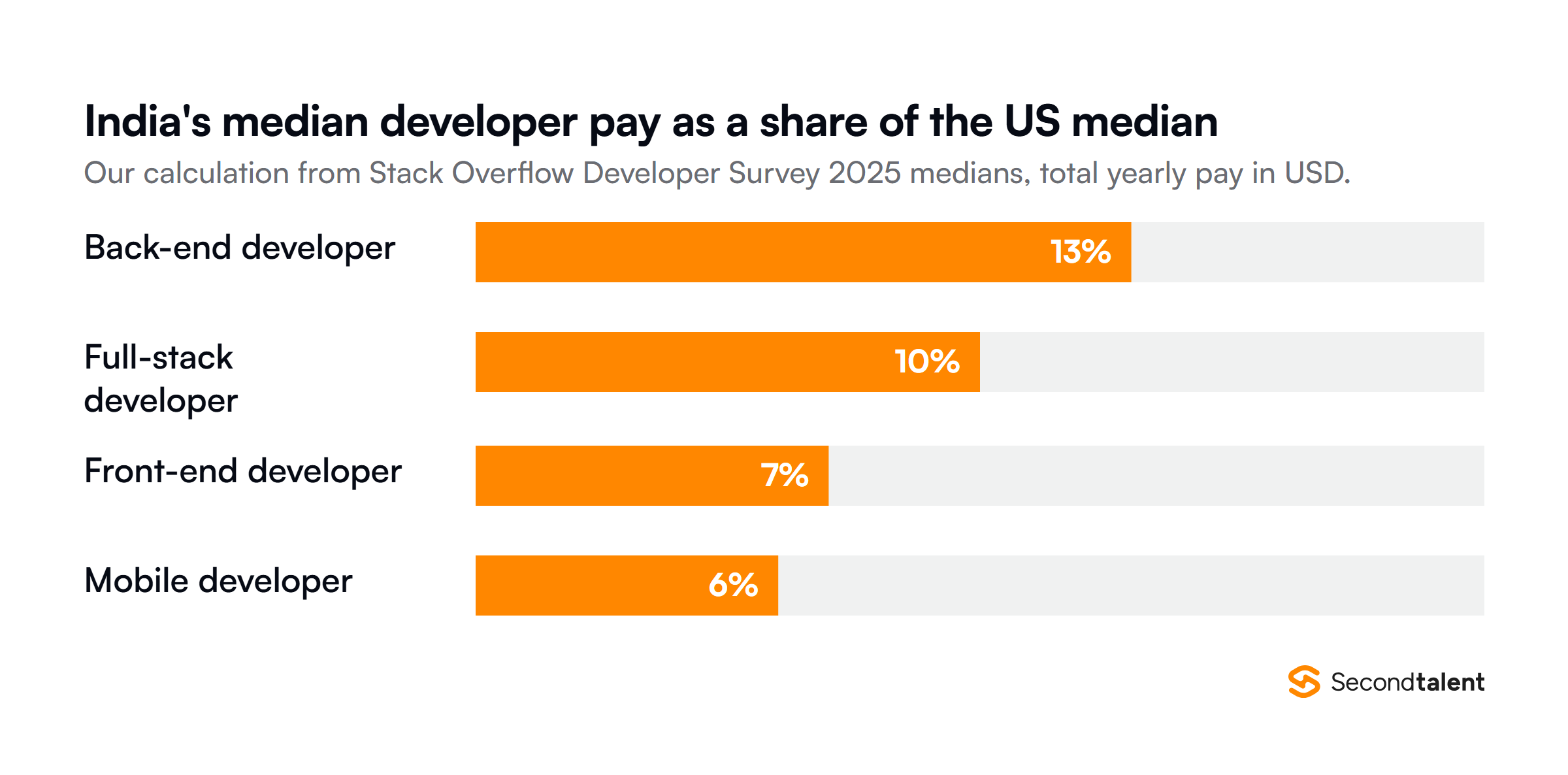
India’s respondents also include more students: 17.8%, against 6% in the US. Our software engineer salaries by country use the same survey’s raw data, and the developer rate cards break pay down by role for ten Asian markets.
Which Asian Markets Have the Strongest English?
Malaysia and the Philippines lead Asia’s large developer markets on the EF English Proficiency Index 2025, which ranks 123 countries and regions. Singapore and Taiwan are not in this edition’s ranking.
India, Indonesia, China and Thailand score below the global average of 488.
| Market | EF EPI 2025 rank | Score | Change on last edition |
|---|---|---|---|
| Malaysia | 24 | 581 | +15 |
| Philippines | 28 | 569 | -1 |
| Hong Kong | 39 | 538 | -11 |
| Vietnam | 64 | 500 | +2 |
| India | 74 | 484 | -6 |
| Indonesia | 80 | 471 | +3 |
| China | 86 | 464 | +9 |
| Thailand | 116 | 402 | -13 |
National scores hide the cities where developers work. EF’s Philippine results put Manila at 603, above the national 569. Bengaluru scores 569, a full 85 points above India’s average.
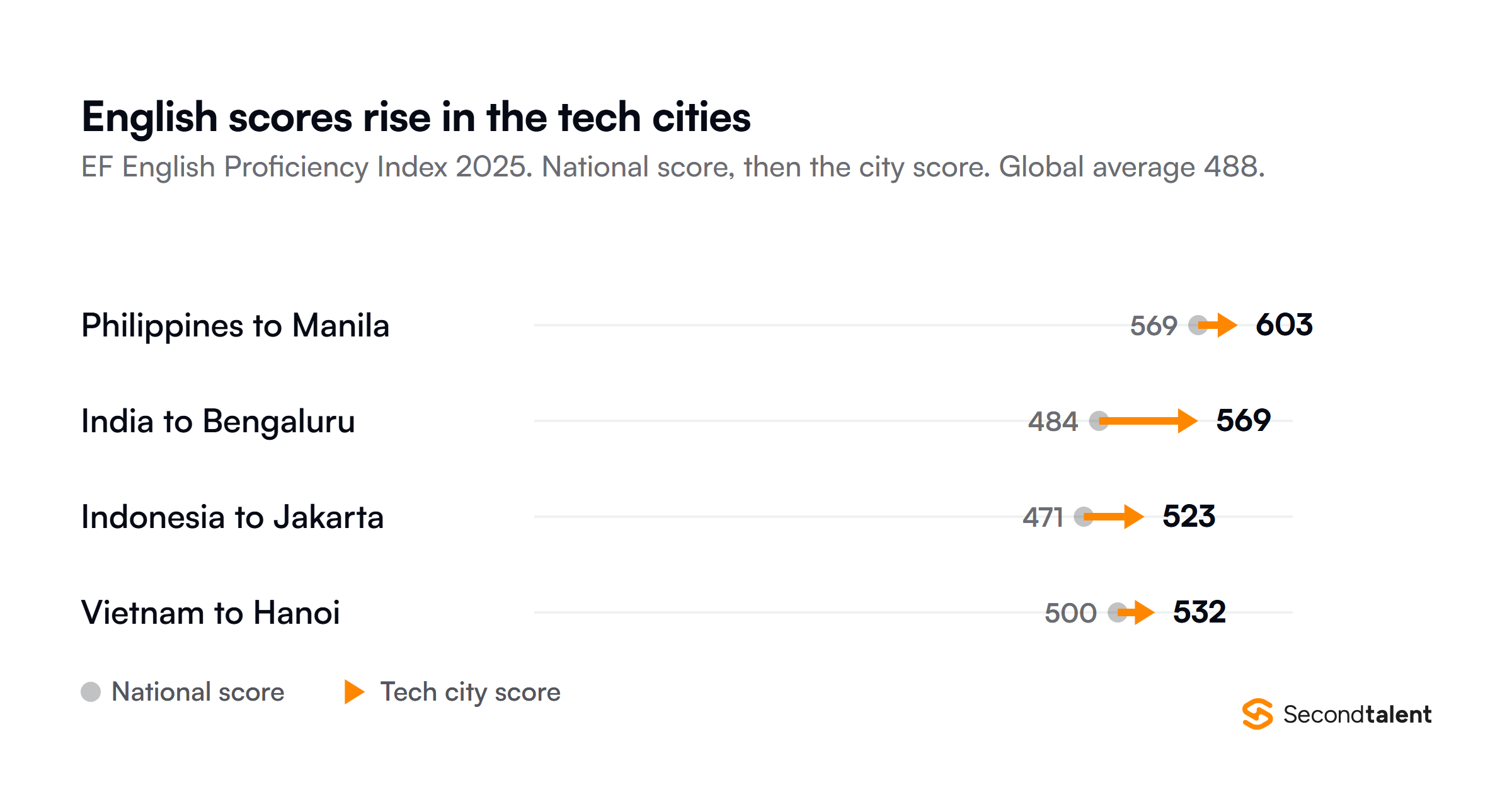
Test the skill the job needs. EF scores Vietnam at 522 for reading but 470 for listening, so a developer who handles written tickets well may still struggle on a fast video call. India shows the same split: 494 reading, 457 listening.
Hanoi outscores Ho Chi Minh City by 24 points. For market-by-market hiring detail, see how we hire developers in the Philippines, Vietnam, India and Indonesia.
How Many Working Hours Overlap With the US?
None, on a standard 9 to 5 in both places. Manila is 12 hours ahead of New York in summer, so the whole Manila workday falls during New York’s night. Any overlap here means someone works outside local office hours.
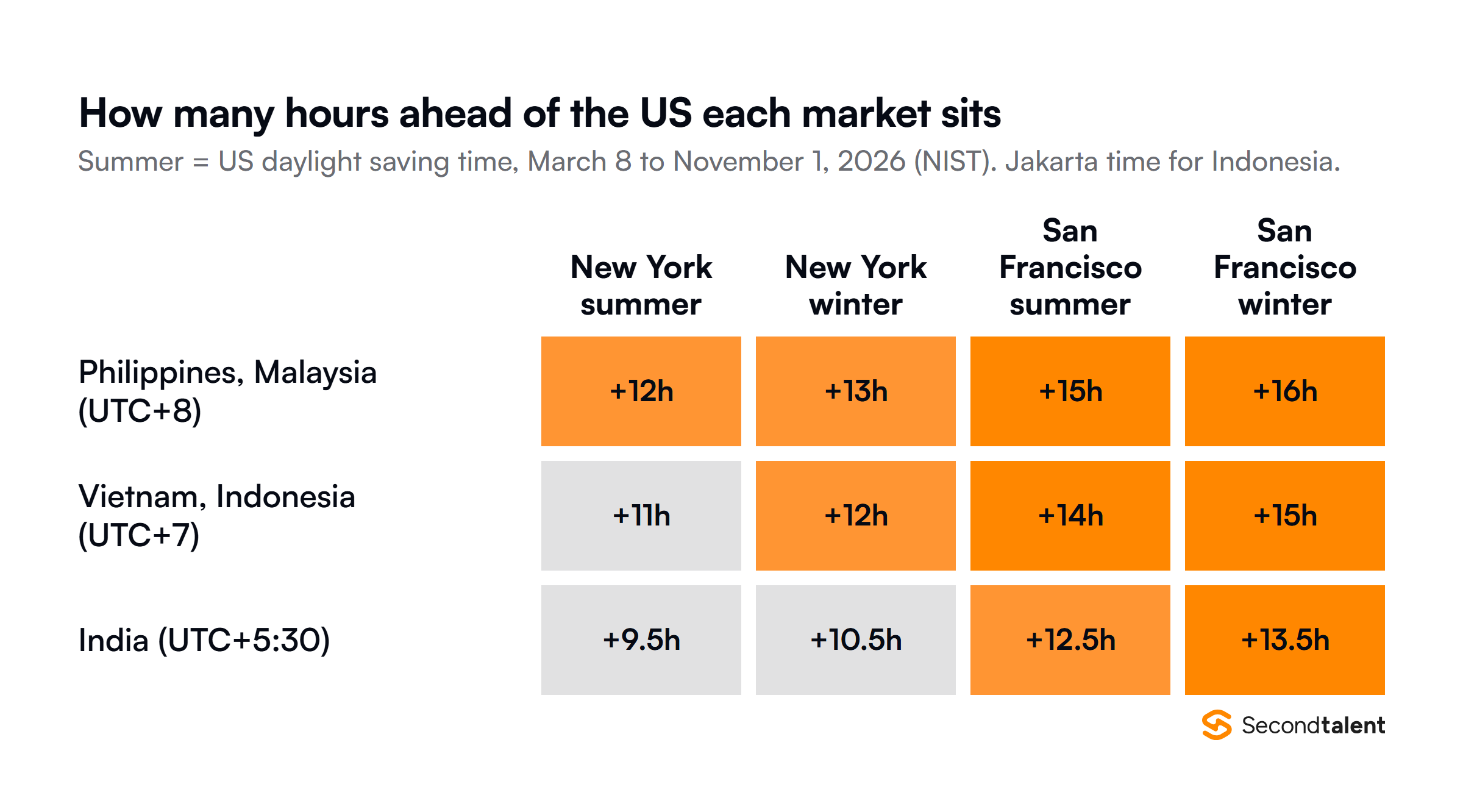
The gap moves twice a year on the US side only. Daylight saving time runs from March 8 to November 1 in 2026, according to NIST, and the Philippines, Vietnam, Indonesia and India keep one time all year.
A standing meeting set in July lands an hour later in Asia from November.
- East Coast teams: India sits closest. A 9am New York call is 6:30pm in Bengaluru in summer, and 7:30pm in winter.
- West Coast teams: the Asian morning overlaps the Californian late afternoon. 5pm in San Francisco is 8am the next day in Manila in summer.
- Split teams: two hours of overlap means one side starts early or the other stays late. Put that in the contract, with the hours written down.
Our time zone coordinator finds the overlap for any city pair. Our remote work hiring statistics cover how US employers use remote and hybrid roles.
Contractor, Employer of Record or Your Own Entity?
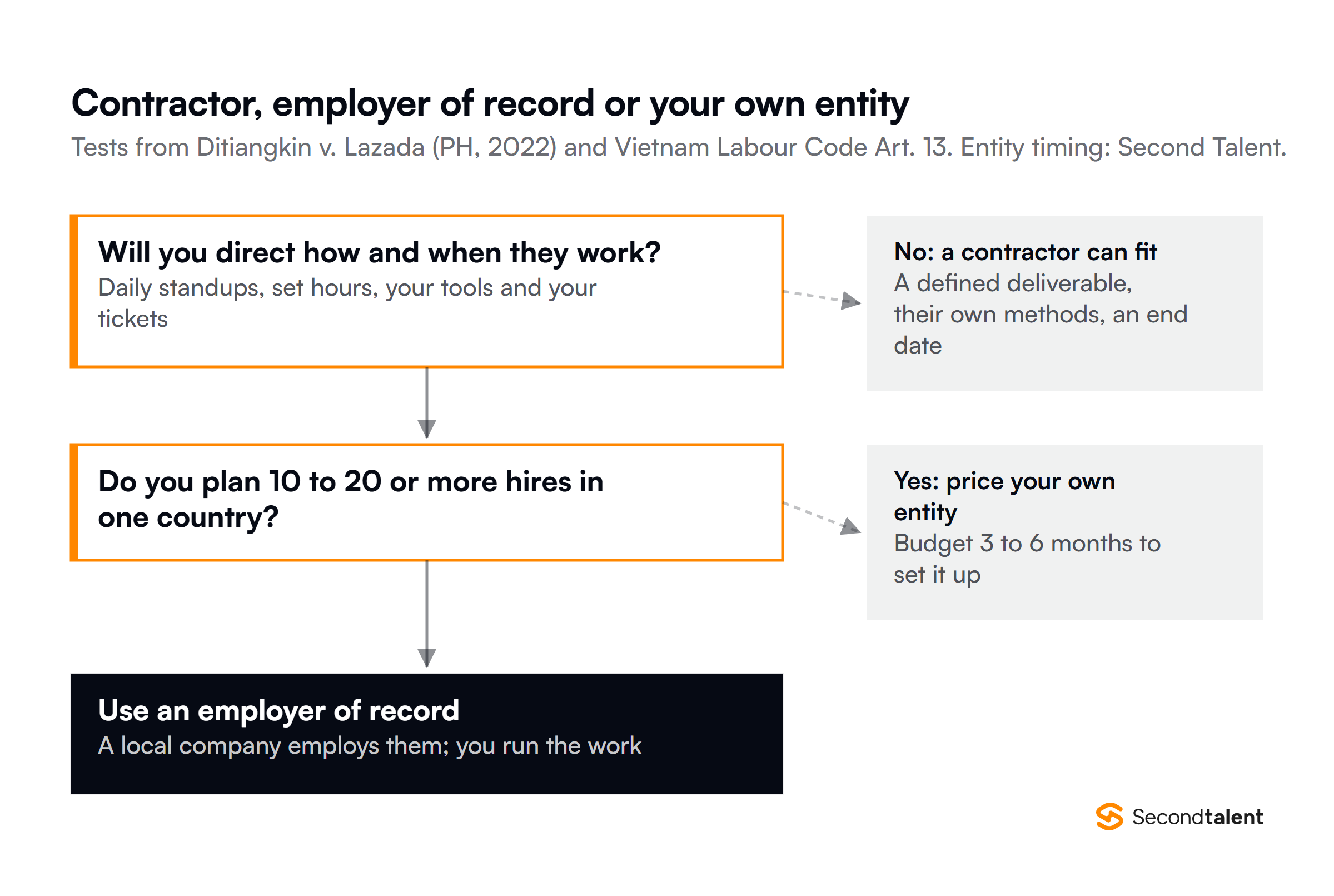
Pick the route by how you plan to manage the work. A contractor fits a defined job done their way. An employer of record, or EOR, employs the developer through its local company while you direct the work.
Your own entity makes sense once headcount in one country justifies it.
| Route | Who employs the developer | What you pay | Main risk |
|---|---|---|---|
| Independent contractor | Nobody. They invoice you | Their rate | Reclassified as an employee if you control the work |
| Employer of record | The EOR’s local company | Salary, statutory contributions and a monthly fee | Fee per head does not fall with scale |
| Your own entity | You | Setup, then payroll, tax filings and local staff | Months before the first hire can start |
Our pricing page puts EOR fees from $129 per employee a month in our core Asian markets, with social contributions passed through at cost.
The same page estimates 3 to 6 months to set up a legal entity, and suggests it starts to pay once a company has 10 to 20 employees in one market.
Philippines: control decides
Philippine courts apply a four-fold test: who selected the worker, who pays, who can dismiss, and who controls the means and methods of the work.
ACCRA Law calls control “the most important element,” and notes the test applies to remote engagements by foreign companies too.
The Lazada riders show what a label is worth. In Ditiangkin v. Lazada (G.R. No. 246892), the Labor Arbiter and the labor commission had relied on the contract’s no-employment clause.
The Supreme Court reversed them and ordered reinstatement, backwages, overtime and 13th month pay.
- Paid for a deliverable, not for hours
- Chooses their own methods and schedule
- Uses their own equipment and has other clients
- Set hours and daily standups
- Your manager assigns and supervises the tickets
- Works only for you, month after month
Vietnam: the name on the contract does not count
Article 13 of Vietnam’s Labour Code treats any agreement with a paid job, a wage and one party’s “management, administration and supervision” as a labour contract, “in case the two parties give another name to their agreement.”
A service agreement for a developer who works your hours on your backlog meets that test.
Our guide to the five ways to build a tech team in Vietnam covers contribution rates and entity setup there. The Philippine version does the same for the Philippines.
India: new labour codes since November 2025
India’s four labour codes took effect on November 21, 2025. The labour ministry’s March 2026 FAQ confirms a new wage definition for benefits from that date, and gratuity for fixed-term employees after one year of service.
Budget an Indian hire under the codes rather than the older acts.
Our EOR vs PEO vs contractor comparison covers the US side of classification, and the employer of record overview lists the markets we cover.
What US Tax and Paperwork Apply?
Little on the US side, as long as the developer is not a US citizen or resident and does the work outside the US.
IRS Publication 515 says pay to a nonresident alien “for services performed outside the United States is not considered wages and is not subject to withholding.”
- Social Security and Medicare: these apply to wages “for services performed as an employee in the United States,” the IRS says, and nonresident aliens are not subject to self-employment tax.
- Form W-8BEN: the IRS certificate a foreign person gives to a payer to establish foreign status. Keeping one on file documents why you withheld nothing.
- US citizens abroad: an American developer living in Manila is a different case, so get tax advice before you pay one as a foreign contractor.
Local tax is where the work sits. Through an EOR, the provider runs payroll, deducts tax and pays social contributions in the developer’s country, and you get one invoice. A contractor registers and files tax in their own country.
How to pay a contractor safely
Pay a bank account in the contractor’s own name.
The Treasury, State Department and FBI advisory on North Korean IT workers tells companies to “avoid payments in virtual currency and require verification of banking information corresponding to other identifying documents.”
A request to switch to a different account in a different name is one of its red flags.
How Do You Avoid Hiring a Sanctioned Worker?
Verify identity before the offer, and keep checking after it. North Korea sends IT workers abroad who pose as other nationalities, and the US government has warned companies about it since 2022.
“The DPRK dispatches thousands of highly skilled IT workers around the world to generate revenue that contributes to its weapons of mass destruction (WMD) and ballistic missile programs.”
US Department of State, Treasury and FBI, advisory of May 16, 2022
The 2022 advisory says most of these workers live in China and Russia, with smaller numbers in Africa and Southeast Asia. They often present themselves as South Korean, Chinese, Japanese, Eastern European or US-based.
It warns of legal consequences, including sanctions designation, for anyone who supports the activity or processes related payments.
In the scheme the Justice Department charged, US-based helpers hosted company laptops at home so the workers looked local.
Victim companies lost at least $3 million, and an overseas co-conspirator reached files controlled under US arms export rules at a California defense contractor.
The FBI’s January 2025 notice lists checks any hiring team can run:
- Verify identity during interviews, onboarding and employment, and cross-check applicants who share résumé text, phone numbers or email addresses.
- Ask for specific details about location and schooling. The FBI says these workers often claim non-US schools.
- Watch for a change of address or payment platform during onboarding.
- Check that any staffing firm you use runs these checks too, and audits them.
How Long Does It Take to Hire a Developer in Asia?
Plan on two weeks for someone who can start now, and nine weeks or more for someone who must resign first. The notice period is often the longest step, and local law sets it.
An employer can hold a Filipino developer who quits without notice liable for damages under Article 285 of the Philippine Labor Code, For India, ask each candidate about the notice period in their current contract at the first interview.
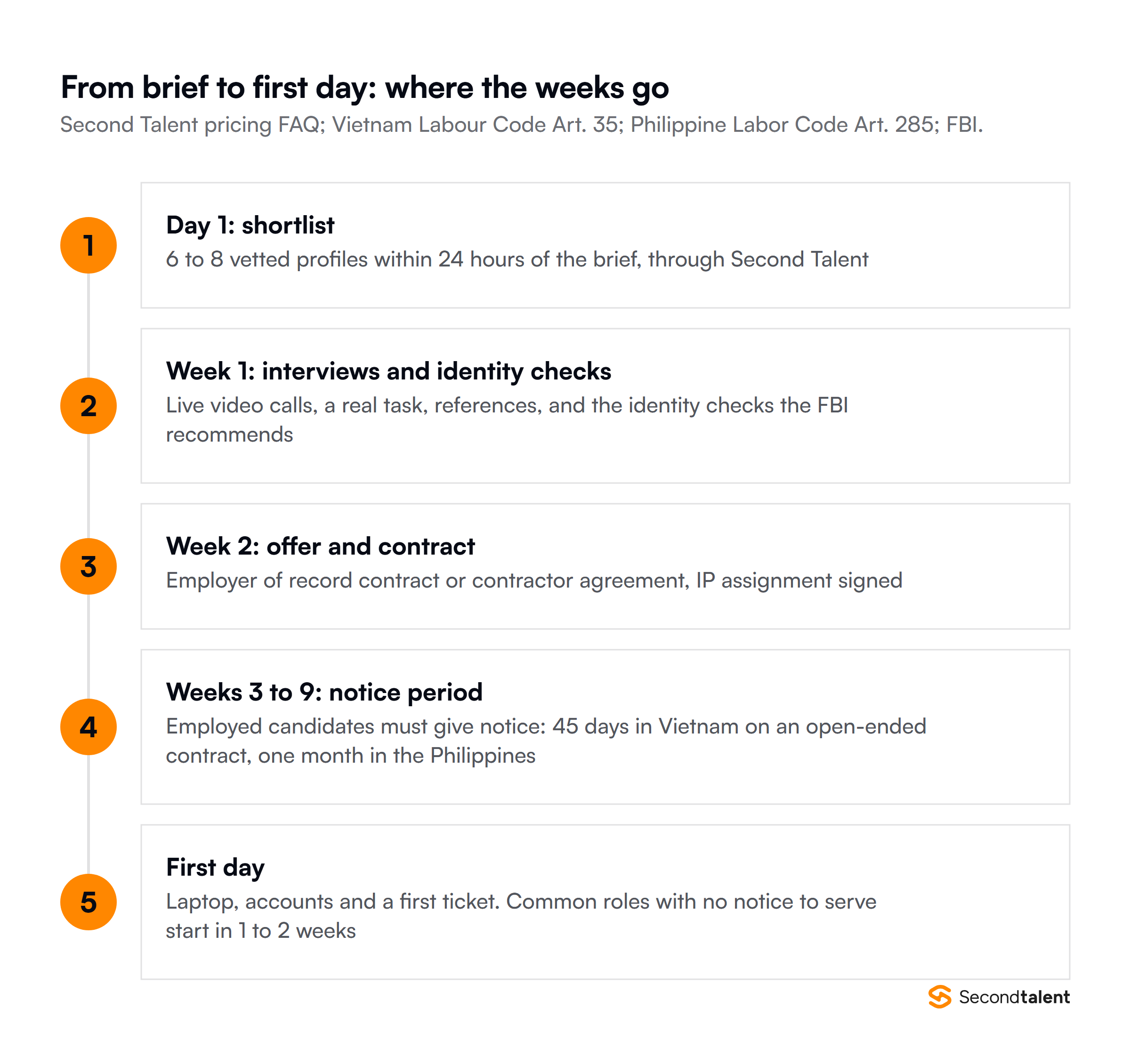
Sourcing is the step you can shorten. Second Talent sends 6 to 8 vetted profiles within 24 hours of the brief, and most clients see an engineer start within 1 to 2 weeks for common roles, as how Second Talent works sets out.
For the Philippines in detail, read our guide to hiring Filipino developers from the USA.
Hire Developers in Asia With Second Talent
We vet engineers for technical skill, English and AI tooling such as Claude Code, then act as their legal employer in nine markets: Vietnam, the Philippines, Indonesia, Malaysia, Singapore, Thailand, Hong Kong, Taiwan and China.
Most clients save 50 to 70% against equivalent US salaries, pay nothing upfront, and get a one-time free replacement in the first 90 days.
Compare markets on our Philippines EOR and Vietnam EOR pages, or tell us the role you need to fill and get a shortlist within 24 hours.
Frequently Asked Questions
Does a US company need to register in the Philippines to hire an individual contractor?
Not under the contracting rules, ACCRA Law argues: DOLE Circular No. 01 of 2017 takes individual contractors with unique skills outside the registration and capital rules of Department Order 174.
The four-fold test still applies to the relationship.
Can an EOR employee move to my own company later?
Yes. Once you set up a local entity, Second Talent transfers the employment with continuity of service, so tenure, leave balances and benefits carry across.
Are social contributions included in an EOR fee?
Not in Second Talent’s EOR plan. Second Talent bills employer social contributions, health insurance and country levies at cost, on top of the per-employee fee.
Our monthly developer subscription is different: salary, payroll taxes and contributions sit inside one fee.
Can I hire a developer in Asia on a US-style at-will basis?
Not as an employee. Vietnam’s Labour Code and the Philippine Labor Code both regulate how employment ends, so an EOR handles notice, severance and final pay under local law.