
TL;DR: Employing someone in Vietnam adds 23.5% on top of gross salary in employer contributions, and the employee gives up 10.5%. Both are capped, so the effective employer uplift falls as salary rises.
We employ staff in Vietnam through our own entity, so these are the numbers we run every month. This guide covers what you owe, what your employee takes home, and the three regulatory changes that make 2026 different from any recent year.
Key takeaways
- Employers add 23.5% to gross salary; employees give up 10.5%. Both are capped.
- Contributions stop at VND 46.8 million a month, so senior hires cost proportionally less to employ.
- The PIT deduction rose to VND 15.5 million on 1 January 2026; a new five-bracket schedule follows on 1 July.
- Regional minimum wages rose 7.2% on 1 January. Re-check which region each worksite sits in after the province mergers.
- The 13th month is customary, not statutory, but budget for it anyway.
Download this guide as a PDF
The full 2026 Vietnam payroll, benefits and tax guide, including the contribution table, the five-bracket PIT schedule, regional minimum wages and both worked examples, formatted for sharing with your finance team.
What employing someone in Vietnam costs
Add 23.5% to gross salary. That covers social insurance at 17.5%, health insurance at 3%, unemployment insurance at 1%, and the trade union fee at 2%. Your employee contributes a further 10.5% from their own pay.
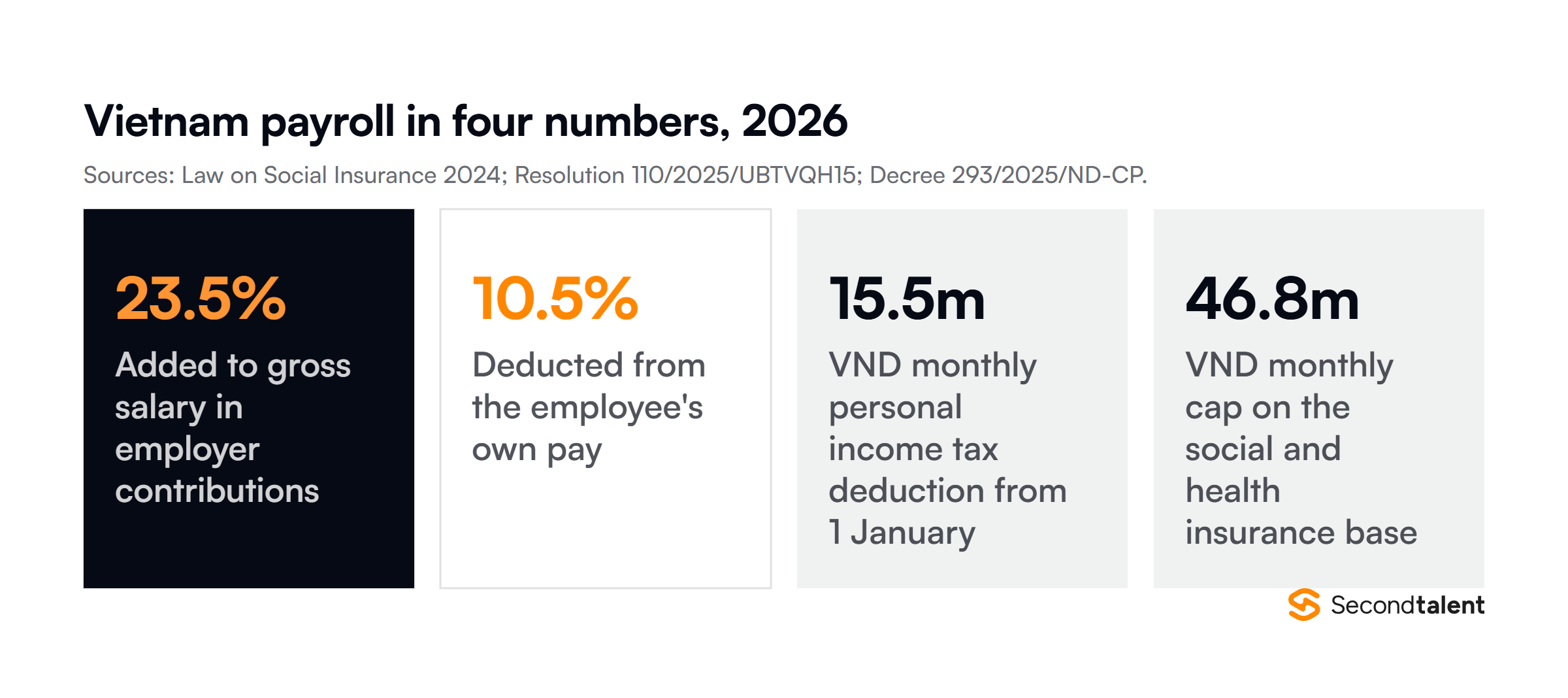
Both sides are capped, which matters more than most cost calculators show. Social and health insurance are capped at 20 times the base salary, or VND 46.8 million a month in 2026. Unemployment insurance is capped at 20 times the regional minimum wage.
Above those ceilings your contributions stop growing. A VND 40 million hire carries the full 23.5% uplift. A VND 80 million hire carries about 14%, because most of the salary sits above the cap.
Mandatory contributions: who pays what
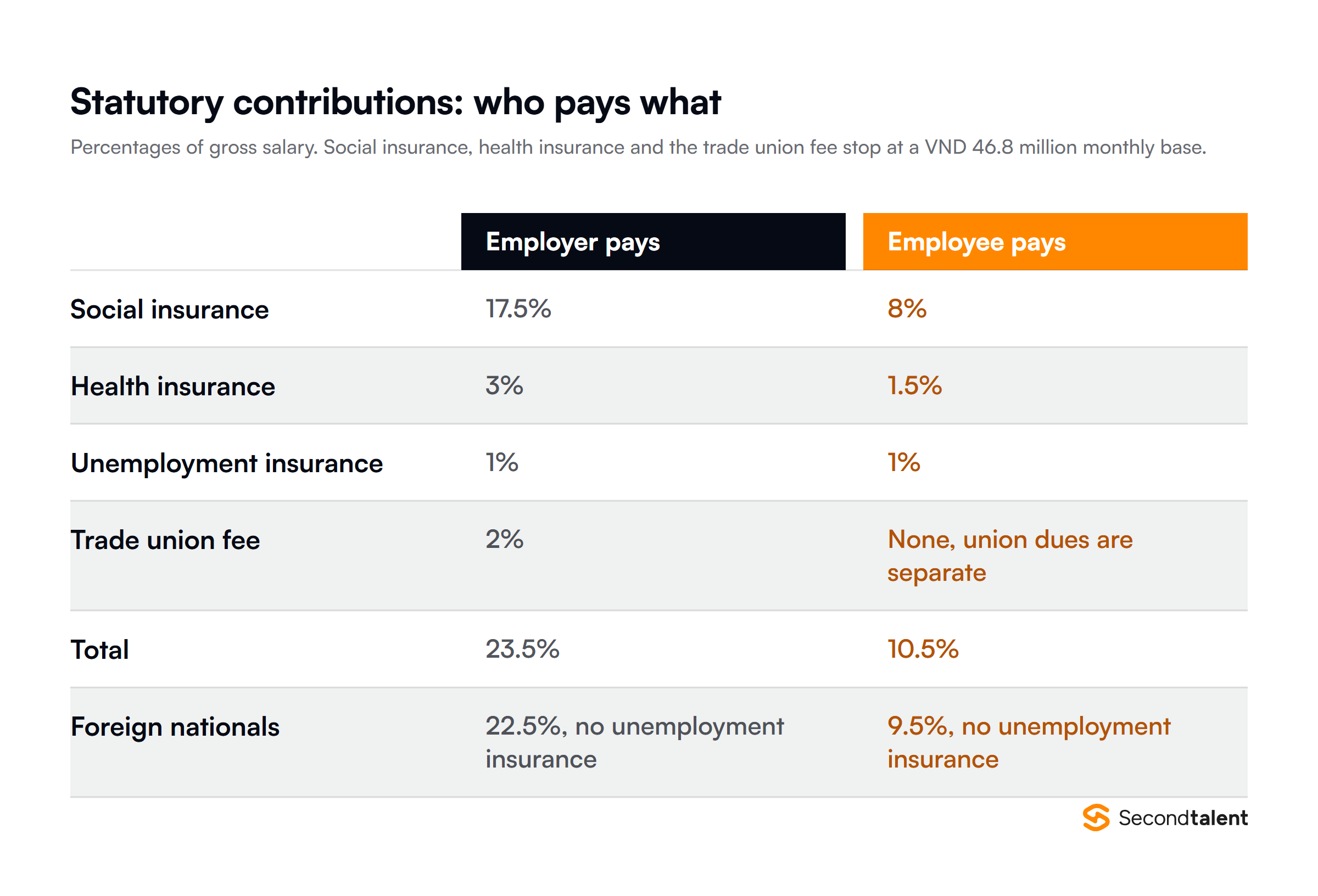
The trade union fee catches foreign employers out. You owe 2% of the social insurance salary fund whether or not a union exists at your company. Union members separately pay their own dues, which is a different payment.
The Law on Social Insurance 2024 took effect on 1 July 2025 and widened who must be enrolled. Anyone on a labour contract of one month or longer now falls inside the mandatory system, including many part-time and managerial arrangements that sat in a grey area before.
Foreign employees are treated differently
Foreign nationals holding a valid work permit join social insurance and health insurance, but are exempt from unemployment insurance. That trims the employer side to 22.5% and the employee side to 9.5%. A work permit is a precondition, not a formality.
Personal income tax in 2026
Two separate changes land this year, on two different dates. Getting them the wrong way round is the most likely payroll error a foreign employer will make in Vietnam in 2026.
From 1 January 2026, Resolution 110/2025/UBTVQH15 raised the family circumstance deduction. The personal deduction went from VND 11 million to VND 15.5 million a month, and the dependant deduction from VND 4.4 million to VND 6.2 million.
From 1 July 2026, PIT Law 109/2025/QH15 takes effect and cuts the progressive schedule from seven brackets to five. The 35% top rate now starts above VND 100 million a month rather than VND 80 million.
The new five-bracket schedule
| Monthly taxable income (VND) | Rate |
|---|---|
| Up to 10 million | 5% |
| Over 10 million to 30 million | 10% |
| Over 30 million to 60 million | 20% |
| Over 60 million to 100 million | 30% |
| Over 100 million | 35% |
The new law also exempts overtime pay, night shift premiums and payments for unused annual leave from personal income tax, within the limits set by law. For manufacturing and engineering teams that run overtime, that is a meaningful change to net pay.
Confirm the transition before you run mid-year payroll
The law carries an effective date of 1 July 2026, while its employment income provisions are set to apply to the 2026 tax year as a whole. Guidance on how withholding is handled across the July boundary was still settling when this guide was written. Confirm the current position with your tax adviser or your EOR before your June and July runs, and do not assume last year’s process carries over.
The three changes landing in 2026
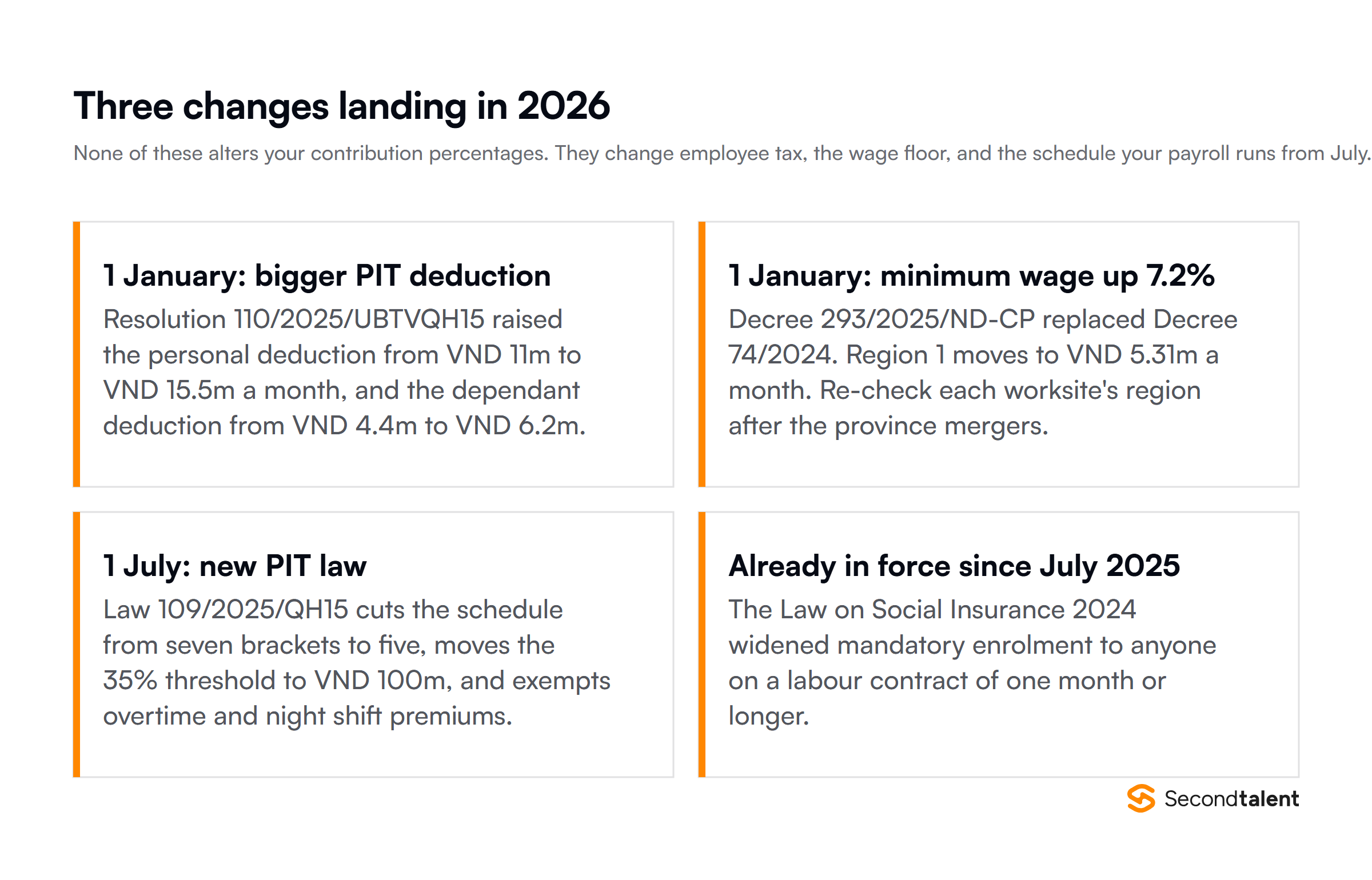
None of these is a rate change to your contribution percentages. They change the tax your employees pay, the floor you can pay them, and the schedule your payroll system needs to apply from July.
Minimum wage by region from 1 January 2026
Decree 293/2025/ND-CP raised the regional minimum wage by an average of 7.2% on 1 January 2026, replacing Decree 74/2024. Vietnam sets four regional rates, with Region 1 covering urban Hanoi and Ho Chi Minh City.
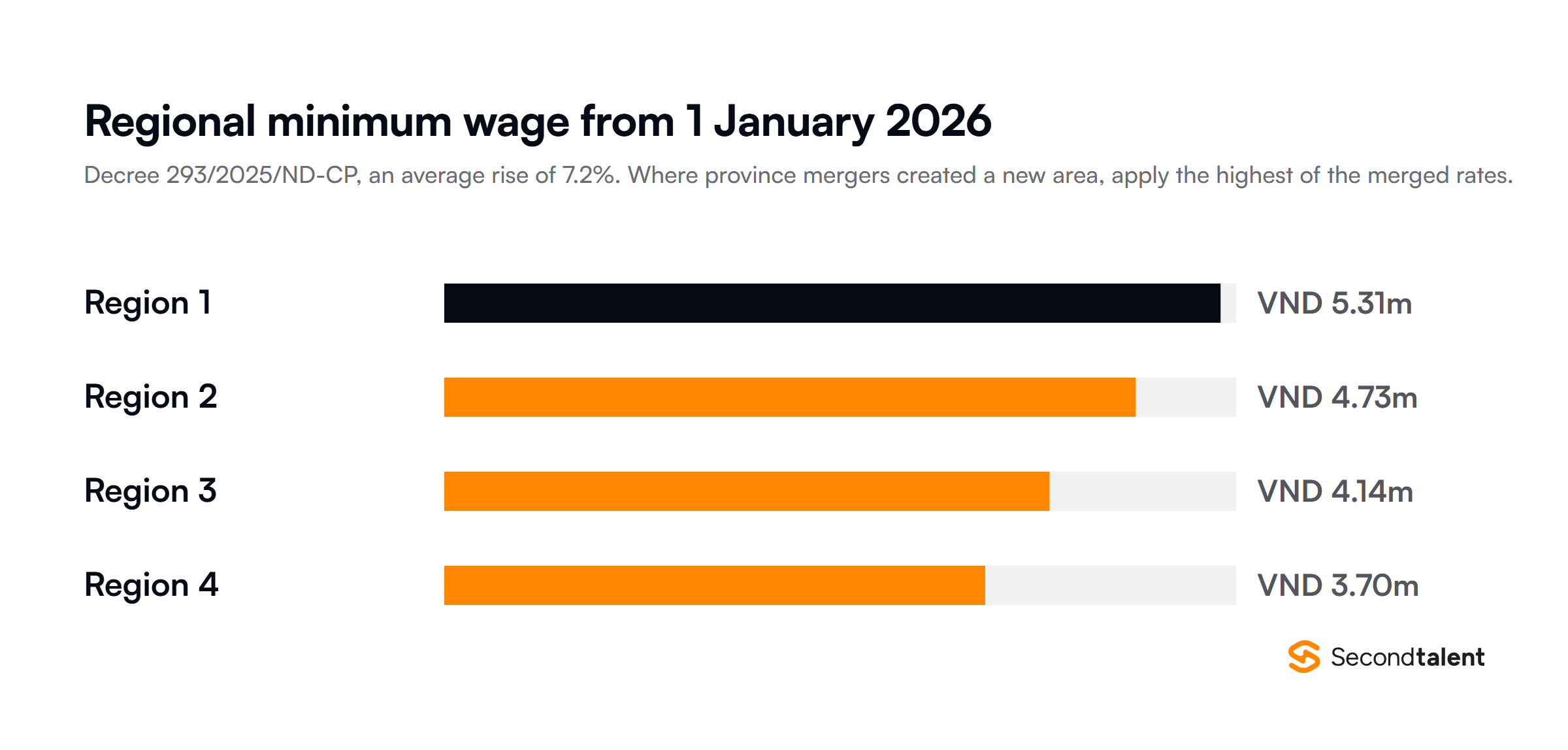
Vietnam’s provincial restructuring created a trap here. Where a new area was formed from areas that previously carried different minimum wage levels, employers apply the highest of those levels until the government issues further guidance.
Check which region each worksite now sits in rather than carrying last year’s mapping forward. Getting this wrong understates both the wage floor and every contribution calculated on it. Baker McKenzie’s note on Decree 293 sets out the transitional rule.
What a hire actually costs
Two worked examples, both for a tax resident in Region 1 with no dependants, using the 2026 deduction and the five-bracket schedule.
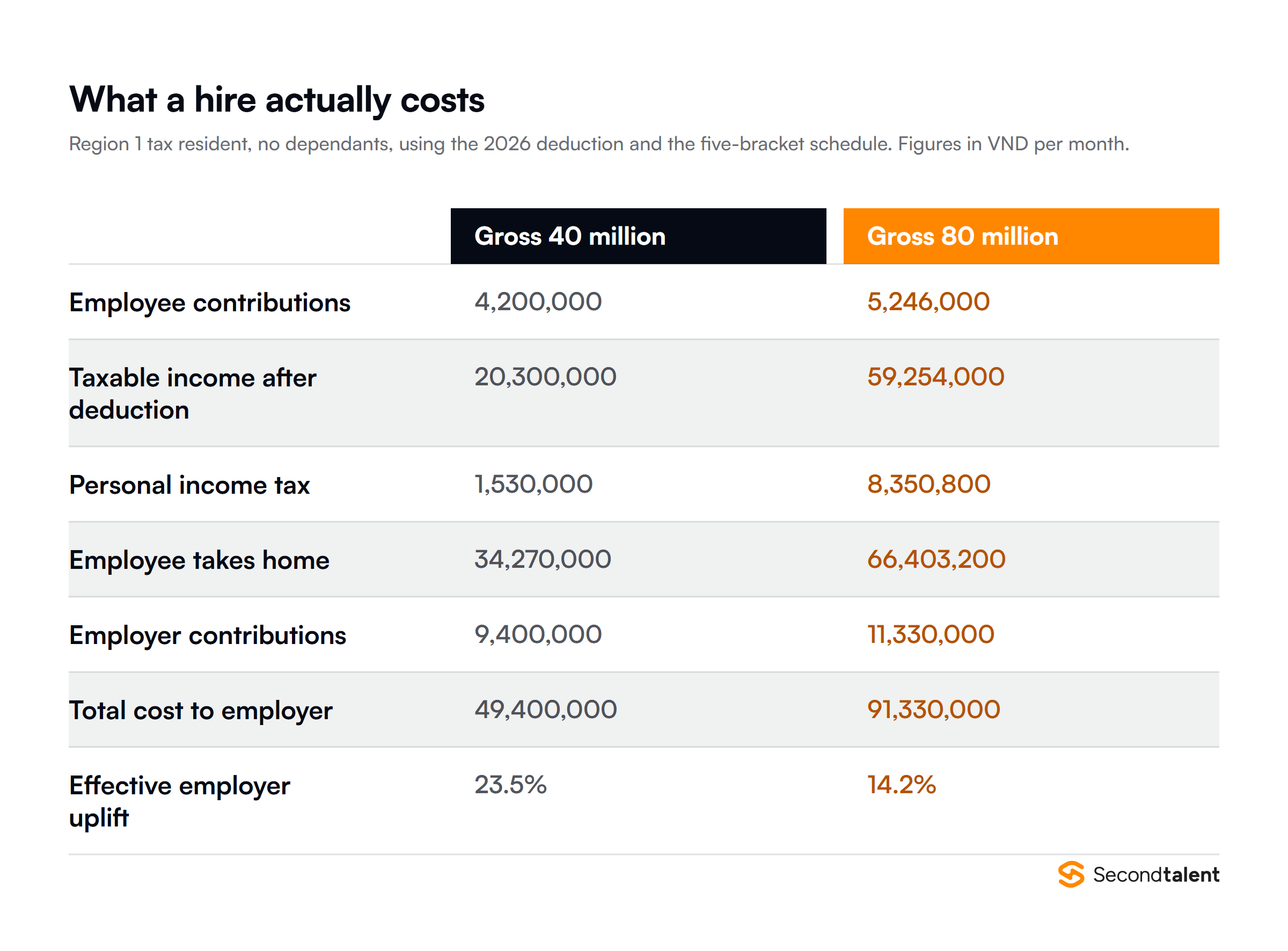
The second example shows the cap effect. The employer uplift falls from 23.5% to about 14.2% because social insurance, health insurance and the trade union fee all stop at VND 46.8 million.
Senior hires therefore cost proportionally less to employ than a cost-per-head model assumes. Our EOR cost calculator models the full stack, and the cost of hiring developers in Vietnam covers market salary levels to feed into it.
Working hours, overtime and leave
Standard hours are 8 per day and 48 per week. Overtime is capped at 40 hours a month and 200 hours a year, rising to 300 hours a year in specified sectors such as textiles, electronics and seafood processing.
- Overtime premiums: 150% on a normal working day, 200% on a weekly rest day, and 300% on a public holiday or paid leave day, on top of the holiday pay itself.
- Annual leave: 12 working days after 12 months of service, plus one extra day for every five years with the same employer.
- Public holidays: 11 paid days a year under Article 112 of the Labour Code.
- Night shift: an additional 30% premium for hours worked at night.
Tet dominates the calendar. The 2026 schedule gives public sector staff nine days off for Lunar New Year, and most private employers follow it. Plan delivery around a near-total shutdown for that period rather than treating it as a normal week.
Bonuses and the 13th month
Vietnam does not mandate a 13th month payment. The Labour Code leaves bonuses to the employer’s own regulations, which must be published and consulted on with employee representatives.
In practice a Tet bonus of about one month’s salary is close to universal, and candidates will assume it. Treat it as a real cost of employment rather than a discretionary extra, and state the basis in the contract so expectations match.
Benefits beyond the statutory minimum
Statutory health insurance buys access to the public system, and most professional candidates expect more. Private medical cover is the single most requested addition, and for technical roles in Hanoi and Ho Chi Minh City it is close to a hiring requirement.
- Private health insurance: standard for professional and technical staff, often extended to a spouse and children at senior levels.
- Meal and travel allowances: common, and exempt from personal income tax up to the caps set in the tax regulations. Anything above the cap is taxable pay.
- Phone and remote work allowances: widely offered, and exempt where they are set out in company policy and reflect actual expense.
- Training budgets: a strong retention lever in a market where engineers change employer often.
Structure allowances in the employment contract and your internal labour rules rather than paying them ad hoc. The exemptions depend on the payment being documented, and an undocumented allowance is simply taxable salary with extra steps.
Employing foreign nationals
A foreign national needs a work permit before starting, unless a narrow exemption applies. Employers must justify the role by showing that a Vietnamese worker could not fill it, and the approval runs through the provincial labour authority.
Budget four to eight weeks for the permit and its supporting documents, which include a criminal record check and legalised qualifications. Permits run up to two years and tie to a specific employer and role.
Probation, notice and severance
Probation runs from 6 to 60 days for most roles, and up to 180 days for enterprise managers. Pay during probation must be at least 85% of the full rate for the job, and the probation period counts towards service for severance purposes.
Notice to terminate depends on the contract type. An indefinite-term contract requires 45 days, and a fixed-term contract of 12 to 36 months requires 30 days. Shorter contracts carry shorter notice.
- Severance allowance: half a month’s salary for each year of service, for employees with 12 months or more, reduced by the periods already covered by unemployment insurance.
- Job loss allowance: one month per year of service where the role is cut for restructuring or economic reasons, with a two month minimum.
- Grounds matter: Vietnam does not recognise at-will employment. Termination has to fit a statutory ground, and the process is as important as the reason.
Because unemployment insurance has covered most service since 2009, the severance bill is usually smaller than the headline formula suggests. Long-tenured staff and uninsured periods are where it still bites. Le & Tran’s note on severance allowance works through the offset.
Registering as an employer
Before the first payday you need a tax code for withholding, registration with the provincial social insurance agency, and labour registration covering your headcount and internal labour rules. Companies of 10 or more employees need written internal labour regulations registered with the labour authority.
Standing this up takes three to six months alongside company incorporation, which is the practical reason most teams start on an employer of record and move to their own entity once headcount justifies it.
Running payroll each month
- Pay salaries at least monthly, on the date fixed in the contract.
- Withhold employee contributions and personal income tax at source.
- Remit social, health and unemployment insurance to the provincial social insurance agency, with the trade union fee on the same cycle.
- Declare and pay withheld PIT monthly or quarterly, depending on your registered filing frequency.
- Finalise personal income tax annually, and issue withholding statements to employees who finalise their own.
Payments must be made in Vietnamese dong. Late contribution payments attract interest and, since the 2024 law, stronger enforcement powers against persistent non-payment.
Frequently asked questions
What is the total employer cost of hiring in Vietnam?
Gross salary plus 23.5% in statutory contributions, capped at a salary base of VND 46.8 million a month for social insurance, health insurance and the trade union fee. A VND 40 million hire costs about VND 49.4 million a month in total.
How much is personal income tax in Vietnam in 2026?
Residents pay progressive rates from 5% to 35%. From 1 July 2026 the schedule has five brackets, with 35% applying above VND 100 million of monthly taxable income. Non-residents pay a flat 20% on Vietnam-sourced employment income.
Do foreign employees pay social insurance in Vietnam?
Yes, foreign nationals with a valid work permit contribute to social insurance and health insurance. They are exempt from unemployment insurance, which reduces the employer rate to 22.5% and the employee rate to 9.5%.
Is a 13th month salary required in Vietnam?
No. Vietnamese law does not require a 13th month payment. A Tet bonus of roughly one month’s salary is standard practice, and most candidates expect it, so budget for it as a real cost.
Can I pay a Vietnamese employee without a local entity?
Not directly. Payroll, insurance registration and PIT withholding all require a registered local employer. An employer of record in Vietnam holds the contract on its own entity and handles the filings, which is the usual route below about five to eight employees.
Above that headcount, the fees usually justify your own entity. Our EOR versus entity calculator models the crossover, and the Vietnam EOR provider comparison covers the local market.
Hiring in Vietnam?
Second Talent employs staff in Vietnam on our own entity and handles contracts, payroll, insurance registration and PIT withholding, so the rules above become our problem rather than yours. We also source the candidates. Tell us the role and we will come back with candidates and a full employment cost.
This guide is general information, current as at the date of publication, and is not tax or legal advice. Vietnamese payroll rules change often, and the 1 July 2026 PIT transition in particular is still bedding in. Confirm your position with a qualified adviser before acting.

![How to Hire Developers in Asia Remotely. How to Hire Developers in Asia Remotely from the USA [2026], by Second Talent.](https://www.secondtalent.com/wp-content/uploads/2026/09/hire-developers-in-asia-remotely-featured-v2-768x403.jpg)
![AI Outsourcing in Singapore. Top 10 AI Outsourcing Companies in Singapore [2026], by Second Talent.](https://www.secondtalent.com/wp-content/uploads/2026/09/ai-outsourcing-companies-singapore-featured-v2-768x403.jpg)
![AI Outsourcing in India. Top 10 AI Outsourcing Companies in India [2026], by Second Talent.](https://www.secondtalent.com/wp-content/uploads/2026/09/ai-outsourcing-companies-india-featured-v2-768x403.jpg)
![AI Outsourcing in the Philippines. Top 10 AI Outsourcing Companies in the Philippines [2026], by Second Talent.](https://www.secondtalent.com/wp-content/uploads/2026/09/ai-outsourcing-companies-philippines-featured-v2-768x403.jpg)

![Software Development Outsourcing in Vietnam. Top 10 Software Development Outsourcing Companies in Vietnam [2026], by Second Talent.](https://www.secondtalent.com/wp-content/uploads/2026/09/software-development-outsourcing-companies-vietnam-featured-v2-768x403.jpg)