TL;DR: US employers are posting fewer remote and hybrid jobs in 2026, while candidates keep chasing the ones that exist. Robert Half found that 87% of the US professional job postings it analyzed in Q2 2026 were fully on-site. On LinkedIn, fully remote roles made up 8% of paid US postings in September 2025 and drew 35% of applications.
On September 2, 2026, Uber announced about 3,300 corporate job cuts and told most of its remaining remote staff to work from an office, leaving under about 1% remote. A month earlier, Dropbox said applications per job in 2025 ran nearly seven times their level before it went virtual-first, and its offer acceptance rate was the highest since the switch.
- 1JLL counts 56% of Fortune 100 office employees on a fully in-office policy at the end of 2025, up from 7% two years earlier.
- 2Remote job ads ask for about 25% more skills than otherwise identical in-person roles, in a study of 50 million European postings.
- 3New York Fed economists estimate remote work explains 64% of the rise in unemployment among young college graduates.
- 4Employing one person abroad through an employer of record lists at $599 to $699 a month at Deel, Remote and Oyster.
What Share of Job Postings Are Remote or Hybrid?
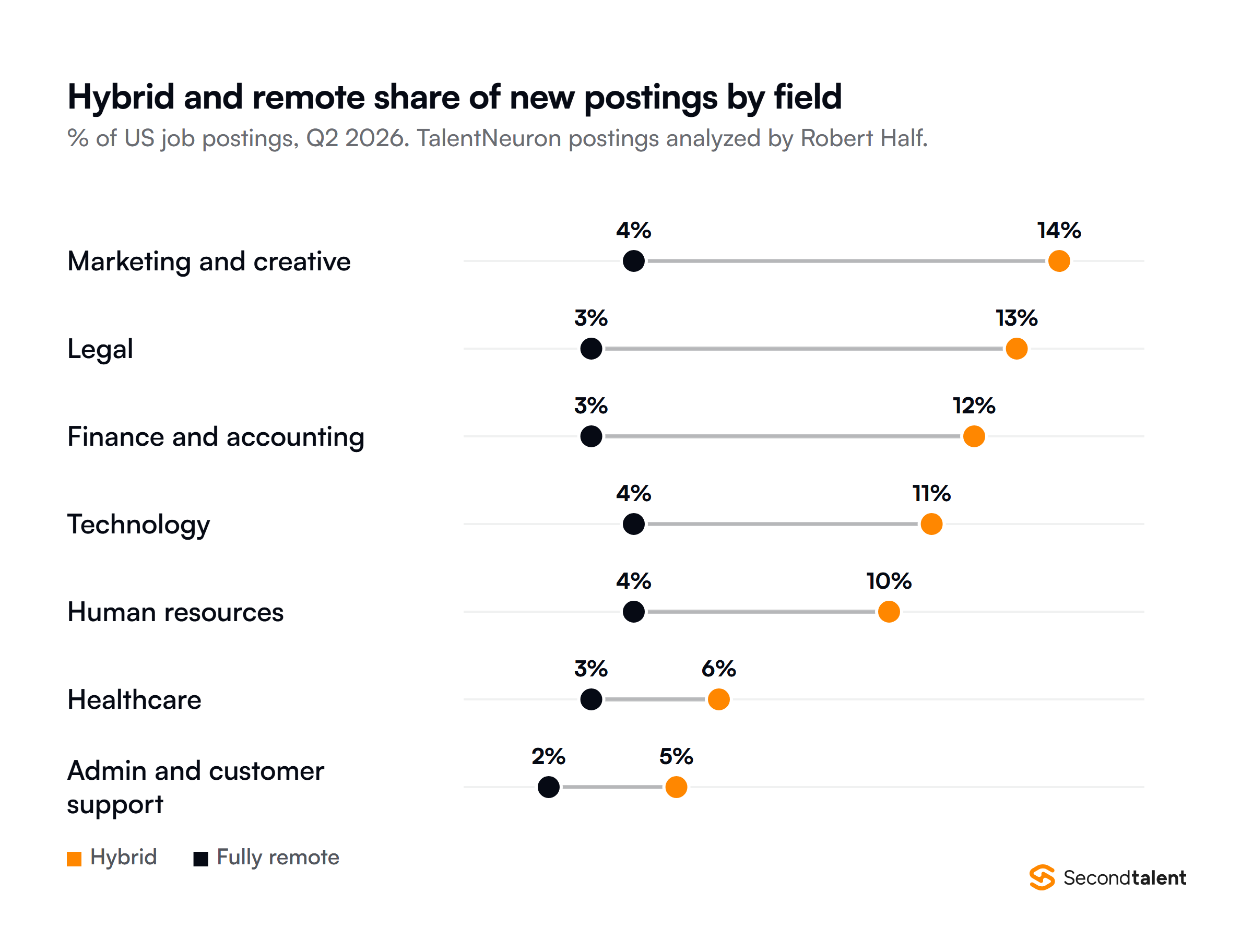
Fully on-site roles went from 65% of the US postings Robert Half tracks in Q4 2025 to 87% in Q2 2026. In the latest quarter, 10% were hybrid and 3% fully remote, according to Robert Half’s remote work research, published in July 2026.
Robert Half reads the jump as companies putting return-to-office plans into effect. Its employer survey backs that up: 36% of employers said they had raised the number of days staff must work on-site over the past year.
Indeed’s count moves far less. Its remote tracker data finds remote or hybrid terms in 8.4% of US postings on August 31, 2026, against 8.2% a year earlier. The share peaked at 10.5% in February 2022 and has stayed between 7.7% and 9.1% since the start of 2024.
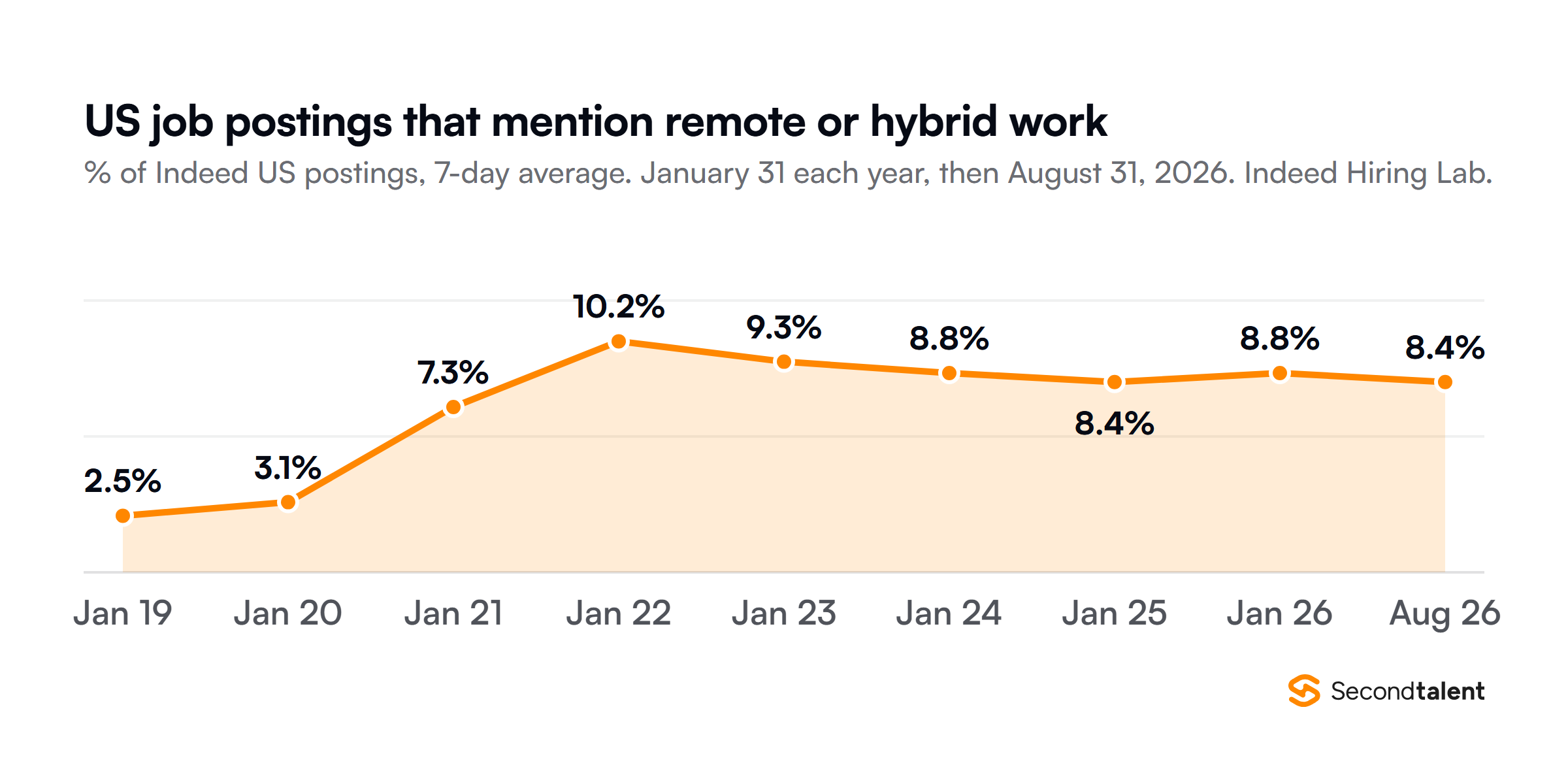
The two trackers sit several points apart because they count different jobs in different ways.
- 13% of postings hybrid or fully remote
- TalentNeuron postings mapped to 450+ professional job titles
- Finance, tech, marketing, legal, HR, admin and healthcare support
- 8.4% of postings mention remote or hybrid work
- Keyword match on the posting text, 7-day average
- All US jobs on Indeed, including retail, driving and construction
Which jobs are most often advertised as remote
Indeed’s occupation data shows why an all-jobs count runs lower. Insurance postings now mention remote or hybrid work more often than software development postings do, and in retail and driving the share is close to zero.
Software development slipped from 33.7% a year earlier while insurance climbed from 36.1%. Retail fell from 3.6% to 1.9% over the same twelve months.
By professional field
Inside Robert Half’s narrower set of professional roles, marketing and creative jobs carry the most flexibility and admin and customer support jobs the least. Technology sits mid-table, at 85% fully on-site.
Minnesota and Massachusetts had the highest hybrid share of any state in Q2 2026, at 13% each, and Minneapolis, Boston and San Francisco led metro areas at 14%.
How Does US Remote Hiring Compare With Other Countries?
The US has the lowest remote or hybrid share of the seven countries in Indeed’s tracker, and one of only two where the share is lower than it was four years ago. Germany is the other.
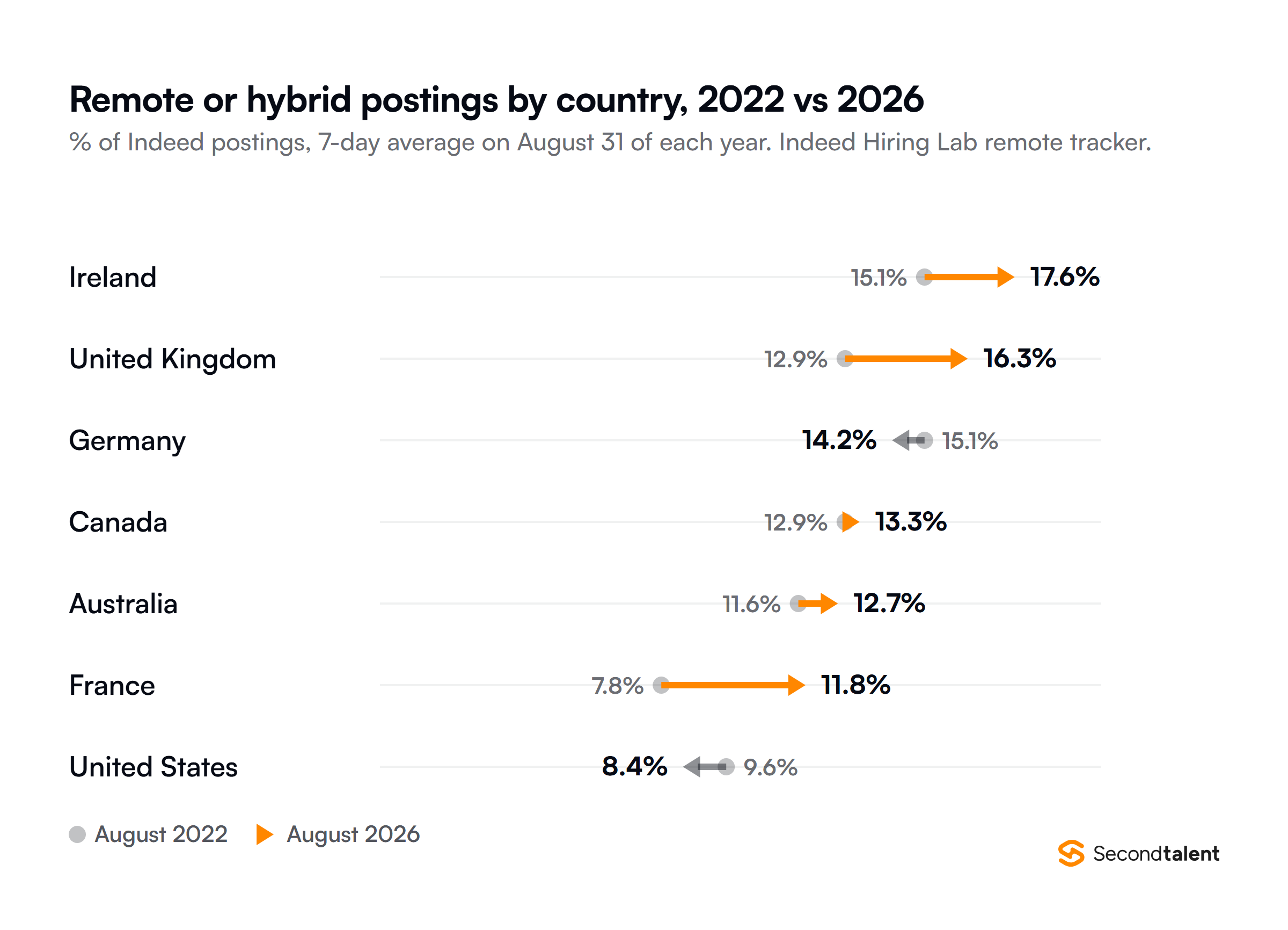
Ireland leads at 17.6%, after reaching 19.9% on December 30, 2025. The UK share has risen in each August reading since 2022, to 16.3%, and Indeed’s mid-year UK report finds two office days a week the most common hybrid arrangement in British postings. France moved furthest, from 7.8% to 11.8%.
Job seekers search in their own pattern. In the US, 7.9% of Indeed searches on August 31, 2026 included remote or hybrid terms, close to the 8.4% posting share. In the UK only 2.8% of searches did, against 16.3% of postings.
How Many Applications Do Remote Jobs Get?
Before March 2020, 1 in 50 US job postings on LinkedIn was fully remote. By early 2025 it was about 1 in 12, and remote and hybrid roles together were 20% of postings while attracting up to 60% of applications, LinkedIn’s head of economics Kory Kantenga wrote in the Economic Graph newsletter.
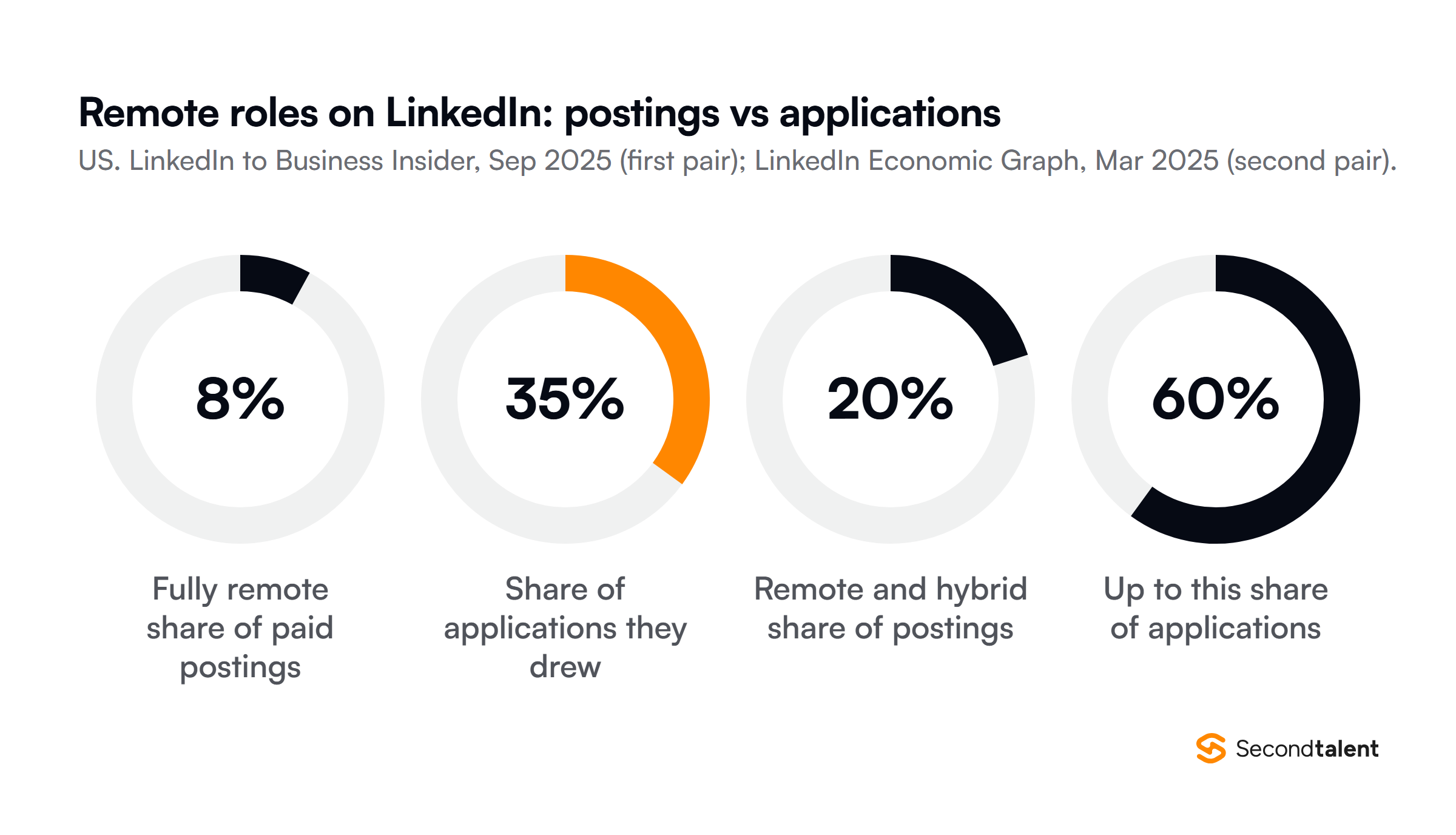
LinkedIn’s later figure covers fully remote roles only. In September 2025, fully remote roles were about 8% of paid US postings on LinkedIn and drew 35% of applications, a LinkedIn spokesperson told Business Insider. LinkedIn’s March 2025 newsletter also found women send 42% of their applications to remote roles, against 38% for men.
Dropbox has been virtual-first since 2021, and it told Business Insider its attrition is also the lowest since the change. For turnover figures across employers, see our employee retention statistics.
Are Remote Jobs Harder to Get Into?
Remote postings set a higher bar. Researchers Zhenyu Liao, Letian Zhang and Shinan Wang analyzed 50 million European job postings and ran experiments with 1,200 hiring managers. Remote roles asked for roughly 25% more skills than otherwise identical in-person jobs, plus more experience and credentials, they wrote in Harvard Business Review in August 2026.
The same pattern shows in US postings. Robert Half’s Q2 2026 data, above, gives roles for people with 0 to 2 years of experience the smallest hybrid and remote shares, and senior roles with 5 or more years the largest.
Three New York Fed economists put a number on the cost to graduates. Unemployment among college graduates under 29 averaged 3.1% in 2017 to 2019 and 3.7% in 2022 to 2025, while the rate for older graduates dipped from 1.9% to 1.8%. Almost all of the rise came from remotable occupations such as software engineering.
“Employers may not want to hire fresh graduates onto distributed teams because it is more difficult to teach them the requisite skills from afar.”
Natalia Emanuel, Emma Harrington and Amanda Pallais, Liberty Street Economics, June 1, 2026
Their back-of-the-envelope estimate is that remote work explains 64% of the increase for young graduates between 2017 to 2019 and 2022 to 2024. They add that the rise began before generative AI spread, and that holding AI exposure constant does not remove the age gap.
For employers that do hire junior staff remotely, the screening problem moves to the interview. Our guide on evaluating engineering talent when hiring remotely covers paid trial projects and scorecards for remote candidates.
How Many Employers Require Office Days?
The average weekly office requirement for a Fortune 100 office employee rose from 2.8 days at the end of 2023 to 4.0 days at the end of 2025, according to JLL’s Q4 2025 office market report. It found 97% of those employees now under hybrid or full-time office rules.
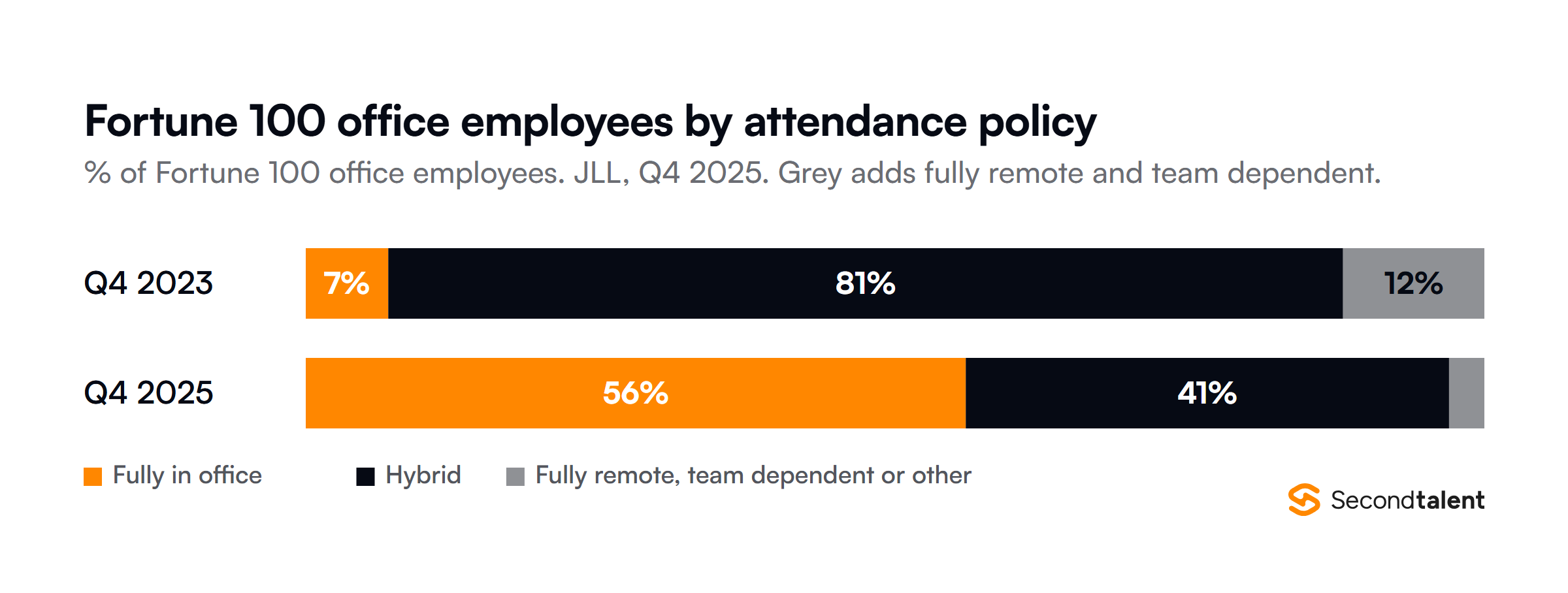
The Flex Index found 29% of Fortune 100 firms required full-time office attendance in its Q3 2025 report, with 45% asking for four or five days.
Counting companies instead of employees explains the gap. JLL weights by headcount, so one large five-day employer such as Amazon moves its figure far more than one firm moves a company count.
Across all US firms, the same Flex Index report found two-thirds (66%) still offered some location flexibility and 34% required full-time office presence. Smaller firms are the flexible ones: 67% of companies under 500 employees were fully flexible. Required office time rose 12% from early 2024, yet actual attendance rose only 1% to 3%.
Which Companies Have Ordered Staff Back to the Office?
TikTok is one of the most recent large employers to move to five days: starting in September 2026 it requires most US employees in the office full-time, ending the one remote day some product, marketing and ad sales teams still had, Business Insider reported.
The primary documents are public for three of them: Andy Jassy’s memo, the White House memorandum and Microsoft’s September 2025 update. PNC’s chief executive Bill Demchak set out its rule in a memo reported by Banking Dive, and Entrepreneur covered Instagram’s policy.
Telework rates have barely moved
The mandates show up in postings far more than in national telework data. The US Bureau of Labor Statistics measures telework in its monthly household survey, and the August reading has drifted down less than one and a quarter points in two years.
The BLS telework series also shows 49.1% of teleworkers worked from home for all their hours in August 2026. The SWAA survey by Nick Bloom and colleagues finds employer plans for home working steady at about 1.3 to 1.5 days a week. Our remote work statistics cover who works remotely in more detail.
What Does It Cost to Hire Remote Employees Abroad?
The best-funded startups are not hiring abroad to save money, on Deel’s numbers. Startups founded from 2020 to 2025 that raised $100 million or more hired 1,400+ cross-border employees through Deel’s employer of record service in 2025. The five countries that took the most were all high-income.
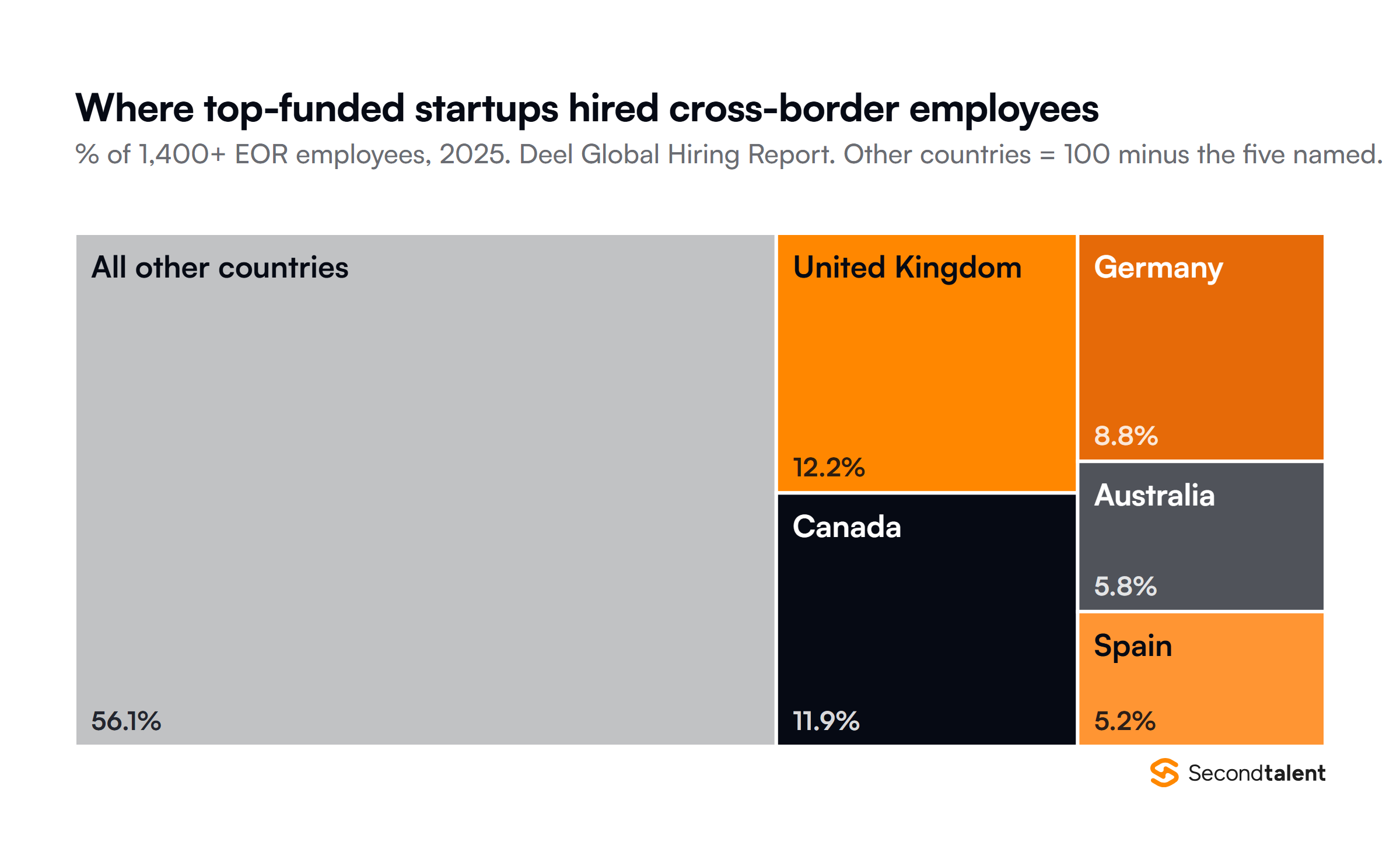
Software developers were 28% of those startups’ cross-border hires and AI engineers 2%. Smaller businesses on the platform hired more heavily from the Philippines, Mexico, Colombia and India, according to the Deel Global Hiring Report, drawn from over one million worker contracts at 37,000+ companies. General AI trainer roles grew 283% cross-border in 2025.
Employer of record list prices
An employer of record becomes the legal employer in the worker’s country and runs payroll, tax and benefits, so a company can hire there without its own entity. The monthly fee sits on top of salary and the employer’s statutory contributions.
At Deel’s starting price, one employee costs $7,188 a year in fees (our calculation, 12 months at $599). Remote and Oyster list $699. Our comparison of EOR vs PEO vs contractor management sets these fees against the contractor route and its misclassification risk.
Identity fraud and monitoring
Remote hiring has opened a fraud channel. On June 30, 2025, the US Justice Department announced searches of 29 known or suspected laptop farms across 16 states. One indictment describes North Korean IT workers using the identities of more than 80 Americans to get remote jobs at more than 100 US companies.
Gartner predicts that by 2028, 1 in 4 candidate profiles worldwide will be fake. In its survey of about 3,000 job candidates, 6% admitted to interview fraud, either posing as someone else or having someone else pose as them, HR Dive reported. Our AI in recruitment statistics track how screening tools are changing.
Oversight after the hire carries its own risk. Morgan & Morgan pairs home working with employee monitoring software: founder John Morgan said on an August 2026 podcast that the firm puts cameras on remote staff’s computers and scores keystrokes, and that 23 employees quit in the first week, People reported.
Hiring Remote Developers With Second Talent
If your office policy has shrunk your local candidate pool, Second Talent matches companies with pre-vetted remote developers across Asia. Our developer rate cards show what each role costs by country and seniority.
To take the hire on as a full employee without setting up an entity, use our employer of record service handles contracts, payroll and local compliance. Tell us the role you are hiring for and we will send matching profiles.
Frequently Asked Questions
Is remote hiring growing or shrinking in 2026?
It depends on the tracker and the country. Indeed shows the US share of remote or hybrid postings roughly flat on the year, while Robert Half’s professional postings swung toward on-site work. The UK, Ireland and France posted higher shares than a year earlier.
What counts as a remote job posting?
Each source draws the line differently. Indeed flags any posting whose text uses remote, hybrid or flexible work keywords. Robert Half splits hybrid from fully remote. LinkedIn reports fully remote roles on their own, and remote plus hybrid as a second figure.
Can a company hire a remote employee in another country without an entity?
Yes. An employer of record employs the worker locally on the company’s behalf and bills a monthly fee. The other route is an independent contractor agreement, which costs less but carries the risk that local authorities treat the arrangement as employment.
Do remote roles attract better candidates?
They attract more candidates, which lets employers ask for more. The European study in Harvard Business Review names larger applicant pools as one reason remote postings list more skills. More applicants also means more screening, and more exposure to the fake profiles Gartner warns about.


![Workplace Diversity Statistics. Top 100+ Workplace Diversity Statistics [2026], by Second Talent.](https://www.secondtalent.com/wp-content/uploads/2026/09/workplace-diversity-statistics-featured-v2-768x403.jpg)

![Tech Industry Hiring Statistics. Top 50+ Tech Industry Hiring Statistics: Salaries, Skills Demand [2026], by Second Talent.](https://www.secondtalent.com/wp-content/uploads/2026/09/tech-industry-hiring-statistics-featured-v2-768x403.jpg)