
TL;DR: Most employer of record providers list between $399 and $699 per employee per month in September 2026, and $599 is the most common list price (Deel, G-P, Atlas HXM and Justworks). That fee sits on top of salary and the employer's statutory contributions, which run from 7.65% of pay in the United States to 23.5% in Vietnam.
Remote and Oyster both charge $699 a month for an EOR employee, while Pebl, the company that was Velocity Global, lists $399 for the same service. On a 10-person team that gap is $36,000 a year before you pay a cent of salary.
We run EOR employment in nine Asian markets through our own entities, and on most of our invoices the country's payroll contributions cost more than the fee.
- 1The lowest published list prices are $199 (Skuad and RemoFirst), and Rippling publishes no EOR price at all.
- 2A fee of 10% of salary costs more than a flat $599 once gross pay passes about $6,000 a month.
- 3Playroll takes a refundable deposit of one month's salary per employee; Borderless AI says it takes none.
- 4On our model, your own entity pays back in under a year once a country holds 10 or more staff.
How much does an employer of record cost per employee?
An employer of record costs $199 to $699 per employee per month in published list prices, read from 14 provider pricing pages on 26 September 2026. That is the service fee only.
Salary, employer taxes, statutory benefits and any deposit come on top.
Older buyer guides still quote global EOR costs ranging from $199-$1,000+ per employee monthly. Remote People's current comparison of 30 providers puts advertised starting fees between $99 at Native Teams and $699 at Remote.
No pricing page we read lists more than $699.
"Starting at" matters. G-P, Atlas HXM, Papaya Global, Skuad and RemoFirst all print a floor, and the final price depends on country, headcount and contract length. Oyster and Multiplier discount annual billing.
EOR pricing by provider in 2026
We read each price below off the provider's own pricing page on 26 September 2026. If a provider hides its price, the table says so rather than quoting a third-party estimate.
| Provider | EOR price per employee per month | What the pricing page adds |
|---|---|---|
| Second Talent (Asia) | From $129 | Rate varies by country, headcount and benefits; no upfront fees (pricing) |
| Skuad | From $199 | Bigger discounts with more onboardings (pricing) |
| RemoFirst | From $199 | No minimum contract term or headcount (pricing) |
| Pebl (formerly Velocity Global) | $399 | Country quote on request (pricing) |
| Playroll | From $399 | No onboarding or offboarding fees; refundable deposit of one month's salary (pricing) |
| Multiplier | $459 Core, $519 Growth | Billed annually; plus compliance-mandated add-ons and an implementation fee "as applicable" (pricing) |
| Papaya Global | From $499 | Tailored quote (pricing) |
| Borderless AI | $579 | No upfront deposits or salary pre-funding (pricing) |
| Deel | $599 | Month to month, no long-term contract (pricing) |
| G-P (Globalization Partners) | From $599 | Volume discounts (pricing) |
| Atlas HXM | From $599 | Volume pricing for multi-country teams (pricing) |
| Justworks | $599 | No base fee (pricing) |
| Remote | $699 | No platform, onboarding or setup fees (pricing) |
| Oyster | $699 | Refundable deposit; annual seat discounts (pricing) |
| Rippling | Not published | Custom quote only (pricing) |
The cheapest list price is not the cheapest year.
Borderless AI prices its EOR services at $579 and says it never asks for salary pre-funding, while Playroll, $180 cheaper per month, holds one month of salary per employee until the contract ends.
For a hire on $6,000, that deposit ties up more cash than 30 months of the price gap.
Our EOR cost calculator puts these providers side by side for one hire, and our Remote, Oyster and G-P comparisons cover the service differences behind the prices.
Flat fee vs percentage of salary
A flat fee charges the same amount per employee whatever the salary; a percentage model charges a share of each employee's gross pay.
Every provider in the table that publishes a price quotes a flat monthly fee, which is the model most EOR providers typically use today.
None of the 15 pricing pages offers a percentage plan. SelectSoftware Reviews puts the global average for EOR services at $300 to $1,000 a month on fixed fees and 5% to 10% of salary on percentage deals.
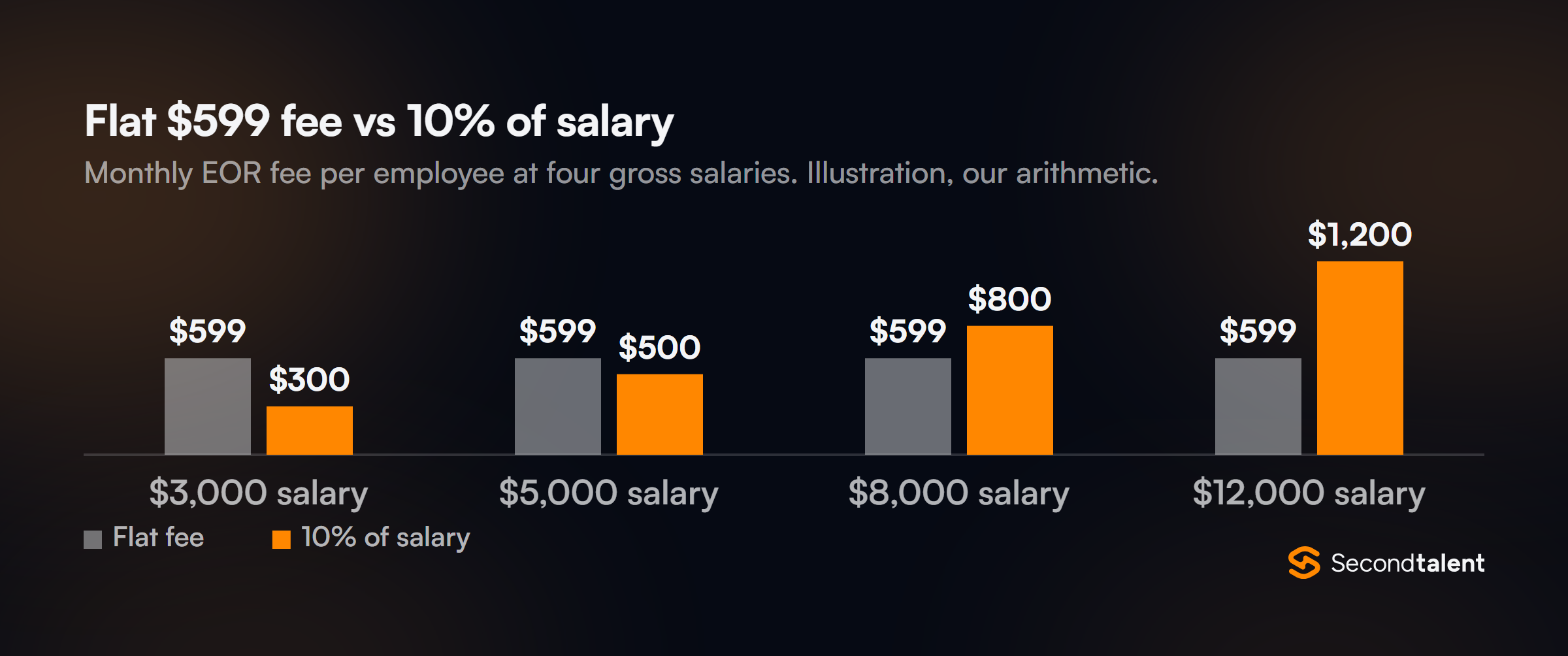
At 10%, the two models cross at a gross salary of $5,990 a month. Below that the percentage deal is cheaper; above it, every raise or promotion raises the fee too.
A $12,000 employee on a 10% contract costs $1,200 a month in fees, double the flat price.
Ask for a monthly cap on any percentage quote. The full comparison, including hybrid and custom packages, is in our guide to EOR pricing models.
What the EOR fee includes and what costs extra
The monthly fee covers the legal employment itself: a local contract, payroll, tax filings and statutory benefits administration.
Deel's FAQ lists onboarding, local compliance, payroll, benefits administration and HR and legal support as included. Deposits, currency conversion and optional benefits are where providers differ.
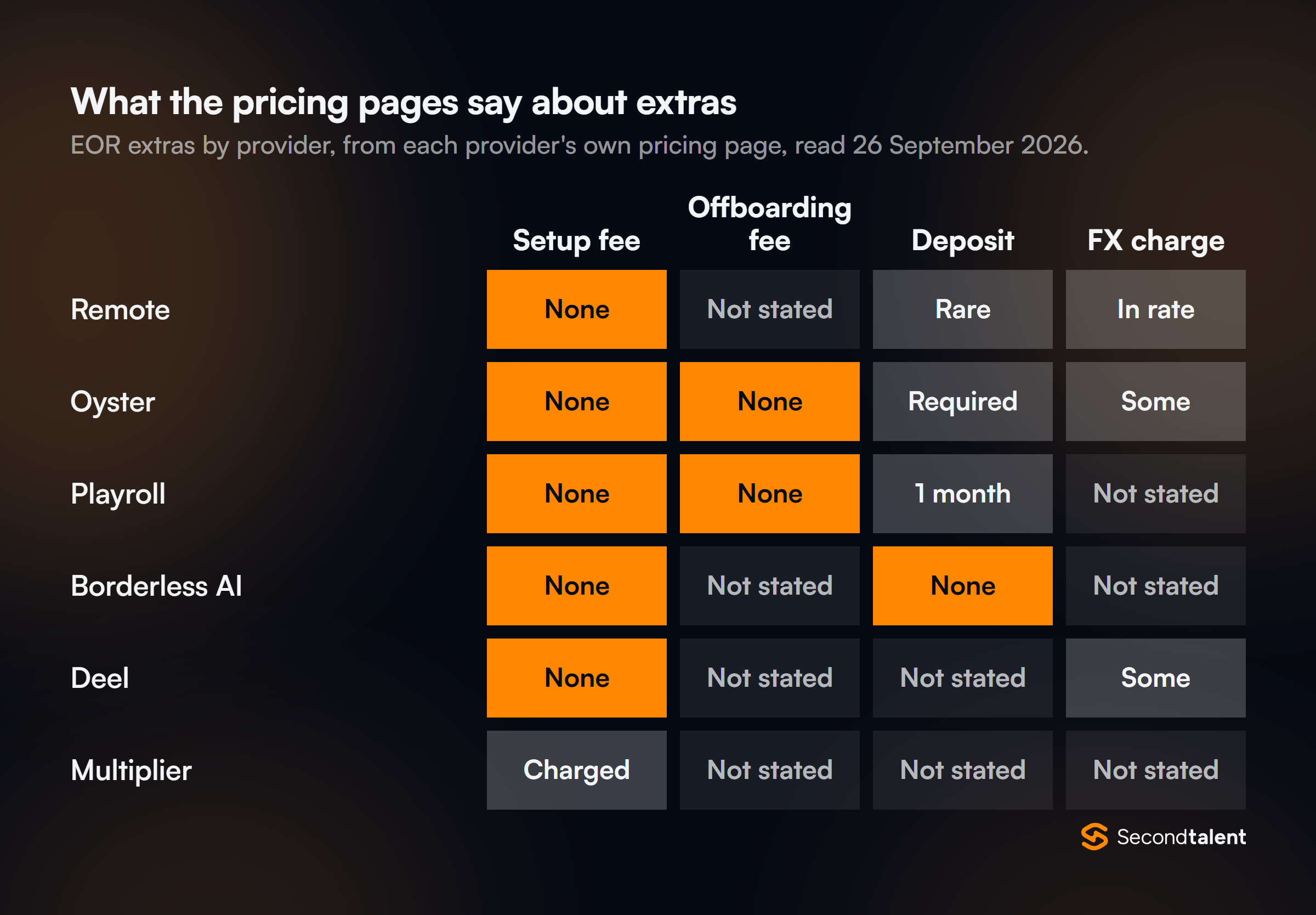
Remote collects reserve payments only "in rare, high risk circumstances" and prices currency risk into its own Remote FX rate.
Oyster requires a refundable deposit for every EOR employee and charges a conversion fee only when you pay in a currency other than the contract's. Multiplier's page adds an implementation fee "as applicable".
- Local employment contract
- Payroll runs and tax filings
- Statutory benefits administration
- Onboarding and, at Oyster and Playroll, terminations
- Salary and employer contributions, passed through at cost
- Refundable deposits (one month's salary at Playroll)
- Private health cover (RemoFirst's RemoHealth from $55 a month)
- Visa sponsorship, priced per case
Industry experts warn that these lines add up: Tarmack's guide cites currency fees of 2% to 10% per transaction and deposits of one to three months' salary at some providers.
Ask each provider for a sample invoice for one employee in your target country before you sign.
EOR cost by country
Country changes the total cost far more than it changes the fee. None of the pricing pages we read shows a higher list price for Europe; the difference comes from what the law makes the employer pay on top of salary.
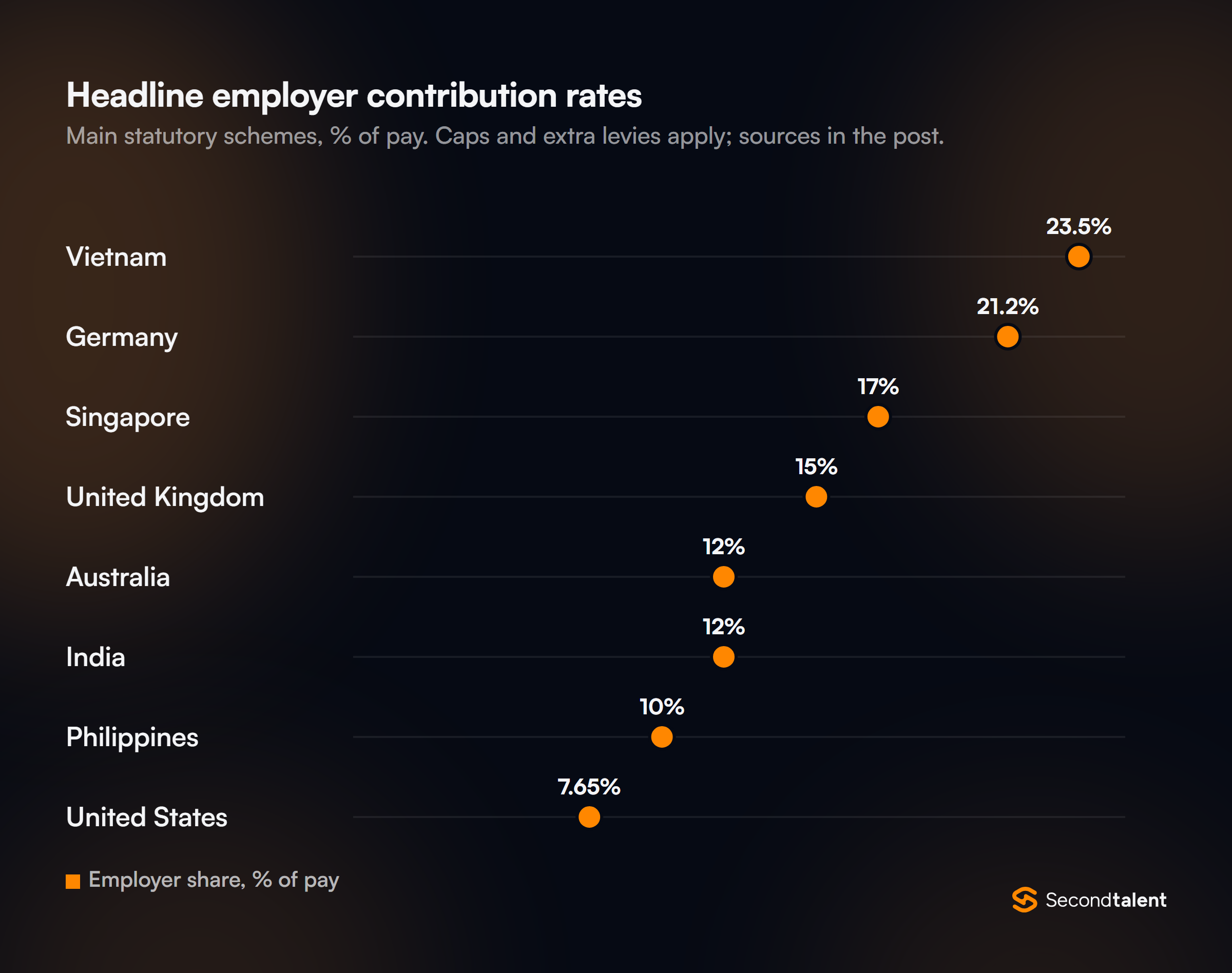
- Vietnam, 23.5%: 17.5% social, 3% health and 1% unemployment insurance per PwC's tax summary, plus a 2% trade union fee. Contributions stop at 20 times the reference level (see our Vietnam payroll guide).
- Germany, about 21.2%: our sum of the employer halves of the 2026 health, care, pension and unemployment rates SBK publishes, at the 2.9% average health add-on. Sick-pay and maternity levies come on top.
- Singapore, 17%: CPF for citizens and PRs aged 55 and under, on wages up to S$8,000 a month from January 2026. Employment Pass holders pay no CPF.
- United Kingdom, 15%: employer National Insurance on earnings above £5,000 a year in 2026-27, per GOV.UK.
- Australia, 12%: the super guarantee since 1 July 2025.
- India, 12%: the employer's provident fund contribution (PwC summary), with the 8.33% pension part capped at ₹15,000 of wages.
- Philippines, 10%: the employer's SSS share since January 2025, per KPMG, on salary credits up to PHP 35,000. PhilHealth, Pag-IBIG and 13th-month pay are extra.
- United States, 7.65%: Social Security and Medicare, per the IRS, before federal and state unemployment tax.
In Europe, the fee is the same list price and the contributions set the gap. A German employee on €5,000 a month adds about €1,060 in employer contributions at 21.2%, before levies.
A UK employee on £4,000 adds £537 of National Insurance, since the first £417 a month is exempt. Both are our arithmetic on the rates above.
Borderless AI's regional table, built on 2025 pricing data, reflects the same pattern at the fee level: $450 to $800 a month in Western Europe against $300 to $500 in Latin America. Those are Borderless AI's estimates, not list prices.
What one EOR hire costs in total
A Singapore citizen on $5,000 a month costs $6,449 through a $599 EOR: salary, $850 of CPF and the fee. The fee is 9% of that total.
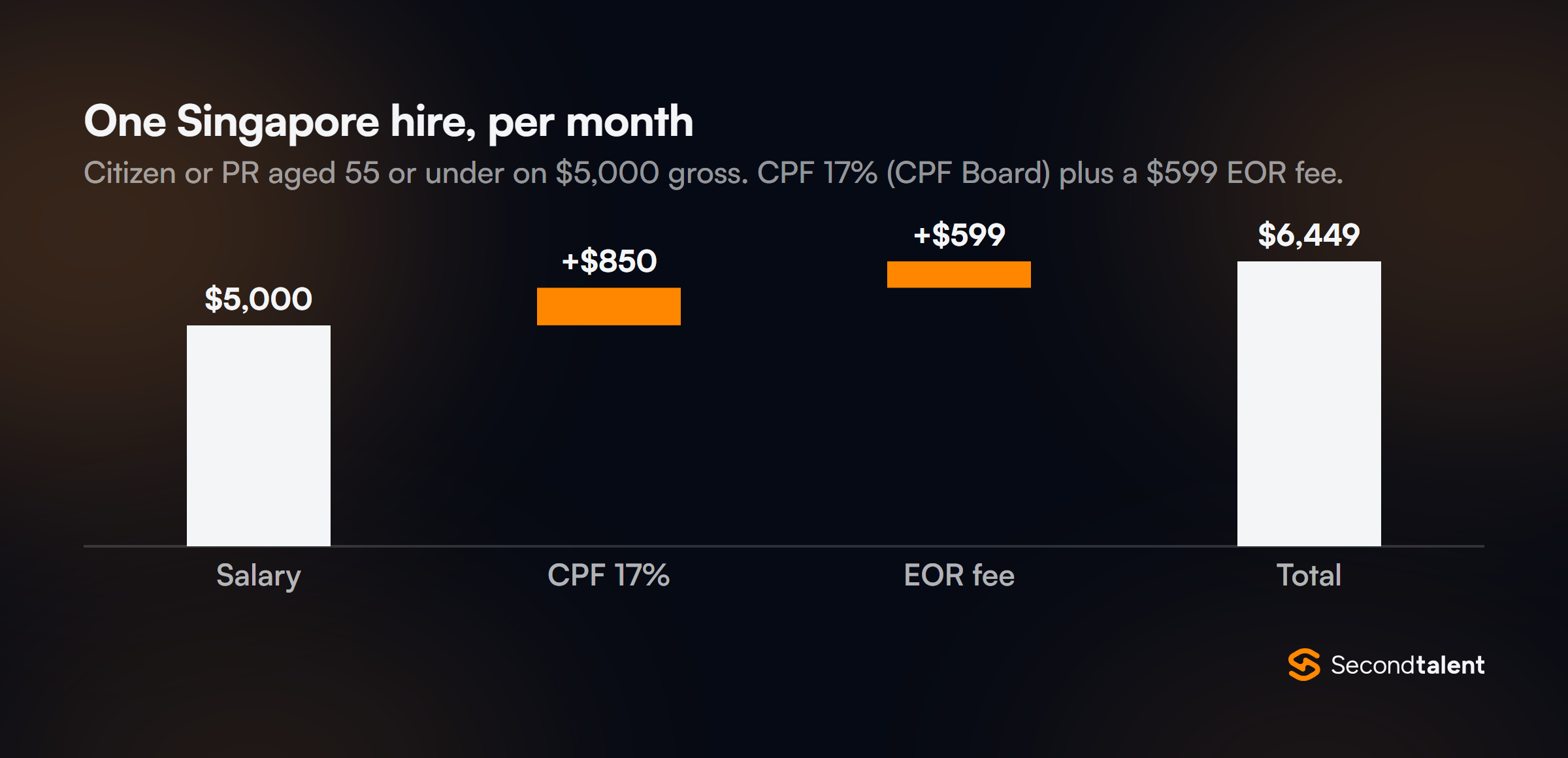
To budget 10 hires, run the same sum per country: salary, the employer rate from the list above, the fee, then one deposit per head if your provider takes one.
Our Singapore and Philippines payroll guides carry full worked examples, and the Asia EOR guide compares statutory costs across the region.
EOR vs your own entity: the break-even
An entity pays back when the EOR fees you stop paying each month exceed the entity's own running cost by enough to recover its setup. Headcount in one country decides it, not years in the market.
Finding the break-even point starts with the entity's price: RemoFirst puts initial setup at $20,000 to $150,000. Our EOR vs entity cost calculator uses $15,000 to $40,000 of setup and $1,500 to $4,500 a month of upkeep for our markets.
The chart takes the midpoints.
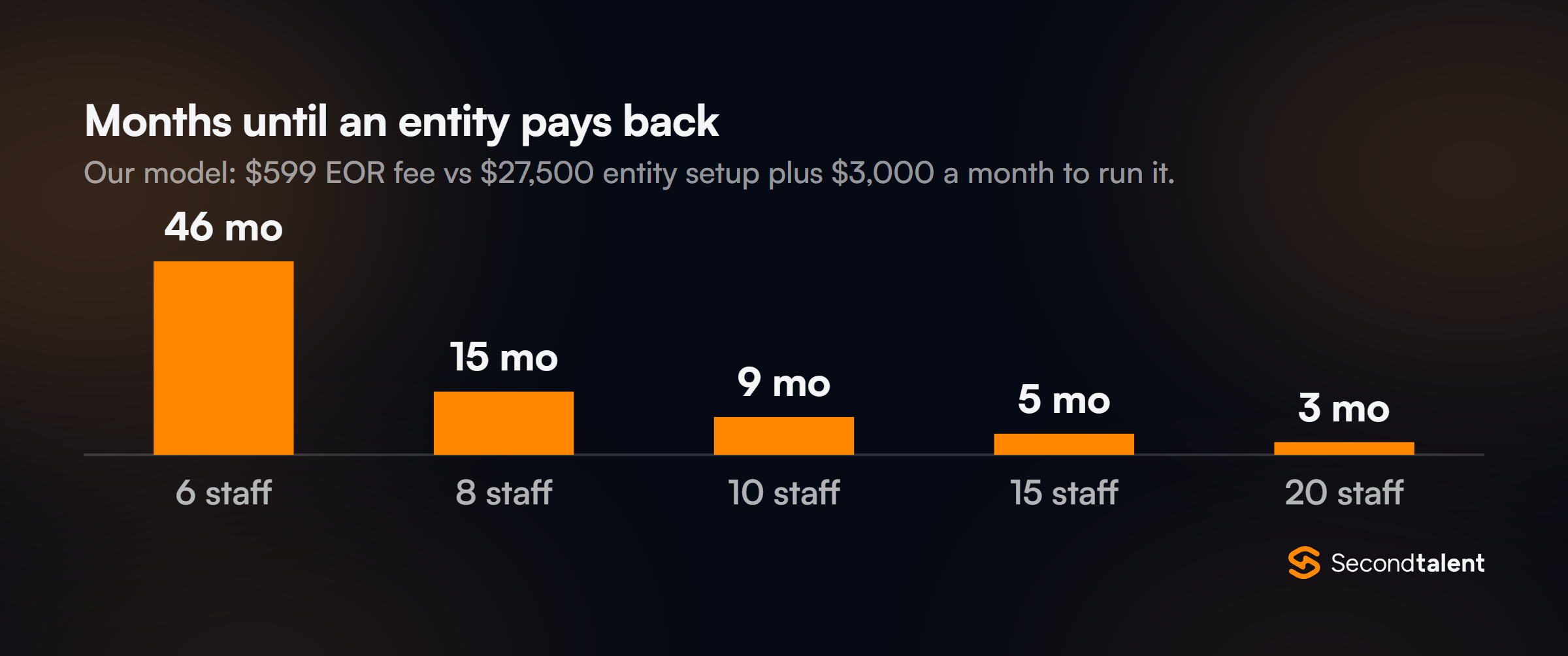
With five staff or fewer, $599 fees total less than $3,000 a month, so the entity never pays back. At six it takes 46 months; at 10, nine months.
A cheaper EOR fee pushes each of those numbers later, which is why a $599 provider and a $199 provider give different answers to the same question.
For the wider trade-off, see EOR vs PEO vs contractor management.
Second Talent EOR in Asia
Our EOR service starts from $129 per employee per month on our pricing page, with the final rate set by country, headcount and benefits scope, and the calculators model it at a flat $199.
We employ staff through our own entities in Vietnam, the Philippines, Singapore and six other Asian markets, with no upfront fees. Get an EOR quote for the country you have in mind.
FAQ
Which countries are cheapest to hire in through an EOR?
List fees do not change by country on the pages we read, so the cheapest countries are the ones with low salaries and low employer contributions.
Of the eight above, the United States and the Philippines carry the lowest headline rates, though the Philippine figure leaves out PhilHealth, Pag-IBIG and 13th-month pay.
Does the EOR fee rise when an employee gets a raise?
On a flat fee, no. On a percentage contract, yes, by the same share: a $1,000 raise adds $100 a month at 10%.
Can I negotiate EOR pricing?
G-P and Atlas HXM advertise volume pricing, and Oyster and Multiplier discount annual billing, so headcount and commitment are the levers the providers themselves name.






![How to Hire Developers in Asia Remotely. How to Hire Developers in Asia Remotely from the USA [2026], by Second Talent.](https://www.secondtalent.com/wp-content/uploads/2026/09/hire-developers-in-asia-remotely-featured-v2-768x403.jpg)