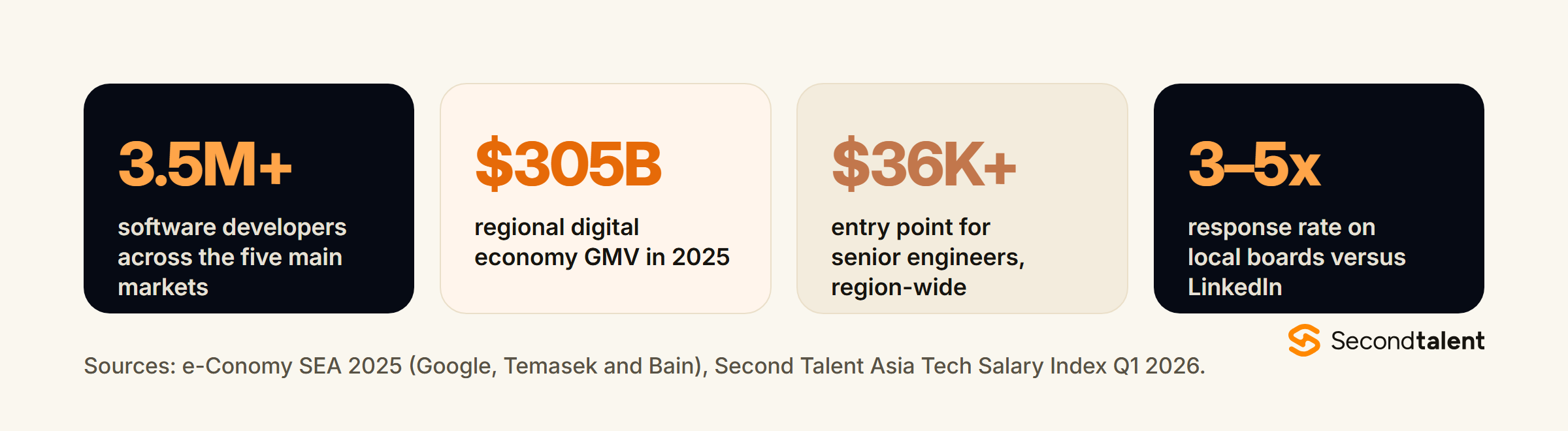
TL;DR: Southeast Asia has more than 3.5 million software developers across its five main markets, and the region’s digital economy passed $305 billion in GMV in 2025.
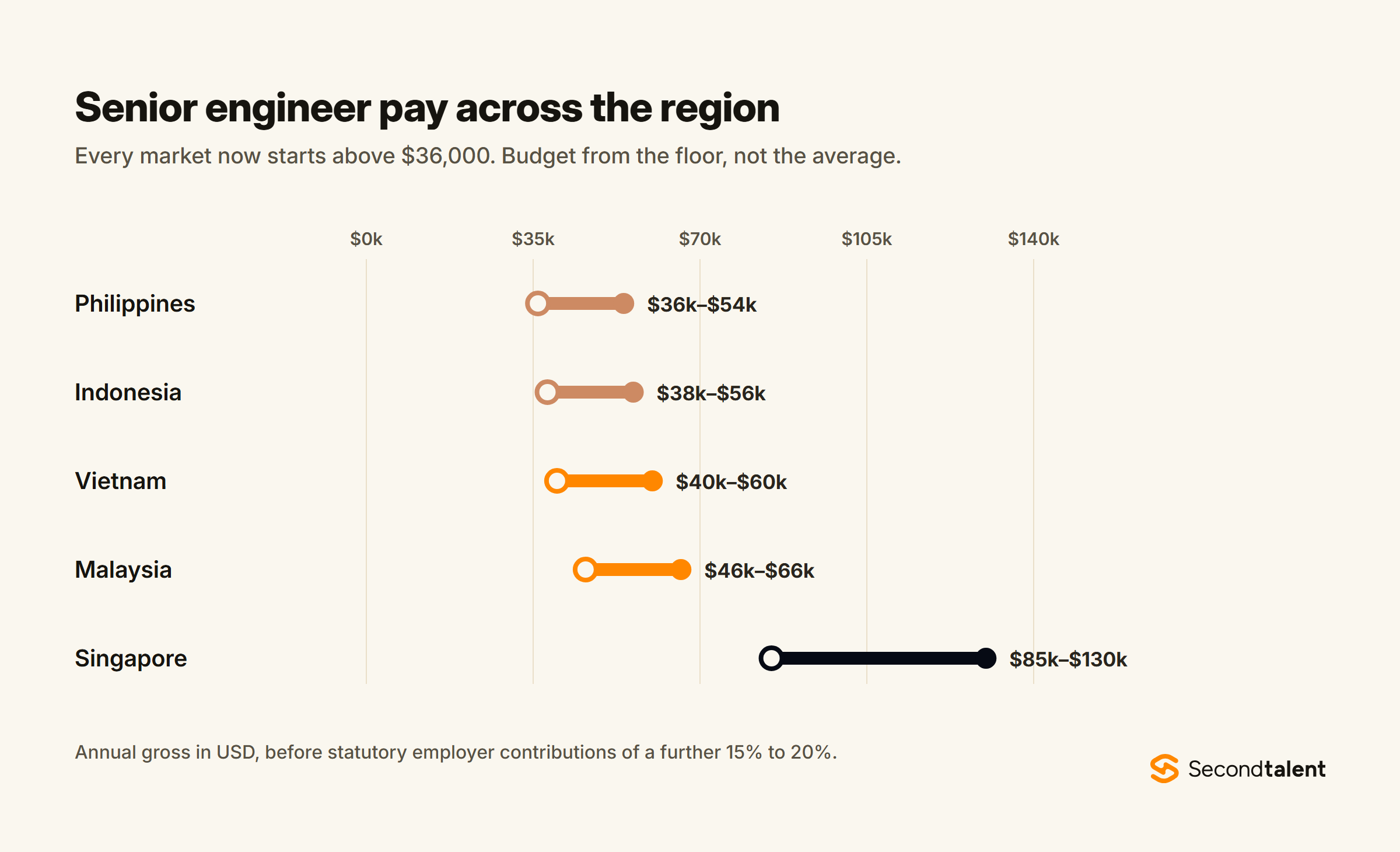
Costs still sit well below US rates, but the discount has narrowed: senior engineers now start above $36,000 a year in every market here, and statutory employer contributions add another 15% to 20% on top.
The sourcing playbook is the part that has not changed. Local job boards, local communities and a compliant employment structure beat posting on LinkedIn and hoping.
Southeast Asia has become the answer for many startups. The region produces over 200,000 computer science graduates annually according to Statista data.
Vietnam, Philippines, Indonesia, Malaysia, and Singapore combined have more than 3.5 million software developers.
But sourcing talent here is different from hiring in Western markets. The job boards are different. The interview expectations are different. Even the salary negotiation process works differently.
We have placed over 500 developers from Southeast Asia with startups in the past three years. This guide shares what actually works, updated for 2026 pay levels.
What’s your hiring priority right now?
Select your situation below.
You need developers onboarded within 2-4 weeks, not months. Our pre-vetted talent pool in Vietnam and Philippines means you skip the 6-8 week sourcing grind. We’ve placed 500+ developers with 14-day average time-to-hire. Get pre-vetted developers →
You’re evaluating where to build your team among the 3.5M+ developers across Southeast Asia. Vietnam offers 50-70% cost savings versus US rates, while Singapore provides premium talent at different price points. See exact salary ranges by country and role. View Southeast Asia salary data →
You need developers across Vietnam, Philippines, or Indonesia but don’t want to set up legal entities in each country. Our EOR service handles payroll, taxes, and compliance in 5+ Southeast Asian markets so you stay compliant from day one. Explore EOR solutions →
You’re hiring multiple roles—backend, full-stack, DevOps—across Southeast Asia’s 200,000 annual CS graduates. Our talent sourcing service builds complete engineering teams from the region’s top 3.5M developer pool with role-specific vetting. Scale with talent sourcing →
Quick Regional Comparison: Where to Focus Your Search
| Country | Developer Pool Size | Senior Dev Salary (USD/year) | English Proficiency | Time Zone (GMT) |
|---|---|---|---|---|
| Vietnam | 530,000+ | $40,000-$60,000 | Moderate | +7 |
| Philippines | 200,000+ | $36,000-$54,000 | High | +8 |
| Indonesia | 600,000+ | $38,000-$56,000 | Moderate | +7 |
| Malaysia | 150,000+ | $46,000-$66,000 | High | +8 |
| Singapore | 100,000+ | $85,000-$130,000 | High | +8 |
Data sources: Stack Overflow Developer Survey 2023, and our internal Asia Tech Salary Index. Salary bands reflect Q1 2026 placement data and are gross annual figures before employer contributions.
Understanding the Southeast Asian Developer Market
The tech talent landscape in Southeast Asia has grown steadily since 2020, and remote work adoption moved faster here than in most regions. What has changed most since then is price. The region is no longer a discount bin.
It is a mature market with its own competition for senior people.
Each country has different strengths. Vietnam excels in backend and DevOps engineering. The Philippines leads in full-stack development and has the highest English proficiency. Indonesia offers the largest pool but requires more screening.
Malaysia and Singapore attract senior talent but cost more.
Market Size and Growth Trends
Google, Temasek and Bain put Southeast Asia’s digital economy at $305 billion in gross merchandise value in 2025, with revenue around $135 billion, in the tenth edition of their e-Conomy SEA report.
That is 7.4 times the GMV of a decade earlier. Earlier McKinsey research projected the region on a path to trillion-dollar scale, and the trajectory has held.
Vietnam alone now has over 530,000 IT professionals and produces more than 57,000 IT graduates a year.
Demand has broadened with it: Go and Rust roles that barely existed in the region five years ago are now routine postings in Ho Chi Minh City and Jakarta.
We worked with a Series A fintech startup that needed five backend engineers. They tried hiring in San Francisco first. The average offer was $180,000 per engineer.
They switched to Vietnam and hired the same skill level for around $45,000 per engineer all-in. The team has been with them for two years now.
The cost difference is real, but it is narrowing and it is not the whole case. Quality matters more than price. You need to know where to look and how to evaluate candidates.
Key Technical Skills Available
Southeast Asian developers have strong foundations in:
- Backend Development: Java, Python, Node.js, Go are widely used. Vietnam has particularly strong Java and Python talent.
- Frontend Development: React, Vue.js, Angular expertise is common. Philippines developers often have good UI/UX sense.
- Mobile Development: iOS and Android native development plus React Native and Flutter. Indonesia has a large mobile dev community.
- Cloud and DevOps: AWS, GCP, Azure certifications are increasingly common. Malaysia has strong cloud engineering talent.
- Data and AI Engineering: Python, SQL, Spark and the modern data stack, increasingly alongside retrieval pipelines and LLM application work. Singapore leads, but the gap has closed sharply since 2024.
Frontier AI research talent is still concentrated in Singapore. Applied AI engineering, the work of serving models and wiring them into products, is now available across the region and priced well below Singapore levels.
Primary Sourcing Channels That Actually Work
Western job boards do not work well in Southeast Asia. LinkedIn has limited reach outside Singapore and Malaysia. Indeed and Glassdoor have minimal presence.
You need to use local platforms and communities. Here is what works based on our experience placing hundreds of remote developers.
Local Job Boards and Platforms
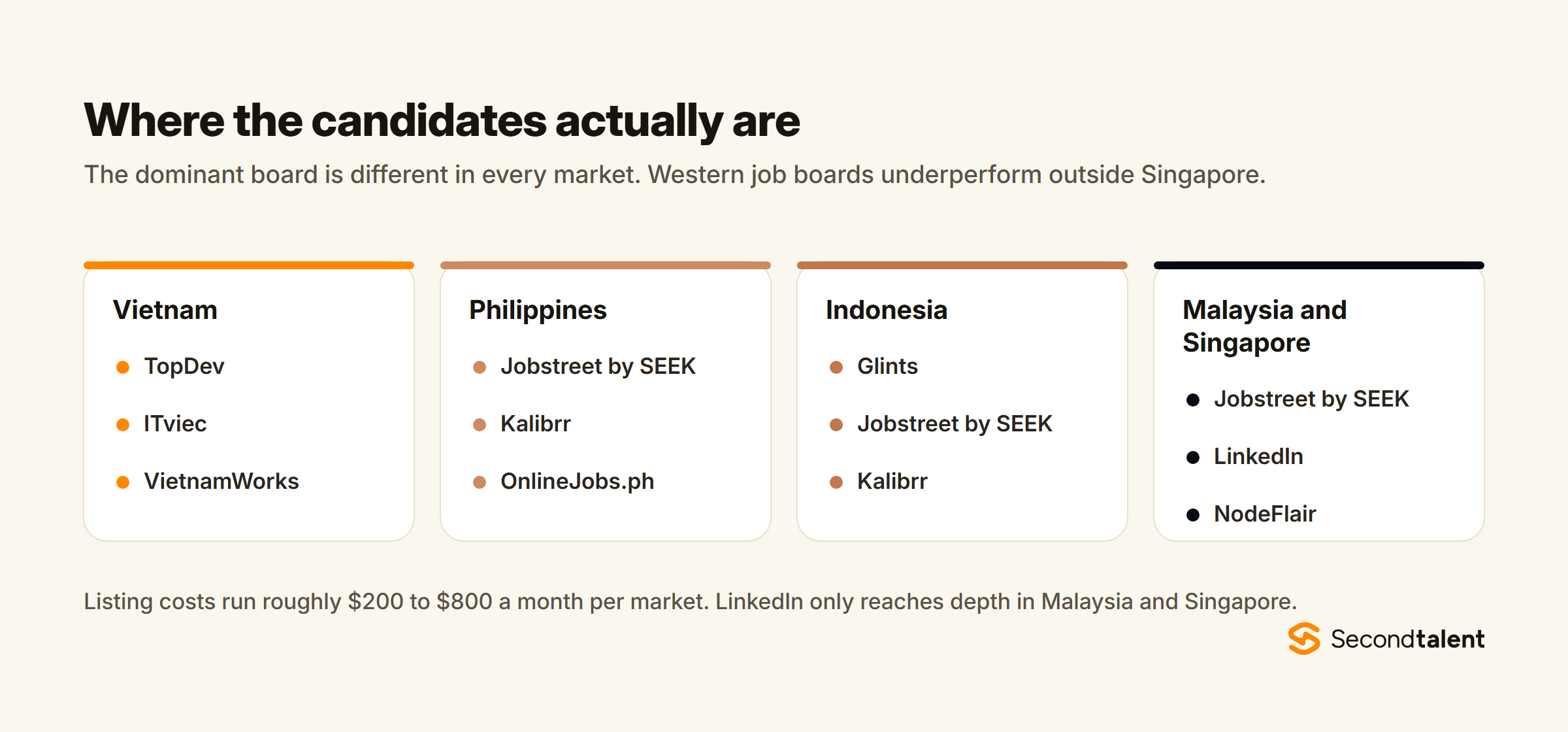
Each country has dominant job platforms. These get more qualified applicants than international sites.
One structural change worth knowing: SEEK has unified JobStreet and JobsDB onto a single platform, so listings now run under the Jobstreet by SEEK brand across most of the region.
Vietnam:
- TopDev.vn: The leading tech job board. Over 300,000 registered developers. Good for mid to senior level positions.
- ITviec.com: Focused exclusively on IT jobs. Strong candidate quality, English-friendly interface, and it publishes a useful annual Vietnam IT salary report.
- VietnamWorks: General job board but large tech section. Good for junior to mid-level developers.
Philippines:
- Jobstreet by SEEK: Largest job platform. Wide reach but requires heavy screening.
- Kalibrr: Tech-focused with skills assessments. Better candidate quality than the general boards.
- OnlineJobs.ph: Popular for remote positions. Many developers actively looking for international work.
Indonesia:
- Glints: Tech and startup focused, now operating across most of the region. Good for early to mid-career developers.
- Jobstreet by SEEK Indonesia: Large reach. Requires significant filtering.
- Kalibrr Indonesia: Similar to the Philippines version. Growing tech candidate base.
Malaysia and Singapore:
- Jobstreet by SEEK: Dominant in both markets. Better candidate quality than other countries.
- LinkedIn: Actually works well here. Most senior developers have active profiles.
- NodeFlair (Singapore): Tech-specific job board. Good for startup hiring, and its annual salary report is a useful benchmark.
Posting on these platforms costs $200-$800 per month depending on the country. Response rates are 3-5x higher than LinkedIn for most technical roles.
Tech Communities and Developer Groups
Active developers hang out in local tech communities. These channels often yield better candidates than job boards.
Facebook Groups remain surprisingly effective. Vietnam has groups like “Vietnam Silicon Valley” with 50,000+ members. Philippines has “Philippine Startup Community” and “PH Tech Jobs” groups.
Indonesia has “Tech in Asia Indonesia” and local city-based groups.
Telegram and Discord channels are growing fast. Many developers prefer them over Facebook now. Look for country-specific tech channels and programming language communities.
GitHub and Stack Overflow profiles help identify strong candidates. Search for developers in target cities who contribute to open source projects. We found three excellent backend engineers this way for a client.
Meetup.com events happen regularly in major cities. Ho Chi Minh City, Manila, Jakarta, Kuala Lumpur, and Singapore all have active tech meetups. Sponsor events or send team members to recruit directly.
University Partnerships and Bootcamps
Top universities produce strong graduates. But you need to know which schools have good CS programs.
Vietnam: HCMC University of Technology, Hanoi University of Science and Technology, FPT University
Philippines: University of the Philippines, Ateneo de Manila, De La Salle University
Indonesia: Institut Teknologi Bandung, Universitas Indonesia, Binus University
Malaysia: University of Malaya, Universiti Teknologi Malaysia
Singapore: National University of Singapore, Nanyang Technological University
Coding bootcamps are expanding. Hacktiv8 in Indonesia, Coding Dojo Philippines, and CoderSchool Vietnam produce job-ready developers in 3-6 months. Quality varies but top bootcamp grads often outperform university grads in practical skills.
We partner with several bootcamps to source junior developers. One client hired three bootcamp graduates for their full-stack team. All three are still with the company after 18 months.
Recruitment Agencies and Talent Platforms
Local recruitment agencies know their markets well. But fees are high. Expect 15-25% of annual salary for permanent placements.
International agencies charge even more. One startup paid 30% to place two senior engineers through a US-based agency. The engineers left after six months.
Vetted talent platforms offer better value. Platforms pre-screen candidates for technical skills and English ability. Fees are typically lower than traditional agencies.
We built Second Talent specifically for this.
Salary Expectations and Compensation Structure
Getting compensation right is critical. Offer too little and you will not attract good candidates. Offer too much and you create internal equity issues.
Southeast Asian developers increasingly research global salary ranges. They know what US and European companies pay.
They also know what the other companies hiring remotely into their city are paying, which is the number that actually moves offers.
Detailed Salary Benchmarks by Role and Seniority
| Role / Seniority | Vietnam (USD/year) | Philippines (USD/year) | Indonesia (USD/year) | Malaysia (USD/year) |
|---|---|---|---|---|
| Junior Backend Dev | $16,000-$24,000 | $14,000-$22,000 | $15,000-$23,000 | $18,000-$27,000 |
| Mid Backend Dev | $26,000-$42,000 | $23,000-$37,000 | $24,000-$39,000 | $30,000-$46,000 |
| Senior Backend Dev | $40,000-$60,000 | $36,000-$54,000 | $38,000-$56,000 | $46,000-$66,000 |
| Junior Frontend Dev | $15,000-$22,000 | $13,000-$20,000 | $14,000-$21,000 | $17,000-$25,000 |
| Senior Frontend Dev | $37,000-$55,000 | $36,000-$50,000 | $36,000-$52,000 | $43,000-$62,000 |
| DevOps Engineer | $40,000-$58,000 | $36,000-$52,000 | $37,000-$54,000 | $45,000-$64,000 |
| Mobile Developer | $36,000-$52,000 | $36,000-$48,000 | $36,000-$50,000 | $40,000-$58,000 |
These ranges come from our developer rate card and Q1 2026 placement data. Every senior band now opens at $36,000 or above, which is the single biggest change since this guide was first published.
Salaries in Singapore run roughly 2x the regional senior bands across all levels.
Currency fluctuations matter. The Vietnamese dong, Indonesian rupiah, and Philippine peso can swing 5-10% annually against the US dollar. Some companies pay in USD to avoid currency risk. Others pay in local currency at market rates.
Benefits and Perks That Matter
Base salary is not everything. Southeast Asian developers value certain benefits highly.
- Health Insurance: Critical in countries with limited public healthcare. Budget $60-$180 per month per employee.
- Equipment Allowance: Provide laptops and home office setup. Expect $1,800-$3,000 per developer.
- Internet Stipend: $30-$50 monthly covers high-speed internet in most locations.
- Professional Development: Course budgets of $500-$1,500 annually are highly valued, and AI tooling subscriptions now come up in almost every negotiation.
- Paid Time Off: 15-20 days is standard. Some countries have mandatory leave days.
Equity is becoming more understood. But many developers still prefer higher base salary over stock options. Explain equity value clearly if you offer it.
One client offered 0.1% equity to senior engineers. Only two out of five candidates understood the potential value. The others asked for $5,000 more in base salary instead.
Screening and Interview Process Adaptations
Your standard Silicon Valley interview process will not work well here. You need to adapt for cultural differences and practical constraints.
Resume and Portfolio Review
Southeast Asian resumes look different from Western ones. Many include photos, age, and marital status. This is normal locally.
Focus on technical details instead of resume format. Look for:
- Specific technologies used: Not just “worked with React” but “built React app with Redux, TypeScript, and Jest”
- Project scope and impact: Team size, project duration, user numbers
- GitHub or portfolio links: Active contributions show genuine interest
- English ability indicators: Technical blog posts, documentation, or open source contributions
Job hopping is common. Average tenure is 1-2 years according to Forbes research. Do not automatically reject candidates with multiple short stints. Ask about reasons for leaving.
Technical Assessment Best Practices
Take-home assignments work better than live coding. Time zone differences make scheduling hard. Many candidates have day jobs and need flexibility.
Keep assignments realistic. One client gave a 10-hour coding challenge. Completion rate was 30%. They reduced it to 3 hours and completion jumped to 75%.
Decide your AI policy before you send the assignment, and say it out loud. Most candidates now use coding assistants by default. Banning them quietly just selects for people who hide it.
A better approach is to allow the tools and then ask the candidate to walk through the code line by line in a follow-up call, which surfaces understanding far faster than a clean diff does.
Provide clear instructions in simple English. Avoid idioms and complex sentences. One candidate spent two hours confused by “make it pop” in design feedback.
Test practical skills over algorithm puzzles. LeetCode-style questions are less common in Southeast Asian tech interviews. Focus on real-world scenarios instead.
We use project-based assessments. Candidates build a small feature similar to actual work. This shows coding style, testing approach, and documentation skills.
Cultural Considerations in Interviews
Communication styles differ across the region. Filipino candidates are typically more outspoken. Vietnamese and Indonesian candidates may be more reserved initially.
Direct confrontation is avoided in many Southeast Asian cultures. A candidate saying “maybe” or “I will try” might actually mean “no” or “I cannot do this.”
Ask specific questions to get clear answers. Instead of “Can you do this?” ask “Have you done this before? What was the result?”
Hierarchy matters. Junior developers may hesitate to disagree with senior interviewers. Create a comfortable environment. One client starts every interview saying “We want your honest opinions. There are no wrong answers.”
English proficiency varies. Philippines has the highest English fluency. Vietnam and Indonesia require more patience. Speak slowly and avoid complex vocabulary.
We recorded interview feedback from 200+ hiring managers. The biggest complaint was “I could not understand their accent.” The second biggest was “They seemed to agree with everything I said.”
Both are cultural adaptation issues, not technical problems.
Legal and Compliance Requirements
Hiring across borders creates legal complexity. Each country has different employment laws.
Employment Structures and Entity Requirements
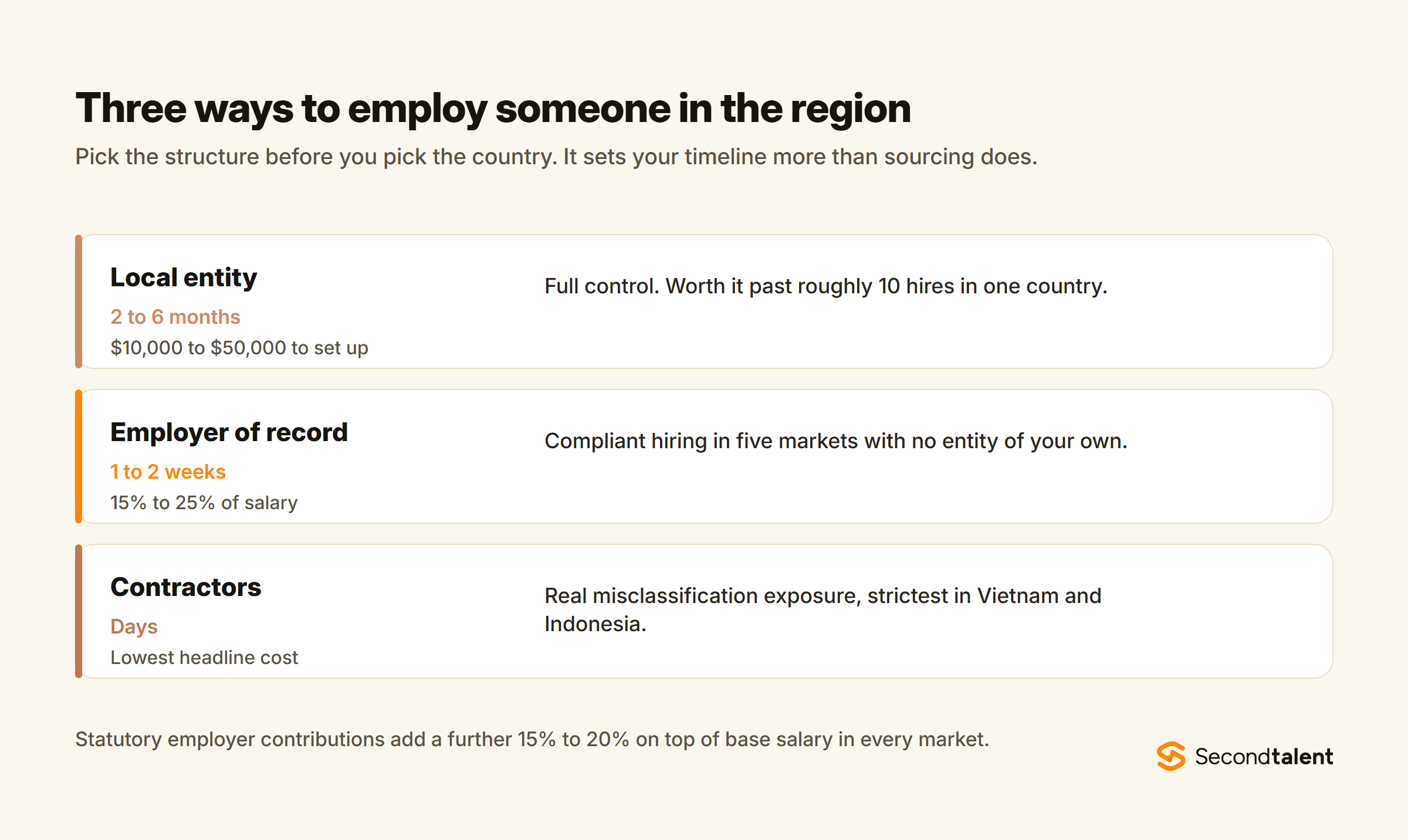
You have three main options for hiring in Southeast Asia:
Option 1: Establish a local entity. This gives you full control but takes 2-6 months and costs $10,000-$50,000 depending on the country. Ongoing compliance requires local accounting and legal support.
One Series A startup spent $35,000 and four months setting up a Vietnam entity. They hired 12 developers in the first year. The entity setup made sense for them.
Option 2: Use an Employer of Record (EOR). The EOR becomes the legal employer. You manage the work. Setup takes 1-2 weeks. Costs are typically 15-25% of salary.
Our EOR service handles all compliance, payroll, and benefits administration. Companies can hire in Vietnam, Philippines, Indonesia, Malaysia, and Singapore without local entities.
Option 3: Hire contractors. Fastest and cheapest option. But misclassification risk is high. Many countries crack down on fake contractor relationships.
Indonesia and Vietnam are particularly strict. If contractors work exclusively for you and follow your schedule, authorities may reclassify them as employees. Penalties can be severe.
Mandatory Benefits and Statutory Requirements
Each country requires different benefits. Non-compliance can result in fines or legal issues.
Vietnam: Social insurance (17.5% employer contribution), health insurance (3% employer), unemployment insurance (1% employer). 13th month salary is customary but not legally required.
Philippines: SSS (social security), PhilHealth (health insurance), Pag-IBIG (housing fund). Total employer contribution is approximately 12-13% of salary. 13th month pay is mandatory.
Indonesia: BPJS Kesehatan (health insurance, 4% employer), BPJS Ketenagakerjaan (employment insurance, 6.24% employer). Religious holiday allowance (THR) is mandatory, typically one month salary.
Malaysia: EPF (pension fund, 12-13% employer), SOCSO (social security, 1.75% employer), EIS (employment insurance, 0.2% employer).
These contributions add 15-20% to base salary costs. On a $40,000 senior engineer that is another $6,000 to $8,000 a year. Factor it into your budget before you quote a range to a candidate.
Intellectual Property and Data Protection
IP ownership must be explicit in contracts. Default laws vary by country. Some countries give employees ownership of work created outside office hours.
Include clear IP assignment clauses. Specify that all work product belongs to the company. Have contracts reviewed by local lawyers.
Data protection regulations have tightened. Singapore has the Personal Data Protection Act (PDPA), Indonesia’s PDP Law is now in force with its own transfer rules, and Vietnam and the Philippines both have active regimes.
Ensure compliance if you handle user data, and check transfer requirements before you route production data to an offshore team.
One US client got fined for transferring Philippine customer data without proper consent. The fine was small but the reputational damage hurt.
Building Effective Remote Teams Across Time Zones
Southeast Asia spans GMT+7 to GMT+8. This creates overlap challenges with US teams but works well for European and Australian companies.
Time Zone Management Strategies
US West Coast companies have 15-16 hour time difference with Southeast Asia. US East Coast has 12-13 hours difference.
We worked with a San Francisco startup that tried 9am PT standups. That meant 1am Vietnam time. Attendance was poor and engineers were exhausted.
They switched to async standups via Slack. Each engineer posted updates when starting their day. The US team read updates in their morning. Team satisfaction jumped.
Schedule synchronous meetings during overlap hours. For US-Vietnam teams, that is 8-10pm Vietnam time or 8-10am US East Coast time. Rotate meeting times if possible so the burden is shared.
Document everything. Async communication requires better documentation. Use Notion, Confluence, or similar tools. Record important meetings for those who cannot attend.
Communication Tools and Practices
Slack or Microsoft Teams for daily communication. Video quality matters more than you think. Poor connections are common in some areas. Use audio-only when video lags.
GitHub or GitLab for code collaboration. Clear PR descriptions and comments become critical when teams work async. One client requires all PRs to have a summary, testing steps, and screenshots.
Loom for async video updates. Engineers can record screen walkthroughs instead of writing long explanations. This works especially well for complex technical discussions.
Establish response time expectations. One company has a “respond within 24 hours” rule for all messages. This prevents people from feeling ignored during off-hours.
Onboarding Remote Southeast Asian Developers
First impressions matter. A strong onboarding process improves retention significantly.
Send equipment before day one. Laptops should arrive 3-5 days early so developers can set up. Include a welcome package with company swag, like custom mugs, hoodies, shirts, and other gifts.
Create a detailed onboarding checklist. Cover technical setup, access to tools, team introductions, and first week tasks. One client has a 30-60-90 day plan for every new hire.
Assign an onboarding buddy. Pair new hires with experienced team members. The buddy answers questions and helps with cultural adaptation. This reduced early turnover by 40% for one of our clients.
Schedule regular check-ins during the first month. Weekly 1-on-1s help identify issues early. Many problems can be solved if caught quickly.
Retention Strategies for Southeast Asian Engineering Teams
Hiring is expensive. Retention is cheaper. Average cost to replace a developer is 6-9 months of salary according to Gartner research.
Career Development and Growth Paths
Southeast Asian developers want clear career progression. Create defined levels with specific requirements for promotion.
Offer learning budgets. Pay for courses, conferences, and certifications. We see retention improve 25-30% when companies invest in development.
One client gives every engineer $1,000 annually for learning. They can use it for Udemy courses, conference tickets, or books. Engineers appreciate the investment.
Provide mentorship from senior engineers. Many developers in the region lack exposure to experienced mentors. Your senior engineers can fill this gap.
Create technical leadership tracks. Not everyone wants to be a manager. Offer principal engineer or architect paths for strong individual contributors.
Competitive Compensation Reviews
Review salaries annually at minimum. Tech salaries in Southeast Asia are rising 10-15% yearly in hot markets like Vietnam and Indonesia, and faster than that for anyone with credible AI or platform experience.
One startup didn’t adjust salaries for two years. They lost three senior engineers in one month. All three got 30-40% raises at new companies.
Benchmark against local and international rates. Your developers know what other companies pay. Be transparent about your compensation philosophy.
Consider annual bonuses tied to company performance. Many Southeast Asian companies give 1-2 month bonuses. This helps with retention and motivation.
Building Company Culture Remotely
Remote work makes culture harder but not impossible. Intentional effort is required.
Host virtual team events. Game nights, coffee chats, or show-and-tell sessions build connections. One company does monthly “demo days” where anyone can show personal projects.
Visit teams in person when possible. Annual or bi-annual trips to Southeast Asia strengthen relationships. Budget $3,000-$5,000 per trip including flights and accommodation.
Celebrate local holidays. Acknowledge Lunar New Year, Eid al-Fitr, and other regional holidays. Small gestures show respect for different cultures.
Create channels for non-work chat. One client has Slack channels for gaming, cooking, and pets. These informal spaces help team bonding.
Conclusion
Sourcing engineering talent in Southeast Asia requires a different approach than Western markets. But the opportunity is significant.
Start with one country. Vietnam or Philippines are good first choices. Test your processes with 1-2 hires before scaling.
Use local job boards and communities. International platforms have limited reach. Go where developers actually spend time.
Budget from the current floor, not from a 2023 spreadsheet. Senior engineers open above $36,000 across the region now, and statutory contributions add 15-20% on top of whatever you agree.
Adapt your interview process. Simple English, practical assessments, a stated AI policy, and cultural awareness all improve candidate experience.
Choose the right employment structure. EOR services offer the fastest path to compliant hiring without local entities.
Invest in onboarding and retention. The real cost is not hiring but replacing people who leave.
We have helped over 200 startups build engineering teams in Southeast Asia. The companies that succeed follow these principles consistently.
Hire vetted remote developers from Vietnam, Philippines, Indonesia, and Malaysia with Second Talent to build your engineering team 40-60% faster at lower cost without compromising quality.