TL;DR: The unsupervised take-home test stopped measuring developer quality once 97% of developers started coding with an AI assistant. Verify identity first, then score judgement over output: how the candidate routes work, what they check before shipping, and how they write when nobody is on the call. Finish with a paid trial, which is the one signal AI cannot fake for you.
Remote developer hiring broke in a specific way over the last 18 months. Gartner now projects that one in four candidate profiles worldwide will be fake by 2028, and 97% of developers already code with an AI assistant. About 8% of applicants clear our full screen, and the stage that eliminates most of them is no longer the coding test.
We worked with a Series A startup that hired three remote developers in two months. One stayed past 90 days. Their evaluation process was fine for 2021 and useless by the time they ran it.
| Evaluation Method | What It Measured in 2021 | What It Measures in 2026 | What to Do Instead |
|---|---|---|---|
| Unsupervised take-home | Coding ability | Prompting ability, or nothing | Keep it, then defend it in a live walkthrough |
| Algorithm puzzle | Raw problem-solving | Whether they memorised the pattern | A task from your real backlog |
| Polished README | Written communication | Access to a chat model | Live written answers under observation |
| Resume and profile | Work history | Little, until identity is verified | ID check plus a live camera-on session |
| Paid trial project | Real performance | Real performance | Keep it, and weight it heavily |
What’s your biggest hiring challenge?
Select your situation below.
AI-written applications have pushed volume up and signal down. Our sourcing team runs the identity check, the live technical screen and the reference calls before you see anyone, so your first conversation is with a candidate who already passed. Access pre-vetted developers →
Vietnam and the Philippines field senior full-stack developers well below Western rates, and AI fluency there is table stakes rather than a premium. Compare Vietnam rates →
Our EOR service handles contracts, payroll, IP assignment and compliance across ten APAC markets, so you hire in days instead of spending months on a subsidiary. Get EOR pricing →
Every candidate we present has passed an identity check, a live coding session with AI tools enabled, and reference calls. Paid trial projects are standard, not an upsell. See our vetting process →
What AI Changed About Evaluating Developers Remotely
AI assistance collapsed the gap between a strong developer and a weak one on any unsupervised written task. That covers the take-home project, the README, the cover letter and most of what a resume claims.
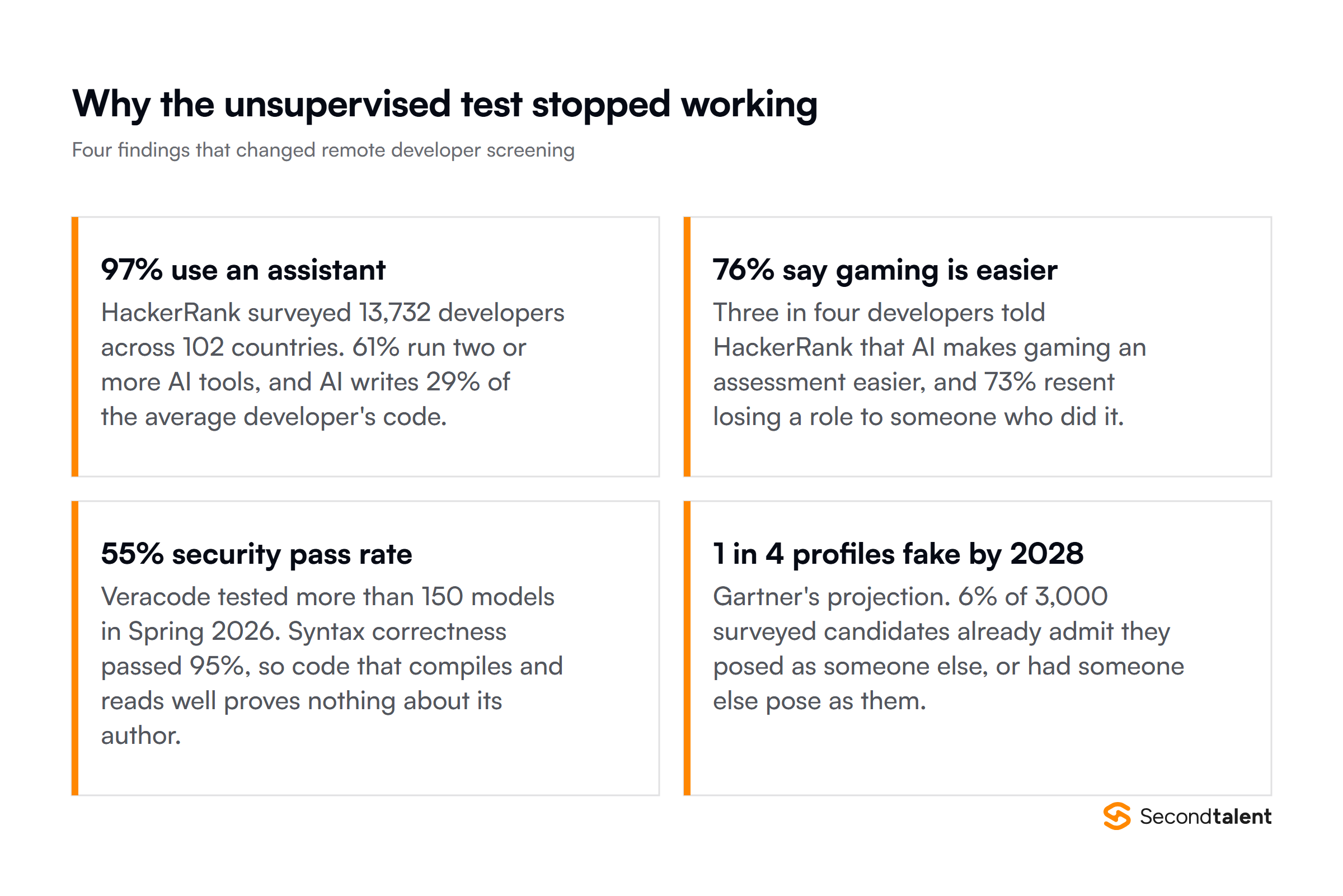
HackerRank surveyed 13,732 developers, managers and recruiters across 102 countries for its 2025 Developer Skills Report. It found 97% using at least one AI assistant and 61% using two or more. AI writes 29% of the average developer’s code, and 15% of respondents said it writes more than half of theirs.
The hiring consequence sits in the same report: 76% say AI makes gaming an assessment easier, and 73% think it is unfair to lose a role to someone who used AI to game the test. Your candidates already know what a take-home measures now. Many of them resent it.
Which Signals Survived and Which Died
Any signal a model can produce alone is now worthless, and any signal that requires the candidate to defend a decision in real time got more valuable. That single rule reorganises the whole process.
Clean syntax died first. Veracode’s Spring 2026 testing of more than 150 models found syntax correctness above 95% while the security pass rate sat at 55%, so a submission that compiles and reads well tells you almost nothing about the person who sent it.
Developers know this. In Stack Overflow’s 2025 survey, 66% named “AI solutions that are almost right, but not quite” as their biggest frustration and 45.2% said debugging generated code costs more time than writing it themselves would have. Reviewing that kind of code is now a core skill, and you can test for it.
Judgement under observation survived: why this data structure, what breaks at 10x load, which part of your own submission you would rewrite. Our guide to spotting AI-native against traditional engineers covers the interview questions that get at this.
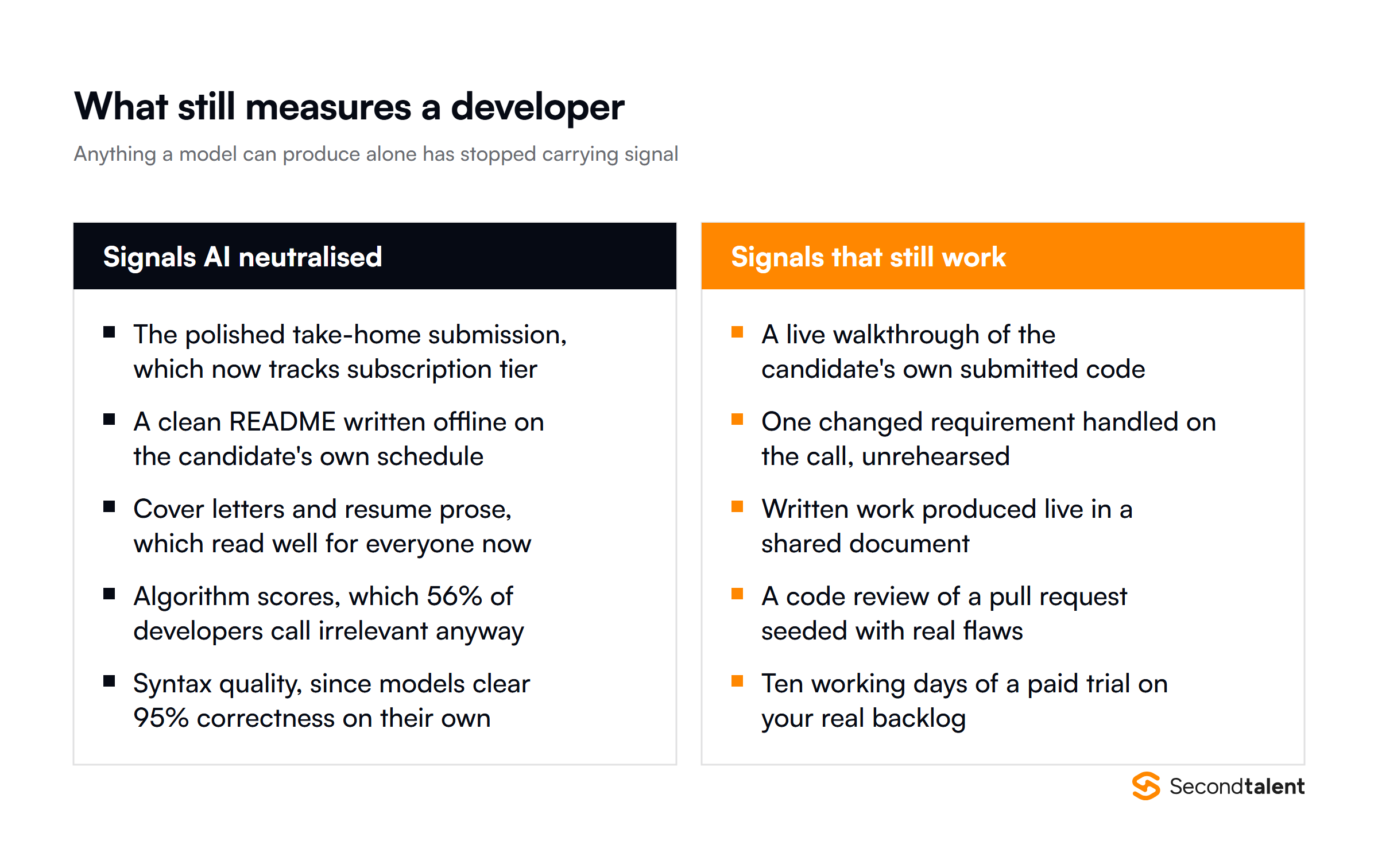
Key insight: Keep the take-home, and stop grading the artefact. Grade the 20-minute live walkthrough of it. A candidate who cannot explain their own submission has told you everything you needed to know, and it costs you 20 minutes to find out.
Verifying Who You Are Actually Hiring
Identity verification comes before every technical stage now. In the Gartner research behind the 2028 projection, 6% of 3,000 surveyed candidates admitted to interview fraud, meaning they either posed as someone else or had someone else pose as them.
The same survey found only 50% of candidates believed the jobs they applied to were real, and 62% said they were more likely to apply when a role included in-person interviews. Trust is low in both directions, and saying out loud that you verify identity reassures the honest majority rather than offending them.
A Verification Sequence That Takes 15 Minutes
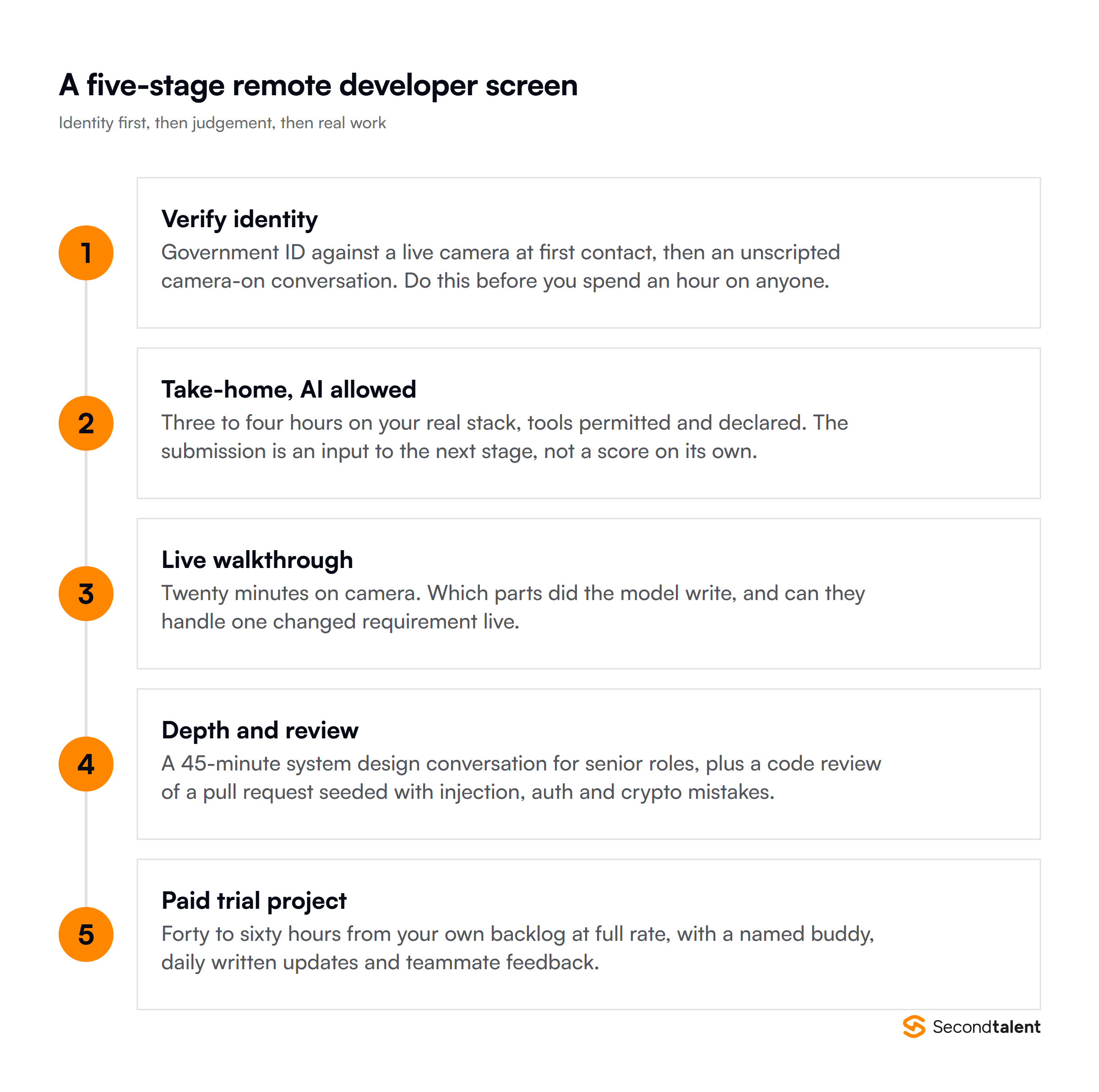
- Government ID against a live camera: Name on the ID, name on the contract and face on the call all match. Do this at first contact, not at offer stage.
- Unscripted camera-on conversation: Ask for a hand wave across the face or a turn of the head. Real-time face filters still break on occlusion and fast motion.
- Payment and residence consistency: A candidate in one country invoicing through a third has a reason, and you want to hear it before the contract.
- References you sourced yourself: Find the former manager on LinkedIn rather than calling the number the candidate supplied.
- Public work that predates the application: A GitHub history with three years of ordinary commits is hard to fabricate. A profile created last quarter is not.
An Employer of Record handles most of this as a byproduct of onboarding, since payroll and tax registration force real identity documents into the process. That is a quieter benefit of EOR hiring than the compliance one, and often the more useful.
Stage One: Technical Baseline Screening
Skip the algorithm puzzles and test the work. HackerRank’s respondents agree: 66% want evaluation on real-world skills, and 56% find algorithm-based questions irrelevant to their jobs.
We give candidates a small feature from the client’s actual stack. One client needed a React developer for their SaaS dashboard, so candidates built a data table with sorting and filters. Three to four hours, AI tools allowed and declared.
Then comes the part that does the actual screening. Twenty minutes, camera on, walking through their own code.
- Allow AI, and say so: Banning it tests a workflow nobody uses after they join, and 73% of developers already resent competing against people who ignore the ban.
- Ask what they generated: Strong candidates name the parts immediately. Vagueness here is the signal.
- Change one requirement live: Ask them to handle a new edge case on the call. Ten minutes of this outranks the whole submission.
- Use your real stack: Same languages and frameworks as the product they will work on.
- Read the commit history: One giant commit at the deadline reads differently from a dozen incremental ones.
Stage Two: Async Communication Assessment
Remote work lives or dies on written communication, and a chat model writes better prose than most engineers. So test writing where the model cannot help: live, in a shared document, on a topic only they know.
We ask candidates to write a short decision log during the walkthrough call, explaining one architecture tradeoff from their own submission. Ten minutes, screen shared. The quality gap between candidates is enormous and it appears within the first paragraph.
- Write live, not offline: The offline README now measures model access rather than clarity.
- Check response time to ambiguity: Send a deliberately incomplete requirement and see whether they ask or guess.
- Look for the non-technical register: Can they explain the tradeoff to a founder who does not code?
- Give feedback and watch: How someone takes a correction in writing predicts how code review will go.
Technical Depth Evaluation Methods
Depth shows up in system design and debugging, and neither survives long in a chat window. Test both live.
We worked with a fintech startup that hired a senior backend engineer who passed every coding test and then struggled with database optimisation and API design. The refactor of their payment processing cost three months. Senior skills need testing separately from junior ones.
System Design for Senior Roles
Give senior candidates a real problem from your roadmap and let them design it in conversation. We use a 45-minute live session rather than the recorded video we used to accept, for the obvious reason.
Push back once during the session. Change a constraint, double the traffic assumption, remove a dependency. A candidate who adapts is thinking. A candidate who restates the original design is reciting.
- Scalability thinking: Do they ask about load and growth before drawing boxes
- Tradeoff awareness: Can they argue the case against their own choice
- Database choices: Do they pick a data store for a stated reason
- Failure modes: What happens when the third-party API is down
- Security basics: Auth, secrets and data protection raised without prompting
Code Review Simulation
Code review is the highest-value exercise left in remote screening, and it got more important as generated code entered every codebase. Hand candidates a pull request seeded with real problems and watch them work.
Seed it the way a model fails. Veracode’s language split is a good template: an injection risk, a weak cipher, a missing auth check. Those are the categories where 45% of generated samples fall down, and a reviewer who walks past all three will walk past them in production too.
Tone matters alongside accuracy. One candidate we assessed found every bug and delivered the feedback like a prosecution. Another found fewer and left comments a teammate could act on. The client hired the second one and did not regret it.
Evaluating Soft Skills for Remote Success
Technical skills get developers hired and soft skills keep them productive. Remote work raises the weight on self-management and proactive communication because nobody is going to notice a quiet developer drifting for a week.
We track retention for developers we place. Those who scored well on communication in screening stay noticeably longer, which is why communication now carries more scorecard weight than it did in 2021.
| Soft Skill | How to Test | Red Flags | Green Flags |
|---|---|---|---|
| Self-management | Ask about daily routine and tools | Vague answers, no system | Specific schedule, named tools |
| Proactive communication | Give a deliberately unclear requirement | Builds the wrong thing silently | Asks clarifying questions early |
| Timezone flexibility | Discuss overlap windows | Rigid about hours | Offers a workable window |
| Problem-solving | Present a blocker scenario | Waits to be unblocked | Tries two things, then asks |
| AI judgement | Ask what they keep away from AI | Uses it for everything | Names a real boundary |
Testing Timezone Compatibility
Aim for at least four hours of overlap. Below that, every clarification costs a day and the developer starts guessing instead of asking.
We helped a US startup hire developers from Vietnam. The 12-hour gap looked fatal until candidates working 2pm to 10pm Vietnam time produced four clean hours against US mornings. Our guide to Asia and Europe overlap hours maps the workable windows market by market.
Ask directly about preferred hours and past distributed-team experience. Flexibility a candidate offers unprompted is worth more than flexibility you had to negotiate.
The Paid Trial Project Approach
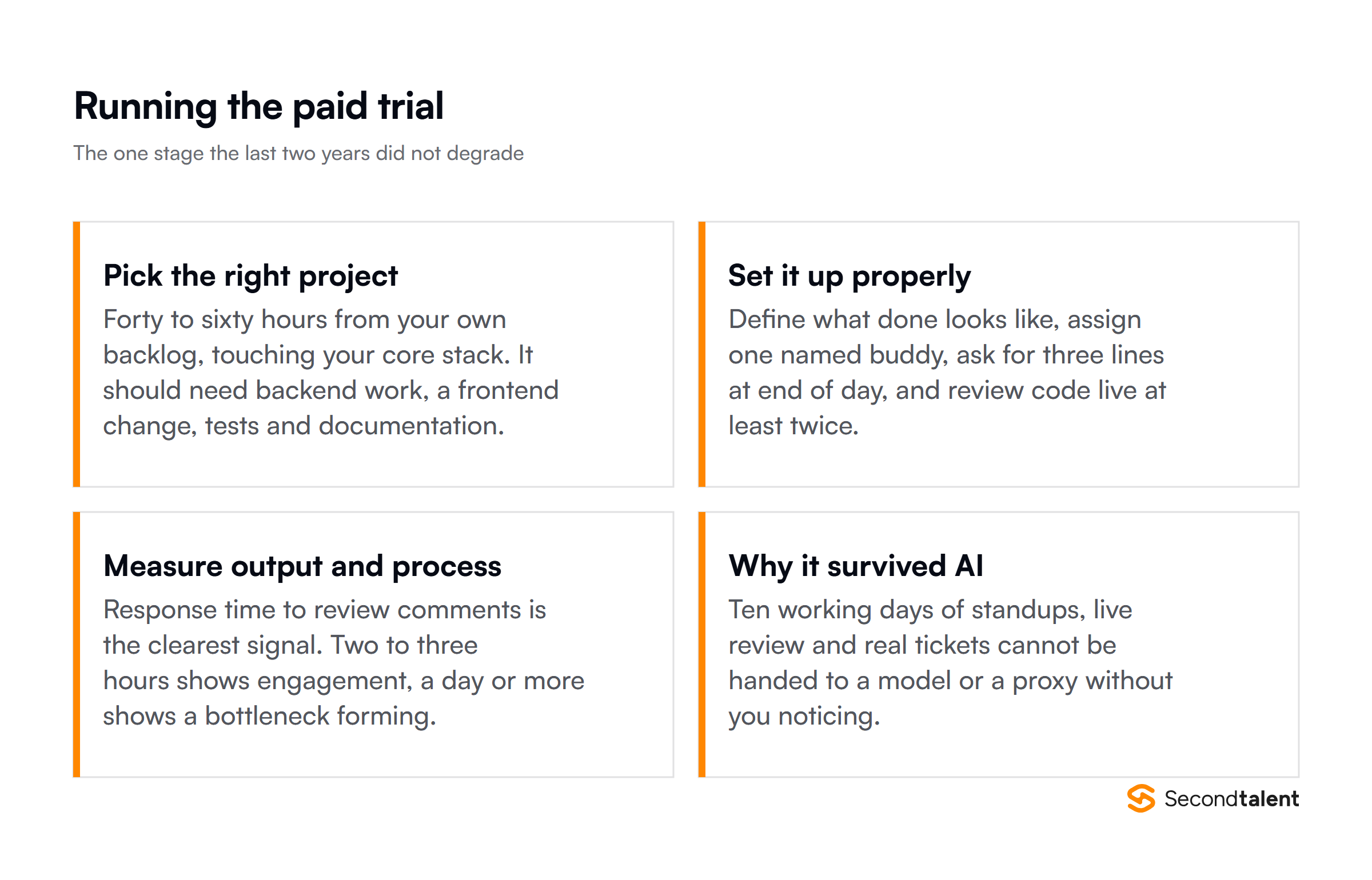
The paid trial is the one stage AI did not degrade, and that makes it the most valuable part of the process now. Two weeks of real work on real tickets cannot be outsourced to a model or a proxy without you noticing.
Use a genuine project from your backlog and pay the full rate. A fake exercise gets fake effort, and an unpaid one filters out exactly the senior candidates you want.
Trials also settle the identity question for good. Someone who shows up on standups for ten working days, answers in their own voice and responds to review comments in real time is who they said they were.
Structuring Effective Trial Projects
Pick something that takes 40 to 60 hours, touches your core stack and needs collaboration. One client’s trial required backend work, a frontend change, tests and documentation, which is enough surface area to see how somebody actually operates.
That trial surfaced what interviews had missed. One developer wrote good code and never asked a question. Another asked so often that the buddy lost half a week. Neither pattern shows up in a 45-minute call.
- Set clear deliverables: Define what done looks like before day one
- Assign a buddy: Give them one named person to ask
- Ask for daily written updates: Three lines at end of day, which doubles as a communication sample
- Review code live at least twice: Screen shared, questions asked
- Collect teammate feedback: The buddy’s opinion is the single best predictor you will get
What to Measure During Trials
Track process alongside output. Response time to code review comments is the clearest single metric we have: two to three hours signals engagement, and a day or more signals a bottleneck forming.
Measure how much unblocking they need. Seniors should clear most obstacles alone. Juniors need help and should be asking good questions when they ask.
Watch what happens when generated code fails a test. Whether the candidate reads the failure or reprompts the model until it goes green tells you which kind of developer you are hiring.
Reference Checks and Portfolio Review
Source your own references and ask remote-specific questions. A number the candidate supplied verifies nothing when 6% of them admit to interview fraud outright.
Public work still helps if you read it correctly. Commit history, pull request descriptions and issue discussions show work habits, and a profile with years of unremarkable activity is far more convincing than a polished one created recently.
Questions for Remote References
- Identity confirmation: Describe the person you worked with, and how often you saw them on camera
- Timezone management: How did they handle the overlap with your team
- Communication frequency: Did they over-communicate or go quiet
- Problem-solving: How did they handle blockers without immediate help
- Code quality: How much of their work came back in review
- Reliability: Did they meet the commitments they made
Evaluating Public Contributions
Open source work shows real collaboration, and quality beats volume every time. One maintained project with issue replies and reviews of other people’s pull requests says more than fifty abandoned repositories.
Read the discussions rather than the code. Watch someone argue a design point with a stranger in a public thread and you get the closest free preview of how they will behave on your team. Our post on vetting senior developers from overseas goes further on portfolio checks.
Red Flags in Remote Developer Candidates
Some warning signs only appear in remote contexts, and they predict problems that surface after the offer. We tracked reasons for failed placements across our client base and the same behaviours kept appearing during hiring.
Communication Red Flags
Slow replies during hiring get slower after it. A candidate taking 48 hours to answer while they want the job will not speed up once they have it.
Watch for polished writing paired with vague speech. Written answers that read like a consultancy deck next to thin live answers mean you are reading a model’s work and hearing the candidate’s.
Camera reluctance deserves attention it did not need in 2021. Occasional bandwidth problems are normal. A pattern of audio-only across every stage is worth one direct question.
Technical Red Flags
The strongest technical red flag now is a candidate who cannot explain their own submission. Not a wrong answer, an absent one, on code they sent you three days earlier.
- Cannot narrate their own diff: Names no part as generated and explains no part as written
- Freezes on a changed requirement: Fine on the submitted version, lost when one constraint moves
- No tests: Code without tests shows where quality sits on their list
- One commit at the deadline: No development process to inspect
- Ignoring review feedback: Comments closed without changes is the cheapest preview of a hard year

Building Your Remote Developer Scorecard
Gut feelings produce inconsistent hires and scorecards produce comparable ones. Weight the categories to the role, then score every candidate on the same sheet.
We run a 100-point scorecard across five categories. The weights below shifted in 2025: technical skills lost points, and the live defence of submitted work gained them, because that is where the remaining signal lives.
| Skill Category | Junior Developer | Mid-Level Developer | Senior Developer | How to Score |
|---|---|---|---|---|
| Technical Skills | 45 points | 35 points | 30 points | Take-home plus system design |
| Live Defence of Work | 15 points | 20 points | 20 points | Walkthrough and changed requirement |
| Communication | 15 points | 25 points | 30 points | Live written decision log |
| Self-Management | 15 points | 15 points | 15 points | Trial project tracking |
| AI Judgement | 10 points | 5 points | 5 points | Routing and verification questions |
Scoring Technical Skills
Break the category into named competencies rather than scoring “coding ability” as one number. Framework knowledge, data modelling, testing and system design each get their own 1 to 5 score.
Weight to the actual job. One client needed a backend developer for a data-intensive API, so database design carried triple the weight of frontend skill, which their separate frontend team already covered.
Scoring Soft Skills
Use observable behaviours as proxies so two interviewers reach the same number. Every item below is something you can count rather than sense.
- Average response time: Under 4 hours during the process gets full points
- Live writing quality: Rate the decision log they wrote on the call, 1 to 5
- Question quality: Count the clarifying questions asked before they started building
- Proactive updates: Progress reports nobody had to request
- Feedback response: Tone and turnaround on review comments during the trial
Regional Considerations for Developer Quality
Quality signals read differently by region, and misreading them costs you good candidates. We place developers from APAC with US and European startups, and the gaps are real but manageable.
A developer from Vietnam who stays quiet in a group call is often following a different meeting norm rather than disengaging. Read their written contributions and their code instead, then decide.
APAC Developer Markets
APAC pairs strong technical supply with the highest AI fluency we measure anywhere. A November 2025 survey by Agoda and Macramé Consulting of more than 600 developers across Indonesia, Malaysia, Singapore, Thailand, the Philippines, Vietnam and India found 95% using AI weekly, and 67% reviewing all AI-generated code before merge.
That 67% is the verification habit this whole article is about, measured at population scale. Vietnam is strongest on backend and mobile, the Philippines on English-language collaboration, and Indonesia, Malaysia and Singapore each carry their own cost and seniority profile.
We helped a SaaS startup hire developers from the Philippines where English proficiency was effectively native and the US West Coast overlap worked without anyone taking a night shift. Our data report on AI engineering talent in Southeast Asia breaks the supply down by market.
Adjusting Evaluation for Cultural Differences
Directness varies by culture and neither style predicts quality. US developers often give blunt feedback while many Asian developers give diplomatic feedback, and both work in distributed teams.
Score clarity and completeness rather than bluntness. A polite code review that names the problem and proposes a fix does the same job as a terse one.
Code quality is the one signal that reads the same everywhere. Clean structure, real tests and clear documentation mean the same thing in Manila and Munich.
Common Evaluation Mistakes to Avoid
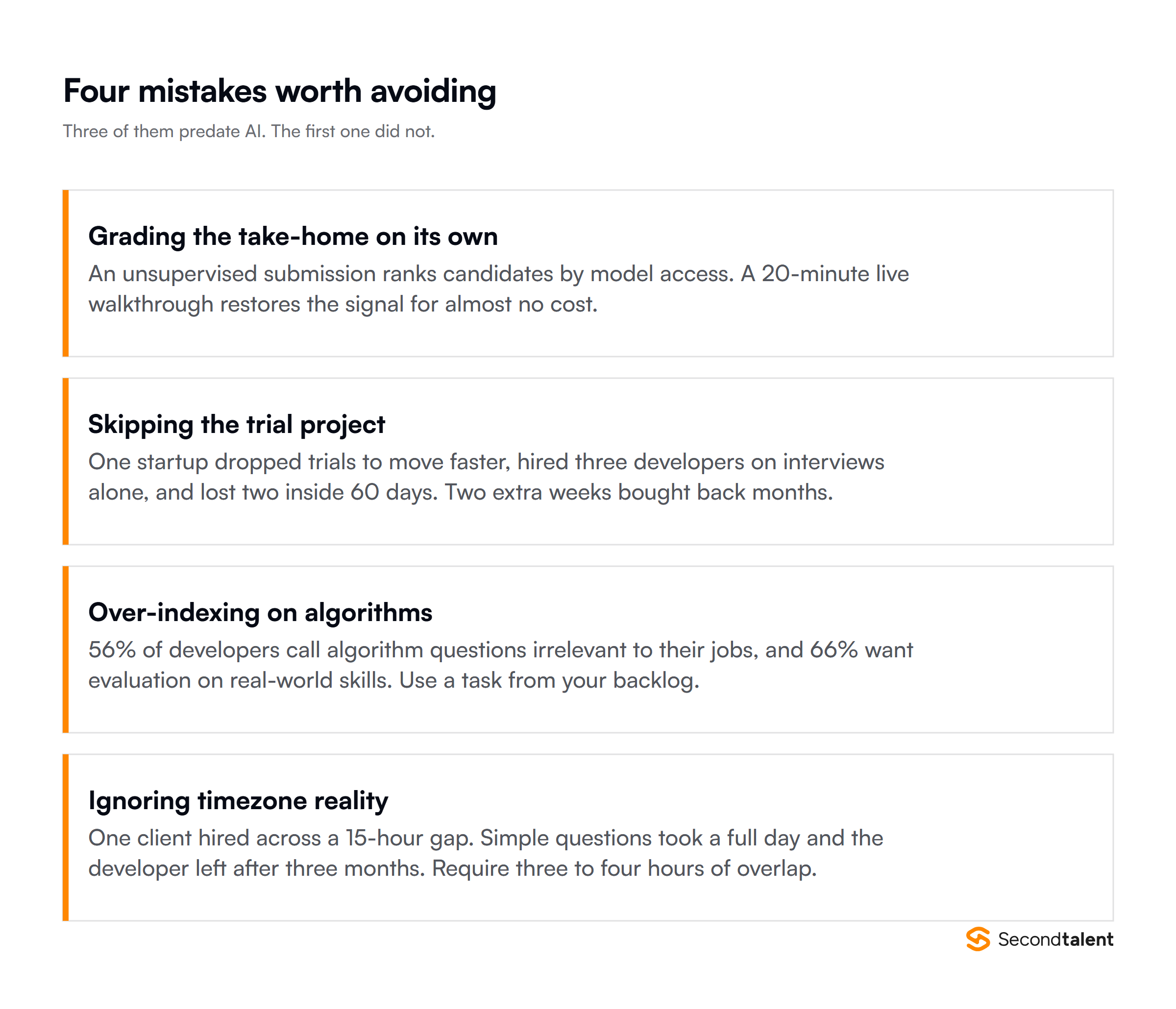
Most startups repeat the same four errors, and three of them predate AI. The fourth is new and now costs the most.
Mistake One: Grading the Take-Home on Its Own
An unsupervised submission measures model access. Scoring it in isolation ranks candidates by subscription tier, and 76% of developers already told HackerRank that AI makes gaming assessments easier.
Adding a 20-minute live walkthrough costs almost nothing and restores the signal completely. Keep the test and change what you grade.
Mistake Two: Skipping the Trial Project
Trials feel slow and cost far less than a replacement search. One startup we worked with dropped trials to move faster, hired three developers on interviews alone, and lost two inside 60 days.
They reinstated trials and their retention recovered. Two extra weeks bought back several months.
Mistake Three: Over-Indexing on Algorithms
Leetcode-style tests measure preparation for Leetcode-style tests. HackerRank found 56% of developers consider algorithm questions irrelevant to their jobs, and 66% want to be evaluated on real-world skills instead.
We dropped algorithm tests years ago in favour of practical challenges, and hire quality went up. Several developers who would have failed a puzzle round became the strongest people on their teams.
Mistake Four: Ignoring Timezone Reality
Zero-overlap hiring assumes async solves everything, and it does not. Complex problems need a live conversation, and waiting a day for one costs more than the salary saving.
One client hired in Australia for a US team across a 15-hour gap. Simple questions took a full day, and the developer left after three months. Require three to four hours of overlap, then hold the line.
Tools and Platforms for Remote Evaluation
Pick tools that record process alongside answers. Anything that stores only a final submission measures the wrong thing now.
For technical screening we use platforms that capture keystroke and edit history alongside the result, so a solution that appeared fully formed at 2am looks different from one somebody built in stages. HackerRank, CodeSignal and Coderbyte all offer some version of this, and HackerRank has since shipped an AI-enabled environment that watches how candidates direct the model rather than blocking it.
For trial projects we use the client’s own environment. Setting up a real development stack is part of the assessment, and it is one more thing a proxy candidate finds awkward.
Communication and Collaboration Tools
Slack or Discord for async, Zoom or Google Meet for live, Notion or Confluence for documentation. Tools like Clariti also help by bringing emails, chats and files into one place for better context.
Watch how candidates use these during the trial. One candidate we assessed never used a thread, posting every reply as a new top-level message. Their trial channel became unreadable inside a week, which told the client more than any interview had.
Legal and Compliance Considerations
Cross-border hiring brings contracts, payroll, tax and labour law with it. Getting any of them wrong is expensive, and identity fraud makes the contract layer riskier than it used to be.
We use Employer of Record services so startups can hire across borders without registering an entity. The EOR runs payroll, tax and benefits, and its onboarding checks double as identity verification.
Contract and IP Protection
IP assignment is not automatic everywhere, so put it in writing in every contract. Vietnam requires specific contract terms, the Philippines mandates particular benefits, and Singapore enforces its own employment rules.
Add a clause covering AI-assisted work while you are in there. Name who owns generated code and what disclosure you expect, because a dispute after the fact is far more expensive than a paragraph before it. One client hired without proper IP clauses and spent $30,000 resolving the ownership argument that followed.
Measuring Developer Quality After the Hire
Evaluation does not end at the offer. Track post-hire performance to find out whether your screening predicts anything, then move the scorecard weights toward whatever correlated.
- Time to first merged PR: How fast they get productive in your codebase
- PR merge rate: Share of pull requests merged without major rework
- Change-failure rate: The 2025 DORA report found AI lifting throughput while delivery stability stayed negative, so watch this one closely
- Review load created: Hours of senior time their output consumes each week
- Retention: Still in the seat at 6 and 12 months
Review load is the metric most teams miss, and AI is what made it necessary. A developer shipping twice the code and consuming three times the review time has not made your team faster. Our breakdown of engineering productivity metrics covers how to instrument these without turning it into surveillance.
Improving Your Evaluation Process
Feed the post-hire data back into the scorecard every quarter. If live-defence scores predict performance and take-home scores do not, move the points across.
One pattern we found is that candidates who asked more clarifying questions during evaluation shipped faster after joining. We now give explicit points for question quality, and the first 90 days go smoother for it. Our 90-day onboarding blueprint covers what happens next.
Working with Talent Partners for Quality Assurance
Building this process in-house takes months, which is why many startups use a partner for the first several hires and copy the framework afterwards. Either route works, and doing neither is the expensive option.
We run identity verification, a live technical screen with AI tools enabled, a code review simulation and sourced reference calls before a client sees anyone. Around 8% of applicants clear the full screen, and clients typically interview two or three people rather than twenty.
One client needed a full-stack developer urgently and had three pre-vetted candidates within 48 hours. They hired after one interview and a trial project, and that developer is still with them. If you are hiring without a technical co-founder, our guide on hiring engineers when you are not technical is the companion piece to this one.
Frequently Asked Questions
Should candidates be allowed to use AI in a coding test?
Yes, and you should tell them so. Banning AI tests a workflow they will never use again after joining, and it is unenforceable on an unsupervised task anyway.
Allow the tools, then grade the live walkthrough of the result. HackerRank found 73% of developers already feel it is unfair to lose out to someone who used AI to game a test, so an open policy is fairer to the honest candidates too.
How do you verify a remote developer is who they claim to be?
Check a government ID against a live camera at first contact, then keep the camera on through an unscripted conversation. Gartner projects one in four candidate profiles worldwide will be fake by 2028, and 6% of surveyed candidates already admit to interview fraud.
Source references yourself rather than calling supplied numbers, and treat a public work history that predates the application as supporting evidence. A paid trial settles any remaining doubt.
Are take-home projects still worth running?
Yes, as an input to a conversation rather than a score on its own. The submission tells you what the candidate can produce with help, and the walkthrough tells you what they understand.
Keep them to three or four hours. Longer tests lose good candidates and buy no extra signal now that the artefact itself is not the evidence.
How much timezone overlap do remote developers need?
Three to four hours is the working minimum for most product teams. That covers a standup and a window where blockers get cleared the same day.
APAC-to-US-West-Coast and APAC-to-Europe both work with a shifted local schedule, which many developers in the region already run. Ask about it during screening rather than assuming after the offer.
Conclusion
Remote developer quality is still measurable, and the measurements moved. Verify identity before you spend an hour on anyone, allow AI in the technical stages, and grade the live defence rather than the submitted artefact.
Keep the paid trial. It is the only stage that survived the last two years intact, and it answers the identity question and the competence question at the same time.
Then instrument what happens after the hire and move your scorecard weights toward whatever predicted it. A process that never learns from its own outcomes will keep making the same hire.
Takeaways
- 97% of developers code with an AI assistant, so an unsupervised take-home no longer measures the candidate.
- Add a 20-minute live walkthrough and change one requirement on the call. That restores the signal for almost no cost.
- Verify identity at first contact. Gartner projects one in four candidate profiles will be fake by 2028.
- Weight communication and live defence higher than raw technical output, especially for senior roles.
- Track review load created alongside throughput, or you will mistake more code for more progress.
Hiring remotely? Second Talent presents vetted developers from ten APAC markets, each one identity-checked and screened on live technical judgement rather than an unsupervised test. Tell us what you need and we will send a shortlist.


![Workplace Diversity Statistics. Top 100+ Workplace Diversity Statistics [2026], by Second Talent.](https://www.secondtalent.com/wp-content/uploads/2026/09/workplace-diversity-statistics-featured-v2-768x403.jpg)

![Tech Industry Hiring Statistics. Top 50+ Tech Industry Hiring Statistics: Salaries, Skills Demand [2026], by Second Talent.](https://www.secondtalent.com/wp-content/uploads/2026/09/tech-industry-hiring-statistics-featured-v2-768x403.jpg)