TL;DR: HR tech stacks in 2026 still do not connect well: only 41% of organizations in HR.com's 2026 survey say their HR tools integrate well or extremely well. Almost half, 48%, say poor integration holds back their HR goals a lot. Spending at the top of the market keeps growing, with Workday guiding to about $9.9 billion of subscription revenue this fiscal year.
81% of HR professionals in Sapient Insights Group’s latest HR Systems Survey use a “bring your own” AI tool for their own work, and 14% of them pay for it themselves.
Only 12% report embedded AI in their core HR management system, HR Executive reported from the survey’s first results.
- 1CFOs surveyed by Gartner plan to grow HR budgets by 0.7% in 2026, the sharpest pullback of any function.
- 2Deel passed $1.5 billion of annual recurring revenue in the first half of 2026.
- 3In SHRM’s December 2025 survey, 39% of organizations had AI adopted inside the HR function.
- 488% of HR leaders told Gartner their organizations have not seen significant business value from AI tools.
How Many HR Systems Does a Typical Organization Run?
26% of organizations now run a single paid HR solution, up from 15% a year earlier. That comes from HR.com’s State of Today’s HR Technology and Integrations 2026, which counts products bought from different providers.
An HRIS with several modules from one vendor counts as one.
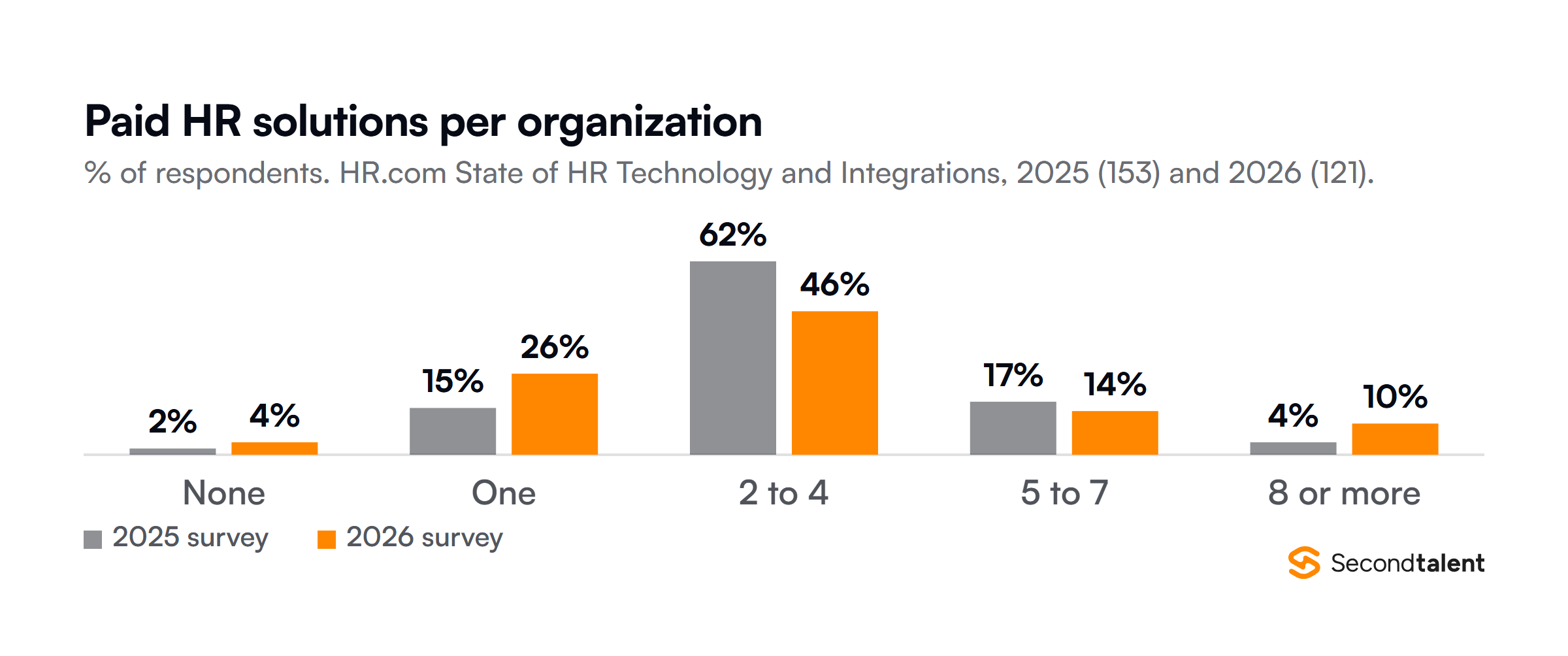
The middle of the range shrank. In 2026, 46% use two to four paid solutions, against 62% in the 2025 edition. The heavy end grew, with 10% now using eight or more, up from 4%.
What sits inside the stack
Payroll is the most common piece. 76% of HR.com’s 2026 respondents have it in their HR tech stack, followed by onboarding at 72%, recruitment at 67%, benefits administration at 66% and performance management at 64%.
For a large employer, payroll can sit inside the HCM suite, or run as separate enterprise payroll software connected to the core HR record. Our guide to payroll software in Singapore compares options for one market.
Buyers choose from a long list of products. Sapient Insights Group’s 2025-2026 HR Systems Survey drew on 9,886 HR professionals at 4,670 organizations, who named 1,539 technology solutions across 22 segments.
This edition added new segments such as labor scheduling, leave management and contingent workforce management.
How Well Do HR Systems Integrate?
Only 9% of organizations say weak integration between HR components is not stopping them from reaching important HR goals. In HR.com’s 2026 report, 44% say it holds them back a little.
The share held back a lot rose from 25% in the 2025 edition to 48%.
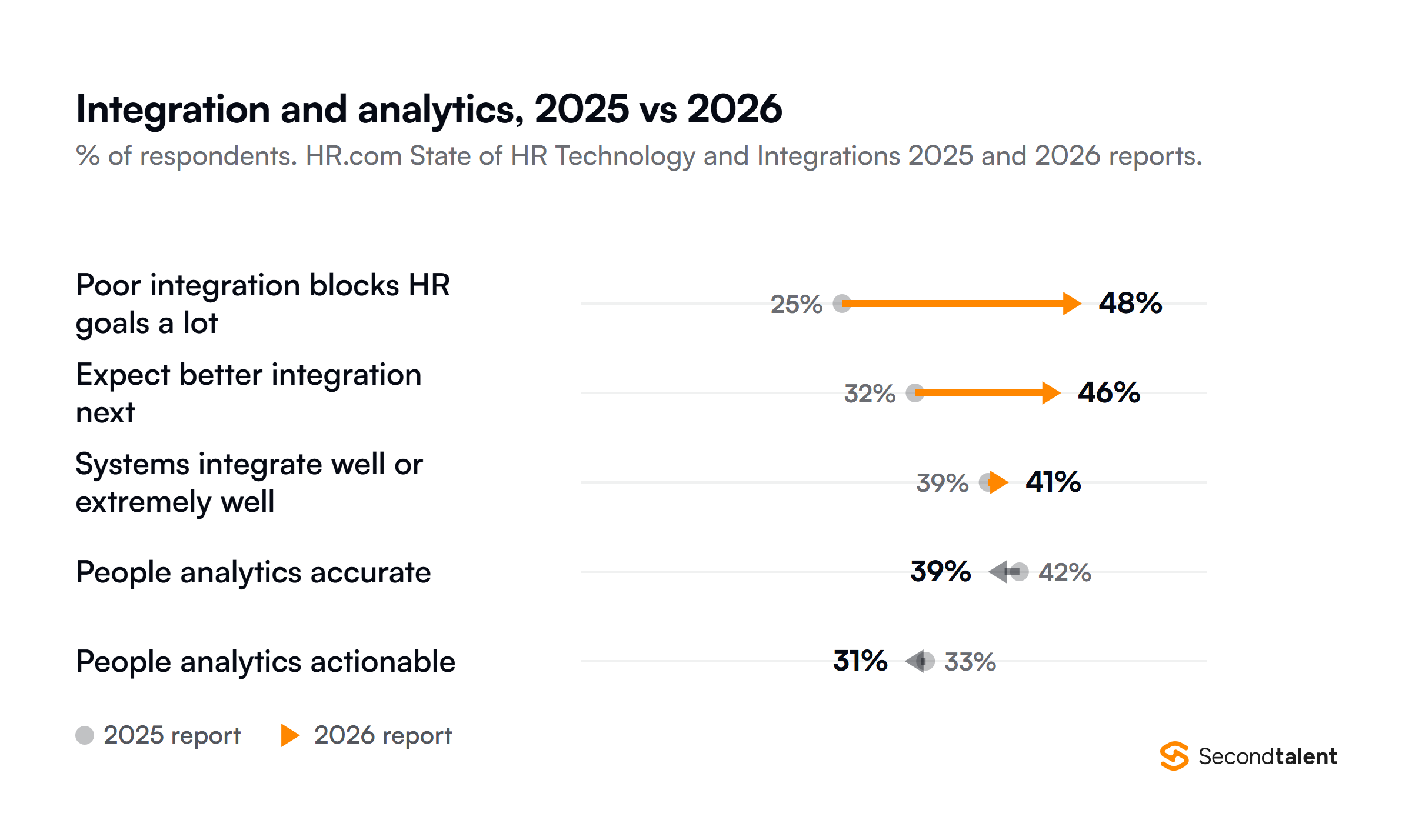
The share saying their tools integrate well moved only from 39% to 41%. The share rating integration poor or very poor reached 26%. Ratings of people analytics slipped on both accuracy and actionability.
Budget has overtaken integration as the top complaint.
Asked for their biggest pain points in 2026, 50% named budget constraints, 44% named missing integrations within or between systems, and 37% each named administrative burden and missing HR functions.
Our HR analytics and metrics statistics cover what those teams try to measure.
Leaders and laggards
HR.com split its 2026 sample by how respondents rated their own stack. Leaders rated it advanced or expert. Laggards rated it undeveloped or beginning.
- 0% say their systems integrate well
- 14% rate their people analytics accurate
- 48% raised HR tech investment in two years
- 72% say their systems integrate well
- 63% rate their people analytics accurate
- 80% raised HR tech investment in two years
Changing a stack gets harder with size. 57% of all respondents say a substantial reconfiguration takes high effort. That rises to 75% at organizations with 1,000 or more employees, against 52% at mid-sized ones and 28% at small ones.
Buyers expect to work on it. 46% expect their HR technology to improve its integration abilities over the next two years, up from 32% in the 2025 report.
In a separate question, 55% plan to focus on process optimization to get better results from the tools they have.
How Much Are Companies Spending on HR Technology?
CFOs and HR teams give different answers. Finance chiefs expect to squeeze HR budgets hardest of any function in 2026, while most HR professionals report their tech spending went up.
Gartner ties the HR pullback to reduced hiring and AI efficiency gains. The same CFOs expect headcount growth to fall from 6% in 2025 to 2% in 2026.
These figures cover the whole HR budget, including staff, so they are not an HR software number.
What HR teams report
In Sapient’s survey, 39% of organizations increased HR tech spending in the past year, 37% plan to grow their HR tech budget and 7% expect a cut.
Chief research officer Stacey Harris also told the HR Technology Conference that spending has fallen 29% since 2020 on Sapient’s measure.
HR.com’s respondents lean more positive. 68% say HR tech investment rose over the past two years, 28% of them by a lot, and 65% expect another increase over the next two.
Large organizations stand out: nearly 45% raised investment a lot, against 16% to 18% of small and mid-sized ones.
Per-employee budgets range from under $500 to over $3,000. 47% of HR.com respondents could not estimate their organization’s spend.
Of those who could, 22% plan to spend under $500 per employee next year, 18% plan $500 to $999, and about three in ten plan $2,500 or more. Our HR industry statistics put these budgets in the context of the wider profession.
Which Vendors Earn the Most From HR Software?
ADP’s client funds averaged $40.4 billion across its fiscal year to June 2026, and the interest on them earned ADP $1.4 billion.
That interest is part of $21.9 billion of revenue, up 7%, at a business serving more than 1.1 million clients in 140+ countries.
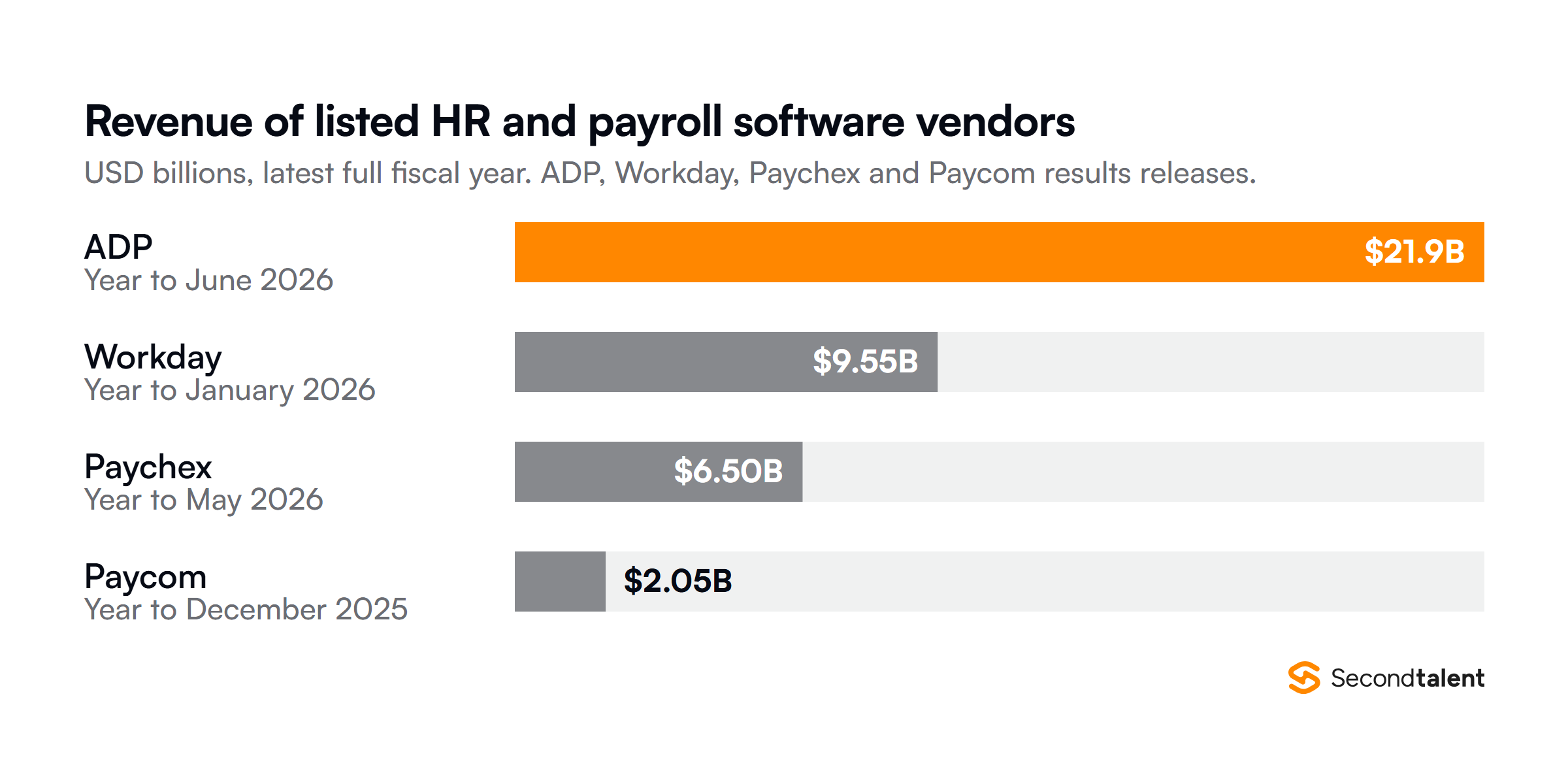
The fiscal years end in different months, so the bars compare scale, not the same twelve months. ADP kept 92.1% of Employer Services client revenue, flat on the year. Its PEO paid an average of about 762,000 worksite employees.
Workday
More than 5,500 Workday customers use at least one of its own AI agents, up more than 35% in a quarter. Its second-quarter results showed subscription revenue of $2.471 billion to July 31, 2026, up 13.9%.
“We had a strong Q2, with AI driving more than 25% of our new ACV and more than 5,500 customers now using at least one of our organic agents.”
Aneel Bhusri, Workday co-founder and CEO, August 27, 2026
For the full year to January 2026, Workday reported total revenue of $9.552 billion, up 13.1%. More than 7,000 of its customers run its core Financial Management or HCM products.
Paychex and Paycom
Paychex grew revenue 17% to $6.5 billion in the year to May 2026, its first full year including Paycor, which it bought in April 2025. Paycom’s 2025 revenue was $2,051.7 million, up 9.0%.
Deel and Rippling
Two private challengers sell payroll, HR and IT tools in one platform. Neither trades on a stock exchange, so the figures below are what each company stated or what reporters confirmed with it.
Deel says customers using three or more of its products rose 480%, and those using four or more rose 1,200%. It runs its own payroll engine in 55+ countries and owns 250+ legal entities.
Calcalist Tech reported the $1.5 billion milestone alongside Deel’s 15th acquisition.
TechCrunch reported that Rippling’s Series G lifted it from $13.4 billion a year earlier and took total funding to $1.85 billion. Our list of Deel alternatives covers other global payroll and EOR providers.
How Much AI Is in the HR Tech Stack?
AI adoption in HR climbs with company size. 60% of extra-large organizations have implemented AI in their HR functions, against 33% of small and 35% of midsize ones, in SHRM’s State of AI in HR 2026.
SHRM surveyed 1,908 HR professionals in December 2025.
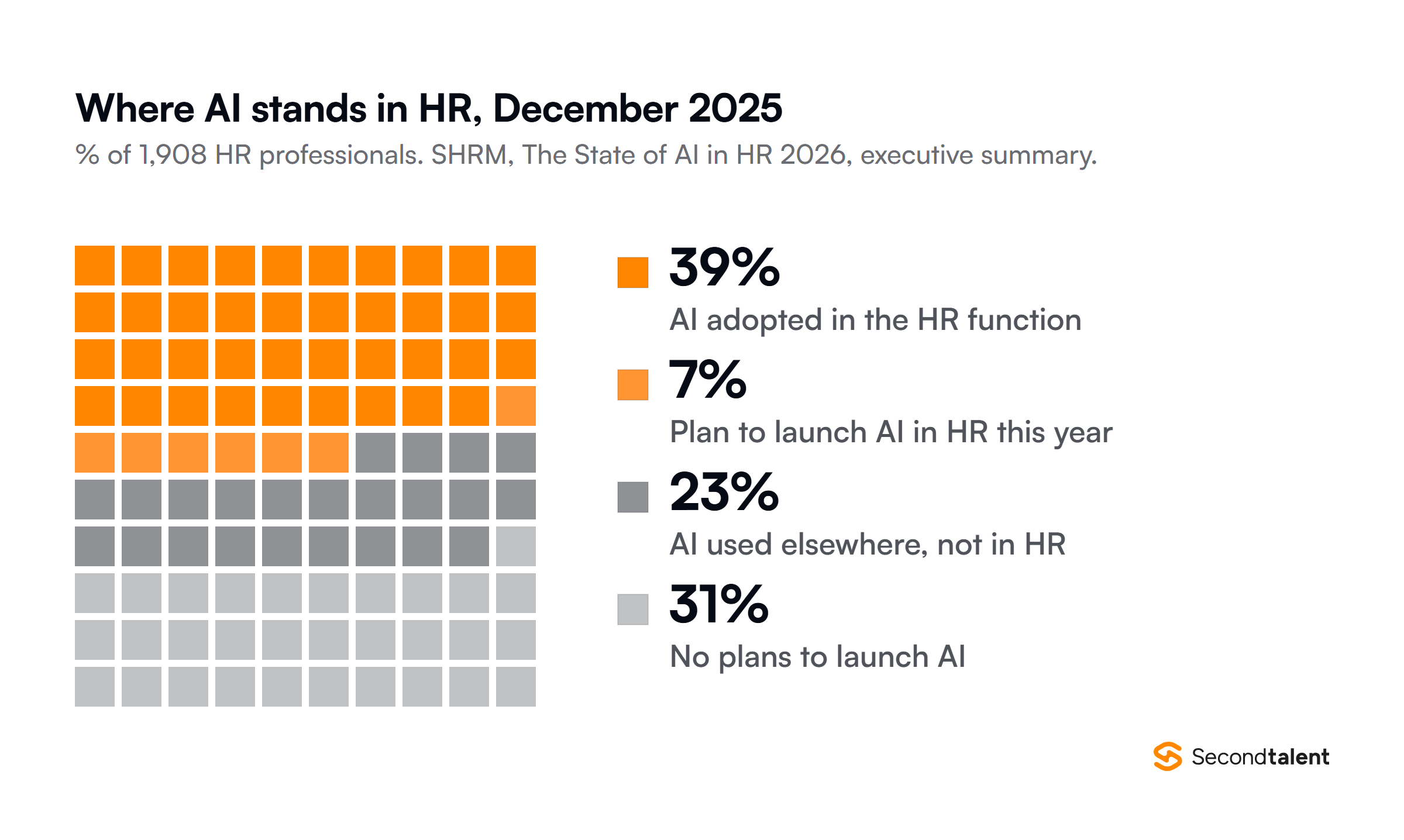
Recruiting is the most common HR use at 27%, followed by HR technology at 21%, learning and development at 17% and employee experience at 14%.
Governance trails use: 49% of organizations using or piloting AI have a workforce AI policy, and 54% of those say their policy is too restrictive. Our AI in recruitment statistics go deeper on hiring.
Four surveys, four readings
Each survey asks a different question, so do not average these figures or read them as a trend.
Sapient’s release breaks its 31% down by tool, from ChatGPT at 58% to AI meeting tools at 11% and HR applications with embedded AI at 9%. Harris made the same point at the conference.
“Organizations are not using embedded AI as much as you would think.”
Stacey Harris, Sapient Insights Group, HR Technology Conference, September 2025, via HR Executive
Agents are still rare
More than a third of HR teams report no agentic AI features at all, and another 23% do not know. HR.com polled 386 members for its 2026 report, and none of the listed capabilities was the most common answer.
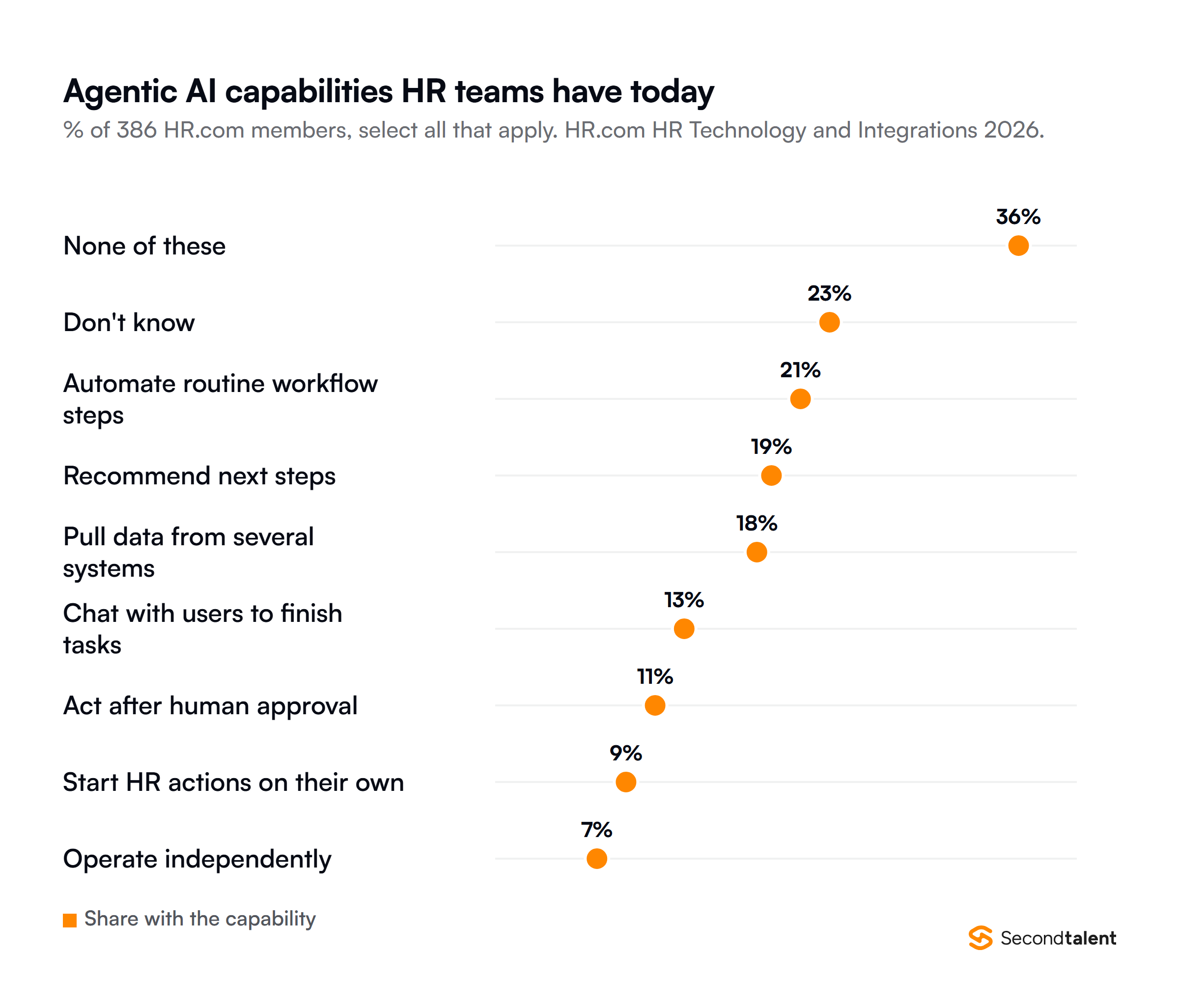
The simple capabilities lead: automating routine steps and recommending next steps. Only 7% say an agent can operate on its own.
Among members who do have agentic features, 40% use them in at least some HR workflows on a regular basis, and 22% are still piloting.
Josh Bersin’s firm sees more automation ahead. Using task data for more than 250 HR jobs, it estimates that software could take over 30% to 40% of existing HR jobs with relatively low effort.
Bersin still expects the profession to change its mix of roles rather than shrink.
Few employers tell staff what to do with the time AI frees up. In a July 2025 Gartner survey of 114 HR leaders, only 7% of organizations gave employees guidelines on using that time, Gartner reported.
Its list of CHRO priorities for 2026 opens with harnessing AI in HR, starting from an HR-focused AI strategy.
Running Payroll for Employees in Asia
Hiring in a new country can mean adding a local entity and payroll provider to the stack. Second Talent’s employer of record service employs your team members in Asia for you, handling local contracts, payroll and social insurance.
We cover markets including the Philippines and Vietnam. If you also need to hire, we match companies with pre-vetted developers and other remote employees. Tell us who you need to hire and we will send matching profiles.
Frequently Asked Questions
What counts as an HR technology stack?
HR.com’s survey defines it as all the technology HR uses to do its work, whether modules in a larger suite or standalone point solutions.
Employees and contractors may use parts of it too, such as self-service apps, and it can connect to non-HR systems like an ERP.
Do larger companies have more mature HR tech stacks?
Yes, on HR.com’s 2026 data. About 60% of organizations with 1,000 or more employees rate their stack advanced or expert, against around 26% of mid-sized and 24% of small organizations.
Only 15% of all respondents put themselves at the expert stage.
Which HR tools do organizations say they still need?
Among HR.com respondents in 2026 who said their HR tech lacks features they need, skills assessment tops the list at 76%, followed by learning and development at 70%, and employee engagement and succession management at 64% each.
Payroll, recruitment and onboarding were each named by only 27%.
What is the top HR issue for 2026?
Artificial intelligence usage, named by 36% of 526 HR.com members asked to pick up to five issues. It is the first time AI has topped that annual poll. Leadership development came second at 27% and performance management third at 26%.