
TL;DR: Employing someone in Malaysia adds roughly 14% to gross salary, and the employee gives up about 11.5%. EPF is the bulk of it and has no wage ceiling, so unlike most of the region the employer burden barely falls as salary rises. SOCSO and EIS stop at RM6,000 a month. Two rules decide most compliance questions: EPF became mandatory for foreign workers in October 2025, and a RM4,000 monthly wage line separates who gets statutory overtime and termination benefits from who does not.
We employ staff in Malaysia through our own entity, so these are the numbers we run every month. This guide covers what you owe, what your employee takes home, and the two thresholds that catch foreign employers out.
Key takeaways
- Budget about 14% on top of gross salary, and about 11.5% off the employee’s pay.
- EPF has no wage ceiling, so the employer burden barely falls on senior hires. Only SOCSO and EIS stop, at RM6,000.
- EPF has been mandatory for foreign workers since October 2025, phasing in at 2% from each side.
- The RM4,000 line decides statutory overtime, rest day and holiday premiums, shift allowance and termination benefits.
- Public holidays vary by state. Set the calendar per worksite, not nationally.
What employing someone in Malaysia costs
Budget about 14% on top of gross salary. That covers EPF at 12% or 13%, SOCSO at 1.75%, EIS at 0.2%, and the HRD Corp levy at 1% if you employ ten or more Malaysians.
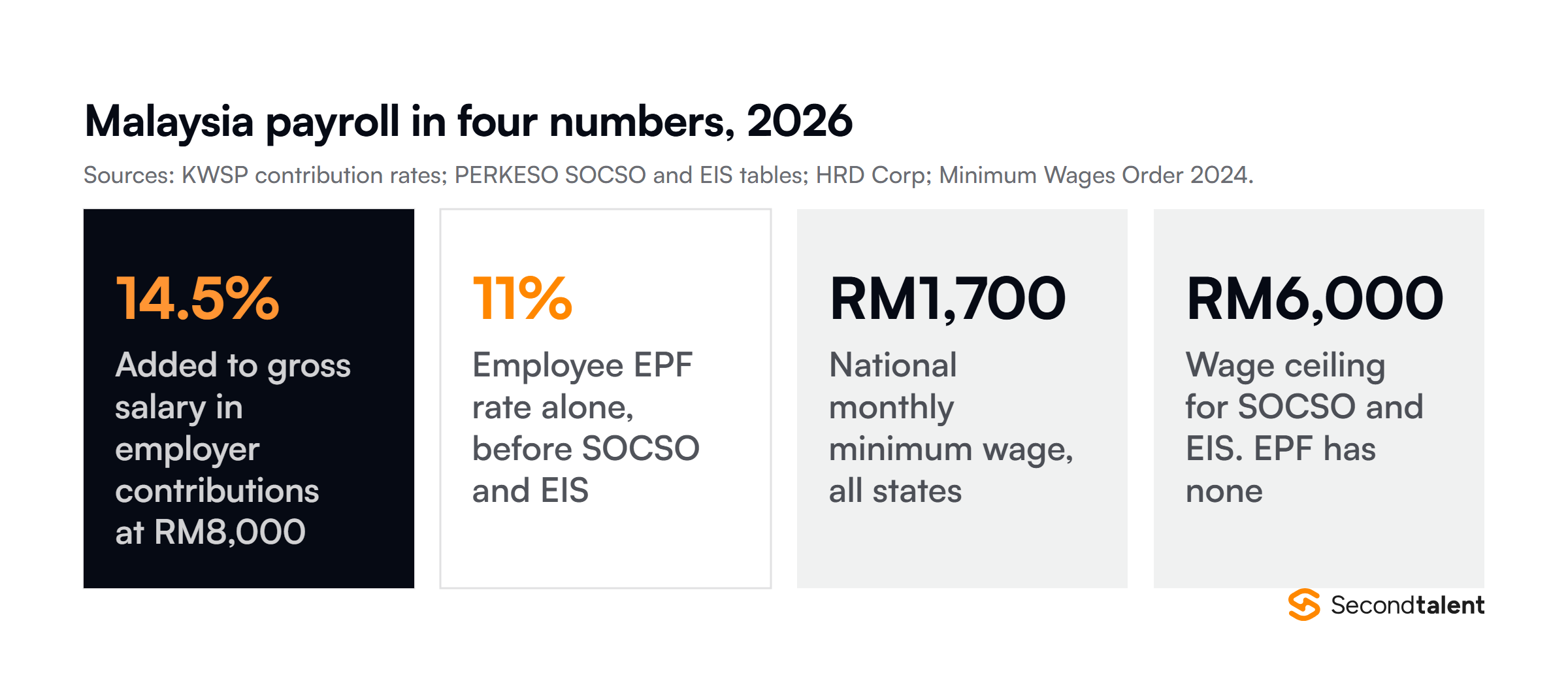
The important structural point is that EPF has no wage ceiling. SOCSO and EIS stop contributing above RM6,000 a month, but EPF keeps applying to the full salary.
That makes Malaysia different from neighbours where caps bite hard. An RM8,000 hire carries about 14.5% in employer contributions, and an RM20,000 hire still carries 13.6%. Senior hires do not get proportionally cheaper to employ here.
Download this guide as a PDF
The full 2026 Malaysia payroll, benefits and tax guide, including the contribution table, the income tax schedule, the RM4,000 entitlement split, leave and termination rules and both worked examples, formatted for sharing with your finance team.
Statutory contributions: who pays what
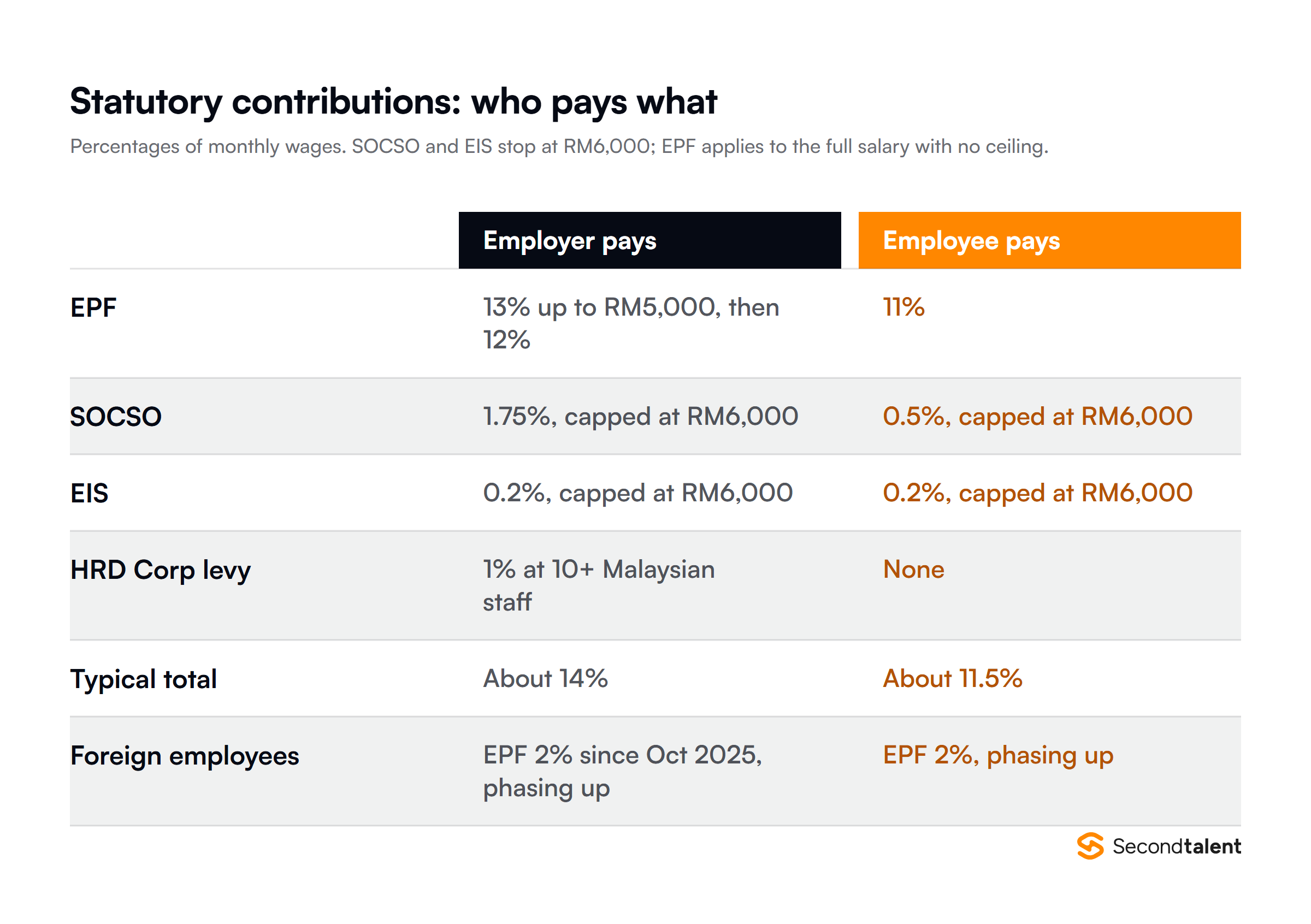
The employer EPF rate depends on salary. It is 13% for monthly wages of RM5,000 or below, and 12% above that. The employee rate is 11% regardless, for Malaysians under 60.
SOCSO and EIS are administered by PERKESO against a published contribution table in wage bands, so the exact ringgit figure can differ slightly from a straight percentage. Both stop at the RM6,000 ceiling.
The HRD Corp levy is 1% of monthly wages for employers with ten or more Malaysian employees, where registration is compulsory. Employers with five to nine Malaysian employees may register voluntarily at 0.5%.
EPF is now mandatory for foreign workers
Since 1 October 2025, EPF applies to non-Malaysian employees under 75, where it used to be voluntary. The phase-in starts at 2% from the employer and 2% from the employee, well below the Malaysian rates, with alignment expected over time. Budget for the rate rising rather than treating 2% as permanent.
Income tax and monthly deductions
Residents pay progressive rates from 0% to 30% on chargeable income, withheld monthly through PCB. Budget 2026 left the personal income tax rates unchanged, so the schedule below carries over.
| Chargeable income (RM) | Rate on the band |
|---|---|
| 0 to 5,000 | 0% |
| 5,001 to 20,000 | 1% |
| 20,001 to 35,000 | 3% |
| 35,001 to 50,000 | 6% |
| 50,001 to 70,000 | 11% |
| 70,001 to 100,000 | 19% |
| 100,001 to 400,000 | 25% |
| 400,001 to 600,000 | 26% |
| 600,001 to 2,000,000 | 28% |
| Over 2,000,000 | 30% |
Residency turns on physical presence, generally 182 days or more in a calendar year. A new arrival who has not yet met the test is taxed at the flat 30% until they do, which surprises relocating hires who expected the resident schedule.
Every resident taxpayer gets RM9,000 in automatic personal relief, and EPF contributions are deductible up to RM4,000 within a wider combined limit. Chargeable income at or below RM35,000 attracts a RM400 rebate.
What changed in 2025 and 2026
Four changes have landed since early 2025, and the most expensive one took effect this June. None of them altered the headline contribution rates, which is why they are easy to miss.
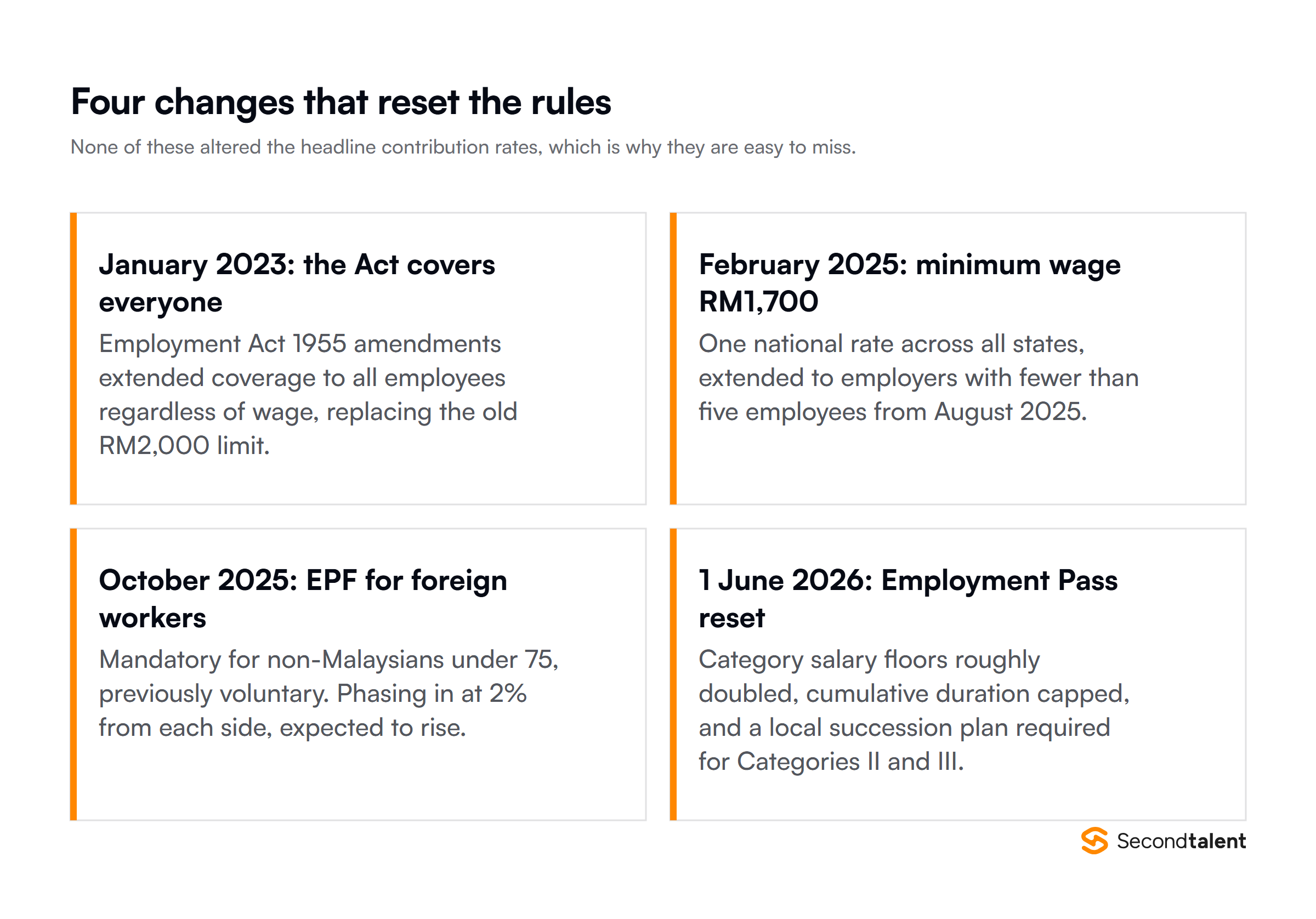
If you have not repriced expatriate roles since May, start there. The Employment Pass reset is the one with an immediate budget consequence.
What a hire actually costs
Two worked examples, both for a Malaysian citizen under 60 with personal relief and EPF relief only, at an employer with ten or more Malaysian employees.
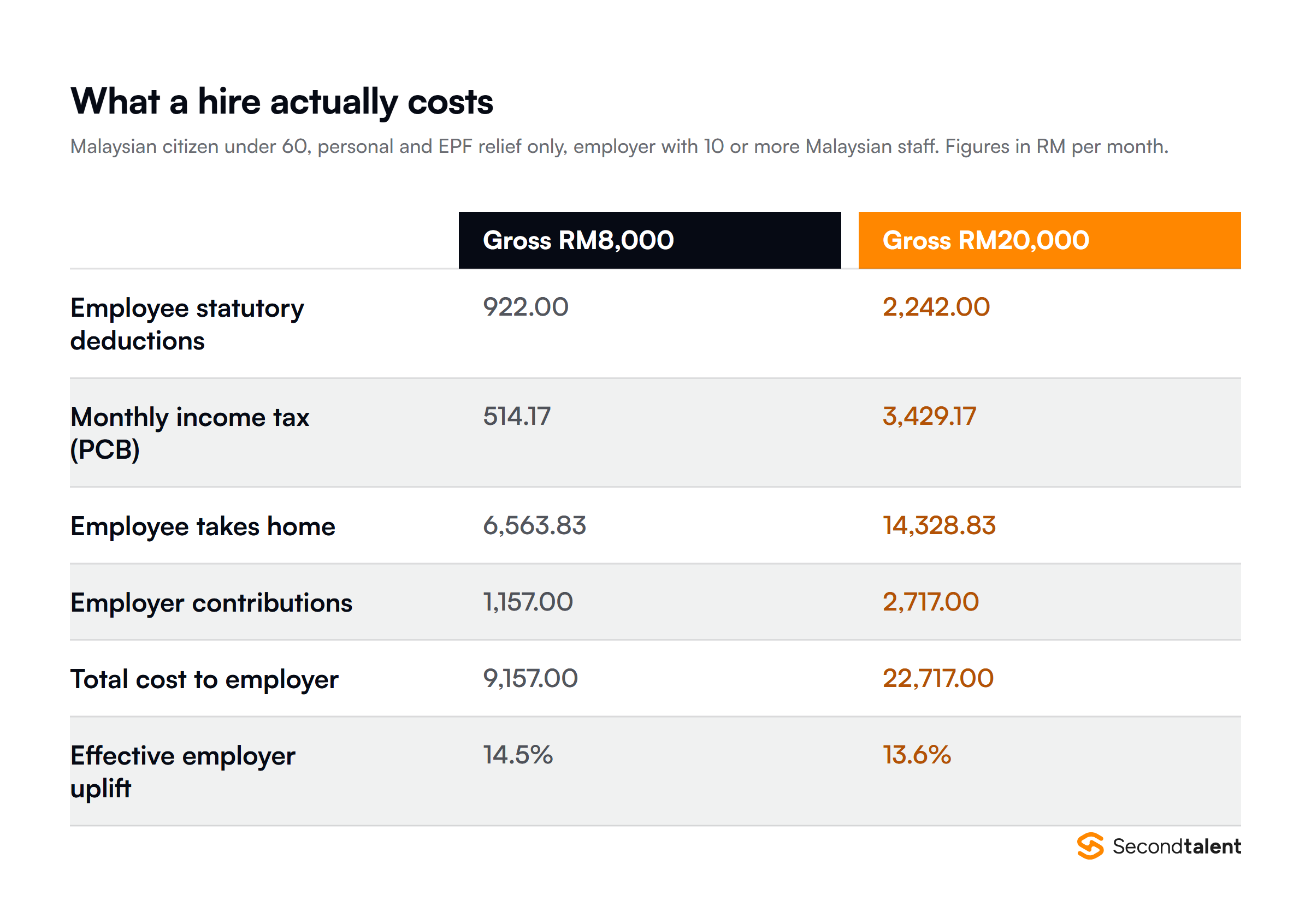
Compare that with markets where contributions are capped on both sides. The employer uplift here moves from 14.5% to 13.6% across a salary that more than doubles, because only SOCSO and EIS stop growing.
Our EOR cost calculator models the full stack, and the Malaysia EOR page covers what we handle on your behalf.
The RM4,000 line that decides overtime and severance
Since January 2023 the Employment Act 1955 covers every employee regardless of salary. A separate threshold then removes five entitlements from employees earning more than RM4,000 a month, unless they do manual work.
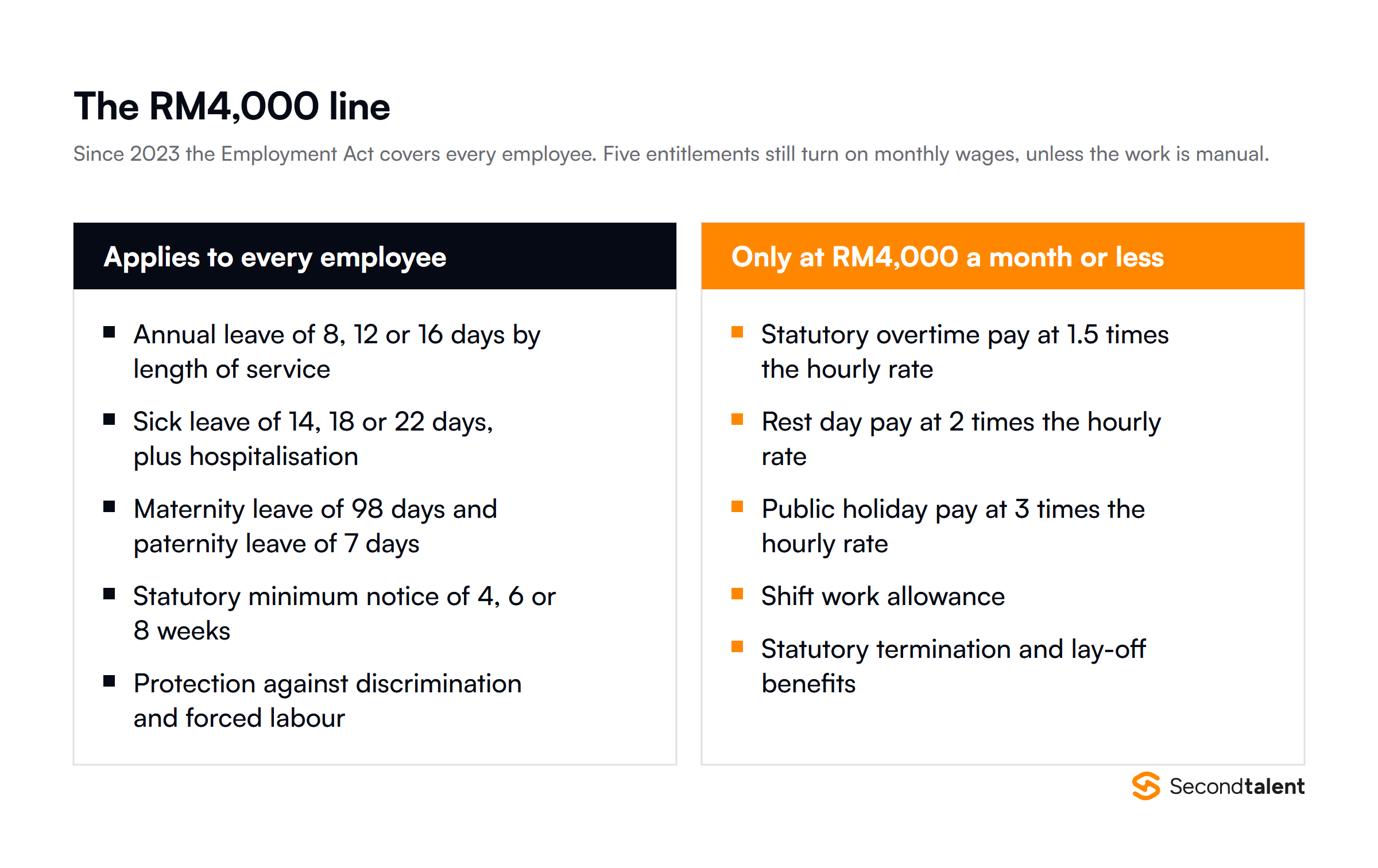
Getting this backwards is expensive in both directions. Treating a RM6,000 engineer as entitled to statutory overtime overpays, and treating a RM3,500 employee as exempt underpays and creates a claim.
The 2022 amendments set out the full position. Note that contractual overtime above the threshold is still enforceable if you promised it, so audit your offer letters rather than assuming the statute is the whole answer.
Minimum wage, hours and overtime
The national minimum wage is RM1,700 a month, in force since February 2025 and extended to employers with fewer than five employees from August 2025. One rate applies across all states, including Sabah, Sarawak and Labuan.
- Standard hours: 45 per week, and no more than 8 in a day.
- Overtime premiums: 1.5 times the hourly rate on a normal working day, 2 times on a rest day, and 3 times on a public holiday.
- Overtime cap: 104 hours a month.
- Rest day: at least one full day each week.
Those premium rates are statutory only for employees at or below the RM4,000 line. Above it, overtime is a matter of contract.
Leave entitlements
Annual leave scales with service, and applies to all employees regardless of salary.
- Annual leave: 8 days for under 2 years of service, 12 days for 2 to 5 years, and 16 days beyond 5 years.
- Sick leave: 14, 18 or 22 days a year by the same service bands, plus up to 60 days where hospitalisation is required.
- Maternity leave: 98 days of paid leave.
- Paternity leave: 7 consecutive days for a married employee.
- Public holidays: at least 11 paid days, of which 5 are compulsory national days.
Public holidays vary by state, and a Kuala Lumpur team and a Penang team will not have identical calendars. Set the list per worksite at the start of each year rather than running one national calendar.
Notice and termination
Statutory minimum notice runs on service: 4 weeks under 2 years, 6 weeks for 2 to 5 years, and 8 weeks beyond 5 years. A contract may improve on those, and many do.
Termination benefits are separate from notice, and apply to employees at or below the RM4,000 line. They run at 10, 15 or 20 days of wages for each year of service across the same bands.
Malaysia has no at-will employment
Dismissal needs just cause or excuse, and an employee who disputes it can bring an unfair dismissal claim to the Industrial Court. Reinstatement and back pay are live remedies there, so the process and the paper trail matter as much as the commercial decision.
Benefits beyond the statutory minimum
EPF and SOCSO do not cover medical care the way candidates expect, so private cover is the standard addition for professional and technical roles.
- Private medical and hospitalisation insurance: close to expected for engineering hires in Kuala Lumpur and Penang.
- Additional EPF: some employers contribute above the statutory rate as a retention tool, which is straightforward to administer.
- Allowances: transport, parking, mobile and remote work allowances are common, and several carry tax exemptions up to published limits.
- Bonuses: not statutory. A contractual or discretionary annual bonus is normal, often paid before Hari Raya or at year end.
Document allowances in the contract and your handbook. Several exemptions depend on the payment being properly categorised, and an undocumented allowance is taxable salary with extra steps.
Hiring foreign nationals after the June 2026 reset
Employment Pass salary floors roughly doubled on 1 June 2026, and the change applies to renewals as well as new applications. Any expatriate package built on the old thresholds needs rechecking now rather than at renewal.
| Employment Pass category | Minimum monthly salary from 1 June 2026 | Previously |
|---|---|---|
| Category I | RM20,000 and above | RM10,000 and above |
| Category II | RM10,000 to RM19,999 | RM5,000 to RM9,999 |
| Category III | RM5,000 and above | RM3,000 to RM4,999 |
Two further conditions come with it. Cumulative employment is now capped at 10 years for Categories I and II and 5 years for Category III, and employers applying under Categories II and III must submit a local succession plan showing how the role transitions to a Malaysian.
Global Business Services roles needing native or near-native language skills keep the old Category III thresholds until 1 June 2027. Outside that carve-out, a role paying RM6,000 that used to qualify comfortably under Category II now sits in Category III with a succession plan attached.
Registering as an employer
Four separate registrations sit between incorporation and your first payday, and none of them depends on the others. Start them in parallel rather than in sequence.
- EPF (KWSP): register as an employer within 7 days of taking on your first employee.
- PERKESO: register for SOCSO and EIS, which share one enrolment.
- LHDN: obtain an employer tax file number for PCB withholding, and register each employee for a tax file.
- HRD Corp: compulsory once you reach ten Malaysian employees, optional from five.
Company incorporation with SSM comes first and is comparatively quick, but a foreign-owned entity still needs a resident director and a local address. Most teams start on an employer of record and move across once headcount justifies the overhead.
Running payroll each month
- Pay wages within 7 days of the end of the wage period.
- Remit EPF by the 15th of the following month.
- Remit SOCSO and EIS to PERKESO by the 15th.
- Remit PCB to LHDN by the 15th, and the HRD Corp levy by the 15th where you are registered.
- File Form E annually, and issue Form EA to each employee by the end of February.
Late payment attracts interest and penalties from each agency separately, so a single missed cycle can produce four different charges.
Frequently asked questions
What is the total employer cost of hiring in Malaysia?
Gross salary plus about 14%. That is EPF at 12% or 13%, SOCSO at 1.75% and EIS at 0.2% up to a RM6,000 wage ceiling, and the HRD Corp levy at 1% for employers with ten or more Malaysian employees.
Do foreign workers pay EPF in Malaysia?
Yes, since 1 October 2025. EPF became mandatory for non-Malaysian employees under 75, having previously been voluntary. The phase-in rate is 2% from each side, below the Malaysian rates, and is expected to rise.
Is there a wage ceiling for EPF?
No. EPF applies to the full salary with no upper limit, which is why the employer burden in Malaysia stays close to 14% even on senior packages. SOCSO and EIS are the capped ones, both stopping at RM6,000 a month.
Who is entitled to overtime pay in Malaysia?
Employees earning RM4,000 a month or less, plus manual workers regardless of wage. Above that line, statutory overtime, rest day and holiday premium rates and termination benefits do not apply, though a contract can still grant them.
Can I pay a Malaysian employee without a local entity?
Not directly. EPF, SOCSO, EIS and PCB registration all require a registered local employer. An employer of record in Malaysia holds the contract on its own entity and handles every filing above.
That is the usual route below roughly five to eight employees. Our EOR versus entity calculator models the crossover, the Malaysia EOR provider comparison covers the local market, and this Singapore and Malaysia expansion case study shows how it runs in practice.
Hiring in Malaysia?
Second Talent employs staff in Malaysia on our own entity and handles contracts, EPF, SOCSO, EIS and PCB, so the rules above become our problem rather than yours. We also source the candidates. Tell us the role and we will come back with candidates and a full employment cost.
This guide is general information, current as at the date of publication, and is not tax or legal advice. Contribution tables and thresholds change, and the foreign worker EPF rate is explicitly phasing upward. Confirm your position with a qualified adviser before acting.

![How to Hire Developers in Asia Remotely. How to Hire Developers in Asia Remotely from the USA [2026], by Second Talent.](https://www.secondtalent.com/wp-content/uploads/2026/09/hire-developers-in-asia-remotely-featured-v2-768x403.jpg)
![AI Outsourcing in Singapore. Top 10 AI Outsourcing Companies in Singapore [2026], by Second Talent.](https://www.secondtalent.com/wp-content/uploads/2026/09/ai-outsourcing-companies-singapore-featured-v2-768x403.jpg)
![AI Outsourcing in India. Top 10 AI Outsourcing Companies in India [2026], by Second Talent.](https://www.secondtalent.com/wp-content/uploads/2026/09/ai-outsourcing-companies-india-featured-v2-768x403.jpg)
![AI Outsourcing in the Philippines. Top 10 AI Outsourcing Companies in the Philippines [2026], by Second Talent.](https://www.secondtalent.com/wp-content/uploads/2026/09/ai-outsourcing-companies-philippines-featured-v2-768x403.jpg)

![Software Development Outsourcing in Vietnam. Top 10 Software Development Outsourcing Companies in Vietnam [2026], by Second Talent.](https://www.secondtalent.com/wp-content/uploads/2026/09/software-development-outsourcing-companies-vietnam-featured-v2-768x403.jpg)