TL;DR: Women hold 34.5% of executive and senior manager jobs at large US private employers, on the EEOC's latest count, and run 55 of the Fortune 500 companies. Women working full time earned 82.0% of men's median weekly pay in the second quarter of 2026, according to the Bureau of Labor Statistics.
On July 21, 2026, the EEOC voted 2 to 1 to end the EEO-1, the race and sex headcount that large US employers have filed every year since 1966. The agency collected 2024 data but has not published it, so the newest national count of who holds which jobs dates from 2023.
- 1White men held 52.7% of executive and senior manager roles in the EEO-1 data.
- 2For every 100 men promoted to manager last year, only 60 Black women were.
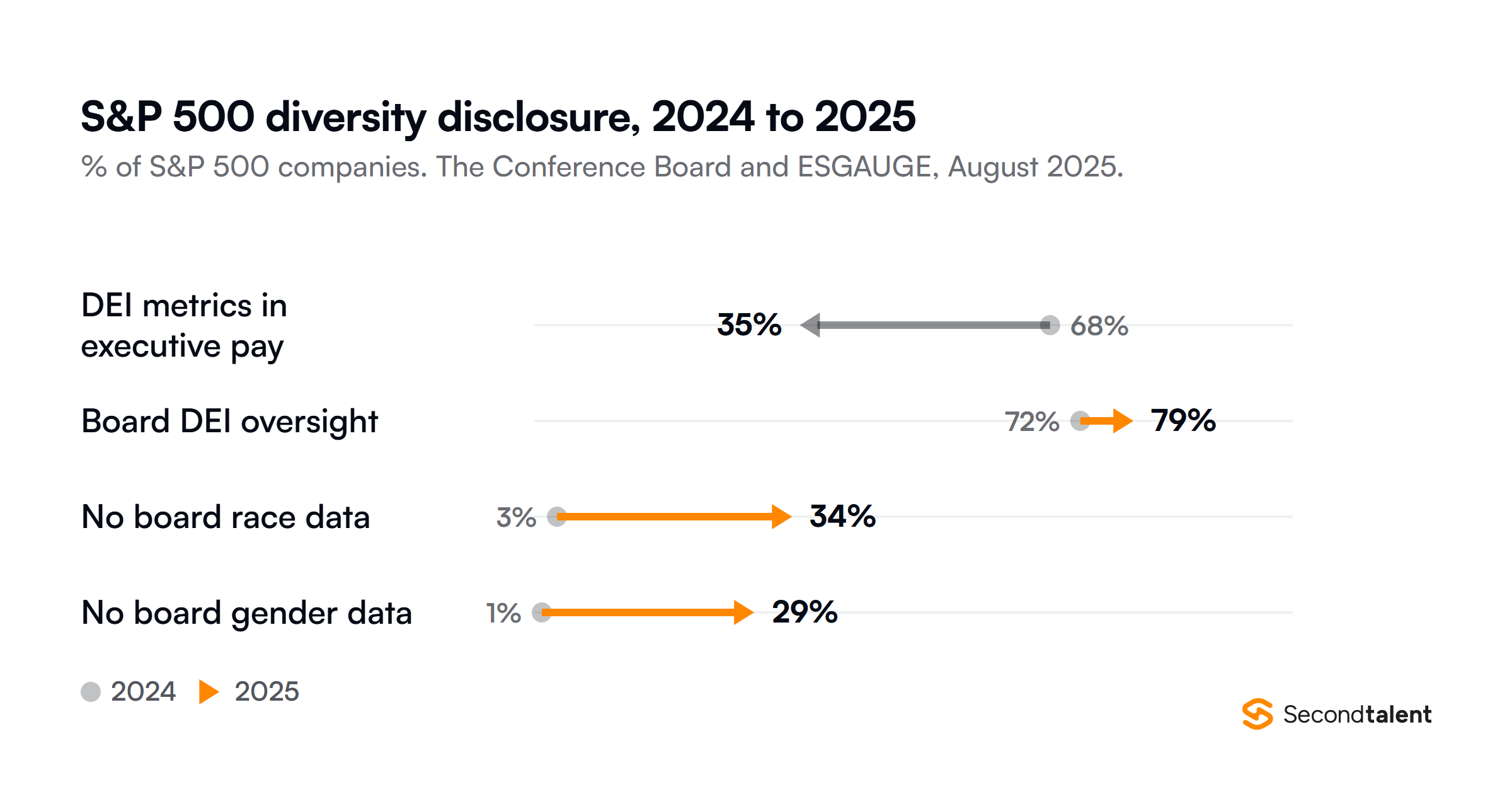
- 3The share of S&P 500 companies reporting DEI metrics in executive pay fell from 68% to 35% in one year.
- 4Only four of the 27 EU member states fully wrote the Pay Transparency Directive into national law by its June deadline.
How Many Women and Minorities Hold Executive Jobs?
Black employees made up 15.4% of the workforce at companies filing EEO-1 reports in 2023, but 4.1% of executives and senior managers. Hispanic and Latino employees were 18.6% of the workforce and 7.3% of executives. Asian employees were the one group whose share at the top matched their share of all jobs.
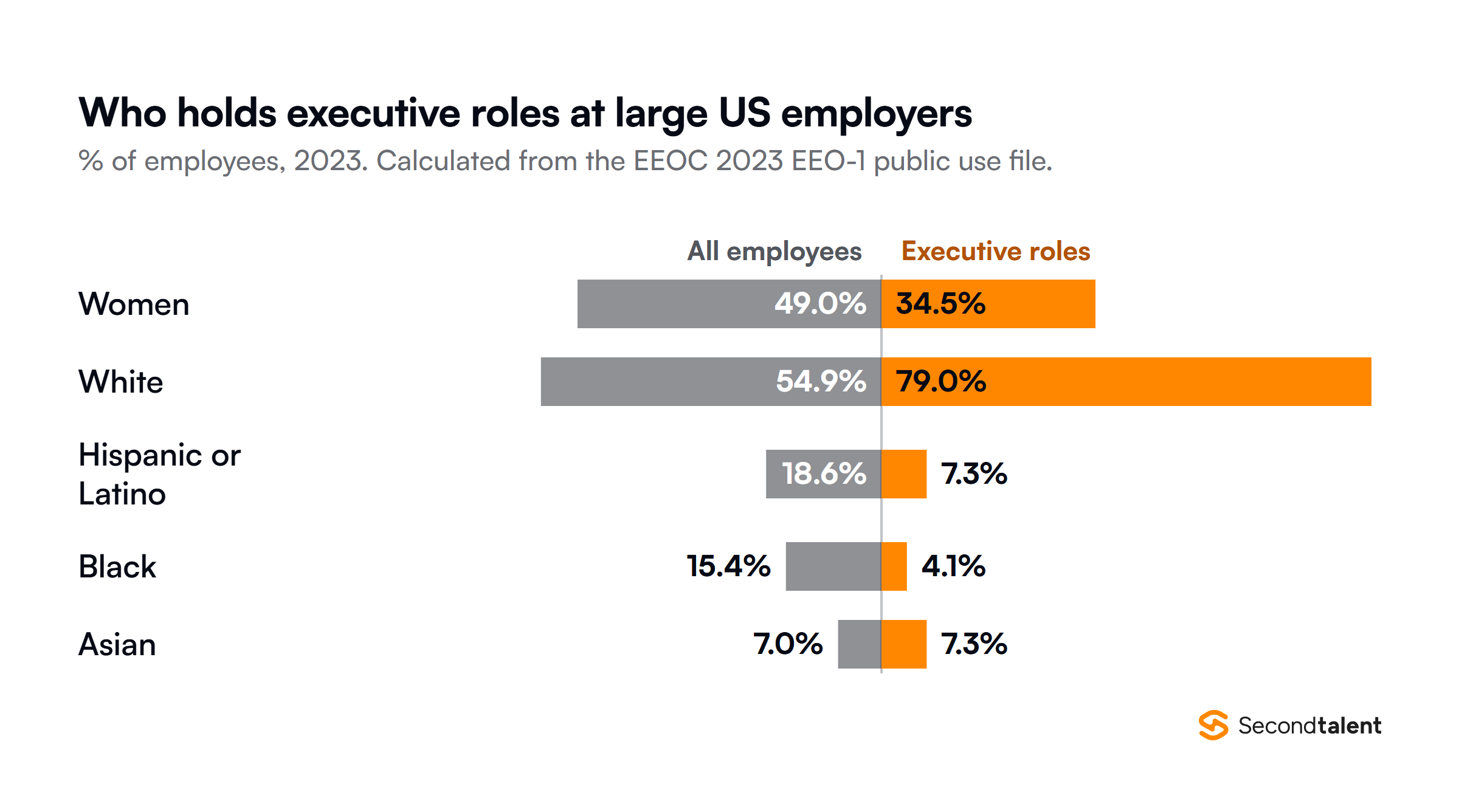
Women held 34.5% of those executive roles, up from 29.2% a decade earlier, the Associated Press reported from the same data. One level down, women were 43.3% of first and mid-level managers.
Women run 11% of the Fortune 500
The record came in a year of exits. Safra Catz left Oracle and Michele Buck left Hershey, yet a record 55 women led Fortune 500 companies when the 2026 list came out, Fortune reported in June. The share was 7.4% in 2020 and sat at 10.4% in both 2023 and 2024.
Women CEOs are rarer on the global list, which includes the largest companies in Greater China and Japan. Fortune notes that no company in the Global 500’s top 30 has a woman in charge.
The first promotion is where women fall behind
Women’s share of C-suite roles stayed at 29% between 2024 and 2025 in Women in the Workplace 2025, the study by LeanIn.Org and McKinsey. It draws on 124 companies employing about 3 million people and a survey of 9,500 employees. The gap opens at the first step up.
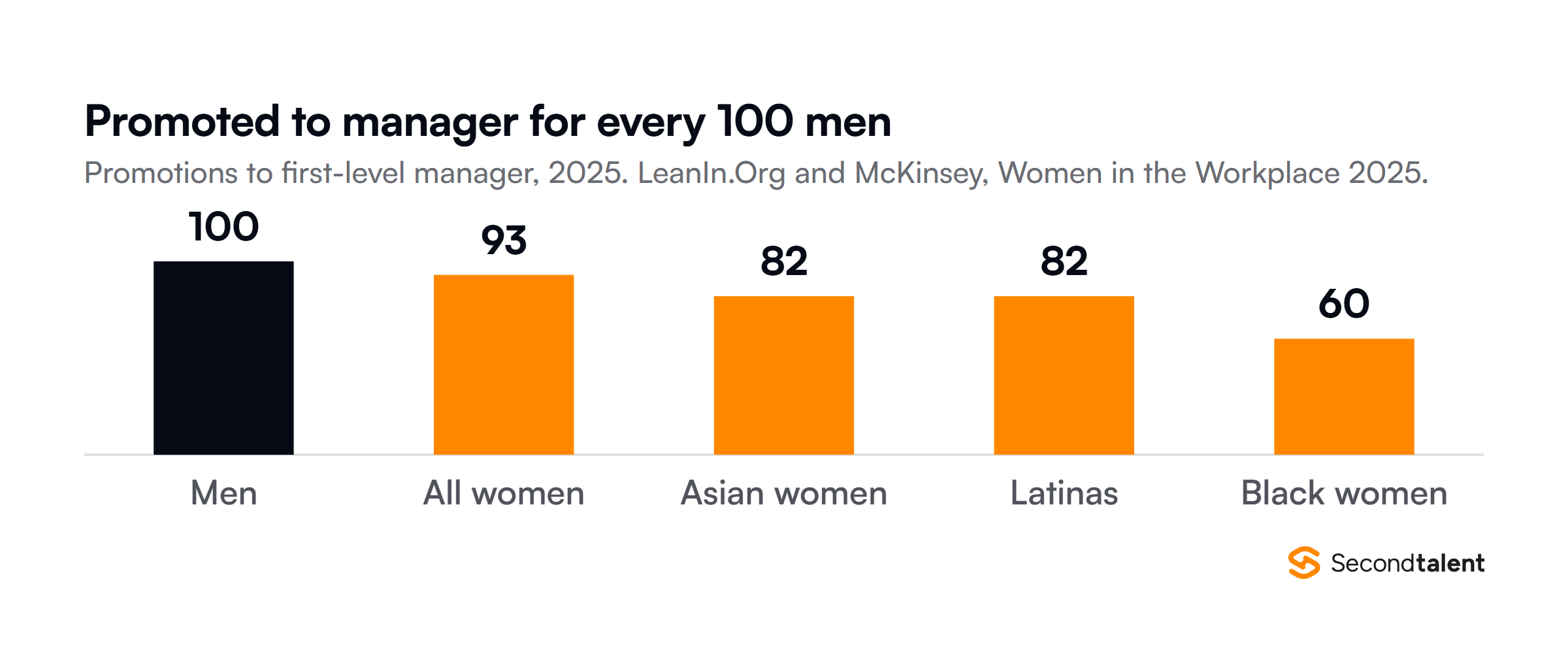
That “broken rung” has held for 11 years in a row. The 2025 study also found an ambition gap for the first time: 80% of women want to be promoted, against 86% of men. Only 21% of entry-level women said their manager encouraged them to use AI, against 33% of entry-level men.
Which US Jobs Have the Widest Gender and Race Gaps?
Women were 4.3% of construction and extraction workers in 2025 and 87.3% of registered nurses, according to BLS household survey data. Across all jobs, women were 47.1% of the 163.5 million employed people.
Race splits by job as well. Asian workers were 7.5% of all employed people but 39.8% of software developers. Hispanic or Latino workers held 41.7% of construction jobs, more than double their 20.0% share of all jobs. Black workers were 12.7% of the employed and 5.6% of chief executives.
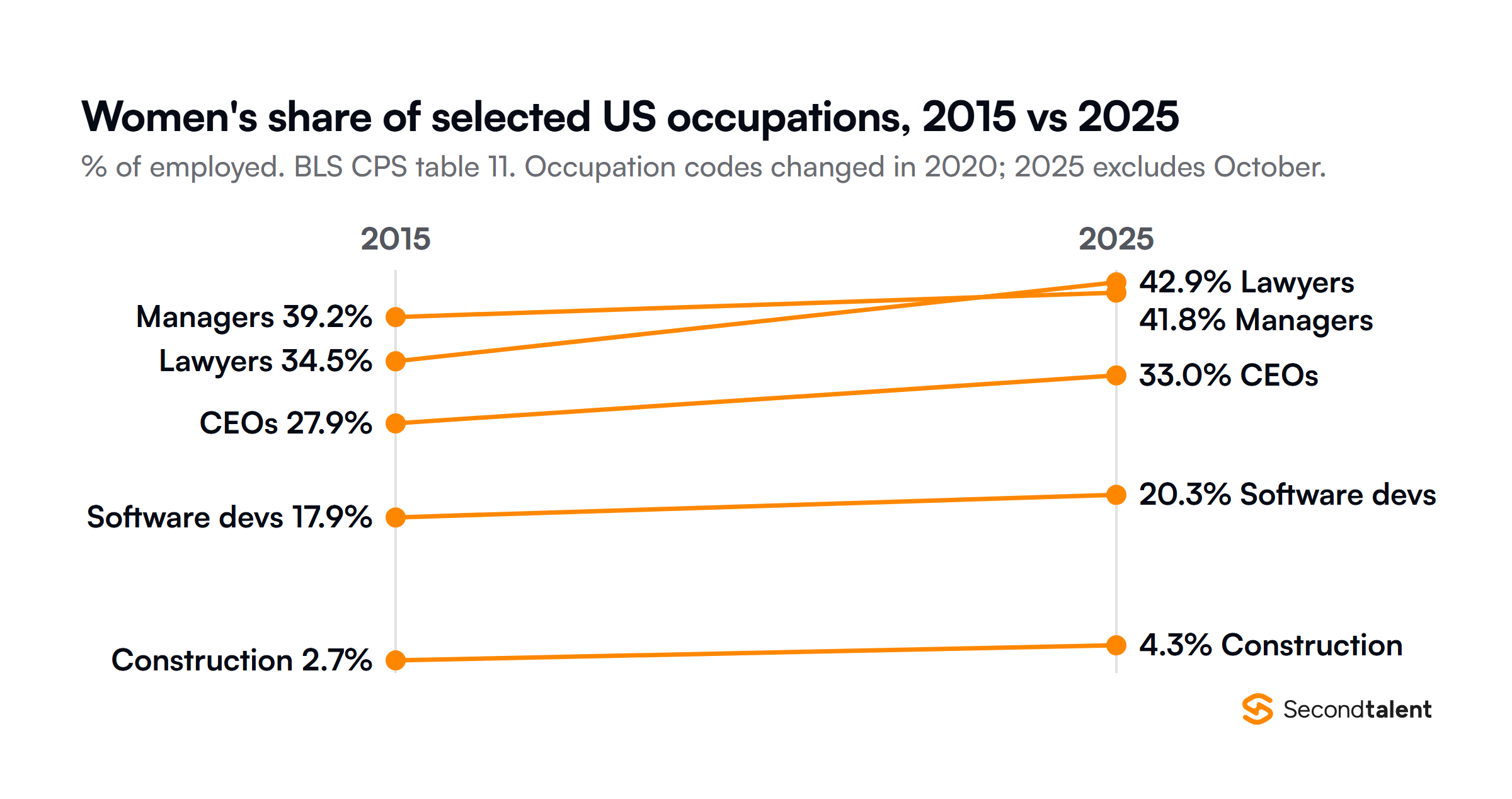
Law moved fastest of these jobs over the decade: women went from 34.5% of lawyers in 2015 to 42.9% in 2025. Software development moved less, from 17.9% to 20.3%. Human resources managers stayed a female-majority job, at 79.6% women in 2025.
Work, unemployment and leaving the workforce
Those are unemployment rates by race for August 2026, from the BLS jobs report. The overall rate was 4.1%. Among people aged 25 to 54, 77.8% of women were in the labor force in 2025, against 89.4% of men.
Caregiving was the top reason women gave for leaving work in 2025. In a Catalyst survey of a little over 200 women who left the workforce, 42% named caregiving and 17% low pay, CNBC reported. Women of color were more likely than white women to say they had been laid off, 53% against 37%.
For the wider picture of why employees quit, see our employee retention statistics.
How Big Is the Gender Pay Gap in 2026?
Black women working full time earned 91.0% of Black men’s median weekly pay in the second quarter of 2026, the narrowest gap of any major group. For all full-time workers, women’s median was $1,131 a week and men’s $1,380, in the BLS usual weekly earnings release.
The gap widens with age. Women aged 16 to 24 earned 91.1% of what men their age earned, while for workers 55 and over the ratio was 78.5%. Pay gaps between men of different races are wider still: Black men’s median was 77.8% of White men’s.
Europe and the OECD
The EU’s unadjusted gender pay gap fell to 11.1% in 2024, from 16.2% in 2011, Eurostat reports. It compares average gross hourly pay at firms with 10 or more employees.
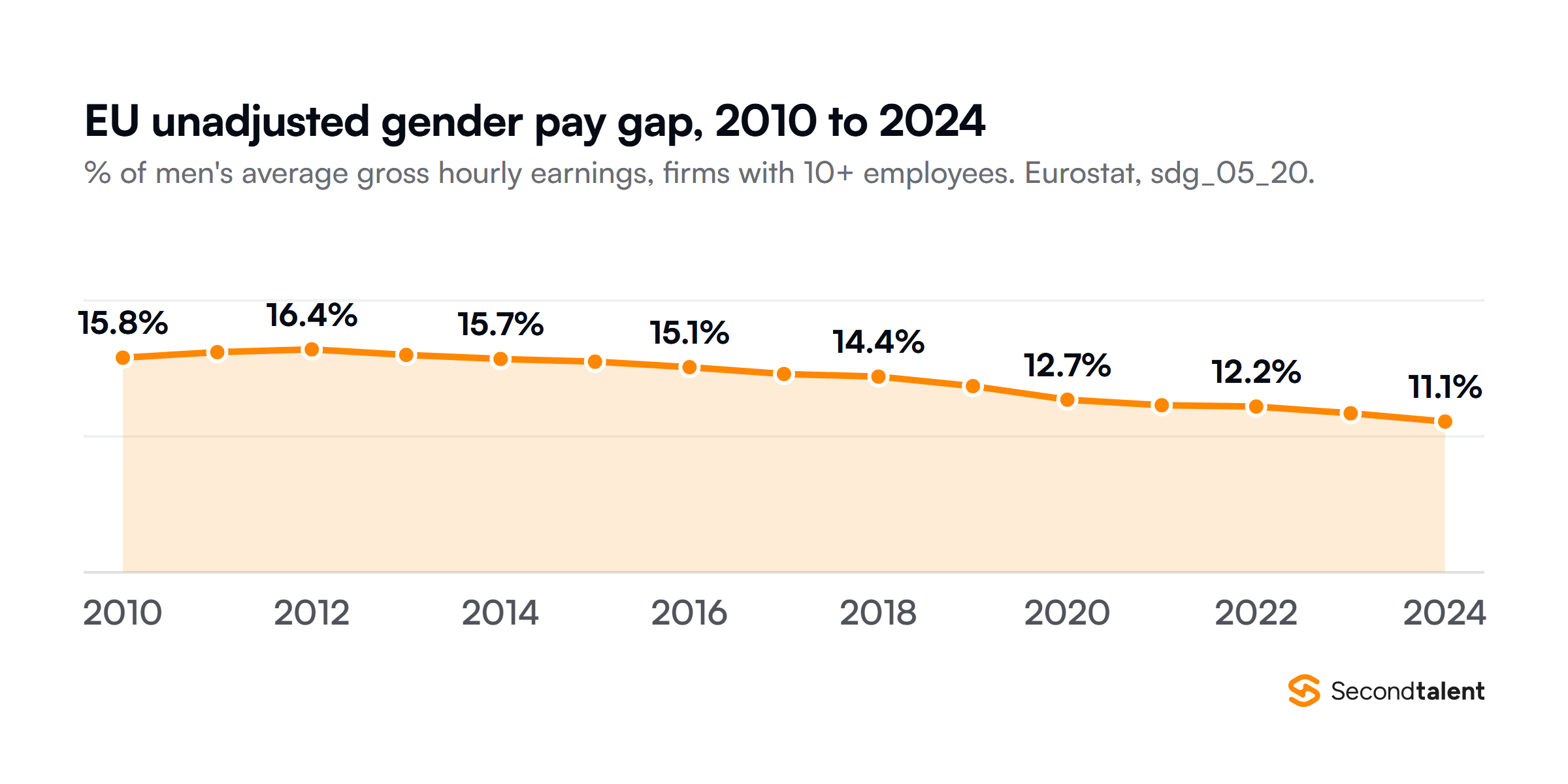
Estonia had the widest gap in 2024, at 18.8%. Luxembourg was the only EU country where women out-earned men on average, by 0.8%. In finance and insurance, the gap reached 40.3% in Hungary.
In the average OECD country, a full-time woman earns about 89 cents for each dollar a man earns, according to an OECD analysis. The gap was 29% in South Korea and 22% in Japan. The OECD finds that three-quarters of the gap comes from pay differences between men and women with similar qualifications inside the same firm.
Which Companies Cut DEI Programs, and When?
Executive Order 14173, signed on January 21, 2025, revoked the 1965 order behind federal contractor affirmative action. Every federal contract and grant must now include a clause in which the recipient certifies that it runs no DEI program that breaks federal anti-discrimination law.
The order also told each agency to identify up to nine potential civil compliance investigations of public companies, large nonprofits, foundations with assets of $500 million or more, bar and medical associations, and universities with endowments over $1 billion. A day earlier, Executive Order 14151 ended DEI programs inside the federal government.
Several of these announcements kept parts of the old programs. The McDonald’s memo said over 30% of its US leaders came from underrepresented groups. It also cited its most recent employee pulse survey, in which 84% of employees said McDonald’s “is an environment that allows me to be myself.”
Target kept its employee resource groups, now open to all. Google said its resource groups would stay. Women made up 48% of Accenture’s workforce and 30% of its managing directors when it dropped its goals, the Guardian reported, citing the company’s annual report.
“The term ‘DEI’ has also become charged, in part because it is understood by some as a practice that suggests preferential treatment of some groups over others.”
Janelle Gale, Meta vice president of people, internal memo published by CNBC, January 10, 2025
Most shareholder votes have gone the other way. More than 98% of Costco votes went against the anti-DEI proposal, Axios reported. At Goldman Sachs, the change came through a deal with the National Legal and Policy Center, which withdrew its proposal, the Guardian reported.
The courts have let the orders run. On February 6, 2026, the Fourth Circuit found the challengers were unlikely to win a facial challenge to the certification and grant termination provisions, law firm Saul Ewing explains. Future challenges have to target specific government actions.
Companies disclose less and prioritize less
Use of the acronym “DEI” in S&P 500 filings fell 68% between 2024 and 2025, The Conference Board found. “Racial” fell 58% and “gender” 35%. Board oversight of DEI moved the other way.
Priorities shifted inside companies too. In 2021, 90% of companies in the Women in the Workplace study called diversity and inclusion a high priority. In 2025, 67% said fostering diversity was, though the 2025 survey used different wording. At least 1 in 6 cut staff or resources for diversity, and 25% scaled back remote or hybrid work.
Our remote work hiring statistics track that pullback across employers. Shareholder pressure is also fading: human capital proposals fell 37% in the 2026 proxy season and average support dropped from 9% to 6%, The Conference Board’s proxy review found. Proposals asking for EEO-1 disclosure drew stronger support than average.
What Happens to Diversity Data if the EEO-1 Ends?
The EEOC puts the cost of its demographic reports at almost $275 million a year for employers and almost $4 million for the agency. Its proposal would end the EEO-1 and five related reports, EEO-2 through EEO-6, along with their recordkeeping rules.
“Because the EEO Data Reports require all covered employers to categorize employees by race and sex annually, disconnected from any allegation of a Title VII violation or related Commission enforcement proceeding, the EEO Data Reports stand in direct tension with Title VII’s requirement that employment practices be colorblind.”
Andrea Lucas, EEOC Chair, EEOC press release, July 21, 2026
Commissioner Kalpana Kotagal, the only Democrat on the commission, voted against. She said the agency used EEO-1 data in a case against a California grocer where “nearly 100 percent of its employees were Hispanic,” the AP reported. Comments closed on August 24, after a public hearing on August 11.
Until the EEOC issues a final rule, current filing duties stay in effect. California, Illinois and Massachusetts collect their own pay data reports, and Colorado is due to join in 2027, Hall Render notes.
Public disclosure was already falling before the vote. In 2025, 24 companies in the S&P 100 stopped publishing EEO-1 data they had released the year before, while 60 still published it, according to Conference Board researcher Andrew Jones. Among Russell 3000 companies, those reporting metrics on women in the workforce fell from 75% to 62%.
How Do Countries Compare on Gender Parity?
The Philippines ranks 20th of 148 economies in the World Economic Forum’s Global Gender Gap Index 2025, ahead of the United States at 42nd. Iceland leads for the 16th year running, with 92.6% of its gap closed.
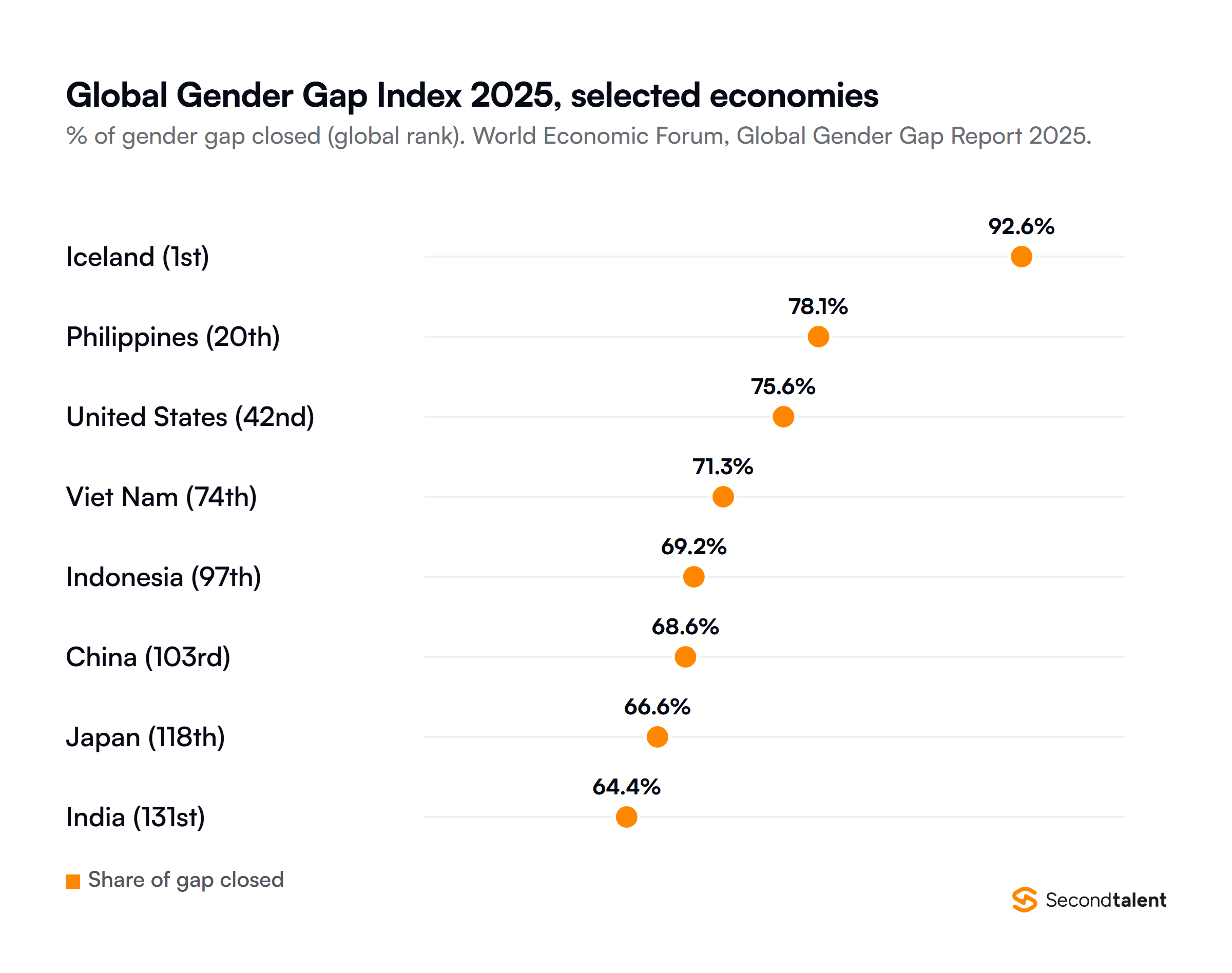
The global score is 68.8%. At the pace of the 100 economies tracked since 2006, full parity is 123 years away, and parity in economic participation 135 years. LinkedIn data in the report puts women at 28.8% of top management roles in 2024, across 74 economies.
Viet Nam, at 74th, has closed 75.9% of its economic participation gap. In the US, the report’s score for women’s estimated earned income fell to 63.3%, its lowest since 2010, even as the score for women in senior roles rose to 75%.
Which EU Countries Met the Pay Transparency Deadline?
Malta’s rules came into force on June 5, 2026, two days before the deadline, after a general election. It was one of four member states to fully transpose the directive on time, with Slovakia, Lithuania and Italy, according to Trusaic’s transposition tracker.
- Slovakia: law published 8 May 2026
- Lithuania: Law No. XV-969, adopted 21 May 2026
- Italy: decree published 1 June 2026
- Malta: regulations in force 5 June 2026
- Czechia, Denmark, Netherlands: targeting 1 January 2027
- Belgium: asked for a six-month delay
- Poland: partial rules in force since 24 December 2025
- Sweden, Estonia: seeking postponement
The directive gives job applicants pay information before hiring and bans questions about pay history. Workers can ask for average pay levels by sex for work of equal value, and employers with at least 100 employees must report their gender pay gap, the European Commission summarizes.
The Commission says it will now assess national laws for conformity. Germany is aiming for 2027, with the right to pay information delayed to 2028, according to Trusaic. Italy’s decree requires first reports by 7 June 2027 from employers with 150 or more employees.
Does Diversity Improve Company Performance?
Researchers disagree. McKinsey’s 2023 report Diversity Matters Even More links diverse executive teams with better financial results across 1,265 companies in 23 countries. Two academics could not reproduce the result for the S&P 500.
- Top quartile for executive gender diversity: 39% more likely to outperform the bottom quartile
- Top quartile for board gender diversity: 27% more likely
- 54.0% of the most ethnically diverse S&P 500 quartile beat their industry margin, against 51.2% of the least diverse
- Difference not statistically significant
Green and Hand say McKinsey would not share its company list, so they rebuilt the test on S&P 500 firms. They also note that McKinsey measured profits in the years before it measured executive diversity, so the link could run from profits to diversity. McKinsey describes its findings as correlations.
Hiring Across Asia With Second Talent
Hiring outside the US means working under each country’s own payroll, leave and benefits law. Second Talent matches companies with pre-vetted developers in the Philippines and across Asia, and our employer of record service handles contracts and payroll where you have no local entity.
Our Philippines payroll guide covers employer costs. Tell us who you need to hire and we will send matching profiles.
Frequently Asked Questions
What do federal contractors have to certify about DEI?
That they run no DEI program that violates federal anti-discrimination law. Under Executive Order 14173, contracts and grants also state that compliance with those laws is material to payment, for the purposes of the False Claims Act.
When do EU employers publish their first pay gap reports?
Employers with 150 or more workers report by 7 June 2027, covering 2026. Those with 100 to 149 start in 2031. If a report shows a gap of at least 5% in a worker category that the employer cannot justify, it must run a joint pay assessment with worker representatives.
What is the difference between an adjusted and unadjusted pay gap?
An unadjusted gap compares the pay of all women with all men, without controlling for job, hours or experience. The Eurostat and BLS figures in this post both measure the unadjusted gap. Adjusted gaps compare similar workers, so they come out smaller, and each study controls for different factors.
Where else can I find US workforce diversity data?
The BLS Current Population Survey publishes employment and earnings by sex, race and occupation every year, and it does not depend on the EEO-1. The HR industry statistics we track cover how HR teams report on their own workforce.

![Tech Industry Hiring Statistics. Top 50+ Tech Industry Hiring Statistics: Salaries, Skills Demand [2026], by Second Talent.](https://www.secondtalent.com/wp-content/uploads/2026/09/tech-industry-hiring-statistics-featured-v2-768x403.jpg)