On most consumer platforms, the recommendation system is the product. What a user sees on a homepage, in a feed, or beside a product listing is chosen by a model, and the difference between a good ranking and a mediocre one shows up directly in engagement, order value, and retention. Few pieces of machine learning have a clearer line to revenue.
A Recommender Systems Engineer builds and operates that machinery: candidate generation, ranking, real-time features, and the experimentation loop that decides whether a change was actually an improvement. It is one of the oldest applied machine learning specialties and it has been reshaped twice, first by deep learning and now by sequence models and generative retrieval.
What is a Recommender Systems Engineer?
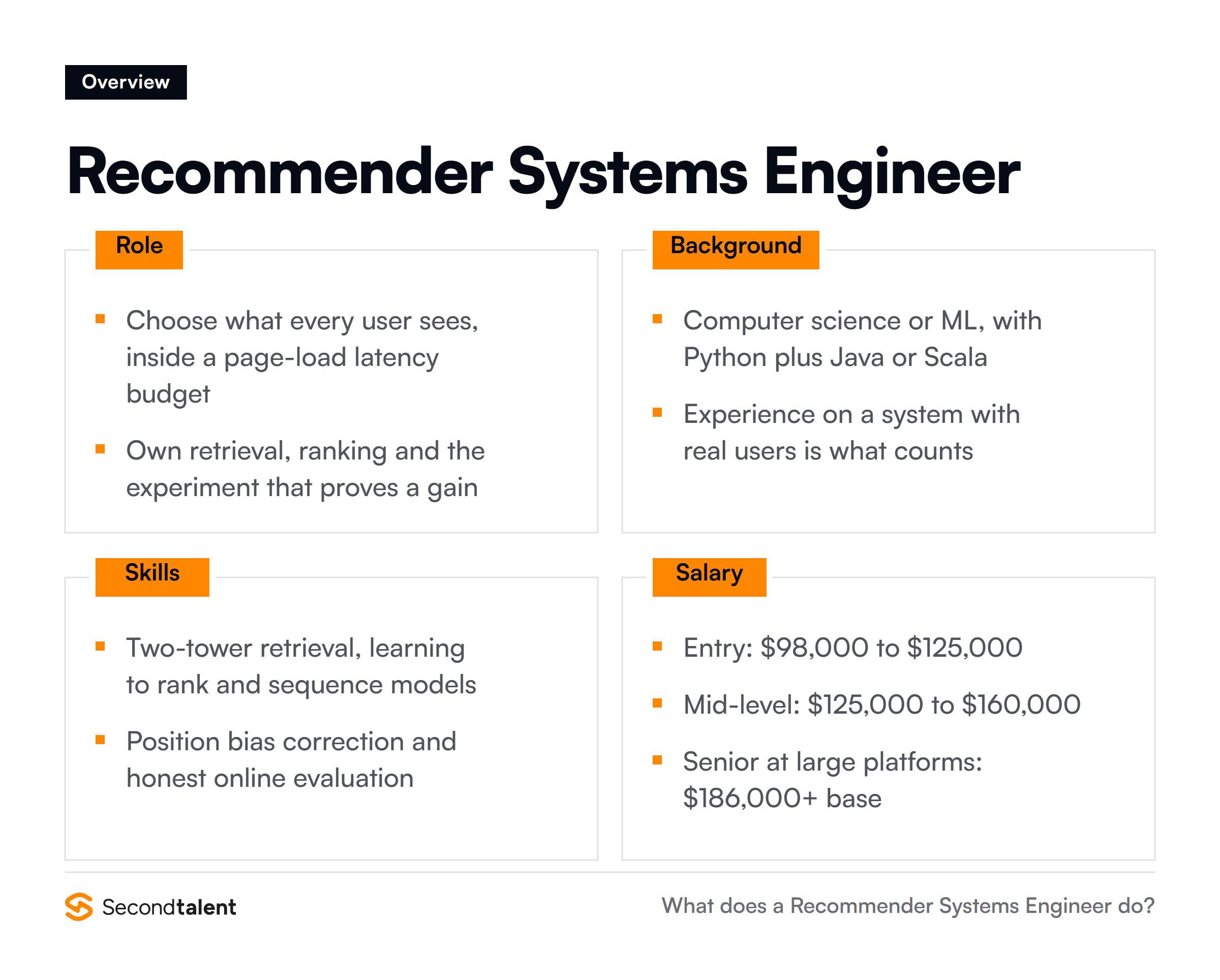
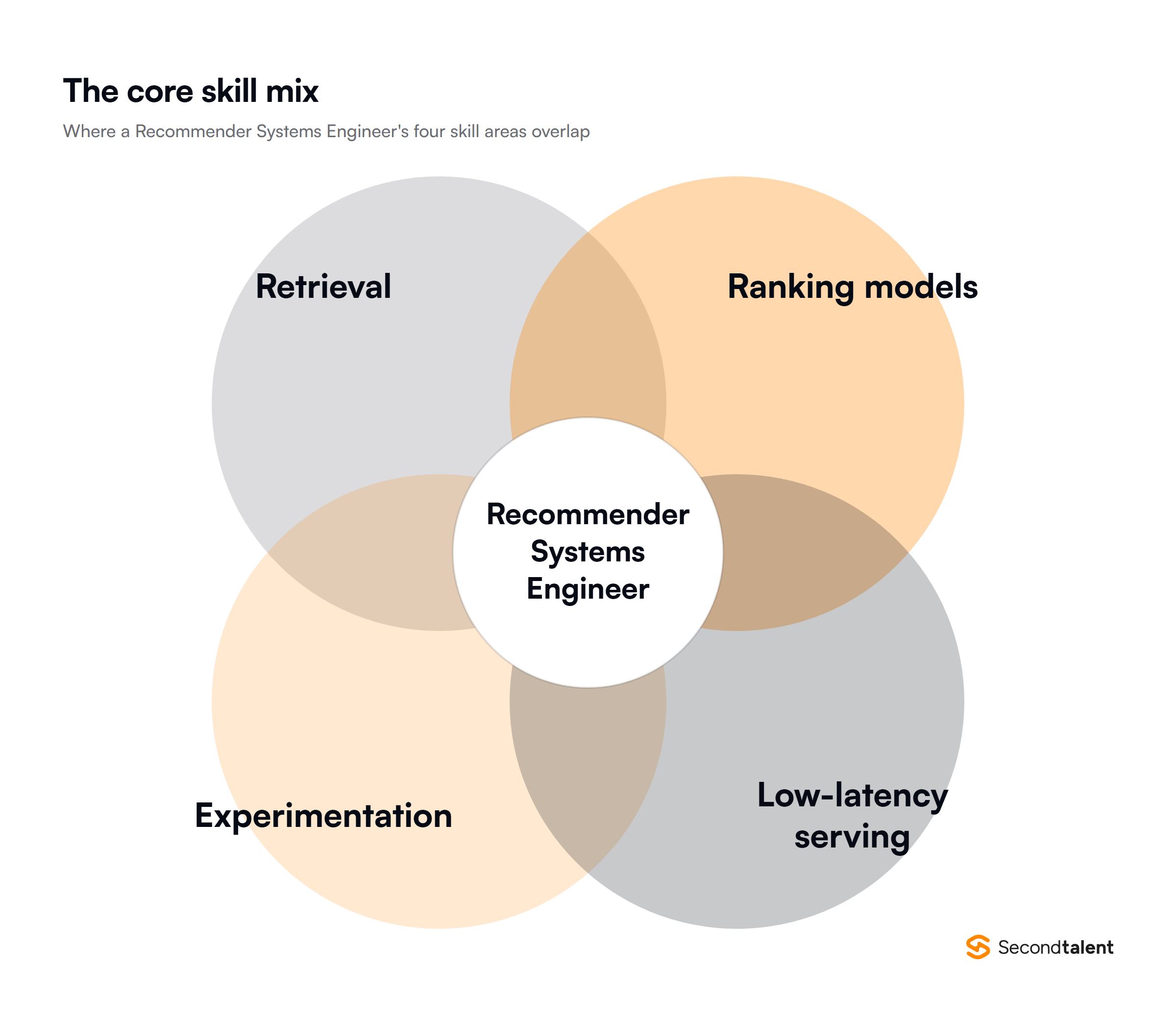
A Recommender Systems Engineer designs, builds, and optimizes the algorithms that suggest relevant content, products, or services based on user behavior and preferences. The role spans machine learning, data engineering, and low-latency serving, because a recommendation that takes two seconds to compute is worthless no matter how accurate it is.
Production systems are almost always staged. A retrieval step narrows millions of candidate items to a few hundred using cheap approximate methods. A ranking model scores that shortlist with an expensive model. A re-ranking step applies business rules, diversity, and freshness. Each stage has different constraints, and engineers frequently specialize in one of them.
The hard problems are not primarily modeling problems. Cold start decides what to show a user or an item with no history. Feedback loops mean the model trains on data its own recommendations generated, quietly amplifying whatever it already favored. Position bias means a click may reflect placement rather than preference. Getting these wrong produces a system that looks excellent offline and stagnates in production.
The role overlaps with the Applied Scientist role, and at some companies they are the same job. The distinction, where one exists, is that the engineer owns the serving system and its infrastructure as well as the model.
Recommender Systems Job Market and Career Opportunities
Demand is broad and durable. E-commerce, streaming, social platforms, marketplaces, food delivery, news, and increasingly financial services and healthcare all run recommendation or personalization systems, and each of them can attribute a measurable share of revenue to it. That attribution is why these teams are usually protected when budgets tighten.
Average Salary Ranges (US market):
- Entry-level Recommender Systems Engineer: $98,000 to $125,000
- Mid-level Recommender Systems Engineer: $125,000 to $160,000
- Reported average for the title: $127,215, with most roles between $98,000 and $157,000
- Senior roles at large consumer platforms, on machine learning engineer bands: $186,000+ base
Title-level figures come from ZipRecruiter’s July 2026 data. Read them as a floor rather than a ceiling: at large consumer platforms this work is compensated on standard machine learning engineer bands, which run considerably higher, and senior personalization engineers at scale sit well above the reported title average.
Asia is a particularly strong market to hire this skill set. The region’s e-commerce, short-video, super-app, and marketplace platforms operate recommendation systems at a scale most Western companies never reach, which produces engineers with genuine large-scale experience at rates far below US bands.
Essential Recommender Systems Skills and Qualifications
Recommendation Modeling:
- Collaborative filtering and matrix factorization, still the correct baseline and still competitive on many problems
- Two-tower and dual-encoder retrieval architectures for large-scale candidate generation
- Learning to rank, including pointwise, pairwise, and listwise objectives and when each fits
- Sequence models for behavior, including transformer-based approaches that treat a user’s history as an ordered sequence
- Content-based and hybrid methods for cold-start users and items
Evaluation and Experimentation:
- Offline metrics: NDCG, recall at k, hit rate, and mean average precision, plus their known weaknesses
- Online experimentation, since offline gains frequently fail to reproduce in an A/B test
- Correcting for position and presentation bias in logged interaction data
- Counterfactual and off-policy evaluation for estimating how an unshipped policy would have performed
- Beyond-accuracy objectives: diversity, novelty, serendipity, and freshness
Systems and Serving:
- Approximate nearest neighbor search with FAISS, ScaNN, or a vector database, and the recall and latency trade-off it forces
- Feature stores and the consistency problem between training-time and serving-time features
- Real-time feature computation, so a user’s last five actions influence the next page they see
- Latency budgets and caching, since ranking happens inside a page load
Data Engineering:
- Large-scale processing with Spark or an equivalent over interaction logs
- Streaming pipelines for behavioral events
- Training data construction, including negative sampling strategy, which affects results more than most model choices
- Data quality monitoring, because a broken logging change silently degrades every downstream model
Educational Background: Computer science, machine learning, or a quantitative field, with Python and often Java or Scala for the data and serving layers. Practical experience with a system that has real users matters more than credentials, because the difficult parts of this role only appear at scale.
Recommender Systems Career Paths and Specializations
Career Progression:
- ML Engineer or Data Scientist → Recommender Systems Engineer → Senior Recommender Systems Engineer → Staff Engineer or Personalization Lead → Head of Personalization or Applied Science
Specialization Areas:
- Retrieval: Candidate generation at scale, embeddings, and approximate nearest neighbor infrastructure
- Ranking: The heavy scoring models, feature engineering, and multi-objective optimization
- Real-Time Personalization: Session-based and streaming systems that respond within a single visit
- Search and Discovery: Where ranking, query understanding, and recommendation converge
- Ads and Marketplace Ranking: Auction dynamics and multi-sided objectives, typically the best-paid specialization
Ads and marketplace ranking pays the most because the objective function includes revenue directly and the systems are adversarial: sellers, advertisers, and users all respond to the ranking, which changes the data the next model trains on.
Recommender Systems Tools and Technologies
Modeling Frameworks:
- PyTorch and TensorFlow, including TensorFlow Recommenders
- Gradient boosting libraries such as XGBoost and LightGBM, which remain strong ranking baselines
- Open-source recommendation libraries including RecBole and Merlin
- Embedding training pipelines for users, items, and content features
Retrieval Infrastructure:
- FAISS and ScaNN for approximate nearest neighbor search
- Vector databases where the retrieval layer needs to be a managed service
- Elasticsearch or OpenSearch for hybrid keyword and vector retrieval
- Caching layers for popular and precomputed recommendation slates
Data and Serving:
- Spark and distributed processing over interaction logs
- Kafka or an equivalent for behavioral event streams
- Feature stores including Feast and commercial equivalents
- Low-latency model serving, with hard latency budgets enforced in production
Experimentation:
- A/B testing platforms with support for long-running holdouts
- Offline evaluation harnesses aligned to online metrics
- Bandit and exploration frameworks for balancing exploitation against discovery
- Monitoring for drift, popularity bias, and coverage collapse
Building Your Recommender Systems Portfolio
Portfolio Components:
- A Full Pipeline: Retrieval, ranking, and re-ranking on a public dataset, with offline metrics reported at each stage
- A Cold-Start Strategy: A documented approach for new users and new items, with measured results rather than a description
- A Bias Analysis: Evidence you can identify and correct for position bias or popularity bias in logged data
- A Latency-Constrained Design: A system built to a serving budget, showing what you traded away to meet it
Beyond-accuracy analysis is the strongest differentiator. Most candidates optimize NDCG on a benchmark. Very few can discuss what happens to catalog coverage and diversity when their model ships, which is exactly the failure mode that damages a real product over months.
Recommender Systems Methodology and Best Practices
Ship the simple baseline first. Popularity and item-to-item collaborative filtering are surprisingly strong, and without them you cannot tell whether a deep model earned its complexity and its serving cost.
Trust the A/B test over the offline metric. Offline gains routinely fail to reproduce online, because logged data reflects what the previous system chose to show. Treat offline evaluation as a filter, not as proof.
Design against the feedback loop. A model trained only on interactions its own recommendations produced narrows over time. Deliberate exploration is not a research luxury; it is what keeps the catalog from collapsing to a few popular items.
Correct for position bias. Items shown first are clicked more regardless of quality. Training on raw click data without correction teaches the model to reproduce the previous ranking rather than improve on it.
Measure more than accuracy. Coverage, diversity, and freshness protect the long-term health of the marketplace or catalog. A system optimized purely for immediate clicks tends to degrade the thing it is ranking.
Guard training and serving consistency. A feature computed one way in training and another way at serving time is the most common silent bug in this field, and it is almost invisible in offline evaluation.
Future of Recommender Systems Careers
Sequence and transformer-based models have become the default for behavioral modeling, treating a user’s history as an ordered sequence rather than a bag of interactions. That shift raised the ceiling on what these systems can capture and raised the infrastructure requirements alongside it.
Expect generative and language-model-assisted recommendation to expand. Using a language model to interpret intent, explain a recommendation, or generate candidates from a natural language request is moving from experiment into product, and it puts a new set of skills next to the classic ranking stack.
Expect privacy constraints to keep reshaping the field. Reduced third-party tracking and stricter data rules push personalization towards first-party signals and on-device approaches, which changes what features are available rather than reducing the need for the role.
Expect the fundamentals to hold their value. Retrieval and ranking architecture, evaluation discipline, and bias correction have survived every modeling shift so far, and they are what makes an engineer effective on whatever model family comes next.
Getting Started as a Recommender Systems Engineer
Practical Steps:
- Build a complete pipeline on a public dataset, including retrieval and ranking as separate stages rather than one model
- Implement collaborative filtering from scratch once, so the intuition behind the modern architectures is grounded
- Learn ranking metrics properly, including where NDCG and recall at k mislead
- Study position bias and off-policy evaluation, which is the knowledge gap that most distinguishes candidates
- Build something with a real latency budget, since serving constraints shape design more than model choice does
- Read published system descriptions from large platforms, which are unusually open about their recommendation architectures
Candidates arriving from general machine learning usually need to build serving and data engineering depth. Candidates arriving from backend or data engineering usually need to build ranking and evaluation knowledge. Both are common routes into the role.
If you are hiring rather than applying, Second Talent places Recommender Systems Engineers and other AI-native talent across Asia, with vetting, compliance, and payroll handled for you.
Frequently Asked Questions
What is the difference between a Recommender Systems Engineer and a Machine Learning Engineer?
A machine learning engineer is a general role covering model development and deployment across problem types. A recommender systems engineer specializes in ranking and personalization, with specific depth in retrieval architecture, ranking objectives, position bias, cold start, and low-latency serving. The specialization matters because these systems fail in ways general ML training does not cover.
What is the cold-start problem?
Cold start is the difficulty of recommending for a user or an item with no interaction history. New users have no behavior to learn from and new items have no engagement signal, so pure collaborative filtering cannot place them. The usual answers are content-based features, contextual signals, and deliberate exploration, and how well a system handles cold start largely determines whether new inventory ever gets discovered.
Why do offline improvements often fail in an A/B test?
Because offline evaluation uses logged data produced by the system currently in production, which only shows what that system chose to display. A new model is judged on a biased sample of what users might have engaged with, and effects such as position bias, novelty, and user adaptation do not appear offline at all. Offline metrics are a useful filter, not a substitute for an online test.
How much does it cost to hire a Recommender Systems Engineer through Second Talent?
Cost depends on seniority and the scale of your system. Asia is a particularly strong market for this role, since the region’s e-commerce, marketplace, and short-video platforms run personalization at a scale that produces genuinely experienced engineers, at rates well below US bands. Get in touch for a current rate breakdown.
How quickly can Second Talent place a Recommender Systems Engineer?
We can usually present a shortlist of pre-vetted candidates within days, with placements typically completed in a few weeks depending on your interview process and start-date requirements.
Related Roles
Explore related roles you can hire on Second Talent: Applied Scientist, Behavioral Data Scientist, Machine Learning Infrastructure Engineer, Data Pipeline Engineer, E-commerce Specialist, Knowledge Graph Engineer.