Research that never leaves the lab tends to answer questions nobody asked. Meanwhile the most valuable signal about how a product actually performs is sitting in a customer’s workflow, unobserved.
Forward Deployed Researchers close that loop. They embed with customers, study how the product is genuinely used, run experiments against real conditions rather than clean benchmarks, and carry findings back to the teams building the thing.
In AI companies especially, this has become one of the highest-leverage roles on the field team.
What is a Forward Deployed Researcher?
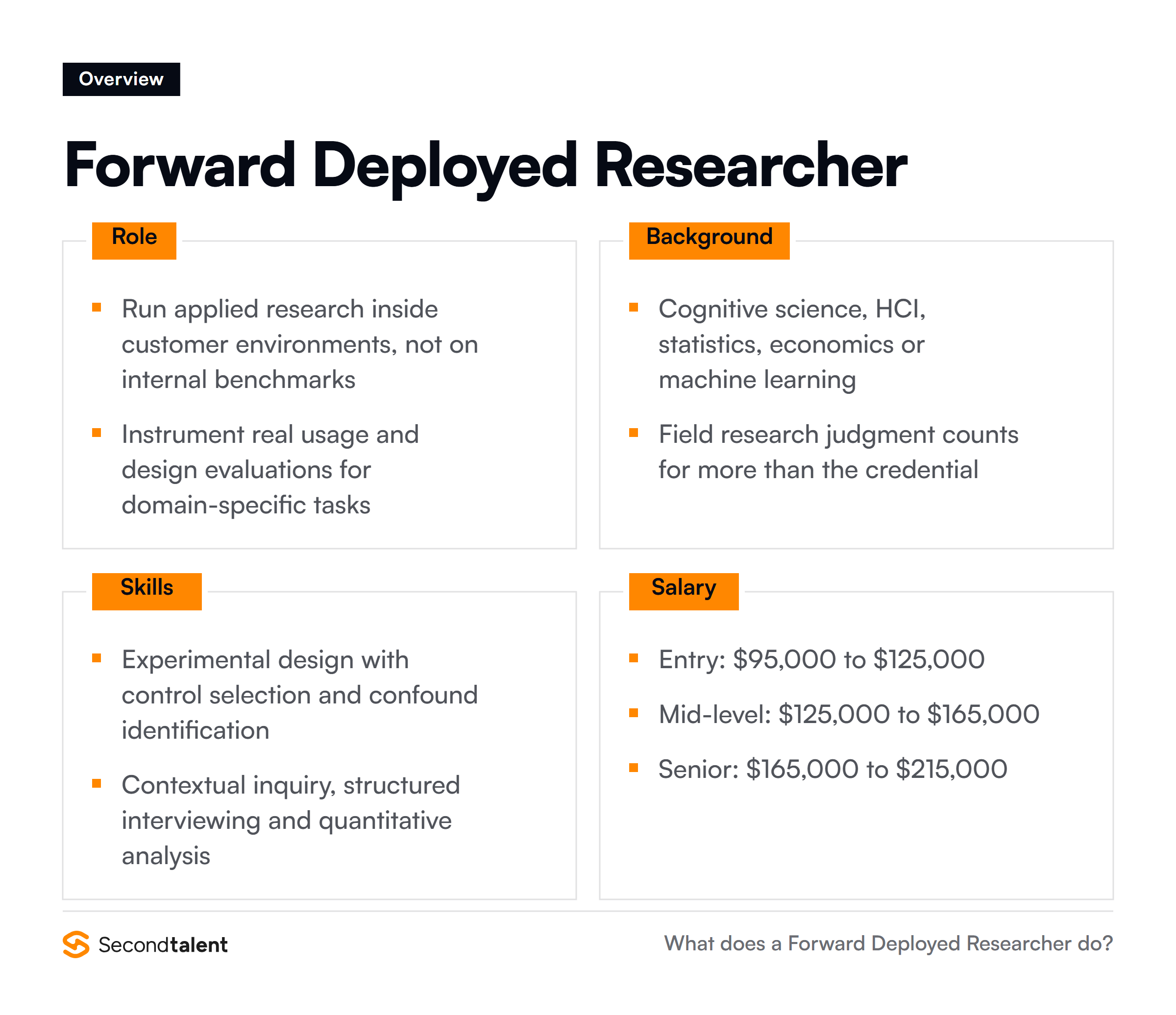
A Forward Deployed Researcher conducts applied research inside customer environments.
Rather than working from internal datasets and controlled benchmarks, they gather evidence where the product meets reality: observing workflows, instrumenting real usage, running structured experiments on customer data, and interviewing the people whose work the product is meant to change.
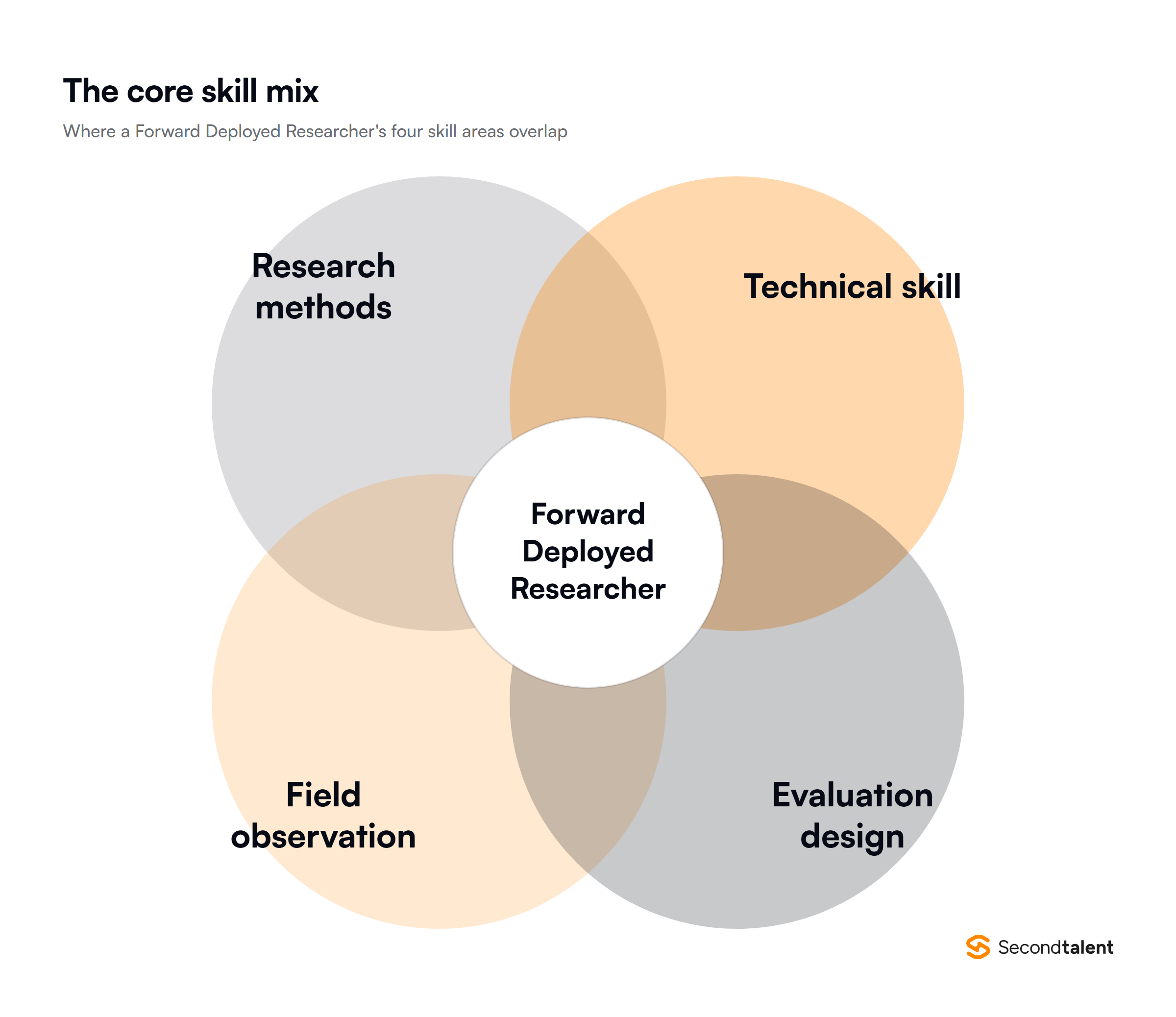
The role blends three traditions. From user research it takes observation, interviewing, and synthesis. From applied science it takes experimental design, measurement, and statistical rigor.
From forward deployed engineering it takes the embedded model, in which you work alongside the customer rather than surveying them from a distance.
Output is not a paper. It is a decision-grade finding: which capability gap is blocking adoption, which failure mode is costing the customer trust, which benchmark the team is optimizing that does not predict real-world performance.
In AI organizations, Forward Deployed Researchers frequently own the domain-specific evaluation sets that internal teams then build against.
Forward Deployed Research Job Market and Career Opportunities
This is an emerging title, concentrated in AI labs, applied AI companies, and enterprise platform vendors where the gap between benchmark performance and customer-perceived performance has become a commercial problem.
As organizations discover that internal evaluations do not predict deployment success, they invest in people who can measure the real thing.
Adjacent demand comes from health technology, financial services, and industrial companies deploying complex systems where field evidence determines whether a product is trusted.
Average Salary Ranges (US market):
- Entry-level Forward Deployed Researcher: $95,000 – $125,000
- Mid-level Forward Deployed Researcher: $125,000 – $165,000
- Senior Forward Deployed Researcher: $165,000 – $215,000
- Staff / Principal Forward Deployed Researcher: $215,000 – $280,000+
Roles at frontier AI labs sit above these bands. Hiring researchers across Asia offers substantial cost advantages alongside access to strong quantitative talent.
Essential Forward Deployed Research Skills and Qualifications
Research Skills:
- Experimental design, including control selection and confound identification
- Qualitative methods: contextual inquiry, structured interviewing, and observation
- Quantitative analysis and appropriate statistical inference
- Evaluation and benchmark design for domain-specific tasks
- Synthesis: turning messy field evidence into a defensible recommendation
Technical Skills:
- Python and the standard analysis stack, including pandas and notebooks
- SQL and comfort working with unfamiliar production data schemas
- Instrumentation and telemetry design for capturing real usage
- For AI contexts, working knowledge of model behavior, evals, and error analysis
- Data visualization that communicates rather than decorates
Field Skills:
- Building trust quickly with customer staff who did not ask to be studied
- Navigating data access, privacy, and consent constraints
- Reporting inconvenient findings to internal teams without diplomacy failures
- Working with incomplete data and knowing which conclusions it will not support
Educational Background: Common backgrounds include cognitive science, human-computer interaction, statistics, economics, and machine learning.
Advanced degrees are common but demonstrated field research judgment matters more than the credential.
Forward Deployed Research Career Paths and Specializations
Career Progression:
- UX Researcher / Data Scientist / Research Engineer → Forward Deployed Researcher → Senior Forward Deployed Researcher → Principal Researcher or Head of Applied Research → Research or Product leadership
Specialization Areas:
- Applied AI Evaluation: Domain-specific eval sets and real-world model performance
- Human-AI Interaction: How people actually work alongside automated systems
- Regulated Domains: Clinical, financial, and safety-critical field research
- Adoption and Change: Why deployed technology succeeds or is quietly abandoned
- Measurement Infrastructure: Building the telemetry that makes field research repeatable
The role’s rare combination of customer proximity and analytical rigor makes it a natural feeder into product leadership and applied research management.
Forward Deployed Research Tools and Technologies
Analysis:
- Python with pandas, scikit-learn, and Jupyter
- R for statistical work where appropriate
- SQL against warehouses such as Snowflake and BigQuery
- Notebook-based reproducible analysis workflows
Qualitative Research:
- Interview and session recording platforms
- Transcription and thematic coding tools
- Diary study and in-context observation methods
- Research repositories such as Dovetail
Evaluation and Instrumentation:
- Eval frameworks and annotation tooling
- Product analytics such as Amplitude and Mixpanel
- LLM tracing platforms for AI deployments
- Experiment and feature-flag platforms
Communication:
- Visualization in matplotlib, Plotly, or Looker Studio
- Structured written reports and decision memos
- Shared research repositories accessible to product and engineering
Building Your Forward Deployed Research Portfolio
Portfolio Components:
- Field Study Write-Up: A real research question, the method chosen, and why
- Evaluation Set: A domain benchmark you designed, with its validity argument
- Decision Impact: A case where your finding changed a product or roadmap decision
- Methodological Honesty: A study whose limitations you documented clearly
- Communication Artifact: The actual memo or deck that moved a stakeholder
Interviewers probe for whether you can distinguish a finding from an anecdote. Portfolios that show sample sizes, competing explanations considered, and stated confidence levels stand out sharply.
Forward Deployed Research Methodology and Best Practices
Start from a decision, not a curiosity. Establish which decision the research will inform and who will make it. Research without an owner and a decision attached rarely changes anything.
Observe before you ask. People describe their workflow inaccurately, not dishonestly. Watching the work reveals the gaps that interviews miss.
Triangulate. Combine telemetry, interviews, and direct observation. Any single source will mislead you, and agreement across three is far stronger evidence than depth in one.
Respect the constraints you are working under. Customer data comes with privacy, consent, and contractual limits. Design the study around them from the outset rather than seeking forgiveness later.
Report the uncomfortable result. The role’s entire value rests on being a reliable source of truth about how the product performs in the field.
A researcher who softens findings to keep internal teams comfortable is worse than no researcher.
Future of Forward Deployed Research Careers
As AI systems become more capable, the difficulty of evaluating them grows rather than shrinks.
Static benchmarks saturate, and the questions that matter, such as whether the system helps this team do this job more reliably, can only be answered in the field. That structural fact should keep demand rising.
Expect increasing formalization.
What is currently ad hoc field work at AI companies is likely to become a defined discipline with shared methods, tooling, and standards, in the way that user research professionalized over the previous two decades.
Governance is another tailwind. As AI regulation matures, organizations will need documented, credible evidence about real-world system behavior, which is precisely what this role produces.
Getting Started as a Forward Deployed Researcher
Practical Steps:
- Build genuine competence in both qualitative and quantitative methods; the role needs both
- Run a field study end to end, however small, and write it up honestly
- Learn evaluation design, which is the most transferable skill in AI contexts
- Get comfortable with messy, undocumented production data
- Practice writing short decision memos rather than long reports
- Seek roles with direct customer access, even in a support capacity at first
Researchers from academic backgrounds usually need to adjust to speed and decision-orientation. Those from product analytics usually need to build qualitative depth.
If you are hiring rather than applying, Second Talent places applied and field researchers across Vietnam, the Philippines, and the wider Asia region.
Frequently Asked Questions
How is a Forward Deployed Researcher different from a UX researcher?
UX research typically studies usability and experience, often in controlled sessions.
A Forward Deployed Researcher embeds in the customer’s live environment and studies system performance and adoption in real conditions, usually combining qualitative observation with quantitative measurement of how the product actually behaves.
How is it different from an AI Research Scientist?
An AI Research Scientist advances model capability, usually working from internal datasets and benchmarks.
A Forward Deployed Researcher measures how those capabilities perform against real customer tasks and feeds that evidence back into development priorities.
Is a PhD required?
No, though advanced degrees are common. What matters is demonstrated research judgment: designing a study that answers the question asked, recognizing confounds, and stating conclusions with appropriate confidence.
How much travel or on-site work is involved?
It varies. Some engagements are largely remote with periodic on-site visits; others require sustained presence at customer sites.
Distributed teams increasingly run this role remotely with instrumented telemetry supplementing direct observation.
Can Second Talent help us hire this role?
Yes. We place applied researchers with field research and evaluation experience across nine Asian markets, with employment and compliance handled for you.
Related Roles
Explore related roles you can hire on Second Talent: Forward Deployed Engineer, AI Forward Deployed Engineer, AI Research Scientist, Behavioral Data Scientist, Human-AI Interaction Designer, AI Ethics Researcher.