In the 2025 Stack Overflow Developer Survey, 84 percent of developers said they use or plan to use AI tools, but only 14.1 percent use AI agents every day.
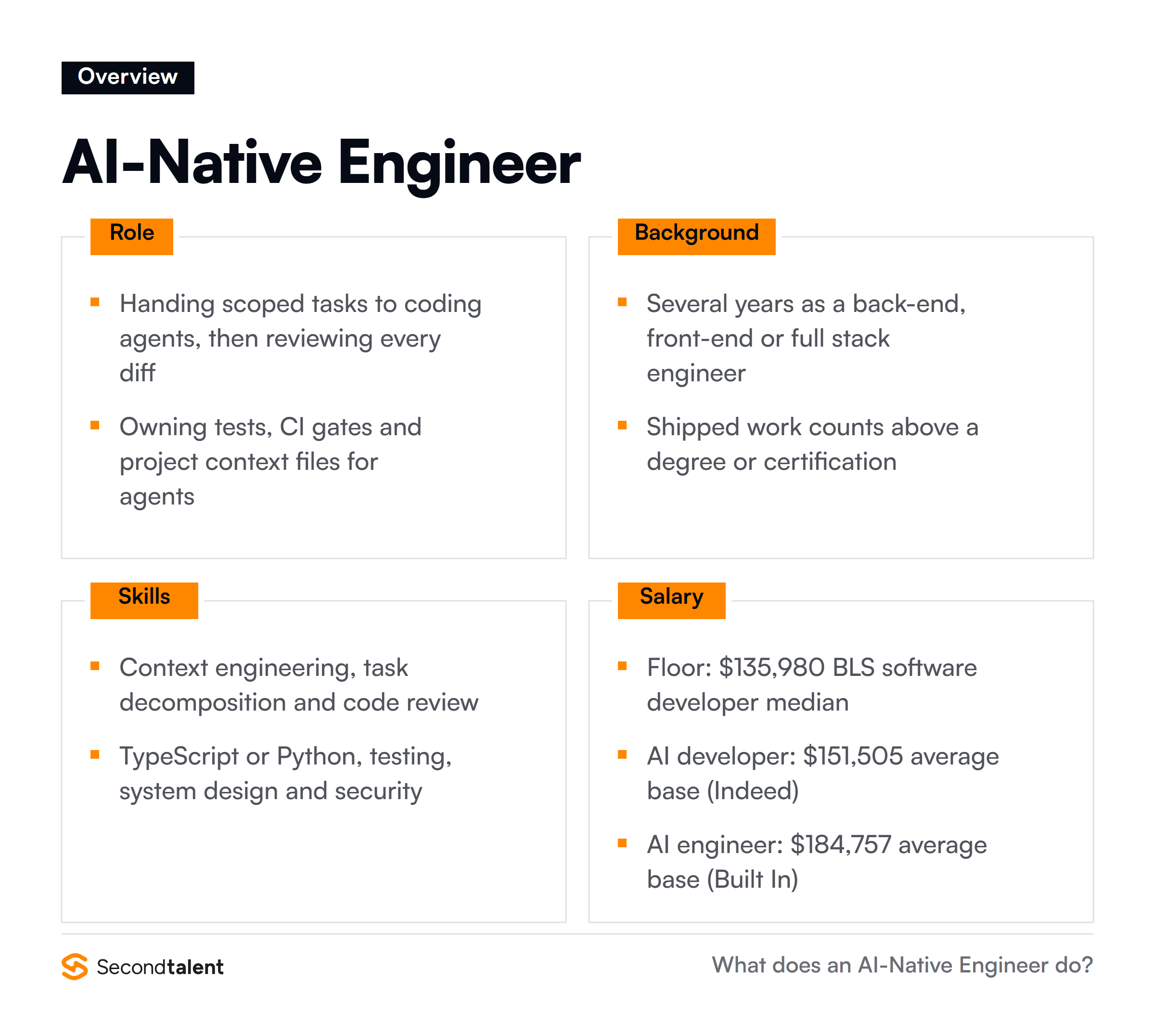
An AI-native engineer works in that smaller group: a software engineer who hands scoped tasks to coding agents all day, then reviews, tests and owns everything those agents produce.
The title is new enough that no federal wage series tracks it. US pay sits between the median for software developers and the averages reported for AI engineers.
What is an AI-Native Engineer?
An AI-native engineer is a software engineer whose default way of working runs through AI coding agents and language models. The job is still building and shipping software: product features, APIs, data flows, internal tools.
What changes is the loop. The engineer writes the plan and the guardrails, an agent drafts the code, tests and migrations, and the engineer reviews every diff before it merges.
"AI-native" describes how someone works, not what they build. A back-end, front-end, full stack or platform engineer can be AI-native. Two traits separate the role from a developer who simply has an AI assistant installed:
- The agent is part of the system, not a shortcut. The engineer keeps written project context for agents, splits work into tasks an agent can finish, and connects agents to real tools through protocols such as MCP.
- Verification is the job. Tests come before generation, generated code is treated as untrusted until it passes review, and the engineer can explain every line that ships.
Many AI-native engineers also build AI into the product itself, such as a retrieval feature or an agent workflow, but that is not required.
An engineer who ships ordinary SaaS features twice as fast with agents, without a higher defect rate, fits the title. For the full side-by-side with a hand-coding engineer, see AI-native vs traditional engineers.
AI-Native Engineer Job Market and Salary
The Bureau of Labor Statistics has no AI-native engineer category, and salary sites do not track the title yet. The band below is built from three published figures, each labeled with what it measures:
- Floor, BLS software developers: $135,980 median annual wage in May 2025. Software publishers paid a median of $164,550, and the top 10 percent of software developers earned more than $214,670.
- Indeed, AI developer: $151,505 average base salary, from about 3,800 salaries in job postings, updated October 12, 2026, with a range of $92,136 to $249,131.
- Built In, AI engineer: $184,757 average base salary and a $180,000 median, plus $26,486 in average additional cash for $211,243 in total compensation.
How to read it: an AI-native engineer building ordinary product software is paid like a strong software developer, roughly $136,000 to $151,000 in base salary.
One who also ships AI features (retrieval, agents, evaluation) is priced against AI engineer data, closer to $185,000. This is our derived band, not a survey of the title.
At large tech employers, Levels.fyi reports $250,000 median total compensation for software engineers with an ML or AI focus, which includes equity.
Experience moves pay sharply. Built In reports an $80,000 average for AI engineers with under a year of experience and $194,413 for those with seven or more years.
Demand signal: AI engineer leads LinkedIn Jobs on the Rise 2026, the list of the 25 fastest-growing US job titles.
BLS projects 10 percent employment growth for software developers from 2025 to 2035, much faster than the average for all occupations. For hourly rates and the cost of hiring the same skills from Asia, see the AI-native engineer cost guide.
AI-Native Engineer Responsibilities
Agent output is already a measurable share of software work. GitHub's Octoverse 2025 report counted more than 1 million pull requests created by the Copilot coding agent between May and September 2025.
Someone has to scope, review and merge that work, and on a startup team that someone is the AI-native engineer.
Typical Day-to-Day Work
- Planning with the agent: turning a ticket into a written spec, acceptance criteria and a task list small enough for an agent to finish in one pass
- Maintaining project context: keeping AGENTS.md or similar rules files current so agents follow the team's conventions, test commands and no-go areas
- Running agents in parallel: assigning tests, migrations, refactors and boilerplate to agents while the engineer works on design decisions
- Reviewing diffs: reading every change line by line, rejecting plausible but wrong code, and checking security-sensitive paths by hand
- Owning quality gates: tests written before generation, CI that blocks bad output, and evaluation sets for any LLM feature
- Wiring tools: connecting agents to the repo, issue tracker, database or internal APIs, often through MCP servers
At a seed or Series A startup one AI-native engineer often owns a whole feature area end to end. On larger teams it includes setting agent standards for other engineers.
Essential Skills and Qualifications
Trust is the skill gap. The 2025 Stack Overflow survey found 45.7 percent of developers distrust the accuracy of AI output, against 32.7 percent who trust it.
The most common frustration, cited by 66 percent, is "AI solutions that are almost right, but not quite." An AI-native engineer is paid to catch the "not quite."
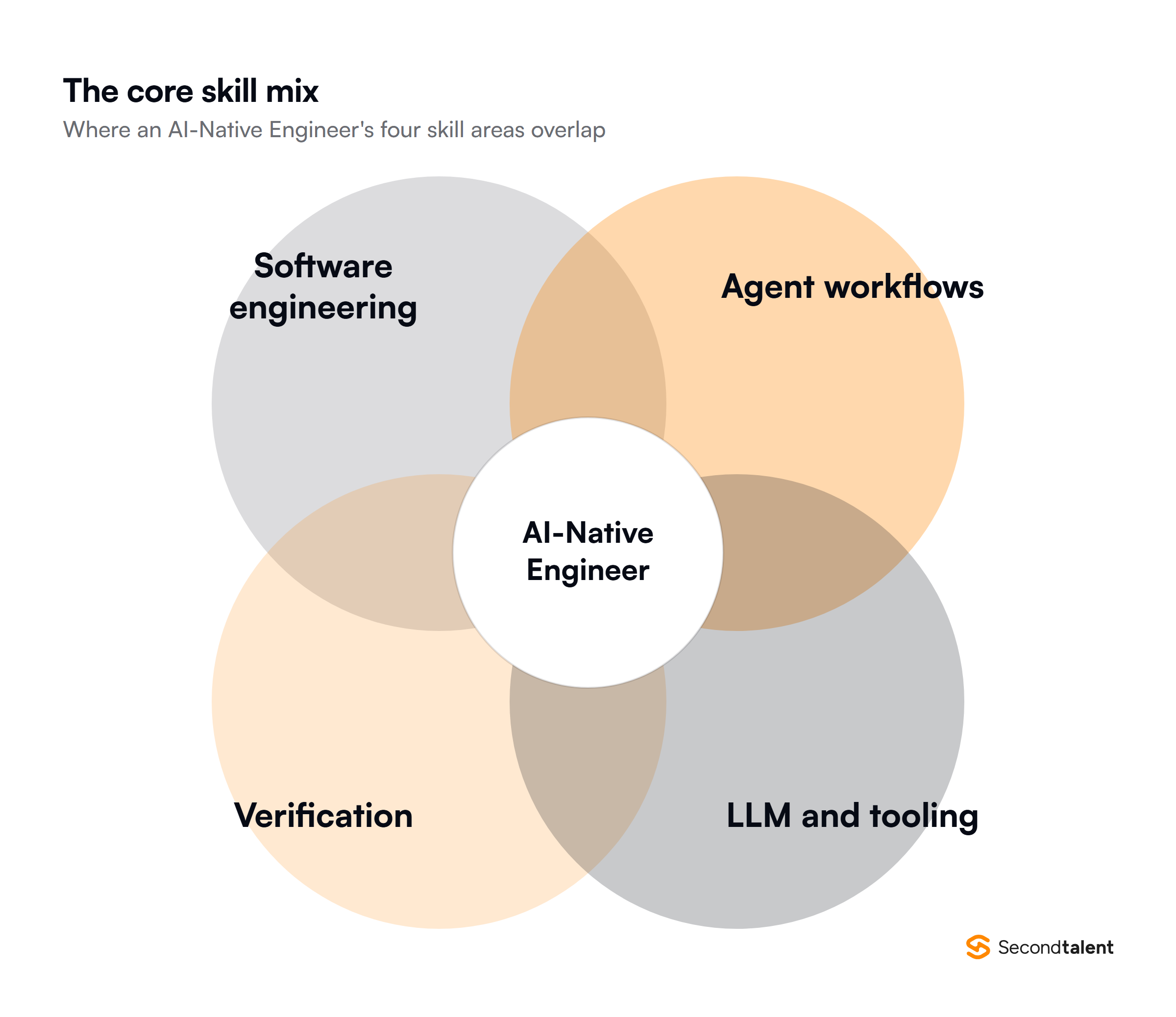
Software Engineering Foundations:
- Fluency in at least one production language, usually TypeScript or Python, deep enough to review code faster than an agent writes it
- Testing discipline: unit, integration and end-to-end tests, and writing the failing test first
- System design: APIs, data models, queues and the tradeoffs an agent will not raise on its own
- Security review: input validation, secrets handling, dependency risk and authorization checks
Agent and LLM Skills:
- Context engineering: writing specs, rules files and examples that make agent output predictable
- Task decomposition: breaking work into pieces an agent can complete and a human can verify
- Model fluency across more than one provider, including context limits, cost per request and when a smaller model is enough
- Retrieval, tool calling and evaluation for teams that ship AI features to users
Judgment: knowing when not to use an agent. A sensitive data migration or a security fix often goes safer by hand.
Qualifications: there is no degree or certification for the title. Most US postings ask for a bachelor's degree in computer science or equivalent experience, plus several years as a software engineer.
Employers weigh shipped work, and a clear account of what an agent got wrong and how it was caught, above credentials.
AI-Native Engineer Tools and Tech Stack
The stack is young and changes by the quarter, so the habits transfer better than any single tool. Two open standards now anchor it.
In December 2025 the Linux Foundation formed the Agentic AI Foundation around Anthropic's Model Context Protocol, Block's goose and OpenAI's AGENTS.md.
The announcement put AGENTS.md adoption at more than 60,000 open source projects and agent frameworks, with more than 10,000 published MCP servers.
- Coding agents: Claude Code, OpenAI Codex, Cursor and GitHub Copilot, used in the terminal and the IDE
- Project context: AGENTS.md or tool-specific rules files, plus written specs checked into the repo
- Tool connections: MCP servers for the repo, browser, database, issue tracker and internal APIs
- Model APIs: Anthropic, OpenAI, Google Gemini and open-weight models, chosen by task, latency and cost
- Agent frameworks: LangGraph, the OpenAI Agents SDK or the Claude Agent SDK for features that take multiple steps and call tools
- Retrieval and evaluation: pgvector or a vector database, plus an eval suite that scores every prompt or model change
- Quality gates: CI, type checking, linting, test coverage and security scanning on every agent-written change
Typed languages fit this workflow. Octoverse 2025 reports that in August 2025 TypeScript became the most used language on GitHub by monthly contributors, and more than 1.1 million public repositories now use an LLM SDK.
AI-Native Engineer vs Adjacent Roles
Postings mix these titles freely; the test is what each one ships.
- Traditional software engineer: same output, different loop. Writes and reviews most code by hand and uses AI for lookups or autocomplete. The full comparison covers when to hire each.
- AI engineer: builds AI into the product: LLM features, retrieval, agents and evals. An AI-native engineer works with agents on any kind of software. Many engineers are both, which is why the pay data overlaps.
- Machine learning engineer: trains, deploys and monitors models on company data. Judged on model quality in production, with more statistics and data work than an AI-native product engineer.
- AI agent developer: builds agents as the product, for customers or internal operations. An AI-native engineer uses agents to build the product.
- Prompt engineer: specializes in prompts and evaluation for a model-driven feature. For an AI-native engineer, prompting is one skill among many.
- MCP engineer: builds and secures the MCP servers that connect models to company systems. AI-native engineers consume those servers daily and may write a simple one.
For a first engineering hire, the AI-native profile is usually the better bet: it covers ordinary product work, and the same engineer can add a first AI feature when the product needs one.
Specialist titles make sense once AI is a core product line.
AI-Native Engineer Career Paths
Most AI-native engineers did not start with the title. They were back-end, front-end or full stack engineers who rebuilt their workflow around agents, which is why employers look for several years of conventional engineering first.
Job seekers can follow the roadmap to becoming an AI-native engineer.
Progression:
- AI-native engineer: ships features with agents, owns tests and review for their own work
- Senior AI-native engineer: owns a product area, sets agent conventions and reviews other engineers' agent output
- Staff engineer or AI platform lead: chooses approved tools, builds shared MCP servers, eval suites and CI gates for the whole team
- Engineering manager, head of engineering or founding CTO: designs a team that ships with fewer engineers per product line
Side moves: engineers drawn to the product's AI features move into AI engineer or LLMOps engineer roles. Those who like customer work move into AI forward deployed engineer roles, where they build agent workflows inside client systems.
The skill set also changes what a company looks like. In an AI-native company, AI is the foundation of the product, and its engineering team is usually built from AI-native engineers from day one.
How to Evaluate an AI-Native Engineer
Résumé keywords say little. "Experience with AI tools" describes most of the market, and the 2025 DORA report found 90 percent of technology professionals already use AI at work.
The same report links AI adoption to higher delivery throughput but lower delivery stability, so the hire that matters is the engineer who keeps stability intact.
What to Test
- A live session with an agent: 60 minutes on a real, anonymized repository with a scoped ticket. Watch how the candidate sets context, splits the task and reads the diff
- A seeded flaw: plant a subtle bug or security hole in agent-style output and ask for a review. Strong candidates find it before running anything
- Context writing: ask for a short AGENTS.md for a sample repo, including test commands and files the agent must not touch
- System design with an LLM in the loop: an agent feature with failure modes, costs and an evaluation plan
- Past work: a feature shipped with agents, what the agent got wrong and how it was caught
Question sets for each stage are in the AI-native engineer interview guide.
Red Flags
- Cannot explain code in their own submission
- Measures success in lines or tickets, not merged and stable changes
- Uses one tool for everything and has never dropped a tool that did not work
- No tests, or tests generated after the code to match whatever it does
Hiring From Asia
Second Talent helps US startups hire vetted AI-Native Engineers and Specialists from Asia.
Candidates are matched in 24 hours with 4-6 hours of US time-zone overlap, at $29 to $39 USD an hour billed monthly (160 hours = $4,599 to $5,999 a month).
There is no cost until you hire, and every placement carries a 90-day, one-time replacement guarantee. See how to hire AI-native developers or tell us what you need.
Frequently Asked Questions
What is an AI-native engineer?
An AI-native engineer is a software engineer whose default workflow runs through AI coding agents. They plan the work, give agents scoped tasks and written project context, then review, test and own every change before it merges.
The term describes a way of working, so a back-end, front-end or full stack engineer can be AI-native.
How much does an AI-native engineer make in the US?
No salary source tracks the title yet. Published proxies put base pay between $135,980, the May 2025 BLS median for software developers, and $184,757, Built In's average base for AI engineers.
Indeed reports a $151,505 average for AI developers. Engineers who also ship AI features into the product sit at the top of that band.
Is an AI-native engineer the same as an AI engineer?
No. An AI engineer builds AI features into a product, such as retrieval, agents and evaluations. An AI-native engineer uses AI agents to build any kind of software. The two overlap often, and many engineers hold both skill sets.
What tools do AI-native engineers use?
Coding agents such as Claude Code, OpenAI Codex, Cursor and GitHub Copilot; AGENTS.md or similar rules files; MCP servers that connect agents to tools and data; model APIs from more than one provider; and CI, tests and security scanning that check every agent-written change.
How do you interview an AI-native engineer?
Run a live session where the candidate uses a coding agent on a real repository, ask them to review agent output with a planted flaw, and ask about a feature they shipped with agents and what went wrong.
Test system design with an LLM in the loop rather than tool trivia.
How much does it cost to hire an AI-native engineer through Second Talent?
Second Talent charges $29 to $39 USD an hour, billed monthly, which is $4,599 to $5,999 a month for 160 hours.
Vetted engineers from Asia are matched within 24 hours with 4-6 hours of US time-zone overlap, there is no cost until you hire, and each placement includes a 90-day, one-time replacement guarantee.
Related Roles
Explore related roles you can hire on Second Talent: Machine Learning Engineer, AI Agent Developer, Prompt Engineer, MCP Engineer, LLMOps Engineer, AI Forward Deployed Engineer.