TL;DR: AI-native engineer interviews in 2026 test whether a candidate ships faster with coding agents without shipping more defects: how they plan and split work, give an agent the right context, prove generated code correct with tests and review, and lock down secrets, dependencies and agent permissions. They should also know when to switch the agent off.
In the 2026 Stack Overflow Developer Survey, Claude Code (66%) and GitHub Copilot (59%) were the coding agents of choice, and 73% of developers who use AI coding assistants or agents use them daily.
Using an agent no longer sets anyone apart. The difference is the plan before the prompt, the checks after it, and the judgment to write some code by hand.
- 1In METR's early-2025 trial, experienced open-source developers took 19% longer with AI tools, while believing afterward that AI had sped them up by 20%.
- 2A USENIX Security 2025 study found that at least 5.2% of packages suggested by commercial models, and 21.7% by open-source models, did not exist.
- 3In Veracode's 80-task test of more than 100 models, generated code failed to defend against cross-site scripting 86% of the time.
- 4Claude Code checks permission rules deny first, then ask, then allow, so an allow rule can never carve an exception out of a deny rule.
Agent Workflow
1. Walk me through how you take a ticket to a merged pull request with a coding agent.
Explore, plan, implement against a check, review in a fresh context, then open the pull request with evidence.
Anthropic's Claude Code best practices describe the same four phases: explore in plan mode, write a plan, implement and verify against it, then commit.
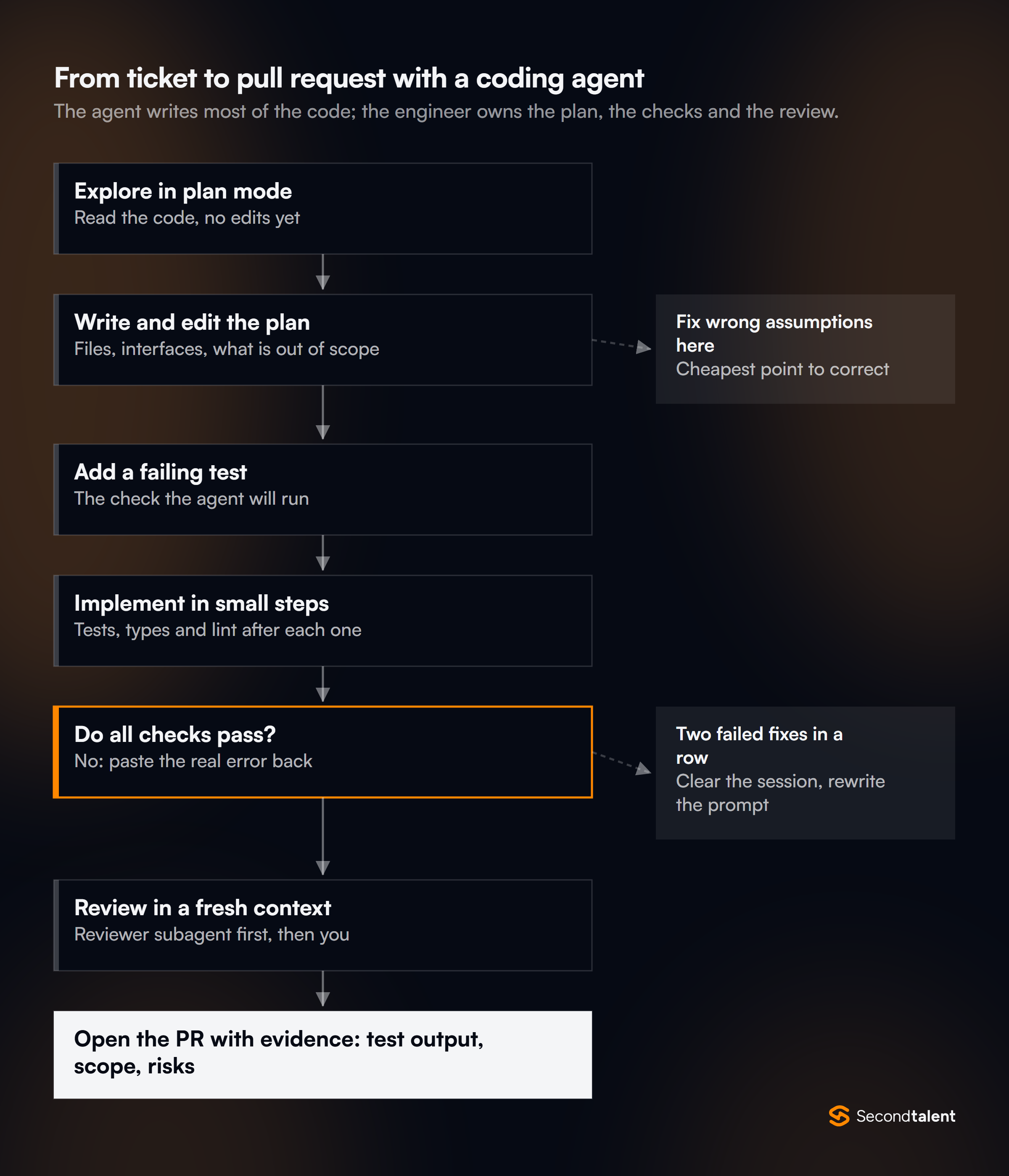
Listen for where the candidate spends human attention. A strong answer puts it on the plan (the cheapest place to catch a wrong assumption) and on the review, not on watching the agent type.
The weak answer is "I paste the ticket in and fix whatever breaks."
Ask a follow-up: what does the pull request description contain? Good candidates include the commands they ran and their output, what was deliberately left out of scope, and which parts they consider risky.
The docs make the same point: reviewing evidence is faster than re-running the verification yourself.
2. How do you split a large feature into tasks an agent can finish reliably?
Cut it into slices that each end in a check the agent can run, and that touch as few modules as possible. A slice such as "add the refund_reason column, migration and model validation, with tests" can be verified in one test run.
"Build refunds" cannot.
Good decomposition follows the dependency order of the code: data model, then service logic, then API, then UI. Each slice lands as its own commit or pull request, so you can revert a bad slice without unwinding the rest.
Candidates who work this way often write the task list into a spec file first, then start a fresh session per slice.
A useful probe: "What do you do when a slice turns out bigger than you thought?" The good answer is to stop and re-plan, not to let the agent keep going for another hour inside one huge context.
3. When do you ask the agent for a plan first, and when do you let it edit straight away?
Plan first when the approach is uncertain, the change spans several files, or the code is unfamiliar. Skip the plan for small, clear changes.
Anthropic's guidance gives a simple test: if you could describe the diff in one sentence, skip the plan.
Planning has a cost. Planning a typo fix wastes time; letting an agent edit an authentication flow it has not read is a risk.
In Claude Code, plan mode lets the agent read files and answer questions without making changes, and you can open the plan in an editor and correct it by hand before implementation starts.
The strongest candidates say they edit the plan, not just approve it.
Plans written by a model often assume a helper exists, or pick a library the project does not use; those are cheap to fix in a text file and expensive to fix in a 400-line diff.
4. How do you run several agents in parallel without them colliding?
Give each agent its own git worktree (or remote machine) and its own branch, and only parallelize tasks that do not touch the same files.
Worktrees share one repository but give each session a separate checkout, so edits never land on top of each other.
# one checkout per agent, each on its own branch
git worktree add ../app-refunds -b feat/refunds
git worktree add ../app-audit-log -b feat/audit-log

# when a branch is merged, remove its checkout
git worktree remove ../app-refunds
Tools now build this in. Cursor 2.0 runs up to eight agents at once on one prompt, each in a worktree or remote machine. Claude Code's /batch command splits a change across 5 to 30 subagents, each in its own worktree.
The senior part of the answer is about the bottleneck. Parallel agents multiply the code waiting for review, and every pull request still needs a human to read it.
A candidate who runs six agents and merges six unreviewed branches is creating a problem, not solving one.
Context Engineering
5. What goes in a CLAUDE.md or AGENTS.md file, and what stays out?
Put in what the agent cannot work out from the code: build and test commands, style rules that differ from defaults, repository etiquette, architectural decisions and known gotchas.
Leave out anything the agent can read from the code, standard conventions, long tutorials and file-by-file descriptions.
The Claude Code memory docs suggest keeping each CLAUDE.md under 200 lines, because longer files consume more context and reduce adherence. The test for each line is whether removing it would cause the agent to make mistakes.
# AGENTS.md
## Commands
- Install: pnpm install --frozen-lockfile
- Test one file: pnpm vitest run path/to/file.test.ts
- Typecheck before every commit: pnpm tsc --noEmit

## Rules
- Money is integer cents (bigint). Never use floats for amounts.
- New endpoints go in src/api/v2/. v1 is frozen.
- Do not add dependencies without asking.

## Gotchas
- Tests need TZ=UTC or the date tests fail.
Candidates should treat the file like code: checked in, reviewed and pruned. If the agent keeps asking a question the file already answers, the wording is probably ambiguous.
6. The agent keeps breaking a project rule. How do you make the rule stick?
First shorten the instruction file, because a rule lost among 400 lines gets ignored. If the rule must hold every time, move it out of the prompt and into something deterministic: a lint rule, a type, a test, a CI check or a hook.
Claude Code's docs are explicit that CLAUDE.md is treated as context, not enforced configuration, while hooks are deterministic and guarantee the action happens.
A hook that runs the formatter after every edit, or blocks writes to a migrations/ folder, cannot be talked out of it.
This question separates two habits. Weaker candidates add "IMPORTANT" in capital letters to more and more lines. Stronger ones ask why the rule is being missed, and turn the rules that matter most into checks the agent's output must pass.
7. How do you give an agent context on a large codebase without flooding its window?
Point it at the right files instead of letting it read everything, and push broad research into subagents that return a summary. Name specific files, reference an existing pattern to copy, and say what is out of scope.
The reason is that the context window is the scarce resource. Anthropic's best practices note that model performance degrades as the context fills, and that an unscoped "investigate this" can read hundreds of files.
Subagents run in a separate context window and report back, so the main session stays focused on the change.
Good candidates also mention CLI tools such as gh or a cloud CLI as the most context-efficient way to reach external systems, and path-scoped rules that load only when the agent works in a matching directory.
Ask how they would onboard an agent to a 2-million-line monorepo; listen for scoping, not for "a bigger context window."
8. A session has gone off track after several corrections. What do you do?
Stop correcting, clear the session, and start again with a better first prompt that includes what you learned.
Claude Code's docs give a concrete threshold: after two failed corrections on the same issue, the context is cluttered with failed approaches, and a clean session with a better prompt almost always does better.
Related failure modes a candidate should recognize: the "kitchen sink" session that drifts across unrelated tasks, and the infinite exploration that fills the window before any code is written.
Tools offer ways back: rewinding to a checkpoint, compacting with instructions on what to keep, or a fresh session per task.
Checkpoints are not version control. Claude Code's checkpoints only track edits made through its own file tools, not changes made by shell commands, so candidates should still commit early and often on a branch.
Reviewing AI Code
9. How do you review a 600-line diff that an agent wrote?
The same way you would review a colleague's, with extra suspicion in specific places, and you own the result once you approve it. Start from the plan and the tests, not line one: does the diff do what was asked, and nothing else?
- Scope: list the touched files and question every one outside the plan.
- Tests: read changed tests before changed code, looking for weakened assertions or deleted cases.
- Boundaries: input validation, error handling, auth checks and anything that touches money or personal data.
- Dependencies: every new import and every line added to a lockfile.
- Duplication: a new helper that already exists elsewhere in the codebase.
Strong candidates also run a first pass with a reviewer in a fresh context, because a model that did not write the code is not biased toward it. They still read the diff themselves.
"The reviewer agent approved it" is not an answer a hiring manager should accept.
10. What mistakes show up most often in AI-generated code?
Code that is almost right. In the 2025 Stack Overflow survey, 66% of developers named "AI solutions that are almost right, but not quite" as their top frustration, and 45.2% said debugging AI-generated code takes more time.
The patterns a reviewer should know by sight:
- Calls to methods or options that do not exist in the installed library version.
- Broad
try/exceptorcatchblocks that swallow the error the test was meant to surface. - Tests edited until they pass, rather than code fixed until it passes.
- Silent scope creep: a renamed variable or reformatted file nobody asked for.
- A fix for the symptom (a null check) instead of the cause (why the value was null).
A good candidate gives a real example from their own work and explains how they caught it. Vague answers ("sometimes it hallucinates") suggest they have not reviewed much generated code closely.
11. The agent says every test passes. What do you check before you believe it?
Whether the tests it ran are the tests that matter, and whether it changed them. Ask for the command and its output, then look at the test diff and for anything skipped or focused.
# which test files changed on this branch?
git diff --stat main...HEAD -- '*test*' '*spec*'

# any new skips, focused tests or loosened assertions?
git diff main...HEAD | grep -nE '^\+.*(\.skip|\.only|xit\(|pytest\.mark\.skip|toBeTruthy\(\))'

# run the full suite yourself, not the subset the agent picked
pnpm test --run
Also check coverage of the new code path. An agent can make a suite green by mocking the very function under test.
Candidates who have been burned by this will say so without being prompted; it is one of the clearest signs of real experience with agents.
12. How do you use tests to steer an agent?
Write or approve a failing test before the implementation, then tell the agent to make it pass without editing the test. The test turns "looks done" into a pass or fail signal the agent can read and iterate on.
Anthropic's guidance frames this as the most important practice: give the agent a check it can run, such as tests, a build or a screenshot to compare.
For a bug, the strong prompt names the symptom, the likely location and asks for a failing test that reproduces the issue before the fix.
Going further, make the check hard to skip. A Stop hook can run the suite and block the agent's turn from ending until it passes. One session can also write the tests while a second, separate session writes the code.
Candidates who mention splitting test author and implementer understand why it matters: the same context that wrote a bug tends to write a test that misses it.
13. How do you keep code quality from drifting when much of the code is generated?
Raise the floor with automation the agent cannot skip: strict types, linters, formatters, architecture tests and required CI checks on every pull request. Then keep human review mandatory for anything that merges.
Google's 2025 DORA report describes AI's primary role as an amplifier, magnifying an organization's existing strengths and weaknesses. A team with weak tests and loose review gets more weakly tested code faster.
Specific habits to listen for: dependency and duplication checks in CI, a size limit on agent pull requests, periodic cleanup passes where the agent is asked to remove dead code it added, and keeping the instruction file current when conventions change.
A candidate who says quality is "the reviewer's job" has not thought about volume.
Security
14. What is slopsquatting, and how do you stop it reaching your lockfile?
Slopsquatting is registering a package name that models tend to hallucinate, then waiting for an agent or developer to install it.
The research behind it, "We Have a Package for You!" at USENIX Security 2025, generated 576,000 code samples with 16 models and found 205,474 unique hallucinated package names.
Defenses work at three levels. The agent should not be able to install packages without approval. Every new dependency in a diff gets checked: does it exist, how old is it, who publishes it, and does the repository match.
CI should install from the lockfile only and run a dependency scanner.
# before accepting a new dependency the agent added
npm view left-pad-utils time.created maintainers repository.url
pip index versions fastjson-schema   # does it exist on PyPI at all?

# CI installs exactly what was reviewed
npm ci          # fails if package.json and the lockfile disagree
A strong candidate also mentions a project rule ("do not add dependencies without asking") plus a CI check that flags any lockfile change for explicit review.
15. How do you keep a coding agent away from secrets?
Keep real secrets off the machine where the agent runs, deny its file tools access to secret files, and isolate its shell with a sandbox. Each layer covers a gap in the others.
In Claude Code, a Read deny rule blocks the agent's file tools from a path:
{
  "permissions": {
    "deny": [
      "Read(./.env)",
      "Read(./.env.*)",
      "Read(./secrets/**)"
    ]
  }
}
The same docs warn that Bash rules match the command text the agent writes and are not a security boundary around a program, so a shell command in a different form can still reach a file.
That is why OS-level sandboxing (restricting filesystem and network access) and scoped, short-lived development credentials matter more than any single rule. Production keys should never be readable from a laptop session.
Ask the candidate what they do if a secret does land in the agent's context: treat it as exposed and rotate it.
16. How can prompt injection reach a coding agent, and what limits the damage?
Through any text the agent reads: an issue, a pull request comment, a README in a dependency, a web page or a tool result.
In May 2025, Invariant Labs showed a malicious public GitHub issue that led an agent using the GitHub MCP server to pull data from the owner's private repositories and publish it in a pull request on the public one.
Invariant's point was that this was not a bug in the server code. The agent used permissions it legitimately had.
The fixes are therefore about scope: a token limited to the one repository the task needs, one repository per session, and no "always allow" on tools that write to public places.
A senior candidate frames the risk as a combination: untrusted input, access to private data and a way to send data out. Remove any one of the three from a session and the injection has nothing to exploit.
17. What permissions would you give an agent on your laptop, and in CI?
On a laptop, the narrowest mode that keeps you productive: allowlist the commands you trust, keep deny rules for secrets and destructive commands, and turn on the sandbox.
In CI, pre-approve exactly the tools the job needs and deny everything else.
# non-interactive run in CI: only these tools, everything else denied
claude -p "Fix the failing lint errors in src/billing/" \
  --allowedTools "Read,Edit,Bash(pnpm lint *)" \
  --permission-mode dontAsk
Claude Code evaluates rules deny first, then ask, then allow, so a broad deny such as Bash(aws *) wins over a narrower allow.
The docs say bypassPermissions should only be used in isolated environments such as containers or VMs, and that administrators can disable it through managed settings.
Red flag: a candidate who runs with all permission checks off on the same laptop that holds production cloud credentials, because "the prompts slow me down."
18. How do you check AI-generated code for security bugs?
Assume the generated code is insecure at boundaries until shown otherwise, and back human review with automated scanning. Veracode's July 2025 study tested more than 100 models on 80 tasks and found security vulnerabilities in 45% of cases.
Java failed more than 70% of the time, and log injection defenses failed in 88% of cases.
In practice: run static analysis and dependency scanning on every pull request, keep a review checklist for input handling, output encoding, authorization and logging, and use a dedicated security reviewer (a person, or a subagent with a narrow brief) on anything that touches authentication or user input.
Good candidates know the specific weak spots.
Models write working code more readily than secure code, so the review focuses where "works" and "safe" differ: string-built SQL, unescaped HTML, user data written to logs, and missing ownership checks on records.
Judgment and Cost
19. When should you not use an AI agent for a task?
Expensive mistakes with no check that can prove the result correct are the clearest case.
Cryptography, payment flows, permission logic and data deletion fall here; use the model to explain code or suggest test cases, and write the change yourself.
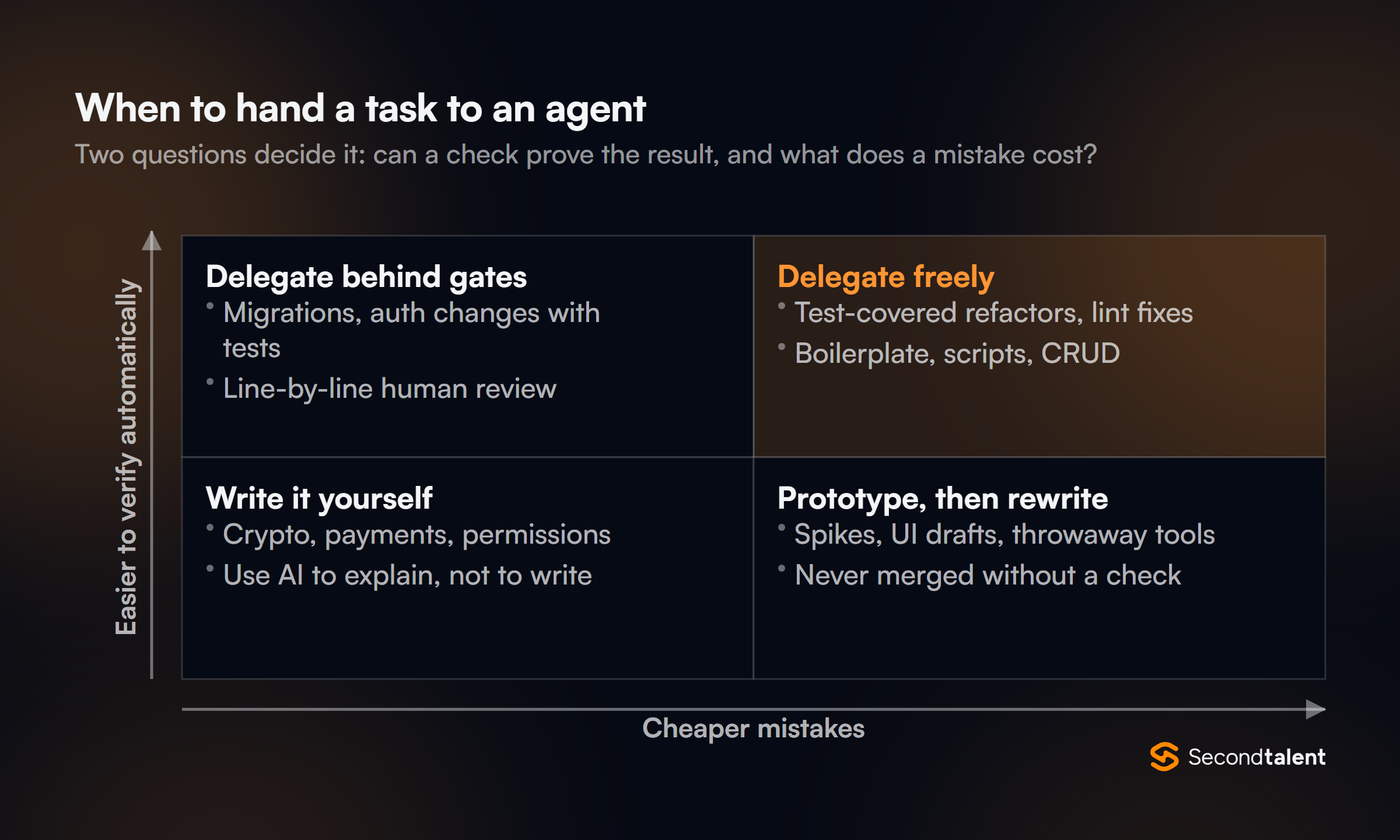
Other good reasons to switch it off: learning a new codebase or language where the struggle is the point, tasks smaller than the prompt it would take to describe them, and code under licensing or confidentiality limits that bar sending it to an external model.
This is one of the best questions in the loop. A candidate who cannot name a single case where they would not use an agent is showing a lack of judgment, not enthusiasm.
20. How would you measure whether AI tools are making your team faster?
Measure outcomes over a period of weeks, not impressions: cycle time from first commit to production, review time, change failure rate, rework and escaped defects, compared before and after, or between similar teams.
Self-reported speed-ups are unreliable.
METR's early-2025 randomized trial is the cautionary example: 16 experienced developers, 246 real issues, a forecast speed-up of 24%, a believed speed-up of 20%, and a measured slowdown of 19%.
METR now marks those results as out of date (see question 30), but the gap between perception and measurement is the lesson.
Good candidates also watch where time moves. Faster code generation can show up as slower reviews, so a team that only tracks lines or pull requests merged will miss it.
21. How do you keep a team's AI spend under control?
Match the model to the task, keep sessions short and focused, and make spending visible.
In the 2026 Stack Overflow survey, respondents said their organizations had put cost controls in place: 38% set limits on usage, 28% reviewed spending data and 27% use different models for different work.
The engineering levers are concrete. A cheaper, faster model handles search and small edits; the strongest model is kept for planning and hard debugging. Clearing context between tasks cuts input tokens on every turn.
For product features, prompt caching helps: on the Claude API, cache reads cost a fraction of the base input price (0.1 times on most models), but only if the stable part of the prompt comes first, because a change early in the prefix invalidates everything after it.
Ask for a number. A candidate who knows roughly what their own agent usage costs per week has been paying attention.
22. You are adding an LLM call to a product feature. How do you test the code around it?
Split the tests by what they prove. Unit tests replace the model with a fake at one boundary and check your code: prompt construction, parsing, validation, retries and what happens on a refusal, a timeout or malformed output.
A small set of real model calls runs separately against fixed examples with pass thresholds.
def test_summary_rejects_malformed_model_output(fake_llm):
    fake_llm.respond('{"summary": 42}')          # wrong type from the model
    result = summarize_ticket(ticket_id=7, llm=fake_llm)
    assert result.status == "needs_review"       # no crash, no bad data saved
    assert fake_llm.calls == 2                    # retried once with the error

def test_summary_handles_timeout(fake_llm):
    fake_llm.raise_timeout()
    assert summarize_ticket(ticket_id=7, llm=fake_llm).status == "fallback"
Deterministic unit tests run on every commit; the real-model checks run on prompt or model changes and on a schedule.
Strong candidates validate every model response against a schema before it touches the database, so a bad output degrades the feature instead of corrupting data.
23. How do you protect a product feature from model changes and provider outages?
Pin model versions, wrap the provider behind your own interface, set timeouts and a fallback, and re-run your checks before switching models.
Models are retired on a schedule: Anthropic's deprecation policy promises at least 60 days' notice, and on September 30, 2026 it deprecated Claude Sonnet 4.5, with retirement set for November 30, 2026.
Request parameters change too. The same page notes that on Claude 4.7 and later models, setting temperature, top_p or top_k to a non-default value returns a 400 error.
Code that ran for years can break on a model upgrade without a single line changing.
A strong answer includes a feature flag to switch models without a deploy, alerting on error rate and latency per model, and a degraded mode (cached answer, simpler rule-based path, or a clear message) for when the provider is down.
Practical Exercises
24. Pairing exercise: add a small feature to an unfamiliar repository with an agent in 45 minutes. What should the interviewer watch?
Watch the process, not the finished feature. Give the candidate a real but modest open-source repository, their own agent of choice and a ticket that needs changes in two or three files. Ask them to share their screen and think aloud.
- First 10 minutes: do they read the code and the tests, or prompt immediately?
- Prompts: do they name files, constraints and a check, or type "add feature X"?
- Corrections: do they read the agent's diff as it lands and stop it when it drifts?
- Verification: do they run the tests themselves and look at the test diff?
- The end: can they explain every line they would merge?
Plant one trap, such as a misleading comment or a flaky test, and see whether they catch it. Unfinished work with a sound process beats a finished feature nobody can explain.
25. Take-home: review an agent-written pull request with planted bugs. How do you score it?
Prepare a pull request of 300 to 500 lines that an agent wrote, then plant five or six problems: a hallucinated library option, a weakened test assertion, an unscoped database query, a secret in a log line, an unnecessary new dependency and a symptom-only fix.
Ask for written review comments within 90 minutes.
| Criterion | Strong (3) | Acceptable (2) | Weak (1) |
|---|---|---|---|
| Bugs found | 5 or more, including the test change | 3 or 4 | 2 or fewer, or style only |
| Security | Flags the log leak and the unscoped query, with fixes | Flags one of the two | Misses both |
| Dependencies | Questions the new package and checks it exists | Notices it, no check | Ignores it |
| Comment quality | Specific, with a suggested change and the reason | Specific, no fix | Vague ("looks off") |
| Verdict | Request changes, ordered by severity | Request changes, unordered | Approve |
A score of 12 or more out of 15 is a strong signal. Allow candidates to use their own agent to help review; the rubric then measures whether they verify what it tells them.
What Changed Recently
26. What changed when coding agents started opening pull requests on their own?
Review became the main human job.
The GitHub Copilot coding agent reached general availability on September 25, 2025: it takes a delegated task, works in the background in its own environment powered by GitHub Actions, opens a draft pull request and requests review.
Business and Enterprise admins must enable it in policy first.
Cursor's changelog shows the same direction in 2026: Cursor Projects (September 10, beta) uses a coordinator agent that delegates to other agents for long-running work, and Security Review (September 23, Teams and Enterprise plans) posts exploitable-bug findings on every pull request.
Ask which tasks the candidate hands to a background agent. Good answers: well-specified, test-covered issues such as dependency bumps, small bug fixes with a reproduction, or adding tests.
Poor answers: anything with an unclear spec, because nobody is there to ask.
27. What is AGENTS.md, and how do tools decide which instruction file to read?
AGENTS.md is an open format for project instructions to coding agents, a "README for agents." Its site says it is used by over 60,000 open-source projects and is now stewarded by the Agentic AI Foundation under the Linux Foundation.
It was one of the foundation's three founding projects, alongside MCP and Block's goose, announced December 9, 2025.
Codex, Cursor, Gemini CLI, Jules, the GitHub Copilot coding agent and others read it.
Claude Code reads AGENTS.md directly from v2.1.277 (released September 18, 2026), but by default only when no CLAUDE.md exists in the working directory or above; a repository with both should import one from the other so instructions do not diverge.
The practical point for a team using several agents: keep one source of truth. Two instruction files that drift apart produce two agents following different rules in the same codebase.
28. What changed in Claude Code's default permission mode?
From v2.1.283 (released September 25, 2026), auto mode is the built-in starting permission mode for interactive terminal and VS Code sessions, according to the best practices page.
A separate classifier model reviews most actions instead of the user and blocks those that look risky, such as scope escalation, unknown infrastructure or actions driven by hostile content.
That shifts the engineer's job from approving each command to configuring the boundaries: deny rules, sandboxing and, for organizations, managed settings.
Administrators can switch auto mode or bypass mode off with disableAutoMode and disableBypassPermissionsMode. The current release on GitHub is v2.1.301 (October 15, 2026), and releases ship almost daily.
A candidate does not need to memorize version numbers. They should know that a classifier reduces prompts but is not a guarantee, and that deny rules and the sandbox still decide what the agent cannot do.
29. What does the 2026 Stack Overflow survey say about trust in AI output?
Trust is now conditional on verification. On the 2026 survey's AI page, 48.0% of respondents said they trust AI output "when I can verify it," and only 6.6% trust it for many tasks including important decisions.
93% rated source citations as at least somewhat important.
The 2025 survey asked a narrower question, about the accuracy of AI output, and distrust (45.7%) outweighed trust (32.7%). Developers have not become credulous; they have built verification into how they work.
That is the skill this interview is testing.
A good follow-up: "What do you verify, and how, for a change you did not write?" Candidates who answer with specific commands and checks are describing a habit. Candidates who answer "I read it carefully" usually are not.
30. What do the newest studies say about how much faster agents make experienced developers?
That the honest answer is still uncertain. METR's February 24, 2026 update covered 57 developers, 143 repositories and more than 800 tasks with late-2025 tools.
Its raw estimates were an 18% speed-up for returning developers and 4% for newly recruited ones, with confidence intervals that cross zero in both groups.
METR itself calls the data very weak evidence of increased speed-up, and lists why: developers declined to join if they could not use AI, 30% to 50% withheld tasks for the same reason, and time tracking broke down for people running several agents at once.
It is changing its study design.
The best candidates hold two ideas at once: agents clearly change how they work, and the size of the gain depends on the task, the codebase and the checks around the agent.
Anyone who quotes a single universal multiplier has not read the research.
Signs of a Strong Answer
- Cannot name a task they would not give an agent
- Merges what the agent says passes, without reading the test diff
- Runs with permission checks off next to production credentials
- Quotes a fixed "10x" speed-up with no measurement behind it
- Gives every task a check the agent can run before calling it done
- Turns repeated mistakes into lint rules, hooks or tests
- Scopes tokens and sessions so an injection has nothing to reach
- Can explain every line of an agent-written diff they approved
- They describe their workflow as a sequence with checkpoints (plan, test, implement, verify, review), not as a single prompt.
- They keep instruction files short and treat them as code, and they know which instructions belong in a hook instead.
- They check every new dependency the agent adds, and they can explain slopsquatting without being prompted.
- They know what their permission settings allow, and why
bypassPermissionsbelongs only in a container or VM. - They measure their own speed in shipped, working changes, and they know the METR results well enough to be cautious about claims.
Hiring AI-Native Engineers
Engineers who already work this way, with agents in the loop and checks around them, are still hard to find.
Second Talent helps US startups hire vetted AI-Native Engineers from Asia, screened with exercises like the ones above, at $29 to $39 USD an hour, billed monthly.
For the skills and scope of the role, see the AI-native engineer role guide; engineers building the skill set themselves can start with how to become an AI-native engineer.
Shortlists arrive within 24 hours, and every placement has a 90-day, one-time replacement guarantee. Tell us what you need to start.