TL;DR: An AI-native company is one where AI is the foundation, not a feature. The simple test: remove the AI and the product stops working entirely. Most firms in 2026 are AI-enabled, not AI-native.
Gartner reckons only about 130 of the thousands of vendors selling agentic AI offer the real thing. The rest rebrand chatbots and automation scripts, a habit it calls agent washing.
"AI-native" has the same problem: the label is cheap, the architecture behind it is not, and the two kinds of company grow at different speeds.
- 1In ICONIQ's 2025 survey, 47% of AI-native companies had reached critical scale, against 13% of companies building AI-enabled products.
- 2The workflow flips: AI does the work and the team supervises, instead of staff doing the work with AI help.
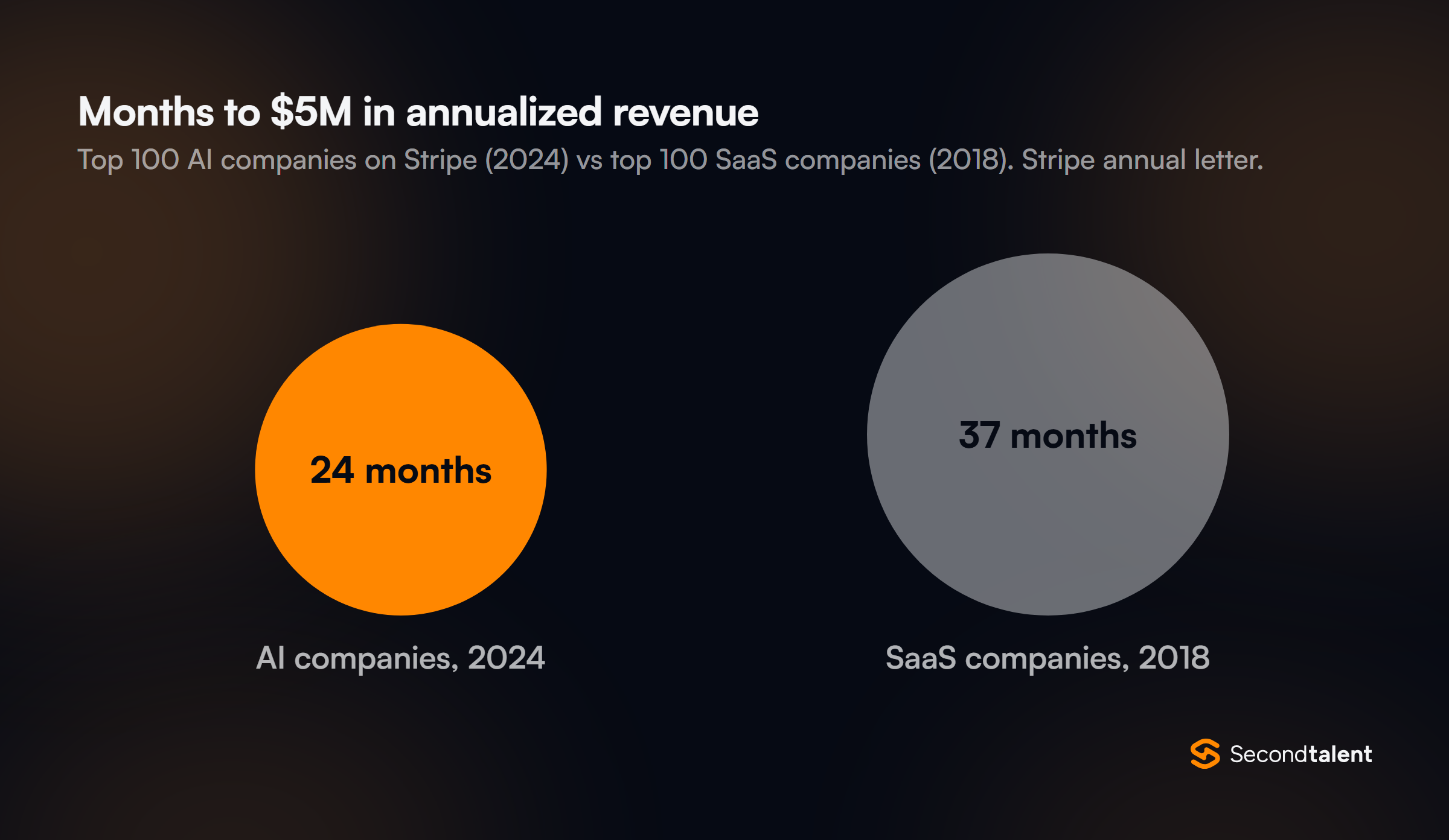
- 3Stripe's top AI companies reached $5M in annualized revenue in 24 months, against 37 months for the top SaaS companies of 2018.
- 4The bottleneck is clean data and senior AI engineers, not access to models.
AI-native vs AI-enabled vs traditional
The difference is not how much AI a company uses. It is where AI sits in the product and in the daily workflow. The table lays out the contrast across the dimensions that matter.
| Dimension | Traditional | AI-enabled | AI-native |
|---|---|---|---|
| Role of AI | None or minimal | A feature added on | The core of the product |
| Workflow | Humans do all the work | Human works, AI assists, human finalizes | AI does the work, human supervises and QAs |
| Data | Siloed, manual | Some data feeds models | Unified, clean, real-time by design |
| Remove the AI | No change | Product still works | Product stops working |
| Team shape | Large, role-heavy | Mixed, AI added to teams | Small, senior, AI-fluent |
Where is your company on the AI-native path?
Pick the stage that fits you best.
Do not try to rebuild everything at once. Pick one workflow where AI can do the core work, then put humans on supervision. You will need engineers who have shipped this before. Hire AI and machine learning engineers who have done it.
You have AI features. The next step is making AI the core, with agents doing real work. That needs agent builders who know tools, memory, and guardrails. Hire AI agent developers who build autonomous workflows.
AI-native runs on clean, unified, real-time data. If your data is siloed, agents will fail. Strong backend engineers build that foundation. Hire backend engineers who can wire it up.
The model is the easy part. The team that builds with it is the hard part. We match you with pre-vetted senior engineers in about 24 hours. Tell us what you need.
The one-question test
The cleanest way to tell AI-native from AI-enabled is a single question. Remove the AI from the product. Does it stop working, or does it only get worse? An AI-native product cannot run without its models.
An AI-enabled product loses a helper but keeps going.
- A bank's support chatbot goes dark and customers call the branch instead
- A retailer's demand forecast stops and planners go back to last year's spreadsheet
- A CRM's email summaries disappear and reps read the thread
- An agentic code editor has nothing left to sell
- A support agent that closes tickets end to end leaves an empty queue with no one assigned
- A prompt-driven video editor has no timeline to fall back on
The test cuts through marketing. Plenty of companies call themselves AI-native in 2026 because it sounds modern, and the question exposes them in seconds.
It also sets the roadmap: to become AI-native, you have to design the product so AI is load-bearing, not decorative. Both kinds of company can be good businesses. They are not the same thing.
Six traits of an AI-native company
AI-native companies share a set of structural choices about product, data and team that go well beyond running a chatbot. The grid sums up the six that show up again and again.

First, AI sits at the core: teams design the product so models do the central job. Second, agents do the work while the team supervises, so the human role shifts from doing to checking and approving.
Third, the company unifies and cleans its data from the start, because agents are only as good as the data they read.
Fourth, the systems are goal-oriented: instead of fixed rules, agents pursue a goal inside clear guardrails. Fifth, the product learns from use and improves without a separate project. Sixth, teams are small and senior.
In Y Combinator's Winter 2025 batch, CEO Garry Tan said about a quarter of startups had 95% of their code written by AI, and the batch grew 10% a week in aggregate.
Why AI-native companies grow faster
The speed gap shows up in revenue first.
Stripe's 2024 annual letter compared the top 100 AI companies on its platform with the top 100 SaaS companies of 2018, and the AI group reached $5 million in annualized revenue more than a year sooner.
Product maturity follows the same pattern.
ICONIQ's 2025 State of AI report, a survey of 300 software executives in April 2025, split builders into AI-native companies and companies adding AI to new or existing products, then asked how many had reached critical scale with proven market fit.
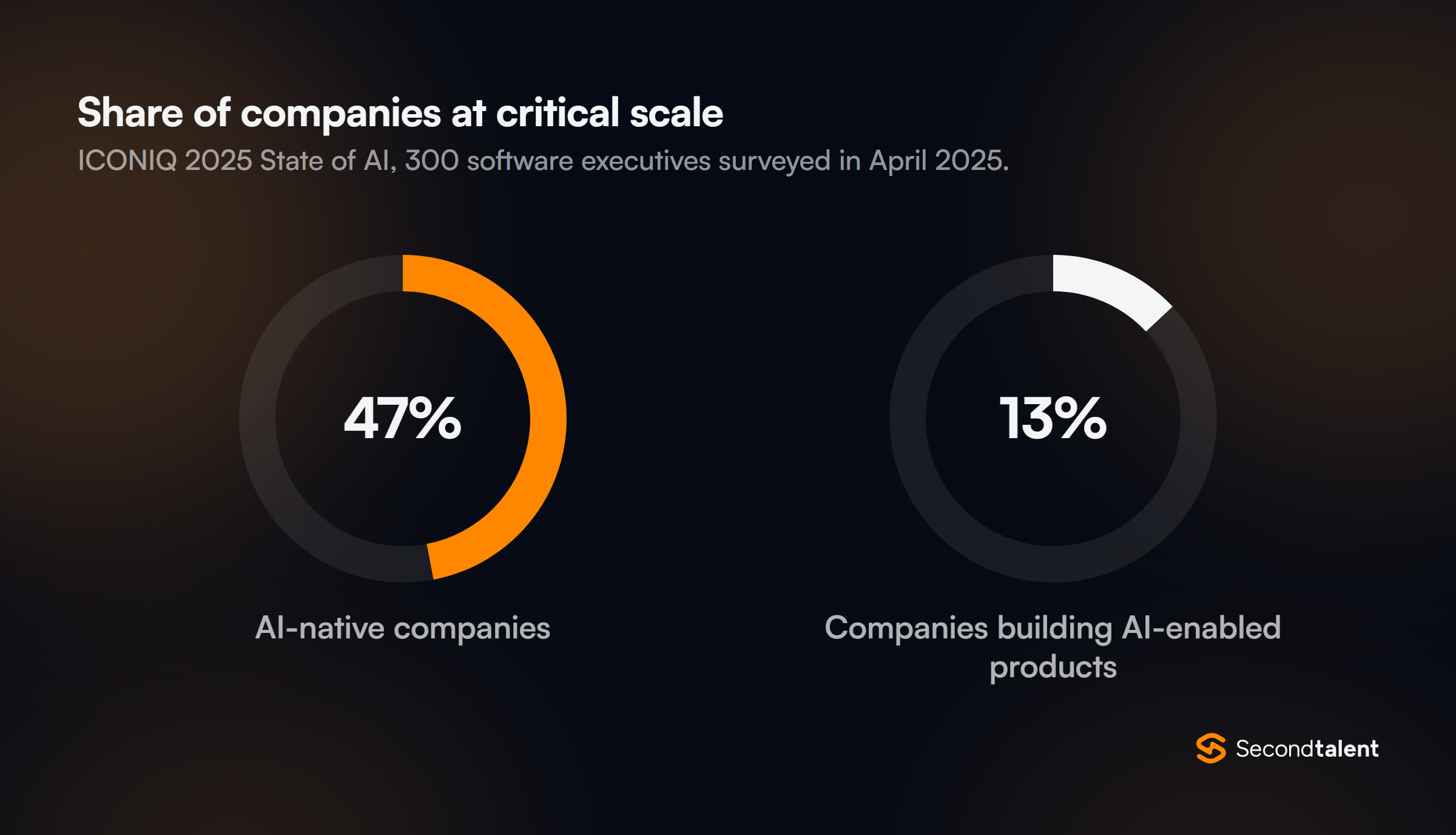
The fastest examples are almost all products that could not exist without their models. Nearly 80% of the AI-native builders in the ICONIQ survey were investing in agentic workflows, the shape these three companies share.
The AI-native maturity ladder
Most companies do not flip to AI-native overnight. They climb a ladder, and knowing your rung helps you set a realistic next step instead of chasing a label. The four stages run from curious to native.

At the bottom is AI-curious: pilots and experiments, nothing in production. Next is AI-enabled, where AI features are added to existing products and deliver real but limited gains.
Above that is AI-first, where AI becomes the default tool for most work across the company, even if the core product predates it.
At the top is AI-native, where removing the AI breaks the product. Most companies in 2026 sit on the first or second rung, whatever their website says.
The useful goal is one rung at a time, with the right team and the right data behind each step.
What it looks like in practice
An AI-native browser puts an assistant at the center, so it summarizes pages, drafts replies and compares options as you go.
Coding tools that write and edit code through agents are AI-native too, and so are support products where an agent resolves tickets end to end.
AI-native video editors work the same way, letting creators edit videos with prompts: you ask in chat to trim, caption, translate or reframe footage instead of working the timeline by hand.
AI-enabled products look different: an established software product adds a smart autocomplete or a summary button. A logistics firm adds demand forecasting.
These are useful and often profitable, but the core product predates AI and still stands without it. The AI-native teams tend to be younger and faster to ship.
Why most companies are not AI-native yet
Using AI is now near universal. McKinsey's state of AI survey, published in November 2025 with 1,993 respondents in 105 countries, found 88% of organizations using AI in at least one business function.
Far fewer have rebuilt anything around it.
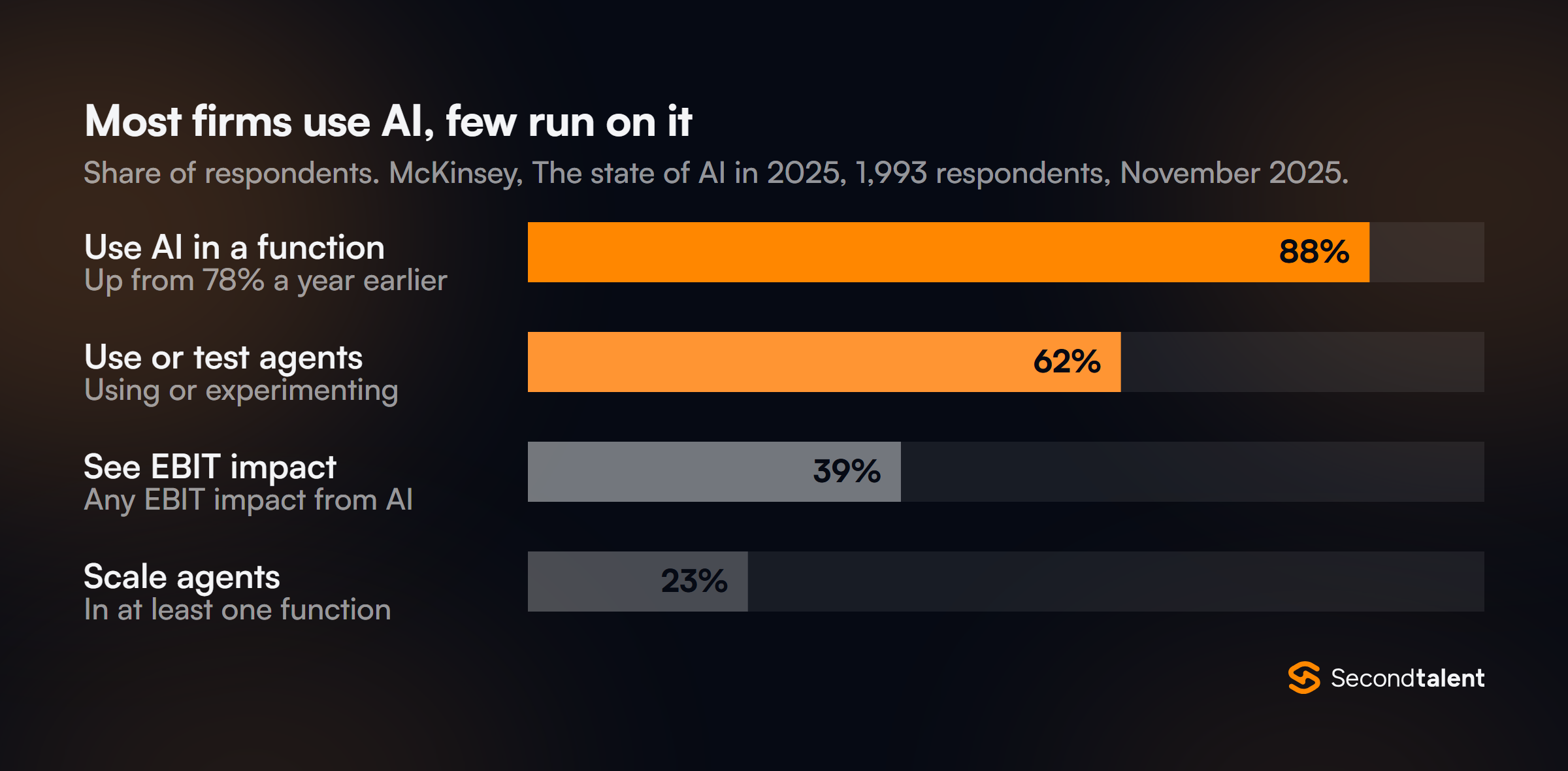
Money and model quality are not what is holding them back.
The Stanford AI Index 2026 counts record investment and a sharp jump in what agents can do on real computer tasks, while Gartner expects companies to scrap a large share of agent projects anyway.
Adoption is not architecture. Adding AI features is easy. Rebuilding a product so AI is load-bearing needs unified data, agent design and a team that has done it before.
Most firms have the budget and the tools, not the data foundation or the senior talent. For more on how fast the leading models are spreading, see our Claude AI statistics for 2026.
Common mistakes on the way to AI-native
The biggest mistake is claiming the label too early. A demo that uses a model is not a product that depends on one. Teams that overclaim end up shipping a thin layer over a model, then lose trust when the AI turns out to be optional.
Run the one-question test on your own product first and be honest about the answer.
The second is skipping the data layer. An agent reading messy, siloed data gives messy answers, and clean, unified, real-time data is the unglamorous part that makes everything above it work. Budget for it first, not last.
The third is hiring the wrong shape of team. AI-native work rewards a few senior, AI-fluent engineers over a large junior team, and one engineer who has shipped agents in production is worth more than five who have only read about them.
For a first build, many teams bring in agentic AI specialists for the first build.
The fourth is treating AI-native as a one-time project. The point is a system that keeps learning, so set up feedback loops, watch where the agent fails and tighten the guardrails over time.
Companies that ship once and walk away slide back down the ladder.
How to start becoming AI-native
Start with one workflow where AI can do the core work, not only assist. Put a person on supervision and quality control, measure the result against the old way, and expand to the next workflow only if it holds up.
That is how the ladder gets climbed in practice.
Fix the data layer early, because agents fail on messy, siloed data. Pick problems where a wrong answer is cheap to catch, so the agent can run with light oversight.
Set the metric before you start, whether that is cost per task, time to resolve or error rate, and track the agent against the old baseline. That keeps the project honest and gives you the proof to expand or stop.
Build your AI-native team
The model is the easy part. The team that builds and ships with it is what separates AI-native from AI-enabled.
Second Talent matches you with pre-vetted senior AI engineers, AI agent developers and backend engineers from Asia in about 24 hours, with no upfront cost and payroll handled. See how Second Talent works, or tell us what you need.
Frequently Asked Questions
Is AI-first the same as AI-native?
No. AI-first describes how a company works: AI is the default tool for most tasks, even if the core product came before it. AI-native describes the product: it cannot run without its models.
A company can be AI-first long before it is AI-native, and many do not need to go further.
Can an established company become AI-native?
Yes, though rarely by retrofitting the old product. The usual route is a new product or business line built around agents from day one, with its own clean data layer, while the legacy product stays AI-enabled.
Rebuilding the core product means rebuilding its data and workflows too.
Is an AI wrapper an AI-native company?
By the one-question test, usually yes: take the model away and a wrapper stops working. Native is not the same as defensible, though.
Stripe's founders argued in their 2025 letter that calling these products wrappers misses the point, because the workflow and data integration around the model is where lasting value builds up.
Do AI-native companies need fewer engineers?
Fewer, but more senior, and more of them working on AI.
ICONIQ found most software companies expect 20 to 30% of their engineering team to focus on AI, up to 37% at high-growth companies, and that AI and machine learning engineers take more than 70 days on average to hire.