TL;DR: HighMatch is the strongest pick for hourly roles because it builds a fit assessment for each role and validates it against your own retention data. Harver suits enterprises hiring at high volume, and Criteria suits teams that want a short values match plus personality testing from one vendor. Traitify, Wonderlic and Prevue cover phone-first screening, a combined ability-and-motivation score, and company-wide values surveys.
Accommodation and food service employers lost 3.5% of their staff to quits in August 2026 alone, against 2.1% across all private employers, according to the BLS JOLTS release. Retail ran at 3.0%.
For jobs paying under $30,000 a year, each exit costs about 16% of annual pay, the Center for American Progress found. The tools below split on one question: do they measure the company's values, or the reality of a specific shift?
- 1Personality predicts who leaves: in a 2008 meta-analysis, conscientiousness and agreeableness best predicted real turnover, while emotional stability best predicted the intent to quit.
- 2The main way realistic job previews cut turnover is by signaling honesty, according to a 52-study meta-analysis covering about 17,000 employees.
- 3Prevue is the only vendor here with a published starting price ($195 a month), and that plan does not include its culture assessment.
- 4Ownership moved fast: Workday bought Paradox in October 2025, and Traitify now belongs to Brilliant, launched in September 2026.
Quick comparison
| Tool | What fit is measured against | Hourly-specific features | Price |
|---|---|---|---|
| HighMatch | Your values, mapped to validated traits per role | Job previews, screeners, retention validation | Custom quote, unlimited assessments |
| Harver | OCAI culture types (clan, adhocracy, hierarchy, market) | 450+ tests, job previews, high-volume workflow | Quote |
| Criteria | Supervisor's ranking of 20 work factors | Untimed, about 10 minutes | Quote by headcount |
| Traitify | Big Five personality, image-based | A few minutes, 95% completion | Via demo |
| Wonderlic | Job benchmarks from 3M+ profiles | Ability, personality and motivation in one score | Package-based |
| Prevue | Employer's Culture Profile of 40 values | Culture fit and culture add reported apart | Premium plan, quote |
1. HighMatch
Best For: Employers with high early turnover in hourly roles that want culture and behavioral fit measured against their own roles, values, and retention data.
HighMatch is an Atlanta-based pre-employment assessment provider that offers custom assessments designed by its group of I/O Psychologists.
Rather than benchmarking candidates using standard labels or descriptions for culture, HighMatch cross-corrects an employer's values with traits validated by others.
The characteristics used to measure a value include empathy and friendliness for Service, objectivity and stress tolerance for Sound Judgment, and reliability and rule-consciousness for Accountability.
Culture fit scores are then combined with skills and personality scores into a single overall score.
HighMatch integrates culture fit into a broader strategy for early turnover for hourly jobs.
Screeners ensure reliability and availability, realistic job previews give candidates a glimpse of the actual job, and skills tests verify job-related competencies.
Candidates who are unlikely to stay don't make it to an interview with a manager. HighMatch also scores on culture add, noting when a candidate "can meaningfully diversify perspective or skill on this team.
Key capabilities include:
- Personalized Culture Fit: core values mapped to validated traits for each role and environment, in the employer's preferred language
- Realistic Job Previews: custom videos scripted with I/O psychology input, followed by questions about what candidates saw
- Early Screening: minimum qualification screeners for reliability, availability and role requirements
- Local Validation: scales with an average reliability of .77, validated against the employer's own outcomes and reviewed for subgroup differences
- Candidate Experience: short, mobile-first assessments with a 91% completion rate
- Manager Support: interview questions based on each candidate's results, plus coaching and onboarding insights
- Integrations: Workday, UKG, iCIMS, Paylocity, Paycor and other ATS platforms
HighMatch reports on the detailed results of hourly and frontline jobs.
Nearly 1,200 people work at Lipari annually, and the company invested in screeners, a custom skills test, and a behavioral assessment in the warehouse hiring area and realized a 72% reduction in early turnover, a 71% reduction in 30-day employee attrition, and a projected savings of $332,000 in the first year.
To achieve this, DaVita Kidney Care prescreened over 100,000 candidates in six months and incorporated a realistic job preview and a series of job-based measures to boost retention of patient care technicians by 13% and save $413,000 per year.
After a 12-month validation study, a Fortune 50 telecom reduced service technicians' turnover by 48% and saved $5.8 million annually.
2. Harver
Harver serves large employers filling hundreds of hourly seats a month in retail, hospitality and contact centers, where the fit check is one step in a longer automated funnel.
Its Cultural Fit Assessment uses the Organizational Culture Assessment Instrument (OCAI), which sorts cultures into four types: clan, adhocracy, hierarchy and market.
Candidates divide 10 stars over four statements to show the culture they prefer, and Harver compares the result with the employer's own profile.
Harver's help documentation says the exercise repeats across six dimensions. They run from leadership and management style to what the organization counts as success, so the profile covers more than one preference.
The test is meant to run next to others. Harver's assessment library lists more than 450 options in dozens of languages, including pymetrics game-based tests, realistic job previews and 900+ ready-made job profiles.
The company is growing by acquisition. It bought pymetrics in 2022, and in September 2026 it acquired Symphony Talent, adding recruitment marketing to a business that says its assessments have reached more than 65 million candidates.
Harver states its assessments cut time-to-hire by around 40% and early attrition by up to 25%.
- Best for: enterprises that want culture, cognitive, game-based and job preview tests inside one hourly hiring workflow.
- Where it struggles: OCAI describes the culture of the whole organization, so a night-shift warehouse role and a daytime store role can end up with the same profile.
- Price: quote-based. Harver publishes no rates, and an account executive builds each proposal.
3. Criteria
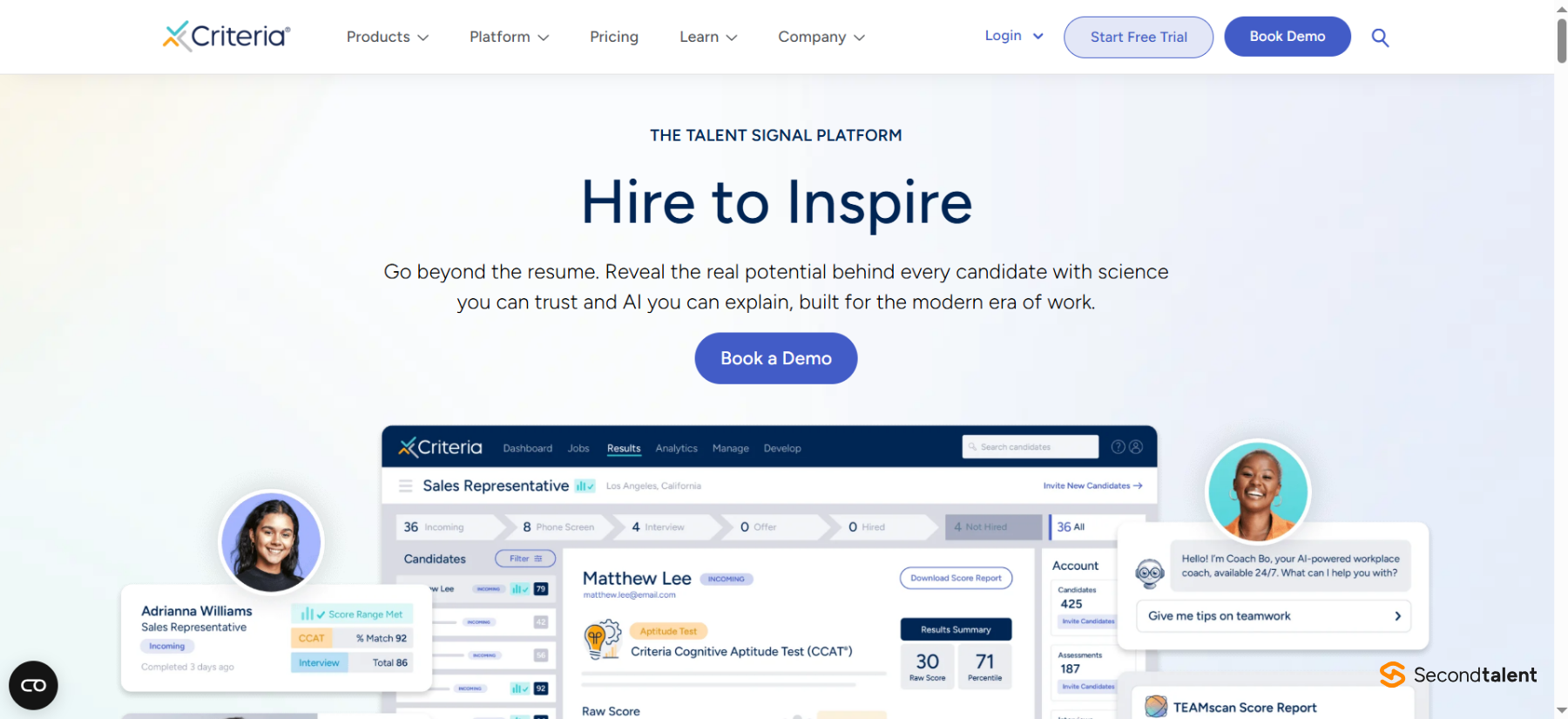
Criteria fits employers that want a short, untimed values match they can talk through in an interview, backed by a personality test from the same vendor.
The Workplace Alignment Assessment (WAA) asks candidates to sort 20 work factors into five levels of importance. The supervisor of the role sorts the same 20 factors for the job.
Criteria reports alignment as a percentile, showing how a candidate compares with others who took the WAA for that job, plus a factor-by-factor breakdown.
The test is untimed and takes around 10 minutes. It is a person-environment fit measure based on the Minnesota Theory of Work Adjustment.
Criteria validated it with employees at more than 50 organizations, where closer alignment went with higher job satisfaction and commitment, and it recommends the test for high-turnover roles.
For trait data, the Employee Personality Profile measures 12 traits in 140 items, takes about 10 minutes and runs in 20 languages.
In a Macfab case study, the manufacturer raised retention among machinists and operators from 65% to 90% after adding Criteria's personality, cognitive and skills tests.
The WAA was not part of that program, so the result speaks for the wider toolkit.
- Best for: teams that want a values conversation with each candidate plus validated personality data from one vendor.
- Where it struggles: each profile rests on one supervisor's sort, and the answers are self-reported, so pair it with a behavioral measure or a job preview.
- Price: quote-based by headcount, across the Criteria Assess, Interview and Hire plans.
4. Traitify
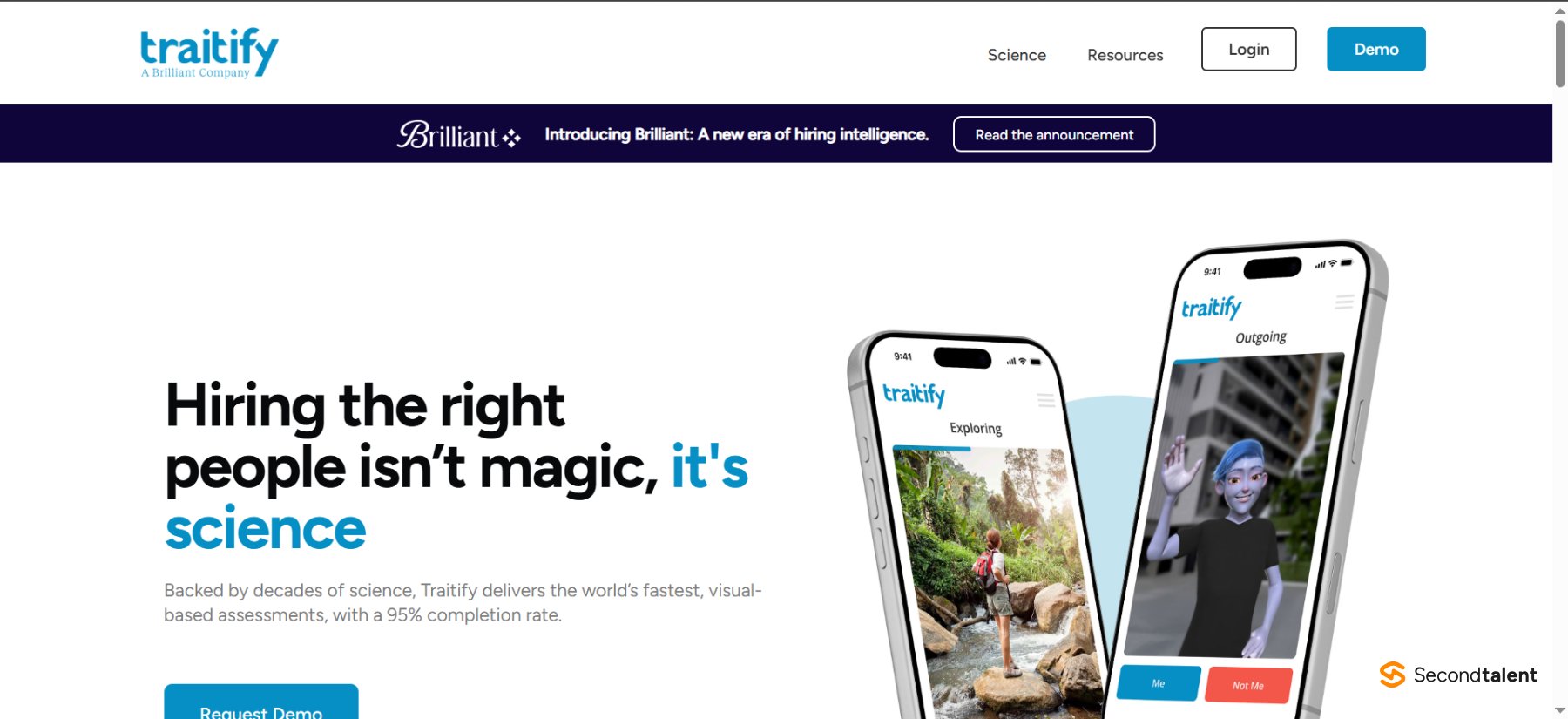
Traitify is for the top of a high-volume funnel, where the biggest risk is candidates quitting the application before they finish it.
Candidates react to a series of images by tapping "Me" or "Not Me," and the answers map to the Big Five personality model.
Traitify says the test takes a few minutes and reports a 95% completion rate, against about 30% for word-based tests that can run 45 minutes. Its customer list leans hourly: McDonald's, 7-Eleven, IHG, Darden and Whole Foods.
The brand has changed hands twice. Paradox bought Traitify in 2021, and Workday completed its purchase of Paradox on October 1, 2025.
Crosschq then acquired Traitify in 2026, and in September 2026 Crosschq merged with ApplicantX and Traitify to form Brilliant, which says Traitify keeps operating under its own name.
Brilliant is a Workday Platinum partner, so employers on Workday still get a supported connection.
- Best for: phone-first screening where completion rate matters more than depth.
- Where it struggles: it measures general personality, not fit with your workplace, so ask how scores link to your roles. After two ownership changes in a year, confirm the product roadmap before signing a long contract.
- Price: not published. Pricing comes through a demo.
5. Wonderlic
Wonderlic Select suits employers that want one score covering whether a candidate can do the job, how they will do it and whether they want it.
Wonderlic Select combines cognitive ability, personality and motivation, framed as three questions: "Can your candidate do the job?", "How will they do the job?" and "Do they want to do the job?"
The motivation section is the closest to culture fit, because it shows what a candidate wants from work.
Results land in four bands: Strong (75 to 100), Moderate (50 to 74), Cautionary (25 to 49) and Weak (0 to 24), which gives recruiters a cut line for shift roles with hundreds of applicants.
Wonderlic is the company behind the Wonderlic test, created in 1936 and used at the NFL Combine until 2022. Select now benchmarks against more than 3 million job profiles, so an employer can start without building its own.
Wonderlic says strong-fit hires show about 50% lower termination rates than moderate-fit hires in the same role.
Candidates take it on any device with no app download, in English, Spanish or French.
- Best for: employers that want ability and motivation weighed together in one ranked list.
- Where it struggles: motivation is matched to job benchmarks, not to your workplace, and the cognitive section adds time, so track completion rates on hourly roles.
- Price: package-based, set by your needs and employee count.
6. Prevue
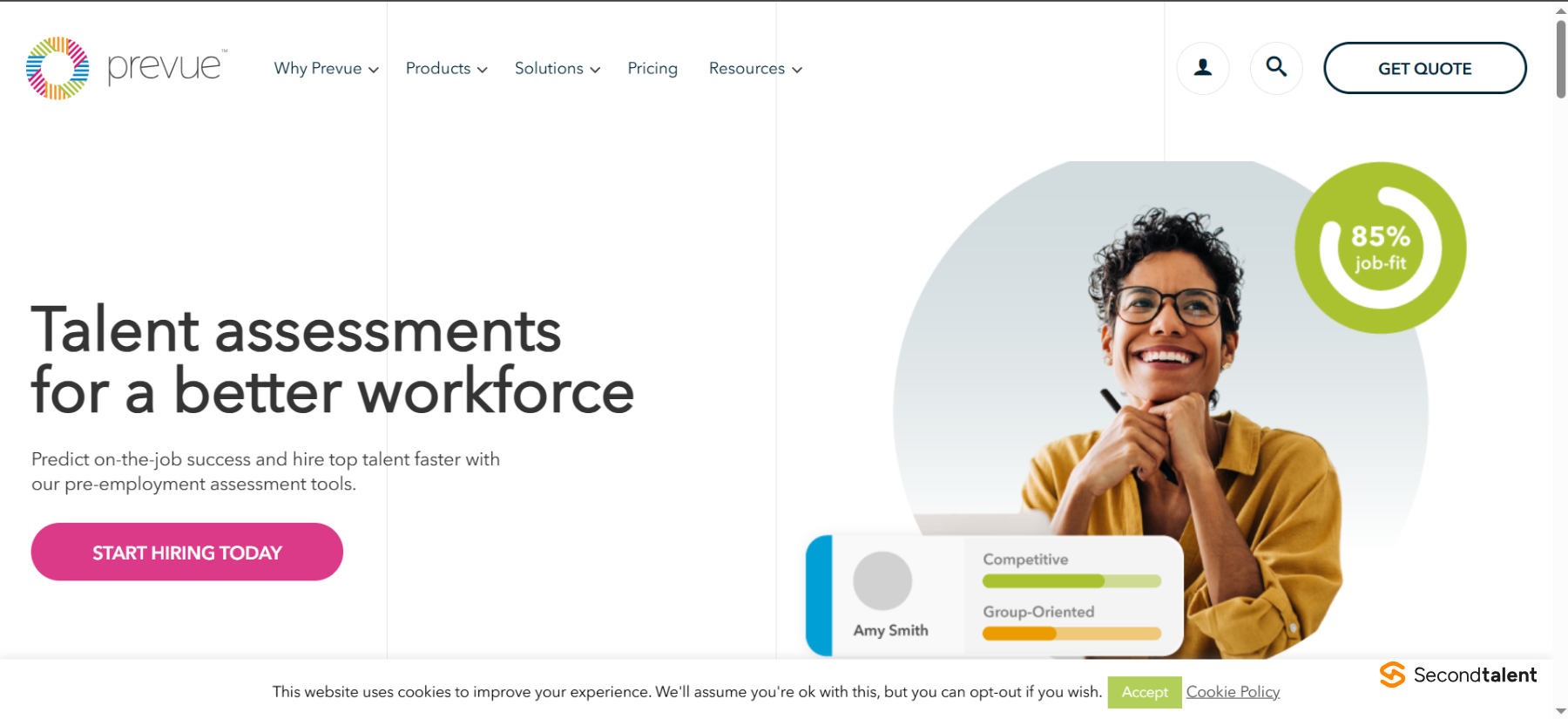
Prevue is for employers that want a dedicated values survey and a clear line between culture fit and culture add.
Prevue's Culture Assessment has current employees and candidates rate the same 40 workplace values. The employee answers form the company's Culture Profile, and each candidate gets a Culture-Fit Report.
That report separates Culture Fit, the match between the candidate's values and the profile, from Culture Add, the new perspectives the candidate could bring.
Prevue's help center groups the 40 values into eight categories drawn from the Organizational Culture Profile of O'Reilly, Chatman and Caldwell and treats a score of 60% or more as a culture match.
Prevue sells into healthcare, manufacturing, retail, hospitality, financial services and government. Its pricing page is the most open of the six: Essentials starts at $195 a month.
The culture assessment sits only in the Premium plan, which Prevue quotes on request and which adds ATS and HRIS integrations and access to Prevue's in-house I/O psychologists.
- Best for: teams that want to see culture add next to culture fit before making an offer.
- Where it struggles: one company-wide values profile can miss the gap between a hospital night shift and a front desk role, and the product page publishes no retention results.
- Price: Premium plan only, quote-based.
Which Type of Fit Assessment Works for Hourly Roles
| Type | What it measures | Fit for hourly roles |
|---|---|---|
| Values and culture surveys | Alignment with company-wide values | Limited: misses what each role demands |
| Work preference rankings | What candidates want against what the role offers | Useful as a quick add-on |
| Personality-based fit | Broad traits linked to success and retention | Good for fast, high-volume screening |
| Role-specific fit | Values and behaviors that predict staying in each role | Strongest when validated against retention |
| Realistic job previews | Self-selection after seeing the real job | Strong partner to any of the above |
Fit at the role level matters because the job, not the company, is what new hires react to. A meta-analysis of 172 studies linked person-job and person-organization fit to attitudes, withdrawal behavior and tenure.
The same logic drives AI-assisted candidate screening: a score only helps when someone checks it against how hires turn out.
Two mistakes undo most rollouts:
- Long tests: every extra minute raises the chance an hourly candidate drops out, so check completion rates monthly.
- Skipping validation: without comparing scores to 30-day and 90-day retention, you cannot tell whether the test works. Our employee retention statistics show leisure and hospitality has the shortest median tenure of any major US industry, at 2.1 years.
Hiring Engineers Instead of Shift Staff?
Fit assessments solve volume hiring.
If your harder problem is technical hiring, Second Talent helps US startups hire vetted AI-Native Engineers and Specialists from Asia, at $29 to $39 an hour, billed monthly, with a 90-day, one-time replacement guarantee.
Tell us the role you need to fill. See how we vet every developer, how teams use AI to source high-quality talent, and which tools fill a typical HR technology stack.
Frequently Asked Questions
What's the Difference Between Culture Fit and Job Fit?
Job fit is whether a candidate can do the work, based on skills and experience. Culture fit is whether they will be comfortable with how the work gets done: the pace, schedule, environment and team.
In hourly roles the two overlap, which is why role-specific assessments often measure both.
Can Culture Fit Assessments Introduce Bias?
Yes, if "fit" means similarity to current staff. Define fit in job-related, behavioral terms, use validated assessments, monitor pass rates by candidate group, and score culture add alongside culture fit.
What If Turnover Is Driven by Pay or Scheduling?
Then an assessment helps only at the margins. Use exit data to separate fit-related exits from those caused by pay, scheduling or management, and fix those causes.
A job preview still helps by showing candidates what they are signing up for.