
TL;DR: US recruiters charge 20% to 35% of first-year salary for a direct hire: 20% is the most common contingency fee, Robert Half's standard schedule says 35%, and retained executive search runs about one-third of first-year cash pay. On a median-paid US software developer ($135,980), that is a one-time fee of $27,196 to $47,593.
Robert Half's January 2026 fee schedule for a California charter school operator lists a standard placement fee of 35% of annual salary, and the cover letter on top of it agrees 25% for that one search.
The gap between the list price and the signed price is where most of a direct hire contract's money moves.
The rest moves through three clauses employers tend to skim: what counts as salary, how the guarantee pays out, and how long the agency can claim a candidate it sent you.
- 1Robert Walters bills on the whole package and counts two-thirds of a bonus that is not guaranteed as salary.
- 2Robert Half's pro rata refund window shrinks from 90 days to 30 days if the invoice is not paid within 15 days.
- 3Both firms charge the fee if you hire a candidate they sent within 12 months, in any role.
- 4Recruiting a nonexecutive hire in-house had a median cost of $1,200 in SHRM's 2025 benchmarks.
How much US recruiters charge for a direct hire
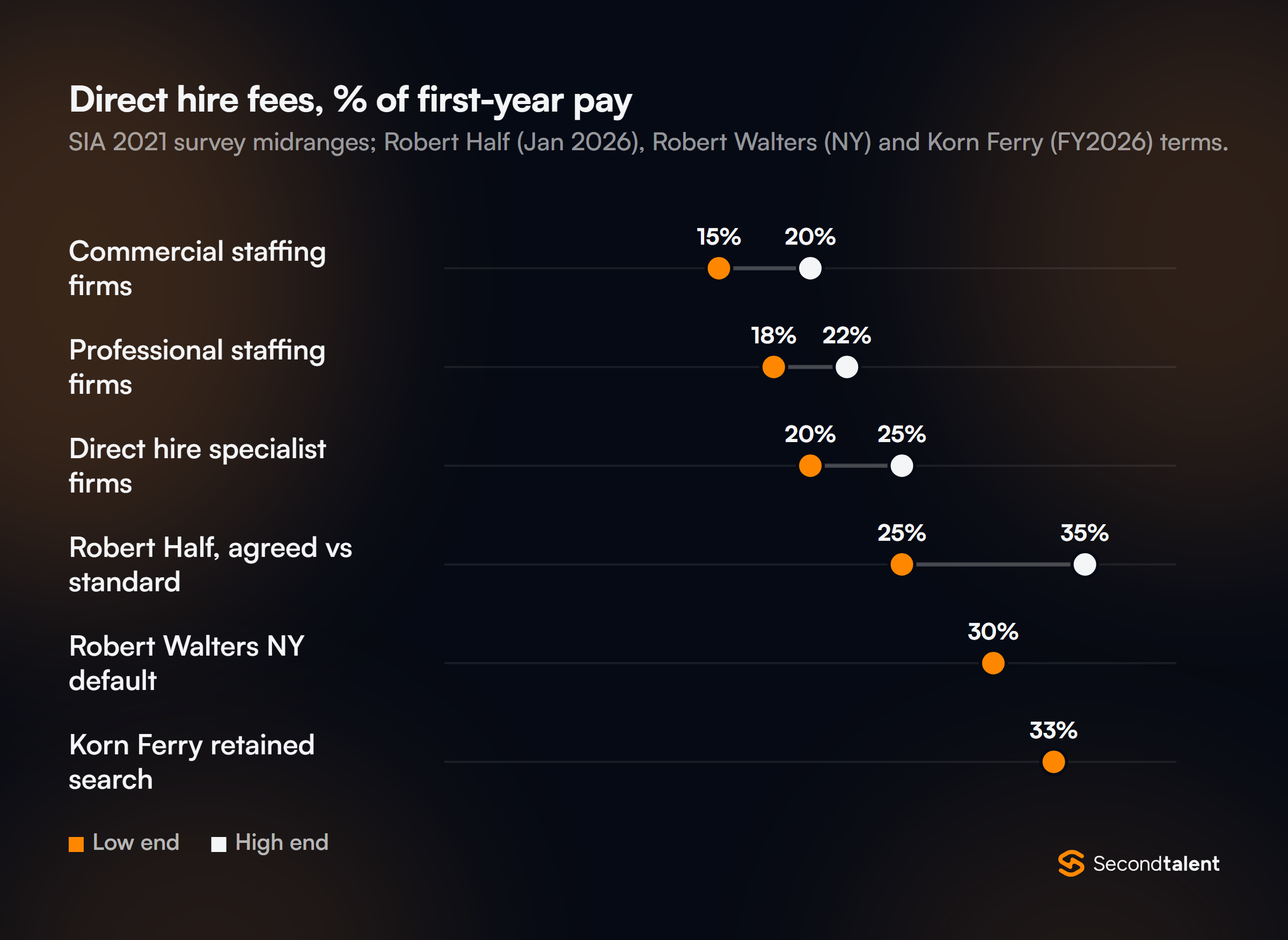
The most common direct hire fee in North America is 20% of first-year salary, charged by 42% of staffing firms in the Staffing Industry Analysts survey. The rate rises with how specialized the firm is.
Commercial staffing firms sit at a midrange of 15% to 20%. Professional staffing firms sit at 18% to 22%, and firms that only do direct hire charge 20% to 25%.
Published contract terms run higher than the survey. Robert Half's January 2026 fee schedule, published in a charter school's board packet, says its standard fee is 35% of annual salary.
The same schedule shows a reduced 25% agreed for a single search. The New York terms of Robert Walters apply a standard 30% unless the client agrees another rate in writing.
Executive search sits above both: Korn Ferry's fiscal 2026 annual report puts its fee at one-third of the placed candidate's estimated first-year cash compensation.
Robert Half's 25% matches its public contract with the Houston-Galveston Area Council, a purchasing program that local governments buy through. That contract sets direct hire at 25% of annual salary.
Between 20% and 25% is a realistic target for a US employer. A list rate of 30% or 35% is where the negotiation starts.
Placement fees in dollars for common US roles
Because the fee is a share of salary, the dollar amount tracks the role more than the agency. A financial manager at the median US salary costs more than twice as much to place as an HR specialist, at the same percentage.
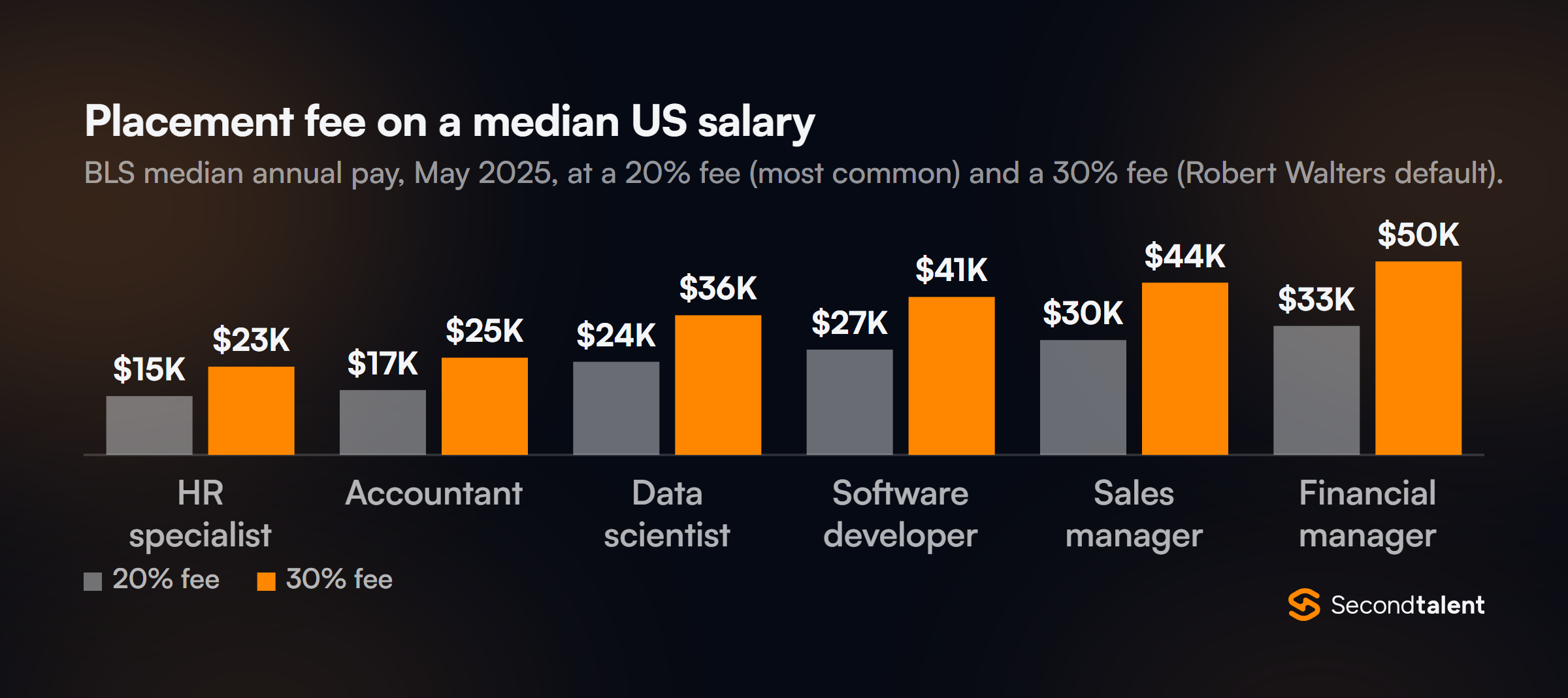
The salaries are national medians from the Bureau of Labor Statistics Occupational Outlook Handbook for May 2025. At 20%, placing a data scientist ($120,230) costs $24,046 and a sales manager ($148,270) costs $29,654.
At 30%, the same two placements cost $36,069 and $44,481.
Real quotes tend to land above these figures, because most agencies bill on more than base salary. The next section covers that.
For software roles, our guide to the cost to hire a software developer in the US compares freelance, in-house and agency rates by seniority and city.
What the fee is calculated on
The percentage is only half the price. The other half is the number it multiplies, and agencies define it in their favor.
Robert Walters bills on the "Salary Package": gross annual salary, bonuses, allowances and joining inducements, which covers a sign-on bonus. Guaranteed bonuses count in full.
Bonuses that are not guaranteed count at two-thirds of the likely amount you tell the agency about.
"For the purposes of calculating Fees, guaranteed bonuses are accounted for in full and where bonuses are not guaranteed, the bonus is valued at two third (2/3) of the likely bonus amount which you inform us of."
Robert Walters Associates, New York Terms and Conditions of Business, July 2024
On a $100,000 base with a $30,000 target bonus, that package is $120,000, so a 30% fee comes to $36,000. Charged on base alone, the same fee would be $30,000.
Robert Half's fee schedule keeps the same option open in shorter words. It reserves the right to include "any expected bonus, commission or guaranteed increase in salary" that is part of the first offer.
Korn Ferry's basis is first-year cash compensation. If the client ends up paying the hire more than the estimate, Korn Ferry bills an extra fee for the difference, and it adds a percentage of the fee to cover indirect expenses.
The fix is cheap if it happens before the search starts. Ask for the fee to be calculated on base salary only, or on base plus guaranteed cash, and write that definition into the agreement.
Commission-heavy roles such as sales are where this clause costs the most.
Contingency, retained and contained search
The fee percentage can be similar across search types, but when you pay it, and whether you get any of it back, is not.
Contingency is the default for most US hiring below the executive level, and it is the model the 20% to 25% benchmarks describe. The agency carries the risk of an unfilled search, which is why it races other agencies to send résumés.
Contained and retained searches buy exclusivity and a dedicated team, and the client carries the risk instead. Under the Robert Walters terms, withdrawing the vacancy before a hire does not end the bill.
You still pay what has fallen due, and the agency keeps what you have paid without moving it to another search.
Retained search makes sense for a role where a failed search costs more than the fee. For a mid-level engineer or accountant, that is seldom the case.
When the fee is due, and the 12-month tail
The fee is earned on acceptance, not on the first day of work. Robert Half's schedule says so in those words, and Robert Walters invoices once the candidate accepts in writing, including by email. Robert Walters goes further.
If the candidate accepts and the job then falls through at no fault of theirs, for example because you pull the offer, you still owe the fee.
The last step is the one that surprises employers. Robert Half's schedule charges the fee on any candidate it referred whom you hire within 12 months of its last referral.
That covers the named position or any other, and hiring as an employee, a consultant or an independent contractor.
Robert Walters counts the 12 months from its last communication about the candidate. Its definition of an introduction is wide: sending a résumé or a LinkedIn profile is enough.
Both sets of terms also reach past the candidate. Robert Half charges if an affiliate hires the candidate on your referral. Robert Walters charges for anyone the candidate recommends to you before they start.
Keep a record of which candidates arrived from which agency, and on what date, because these clauses are where most fee disputes start.
Guarantees: refunds, credits and replacements
Direct hire contracts carry some promise for a hire who leaves early. The useful question is whether it pays back money or only buys another search.
Robert Half's fee schedule offers a 90-day pro rata guarantee if the fee is paid within 15 days of the invoice, and a 30-day one otherwise.
If the hire leaves inside that window, Robert Half refunds 1/90th of the fee for each day left, or gives the same amount as credit toward a replacement.
The refund does not apply to a reorganization, an eliminated position, a takeover or a material change in the job.
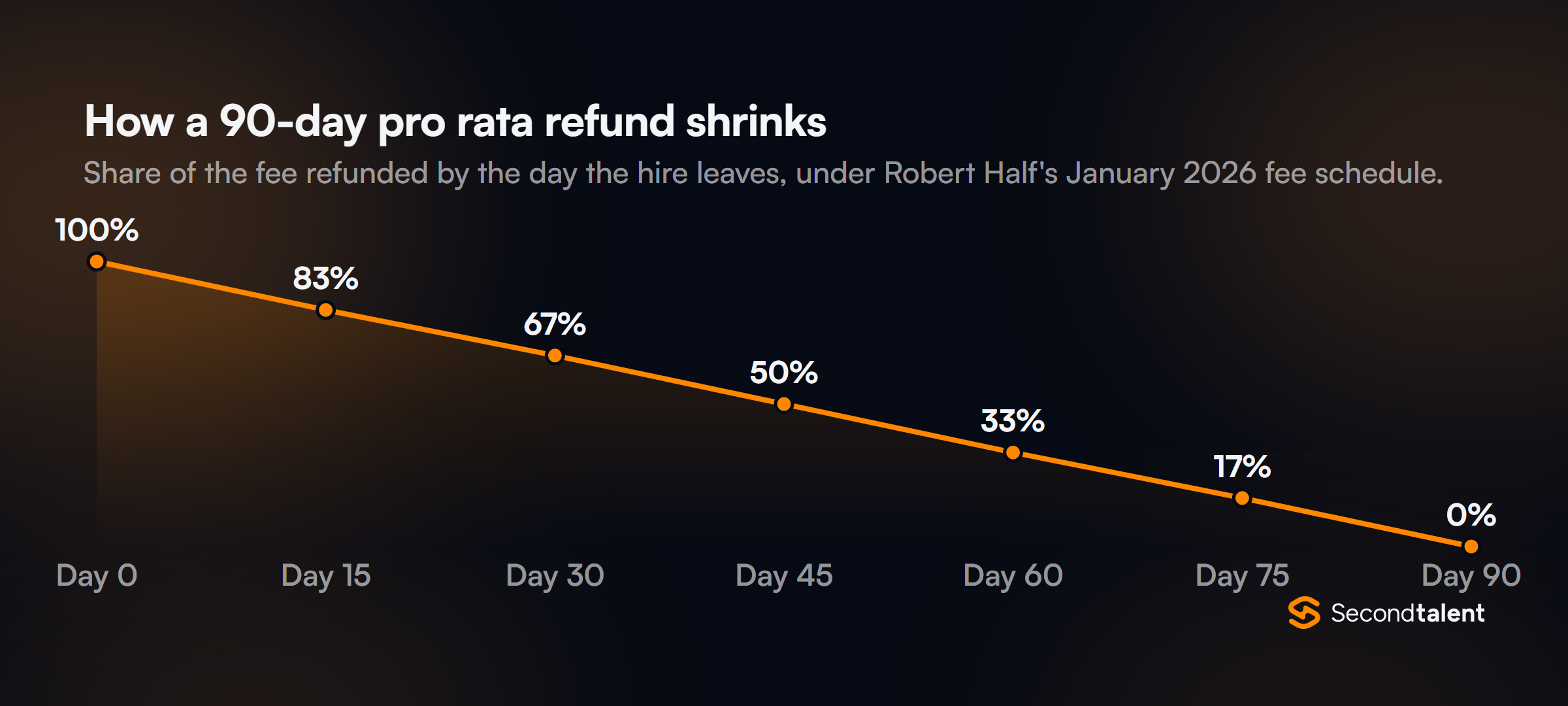
In practice, a hire who leaves on day 30 returns two-thirds of the fee. On a $33,995 fee, 25% of a $135,980 salary, that is $22,663 back. Pay the invoice on day 16 and the same departure falls outside a 30-day window, so nothing comes back.
Robert Walters takes another route. Its New York terms open the clause with "No rebate of Fees shall be made."
Instead, if the hire leaves within 12 weeks, the agency will try to find a replacement within two months, but only if all four of these hold:
- The hire left of their own accord, not through a layoff or a change to the job.
- Every invoice is paid on time.
- You give Robert Walters the replacement search alone, for the same role.
- You tell the agency in writing within 7 days of the decision.
One replacement is offered, and none for the replacement. A cash refund, even a pro rata one, is worth more than a replacement search from the agency that found the first candidate, so it is the clause to push for.
Temp-to-hire: the conversion fee instead
Hiring a temp or contractor the agency already placed with you does not avoid the fee. It turns the fee into a conversion fee that falls the longer the agency has billed for the worker.
Robert Half Technology's scale in the Houston-Galveston contract starts at 25% of annual starting salary within 240 billed hours. It reaches zero after 960 hours, about six months of full-time work.
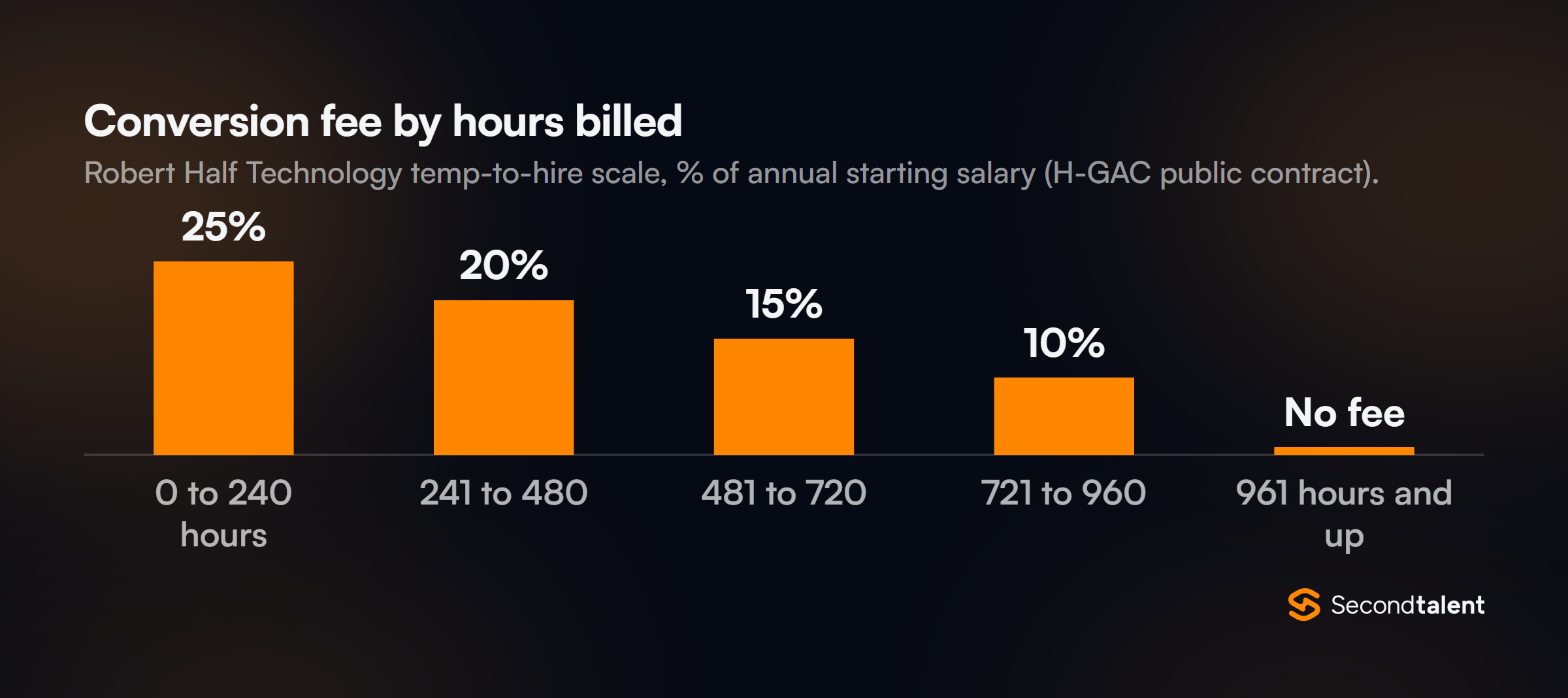
The hours threshold varies by division. Robert Half's administrative staffing line in the same contract drops to no fee after 640 hours.
The conversion fee also applies if you hire the worker within 12 months of the assignment's last day, on any basis, including through another agency.
For a planned hire, conversion can cost less than a direct placement, because the markup you pay during the assignment does part of the agency's earning.
Our breakdown of staffing agency markup rates and bill rates covers that side, and contract vs. direct hire compares the two routes in total cost.
Agency fee vs recruiting in-house
An agency fee buys speed and reach, and it is expensive next to what US employers spend recruiting on their own.
The SHRM 2025 recruiting benchmarking brief, based on 2,371 member organizations, put the median cost per hire at $1,200 for nonexecutive roles and $10,625 for executives.
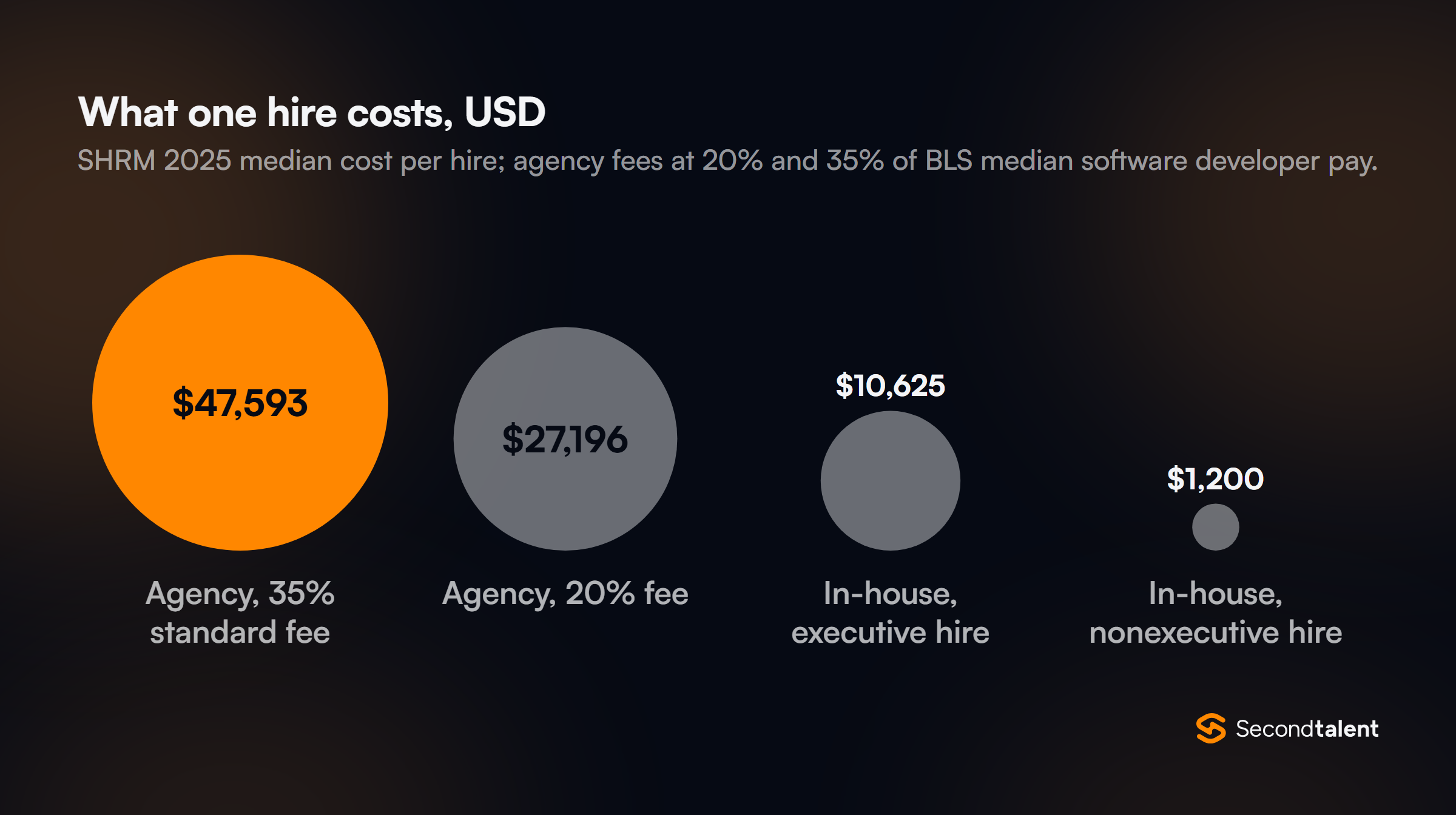
SHRM's cost per hire already includes third-party agency fees, job boards, referral bonuses, travel and recruiter pay, so a $1,200 median implies that most of those hires carried no agency fee at all.
The same brief found time to fill at about a month and a half for both executive and nonexecutive roles.
A median still flatters in-house recruiting, because it leaves out the cost of a seat that stays empty.
An agency earns its fee on hard searches: a niche skill, a confidential replacement, or a role your recruiters have already failed to fill.
For volume roles that post well, the gap between $1,200 and a five-figure fee is hard to justify. Our recruitment agency fee calculator runs the fee models against a salary you enter.
How to negotiate a lower placement fee
Each of these levers comes from a clause in the contracts above, so each one is something an agency has already conceded to someone.
| Clause | What the agency's terms say | What to ask for |
|---|---|---|
| Rate | 35% standard (Robert Half), 30% default (Robert Walters) | 20% to 25% in writing, before the first résumé |
| Salary basis | Package incl. bonuses and sign-on (Robert Walters) | Base salary, or base plus guaranteed cash only |
| Guarantee | Replacement only, 12 weeks (Robert Walters) | Pro rata cash refund for 90 days |
| Payment terms | 15 days, or the guarantee drops to 30 days (Robert Half) | 30 days with the 90-day guarantee kept |
| Candidate claim | 12 months, any role (both firms) | 6 months, and only the role searched |
| Volume | Priced per search | A lower rate for three or more hires |
The rate is the line most employers negotiate, but the salary basis and the guarantee often move more money. A cut from 30% to 25% on a $120,000 package saves $6,000.
Billing on a $100,000 base instead of that package saves the same $6,000 at 30%, and the agency gives up less of its headline price to make it.
Agencies value exclusivity enough that Robert Walters makes it a condition of its replacement search, so trade it rather than give it away. A short exclusive window is a fair price for a lower rate and a pro rata refund.
Direct hire with Second Talent
Second Talent's Direct Hire service charges 25% of annual fixed compensation for a single hire, and 20% per placement when you hire for three or more roles.
Commission, performance bonuses and equity are excluded from the fee, and we invoice within 30 days of the start date.
You get a shortlist of three vetted candidates per role, and each placement carries a 90-day, one-time replacement guarantee.
Because our engineers are based in Asia, the salary the fee is calculated on is a fraction of the US medians above.
If you prefer to skip a placement fee, our Talent Subscription costs $0 until you hire, then $29 to $39 an hour, billed monthly. Compare both models on our pricing page or tell us the role you need to fill.
Frequently Asked Questions
Who pays the direct hire placement fee?
The employer. Robert Half's fee schedule describes its fees as "payable by you, the employer", and its 2025 annual report states that "no fee for placement services is charged to employment candidates."
Do I owe a fee if we found the candidate ourselves?
Not if you found them first, but you need to prove it. Under the Robert Walters terms, an agency "introduces" a candidate by sending their résumé or profile.
If a candidate you already knew arrives through an agency, tell the agency in writing straight away that they were already in your pipeline.
Are direct hire fees negotiable?
Yes. Robert Half's own schedule shows a 35% standard fee reduced to 25% for one search.
The rate, the salary basis, the guarantee and the length of the candidate claim are all negotiable before the search starts, and much harder to change once the agency has sent a résumé.