
Indeed puts the average US base salary for a machine learning engineer at $185,439, based on 5,400 salaries reported through October 2026.
That is about $45,000 above the median the Bureau of Labor Statistics reports for computer and information research scientists, the closest federal category.
Demand is climbing with it. LinkedIn's 2026 Jobs on the Rise list for the US opens with AI engineer, a title LinkedIn says is also known as machine learning engineer.
What is a Machine Learning Engineer?
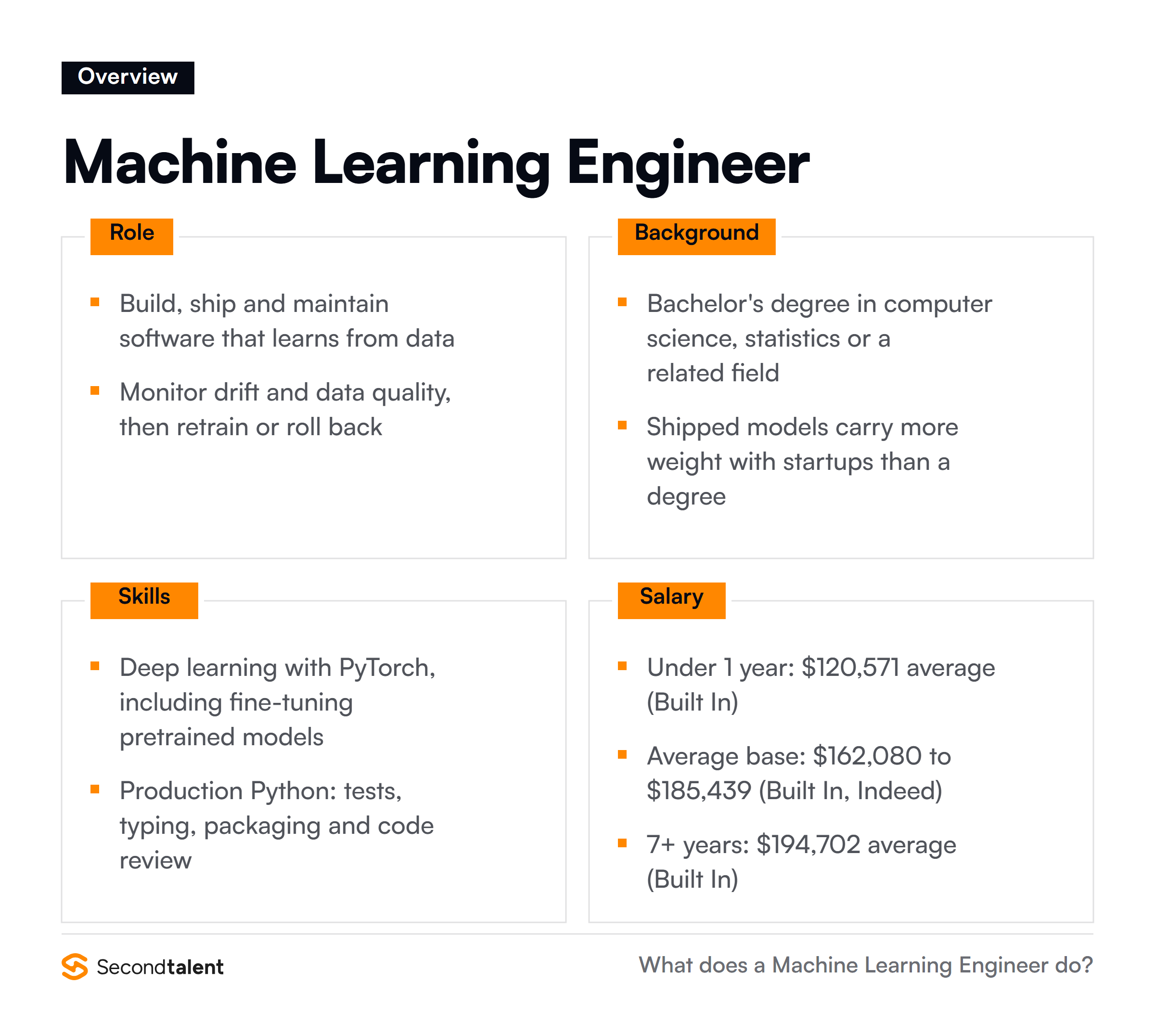
A machine learning engineer builds, ships and maintains software that learns from data.
The job sits between data science and software engineering: a data scientist may prove that a model can predict customer churn in a notebook, and the ML engineer turns that model into a service that scores every account each night, stays accurate as behavior shifts, and does not break the product when it fails.
In 2026 the role covers two kinds of systems:
- Classical and deep learning models trained on the company's own data: ranking, recommendations, fraud detection, forecasting, computer vision
- Applications built on foundation models: fine-tuning open-weight models, retrieval systems, evaluation harnesses and agents that call large language models through an API
The common thread is production. A machine learning engineer is measured on models that run reliably for real users at an acceptable cost, not on a single good result in an experiment.
Machine Learning Engineer Job Market and Salary
The US Bureau of Labor Statistics does not track machine learning engineer as its own occupation.
Its nearest category, computer and information research scientists, had a median annual wage of $140,300 in May 2025, with the top 10 percent earning more than $230,630. Software publishers paid that group a median of $211,270.
BLS projects 22 percent employment growth for the category from 2025 to 2035, against 10 percent for software developers, whose median wage was $135,980.
Salary data specific to the title runs higher than the federal proxy:
- Indeed: $185,439 average base salary, from 5,400 salaries, updated October 12, 2026
- Built In: $162,080 average base salary, plus $49,942 in average additional cash, for $212,022 in total compensation
- Levels.fyi: $250,000 median total compensation for software engineers with an ML or AI focus, which includes equity and skews toward large tech employers
Experience moves pay sharply. Built In reports an average of $120,571 for machine learning engineers with less than a year of experience and $194,702 for those with seven or more years.
Demand signal: In LinkedIn Jobs on the Rise 2026, AI engineer leads the 25 fastest-growing US titles, measured on jobs LinkedIn members started from January 2023 to July 2025.
LinkedIn lists PyTorch, LangChain and retrieval-augmented generation as the most common skills, San Francisco, New York City and Dallas as the top hiring cities, and a median of 3.7 years of prior experience.
Of the postings, 26.2 percent were remote and 27.1 percent hybrid, so most US roles still expect office time.
For a side-by-side of US salaries and the cost of hiring the same role from Asia, see the ML engineer cost guide.
Machine Learning Engineer Responsibilities
D. Sculley and co-authors argued in Hidden Technical Debt in Machine Learning Systems, a NeurIPS 2015 paper, that ML systems are quick to build and expensive to maintain, because data dependencies, feedback loops and configuration sprawl add costs that ordinary code does not have.
Most of an ML engineer's week goes into that maintenance and the engineering around the model, not into model architecture.
Typical Day-to-Day Work
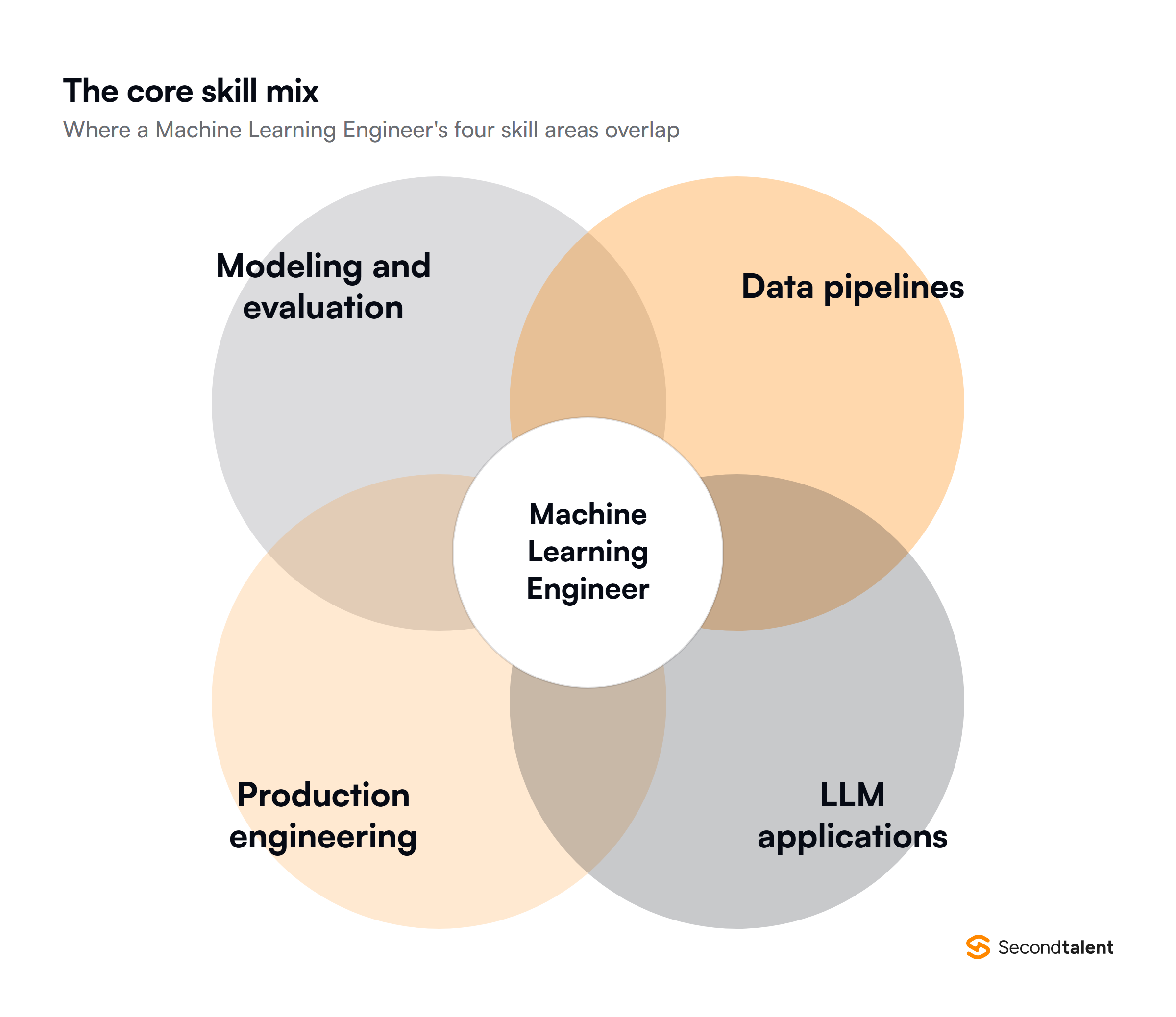
- Framing the problem: turning a product goal such as "fewer chargebacks" into a prediction target, a metric and a baseline to beat
- Data work: writing feature pipelines, fixing label quality, checking for leakage between training and test sets
- Training and evaluation: running experiments, tuning, and building evaluation sets that reflect real traffic, including offline tests for LLM outputs
- Serving: packaging models behind an API or batch job, meeting latency and cost budgets, and managing GPU or CPU capacity
- Monitoring: tracking drift, data quality and business metrics, then deciding when to retrain or roll back
- Collaboration: agreeing on success metrics with product managers and handing reliable interfaces to back-end engineers
Deployment style shapes the job.
A batch model that scores accounts overnight can tolerate a slow feature query; a real-time fraud model has to answer in milliseconds inside a checkout flow, so the engineer spends far more time on caching, feature freshness and fallbacks when the model is unavailable.
At a startup one ML engineer may own all six. At a larger company, platform work often moves to MLOps or infrastructure teams and the ML engineer concentrates on models and features for one product area.
Essential Skills and Qualifications
Python is the working language. In the 2025 Stack Overflow Developer Survey, 57.9 percent of all respondents used Python, up 7 percentage points from 2024.
Machine Learning Skills:
- Supervised learning, gradient-boosted trees and neural networks, and knowing when the simpler model wins
- Evaluation: choosing metrics, building holdout sets, and spotting leakage and overfitting
- Deep learning with PyTorch, including fine-tuning pretrained models
- Working with LLMs: prompt design, retrieval, embeddings and automated evaluation of generated output
Math Foundations: linear algebra, probability and statistics at the level needed to read a loss curve, choose a sample size for an A/B test and explain why a metric moved.
Few product roles need new derivations; all of them need sound judgment about whether a result is real.
Engineering Skills:
- Production Python: tests, typing, packaging and code review
- SQL and data pipeline tools for building features at scale
- Containers, a major cloud platform and CI/CD for training and deploy jobs
- Profiling and optimizing inference for latency and cost
Qualifications: Most US postings ask for a bachelor's degree in computer science, statistics or a related field.
A master's or PhD helps for research-heavy teams, but shipped models and a clear account of the tradeoffs behind them carry more weight with startups than a degree.
Machine Learning Engineer Career Paths
LinkedIn's 3.7-year median of prior experience for AI engineers shows the title is rarely a first job. Most ML engineers arrive from one of three routes:
- From software engineering: back-end engineers who pick up modeling and evaluation, often the strongest at production work
- From data science: analysts and scientists who move closer to production systems
- From graduate research: master's and PhD graduates in ML, statistics or a quantitative science
Progression:
- Machine learning engineer: owns features, experiments and the deployment of one model
- Senior ML engineer: owns a model family or product area end to end, sets evaluation standards
- Staff or principal ML engineer: sets technical direction across teams, such as a shared feature store or evaluation platform
- ML engineering manager or head of ML: leads the team, hiring and the roadmap
Side moves: engineers who enjoy platform work move into MLOps or ML infrastructure, those drawn to new methods move toward research science, and those working mostly with language models often specialize as NLP, LLMOps or inference engineers.
Machine Learning Engineer Tools and Tech Stack
The stack splits in two: a mature layer for training and serving trained models, and a younger, faster-moving layer for building on top of hosted language models. Most US teams now use both.
Engineers who already know a team's stack ramp up in weeks rather than months, so stack fit matters more in hiring than any single tool.
- Languages: Python first, SQL second, and some C++, Rust or Go for performance-critical serving code
- Modeling: PyTorch, scikit-learn and XGBoost or LightGBM for tabular data, and Hugging Face Transformers for pretrained models
- LLM application layer: model provider APIs, LangChain or similar orchestration, vector databases and evaluation frameworks
- Data: a warehouse such as Snowflake, BigQuery or Databricks, plus Spark or a Python dataframe library
- Experiment tracking and orchestration: MLflow or Weights & Biases, Airflow or a similar scheduler
- Serving and infrastructure: Docker, Kubernetes, managed cloud ML services, and inference servers such as vLLM or NVIDIA Triton for GPU workloads
Teams hiring for deep learning work specifically can browse vetted PyTorch developers.
Machine Learning Engineer vs Adjacent Roles
Job titles in this field overlap, and US postings often use them loosely. The useful test is what the engineer is judged on.
- MLOps engineer: judged on the platform many models run on: CI/CD for models, model registries, monitoring and retraining pipelines. The ML engineer builds the model; the MLOps engineer makes shipping any model repeatable. The MLOps engineer vs machine learning engineer comparison covers the split in detail.
- Machine learning infrastructure engineer: judged on compute: GPU clusters, distributed training, storage and serving capacity. Closer to systems and SRE work than to modeling.
- AI research scientist: judged on new methods and published results. Research scientists invent approaches; ML engineers adapt proven ones to a product.
- AI scientist: judged on experiments and analysis that decide which model or approach a company should use. More statistics and less production code than an ML engineer.
- AI engineer: LinkedIn treats the titles as one role. In practice, AI engineer postings lean toward building on hosted foundation models, while ML engineer postings more often include training models on company data.
- Data scientist: judged on insight and decisions, usually in notebooks and dashboards. Many startups hire a data scientist first and an ML engineer once a model needs to run in the product.
At a seed or Series A startup, one strong ML engineer often covers MLOps and infrastructure duties until model count or GPU spend justifies a specialist hire.
How to Hire a Machine Learning Engineer
The most common hiring mistake is testing for the wrong half of the job. A candidate who can derive backpropagation on a whiteboard may never have kept a model accurate in production, and production is what a startup is paying for.
What to Test
- Problem framing: give a real business problem and ask for a target, a metric, a baseline and the first data the candidate would check
- Take-home or paired exercise: a small, messy dataset with a hidden leak or label problem; strong candidates find it before tuning anything
- ML system design: design a recommendation or fraud system end to end, including serving, monitoring and retraining; the AI/ML system design interview guide has question sets
- Code review: hand over a training script and ask what would break in production
- Past work: ask about a model that degraded after launch, how they noticed, and what they changed
Red Flags
- Reports only accuracy, with no baseline or business metric beside it
- Has never deployed a model or cannot describe how one was monitored
- Reaches for a large neural network or an LLM before trying a simple model
- Cannot explain how training data was split, or why
Match seniority to the stage of the company. A first ML hire needs to own data, modeling and deployment with little support, so look for three or more years with at least one model running in production.
Specialists such as research scientists suit later teams with a platform already in place.
Hiring From Asia
Second Talent helps US startups hire vetted AI-Native Engineers and Specialists from Asia.
Companies are matched with vetted machine learning engineers in 24 hours, with 4-6 hours of US time-zone overlap, at $29 to $39 USD an hour billed monthly (160 hours = $4,599 to $5,999 a month).
There is no cost until you hire, and every placement carries a 90-day, one-time replacement guarantee. Browse machine learning engineers for hire or tell us what you need.
Frequently Asked Questions
What does a machine learning engineer do?
A machine learning engineer builds and runs software that learns from data.
The work covers framing the prediction problem, building feature pipelines, training and evaluating models, deploying them behind an API or batch job, and monitoring them for drift once they are live.
How much does a machine learning engineer make in the US?
Indeed reports a $185,439 average base salary from 5,400 salaries as of October 2026.
Built In reports a $162,080 average base and $212,022 in average total compensation, ranging from $120,571 for engineers with under a year of experience to $194,702 for those with seven or more years.
BLS does not track the title; its closest category, computer and information research scientists, had a $140,300 median in May 2025.
Is machine learning engineering in demand?
Yes. AI engineer, which LinkedIn says is also known as machine learning engineer, tops LinkedIn's 2026 Jobs on the Rise list of the 25 fastest-growing US roles.
BLS projects 22 percent growth from 2025 to 2035 for computer and information research scientists, its nearest category.
What is the difference between a machine learning engineer and an MLOps engineer?
The machine learning engineer builds and improves specific models. The MLOps engineer builds the platform that makes deploying, monitoring and retraining any model repeatable, such as CI/CD for models, registries and monitoring.
Startups often combine the two roles in one hire until they run many models.
Do machine learning engineers need a PhD?
No. Most US postings ask for a bachelor's degree in computer science, statistics or a related field. A PhD matters mainly for research scientist roles. For product teams, production experience and sound evaluation habits count for more.
How much does it cost to hire a machine learning engineer through Second Talent?
Second Talent charges $29 to $39 USD an hour, billed monthly, which is $4,599 to $5,999 a month for 160 hours.
Vetted candidates from Asia are matched within 24 hours with 4-6 hours of US time-zone overlap, there is no cost until you hire, and each placement includes a 90-day, one-time replacement guarantee.
Related Roles
Explore related roles you can hire on Second Talent: MLOps Engineer, Machine Learning Infrastructure Engineer, AI Research Scientist, LLMOps Engineer, AI Inference Engineer, NLP Engineer.