Training a model is a one-time cost. Serving it is a bill that arrives every day, for every token, forever. Once an AI product has real traffic, the difference between a naive deployment and an optimized one is routinely three to ten times the cost for the same output, and a user-visible gap in how fast the first word appears.
An AI Inference Engineer owns that gap. They take a trained model and make it serve production traffic at an acceptable latency and a defensible cost per token, using quantization, batching strategy, caching, parallelism, and hardware-aware scheduling. It is one of the highest-paid specializations in AI engineering, for the straightforward reason that the savings are measurable in the monthly invoice.
What is an AI Inference Engineer?
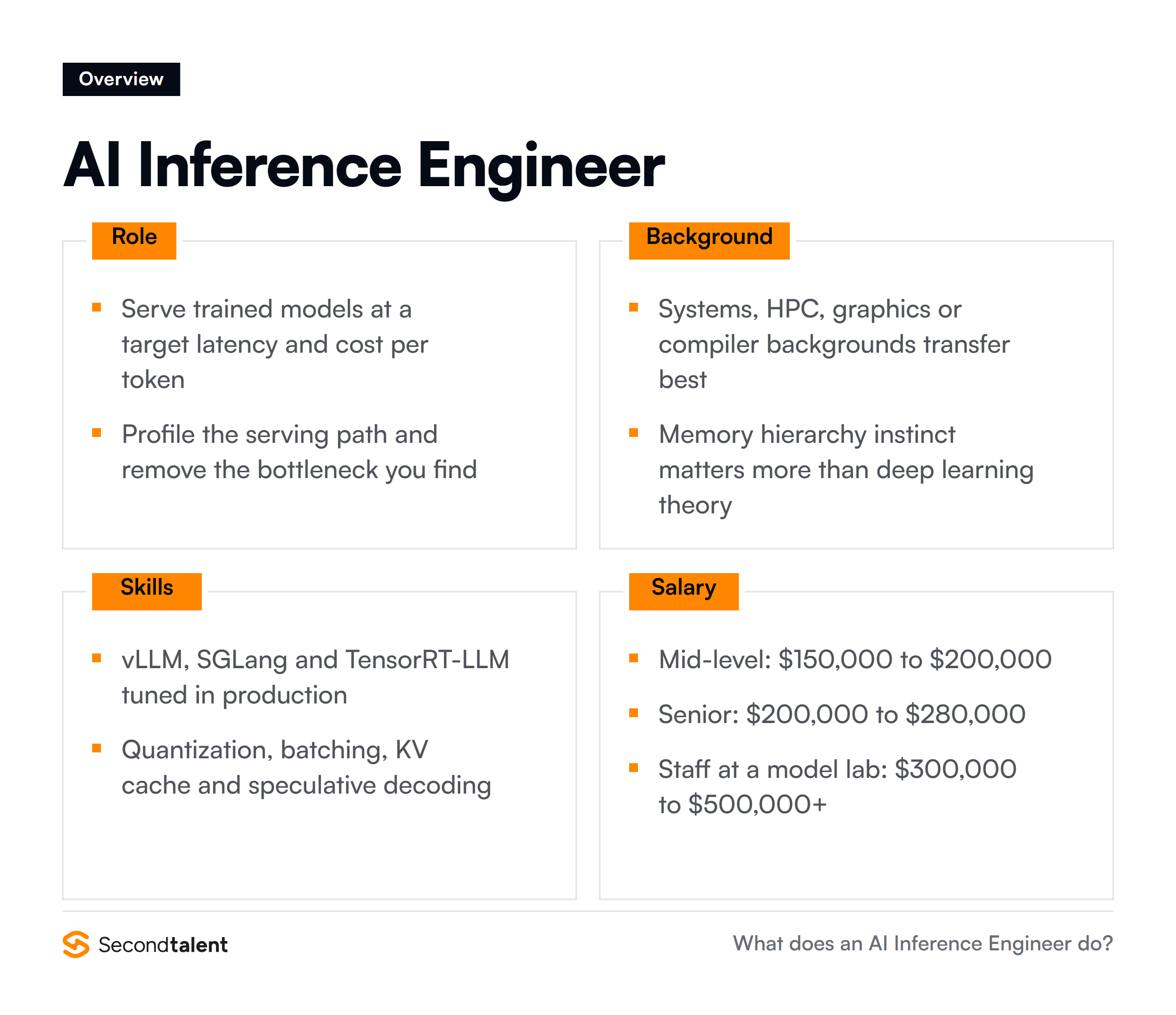
An AI Inference Engineer is responsible for how a model behaves in production serving: throughput, latency, memory footprint, and cost per million tokens. The role begins where training ends. Given a model that already works, the question becomes how many concurrent users one GPU can serve, how quickly the first token arrives, and what has to be traded away to improve either number.
The daily work is measurement and iteration. Profile a serving stack to find where time actually goes. Switch batching strategy and measure the effect on tail latency. Quantize a model to FP8 or INT4 and evaluate whether output quality survived the compression. Tune KV cache allocation so a long-context request does not evict everyone else’s session. Decide whether a workload belongs on fewer large GPUs or more small ones.
Two numbers dominate the job. Time to first token determines whether an interface feels responsive. Inter-token latency determines whether streaming output feels natural. Almost every optimization improves one at the expense of the other or trades throughput for both, and choosing correctly requires knowing what the product actually needs rather than optimizing a benchmark.
The role is distinct from an MLOps Engineer, who owns the pipeline and lifecycle around models, and from a Machine Learning Infrastructure Engineer, who owns the platform underneath. An Inference Engineer goes deeper on the serving path itself, often down to the kernel.
AI Inference Engineer Job Market and Career Opportunities
Inference specialists sit at the top of the AI compensation range. Industry compensation analysis in 2026 places infrastructure, inference, and GPU specialists at $300,000 to $500,000 and above in the highest bands, with LLM fine-tuning and inference roles at $220,000 to $350,000 in total compensation. Distributed inference optimization with vLLM or TensorRT is explicitly listed among the skills that trigger specialist pay adjustments.
The demand comes from arithmetic. A company spending seven figures a year on inference can justify a senior hire on a fifteen percent efficiency gain alone, and gains far larger than that are common in stacks that have never been profiled. That is why an engineer who reliably removes fifty milliseconds from a response is paid as much as one who trains models.
Average Salary Ranges (US market):
- Mid-level Inference Engineer: $150,000 to $200,000
- Senior Inference Engineer: $200,000 to $280,000
- LLM fine-tuning and inference roles, total compensation: $220,000 to $350,000
- Staff or Principal at a model lab or inference provider: $300,000 to $500,000+
Employers fall into four groups: model labs serving their own APIs, inference providers competing on price and speed, enterprises self-hosting open-weight models for cost or data-residency reasons, and hardware vendors building the serving stack itself. The third group is growing fastest, as open-weight models close enough of the quality gap to make self-hosting a genuine financial decision.
This is a genuinely scarce skill set, and over 75% of AI job listings now seek deep specialists rather than generalists. Hiring across Asia reaches strong systems and GPU engineers, particularly those from HPC, graphics, and embedded backgrounds, at rates well below the US bands above.
Essential AI Inference Skills and Qualifications
Serving Stack Expertise:
- vLLM, SGLang, and TensorRT-LLM in production, not just in a benchmark script
- Continuous batching and how it changes the throughput and latency curve versus static batching
- Paged attention and KV cache management, including eviction policy under memory pressure
- Prefix caching for shared system prompts, which is often the single largest cheap win in a chat workload
Model Optimization:
- Quantization: FP8, INT8, INT4, and the AWQ and GPTQ families, plus how to evaluate the quality cost of each
- Speculative decoding and draft-model selection
- Tensor, pipeline, and expert parallelism for models too large for one device
- Multi-LoRA serving, where many fine-tuned adapters share one base model in memory
Systems and Hardware:
- GPU architecture fundamentals: memory bandwidth, occupancy, and why most LLM inference is memory-bound rather than compute-bound
- CUDA and Triton kernel work, at least to the level of reading and modifying an existing kernel
- Profiling with Nsight, PyTorch profiler, and stack-level tracing to find where the time actually goes
- Multi-GPU communication: NCCL, interconnect topology, and when the network becomes the bottleneck
Production Operations:
- Autoscaling GPU capacity against traffic that is spiky and expensive to over-provision
- Load balancing that is cache-aware, so requests sharing a prefix land on the same replica
- Benchmarking discipline: realistic request mixes, warm caches, and percentile latency rather than averages
- Cost accounting per million tokens, tied back to a specific model, hardware type, and configuration
Educational Background: Backgrounds skew systems rather than data science. Computer engineering, HPC, graphics, embedded, and compiler work all transfer well. Deep learning theory matters less here than an instinct for memory hierarchies and profiling.
AI Inference Engineer Career Paths and Specializations
Career Progression:
- Backend, Systems, or ML Engineer → AI Inference Engineer → Senior Inference Engineer → Staff Inference or GPU Systems Engineer → Head of AI Infrastructure
Specialization Areas:
- Serving Systems: Scheduler, batching, and cache design inside the serving engine itself
- Kernel Optimization: CUDA and Triton work on attention, matrix multiply, and quantized paths, the deepest and best-paid corner
- Model Compression: Quantization and distillation with rigorous quality evaluation attached
- Edge Inference: Running models under hard memory and power limits, shading into the Edge AI Engineer role
- Inference Platform: Multi-tenant serving, routing, and capacity planning across a fleet
Kernel optimization is where the compensation ceiling is highest and the candidate pool is thinnest. Very few engineers can profile an attention kernel, identify a memory-bandwidth stall, and write a faster version, and those who can are rarely on the market long.
AI Inference Tools and Technologies
Serving Engines:
- vLLM, the most widely deployed open-source LLM serving engine
- SGLang, particularly for structured generation and complex prompt reuse
- TensorRT-LLM for NVIDIA-optimized deployment
- Triton Inference Server as a multi-model serving front end
- llama.cpp and similar runtimes for CPU and small-footprint deployment
Optimization and Compilation:
- TensorRT and ONNX Runtime
- torch.compile and Inductor
- Triton, the kernel language, for custom operators
- Quantization toolkits including AWQ, GPTQ, and FP8 pipelines
Hardware and Orchestration:
- NVIDIA data center GPUs, plus AMD ROCm and specialist accelerators where cost or supply justifies them
- Kubernetes with GPU scheduling, or a managed equivalent
- Ray Serve for distributed serving topologies
- Spot and preemptible capacity strategies, since GPU cost dominates the budget
Measurement:
- Nsight Systems and Nsight Compute for GPU profiling
- Load generators that reproduce a realistic request mix rather than uniform prompts
- Latency dashboards reporting p50, p95, and p99 separately for time to first token and inter-token latency
- Quality regression suites, so an optimization that degraded output is caught before customers find it
Building Your AI Inference Portfolio
Portfolio Components:
- A Benchmark Study: One model served three ways, with throughput, time to first token, and cost per million tokens measured under an identical realistic load
- A Quantization Evaluation: The same model at several precisions, with both speed gains and measured quality loss reported honestly
- A Profiling Writeup: A specific bottleneck you found, the profile that revealed it, and the change that removed it
- A Cost Reduction Case: A before and after on real or realistic traffic, expressed in dollars per million tokens rather than percentages
Report percentile latency, not averages, and state your request mix. Hiring managers in this field read benchmarks critically, and a result presented without its load profile reads as a result the candidate does not understand.
AI Inference Methodology and Best Practices
Profile before optimizing. Intuition about where inference time goes is wrong more often than it is right, and memory bandwidth is usually the constraint rather than raw compute.
Benchmark with a realistic request mix. Uniform 512-token prompts produce numbers that collapse the moment production traffic arrives with its long tail of oversized requests.
Attach a quality gate to every optimization. Quantization and speculative decoding can silently degrade output on exactly the hard cases users care about. Speed without an accuracy check is not a result.
Optimize the metric the product needs. A batch summarization job wants throughput. A live assistant wants time to first token. Tuning the wrong one produces a better benchmark and a worse product.
Exploit prefix caching early. Most chat workloads repeat a large system prompt on every request. Caching that shared prefix is usually the cheapest large win available and is frequently left on the table.
Measure in dollars per million tokens. Percentage improvements are hard to prioritize against each other. Cost per unit of output makes the trade-offs legible to everyone, including the people approving GPU spend.
Future of AI Inference Careers
Inference has overtaken training as the dominant share of AI compute spend for most companies running products rather than research. That shift is structural: training happens periodically, serving happens continuously, and reasoning models that generate long internal chains multiply the tokens produced per user request.
Expect hardware diversity to increase the value of this skill set. As alternatives to a single GPU vendor become viable, the engineers who can port and tune a serving stack across architectures gain leverage that a single-vendor specialist does not have.
Expect agents to reshape the workload. Agentic systems issue many short model calls in sequence rather than one long one, which changes what the serving layer should optimize for and makes scheduling and cache reuse across a session more important than raw single-request speed.
Expect the role to stay scarce. It requires systems depth and machine learning familiarity at the same time, and most engineers have one or the other. That intersection is what sustains the compensation premium.
Getting Started as an AI Inference Engineer
Practical Steps:
- Serve one open-weight model yourself on a single GPU and measure it properly, including percentile latency and tokens per second
- Change one variable at a time, such as batching strategy or quantization level, and record the effect on both speed and quality
- Learn to read a GPU profile, and find one real bottleneck in a stack you did not write
- Study why LLM inference is memory-bound, because that single fact explains most optimization decisions in the field
- Work through the vLLM or SGLang source far enough to understand how the scheduler and KV cache actually behave
- Publish one honest benchmark with its full methodology, which is currently the fastest way to be taken seriously
Candidates arriving from systems or HPC backgrounds usually need to build familiarity with transformer internals and evaluation. Candidates arriving from machine learning usually need to build profiling and low-level systems skills. The systems-first route is generally faster.
If you are hiring rather than applying, Second Talent places AI Inference Engineers and other AI-native talent across Asia, with vetting, compliance, and payroll handled for you.
Frequently Asked Questions
What is the difference between an AI Inference Engineer and an MLOps Engineer?
An MLOps Engineer owns the lifecycle around models: pipelines, deployment automation, versioning, and monitoring. An AI Inference Engineer owns the serving path itself, going deep on batching, quantization, cache behavior, GPU utilization, and cost per token. MLOps is broad and process-oriented; inference engineering is narrow and performance-oriented, and often reaches down to kernel-level work.
Do I need to write CUDA to work in AI inference?
Not to start. A great deal of value comes from serving-stack configuration, quantization choices, batching strategy, and caching, none of which require writing kernels. CUDA and Triton skills become important at the senior and staff end, where custom kernel work is what separates the highest band from the rest.
Why is inference optimization worth so much to employers?
Because the saving is continuous and measurable. Serving costs recur on every request, so a stack that is three times more efficient permanently reduces a large operating expense while also improving response times. On a seven-figure annual inference bill, a senior hire pays for itself on a modest efficiency gain.
How much does it cost to hire an AI Inference Engineer through Second Talent?
Cost depends on seniority and depth, and kernel-level specialists sit well above generalist serving engineers. Hiring across Asia reaches strong systems, HPC, and GPU engineers at rates meaningfully below US bands. Get in touch for a current rate breakdown for your specific stack.
How quickly can Second Talent place an AI Inference Engineer?
We can usually present a shortlist of pre-vetted candidates within days, with placements typically completed in a few weeks depending on your interview process and start-date requirements.
Related Roles
Explore related roles you can hire on Second Talent: Machine Learning Infrastructure Engineer, MLOps Engineer, LLMOps Engineer, AI/ML Model Deployment Engineer, Fine-Tuning Engineer, Edge AI Engineer.