Most new programming languages either chase the mainstream or vanish into academic curiosity. Gleam has done neither. It is a small, statically typed functional language that compiles to both Erlang and JavaScript, runs on the BEAM virtual machine, and has quietly become one of the most-loved newcomers among engineers who care about reliability, concurrency, and type-driven development.
Gleam Developers are the engineers who saw the same trade-off the language designers did. Erlang and Elixir give you the world’s best concurrency runtime but no static type system. Most static type systems give you safety but force you back onto a less reliable runtime. Gleam offers both. The community is small but unusually high-signal, and the job market is small but unusually well-compensated for the engineers who go deep.
What is a Gleam Developer?
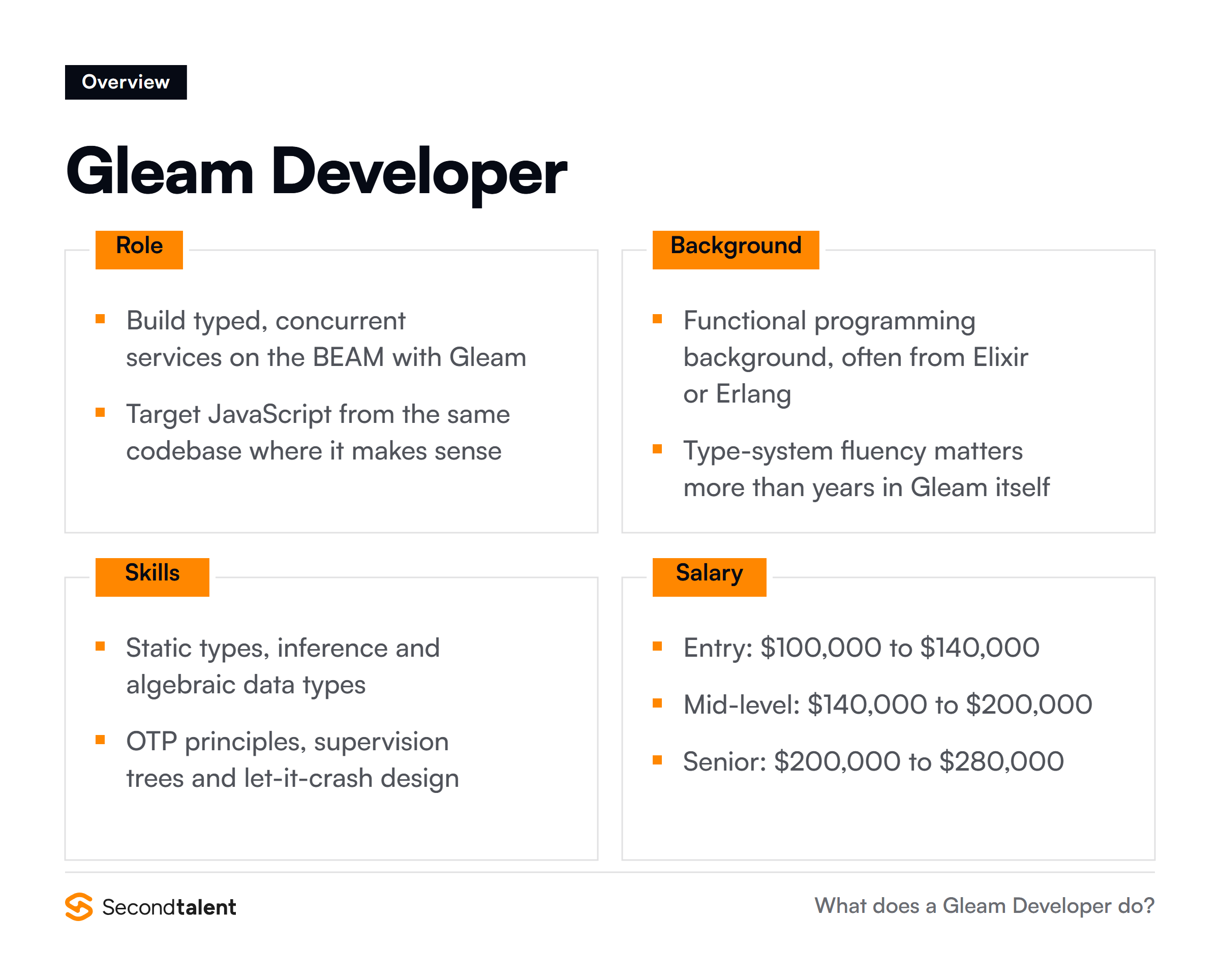
A Gleam Developer builds software with Gleam, a friendly, statically typed functional language that targets the BEAM (the same runtime that powers Erlang, Elixir, and WhatsApp’s messaging infrastructure) and also compiles to JavaScript for browsers and edge runtimes. The language emphasizes ergonomic syntax, sound type inference, and explicit error handling.
The role attracts engineers who want the fault tolerance, concurrency, and distribution story of the BEAM, plus the static-typing safety net that protects production systems from a long list of runtime issues. Many Gleam Developers also work fluently in Elixir or Erlang and adopt Gleam selectively for the parts of their stack where the type guarantees pay for themselves.
Gleam Developer Job Market and Career Opportunities
Gleam is a young language with rapidly growing adoption. The community has crossed the threshold from hobbyist into early commercial use, with a steady stream of small-to-mid-sized teams shipping Gleam in production for web services, internal tools, and BEAM-side performance-critical components. Several developer-tools companies have picked Gleam for parts of their stack, and large Elixir shops are increasingly trialing it.
The hiring economics resemble what early Elixir looked like in 2014. Few jobs are explicitly titled “Gleam Developer.” Many roles are titled “Elixir Engineer” or “BEAM Engineer” and welcome Gleam fluency, often paying a premium for it.
Average Salary Ranges (US-equivalent):
- Entry-level Gleam Developer: $100,000 – $140,000
- Mid-level Gleam Developer: $140,000 – $200,000
- Senior Gleam Developer: $200,000 – $280,000
- Principal Gleam Developer: $280,000 – $400,000+
Demand is concentrated at BEAM-friendly SaaS companies, at early-stage startups shipping reliability-critical services, at fintech and trading shops with Erlang heritage, and at developer-tools companies building infrastructure that benefits from the BEAM’s concurrency model with the safety of a strong type system.
Essential Gleam Skills and Qualifications
Core Knowledge Areas:
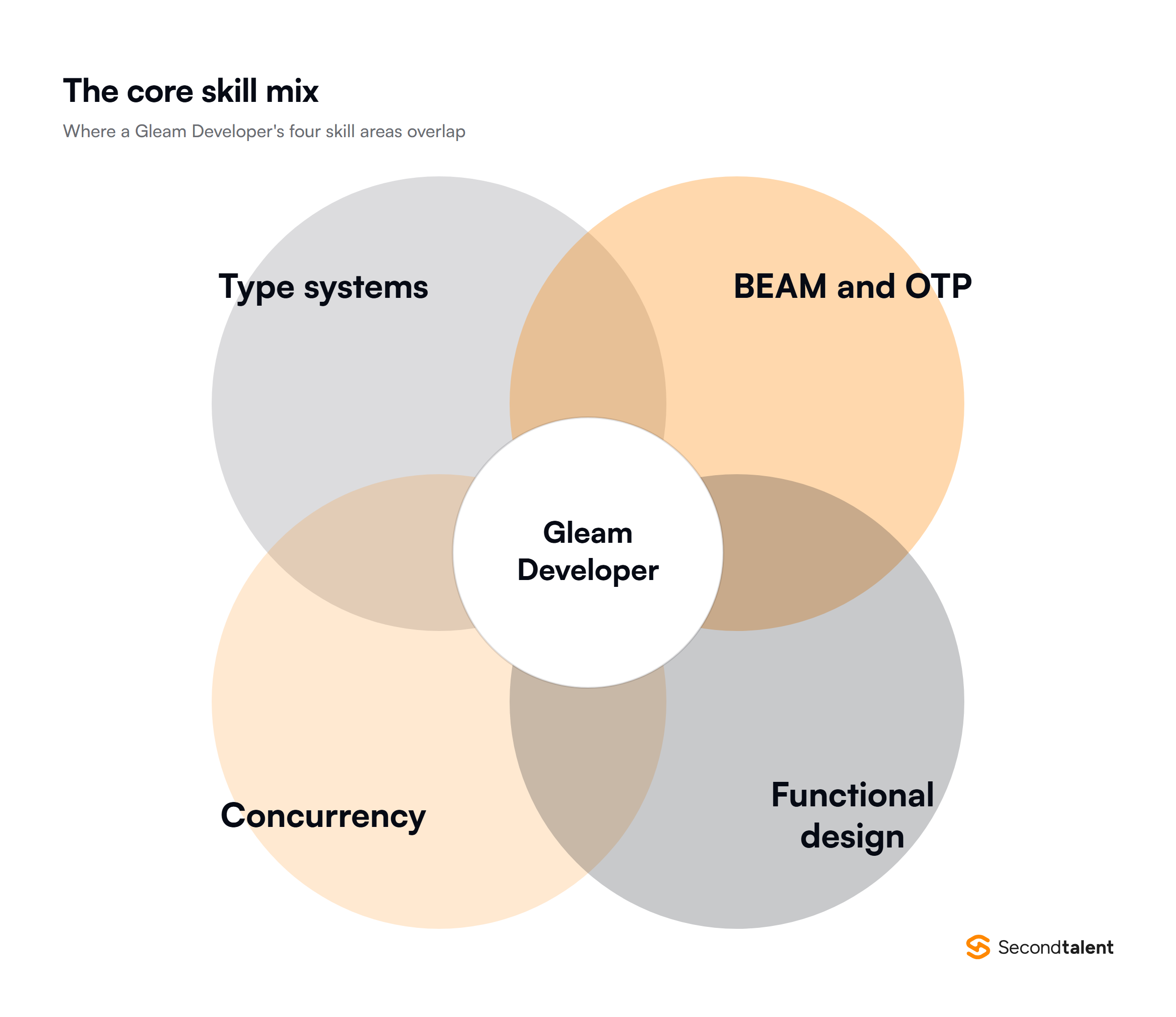
- Static type systems, type inference, and algebraic data types
- The BEAM virtual machine, OTP principles, and the actor model
- Process supervision trees and let-it-crash design
- Pattern matching and exhaustive case handling
- Concurrency, message passing, and distribution on the BEAM
- Result types and explicit error handling
- Functional programming patterns (immutability, pure functions, composition)
Technical Competencies:
- Hands-on fluency with the Gleam toolchain (gleam CLI, hex, rebar3 interop)
- Experience with Erlang or Elixir, since most Gleam code lives next to existing BEAM code
- Comfort calling into Erlang and Elixir libraries through Gleam’s FFI
- Understanding of OTP behaviors (GenServer, Supervisor) and how to use them from Gleam
- HTTP and web frameworks (Wisp, Mist) for backend services
- JavaScript target awareness for sharing code with the browser
- Testing patterns (gleeunit, property-based testing)
Soft Skills:
- Patience for an evolving ecosystem where libraries are still maturing
- Willingness to contribute back, because community involvement is part of the culture
- Clear technical writing for documentation, since the ecosystem rewards good docs
- Pragmatism about when to reach across the FFI boundary into the larger Erlang or Elixir libraries
Gleam Developer Career Paths and Specializations
Gleam roles tend to specialize by what part of the stack the engineer owns.
Backend Services on the BEAM: Building HTTP services, background-job processors, and stateful actors with Gleam on the BEAM target, often interoperating with existing Erlang or Elixir code.
Full-Stack Gleam: Sharing types and code between a Gleam backend and a Gleam-on-JavaScript frontend, an emerging pattern that gives full-stack type safety in a way few other stacks can match.
BEAM Interop and Library Authorship: Specialists who write Gleam libraries that wrap battle-tested Erlang or Elixir libraries, expanding what is available to the Gleam ecosystem.
Real-Time Distributed Systems: Engineers who use the BEAM’s distribution model alongside Gleam’s type system to build fault-tolerant, real-time systems in domains like messaging, gaming, and trading.
Developer Tools and Compilers: Several companies have chosen Gleam for parts of their developer-tooling stack. The language’s combination of safety and speed of iteration suits compiler and tooling work.
Elixir Plus Gleam Hybrid Roles: Many production teams adopt Gleam incrementally, with Elixir as the primary language and Gleam used for components where the type guarantees most pay off.
Gleam Tools and Technologies
Core Toolchain:
- The gleam CLI for building, formatting, and testing
- Hex for package management, shared with the broader BEAM ecosystem
- rebar3 for Erlang interop and BEAM-side packaging
- gleam_lsp for editor integration with type-on-hover and diagnostics
Web and Backend Libraries:
- Wisp for ergonomic HTTP service development
- Mist for low-level HTTP and WebSocket work
- Lustre for full-stack functional UI development with Gleam on both sides
- gleam_otp for type-safe OTP behaviors
Testing and Quality:
- gleeunit for unit testing
- Property-based testing through ported QuickCheck variants
- The Gleam type checker as the first line of defense
Editors and Development Environments:
- Visual Studio Code with the Gleam extension
- Neovim with built-in LSP support
- Emacs with gleam-mode
- Helix with first-class language-server integration
BEAM Ecosystem Interop:
- Calling Erlang libraries directly through Gleam’s FFI
- Calling Elixir libraries through their compiled Erlang form
- Phoenix and Phoenix LiveView as larger frameworks reachable from Gleam services
Building Your Gleam Developer Portfolio
Because the community is small and the open-source surface is highly visible, portfolio work is unusually impactful.
Project ideas that signal seriousness:
- A nontrivial backend service in Gleam with Wisp or Mist, including OTP supervision and integration tests
- A Gleam-on-JavaScript frontend connected to a Gleam BEAM backend with shared types end to end
- A Hex-published library that wraps a popular Erlang library with a clean Gleam API
- A real-time service that uses BEAM distribution for fault tolerance, with measurable failure recovery characteristics
- A contribution to a flagship Gleam project (the compiler, Wisp, or Lustre)
The Gleam community values written explanation. A clear blog post or README explaining the design decisions of any project will carry as much weight in hiring conversations as the code itself.
Gleam Methodology and Best Practices
Lean on the type system. Gleam’s type inference is strong enough that explicit annotations are only needed for public APIs and intentional documentation. Use this to keep code readable while still type-safe.
Use Result types for fallible operations. Gleam has no exceptions in the conventional sense. Every operation that can fail returns a Result, and the discipline of handling both branches at each call site catches a remarkable amount of latent bugs.
Embrace OTP rather than reinventing concurrency. The BEAM’s supervision trees, actor model, and let-it-crash philosophy are the reason to be on the BEAM at all. Use them. Gleam’s typed wrappers make them more pleasant than the raw Erlang equivalents.
Be deliberate about FFI boundaries. Calling into Erlang and Elixir is part of normal Gleam development, but each call is a type-system boundary. Keep the unsafe surface area small and well-documented.
Choose one ergonomic web framework. Wisp for most backend services, Mist for lower-level needs. Resist the temptation to mix unless there is a specific reason.
Write documentation as you go. The community rewards good docs, and Hex’s documentation tooling makes it easy to publish them alongside libraries.
Read the language’s own design notes. The Gleam team publishes excellent rationale for design decisions. The reasoning is part of becoming fluent in the language’s style.
Future of Gleam Developer Careers
Gleam is at the moment Elixir was in 2014. The fundamentals are right, the community is high-signal, and the language is gaining commercial traction without yet being mainstream.
Production adoption is accelerating. More companies are shipping Gleam in production each quarter, and BEAM-shop hiring increasingly mentions Gleam fluency as a plus.
Full-stack Gleam is a credible pattern. The JavaScript compilation target combined with the BEAM target makes Gleam one of the few languages where genuinely shared types across frontend and backend are practical.
The ecosystem is maturing fast. Wisp, Lustre, gleam_otp, and the broader library catalog are filling in the gaps that previously held production teams back.
BEAM remains under-deployed. The BEAM’s runtime advantages for distributed and concurrent systems have not gone away. Gleam gives the BEAM a static type story that opens the platform to teams who previously dismissed it for lack of compile-time safety.
Getting Started as a Gleam Developer
Read the official Gleam Language Tour. It is short, well-written, and covers the language thoroughly. A weekend with the tour and the standard library is enough to become productive.
Set up the toolchain and an LSP-aware editor. The inner loop is fast and pleasant once configured. Get the workflow right first.
Build one backend service end to end. Use Wisp, add database integration through a library wrapper, write integration tests. The first end-to-end project teaches more than any amount of tutorial reading.
Learn enough Erlang and Elixir to be dangerous. You will read library source in those languages, and many production Gleam jobs will expect you to maintain mixed codebases.
Contribute a library or a documentation patch. The community is small, welcoming, and high-leverage. A merged Hex package or a useful blog post gets noticed.
Join the Gleam Discord and the broader BEAM communities. Most early-career Gleam jobs surface in these channels long before they appear elsewhere.
Gleam is a deliberate bet on a small, principled language. The engineers who get fluent now position themselves alongside the early Elixir adopters of a decade ago, with a similar trajectory of growing commercial demand and a strong community premium for genuine expertise.