The next generation of customer interactions is not happening on a screen. It is happening through voice and chat, with AI agents that understand intent, remember context, and resolve issues without escalating. Behind every smooth conversational experience sits an engineer who has solved a long list of hard problems most users will never see.
Conversational AI Engineers are the specialists who build these systems. They combine large language model expertise with dialogue design, voice infrastructure, latency engineering, and the kind of edge-case handling that real users force you to confront.
What is a Conversational AI Engineer?
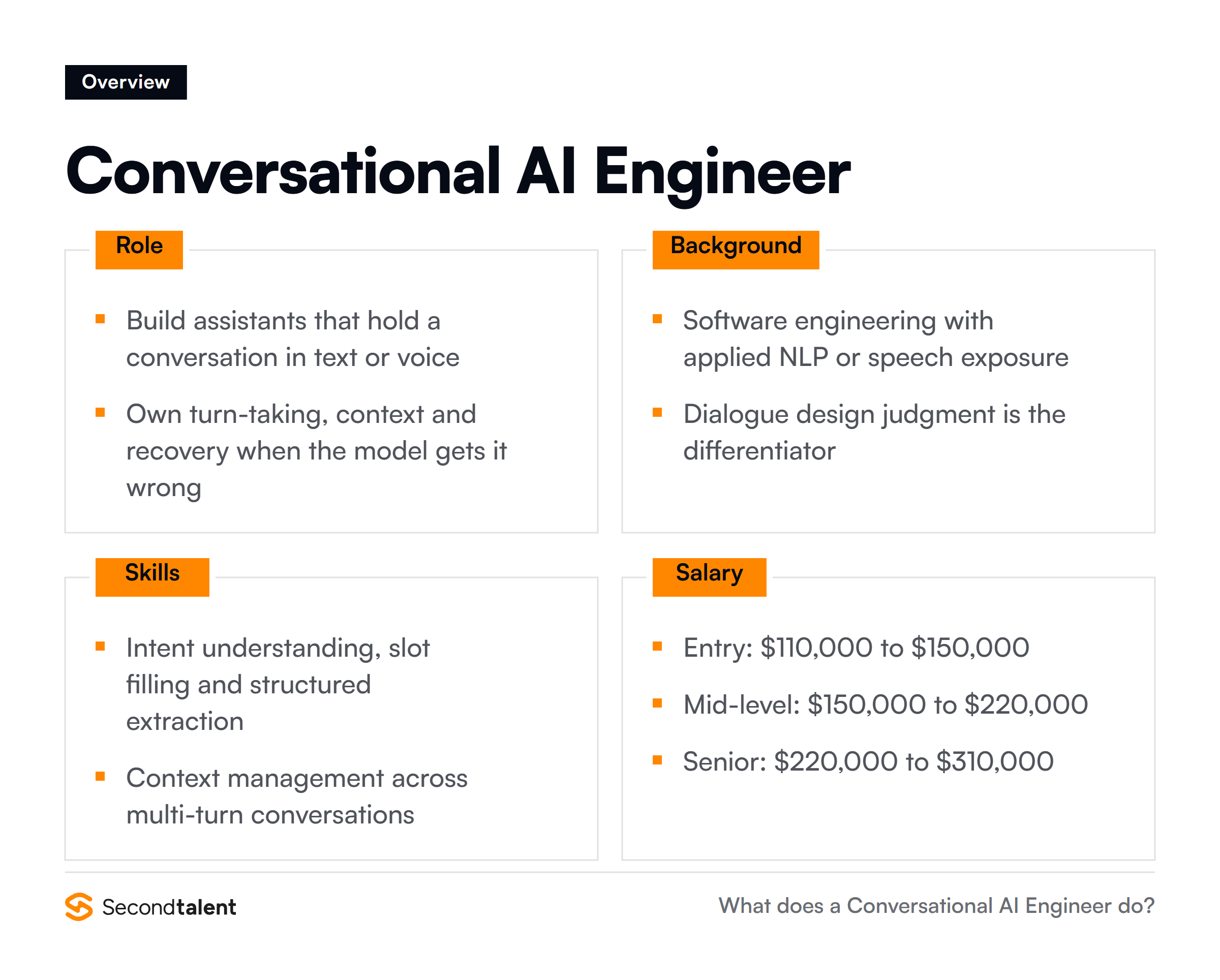
A Conversational AI Engineer designs and builds AI systems that interact with users through natural language, in either text or voice. The work spans chatbots, voice agents, in-app assistants, and the increasingly common hybrid experiences that move fluidly between channels. The discipline combines LLM orchestration, dialogue management, retrieval, and the practical engineering of latency, audio quality, and turn-taking.
The role used to be split across two camps. One was classical conversational AI, with intent classification and rigid flows. The other was newer LLM-first work, with free-form generation. Modern conversational AI engineers blend both. They use LLMs for understanding and generation, but they layer in structure, guardrails, and deterministic fallbacks where the cost of an unbounded response is too high.
Conversational AI Engineer Job Market and Career Opportunities
The category exploded after voice latency dropped below the conversational threshold and after LLM quality crossed the line where customers stopped immediately asking for a human. Real-time voice infrastructure providers report 10x year-over-year growth, and almost every customer-support, sales-development, and consumer-facing AI product now has at least one conversational interface.
Average Salary Ranges (US-equivalent):
- Entry-level Conversational AI Engineer: $110,000 – $150,000
- Mid-level Conversational AI Engineer: $150,000 – $220,000
- Senior Conversational AI Engineer: $220,000 – $310,000
- Principal Conversational AI Engineer: $310,000 – $420,000+
Demand is heaviest at customer-support automation vendors, AI-native consumer apps, voice-first startups, healthcare and telehealth platforms, fintech customer-service teams, and the rapidly growing category of outbound voice agents in sales and revenue operations.
Essential Conversational AI Skills and Qualifications
Core Knowledge Areas:
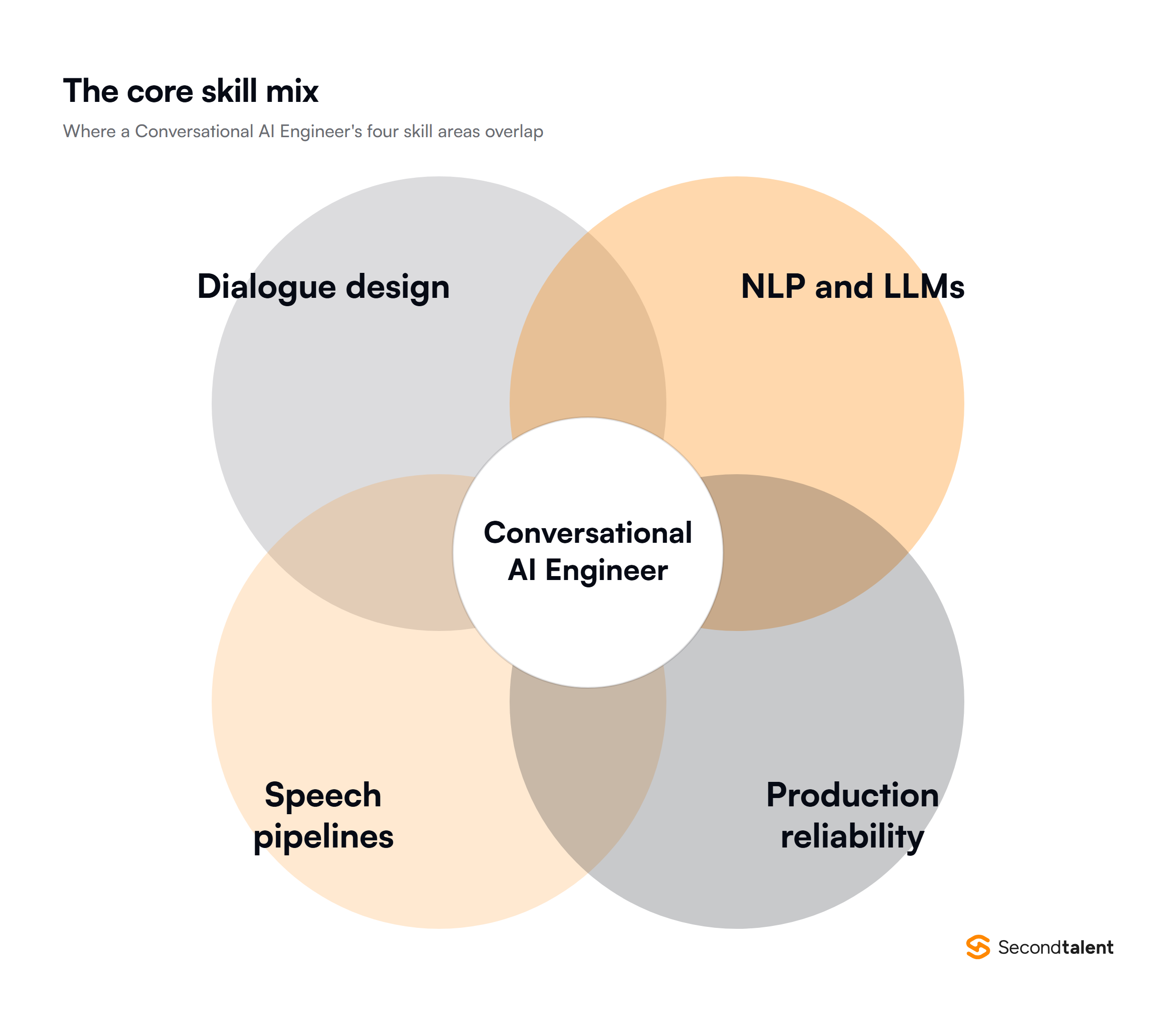
- Dialogue design and turn-taking patterns
- Intent understanding, slot filling, and structured extraction from free text
- Context management across multi-turn conversations
- Speech-to-text, text-to-speech, and real-time audio pipelines
- Latency engineering and streaming response design
- Error recovery patterns when the model fails or misunderstands
- Tool use and function calling for action-taking agents
Technical Competencies:
- Strong Python or TypeScript fluency for orchestration
- LLM APIs with streaming, structured output, and function calling
- Real-time voice stacks (LiveKit, Daily, Twilio Voice, Telnyx, Vonage)
- Speech APIs (Deepgram, Whisper, AssemblyAI, ElevenLabs, Cartesia, PlayHT)
- Conversation orchestration frameworks (Pipecat, LiveKit Agents, custom WebSocket layers)
- Telephony fundamentals (SIP, WebRTC, codec selection)
- LangChain or LangGraph for stateful conversation flows
Soft Skills:
- An ear for natural dialogue and the patience to listen to real call recordings
- Empathy for end users who will not behave like the happy path
- Comfort working closely with product designers and conversation designers
- Operational instincts for shipping systems that talk to real customers
Conversational AI Career Paths and Specializations
The role branches by channel, by use case, and by depth of the voice stack.
Voice Agent Engineering: Real-time outbound and inbound voice systems with sub-second latency, turn-taking, and natural interruption handling. The deepest specialization in the field.
Chatbot and Messaging Engineering: Text-first conversational interfaces inside apps, web widgets, WhatsApp, SMS, and Slack, often with retrieval-augmented context and tool use.
Hybrid Multi-Channel Engineering: Designing experiences that move between voice, chat, email, and human handoff while preserving conversation state.
Customer Support Conversational AI: Specialists who build the conversational layer inside support platforms, with deep integration to ticketing, CRM, and knowledge systems.
Sales and Outbound Conversational AI: Voice and chat agents that handle outbound sales motions, qualification, scheduling, and follow-up.
Conversational AI for Healthcare and Regulated Domains: Where compliance, audit, and clinical accuracy raise the bar far above general consumer use cases.
Conversational AI Tools and Technologies
Voice Infrastructure:
- LiveKit for real-time audio with first-class agent SDKs
- Daily for WebRTC infrastructure with conversational AI tooling
- Twilio Voice, Vonage, Telnyx for traditional telephony integration
- Pipecat as an open-source framework for real-time voice agents
Speech Models:
- Deepgram for low-latency, high-accuracy speech-to-text
- OpenAI Whisper variants for self-hosted transcription
- AssemblyAI for transcription with diarization and topic detection
- ElevenLabs, Cartesia, PlayHT for low-latency text-to-speech with natural voices
LLM Providers:
- OpenAI GPT-5 family with streaming and function calling
- Anthropic Claude for long-context and tool use
- Groq for ultra-low-latency inference on open-weight models
- Mistral and Cohere for cost-sensitive conversational workloads
Orchestration Frameworks:
- LiveKit Agents for fully managed voice-agent runtimes
- Pipecat for self-hosted, open-source voice-agent stacks
- LangGraph and custom Python orchestration for stateful flows
- Voiceflow and Botpress for chat-first low-code stacks
Evaluation and Observability:
- Langfuse, Helicone, LangSmith for trace-level conversation analysis
- Custom golden dialogues for regression testing
- Sentiment, resolution-rate, and escalation-rate dashboards as product metrics
Building Your Conversational AI Portfolio
Hiring managers want to hear or use your work, not read about it.
Project ideas that signal seriousness:
- A live voice agent demo, deployed somewhere callable, that handles a real use case end to end with under one-second latency and graceful handoff
- A multi-turn chatbot with proper context management, retrieval, and tool use, with a published evaluation report
- A side-by-side comparison of two TTS or STT providers on the same conversational workload with quantitative latency and quality numbers
- A hybrid voice-and-chat experience where the conversation state persists across channels
- An interruption-handling demo that shows your system gracefully yields when the user starts speaking mid-response
The signal is the operational craft. Anyone can wire up a basic chatbot. The engineers who get hired are the ones whose systems sound right and feel right under real use.
Conversational AI Methodology and Best Practices
Engineer for latency first. Conversational quality is dominated by perceived responsiveness. Streaming, parallel speech synthesis, and pipelined STT-to-LLM-to-TTS architectures are not optional for voice.
Design dialogue, do not let the model improvise. Free-form generation is a luxury most production conversations cannot afford. Use system prompts, structured outputs, and small finite-state-machine layers to keep the conversation on rails where the cost of drift is high.
Plan for interruption. Real users interrupt. Your voice agent has to detect interruption, stop speaking, and adapt the next turn without breaking continuity. This is one of the hardest parts of the discipline.
Always have a human-handoff path. The most important quality metric for a production conversational AI is how cleanly it escalates when it should. Build the handoff first, not last.
Treat hallucination as a product problem, not a model problem. Ground with retrieval, force citations or structured outputs, and constrain the response surface. Hallucination is largely an architecture decision.
Evaluate on real conversations. Synthetic eval sets miss most of the failure modes. Build evaluation from real call and chat logs, anonymized and curated, and run it on every change.
Instrument outcome metrics, not just response metrics. Did the conversation resolve the user’s actual goal? Did the user feel understood? These matter more than token counts and per-turn latency once the basics are right.
Future of Conversational AI Engineering Careers
The discipline is at the start of a multi-year build-out.
Voice latency is now low enough to feel natural. Sub-second end-to-end latency on real workloads is becoming standard. The bar for what feels like a real conversation has moved, and customer expectations have moved with it.
Multimodal conversation is arriving fast. Voice agents that can see what you see, look at documents you point a camera at, or watch your screen are no longer research. They are early production deployments. Engineers who can extend conversational stacks into multimodal territory will be the most marketable.
Outbound conversational AI is becoming a default sales motion. Voice agents that qualify leads, schedule meetings, and follow up are now shipping in mid-market sales orgs. The volume, the use cases, and the engineering depth are all growing.
Regulated industries are next. Healthcare, finance, and legal are starting to deploy conversational AI in customer-facing contexts. Engineers who can build for these environments, with audit, escalation, and clinical or regulatory accuracy, will be in extreme demand.
Getting Started as a Conversational AI Engineer
Ship one voice agent end to end. Pick a use case. Wire LiveKit or Pipecat, connect STT, an LLM, and TTS, and make it work over a real phone number. The fluency comes from getting one end-to-end stack running.
Study real conversations. Listen to call recordings. Read chat transcripts. The dialogue patterns that work in production rarely match what you might invent in isolation.
Master at least one voice provider deeply. Deepgram, Whisper, or AssemblyAI for STT. ElevenLabs or Cartesia for TTS. The trade-offs are real and the depth pays off.
Build a portfolio of demos that anyone can try. A callable phone number, a public chat interface, a deployed Slack bot. Engineers who let hiring managers experience the product directly skip several layers of interview screening.
Engage with the conversational AI communities. The LiveKit Discord, Pipecat community, and various voice-agent groups are where the current state of the art is being worked out.
Develop the cross-functional muscle. Conversational AI is one of the most product-design-sensitive disciplines in modern AI. Engineers who can collaborate cleanly with conversation designers, product managers, and customer-success teams ship far better systems.
Conversational AI is one of the most rewarding specializations in the modern AI stack. The systems are tangible, the user impact is direct, and the engineering problems are some of the hardest and most varied in the field. Get fluent now and you will have a long, interesting career shaping how humans actually interact with AI.