TL;DR: API developers in Thailand earn $2,500 to $6,000 a month working for international clients on our Node.js developer rate card, and we shortlist 6-8 candidates within 24 hours. The closest US benchmark, the BLS median for software developers, was $135,980 a year in May 2025.
PromptPay, the Bank of Thailand's transfer system launched in 2016, lets a payer send money to a citizen ID or mobile number instead of an account number. A Thai developer who has integrated it has built endpoints keyed on a national identifier, the pattern behind the API risk OWASP ranks first.
Key takeaways
- Thailand's floor is the highest of the four markets in the table, and its ceiling the second lowest.
- The Bank of Thailand's Your Data project plans for users to move bank, securities and insurance data between regulated providers by 2026.
- Under Thailand's Copyright Act, commissioned code belongs to the client unless the parties agree otherwise.
- Bangkok runs one hour behind Singapore and Manila, so the same local shift buys an extra hour with New York.
What API Developers Earn in Thailand Working for International Clients
Thailand's floor sits $300 above Malaysia's, the next highest, while its ceiling stops $500 short of Vietnam's and Malaysia's. We publish no API developer card. The Thailand and Malaysia rows use our Node.js developer rate cards, and the Philippines and Vietnam rows use our back-end developer cards, the closest matches to the work.
The figures are what developers in each market earn working directly for foreign companies, before any employer or platform costs.
| Market |
Monthly pay working for international clients (USD) |
| Thailand |
$2,500-$6,000 |
| Philippines |
$1,520-$4,630+ |
| Vietnam |
$1,800-$6,500 |
| Malaysia |
$2,200-$6,500 |
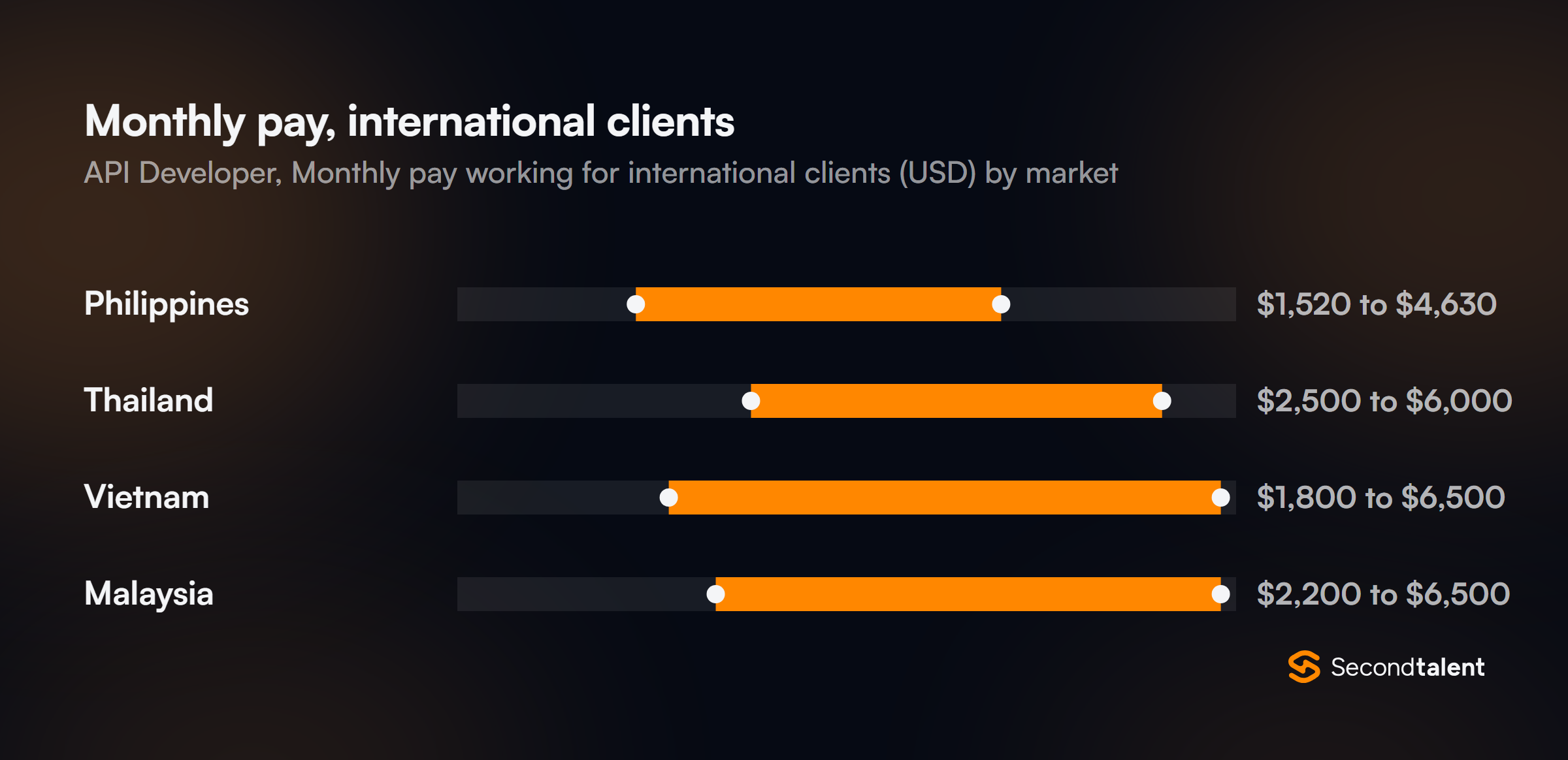
Monthly ranges from the Remote (Working for International Clients) figures on our rate cards for Thailand, the Philippines, Vietnam and Malaysia, converted at ExchangeRate-API mid-market rates for 14 September 2026.
The Thailand Node.js card is set in US dollars, so no conversion applies to that row. For teams on FastAPI or Spring Boot, our Thailand Python developer card runs from $2,870 to $7,710+, and our Thailand Java developer card from $2,870 to $6,200+.
Through Second Talent you pay one monthly fee that bundles salary, payroll taxes, statutory contributions and our service fee, quoted per role and market. Our pricing page sets out the subscription, and our Node.js developer cost-to-hire page lists US freelance rates for short integration projects.
US Pay Benchmark for API Developers
BLS does not track API developer as a job title. The role maps to Software Developers (SOC 15-1252), because designing endpoints, schemas and client libraries is software development.
| BLS OEWS, May 2025, national |
Software Developers (15-1252) |
| Median annual |
$135,980 |
| 10th percentile, monthly |
$6,870 |
| 25th percentile, monthly |
$8,770 |
| Median, monthly |
$11,330 |
| 75th percentile, monthly |
$14,330 |
| 90th percentile, monthly |
$17,890 |
Monthly figures are the annual wages on the OEWS profile for 15-1252 divided by 12, rounded to the nearest $10.
The whole Thailand Node.js range sits below the US 10th percentile monthly figure, ceiling included, because that card has no open top. Even the Python card's open top, at $7,710, falls short of the US 25th percentile.
Salary is only part of the US cost. In the BLS Employer Costs for Employee Compensation release for June 2026, wages and salaries made up 68.5% of employer compensation costs for full-time private industry workers, and benefits the other 31.5%.
Time Zone Overlap: Bangkok Against ET, CT and PT
A developer in Bangkok working 1 pm to 10 pm shares two hours with New York in September, where the same shift in Singapore shares one. Bangkok stays on UTC+7 all year, and US clocks keep daylight time from 8 March to 1 November 2026, per NIST.
The arithmetic: 9:00 am EDT (UTC-4) is 13:00 UTC, or 8:00 pm in Bangkok, so a New York day from 9 to 5 runs from 8 pm to 4 am there. Under EST (UTC-5) it runs from 9 pm to 5 am. Chicago under CST reaches Bangkok at 10 pm, and Los Angeles under PDT at 11 pm.
| Bangkok shift (UTC+7) |
ET overlap (EDT / EST) |
CT overlap (CDT / CST) |
PT overlap (PDT / PST) |
Hours between 10 pm and 6 am |
| 9 am-6 pm |
0 / 0 |
0 / 0 |
0 / 0 |
0 |
| 1 pm-10 pm |
2 / 1 |
1 / 0 |
0 / 0 |
0 |
| 3 pm-12 am |
4 / 3 |
3 / 2 |
1 / 0 |
2 |
| 5 pm-2 am |
6 / 5 |
5 / 4 |
3 / 2 |
4 |
Overlap counts clock hours of a nine-hour shift, meal break included, against a 9 am to 5 pm US day.
API work splits well across that gap. Partner calls, contract reviews and incident triage need the shared hours. Schema changes, SDK regeneration and load tests can run in the Bangkok day and wait for your morning review.
We agree the shift before the offer, which is how our placements get 4-6 hours of daily overlap with US hours.
API Developer Skills to Screen For
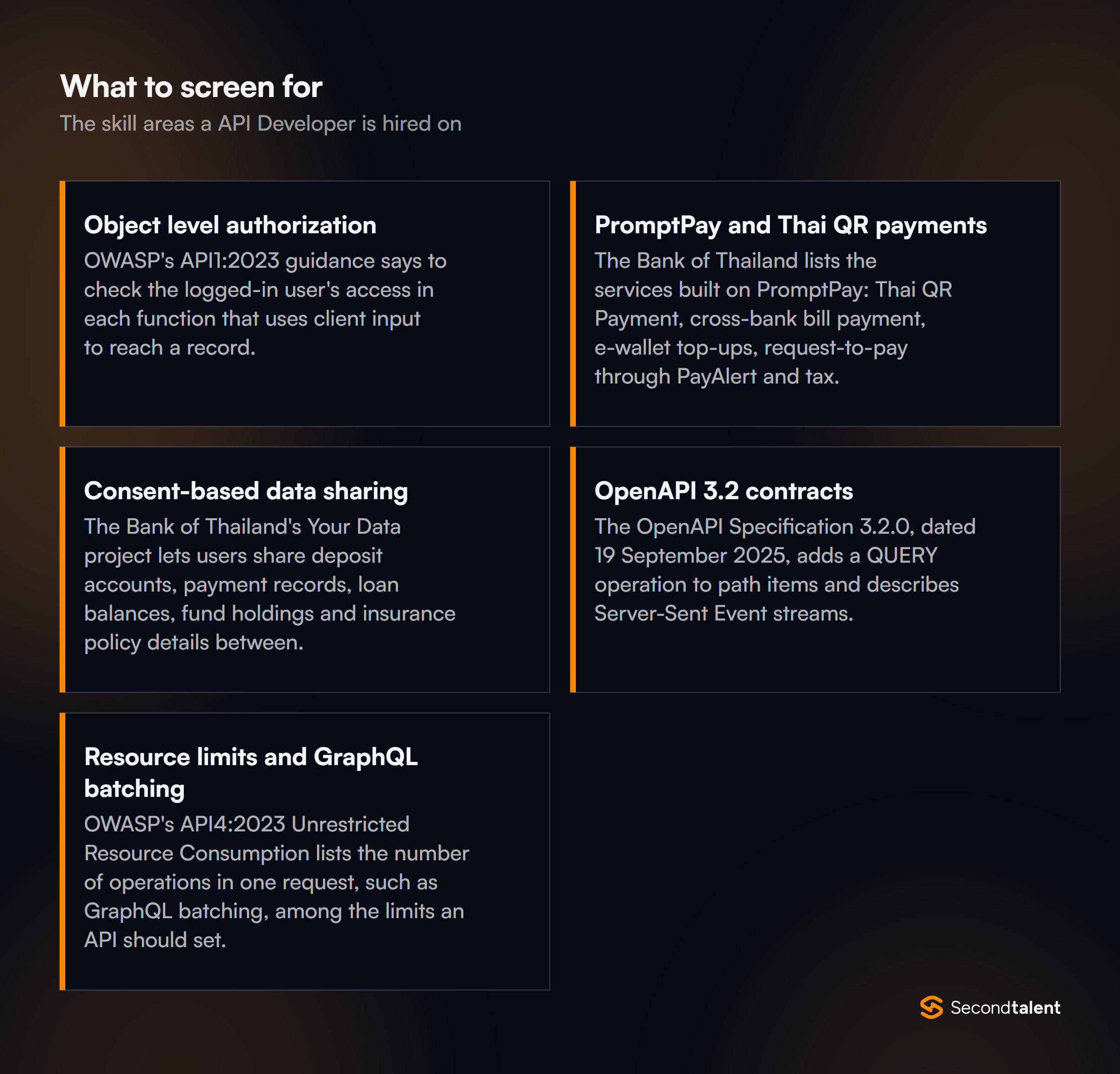
OWASP's API Security Top 10 2023 ranks Broken Object Level Authorization first. Thai payment and data-sharing APIs add consent and national identifiers to that problem, and the screen below covers both.
Object level authorization
OWASP's API1:2023 guidance says to check the logged-in user's access in each function that uses client input to reach a record. It prefers random, unpredictable record IDs, and says not to deploy changes that make authorization tests fail.
A citizen ID or phone number is predictable by design. Give the candidate an endpoint that looks up a customer by phone number and ask them to break it with a second account, then fix it and write the test.
PromptPay and Thai QR payments
The Bank of Thailand lists the services built on PromptPay: Thai QR Payment, cross-bank bill payment, e-wallet top-ups, request-to-pay through PayAlert and tax refunds. MyPromptQR, its customer-presented QR service, adopts ISO 20022 so business data travels with the payment. One phone number can link to only one bank account.
Ask the candidate how they would reconcile a QR payment whose bank callback arrives twice, or after the order has timed out. A good answer names the idempotency key and the state the order moves to.
Consent-based data sharing
The Bank of Thailand's Your Data project lets users share deposit accounts, payment records, loan balances, fund holdings and insurance policy details between providers regulated by the BOT, SEC or OIC by 2026. Electricity and water payment records became downloadable through the Tang Rat app from 30 June 2025.
Providers must get clear consent, use the data only for the stated purpose and meet the BOT's IT and security standards. Ask the candidate to design the consent record, the scope a data consumer receives and the endpoint that revokes it.
OpenAPI 3.2 contracts
The OpenAPI Specification 3.2.0, dated 19 September 2025, adds a QUERY operation to path items and describes Server-Sent Event streams. Ask the candidate to write the spec for a payment-status stream before any code, then generate a client and check it matches. Our OpenAPI interview guide has more questions.
Resource limits and GraphQL batching
OWASP's API4:2023 Unrestricted Resource Consumption lists the number of operations in one request, such as GraphQL batching, among the limits an API should set. Ask how the candidate caps depth, cost and batch size on a public schema, and what the client sees when a limit trips.
Contractor or Employer of Record in Thailand
Software is not one of the nine categories of commissioned work that can be "work made for hire" under 17 U.S.C. § 101, and a transfer must be in writing and signed under § 204(a).
Thailand's Copyright Act B.E. 2537 treats computer programs as literary works (section 4). For commissioned work, section 10 gives copyright to the person who commissioned it unless both sides agree otherwise. For work made in the course of employment, section 9 leaves copyright with the employee unless a written agreement says otherwise.
That makes the contractor route simpler on paper and the employee route stricter than in the US. Section 17 requires an assignment in writing, signed by both assignor and assignee.
An assignment that names no term lasts ten years under the same section. Name the OpenAPI files, generated SDKs and test suites, and state that the assignment runs for the full term of copyright.
IRS Publication 515 says the place where services are performed determines the source of the income, so a developer working from Thailand earns foreign-source income. A foreign individual gives the payer Form W-8BEN to certify foreign status.
Thailand's Revenue Department treats a person living in Thailand for more than 180 days in a calendar year as resident. Residents pay tax on Thai-source income and on foreign-source income brought into Thailand.
A developer who works your hours on your roadmap, on your laptop, is the case for employment. Our Employer of Record service employs that developer in Thailand, and our Thailand EOR page explains the setup. This is a summary, not legal advice.
|
Independent contractor |
Employer of Record |
| Legal employer |
None; the developer invoices you |
The EOR's Thai entity |
| US paperwork |
Form W-8BEN from the developer |
Service agreement with the EOR |
| IP |
Commissioned code vests in you unless agreed otherwise (section 10); written assignment with a stated term (section 17) |
Employee owns by default (section 9), so the employment contract assigns in writing, passed on through your EOR agreement |
| Local labor law |
Employment risk if you control timing, method and tools |
Thai labour law applies to the EOR's employment contract |
| Pay currency |
Agreed in the contract, often USD |
Local payroll run by the EOR |
English Level and Working Norms in Thailand
Thailand scores 402 on the EF English Proficiency Index 2025, 116th of 123 countries and regions, against a global average of 488. Respondents in IT roles score 459. Writing is the country's weakest skill at 363 and reading its strongest at 416, per EF's Thailand page.
API developers write for readers they will not meet: reference docs, changelogs and deprecation notices. Those scores describe a national sample, not your candidate. Ask finalists to write the notice for a breaking change to a partner endpoint, with dates and a migration example, and judge it on its own.
The Bank of Thailand's financial institutions holiday list shows the days Thai banks close. It marks 13 and 23 October 2026, an extra Bangkok holiday on 16 October, Monday 7 December, and 10 and 31 December. Songkran 2027 falls on 13 to 15 April.
Plan payment-partner releases around those dates. Thanksgiving on 26 November 2026 is a working day in Thailand, so a developer there can run integration tests while your US team is off.
API Developer Hiring Process in Thailand
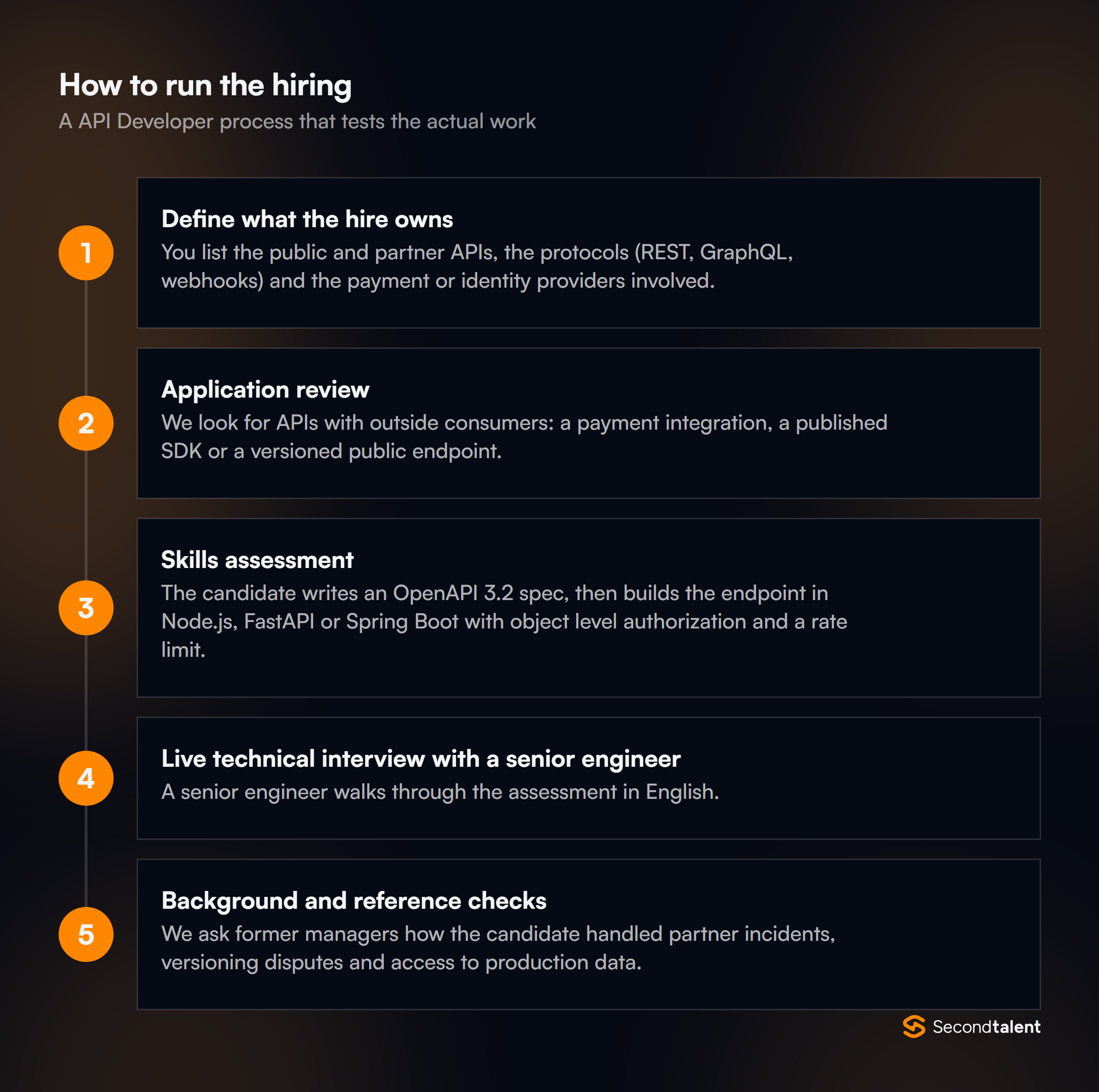
Second Talent's vetting covers stages 2 to 5 before you see a profile.
Stage 1: Define what the hire owns
You list the public and partner APIs, the protocols (REST, GraphQL, webhooks) and the payment or identity providers involved. Say whether the BOT, SEC or OIC regulates any consumer, and pick a Bangkok shift from the table above.
Stage 2: Application review
We look for APIs with outside consumers: a payment integration, a published SDK or a versioned public endpoint. A candidate should name the auth scheme, the traffic and one breaking change they managed.
Stage 3: Skills assessment
The candidate writes an OpenAPI 3.2 spec, then builds the endpoint in Node.js, FastAPI or Spring Boot with object level authorization and a rate limit. We attack it with another user's phone number and a duplicated payment callback, then score what holds.
Stage 4: Live technical interview with a senior engineer
A senior engineer walks through the assessment in English. The questions cover consent scopes and revocation, GraphQL cost limits and the deprecation plan for a version two.
Stage 5: Background and reference checks
We ask former managers how the candidate handled partner incidents, versioning disputes and access to production data. You then choose the contractor or EOR route above.
Hire API Developers from Thailand with Second Talent
We shortlist 6-8 candidates within 24 hours from 100,000+ pre-vetted engineers, accepting only the top 1% of applicants. API developers from Thailand come with $0 upfront, no lock-in and 4-6 hours of daily overlap with US hours. We handle contracts, payroll and equipment, with compliant EOR contracts in Thailand.
Our pricing page covers subscription, direct-hire and EOR pricing. Mixcare Health, whose platform offers OpenAPI integrations across healthcare providers, hired a team of 5 backend developers and customer operations executives in Vietnam and Malaysia through us, and its case study reports a 70% increase in business efficiency. For the services behind the interface, we also staff back-end developers in Thailand.