TL;DR: Back-end developers in Thailand earn $2,500 to $6,000 a month working for international clients on our Node.js developer rate card, and we shortlist 6-8 candidates within 24 hours. The closest US benchmark, the BLS median for software developers, was $135,980 a year in May 2025.
Python 3.10 reaches end of life in October 2026, per the Python developer guide. Go 1.27 shipped on 19 August 2026 and ended support for Go 1.25. A back-end developer from Thailand should know which versions your services run, and how to move them before the fixes stop.
Key takeaways
- Thailand has the narrowest range among the three closed ranges in the table.
- Java's Thai Buddhist calendar numbers years as the ISO year plus 543, the count Thai official pages use.
- Thailand's Copyright Act leaves code an employee writes with the employee unless a written agreement assigns it.
- A normal 9 am to 6 pm day in Bangkok covers the New York night while US daylight time lasts.
What Back-End Developers Earn in Thailand Working for International Clients
Thailand's range spans $3,500 from floor to ceiling, against $4,300 in Malaysia and $4,700 in Vietnam. We publish no back-end developer card for Thailand, so the Thailand row uses our Node.js developer rate card, the closest match. Malaysia has no back-end card either and uses its Node.js card, while the Philippines and Vietnam rows use back-end cards.
The figures are what developers in each market earn working directly for foreign companies, before any employer or platform costs.
| Market |
Monthly pay working for international clients (USD) |
| Thailand |
$2,500-$6,000 |
| Philippines |
$1,520-$4,630+ |
| Vietnam |
$1,800-$6,500 |
| Malaysia |
$2,200-$6,500 |
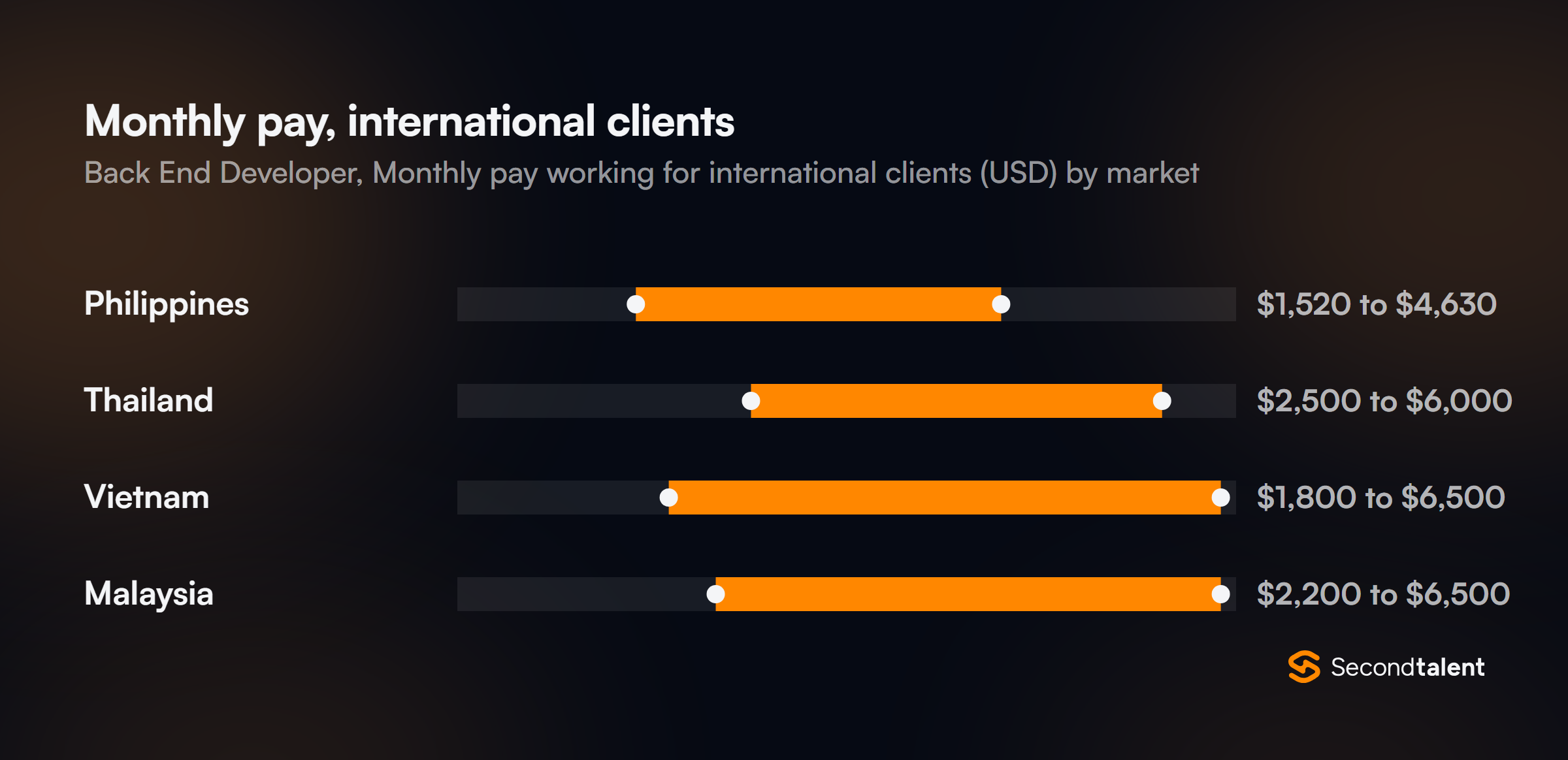
Monthly ranges from the Remote (Working for International Clients) figures on our rate cards for Thailand, the Philippines, Vietnam and Malaysia, converted at ExchangeRate-API mid-market rates for 14 September 2026.
The Thailand card quotes $2,500 to $6,000 a month in US dollars. For Django or FastAPI services, our Thailand Python developer card runs from $2,870 to $7,710+. We publish no Go card for Thailand, so budget a Go hire against the Node.js row.
Through Second Talent you pay one monthly fee that bundles salary, payroll taxes, statutory contributions and our service fee, quoted per role and market. Our pricing page explains the subscription, and our back-end developer cost-to-hire page covers US freelance rates for contract work.
US Pay Benchmark for Back-End Developers
BLS publishes no back-end developer occupation. The role maps to Software Developers (SOC 15-1252), because a back-end developer designs, writes and runs the server-side software behind a product.
| BLS OEWS, May 2025, national |
Software Developers (15-1252) |
| Median annual |
$135,980 |
| 10th percentile, monthly |
$6,870 |
| 25th percentile, monthly |
$8,770 |
| Median, monthly |
$11,330 |
| 75th percentile, monthly |
$14,330 |
| 90th percentile, monthly |
$17,890 |
Monthly figures are the annual wages on the OEWS profile for 15-1252 divided by 12, rounded to the nearest $10.
The Thailand card's ceiling sits $870 below the US 10th percentile monthly figure. A Thai back-end developer at the top of that card earns less than nine in ten US software developers.
Salary is only part of the US cost. In the BLS Employer Costs for Employee Compensation release for June 2026, wages and salaries made up 68.5% of employer compensation costs for full-time private industry workers, and benefits the other 31.5%.
Time Zone Overlap: Bangkok Against ET, CT and PT
A Bangkok developer working 9 am to 6 pm covers 10 pm to 7 am in New York while US daylight time lasts, the hours a US on-call rota likes least. Bangkok keeps UTC+7 with no daylight saving, and US clocks run on daylight time from 8 March to 1 November 2026, per NIST.
The arithmetic: 9:00 am in Bangkok is 02:00 UTC, which is 10:00 pm the previous evening under EDT (UTC-4) and 9:00 pm under EST (UTC-5). In the other direction, New York's 9:00 am is 8:00 pm in Bangkok in September and 9:00 pm after 1 November.
| Bangkok shift (UTC+7) |
ET overlap (EDT / EST) |
CT overlap (CDT / CST) |
PT overlap (PDT / PST) |
Hours between 10 pm and 6 am |
| 9 am-6 pm |
0 / 0 |
0 / 0 |
0 / 0 |
0 |
| 1 pm-10 pm |
2 / 1 |
1 / 0 |
0 / 0 |
0 |
| 5 pm-2 am |
6 / 5 |
5 / 4 |
3 / 2 |
4 |
| 7 pm-4 am |
8 / 7 |
7 / 6 |
5 / 4 |
6 |
Each shift is nine clock hours with a meal break, counted against a 9 am to 5 pm US day.
The first row suits first-line on-call: the developer watches alerts, runs the runbook and escalates, and hands over a written summary as your team logs on. The later rows suit developers who build features with your team and need design reviews in real time.
Pick one model per hire and write it into the offer. We fix the shift before the offer, which is how our placements get 4-6 hours of daily overlap with US hours.
Back-End Developer Skills to Screen For
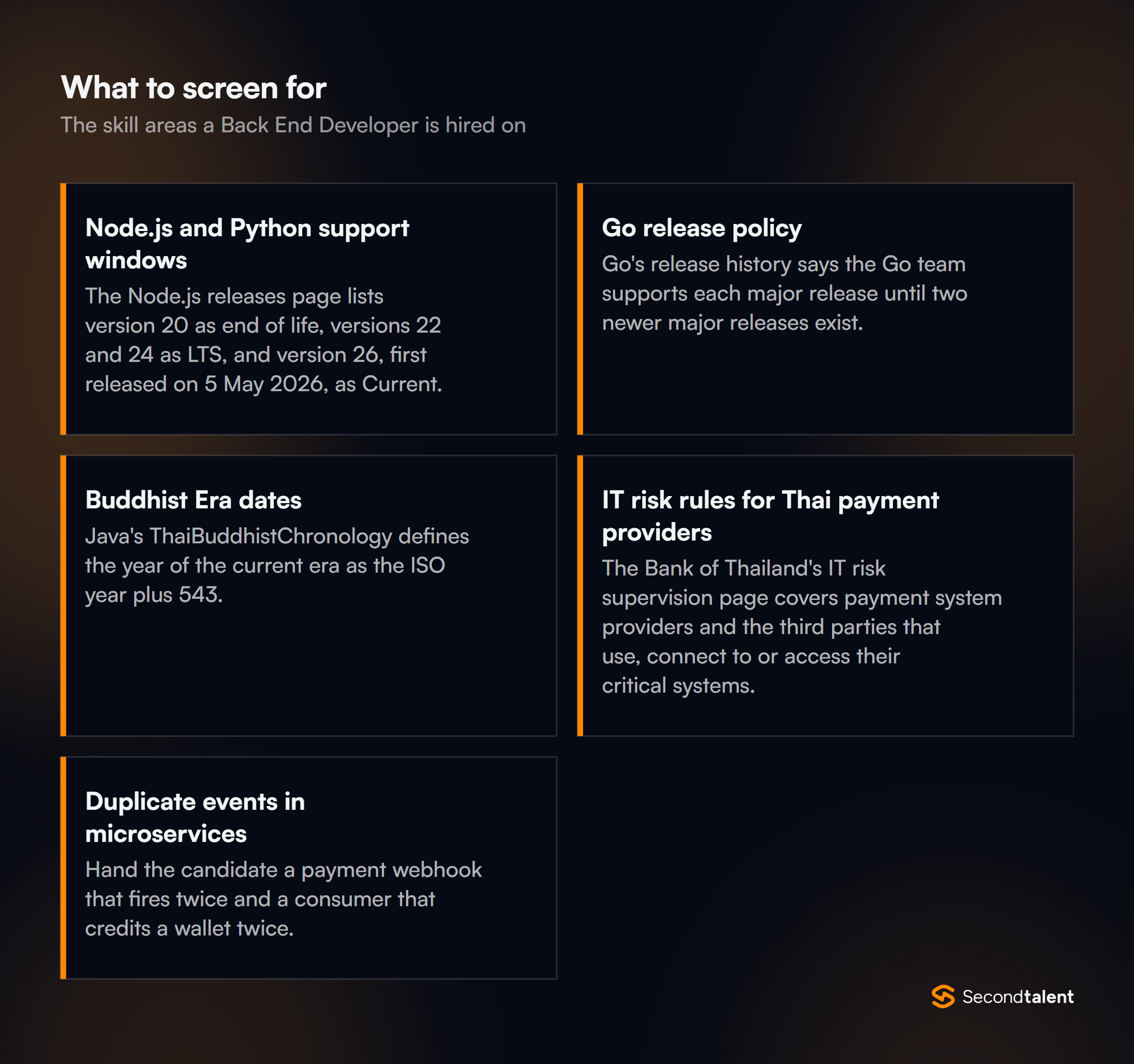
Node.js, Python and Go each publish their own support schedule, and Thai data brings a second calendar into date fields. Screen for runtime upkeep, date handling and incident discipline alongside code.
Node.js and Python support windows
The Node.js releases page lists version 20 as end of life, versions 22 and 24 as LTS, and version 26, first released on 5 May 2026, as Current. Python 3.10 moves off security support in October 2026, and 3.11 follows in October 2027.
Ask which versions the candidate's last production services ran, and how they tested the upgrade before moving traffic.
Go release policy
Go's release history says the Go team supports each major release until two newer major releases exist. Go 1.26 arrived on 10 February 2026 and Go 1.27 on 19 August 2026, so only those two receive fixes now. A Go service pinned to 1.25 is already outside that window.
Ask the candidate how they keep Go toolchain versions current across a dozen services, and what breaks in CI when they do.
Buddhist Era dates
Java's ThaiBuddhistChronology defines the year of the current era as the ISO year plus 543. Thai official sources such as the Bank of Thailand print years that way.
Give the candidate a CSV of Thai dates in mixed B.E. and C.E. formats and ask for a parser that rejects ambiguous rows instead of guessing. Then ask which layer should own the conversion, and why.
IT risk rules for Thai payment providers
The Bank of Thailand's IT risk supervision page covers payment system providers and the third parties that use, connect to or access their critical systems. In 2021 the BOT raised the bar by issuing IT risk management measures and minimum cyber hygiene practices for those providers.
A developer who built for a Thai e-wallet or payment gateway worked inside those controls as a third party or an employee. Ask what access reviews, logging and change approvals they followed, and which of them slowed deploys.
Duplicate events in microservices
Hand the candidate a payment webhook that fires twice and a consumer that credits a wallet twice. Ask for the fix in code. An idempotency key, a unique constraint and a processed-events table all work; the follow-up is how each holds when two consumer instances read the same queue.
Contractor or Employer of Record in Thailand
Software is not one of the nine categories of commissioned work that can be "work made for hire" under 17 U.S.C. § 101, and a copyright transfer must be in writing and signed under § 204(a).
Thailand's Copyright Act B.E. 2537 includes computer programs in its definition of literary works (section 4). Work made in the course of employment belongs to the employee unless it has been otherwise agreed in writing, under section 9, with the employer entitled to communicate it to the public for the purpose of the employment.
Commissioned work goes the other way: section 10 vests it in the person who commissioned it unless the parties agree otherwise. An assignment must be in writing with the signatures of both assignor and assignee, under section 17, and one that names no duration is deemed to last ten years.
For an employed developer, the employment contract needs a written IP clause that covers code, schemas, migrations and runbooks for the full term of copyright. For a contractor, put the same list in a signed assignment.
IRS Publication 515 says the place where services are performed determines the source of the income, so work done in Thailand produces foreign-source income. A foreign individual gives the payer Form W-8BEN to certify foreign status.
The Thai Revenue Department counts anyone living in Thailand for more than 180 days in a calendar year as resident, taxed on Thai-source income and on foreign-source income brought into the country.
A full-time developer on your sprints and your pager is the case for employment. Our Employer of Record service employs that developer in Thailand, and our Thailand EOR page covers the details. This is a summary, not legal advice.
|
Independent contractor |
Employer of Record |
| Legal employer |
None; the developer invoices you |
The EOR's Thai entity |
| US paperwork |
Form W-8BEN from the developer |
Service agreement with the EOR |
| IP |
Commissioned code vests in you unless agreed otherwise (section 10); signed assignment with a stated term (section 17) |
Employee owns by default (section 9), so the employment contract assigns code, schemas and runbooks in writing, passed on through your EOR agreement |
| Local labor law |
Employment finding if you control hours, tools and methods |
Thai labour law applies to the EOR's employment contract |
| Pay currency |
Agreed in the contract, often USD |
Local payroll run by the EOR |
English Level and Working Norms in Thailand
Thailand ranks 116th of 123 countries and regions on the EF English Proficiency Index 2025, with a score of 402 against a global average of 488. Respondents in IT roles score 459, and Bangkok scores 467, per EF's Thailand page. Listening sits at 385 and writing at 363.
Back-end work runs on written English that someone reads at 3 am: incident timelines, runbooks and pull request descriptions. Screen the individual in writing. Ask finalists to write a post-incident summary for a US audience from a log excerpt, and grade it before the live interview.
The Bank of Thailand's financial institutions holiday list sets the days Thai banks close for the rest of 2026: 13 October, 16 October in Bangkok only, 23 October, Monday 7 December in place of 5 December, 10 December and 31 December. Songkran 2027 runs from 13 to 15 April.
If your developer is on call, agree holiday cover in advance. Thanksgiving on 26 November 2026 is a working day in Thailand, so a developer there can watch production while your US team is off.
Back-End Developer Hiring Process in Thailand
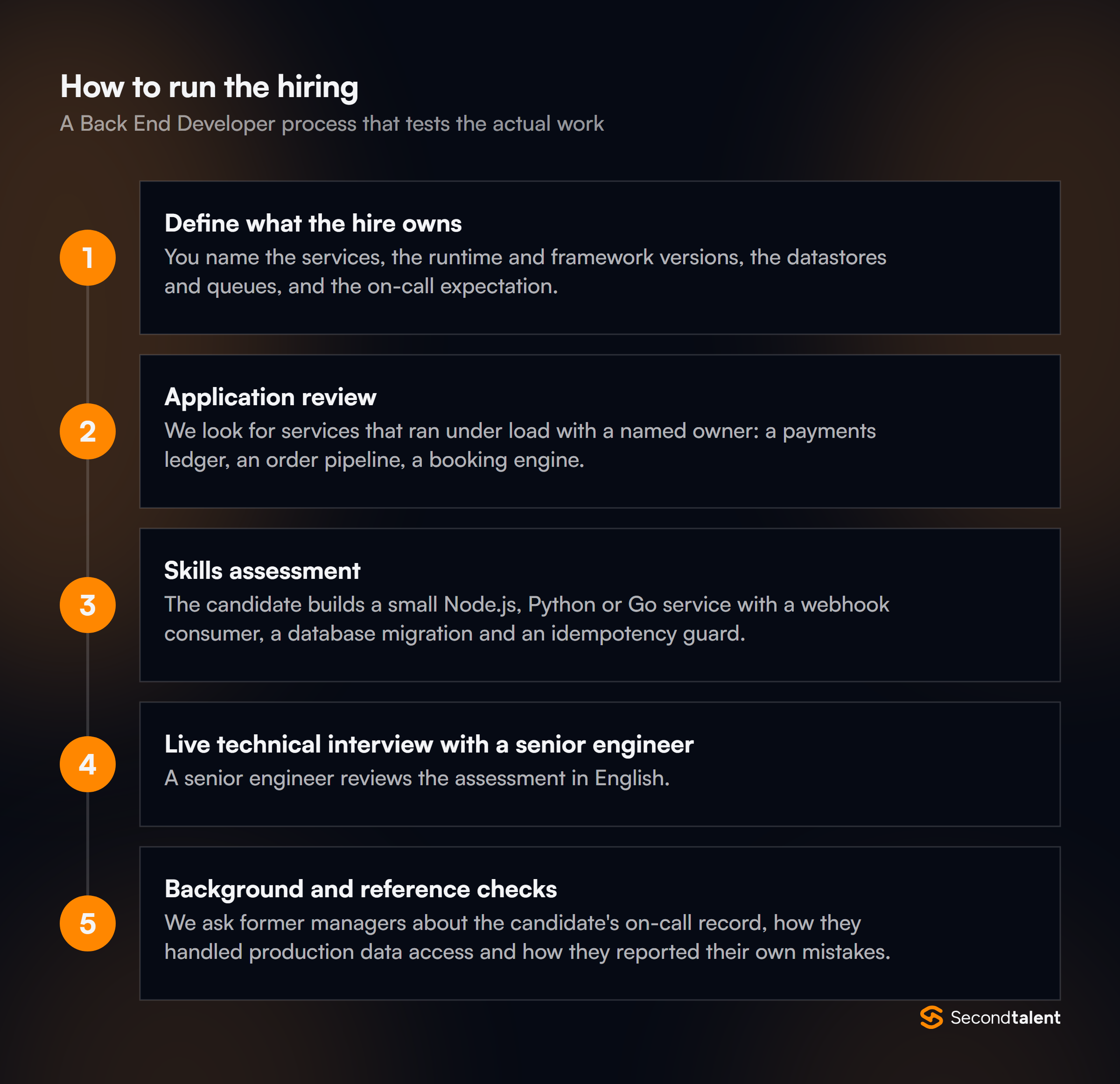
Second Talent's vetting covers stages 2 to 5 before you see a profile.
Stage 1: Define what the hire owns
You name the services, the runtime and framework versions, the datastores and queues, and the on-call expectation. Add any Thai payment or bank integration, and pick a Bangkok shift from the table above.
Stage 2: Application review
We look for services that ran under load with a named owner: a payments ledger, an order pipeline, a booking engine. A candidate should state the traffic, the uptime target and the worst incident they handled.
Stage 3: Skills assessment
The candidate builds a small Node.js, Python or Go service with a webhook consumer, a database migration and an idempotency guard. We send duplicate events, B.E. dates and a slow dependency, then score correctness, logs and upgrade notes.
Stage 4: Live technical interview with a senior engineer
A senior engineer reviews the assessment in English. The design question is a payment service that must survive a regional outage, with the candidate walking through the alerts, the failover and the runbook they would write.
Stage 5: Background and reference checks
We ask former managers about the candidate's on-call record, how they handled production data access and how they reported their own mistakes. You then choose the contractor or EOR route above.
Hire Back-End Developers from Thailand with Second Talent
We shortlist 6-8 candidates within 24 hours from 100,000+ pre-vetted engineers, accepting only the top 1% of applicants. Back-end developers from Thailand come with $0 upfront, no lock-in and 4-6 hours of daily overlap with US hours. We handle contracts, payroll and equipment, with compliant EOR contracts in Thailand.
Our pricing page covers subscription, direct-hire and EOR pricing. Mixcare Health, a digital health and wellness platform, hired a team of 5 backend developers and customer operations executives in Vietnam and Malaysia through us, and its case study reports a 70% increase in overall business efficiency. For contracts built around external integrations, we also staff API developers in Thailand.