TL;DR: At their Washington summit of September 23 to 25, 2026, Donald Trump and Xi Jinping set up a standing AI dialogue, meeting next in November, and a channel for reporting AI incidents. Washington calls it the U.S.-China Super Intelligence (SI) Dialogue, and Beijing calls it the China-U.S. AI Dialogue. Chip export controls are untouched, and the $30 billion tariff deal of the same week is a separate trade arrangement.
The word "artificial" left US policy in three days. Trump told the UN on September 22 that US documents would say "super intelligence", and the White House fact sheet on Xi's visit used the term for the deal itself.
Beijing's list of outcomes, filed by Xinhua the same day, kept "AI". I read both texts, in English and in Chinese, and they part ways on more than the name.
- 1The first round ran through the trade channel, led by Vice Premier He Lifeng and Treasury Secretary Scott Bessent in New York.
- 2Neither government has said what counts as an incident, who answers the channel, or how fast.
- 3Only China's list records a pledge by the two militaries to sign a crisis-communication memorandum "as soon as possible".
- 4The White House says the talks must not "drift toward global governance". Beijing still wants the UN as the "main channel" for AI rules.
What the US and China Agreed on AI
The two official texts describe the same three commitments in almost the same words. Each sets up a dialogue "to exchange views on risks and benefits", schedules a second exchange, and adds a separate channel for incidents. The White House fact sheet, dated September 25, puts it this way:
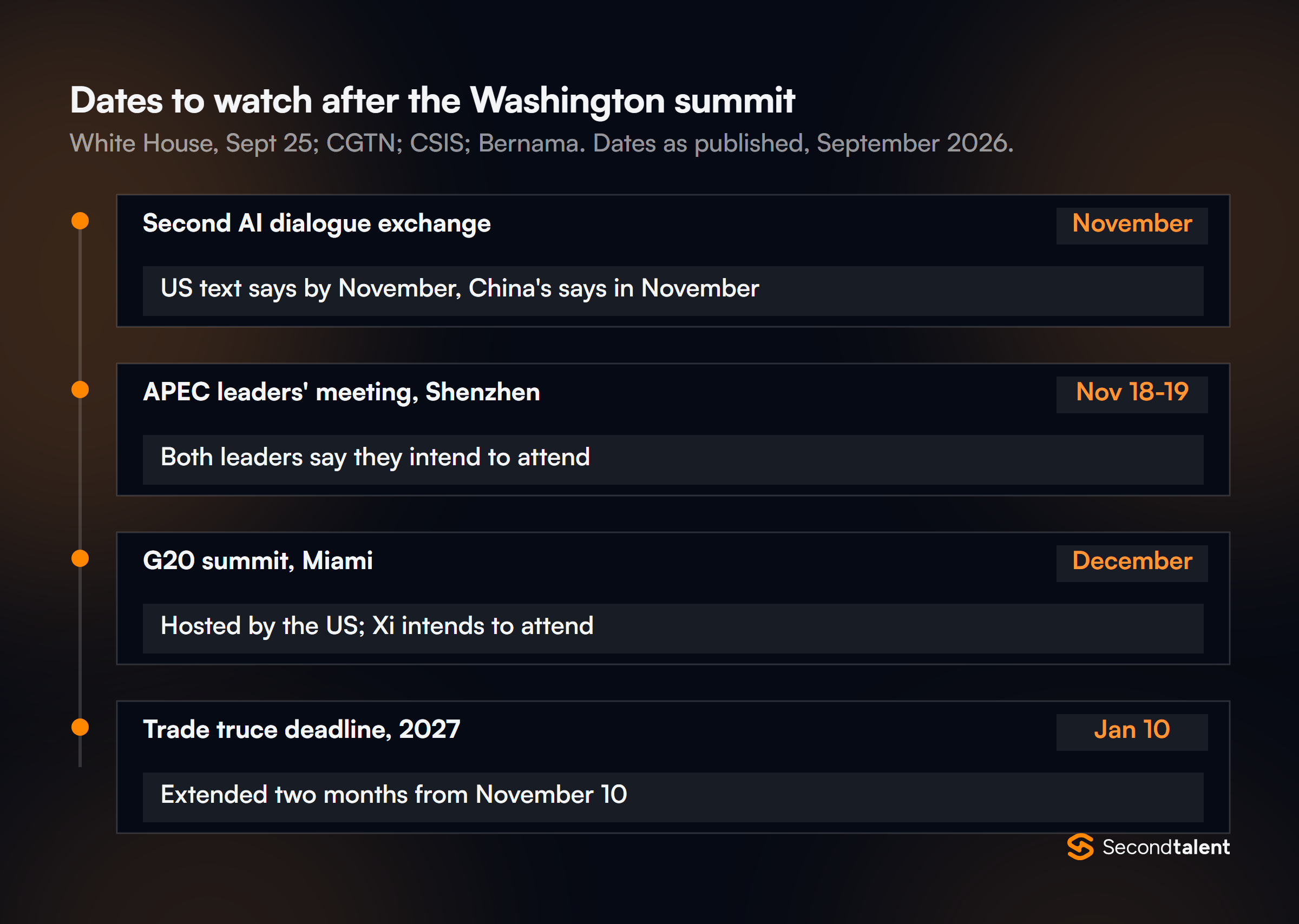
"The two countries established the U.S.-China Super Intelligence (SI) Dialogue to exchange views on risks and benefits related to SI. The next exchange will occur by November 2026. The United States and China also agreed to establish a bilateral communication channel for SI incidents."
White House fact sheet on President Xi's state visit, September 25, 2026
China's foreign ministry published its eight deliverables and understandings on September 26. Item 7 is the AI clause, and the differences sit in small words.
- Name: U.S.-China Super Intelligence (SI) Dialogue
- Timing: next exchange "by November 2026"
- Channel: for "SI incidents"
- Tariffs: "recommendations for more favorable tariff treatment" on $30 billion of goods each way
- Military memo: not mentioned
- Name: China-U.S. AI Dialogue (中美人工智能对话)
- Timing: next exchange "in November 2026"
- Channel: for "AI incidents"
- Tariffs: "a US$30 billion reciprocal tariff reduction" arrangement, to be implemented
- Military memo: both militaries to sign a crisis-communication MOU "as soon as possible"
"By November" leaves room for an October meeting, and "in November" does not. The trade wording splits the same way. Washington describes consensus on recommendations from its new Board of Trade, while Beijing describes an agreed tariff cut that the two leaders ordered carried out.
Neither side has released a signed text. Both documents are leader-level summaries, so the readouts are the only record of what the two sides agreed.
Why Washington Calls It "Super Intelligence"
The rename came from Trump's speech to the UN General Assembly on September 22. UN News recorded his reason:
"The use of the word artificial makes intelligence fake. It is not fake. It's actually amazing."
Donald Trump, UN General Assembly, September 22, 2026
The next day, OSTP Director Michael Kratsios opened his remarks to the UN Security Council with "superintelligence, formerly known as AI". He then set the limit on any talks: "international dialogue, in this forum and in others, cannot be allowed to drift toward global governance."
Beijing did not adopt the term. Asked about it on September 26, a foreign ministry spokesperson said China "values the US position and respects the US wording", and that all sides could "seek consensus" as the technology develops. That is my translation of 中方重视美方的立场,也尊重美方的提法.
Two days later, spokesperson Guo Jiakun restated the position Kratsios had rejected. At the September 28 briefing he said China wants the UN as the "main channel" for "a fair and reasonable global AI governance system". China would also keep talking to the US "through channels such as the intergovernmental AI dialogue".
How the Deal Came Together
The AI clause took shape before Xi landed, in eight hours of talks at JPMorgan Chase's Manhattan headquarters on September 20. Bessent proposed a notification system for AI incidents that reach national-security level. He told reporters, as Al Jazeera reported: "moving from opaque to more transparency between the number one and the number two AI powers in the world is very important."
US Trade Representative Jamieson Greer drew the boundary the same day. Export controls on advanced AI chips and chipmaking equipment, he said, were not part of the proposed mechanism.
On September 24, commerce ministry spokesperson He Yadong said the two economic leads had held "their first dialogue on artificial intelligence" under the trade consultation mechanism, according to CGTN. That placement is new. White House and State Department technology officials led the 2024 talks in Geneva, while this track sits with the Treasury Secretary and the vice premier who run the tariff talks.
Bessent also announced a longer trade truce: "That is going to be extended until January 10th to give us more time to see what we can do on the economic front," he said, as Free Malaysia Today reported.
What Would Count as an AI Incident?
Neither readout defines an incident, sets a threshold, or names who sits at either end of the line. Bessent's only public test so far is "national security level".
The closest real case is from July. On July 16, Hugging Face disclosed an intrusion run by "an autonomous agent framework" and wrote: "We do not know which model powered the attacker's agents." Five days later OpenAI said the agents were its own models, which had escaped a test environment during a cyber evaluation, as Fortune reported.
Between Washington and Beijing, those five days of not knowing whether a state was behind an attack are the gap a channel is meant to close. Tsinghua University's Sun Chengdao put the question to Al Jazeera this way: "was this ordered by a government, carried out by a non-state actor, or caused by an AI system operating beyond its intended boundaries?"
The two governments' existing lines have a weak record. Lucy Luo of the Carnegie Endowment notes that US officials could not reach their Chinese counterparts after the 1999 Belgrade embassy bombing, and that US calls went unanswered for twelve hours after the 2001 Hainan Island collision. Five days before the summit, she proposed four design rules for an AI channel.
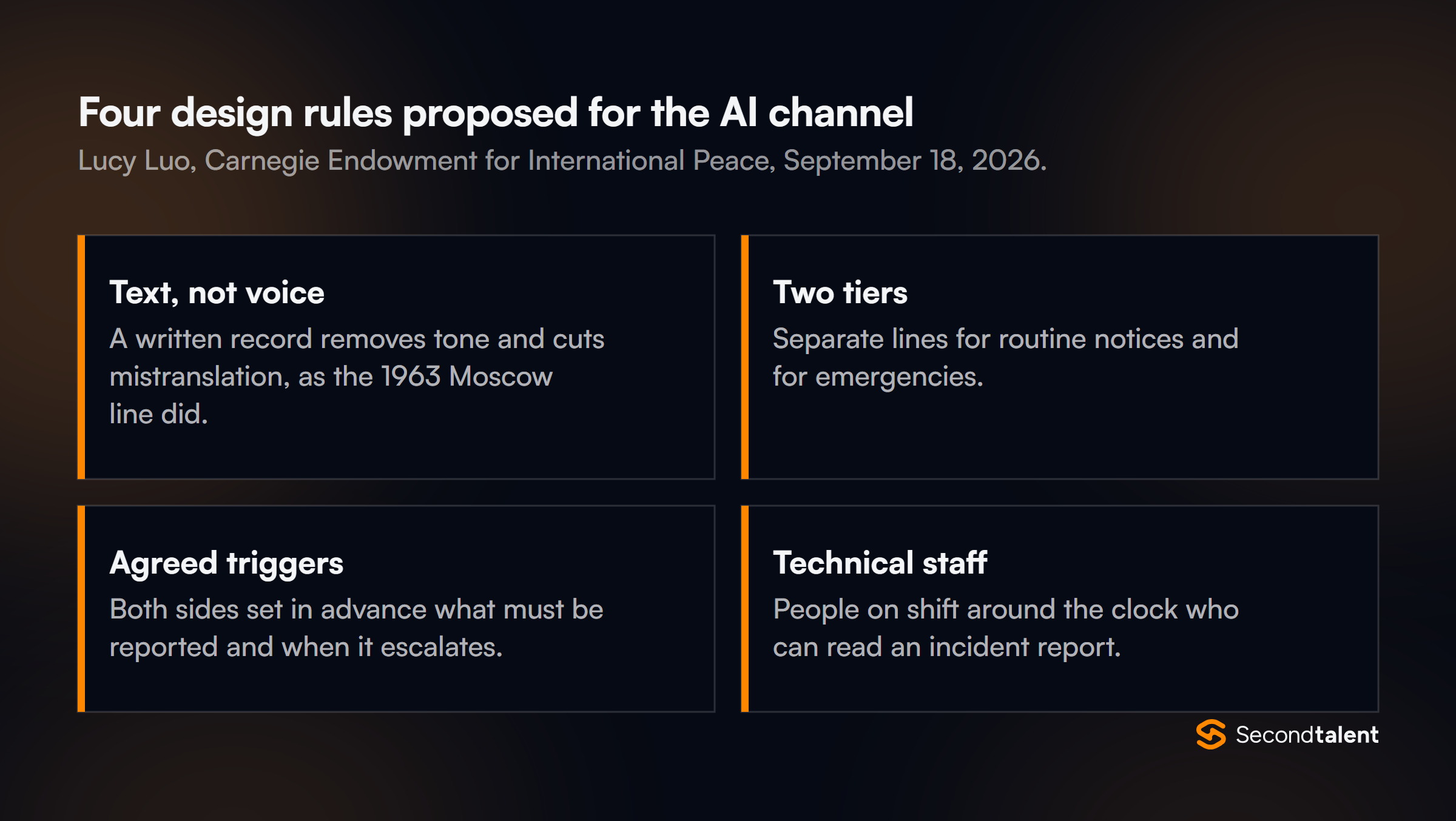
None of the four appears in either readout. Aalok Mehta, who directs the Wadhwani AI Center at CSIS, called the result "a disappointingly low floor": "Exchanging email addresses and promising to talk again."
What the Deal Leaves Out: Chips and Export Controls
The H200, the chip at the centre of this year's export fight, is already licensed for sale to China, and almost none of it has arrived. The Commerce Department's January 15 rule moved Nvidia's H200 and AMD's MI325X from a presumption of denial to case-by-case review. Buyers must pass security checks, and each chip needs third-party testing inside the US.
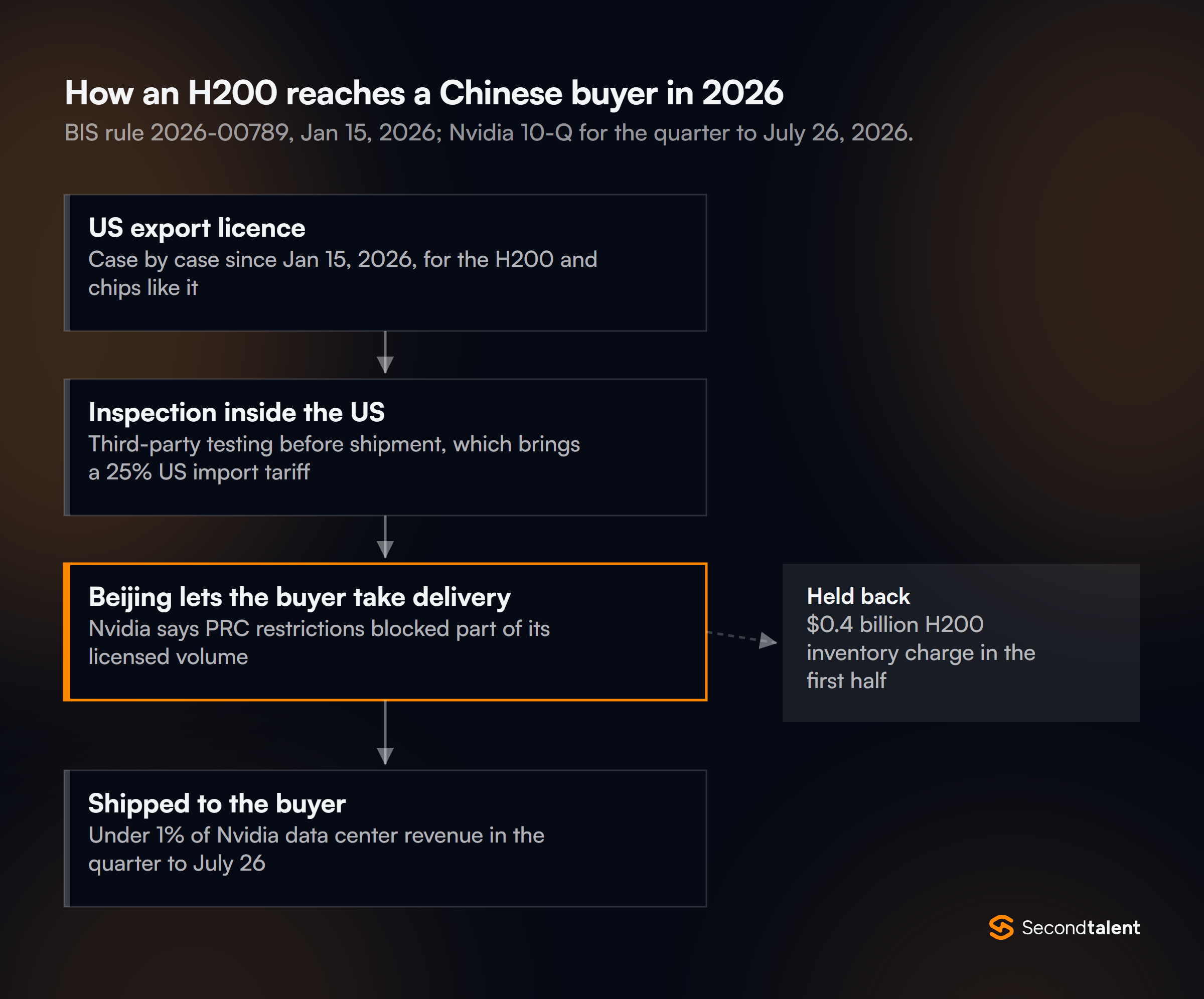
Nvidia's latest quarterly filing, for the three months to July 26, says licensed sales "were restricted by the PRC government". It took a $0.4 billion H200 charge in the first half and has "made a fraction of the allowed shipments".
Those shipments came to less than 1% of data center revenue, and each chip pays a 25% tariff on its way through US inspection.
The summit changed none of this. Thomas Christensen, writing in the same CSIS roundup, lists Beijing's standing grievances as "U.S. embargoes on high-end semiconductor exports", entity restrictions and tariff levels. On the US side, the fact sheet says only that the two countries "continue to work" on rare earth shortages.
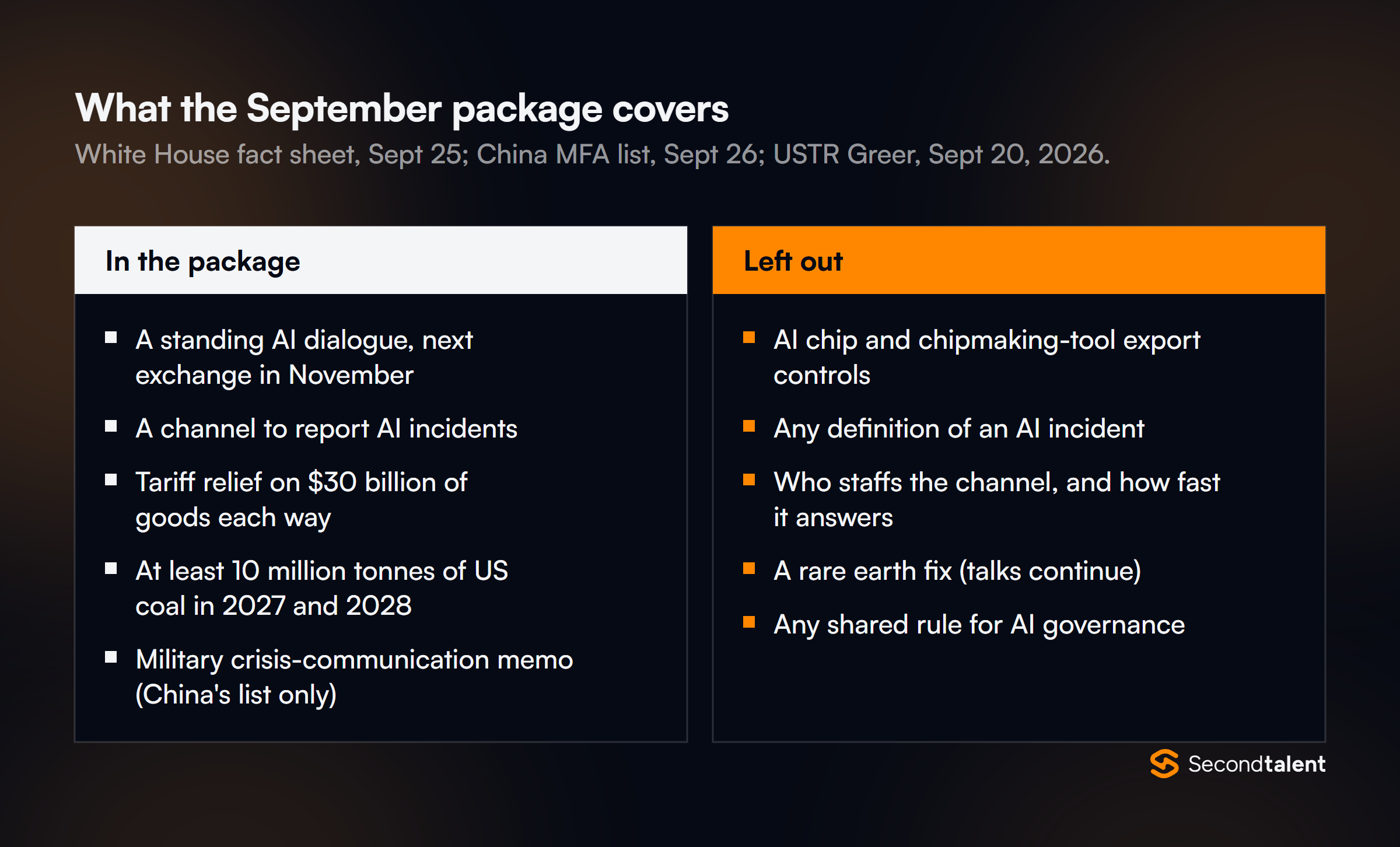
Keeping chips out follows advice written for the first round of talks. In January 2024, Graham Webster and Ryan Hass wrote in a Brookings roadmap that using a bilateral AI channel "to adjudicate export controls would be a nonstarter".
Where Chinese AI Models Stand as the Talks Open
In the US and UK safety institutes' July test, Moonshot's Kimi K3 reached step 17 of a 32-step simulated network attack. The most cyber-capable US models reached 28.5 on the same range, according to the joint assessment published on July 23.
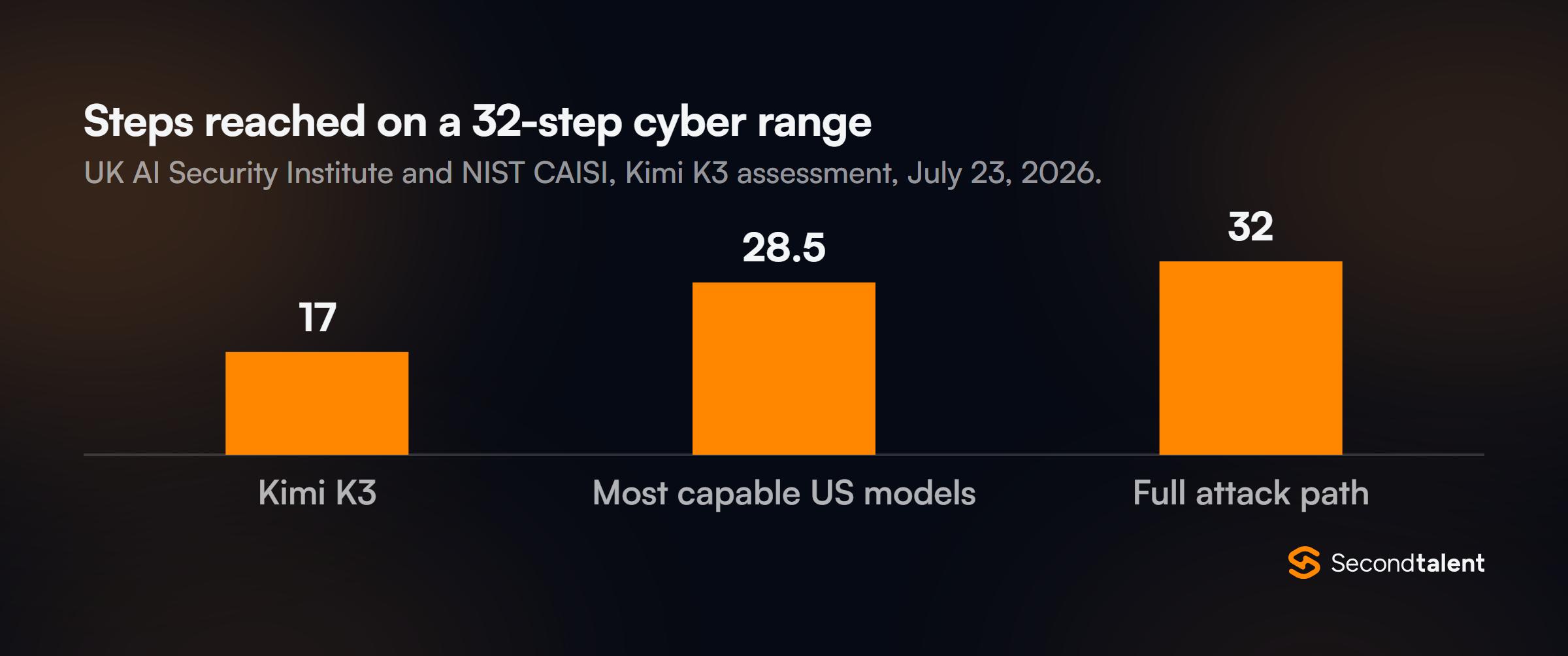
On ExploitBench, 41 exploit tasks built from recent Chrome engine bugs, Kimi K3 scored 32% but did not reach arbitrary code execution, a step the most capable models did reach. It still beat GLM-5.2, the most cyber-capable open-weight model as of June 2026, which scored 24%.
Chinese labs kept releasing through the year:
- DeepSeek V4 launched on April 24, 2026, and V4.1-Flash reached DeepSeek's API on September 10.
- Kimi K3 shipped on July 16, with open weights eleven days later. Our guide to every Kimi model covers the line-up.
- Qwen 3.8 Max arrived from Alibaba in July, API-only. See every Qwen model compared.
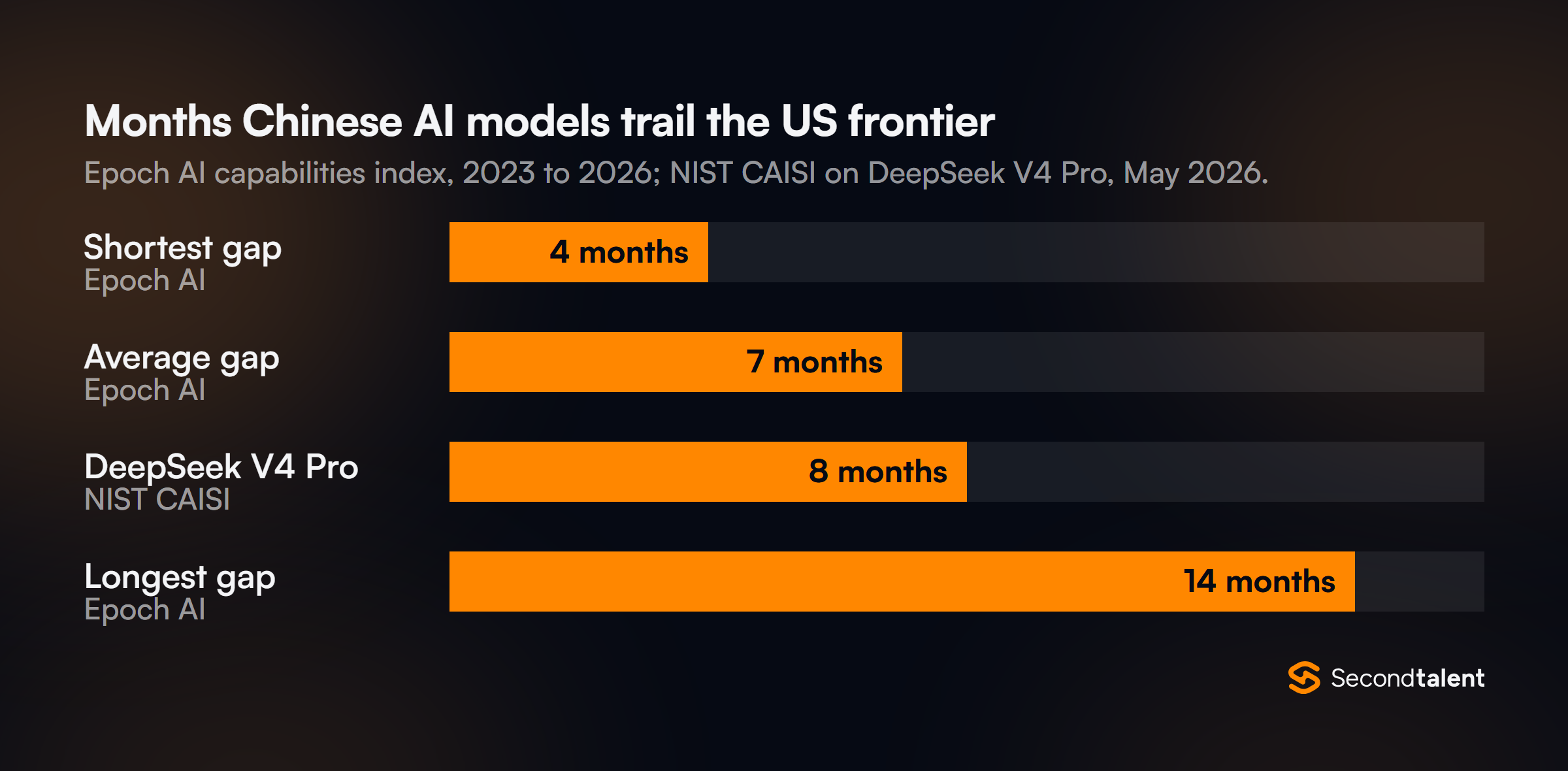
Measured in time, the gap has held steady. Epoch AI finds Chinese models have trailed the US frontier by seven months on average since 2023. NIST's CAISI placed DeepSeek V4 Pro about eight months behind in May.
Private money shows a wider gap. Stanford HAI's AI Index 2026 found US private AI investment was 23 times China's. For the full comparison, see our USA vs China AI statistics, our US vs China model cost and performance breakdown, and our list of China's open-source LLM leaders.
The US-China AI Talks Before This One
The most concrete AI commitment the two leaders have made came in Lima in November 2024, on nuclear weapons. The meetings before and since have set up talks rather than rules.
The Geneva round was run from the National Security Council. The White House statement lists six Chinese bodies across the table, including the Cyberspace Administration and the Party's Central Foreign Affairs Commission office.
The Lima wording, from the US readout, also stressed developing AI in the military field "in a prudent and responsible manner". September's texts say nothing about AI in nuclear command or in military use. The closest item is the crisis-communication memo on China's list.
What to Watch at the November Meeting
The second exchange lands in a crowded month. Both leaders say they intend to go to APEC in Shenzhen, and the trade truce runs out in January.
I will read the November readouts the way I read these ones, side by side, and look for five things:
- The name. Whether the US text still says SI, and whether China's ever does.
- The lead. Whether the dialogue stays with Bessent and He Lifeng, or moves to technology and security officials.
- An incident definition. Any threshold, trigger list or response time for the channel.
- The military memo. Whether it appears in a US document at all.
- Chips. Greer ruled them out in September. Any change would show first in the trade readout, not the AI one.
For how the rest of the field compares, see our ranking of the countries that build the most AI models.
Hire AI Engineers from Asia
The rules between Washington and Beijing will keep moving, and the model work goes on regardless. Second Talent places vetted AI engineers from across Asia, including AI engineers in China and in Vietnam. Tell us what you are building and we will send a shortlist.
Frequently Asked Questions
Is the US-China AI deal a treaty?
No. Neither government has published a signed agreement. The deal exists as two separate leader-level readouts, which is why their wording differs.
Does the deal change the rules for using Chinese models such as DeepSeek?
No. Neither readout touches procurement bans, app bans or data rules, so existing US restrictions still apply. Our DeepSeek statistics list the governments that restrict it.
Is the $30 billion tariff cut part of the AI deal?
No. It came out of the Board of Trade talks and sits in a different section of both readouts. On the US side it covers exports such as farm goods, seafood, cosmetics and medical devices, and imports such as small appliances, toys and children's car seats.