TL;DR: DeepSeek had 129 million monthly app users in China in June 2026, third behind Doubao and Qwen. Outside China its chatbot is a small brand: deepseek.com drew 353.8 million visits in August, about 6% of chatgpt.com's traffic. Among developers it is one of the largest names in AI, with 371 million model downloads on Hugging Face.
Nvidia lost close to $600 billion in market value on January 27, 2025, the day DeepSeek’s app reached the top of Apple’s App Store. Coverage that week centred on one figure from the V3 report: $5.576 million, the rented GPU time for one final training run.
DeepSeek’s newest model, V4.1-Flash, reached the API on September 10, 2026 at $1.20 per million output tokens during peak hours.
- 1At peak list prices, V4.1-Flash output costs about 17 times less than GPT-5.6 Sol and 21 times less than Claude Opus 5.
- 2From September 14, 2026, requests to V4-Pro run on V4.1-Flash at the Flash price.
- 3Eight governments or regulators have acted against DeepSeek’s app or services, five of them on government devices or agencies.
- 4R1, released in January 2025, is still its most downloaded model, at 48.5 million downloads.
How Many People Use DeepSeek?
QuestMobile’s 2026 half-year AI app report puts DeepSeek at 129 million monthly active users on its app in China in June 2026. Outside China the product people use is the website, and Similarweb’s estimate for deepseek.com is the closest public measure.
- 129M monthly active users
- Third among China’s AI-native apps
- 30.0% of users in the 10-minutes-plus usage bracket
- 353.8M visits, up 2.14% on July
- 51.43% of desktop traffic from China
- 8.27% from Russia, 5.86% from the US
ByteDance’s Doubao led China’s AI apps with 382 million monthly users and Alibaba’s Qwen had 167 million. Our Doubao vs DeepSeek comparison covers how the two apps differ.
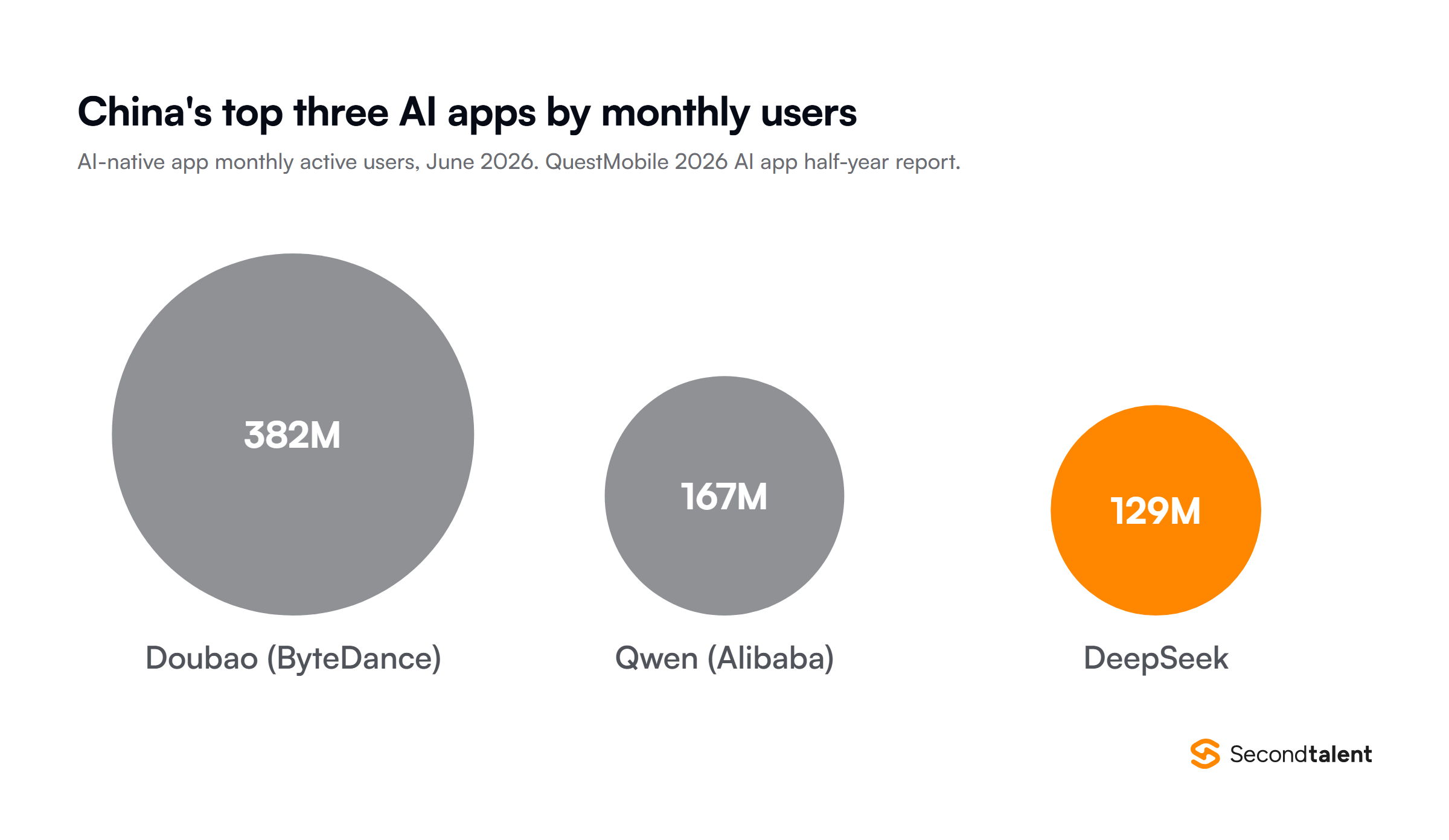
DeepSeek gained 2 million users between March and June. QuestMobile’s first-quarter report had it at 127 million in March, in a quarter when Qwen added 126 million. The users it has stay longer: its 30.0% share in the 10-minutes-plus bracket beat Doubao’s 27.5% and Kimi’s 26.1%.
On the web, deepseek.com is a small site next to its US rivals. Similarweb puts chatgpt.com at 5.6 billion visits in August 2026, gemini.google.com at 2.6 billion and claude.ai at 950.2 million.
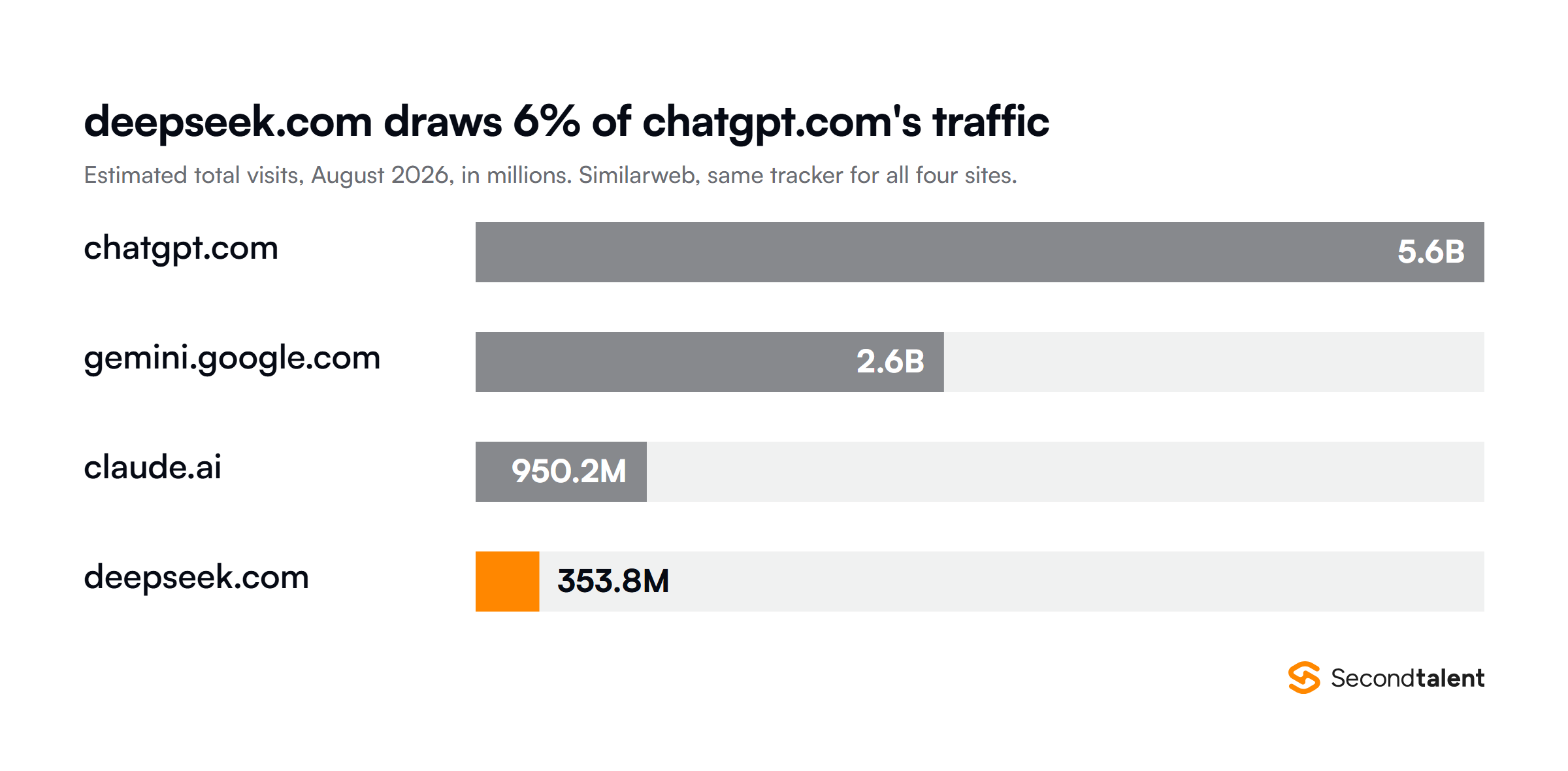
That makes DeepSeek’s site about 6% the size of ChatGPT’s and a little over a third the size of Claude’s. Our ChatGPT statistics and Claude AI statistics pages carry the figures for those two companies.
DeepSeek on OpenRouter
On OpenRouter’s model rankings, DeepSeek V4 Flash 0731 processed 12.3 trillion tokens in the seven days to September 9, 2026, the fourth highest of any model that week.
DeepSeek Models and Benchmarks
DeepSeek shipped three releases in the four weeks to September 10, 2026. The news page of DeepSeek’s API documentation lists its releases, and the timeline below picks nine.
The V4 preview in April 2026 came in two sizes: V4-Pro at 1.6 trillion parameters with 49 billion active, and V4-Flash at 284 billion with 13 billion active.
V4.1-Flash sits between them. Its model card lists these specifications:
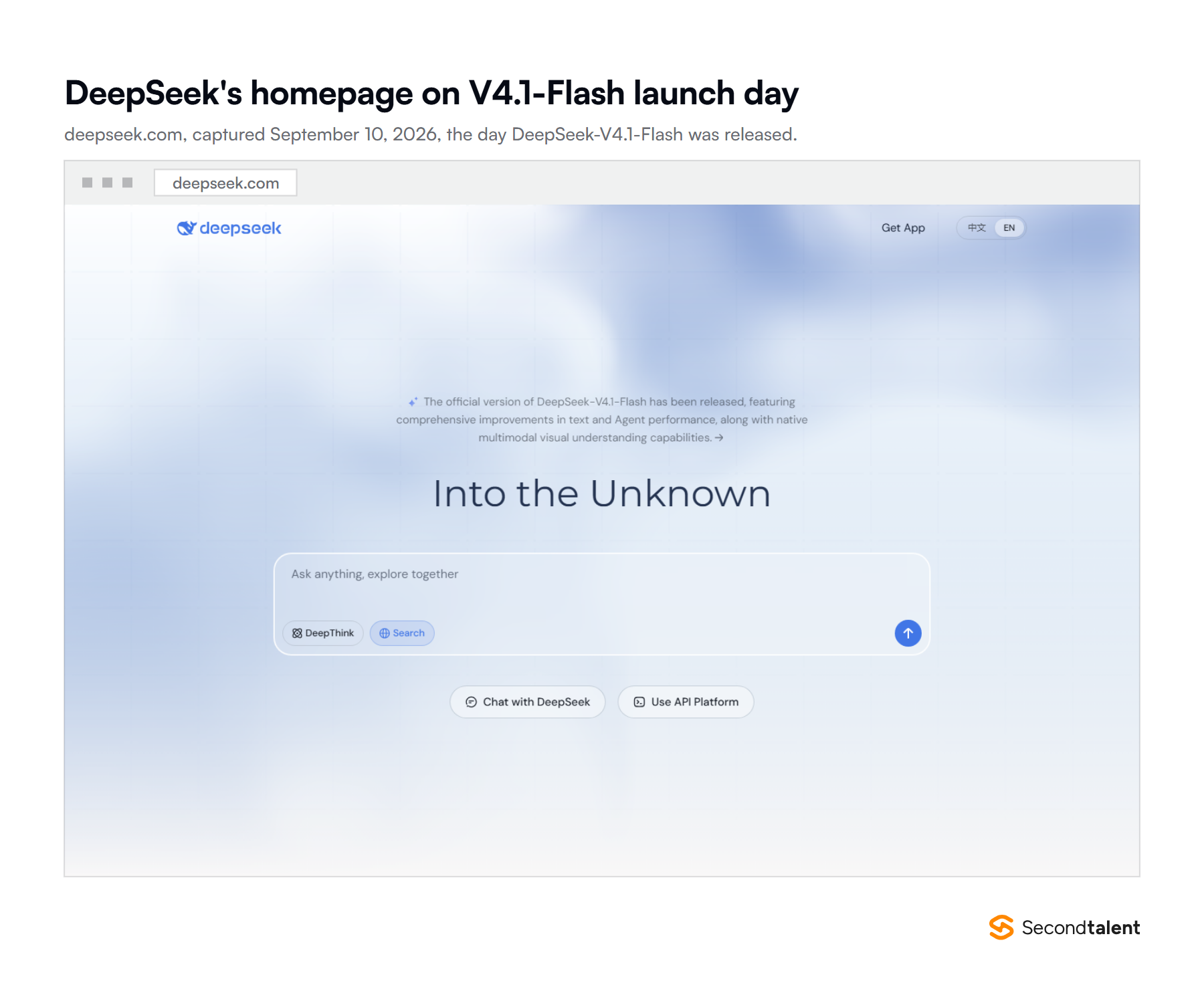
The gap between reading and writing comes from a new design. The model card describes a 40-layer transformer split into a 20-layer encoder and a 20-layer decoder. DeepSeek’s release note says its key-value cache needs a quarter of the GPU memory and an eighth of the SSD storage of the previous generation. The launch took over the deepseek.com homepage on release day.
On DeepSeek’s own tests, V4.1-Flash resolves 74.2% of DeepSWE tasks, which ask a model to fix real software issues. Claude Opus 5 scores 74.0% and GPT-5.6 Sol 73.0% in the same table. On Terminal-Bench 4.0, a harder agent test, V4.1-Flash scores 31.2% against 51.8% for Opus 5.
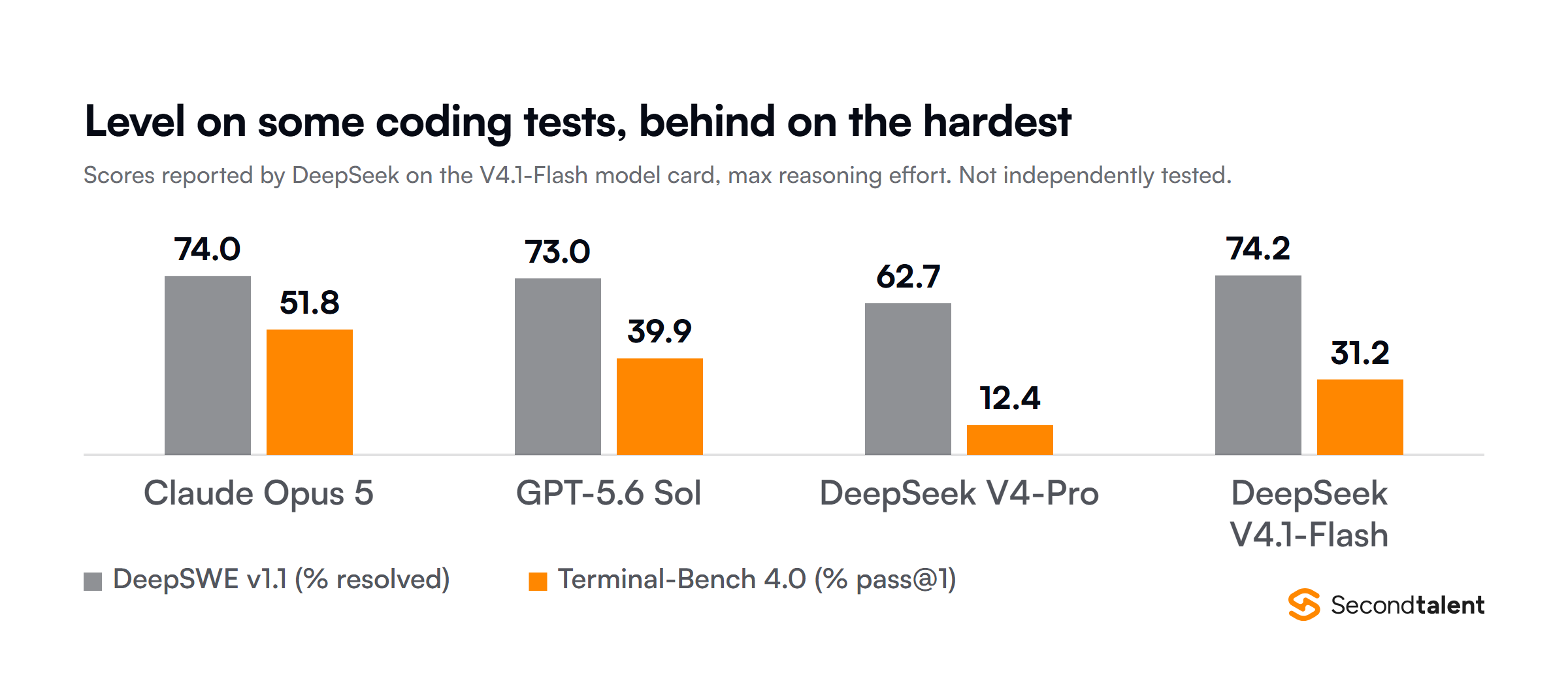
DeepSeek ran all of these tests itself, so treat the scores as vendor claims. Our DeepSeek for coding review looks at how the models handle development work, and our DeepSeek model guide walks through the lineup one model at a time.
How Much Does the DeepSeek API Cost?
DeepSeek V4.1-Flash costs $0.30 per million input tokens and $1.20 per million output tokens at peak hours on DeepSeek’s pricing page, with off-peak rates at half that. Peak hours run 01:00 to 04:00 and 06:00 to 10:00 UTC on weekdays. The new prices took effect at 04:00 UTC on September 10, 2026.
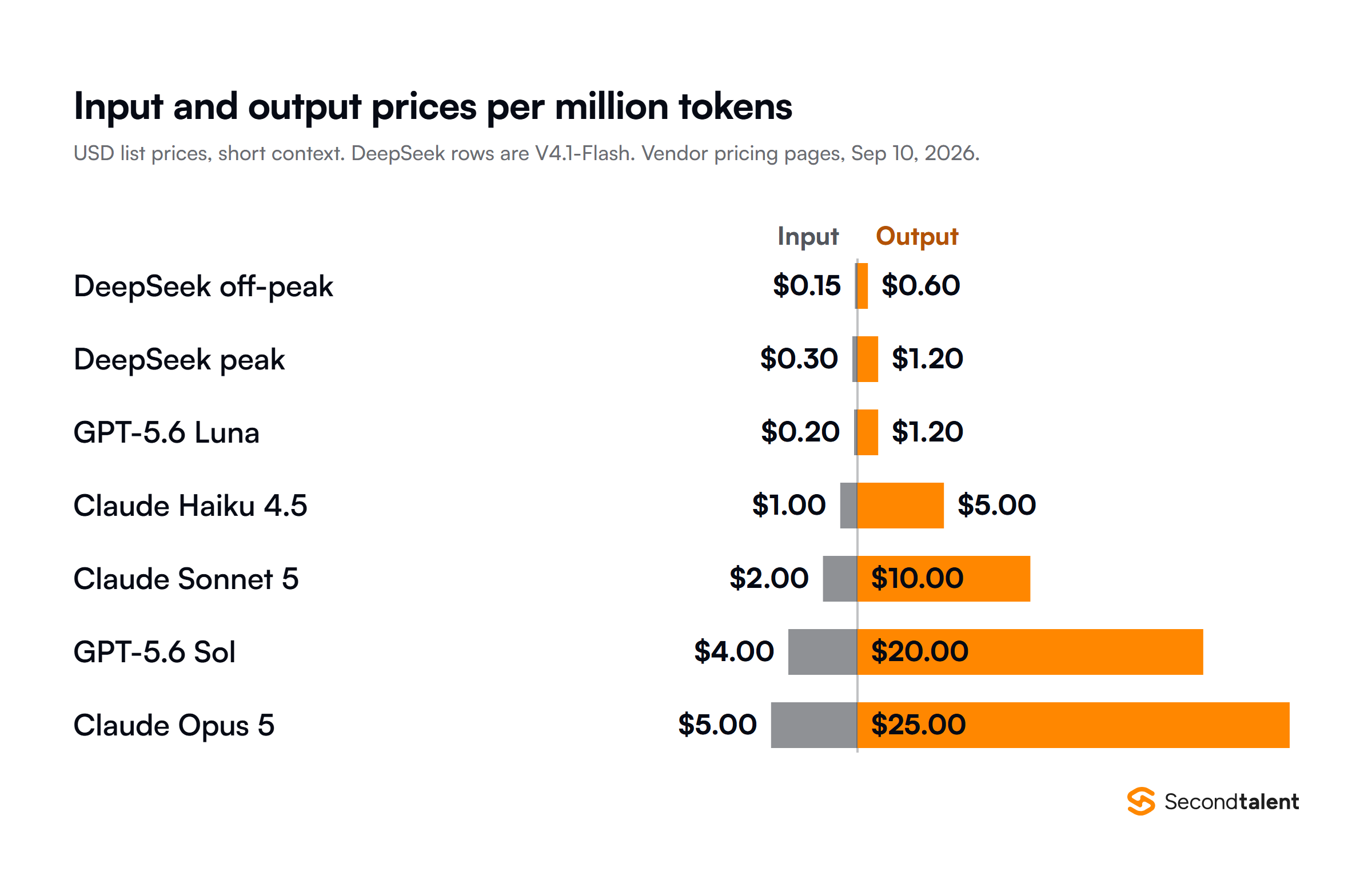
OpenAI lists GPT-5.6 Sol at $20 per million output tokens, a promotional price it says runs to at least November 21, 2026. Anthropic lists Claude Opus 5 at $25. By our arithmetic, DeepSeek’s peak output price is about 17 times below Sol and 21 times below Opus 5. Input runs in the same order: $4 per million tokens for Sol and $5 for Opus 5, against DeepSeek’s $0.30.
Per-token prices are not a like-for-like comparison. Anthropic says the tokenizer on Claude 4.7 and later models produces about 30% more tokens for the same text.
Cached input matters more for agents than the headline rate. DeepSeek says cache-hit charges often make up a large share of agent costs, and it charges $0.006 per million cached input tokens at peak.
| DeepSeek API, per million tokens | V4.1-Flash (deepseek-flash) | V4-Pro |
|---|---|---|
| Input, cache hit (peak / off-peak) | $0.006 / $0.003 | $0.044 / $0.022 |
| Input, cache miss (peak / off-peak) | $0.30 / $0.15 | $1.32 / $0.66 |
| Output (peak / off-peak) | $1.20 / $0.60 | $3.96 / $1.98 |
| Context length | 1M tokens | 1M tokens |
V4-Pro is on its way out. DeepSeek says V4.1-Flash outperforms it, and from 04:00 UTC on September 14, 2026, requests to deepseek-v4-pro will route to V4.1-Flash at the Flash price until a V4.1-Pro ships. If your code names V4-Pro, your bill drops and your model changes on that date.
V4-Flash and V4-Flash-Vision-Exp are already retired. Their model names, deepseek-v4-flash and deepseek-v4-flash-vision-exp, route to V4.1-Flash for compatibility.
How Much Did DeepSeek Cost to Train?
DeepSeek has not published a total cost for building its models. Its two public figures cover training runs: $5.576 million for V3’s final run and $294,000 for R1’s reasoning training, both priced at an assumed $2 per GPU hour.
The DeepSeek-V3 technical report counts 2.788 million H800 GPU hours on a 2,048-GPU cluster. In its own words, the figure “include[s] only the official training of DeepSeek-V3, excluding the costs associated with prior research and ablation experiments.”
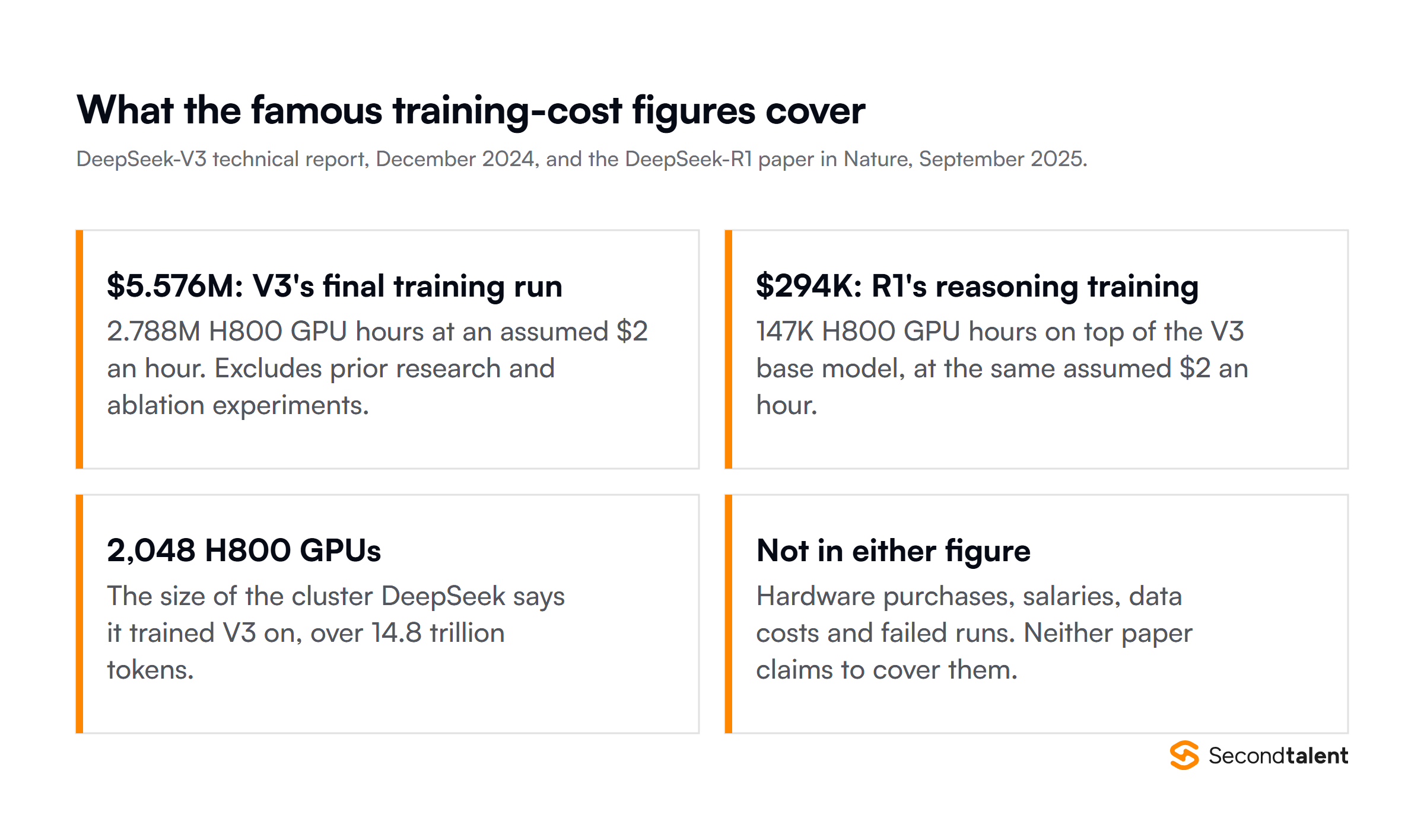
That makes $5.576 million the rental value of one run. It leaves out the GPUs DeepSeek owns, its salaries, its data and the experiments that did not ship.
R1’s $294,000 comes from the supplementary information to the peer-reviewed R1 paper in Nature, published in September 2025. It covers 147,000 H800 GPU hours for R1-Zero, the supervised data creation and R1 itself, on top of V3.
DeepSeek Company Facts and Funding
Liang Wenfeng founded DeepSeek, which operates through Chinese entities including Hangzhou DeepSeek Artificial Intelligence and Beijing DeepSeek Artificial Intelligence, the two companies named in Italy’s 2025 privacy order.
Its first outside funding round surfaced in June 2026. Reuters reported that DeepSeek was set to raise about 50 billion yuan ($7.4 billion) at a post-money valuation of $52 billion to $59 billion. Its sources said Liang committed 20 billion yuan of his own money, with Tencent considering 10 billion yuan and battery maker CATL 5 billion yuan.
Those figures come from people with knowledge of the deal. DeepSeek did not respond to Reuters and has not confirmed them.
Where Is DeepSeek Banned or Restricted?
Most DeepSeek restrictions cover government devices. Italy, South Korea and Berlin went further and acted on the public app.
Each entry links to the regulator’s or government’s own notice, apart from South Korea, where the dates come from news reports quoting its privacy commission.
| Jurisdiction | Date | What it restricts |
|---|---|---|
| Italy | January 30, 2025 | Garante order limiting DeepSeek’s processing of Italian users’ data, with immediate effect |
| Taiwan | January 31, 2025 | Ministry of Digital Affairs bars public agencies from using DeepSeek AI services |
| Texas, US | January 31, 2025 | Governor’s ban on state employees and contractors using it on work devices |
| Australia | February 4, 2025 | PSPF Direction 001-2025 removes DeepSeek from all federal government systems and devices |
| New York, US | February 10, 2025 | Statewide ban on state-managed government devices and networks |
| South Korea | February 2025 to April 28, 2025 | New downloads suspended at the privacy commission’s request, reported February 17; service resumed April 28 |
| Berlin, Germany | June 27, 2025 | Data protection authority reports the app to Apple and Google as unlawful content under the Digital Services Act |
| Czech Republic | July 10, 2025 | NÚKIB warning covering DeepSeek products, apps and APIs, alongside a government ban in state administration |
Most of these notices name DeepSeek’s apps, websites and APIs, which send data to DeepSeek’s servers. Self-hosted open weights keep data on your own hardware. Whether a rule reaches self-hosted weights depends on its wording. Texas’s ban also covers state contractors on work devices, so a company selling to the state has to check it.
DeepSeek Open-Weight Downloads
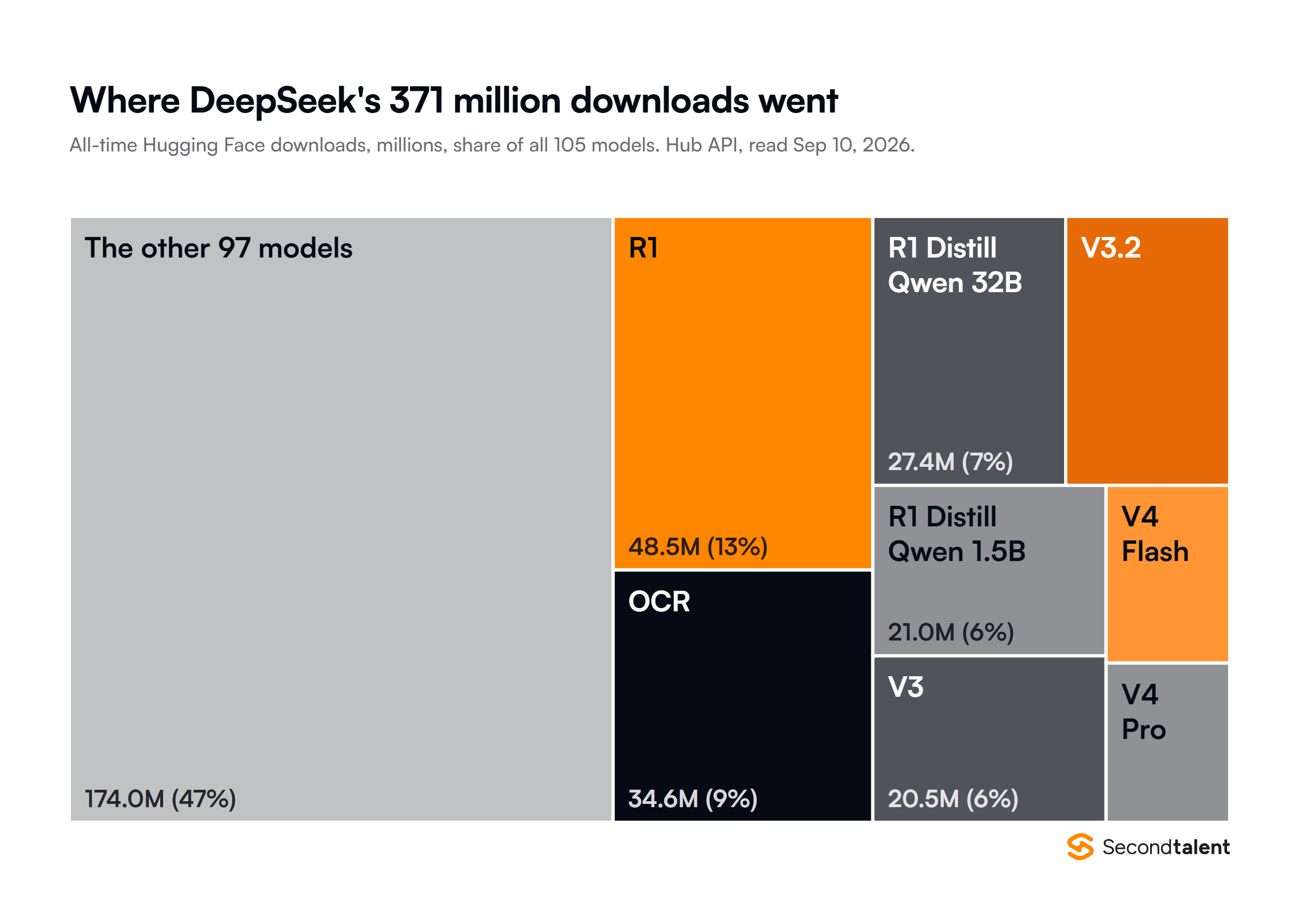
Developers have downloaded DeepSeek’s models 371 million times on Hugging Face, by our sum from the Hub API across the public models on its Hugging Face organisation page as of September 10, 2026.
Six of the ten R1-family models are smaller distilled versions built on Qwen and Llama. DeepSeek-OCR, a document-reading model, sits second on the list behind R1 itself.
Running V4.1-Flash on your own hardware
The weights are free under the MIT licence, which allows commercial use and modification. DeepSeek sizes the job itself: its release note invites anyone “planning a large-scale deployment with 2,000 GPUs + a storage cluster” to get in touch.
The release ships without a Jinja chat template, the file most inference servers read to format prompts. DeepSeek provides a Python reference encoder instead, plus deepseek-recipe, a set of Rust libraries with Python bindings for production use. The model card recommends a one-million-token context window and a max_tokens setting of at least 256,000.
Our list of Chinese open-source LLMs covers the other open-weight models Chinese labs publish.
Build Your DeepSeek Team With Second Talent
Self-hosting the weights, wiring in DeepSeek’s own prompt encoder and moving batch work into off-peak hours are engineering jobs the API bill does not cover. We match companies doing that work with pre-vetted AI engineers in 24 hours, with employer of record across nine Asian markets. See our LLM developers, AI developers and China developers, or tell us what you are building and we will send profiles the next day.
Frequently Asked Questions
Is DeepSeek free to use?
The chat app is free. Its January 2025 app announcement launched it with no ads or in-app purchases. The API charges per token, and the open weights are free to download under the MIT licence.
Does DeepSeek publish a global user count?
No. The global DeepSeek user totals on statistics aggregator sites do not trace back to DeepSeek or a named tracker. The traceable figures are QuestMobile’s count for the app in China and Similarweb’s estimate for the website.
Is DeepSeek banned in the United States?
Not for the public, in the government sources we checked. The US restrictions we verified cover state government devices in Texas and New York.

![Singapore AI Companies Leading Southeast Asia. Top 10 Singapore AI Companies Leading Southeast Asia [2026], by Second Talent.](https://www.secondtalent.com/wp-content/uploads/2026/09/singapore-ai-companies-featured-v2-768x403.jpg)
![AI Recruiting Tools. Top 7 AI Recruiting Tools in 2026 [Tried & Tested], by Second Talent.](https://www.secondtalent.com/wp-content/uploads/2026/09/top-ai-recruiting-tools-featured-v2-768x403.jpg)