Outsourcing vs EOR vs In-House: The Best Model for 10 Common Roles (2026)
By Eric Cheng, Head of International Business
11 min read
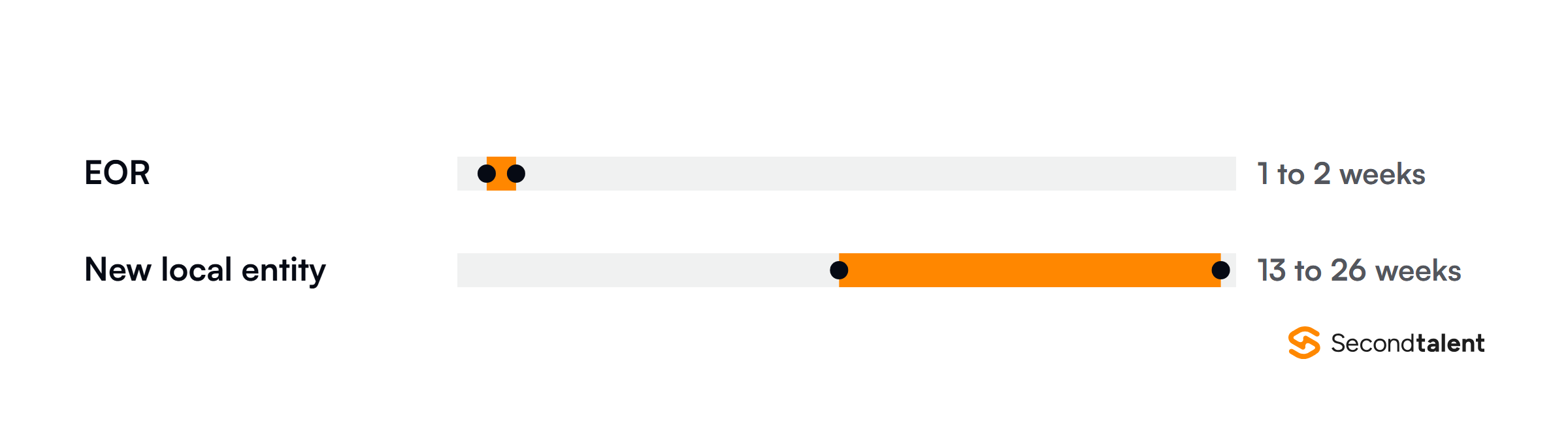
TL;DR: Use an employer of record (EOR) for specialists you direct every day, managed outsourcing for measurable work with swinging volume, and your own payroll for leadership and sign-off roles. An EOR gets a first hire working in 5 to 10 business days, against 3 to 6 months to open an entity. Plan your own entity once a country team reaches about 10 staff you expect to keep for two to three years.
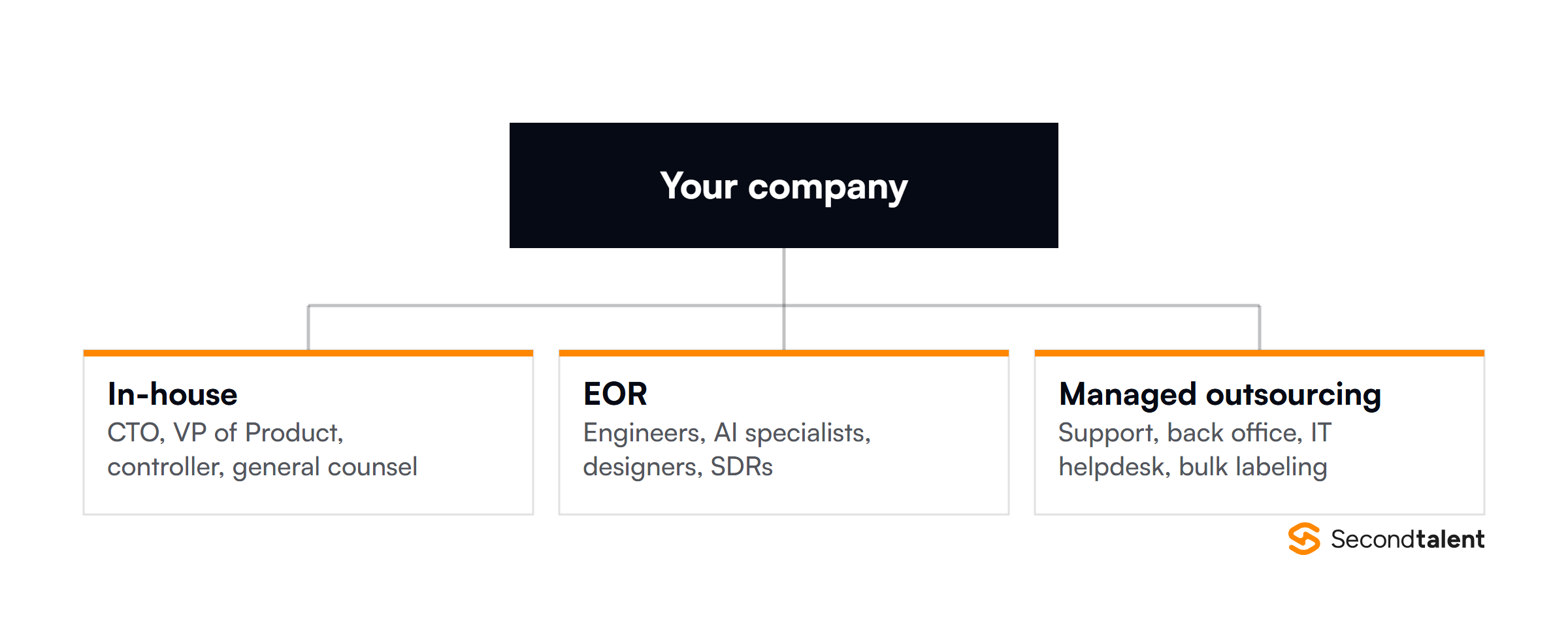
A US startup can run all three hiring models in the same quarter: senior engineers in Vietnam on EOR contracts, a CTO on its own payroll, and data entry, order processing and billing handed to a provider of back-office support services that runs the team end to end.
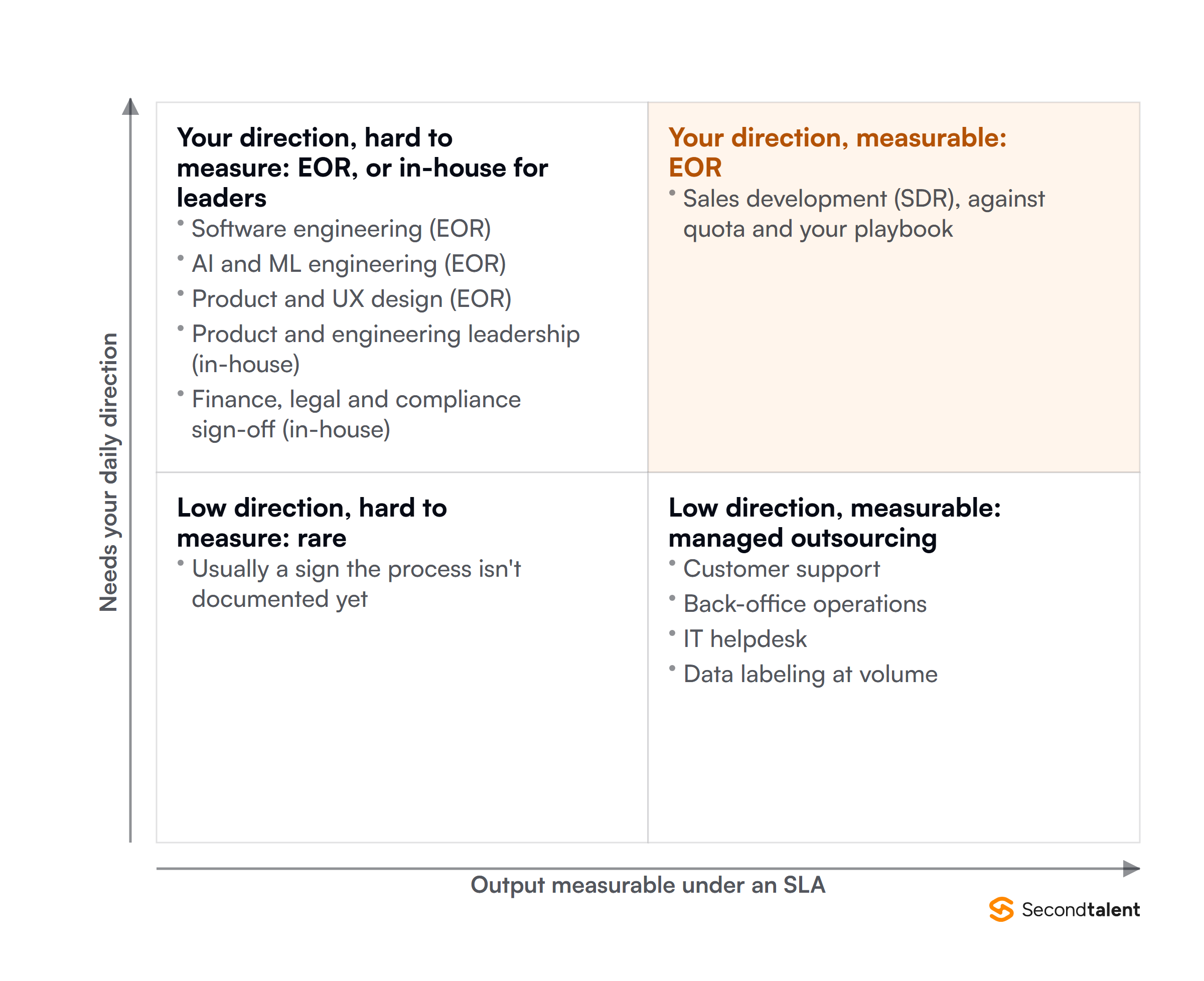
The three models split on two questions: who employs the worker, and who manages the work. You answer them role by role, not once for the whole company.
Key takeaways
1Benefits were 30.0% of US private-industry compensation cost in June 2026, and in-house and EOR hires both carry that load.
2Helpware says a managed back-office team saves up to 50% of overhead against running the same team in-house.
3On our cost model, an entity and a $599-a-month EOR cost the same at about six staff in one country.
The best model for 10 common services
Engineering, AI, design and sales development go to an EOR. Support, back office, IT helpdesk and bulk data labeling go to a managed provider. Leadership and finance or legal ownership stay on your payroll.
#
Service
Best model
Main reason
1
Software engineering
EOR
Needs daily direction, no entity required
2
AI and ML engineering
EOR
Core IP and deep product context
3
Product and UX design
EOR
Works inside product squads
4
Sales development (SDR)
EOR
Your playbook, your CRM, weekly coaching
5
Customer support
Managed outsourcing
Volume swings, 24/7 coverage, clear SLAs
6
Back-office operations
Managed outsourcing
Repeatable, measurable, needs a QA layer
7
IT helpdesk
Managed outsourcing
Ticket-based and SLA-driven
8
Data labeling at volume
Managed outsourcing
Project spikes and QA sampling
9
Product and engineering leadership
In-house
Owns strategy and answers to the board
10
Finance, legal and compliance ownership
In-house
Sign-off and regulatory accountability
1. Software engineering: EOR
Model: EORDirected by: your engineering managerSwitch to: own entity at ~10 staff
In the Philippines, an employer must pay a 13th-month salary to rank-and-file staff under Presidential Decree 851, and Vietnam has its own payroll and social insurance rules.
An EOR carries those obligations while your engineering manager runs the sprint, the codebase reviews and the roadmap. Engineers need that daily direction, which an agency hand-off can't give core product work.
In a country where you already have an entity, hire engineers in-house. Elsewhere, revisit the choice once the country team passes the break-even point in our guide to switching from an EOR to your own entity.
2. AI and ML engineering: EOR
Model: EORTouches: eval sets, weights, customer data
AI engineers handle your evaluation sets, model weights and customer data pipelines, which are the assets you least want sitting with a vendor's staff. A local EOR contract covers IP assignment and confidentiality under that country's law.
That matters when the person building your retrieval pipeline works in another jurisdiction.
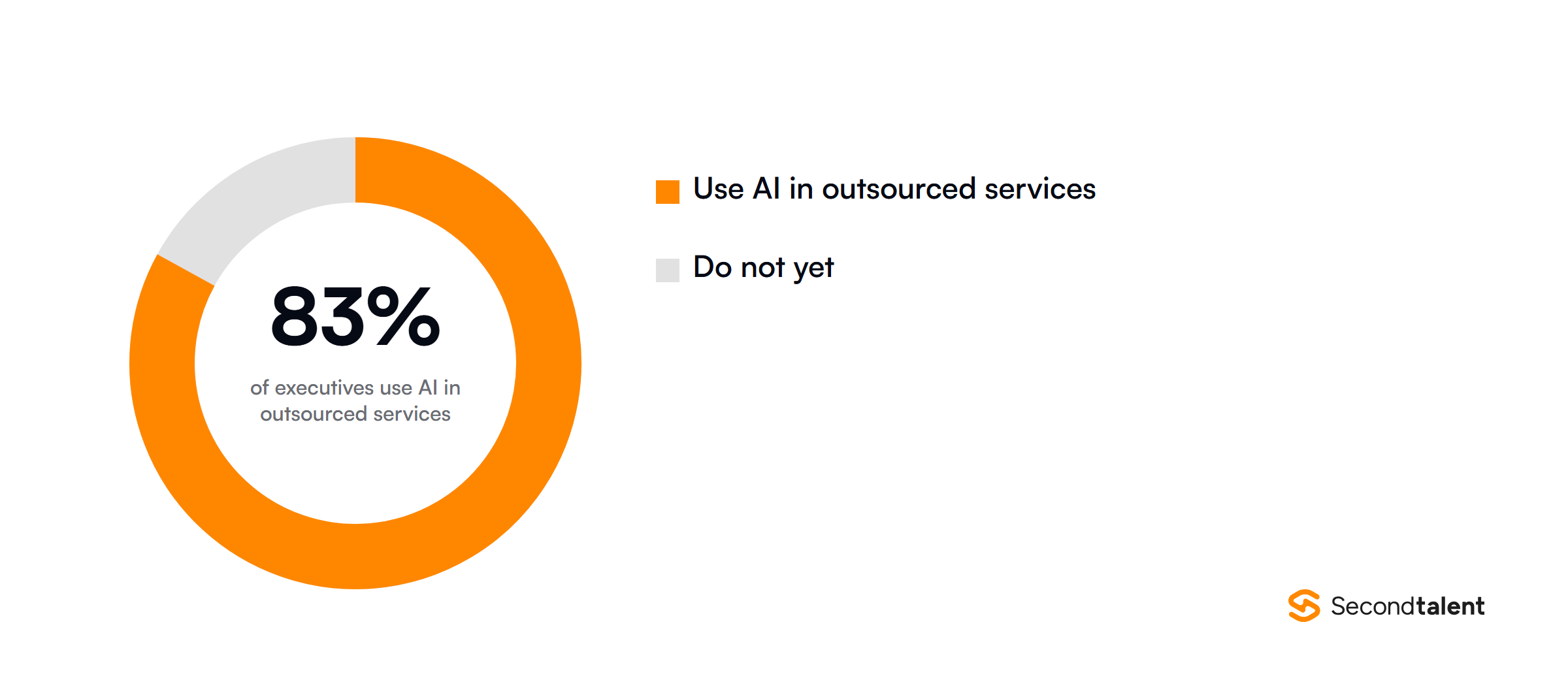
Your vendors will still bring AI into the services you buy. In Deloitte's 2024 Global Outsourcing Survey, 83% of executives said they use AI as part of their outsourced services.
Build your core models with engineers you direct, and buy AI-enabled processes from providers.
3. Product and UX design: EOR
Model: EORException: one-off brand work to an agency
Designers sit in your discovery calls, user research sessions and design files. An agency can deliver a set of screens, but the context from this quarter's research seldom survives into next quarter's brief.
Hire product designers through an EOR when they will work inside your squads, and give one-off brand or campaign projects to an agency.
4. Sales development (SDR): EOR
Model: EORAgency fit: short campaigns only
SDRs pitch your product from your playbook and log their calls in your CRM. You coach them weekly and rewrite the script when the market moves.
An EOR lets you hire in a time zone that covers your target region and keep the rep on your team.
Lead-generation agencies suit a short campaign. The call notes and pipeline habits leave with the contract.
5. Customer support: managed outsourcing
Model: Managed outsourcingKeep in-house: support lead, knowledge base
Support volume jumps with launches, holidays and outages. A managed provider staffs to forecast, covers nights and weekends across time zones and checks quality with its own QA team.
You set the targets: first response time, resolution rate and CSAT.
Keep a small in-house support lead who owns the knowledge base and the escalation paths. A complex developer product is the exception: L2 and L3 technical support can justify EOR hires who sit with engineering.
6. Back-office operations: managed outsourcing
Model: Managed outsourcingTasks: data entry, orders, billing, claimsKeep in-house: sign-off
A four-person back-office team still needs a lead who reviews output, someone running QA samples, a workforce plan and cover for sick days and attrition. On a team that small, whoever owns that layer isn't processing orders.
An EOR solves the entity problem but leaves all of that supervision with you.
Data entry, order processing, account setup, billing and claims handling repeat, carry clear volume and accuracy numbers, and move with sales. A managed provider spreads the supervision, QA and staffing buffer across many clients.
Helpware, which sells this service, says clients save up to 50% of overhead costs compared with running an in-house back-office team.
Back office on an EOR
You fund the team lead, QA sampling and cover on top of salary, benefits and the EOR fee.
Back office with a managed provider
Supervision, QA and capacity planning sit inside one rate, measured against an SLA.
Two conditions make the handover work. Document the process with examples of correct and incorrect output before the provider starts. Then write accuracy and turnaround targets into the contract. You can then compare vendors on numbers.
Keep sign-off roles, such as the controller who approves the books, in-house (see entry 10).
Password resets, laptop setup and SaaS access requests arrive as tickets. Each one closes against a response-time target, which makes internal IT support a natural fit for a managed service desk with round-the-clock coverage.
Keep security architecture and identity policy with a senior in-house or EOR hire, and outsource the ticket queue.
8. Data labeling at volume: managed outsourcing
Model: Managed outsourcingException: RLHF and eval specialists on an EOR
Labeling projects swing from zero to thousands of items a week and back again. A managed annotation provider can scale a trained team for the sprint and run QA sampling on the output.
Expert work needs a different model. RLHF trainers and AI evaluation specialists shape how your model behaves, need your rubrics and work in tight loops with your researchers. Hire them as dedicated specialists through an EOR.
9. Product and engineering leadership: in-house
Model: In-houseEOR use: short bridge only
Your CTO, VP of Product and heads of engineering set direction, make hiring decisions and answer to the board. Put them on your own payroll, with equity, in your home country or the country you've picked for a long-term hub.
An EOR can bridge a senior hire for a few months while you set up an entity. Plan the move before the bridge turns permanent.
10. Finance, legal and compliance ownership: in-house
Model: In-houseOutsource: the queue below sign-off
Someone inside the company has to sign the books, answer the auditor and own regulatory filings. Keep the controller, general counsel and compliance lead in-house.
Invoice processing, reconciliations and document collection beneath them can move to a managed back-office team. Draw the line at sign-off authority and move the queue below it.
How outsourcing, EOR and in-house hiring differ
In-house, your entity employs the worker and directs the work. With an EOR, a provider becomes the legal employer while you direct the person day to day.
With managed outsourcing, the provider employs, manages and quality-checks the team, and you buy an agreed outcome.
Factor
In-house
EOR
Managed outsourcing
Legal employer
Your entity
EOR provider
Outsourcing provider
Who directs daily work
You
You
The provider, to your SLA
What you pay for
Salary, benefits, overhead
Salary, benefits, monthly EOR fee
Output, hours or seats under an SLA
Supervision, QA, tooling
You build it
You build it
The provider supplies it
Speed to first hire
3 to 6 months if you need a new entity
5 to 10 business days
Weeks, often after a pilot
Best for
Strategic, long-term roles
Specialists inside your team, no entity
Repeatable, measurable work with shifting volume
The speed figures come from our employer of record guide for APAC, which also compares statutory costs country by country. Weighing a PEO or contractor platform as well?
Cost is where the models pull apart, and salary is only part of the bill. The US Bureau of Labor Statistics put private-industry compensation at $46.89 per hour worked in June 2026:
$32.82
Wages and salaries per hour worked
$14.07
Benefits per hour worked
30.0%
Benefits share of total compensation cost
US private industry, June 2026. Source: BLS Employer Costs for Employee Compensation, released September 9, 2026.
In-house and EOR hires both carry that benefits load, plus the manager time spent supervising them. Managed outsourcing rolls supervision and benefits into one rate.
Our employer of record cost guide breaks down EOR fees by provider and country, so you can price the middle column before you compare.
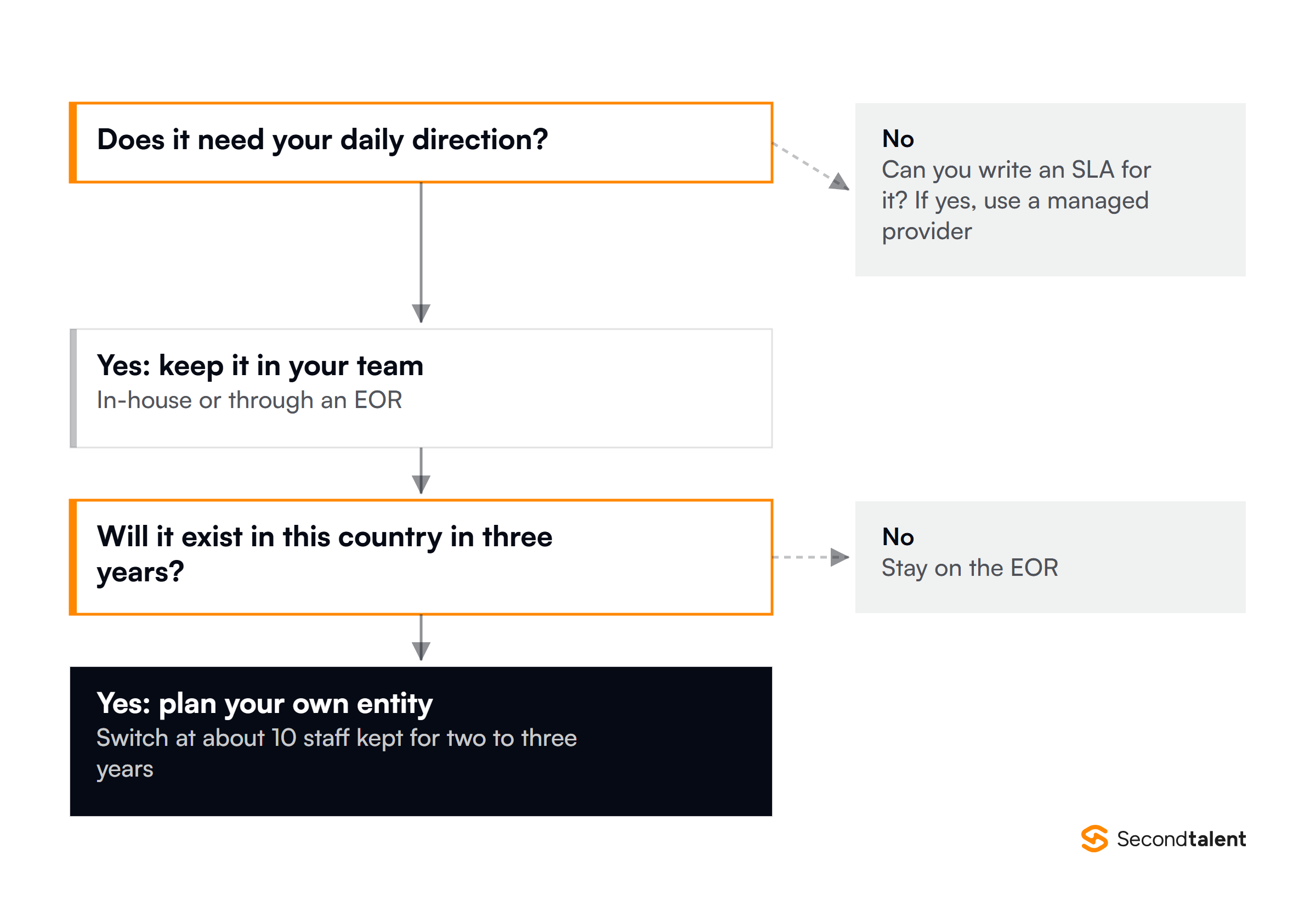
A three-question test for roles not on the list
For a role outside the 10 above, ask three questions in order. The answers point to EOR, managed outsourcing or in-house.
Does it need your daily direction and product context? If the person needs your standups, codebase and roadmap, keep them inside your team through in-house hiring or an EOR.
Can you measure the output? If you can write an SLA with accuracy, turnaround and volume targets, managed outsourcing becomes a real option.
Will the role exist in the same form, in the same country, three years from now? If a country team will stay and grow, plan for an entity. Our entity guide sets the switch point at about 10 staff kept for two to three years.
A role that fails the first question and passes the second goes to a managed provider. A role that passes the first and the third belongs on your own entity, with an EOR as the bridge until the entity exists.
Most scaling teams end up with in-house leaders, EOR specialists and managed operations side by side. Problems show up at the seams between them, and four habits close those seams:
Name an owner. Give each managed process an internal owner who reads the reports and joins the monthly SLA review.
Track headcount by country. When EOR headcount nears the threshold in the entity guide, start the entity plan. Setup takes about six months.
Watch permanent establishment risk. Tax authorities look at what your staff do in the country, such as signing sales contracts, whoever employs them. Vistra's tax team says six staff kept for two to three years makes it hard to argue you have no taxable presence.
Keep documentation portable. Store process docs and knowledge bases in your own systems, so you can switch vendors without starting over.
Hiring engineers in Asia through an EOR
Second Talent hires and employs engineers, AI specialists and designers across Southeast Asia, including Vietnam and the Philippines, so you can direct them as part of your team without opening an entity.
No. An EOR employs a person on your behalf, and you direct that person's work. With outsourcing, a provider delivers a process or outcome and manages the staff who do it.
You hire individuals through an EOR and buy results from an outsourcing provider.
When should back-office work stay in-house?
Keep it in-house when the work depends on judgment you can't document, when volume is too low to fill a part-time role, or when it carries sign-off authority, such as final approvals and month-end close.
The rest is a candidate for a managed team.
Which model costs the least?
It depends on what you count. An EOR adds a monthly fee on top of salary and benefits, and you still fund supervision. Managed outsourcing folds supervision, QA and tooling into one rate.
Compare the fully loaded cost of each option, including the hours your managers spend.
As the Head of International Business at Second Talent, Eric help companies build, manage, and scale their teams across Hong Kong, Southeast Asia, and Taiwan. He leverage my skills in business growth, business development strategy, and new business development to create and execute effective crossborder hiring, EOR and payroll solutions for clients in various industries, such as e-commerce, fintech, and edtech.