TL;DR: AI engineers in China cost more than in any other market we compare except Singapore, and we shortlist 6-8 candidates within 24 hours. The closest US benchmark, the BLS median for software developers, was $135,980 a year in May 2025.
The US Justice Department's data security rule uses an AI hire as a worked example. A data scientist living in a country of concern builds an AI assistant with admin rights over bulk customer financial data, and the job becomes a restricted transaction. The rule's definition of China covers Hong Kong and Macau too. Decide what data the engineer can reach before you pick the model.
Key takeaways
- On our AI engineer rate card, engineers in China earn $9,680 to $18,760+ a month working for international clients, more than double the Vietnam floor.
- The supported-country lists for the Anthropic, OpenAI and Gemini APIs leave out mainland China, so settle which models the engineer will call before the offer.
- China's Labor Law caps extended hours at 36 a month, which matters when a Shanghai engineer covers US meetings on top of a local day.
- Under China's software regulations, commissioned code belongs to the developer unless a written contract says otherwise.
What AI Engineers Earn in China Working for International Clients
China's AI engineer range opens at $9,680 a month, above the ceilings of our Vietnam card and close to India's. Singapore is the only market in the table that starts higher. The figures are what AI engineers in each market earn working directly for foreign companies, before any employer or platform costs.
| Market |
Monthly pay working for international clients (USD) |
| China |
$9,680-$18,760+ |
| India |
$2,610-$10,150+ |
| Vietnam |
$3,870-$7,730+ |
| Singapore |
$14,210-$27,620+ |
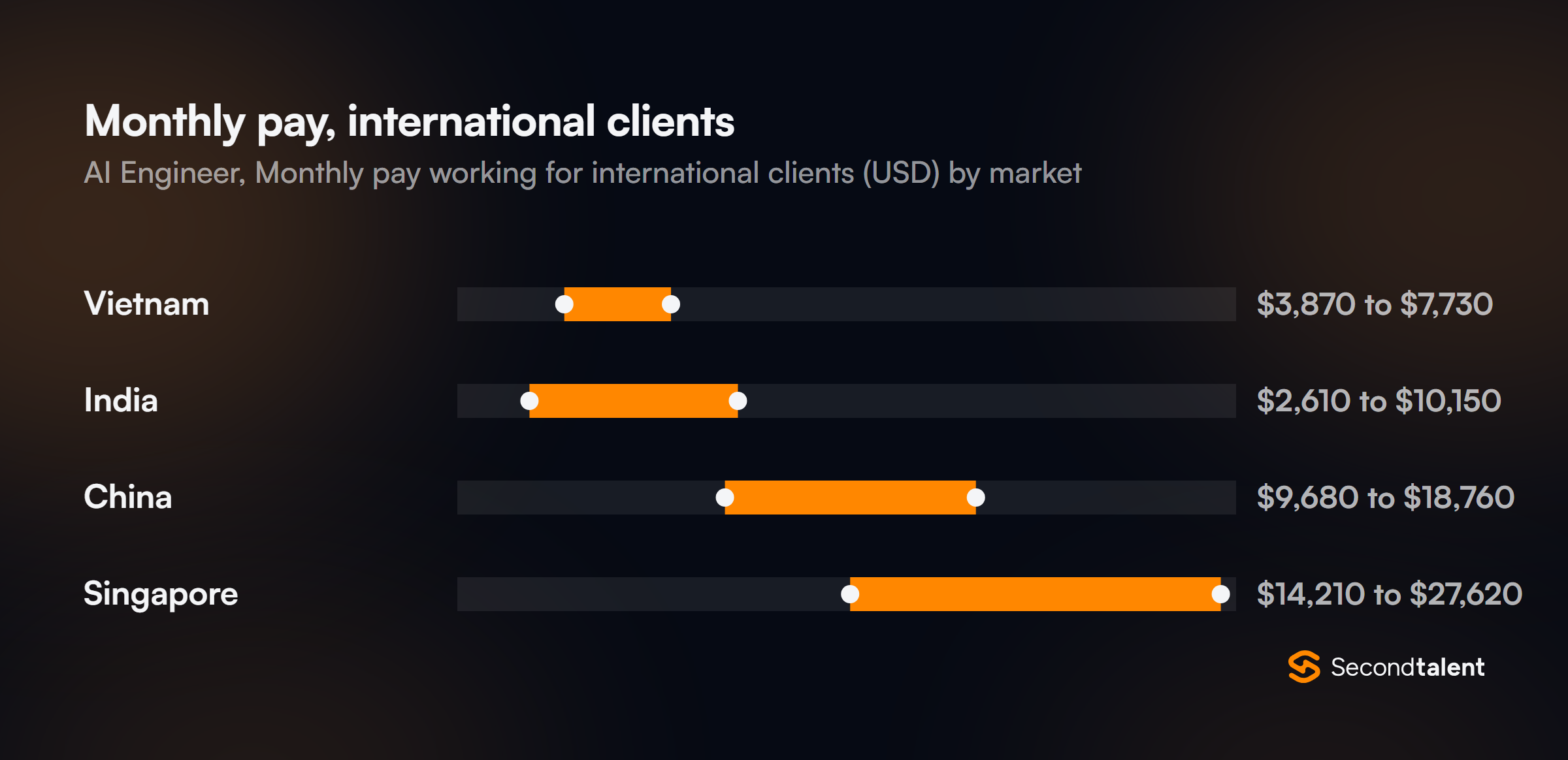
Monthly ranges from the Remote (Working for International Clients) figures on our rate cards for China, India, Vietnam and Singapore, converted at ExchangeRate-API mid-market rates for 14 September 2026.
The China card quotes ¥65,000 to ¥126,000+ a month, and all four ranges are open at the top. India's spread is the widest: its ceiling is almost four times its floor.
Through Second Talent you pay one monthly fee that bundles salary, payroll taxes, statutory contributions and our service fee, quoted per role and market. Our pricing page explains the monthly subscription, and our AI engineer cost-to-hire page prices the US freelance route.
US Pay Benchmark for AI Engineers
BLS publishes no AI engineer occupation. The role maps to Software Developers (SOC 15-1252), because an AI engineer who ships retrieval, agents and model calls into a product is building production software around a model.
| BLS OEWS, May 2025, national |
Software Developers (15-1252) |
| Median annual |
$135,980 |
| 10th percentile, monthly |
$6,870 |
| 25th percentile, monthly |
$8,770 |
| Median, monthly |
$11,330 |
| 75th percentile, monthly |
$14,330 |
| 90th percentile, monthly |
$17,890 |
Monthly figures are the annual wages on the OEWS profile for 15-1252 divided by 12, rounded to the nearest $10.
Salary is only part of the US cost. In the BLS Employer Costs for Employee Compensation release for June 2026, wages and salaries made up 68.5% of employer compensation costs for full-time private industry workers, and benefits the other 31.5%.
Time Zone Overlap: Shanghai Against ET, CT and PT
Shanghai runs on UTC+8 all year. US daylight time lasts from 8 March to 1 November 2026, per NIST, and each change moves the gap by an hour.
The arithmetic: Shanghai is 12 hours ahead of Eastern Daylight Time (UTC-4) and 13 ahead of Eastern Standard Time (UTC-5). It is 13 and 14 hours ahead of Central, and 15 and 16 ahead of Pacific.
A 9 am to 5 pm day in New York runs from 9 pm to 5 am in Shanghai until 1 November. After that it runs from 10 pm to 6 am.
| Shanghai shift (UTC+8) |
ET overlap (EDT / EST) |
CT overlap (CDT / CST) |
PT overlap (PDT / PST) |
Hours between 10 pm and 6 am |
| 9 am-6 pm |
0 / 0 |
0 / 0 |
0 / 0 |
0 |
| 4 pm-1 am |
4 / 3 |
3 / 2 |
1 / 0 |
3 |
| 6 pm-3 am |
6 / 5 |
5 / 4 |
3 / 2 |
5 |
| 9 pm-6 am |
8 / 8 |
8 / 7 |
6 / 5 |
8 |
Overlap counts clock hours of a nine-hour shift, including a meal break, against a 9 am to 5 pm US day.
Chinese labour law sets the limits a schedule has to fit. Article 36 of the Labor Law caps working time at eight hours a day, and Article 41 caps extended hours at 36 a month.
Article 44 sets premiums by type of time. Extended hours pay at least 150%, rest days without a make-up day off 200%, and statutory holidays 300%. A 4 pm to 1 am shift counts as an ordinary working day.
Add a 9 pm standup to a 9 am to 6 pm day and you have extended time, which counts toward the monthly cap.
For AI work the zero-overlap row has a use of its own. Batch embedding jobs, eval sweeps and fine-tuning runs can start at the end of a US day and report back by morning.
Keep the shared hours for design reviews and failed-run triage. We agree that schedule before the offer, which is how our placements get 4-6 hours of daily overlap with US hours.
AI Engineer Skills to Screen For
In Stack Overflow's 2025 survey, 23.3% of respondents had used DeepSeek's reasoning models for development work in the past year, ahead of Meta Llama at 17.8%. Alibaba's Qwen stood at 5.2%. For a hire in China, check early that the models a candidate knows are ones your product can use.
Model access from China
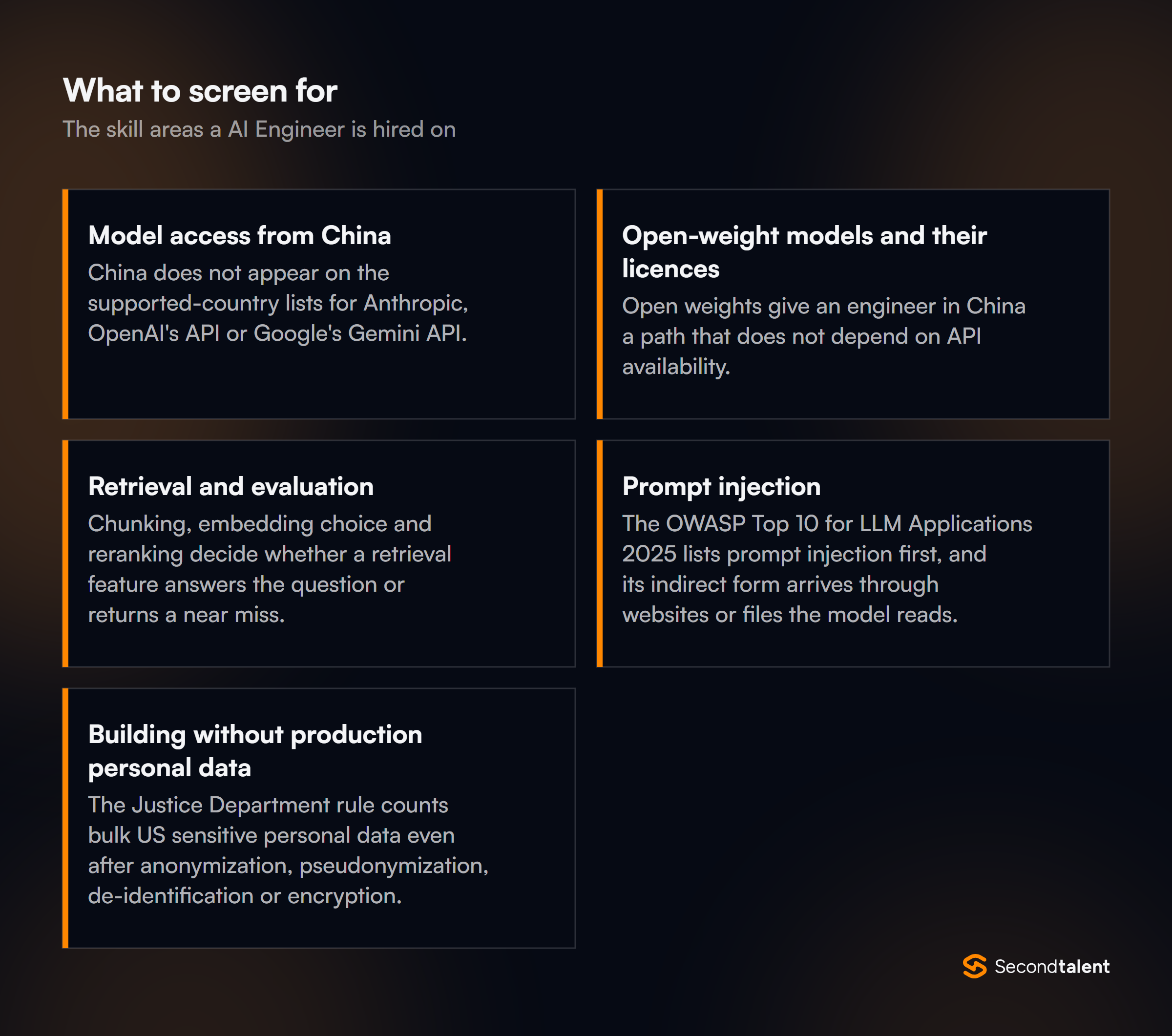
China does not appear on the supported-country lists for Anthropic, OpenAI's API or Google's Gemini API. Ask the candidate where the models behind their last project ran and who held the account. Then ask how they would build against your provider from Shanghai within its terms.
Open-weight models and their licences
Open weights give an engineer in China a path that does not depend on API availability. Alibaba publishes Qwen3.8-27B under Apache 2.0, while Qwen3.8-Flash-Next carries the Qwen Community License 1.0, which requires a separate licence for a model-as-a-service or AI work assistant business. Ask the candidate which licence covers the model they propose and what it asks of your product.
Retrieval and evaluation
Chunking, embedding choice and reranking decide whether a retrieval feature answers the question or returns a near miss. If your product will see English and Chinese documents, test with both. Ask for the eval that scores retrieval before generation. A candidate who reports cost per request with the scores is working the way a production team does.
Prompt injection
The OWASP Top 10 for LLM Applications 2025 lists prompt injection first, and its indirect form arrives through websites or files the model reads. Plant an instruction in one of the assessment documents and ask what the candidate's system does with it.
Building without production personal data
The Justice Department rule counts bulk US sensitive personal data even after anonymization, pseudonymization, de-identification or encryption. An AI engineer in China who builds evals on synthetic or non-personal data does not need the access the rule regulates. Ask how they tested their last feature without copying production records into a notebook.
Contractor or Employer of Record in China
Software is not one of the nine categories of commissioned work that can be "work made for hire" under 17 U.S.C. § 101, and a copyright transfer must be in writing and signed under § 204(a). China's Computer Software Protection Regulations point the same way. Article 11 gives commissioned software to the developer when no written contract settles ownership. Article 13 gives the employer software an employee writes as part of assigned duties, as a foreseeable result of the job, or chiefly with the employer's money and equipment. Name the code, prompts, eval sets and fine-tuned weights in the assignment.
IRS Publication 515 says the place where services are performed determines the source of the income, so an engineer working from Shanghai earns foreign-source income. A foreign individual gives the payer Form W-8BEN to certify foreign status.
China's Labor Contract Law governs employing units within China's territory (Article 2). It requires a written contract within one month of the start date (Article 10), and an employer that goes past that owes double monthly wages (Article 82). Without a written contract, a 2005 Ministry of Labour and Social Security notice still finds a labour relationship on three conditions. Both parties have legal standing, the worker does paid work under the employer's rules and management, and that work is part of the employer's business.
The US side adds its own layer. The Justice Department rule treats an individual primarily resident in China as a covered person. An employment agreement or vendor agreement that gives that person access to bulk US sensitive personal data is a restricted transaction, allowed only when the US company meets CISA's security requirements. The thresholds include personal financial or health data on more than 10,000 US persons.
A full-time engineer who works under your rules and management fits the labour relationship that notice describes, and the Labor Contract Law expects a local employing unit on the other side. Our Employer of Record service provides it, and our China EOR page sets out the details. This is a summary, not legal advice.
|
Independent contractor |
Employer of Record |
| Legal employer |
None; the engineer invoices you |
The EOR's employing unit in China |
| US paperwork |
Form W-8BEN from the engineer |
Service agreement with the EOR |
| IP |
Written contract assigning code, prompts, eval sets and weights (Software Regulations Art. 11) |
Employee software rule (Art. 13) plus assignment in your EOR agreement |
| Local labor law |
Labour relationship risk if the engineer works under your rules and management |
Written contract, working-hour limits and statutory holidays apply |
| Pay currency |
Agreed in the contract, often USD |
Local payroll run by the EOR |
English Level and Working Norms in China
China's IT job-function score on the EF English Proficiency Index 2025 is 491, above the global average of 488. Its national score is 464, 86th of 123 countries and regions, on EF's China page. For an AI engineer, test the written side: a design doc, an eval report, a pull request description your US reviewers will read the next morning.
Two holiday facts shape a 2026 start date. The State Council raised China's national public holidays from 11 days to 13 from 1 January 2025, adding Lunar New Year's Eve and 2 May, under State Council Order 795. The 2026 schedule gives 25 to 27 September for Mid-Autumn Festival and 1 to 7 October for National Day, with Sunday 20 September and Saturday 10 October as make-up workdays.
Thanksgiving on 26 November 2026 is a working day in China, so an engineer there can watch a model release while your US team is off. Plan the reverse for the National Day week: no launches that need the engineer between 1 and 7 October.
AI Engineer Hiring Process in China
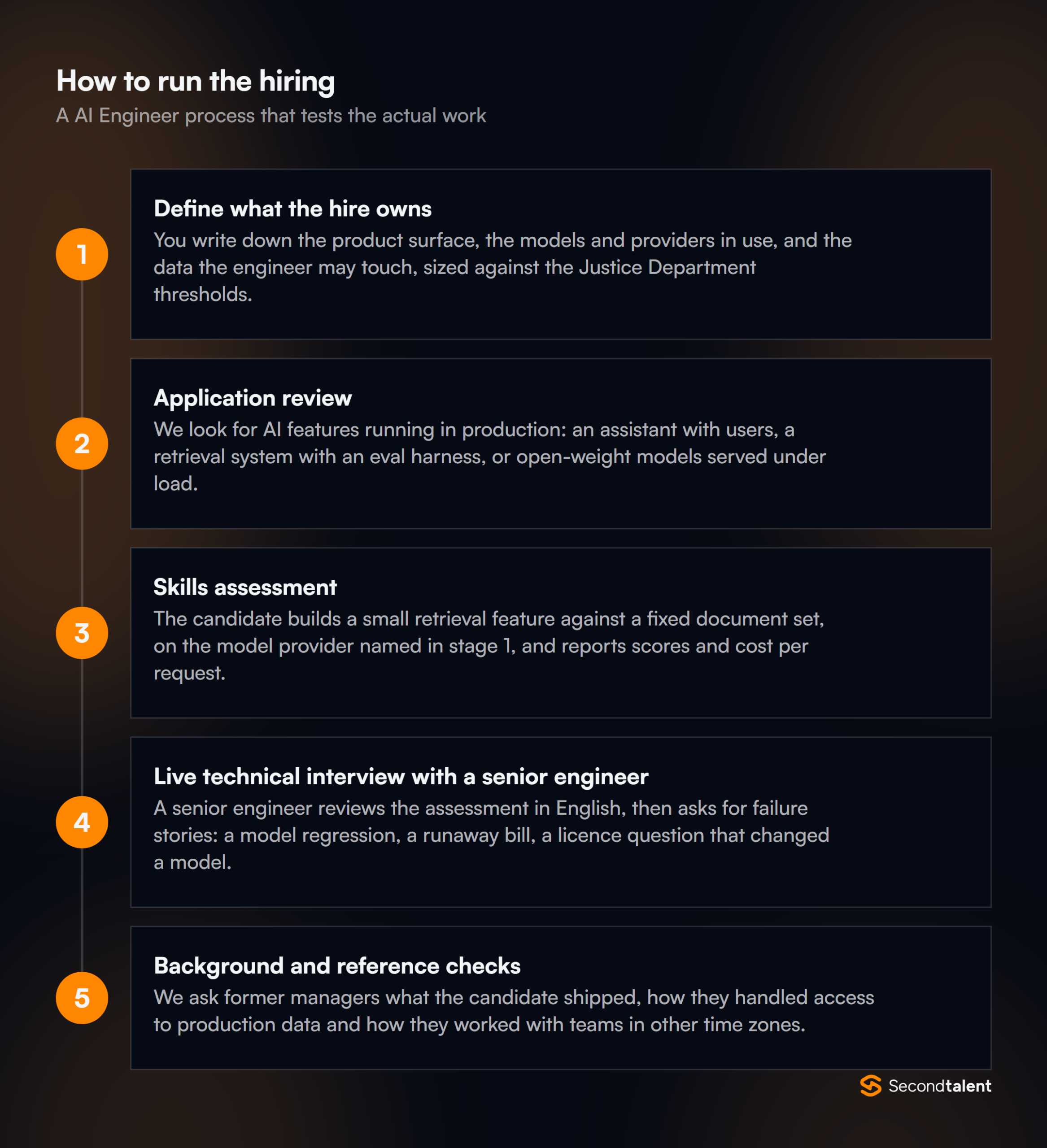
Second Talent's vetting covers stages 2 to 5 before you see a profile.
Stage 1: Define what the hire owns
You write down the product surface, the models and providers in use, and the data the engineer may touch, sized against the Justice Department thresholds. Add the Shanghai shift from the table above and the overlap your team needs.
Stage 2: Application review
We look for AI features running in production: an assistant with users, a retrieval system with an eval harness, or open-weight models served under load. Tool names on a CV do not pass on their own.
Stage 3: Skills assessment
The candidate builds a small retrieval feature against a fixed document set, on the model provider named in stage 1, and reports scores and cost per request. One document carries an injected instruction, and none carries real personal data.
Stage 4: Live technical interview with a senior engineer
A senior engineer reviews the assessment in English, then asks for failure stories: a model regression, a runaway bill, a licence question that changed a model choice.
Stage 5: Background and reference checks
We ask former managers what the candidate shipped, how they handled access to production data and how they worked with teams in other time zones. You then choose the contractor or EOR route above, and set a start date clear of the National Day week.
Hire AI Engineers from China with Second Talent
We shortlist 6-8 candidates within 24 hours from 100,000+ pre-vetted engineers, accepting only the top 1% of applicants. AI engineers from China come with $0 upfront, no lock-in and 4-6 hours of daily overlap with US hours. We handle contracts, payroll and equipment, with compliant EOR contracts in China.
Our pricing page sets out how the monthly subscription works, and for model-heavy briefs we also staff LLM engineers in China.