TL;DR: The United States builds the most AI models: 365 of the 727 released from January 2025 to September 2026 that Epoch AI has documented. China is second with 248. France (32), South Korea (23) and Canada (19) complete the top five, a long way behind.
Chinese labs released 82 large-scale AI models in 2025, trained with more than 1023 operations each. American labs released 66. The biggest runs are still American. Of the models Epoch AI has a compute estimate for, the eight largest since January 2025 all come from US labs, led by xAI’s Grok 4.
- 1China released 28 open-weight notable models in 2025, against 11 from the US.
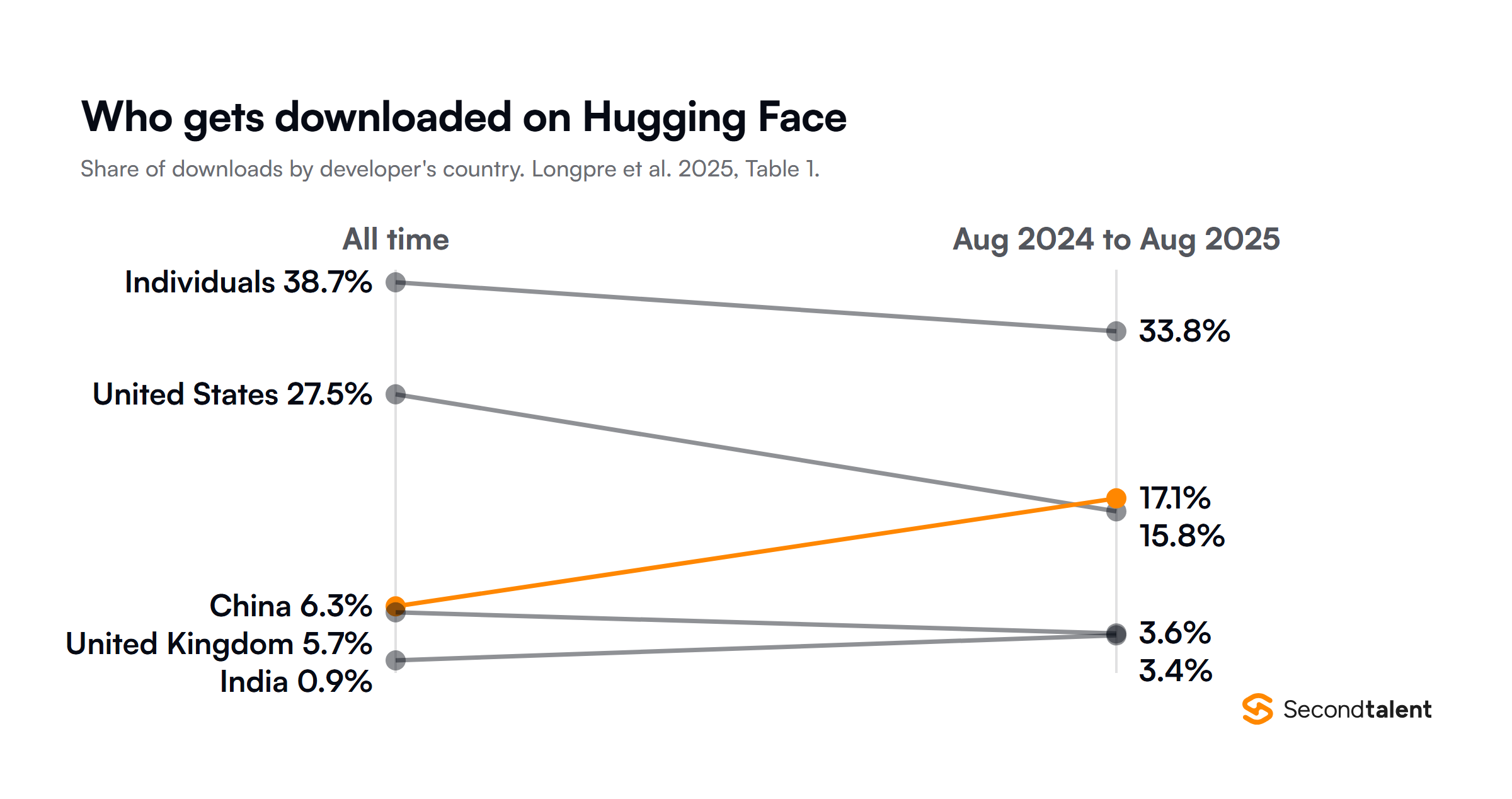
- 2Chinese developers took 17.1% of Hugging Face downloads in the year to August 2025, passing US developers for the first time.
- 3Alibaba released 62 models in the period, more than OpenAI or Google DeepMind.
- 4In March 2026 the best US model led the best Chinese model by 2.7% on the Arena leaderboard.
The Top 10 Countries Building the Most AI Models
The ten countries that build the most AI models are the United States, China, France, South Korea, Canada, Hong Kong, the United Kingdom, Singapore, Russia and Germany. The ranking is our count of the models in Epoch AI’s database of AI models released from 1 January 2025 to 8 September 2026, downloaded on 11 September.
| Rank | Country | Models | Notable | Large-scale | Most active builder |
|---|---|---|---|---|---|
| 1 | United States | 365 | 102 | 83 | OpenAI, Google DeepMind (57 each) |
| 2 | China | 248 | 61 | 93 | Alibaba (62) |
| 3 | France | 32 | 1 | 3 | Mistral AI (26) |
| 4 | South Korea | 23 | 13 | 8 | LG AI Research (12) |
| 5 | Canada | 19 | 1 | 2 | Cohere (7) |
| 6 | Hong Kong | 12 | 1 | 2 | Shanghai AI Lab, NVIDIA (3 each) |
| 7 | United Kingdom | 11 | 1 | 0 | DeepMind, Darktrace, Stability AI (2 each) |
| 8 | Singapore | 9 | 2 | 1 | MiniMax (3) |
| 8 | Russia | 9 | 0 | 1 | Sber (5) |
| 10 | Germany | 8 | 0 | 1 | Black Forest Labs (4) |
That catch-up shows in the Stanford AI Index 2026, which read Epoch’s data on 22 April. It counts 59 notable US models for 2025, China 35 and South Korea 8. The same data today gives the US 64.
1. United States: 365 models
xAI’s Grok 4, released in July 2025, is the largest training run in Epoch’s data since January 2025, at an estimated 5 × 1026 operations. OpenAI’s GPT-4.5 and xAI’s Grok 3 come next. Epoch has no compute estimate for many of the newest frontier models, including Anthropic’s Claude Opus 5 and OpenAI’s GPT-6 Astra.
OpenAI and Google DeepMind released 57 models each in the period, and NVIDIA 46. The chipmaker is the third most active model builder in the country, ahead of Anthropic (18) and xAI (15). On notable models alone, the AI Index ranks OpenAI first for 2025 with 20, then Google with 14.
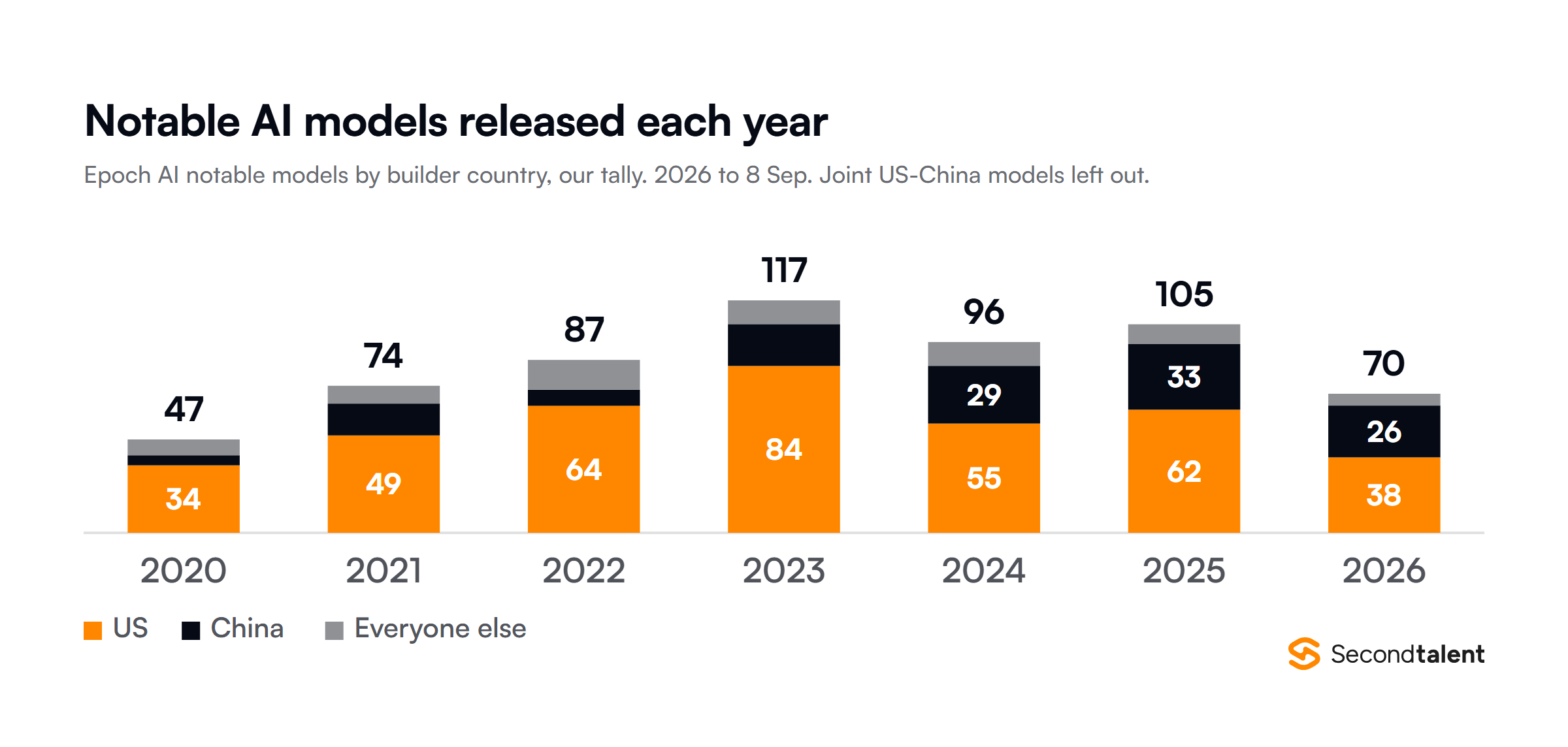
US notable output peaked in 2023, at 84 models built without a Chinese partner, and has not returned to that level. China’s count rose from 21 in 2023 to 29 in 2024 and 33 in 2025. Our comparison of US and Chinese AI models on cost and performance covers what that means model by model.
2. China: 248 models
Alibaba released more AI models than any other organisation in the world over the period. Its Qwen family runs from small open models to Qwen 3.8 Max, released in July 2026, and our guide to every Qwen model covers the line-up.
DeepSeek (23), ByteDance (21), MiniMax (17), Zhipu AI (14), Ant Group (14) and Moonshot (11) follow. Our lists of the top Chinese AI companies and DeepSeek statistics cover the firms behind those counts.
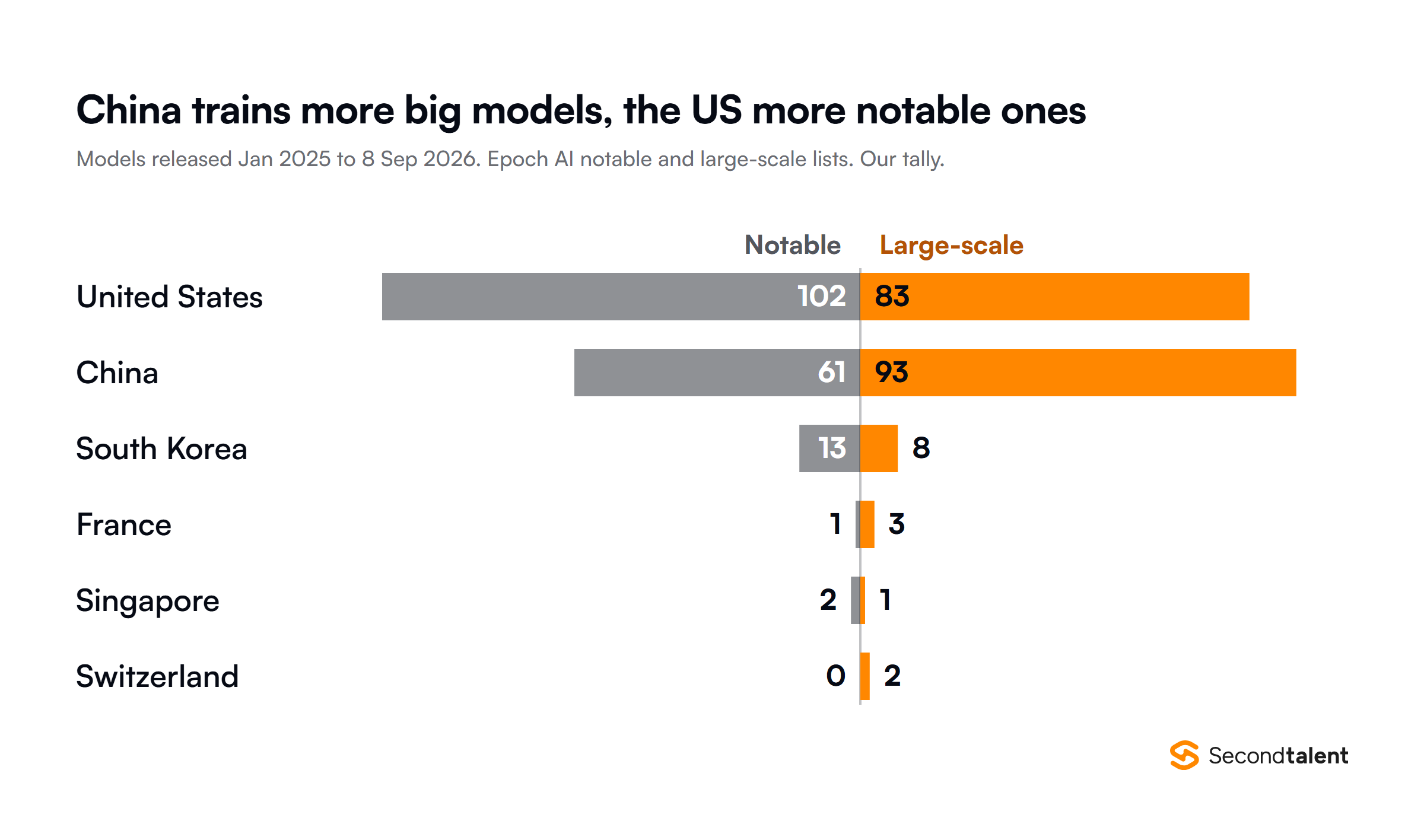
China trains more large-scale models than the US, 93 to 83 across the period, but smaller ones. The largest Chinese run Epoch has estimated is Moonshot’s Kimi K3, from July 2026, at about 2 × 1025 operations. That is about a 25th of Grok 4, by our calculation from Epoch’s two estimates.
3. France: 32 models
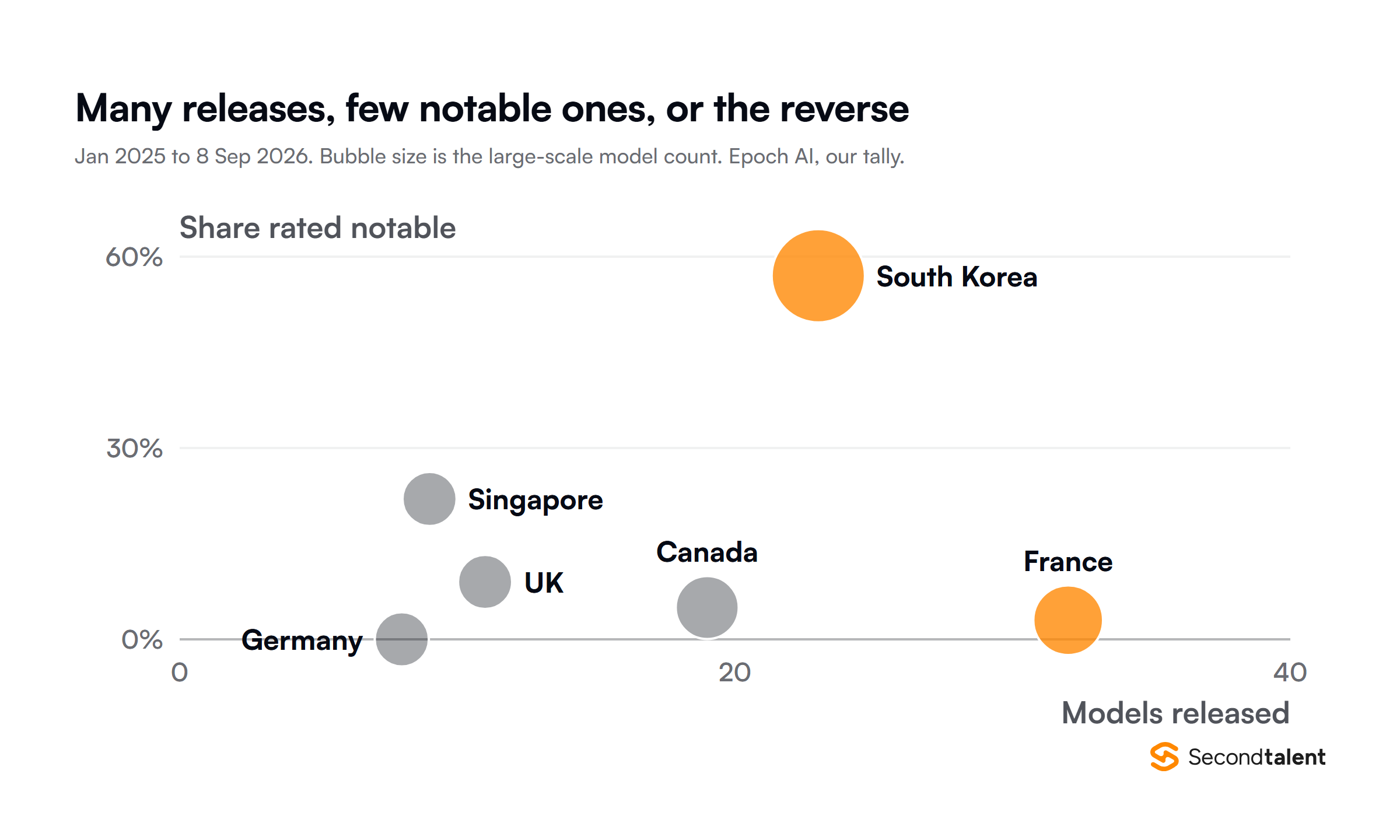
Mistral AI released 26 models in 20 months, and Epoch rates one of them notable: Mistral OCR, from March 2025. Outside the US and China, no country has a wider gap between models released and models rated notable.
The biggest was Mistral Large 3, released on 2 December 2025 with 675 billion total and 41 billion active parameters, under an Apache 2.0 licence. Our guide to every Mistral model lists the rest. Europe as a whole produced two notable models in 2025, the AI Index says.
4. South Korea: 23 models
All five teams in South Korea’s sovereign AI contest released a model between 29 and 31 December 2025. The contest, run by the Ministry of Science and ICT, picked five teams in August 2025 to build Korean foundation models trained from scratch, and it cuts teams in rounds.
Naver Cloud went out on originality. Its vision encoder used weights from Alibaba’s Qwen 2.5-VL in a locked form Naver could not update, which broke the contest’s rule that teams train their models from scratch.
The contest also asks each team to release more than half of its models as open source, KED Global reported. Across the period, 18 of Korea’s 23 models shipped open weights, and LG AI Research built 12 of the 23, most of them in its EXAONE family.
5. Canada: 19 models
Seven of Canada’s 19 models also list an organisation in another country, the highest share in the top five. Entries led by NVIDIA, the Allen Institute for AI and MIT also carry a Canadian affiliation.
Cohere is the one Canadian lab with a steady release line: Command A in March 2025, then Command A Vision and Command A Reasoning, and Command A+ in May 2026. Image generator Ideogram and video startup Moonvalley add two models each.
6. Hong Kong: 12 models
Ten of Hong Kong’s 12 models list a partner outside Hong Kong, most often Shanghai AI Lab, NVIDIA or the National University of Singapore. Epoch and the AI Index list Hong Kong apart from mainland China, so these count for China only when a mainland organisation is also named.
SenseTime, which Epoch files under Hong Kong, is behind both large-scale entries: its SenseNova unified model in January 2025 and SenseNova V6 in April. Epoch has not logged a Hong Kong model released in 2026 yet.
7. United Kingdom: 11 models
London’s largest AI lab adds almost nothing to Britain’s count. Epoch files 60 of the 63 Google DeepMind models released since January 2025 under the US alone, so Gemini adds nothing to the UK total.
The rest come from specialists: Stability AI’s 3D and video models, security firm Darktrace, and Wayve’s GAIA-2 driving model. The UK has no large-scale model in the period.
8. Singapore: 9 models
AI Singapore’s Gemma-SEA-LION-v4-27B, released in August 2025, builds on Google’s Gemma, which AI Singapore tuned for Southeast Asian languages. It is part of AI Singapore’s SEA-LION project, a family of models for the region’s languages.
Sapient Intelligence’s Hierarchical Reasoning Model and the Allen Institute’s MolmoAct 2 are Singapore’s two notable entries. Three MiniMax video models also carry a Singapore affiliation. Our list of Singapore AI companies covers the startups behind them.
8. Russia: 9 models
Sber, Yandex and T-Bank built all nine of Russia’s models. Sber’s GigaChat 2 arrived in March 2025 in three sizes, Lite, Pro and MAX, followed by the Kandinsky 5.0 video model in September.
Yandex released YandexGPT 5 in February 2025, and its Lite version is Russia’s one large-scale model. None of the nine made Epoch’s notable list.
10. Germany: 8 models
Half of Germany’s eight models are image generators from Black Forest Labs, the startup behind FLUX. FLUX.1 Kontext arrived in May 2025 and FLUX.2 in November.
The rest are Teuken 7B from the OpenGPT-X project and three IBM Earth-observation models, TerraMind and two Prithvi versions, which Epoch also files under Germany.
China Now Leads the Open Models
Chinese labs released 28 open-weight notable models in 2025 and US labs 11. The US led 37 to 13 in 2023 and still led 20 to 16 in 2024.
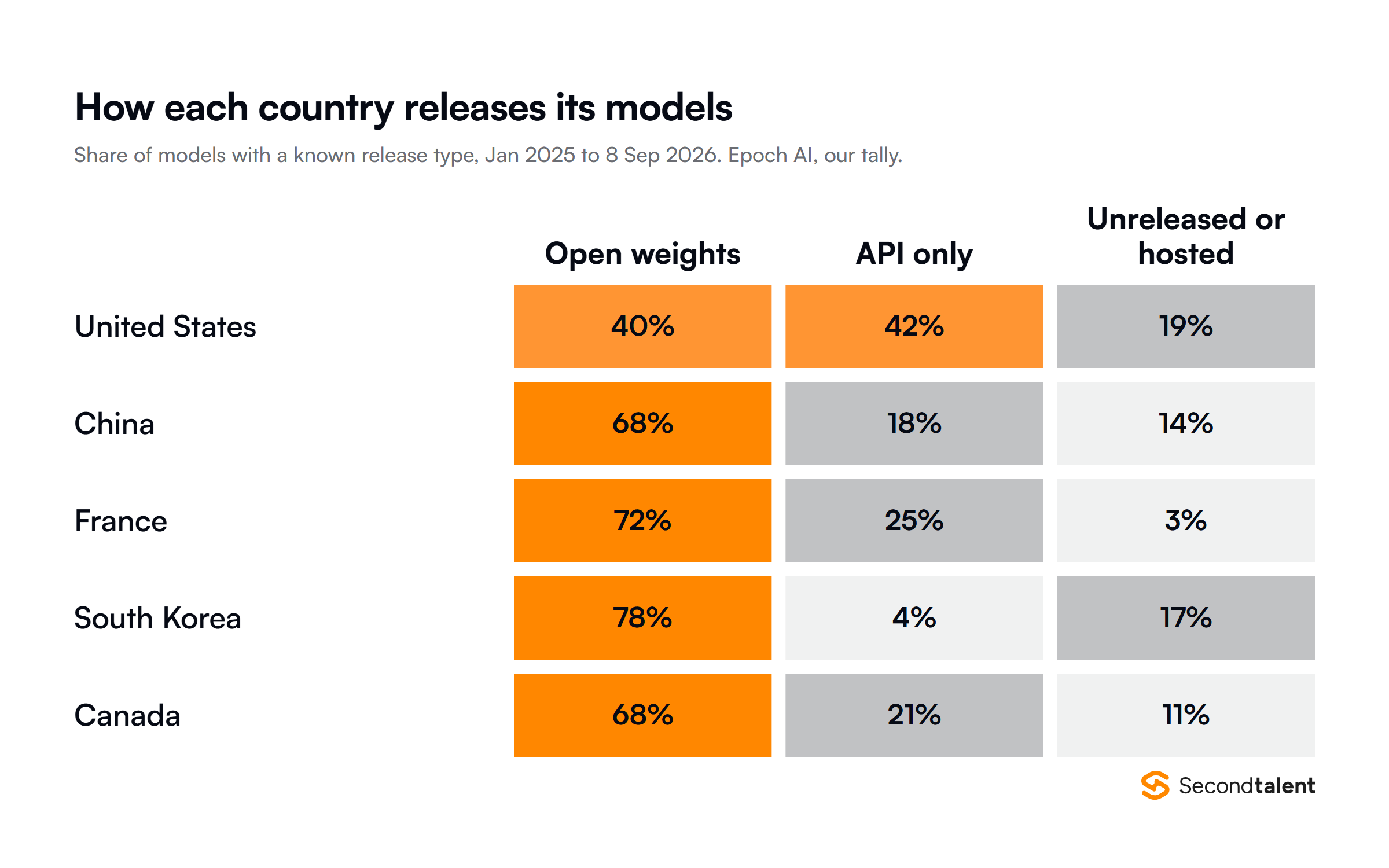
South Korea (78%) and France (72%) release an even larger share with open weights than China (68%). The US is the one country in the top five where API-only releases outnumber open weights, 42% to 40%. Our round-up of Chinese open-source LLMs covers the models themselves.
Downloads moved the same way. Longpre and colleagues traced 2.2 billion Hugging Face downloads across 851,000 models from June 2020 to August 2025. China’s share rose to 17.1% in the last year, from 6.3% over all time. DeepSeek and Qwen alone took 14%.
Usage points the same way. On OpenRouter, Chinese open models averaged 13% of weekly tokens from November 2024 to November 2025, according to a 100-trillion-token study by OpenRouter and Andreessen Horowitz. Their share started as low as 1.2% and passed 30% in some weeks. DeepSeek, Qwen and Moonshot’s Kimi led that growth.
How Close Is China to the US?
Close enough to swap places. US and Chinese models traded the top spot on the Arena leaderboard several times after early 2025, the Stanford AI Index reports. DeepSeek-R1 matched the best US model in February 2025. In March 2026 the US lead was 2.7%.
- Anthropic 1,503
- xAI 1,495
- Google 1,494
- OpenAI 1,481
- Alibaba 1,449
- DeepSeek 1,424
- GLM-5 from Zhipu AI, 1,454, the top open-weight model
The top four companies sat within 25 points of each other, and all four are American. The best closed model, Anthropic’s Claude Opus 4.6, led GLM-5 by 49 points, or 3.4%. Six of the top ten models on the leaderboard are closed. Our guide to every Claude model tracks Anthropic’s releases since.
The Labs Behind the Counts
Ten organisations led 333 of the 727 models in the period, 46% by our count. Six are American and four Chinese, and NVIDIA is the only one better known for hardware.
Companies build almost all of them. For 2025 the AI Index counts 93 notable models from industry and two from academia. Over the past decade, Tsinghua University and Stanford (26 each) and Carnegie Mellon (25) lead the universities.
Countries Outside the Top 10
Switzerland, Thailand, the United Arab Emirates and Japan each have three or four models in the period:
- Switzerland (4): ETH Zurich and EPFL’s Apertus, released on 2 September 2025 with its training data and methods as well as its weights, and trained on the Alps supercomputer. The 70B version is one of Switzerland’s two large-scale models.
- Thailand (4): two Typhoon models from SCB 10X and two from Mahidol University.
- United Arab Emirates (3): the Technology Innovation Institute’s Falcon-H1 and Falcon-Arabic, and K2 Think from MBZUAI and G42.
- Japan (3): entries from SoftBank, Trend Micro and Luminary Cloud, none of them notable.
Epoch lists no model from an Indian organisation released in the period, though India has the second-largest developer population in our count of countries with the most software developers. Epoch’s list is curated, not a census, so a gap there is a gap in documented releases.
Hire Engineers Who Build on These Models
Most of the open models on this list come with weights you can run and fine-tune yourself. We match companies with pre-vetted LLM engineers and AI developers from across Asia in 24 hours. Our AI training specialists produce the RLHF, evaluation and multilingual data that fine-tuning needs. Tell us the role on our talent request form.
Frequently Asked Questions
Which country has the best AI models?
The United States, by a small margin. US labs held the top four company scores on the Arena leaderboard in March 2026. The best US model led the best Chinese one by 2.7%, per the Stanford AI Index.
Which Asian country builds the most AI models after China?
South Korea, with 23 models from January 2025 to September 2026, 13 of them notable. Hong Kong (12) and Singapore (9) follow. Our ranking of countries with the highest AI adoption rates covers use rather than building.
What is a large-scale AI model?
Epoch AI’s term for a model trained with more than 1023 floating-point operations. Its large-scale list held 529 models when we downloaded it, 197 of them released since January 2025.




![Singapore AI Companies Leading Southeast Asia. Top 10 Singapore AI Companies Leading Southeast Asia [2026], by Second Talent.](https://www.secondtalent.com/wp-content/uploads/2026/09/singapore-ai-companies-featured-v2-768x403.jpg)
![AI Recruiting Tools. Top 7 AI Recruiting Tools in 2026 [Tried & Tested], by Second Talent.](https://www.secondtalent.com/wp-content/uploads/2026/09/top-ai-recruiting-tools-featured-v2-768x403.jpg)