TL;DR: NVIDIA's open Nemotron lineup has three main tiers in November 2026: Nemotron 3.5 Lightning (30B total, 3B active) for fast agents, Nemotron 3.5 Super VL (120B, 12B active) for multimodal agent work, and Nemotron 3 Ultra (550B, 55B active) for the hardest reasoning. All three read up to 1M tokens and ship free open weights on Hugging Face. On OpenRouter, hosted output runs from $0.20 per million tokens on Lightning to $2.40 on Ultra.
NVIDIA released nine Nemotron chat and agent models between December 15, 2025 and October 23, 2026, and the names now mix sizes with generations. Nano, Super and Ultra are sizes.
The 3 and 3.5 are generations, and Nemotron 3.5 has no Nano: Lightning took that slot. NVIDIA also publishes the training data and recipes, which Meta and DeepSeek do not.
I'll go through each model, then answer the Nemotron vs Llama and Nemotron vs DeepSeek questions.
Key takeaways
Every Nemotron 3 and 3.5 language model mixes Mamba-2 layers with Transformer attention and Mixture-of-Experts layers, a design NVIDIA uses to keep long context cheap to serve.
The license changed mid-2026. Nano and Super use the NVIDIA Nemotron Open Model License; Ultra and every 3.5 model use OpenMDW-1.1, with no user or revenue caps.
Bolt 74B-A9B is Super VL compressed and quantized to 2-bit weights, so it fits in 24 GB of GPU memory.
NIM endpoints on build.nvidia.com are free for prototyping. Production NIM falls under NVIDIA AI Enterprise, listed at $4,500 per GPU per year.
No Nemotron 3.5 Ultra has shipped. Nemotron 3 Ultra from June 2026 is still the largest open Nemotron.
The Nemotron models at a glance
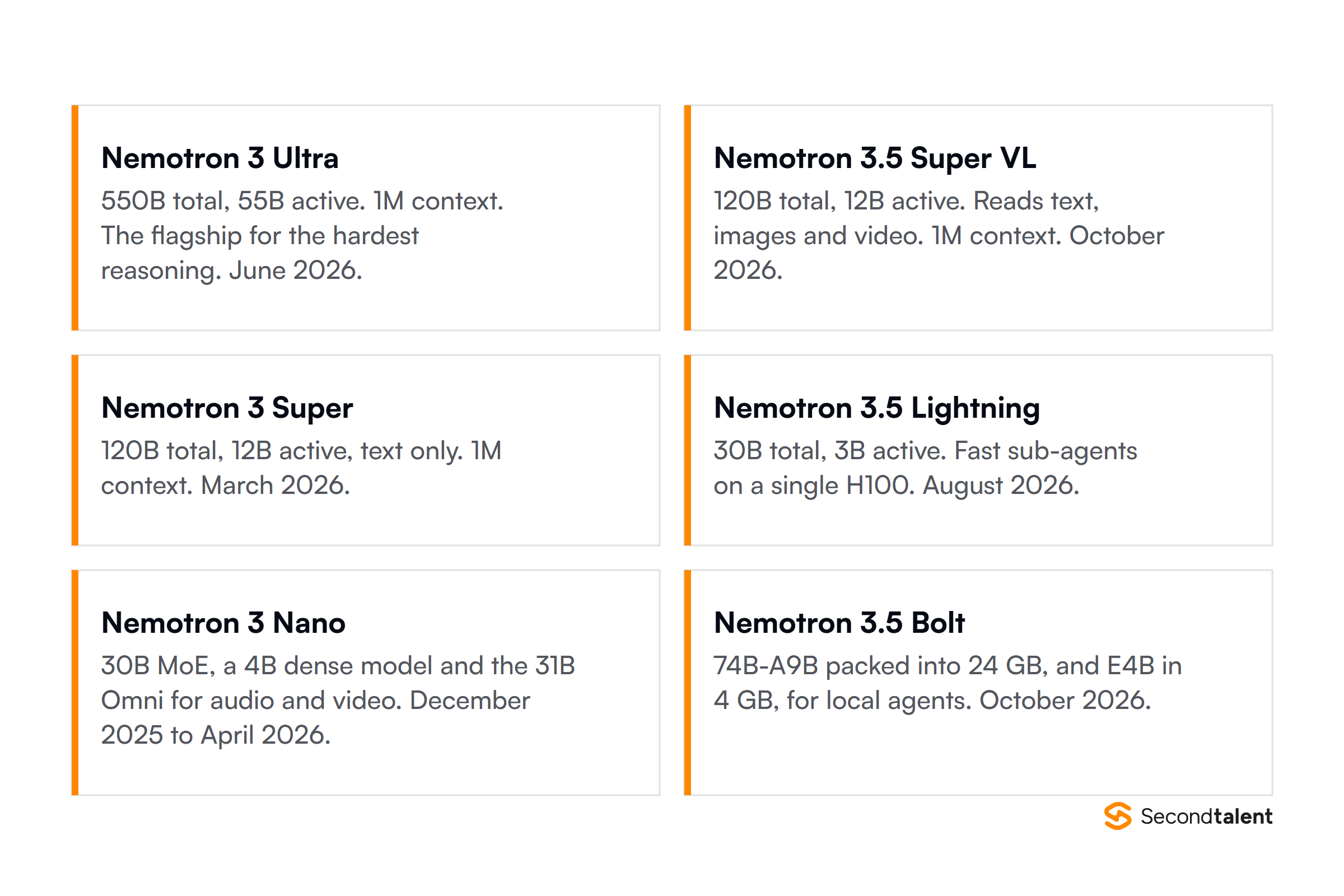
Here is every current general-purpose Nemotron model as of November 12, 2026. Parameters, context and license come from each model's card on NVIDIA's Hugging Face page. The ID is the name used on build.nvidia.com and in NIM.
Hosted prices are the input and output rates OpenRouter lists for each model, per million tokens; individual providers on OpenRouter charge more or less.
The three size names have held since NVIDIA announced Nemotron 3 on December 15, 2025. Nano is the small, fast tier for single tasks and sub-agents. Super is the mid tier for multi-agent work on a few data center GPUs.
Ultra is the largest, for the hardest reasoning.
All of them are Mixture-of-Experts models, so only a slice of the weights runs on each token: the active count, not the total, sets the speed. The 3.5 generation then added Lightning, Super VL and Bolt, and left Ultra on version 3.
Nemotron 3 Ultra
550B total, 55B active1M contextReleased June 4, 20268x B200 or 16x H100 minimum
NVIDIA pretrained Ultra in its own 4-bit NVFP4 format. The model card lists a minimum of 8x B200, 8x H200 or 16x H100 for the BF16 weights, and the NVFP4 version halves that to 4x B200 or 8x H100.
It adds Multi-Token Prediction layers that draft several tokens at once.
Its post-training data runs to May 2026, while its pretraining data stops at September 2025.
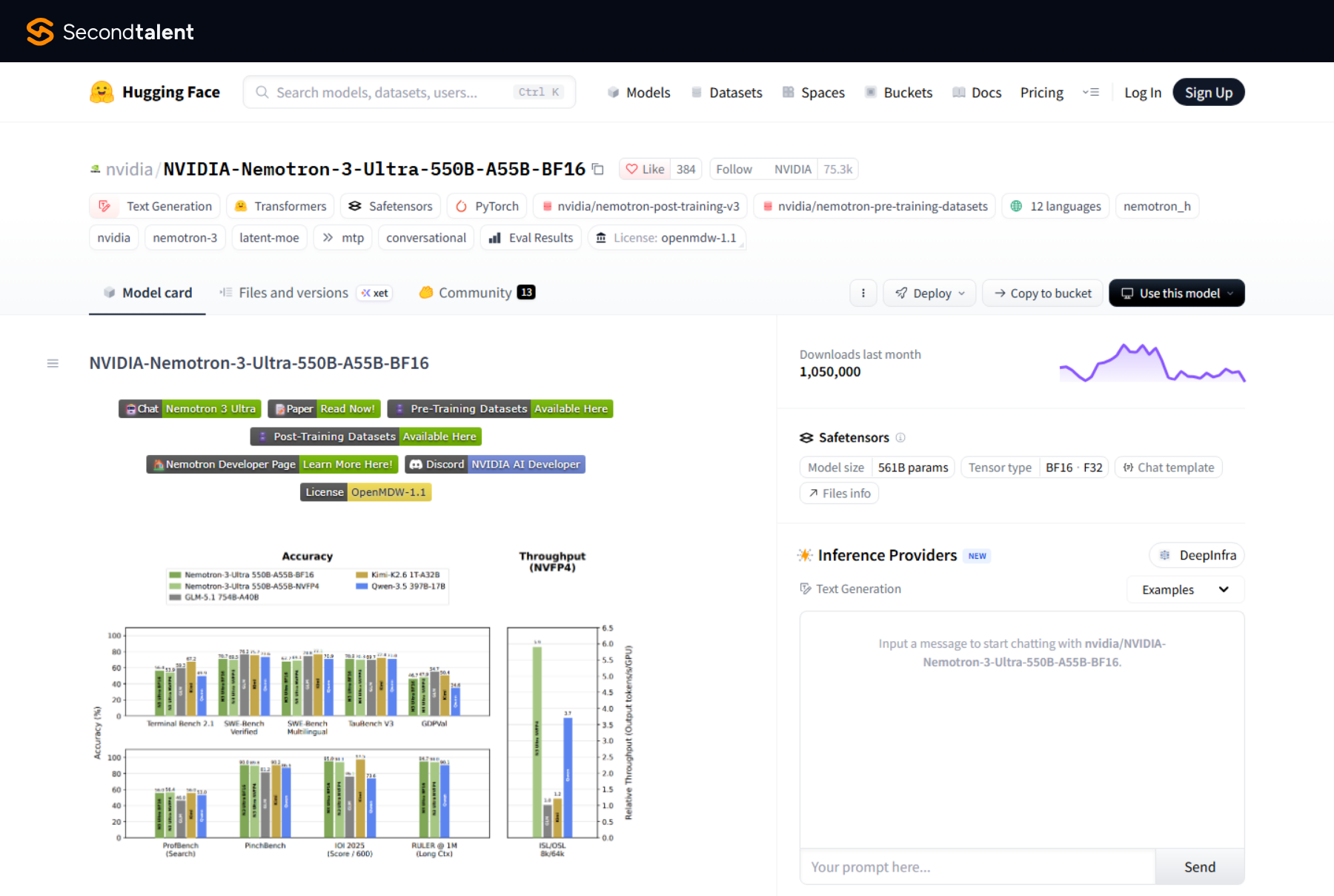
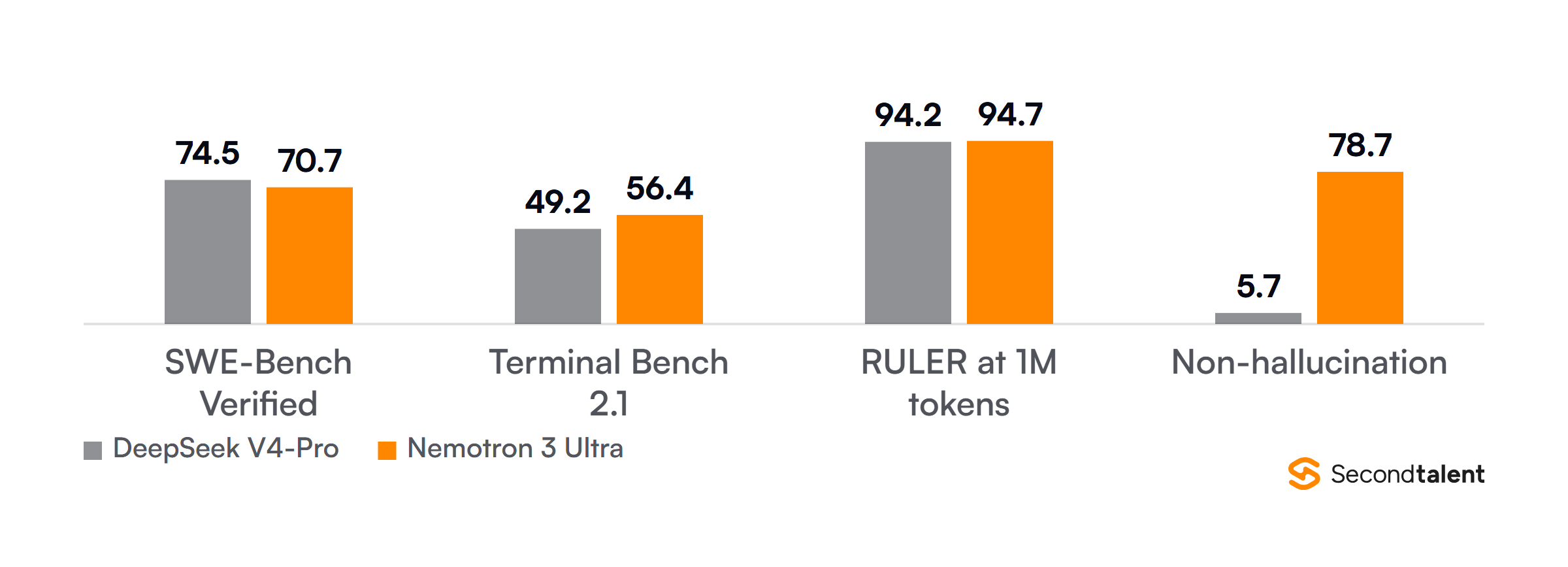
Ultra's standout number is on hallucination: NVIDIA reports 78.7 on the AA-OmniScience non-hallucination score, where the Chinese open models it compares against score between 2.8 and 74.4.
Nemotron 3.5 Super VL
120B total, 12B activeText, images and video inReleased October 15, 20264x H100 or 2x GB200
Super VL is the newest large Nemotron and the one I would test first. It adds a C-RADIO vision encoder to the Super backbone, so it reads screenshots, documents and video frames and writes text.
NVIDIA's launch post says NVIDIA trained it on about 26 trillion tokens and calls it comparable to Ultra at about one-fifth of the parameters.
The model card backs part of that: Super VL scores 89.5 on GPQA-Diamond against Ultra's 87.0, but trails it on IFBench, 70.9 to 82.9. It deploys on 4x H100, half the GPUs the March Super needed.
Nemotron 3 Super
The March 11, 2026 Super is text only, with the same 120B total and 12B active split and a 1M window. Its card names IT ticket automation, tool use and RAG as target jobs and sets a minimum of 8x H100-80GB.
It is the cheapest large Nemotron to rent, at $0.075 input on OpenRouter, and it stays on the older Nemotron Open Model License.
For new text-only work, Super VL does the same jobs and adds vision; keep Super where you already tuned prompts against it.
Nemotron 3.5 Lightning
Lightning, released August 11, 2026, replaced Nano 30B at the small end. It has 30B total and 3B active parameters, runs on one H100 or A100 80GB with a 256K window, and reaches 1M on bigger setups.
NVIDIA claims up to 4x faster output than comparable models.
It is the model NVIDIA pairs with NeMo Switchyard, an open source router that sends each step of an agent to the cheapest model that can handle it.
Lightning is also the most downloaded 3.5 model on Hugging Face, past 1 million downloads in the last month for the BF16 weights alone.
Nemotron 3 Nano: 30B, 4B and Omni
Nano 30B was the first Nemotron 3 model, out December 15, 2025. Its card describes 23 Mamba-2 and MoE layers plus 6 attention layers, 128 experts with 6 active per token, and 3.5B active parameters.
NVIDIA said it delivers up to 4x the throughput of Nemotron Nano 2. Two more Nanos followed. Nano 4B (March 16, 2026) is a dense model compressed from Nano 2 9B, with a 262K window.
Nano Omni (April 28, 2026) takes video, audio, images and text, and its NVFP4 build runs on a single RTX 5090 with 32 GB.
Nemotron 3.5 Bolt 74B and E4B
Bolt is the local tier. Bolt 74B-A9B is Super VL cut down with NVIDIA's Star Elastic compression, from 22 active experts per token to 9, then stored in 2-bit weights to fit a 24 GB card.
It keeps vision input and a 256K window, and ships with llama.cpp, Ollama and LM Studio support.
Bolt E4B (October 23, 2026) is the odd one out: NVIDIA post-trained it from Google's Gemma 4 E4B, so it is a Gemma model under the Nemotron name. It fits in 4 GB and targets voice and device assistants.
Specialised Nemotron models
Nemotron also covers models that are not chat assistants. These four are the ones most teams building retrieval or voice pipelines will meet, and all four sit on NVIDIA's Hugging Face page with open weights.
3.5 TranscribeOct 2026
40 languages
34B total, 4.3B active. Offline transcription of recordings up to one hour.
3.5 Embed and RerankOct 2026
1B and 8B
Embedding models at 1B and 8B, plus an 8B reranker, for RAG search.
3.5 Content SafetyMay 2026
Guardrail
A Gemma 3 4B fine-tune that screens prompts and replies, including images.
3.5 ParseSep 2026
Documents
Turns scans, PDFs and slides into Markdown, HTML or JSON.
NVIDIA also publishes research checkpoints under the Nemotron Labs name, such as a 550B competitive coding model built on Ultra and the 4B Dory model from October 2026.
Treat those as experiments: they come with fewer deployment recipes than the main line.
What the Nemotron models can do
Every current chat model in the family follows the same pattern: it writes a reasoning trace, then a final answer, and it calls tools for agent work. The architecture is the part that differs from Llama and DeepSeek.
Most layers are Mamba-2, a state space design whose memory use does not grow with context the way attention does, so a 1M token prompt costs less to hold in memory. A few attention layers keep recall accurate.
On Ultra, NVIDIA reports 94.7 on the RULER test at 1M tokens.
Openness goes further than weights. NVIDIA released three trillion tokens of pretraining, post-training and reinforcement learning data with Nemotron 3, and each card links the datasets used.
That matters if you need to show an auditor what data a model learned from, or if you want to repeat NVIDIA's post-training on your own domain with its NeMo tools.
Two licenses. The NVIDIA Nemotron Open Model License allows commercial use and derivative models and asks you to keep NVIDIA's notices. OpenMDW-1.1, used from Ultra onward, grants use "without restriction" and places no limits on outputs. Neither sets a user or revenue cap.
Pricing, NIM and self-hosting
NVIDIA does not sell a per-token Nemotron API for production. You have three routes.
First, third-party hosts: OpenRouter lists Nemotron from $0.06 input on Nano 30B to $0.60 input and $2.40 output on Ultra, and most models also have a free, rate-limited endpoint there.
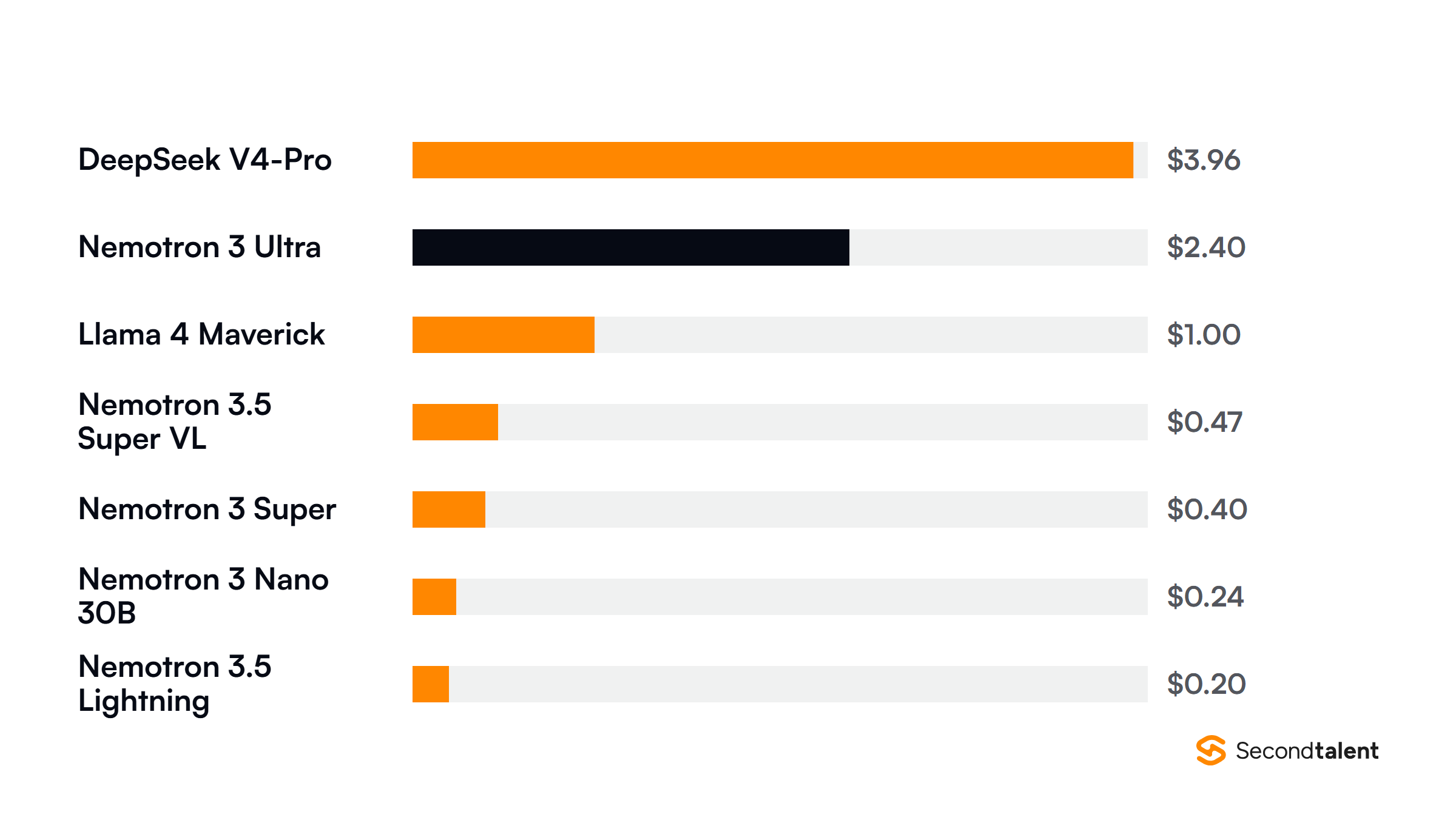
Prices vary by provider: for Ultra on OpenRouter, DeepInfra charges from $0.40 and $1.76, and Venice $0.625 and $3.125. The chart puts Nemotron output prices next to Llama 4 Maverick and DeepSeek V4-Pro.
Second, NVIDIA's own NIM containers. The NIM page says NVIDIA Developer Program members get free hosted NIM APIs and containers for development and testing.
Production use falls under NVIDIA AI Enterprise, which NVIDIA's licensing guide lists at $4,500 per GPU for one year, or $1 per GPU-hour on cloud marketplaces on top of the instance.
Third, download the weights and serve them with vLLM, SGLang or llama.cpp, which needs no NVIDIA license at all.
Rent it (OpenRouter list)
Lightning: $0.07 / $0.20 per million
Super VL: $0.15 / $0.47 per million
No GPUs, pay per token
Self-host it (model card minimums)
Lightning: 1x H100 80GB
Super VL: 4x H100 or 2x GB200
Ultra: 8x B200 or 16x H100
Context windows and long inputs
Ultra, Super VL, Super, Lightning and Nano 30B all accept up to 1M tokens. Bolt 74B and Nano Omni stop at 256K, Nano 4B at 262K, and Bolt E4B at 64K in and 64K out.
The card limit is not what you get from a host: OpenRouter's paid listings for Ultra, Super, Lightning and Nano 30B cap context at 262,144 tokens, while the free endpoints advertise 1M. Lightning's own card uses 256K for a single H100 deployment.
If you need the full window, plan to self-host on enough GPU memory, or pick a provider that lists 1M, as several do for Super VL.
Reasoning modes
Every current Nemotron chat model reasons by default and turns it off through the chat template with enable_thinking=False.
Super VL adds a middle setting: off, on (medium) and on, where medium writes fewer reasoning tokens at some cost in accuracy. Bolt E4B and Nano Omni accept a runtime thinking budget that caps how long the model reasons.
Sampling advice differs by model: the Super, Super VL and Lightning cards recommend temperature 1.0 and top_p 0.95 for every task, while the Nano 30B card suggests 0.6 and 0.95 for tool calling.
The older Llama-based Nemotrons used a different switch, /no_think in the system prompt, so code written for them needs changing before it calls a Nemotron 3 model.
Nemotron vs Llama and DeepSeek
Against DeepSeek, Ultra trades blows on NVIDIA's own scoreboard.
The Ultra card puts it ahead of DeepSeek V4-Pro on Terminal Bench 2.1 (56.4 to 49.2) and far ahead on not hallucinating, behind on SWE-Bench Verified (70.7 to 74.5), and level on long context.
These are NVIDIA's runs, not an independent test. DeepSeek V4-Pro is the bigger model at 1.6T total and 49B active, and its official API charges $1.32 input and $3.96 output at peak.
Nemotron started as Llama fine-tunes: Llama-3.1-Nemotron-70B in October 2024, then Llama-3.3-Nemotron-Super-49B and Llama-3.1-Nemotron-Ultra-253B in 2025, each built by compressing and retraining a Meta model.
Nemotron 3 broke from that with NVIDIA's own pretrained hybrid architecture. Meta, for its part, has shipped no new Llama since April 2025 and now releases open weights under the Muse name, as our Llama model guide explains.
If you run Llama 4 today, Super VL is the closest Nemotron swap: similar active size to Maverick, vision input, and a license with no 700 million user threshold.
My read: pick Nemotron when you want open training data, a permissive license with no user cap, or a model tuned for NVIDIA GPUs and NIM. Pick DeepSeek when raw benchmark scores per dollar on its own API matter most.
Llama 4 is still cheap to rent, but it has stopped moving.
Which model should you use
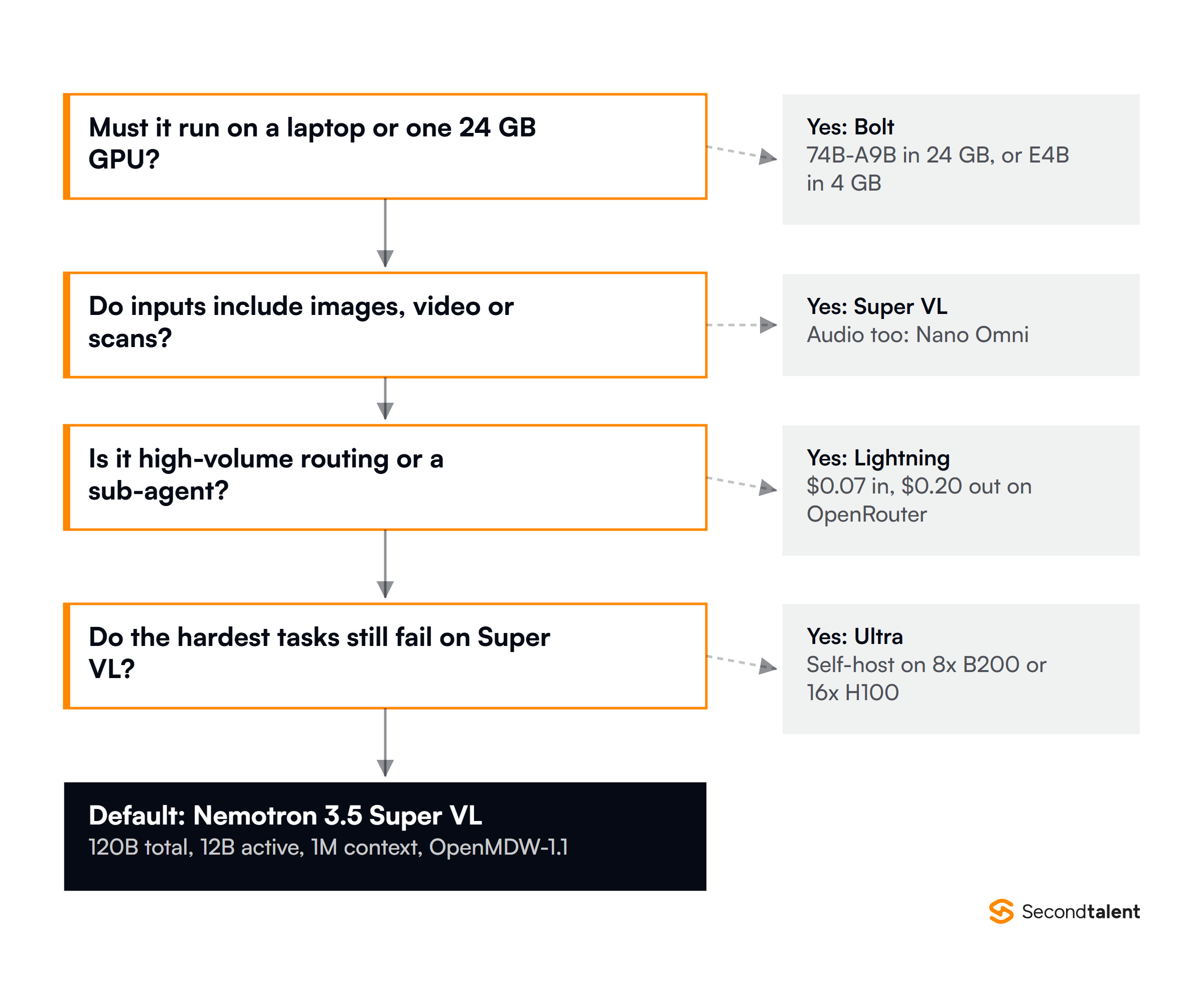
Start on Super VL for most agent and document work, drop to Lightning for volume, and move up to Ultra only for the tasks Super VL fails.
The table maps common jobs to a model, and the flowchart below it walks the same choice as four questions.
Job
Recommended model
Why
Routing, extraction, tagging
Nemotron 3.5 Lightning
3B active, $0.20 output, one GPU
Coding and tool-calling agents
Nemotron 3.5 Super VL
12B active, 1M context, reads screenshots
Document and screenshot understanding
Nemotron 3.5 Super VL
Vision encoder built in
Meeting and call video with audio
Nemotron 3 Nano Omni
Takes video, audio, images and text
Hardest reasoning, low hallucination
Nemotron 3 Ultra
Largest open Nemotron, 78.7 non-hallucination
Agent on a laptop or a 24 GB GPU
Nemotron 3.5 Bolt 74B-A9B
2-bit weights, vision, 256K context
Voice assistant on a device
Nemotron 3.5 Bolt E4B
Fits in 4 GB
Transcription
Nemotron 3.5 Transcribe
40 languages, one-hour recordings
The prices make routing worth the effort. Ultra's output costs 12 times Lightning's on OpenRouter, so a pipeline that sends nine in ten calls to Lightning and the rest to Ultra pays a fraction of an Ultra-only bill.
NVIDIA's NeMo Switchyard does this per agent step; in its August post, LangChain reported 74% lower cost across 145 multi-turn tasks, with a 6% accuracy tradeoff.
Older Nemotron models
NVIDIA leaves older Nemotron weights on Hugging Face rather than deleting them, so old checkpoints keep working if you self-host. The timeline shows how the family moved from Llama derivatives to its own architecture.
June 2024
Nemotron-4 340B: a dense model for generating synthetic training data
October 2024
Llama-3.1-Nemotron-70B: a Llama 3.1 fine-tune for helpfulness
March to July 2025
Llama Nemotron Nano 8B, Super 49B and Ultra 253B: reasoning models compressed from Llama
Moving from a Llama-based Nemotron to Nemotron 3 is more than a model swap.
The architecture, the chat template and the thinking switch all differ, and the hybrid layers need a recent vLLM or SGLang build with Mamba support, so budget a re-test of prompts and serving config.
The Super 49B v1.5 card documents the old /no_think behaviour if you need to compare.
What this means for hiring
Nemotron rewards teams that can serve their own models: sizing GPUs from a model card, running vLLM with Mamba support, and routing between Lightning and Ultra.
In the United States, a senior AI engineer with that skill set costs $12,000 to $18,000 a month all in. A pre-vetted engineer in Vietnam or the Philippines with the same skills often costs $3,000 to $6,000.
Nemotron gives you open weights, open data and a 1M token window at every size above Bolt. The model is free to download; the team that deploys it is what turns it into a product.
Matt Li is a tech-driven entrepreneur with deep expertise in global talent strategy, digital experience optimization, e-commerce, and Web3 innovation.
He is the Co-Founder of Second Talent, a US-based company that connects businesses with top-tier tech professionals worldwide. Since launching the company in 2024, Matt has led its growth by leveraging technology to streamline remote hiring and scale distributed teams.
With a background spanning product, operations, and innovation, Matt brings a cross-disciplinary perspective to the evolving digital economy. His work sits at the intersection of global talent, emerging technology, and scalable digital transformation.