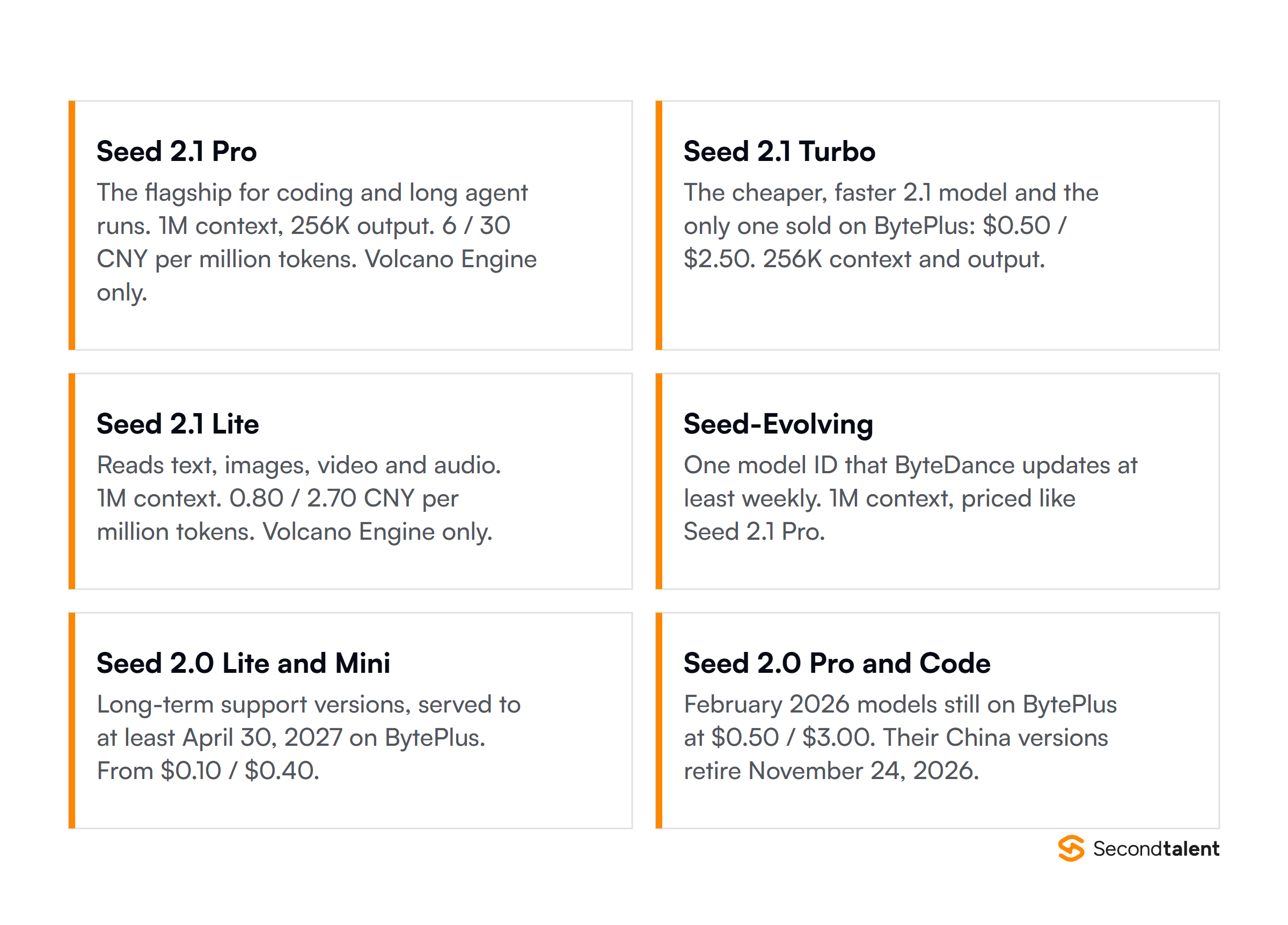
TL;DR: ByteDance's newest Doubao models are Seed 2.1 Pro (¥6 in and ¥30 out per million tokens, 1M context, sold in China on Volcano Engine) and Seed 2.1 Turbo, the one Seed 2.1 model on BytePlus outside China at $0.50 in and $2.50 out. Seed 2.0 Lite and Mini are the long-term support picks for volume work, at $0.25/$2.00 and $0.10/$0.40 on BytePlus. Seed-Evolving is a model ID that ByteDance updates at least once a week, priced like Seed 2.1 Pro.
One Doubao model has no version number at all. Doubao-Seed-Evolving launched on June 23, 2026, and Volcano Engine ships at least one update a week under the same model ID, the latest on November 5.
The rest of the lineup carries dated IDs, two brand names and two price lists, so I have laid it out below in the order a team outside China needs it.
Key takeaways
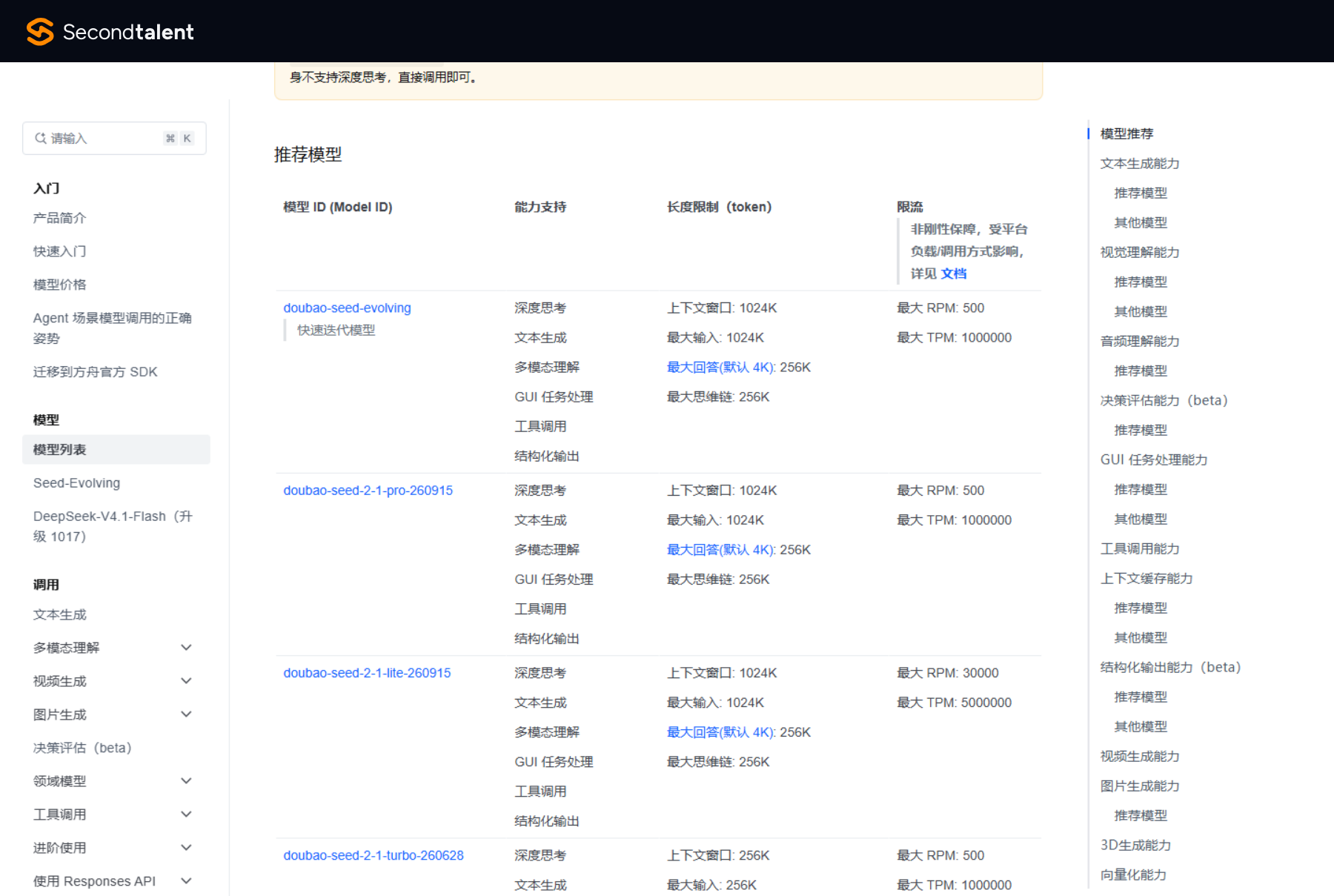
Seed 2.1 Pro, Seed 2.1 Lite and Seed-Evolving read up to 1,024K tokens on Volcano Engine. No Seed model on BytePlus goes past 256K.
Seed 2.1 Lite writes output at ¥2.70 per million tokens in China, below the ¥3.60 of the Seed 2.0 Lite it succeeds.
The two long-term support versions stay on BytePlus until at least April 30, 2027. Most other Doubao versions get three to six months.
Seed 2.0 Pro and Seed 2.0 Code Preview leave Volcano Engine on November 24, 2026, so pinned China code needs a move this month.
The current Doubao models at a glance
This is the full text lineup as of November 12, 2026, with the model ID your engineers type into the API.
Which currency. Prices are list rates per million tokens at the shortest prompt tier: US dollars from BytePlus pricing wherever a model is sold internationally, and yuan (CNY) from Volcano Engine pricing for the models sold only in China. ByteDance sets the two lists separately, so I quote each in its own currency rather than converting.
The Doubao family: Doubao, Seed and Dola
Three names describe the same models. Doubao is ByteDance's consumer assistant in China and the brand its cloud, Volcano Engine, uses for the models behind it.
Seed is the ByteDance research team that builds them, which is why every current ID reads doubao-seed-....
Dola is the international name: doubao.com points visitors outside mainland China to the Dola app, and BytePlus calls Seed 2.0 Lite "the first omnimodal understanding model in the Dola large model family" in its model release notes.
The six-digit suffix on each ID is the version date in YYMMDD form. BytePlus's long-term support table lists seed-2-0-lite-260428 with a version date of 2026-04-28, so 260915 means September 15, 2026.
Two models can share a name and differ in behavior: Seed 2.0 Lite exists as 260215, 260228 and 260428 builds, and only the last one hears audio.
Feb 2026
Seed 2.0: Pro, Lite, Mini and Code Preview reach Volcano Engine
Apr 28, 2026
Seed 2.0 Lite and Mini 260428: audio input, later named LTS
Jun 23, 2026
Seed 2.1 Pro and Turbo announced; Seed-Evolving launches
Jul 2026
Dola Seed 2.1 Turbo goes live on BytePlus; Seed-Evolving moves to 1M context on July 14
Sep 2026
Seed 2.1 Pro and Lite 260915: 1,024K context in China
Nov 5, 2026
Seed-Evolving update aimed at agent tasks and fewer hallucinations
Doubao Seed 2.1 Pro
ByteDance announced Seed 2.1 on June 23, 2026 as "a new generation of agent-capable models built for real-world productivity", and Pro is the top of it.
The September build, doubao-seed-2-1-pro-260915, reads 1,024K tokens and writes up to 256K, chain of thought included. It costs ¥6 in and ¥30 out per million tokens with no extra charge for long prompts, and cached input drops to ¥1.20.
ByteDance does not sell Pro on BytePlus, so a team outside China cannot call it through ByteDance's own cloud. The June build, 260628, is still listed with a 256K window.
Doubao Seed 2.1 Turbo
Turbo is the version built for volume.
Volcano Engine's release note calls it a low-cost, low-latency model whose results stand alongside Pro, and it is the only Seed 2.1 model on BytePlus, where it runs as dola-seed-2-1-turbo-260628 at $0.50 in and $2.50 out.
Its BytePlus model page lists a 256K window, 256K max output and a rate limit of 500 requests a minute, low next to the 30,000 RPM of Seed 2.0 Lite. Plan for that limit before you put a busy product on it.
In China the same model costs ¥3 in and ¥15 out.
Doubao Seed 2.1 Lite
Seed 2.1 Lite arrived with the September builds and is the cheapest way into the 1M window: ¥0.80 in and ¥2.70 out, flat across the whole context.
Volcano Engine describes it as a native all-modality model that understands text, images and audio in one pass. Volcano Engine bills audio input separately, at ¥12 per million tokens. Like Pro, it is a Volcano Engine model only.
Doubao-Seed-Evolving
Seed-Evolving trades a fixed version for speed of improvement. Its Volcano Engine page logs the launch on June 23, the move to a 1,024K context on July 14, and an update on November 5 aimed at multi-step agent tasks and factual consistency.
It costs the same ¥6 / ¥30 as Seed 2.1 Pro, defaults to high reasoning effort, reads images and video, and does not take audio.
Volcano Engine also uses it as the automatic replacement when older coding models retire, which tells you where ByteDance points coding agents.
The catch is the one in the name: the model behind the ID changes under you, so pin a dated model for anything you have to reproduce.
Seed 2.0 Pro, Lite, Mini and Code
The Seed 2.0 family arrived in February 2026 in three sizes.
The Seed2.0 page says Pro "focuses on long-chain reasoning", Lite "balances output quality and response speed" and Mini is "optimized for inference throughput and deployment density".
The April 28 builds of Lite and Mini added audio input and are now long-term support (LTS) versions, with an earliest retirement date of April 30, 2027 on BytePlus.
Code Preview, tuned for IDE agents such as Claude Code, and Seed 2.0 Pro both remain on BytePlus at $0.50 / $3.00, while their February builds in China end service on November 24.
Two narrower models round out the list on Volcano Engine. ByteDance built Seed Character (260628) for role-play and companion chat, with a 128K window and ¥0.80 / ¥2.00 pricing.
Seed Translation (250915) takes 1K tokens of input and writes 3K.
What the current models can do
All the general Seed models think before they answer, read images and video, call tools and handle GUI tasks, the clicking-through-an-app work behind computer-use agents. The differences sit at the edges.
On BytePlus, Seed 2.0 Lite and Mini are the only Seed models that accept audio, and Seed 2.0 Pro and Code Preview do not support structured output, so a pipeline that needs JSON matching a schema belongs on Turbo, Lite or Mini.
ModelArk also serves the models through a Chat API, a Responses API and an Anthropic-style Messages API, which is how Volcano Engine connects them to Claude Code, OpenCode and Codex.
On benchmarks, ByteDance publishes its own numbers, and no outside lab has a full set yet.
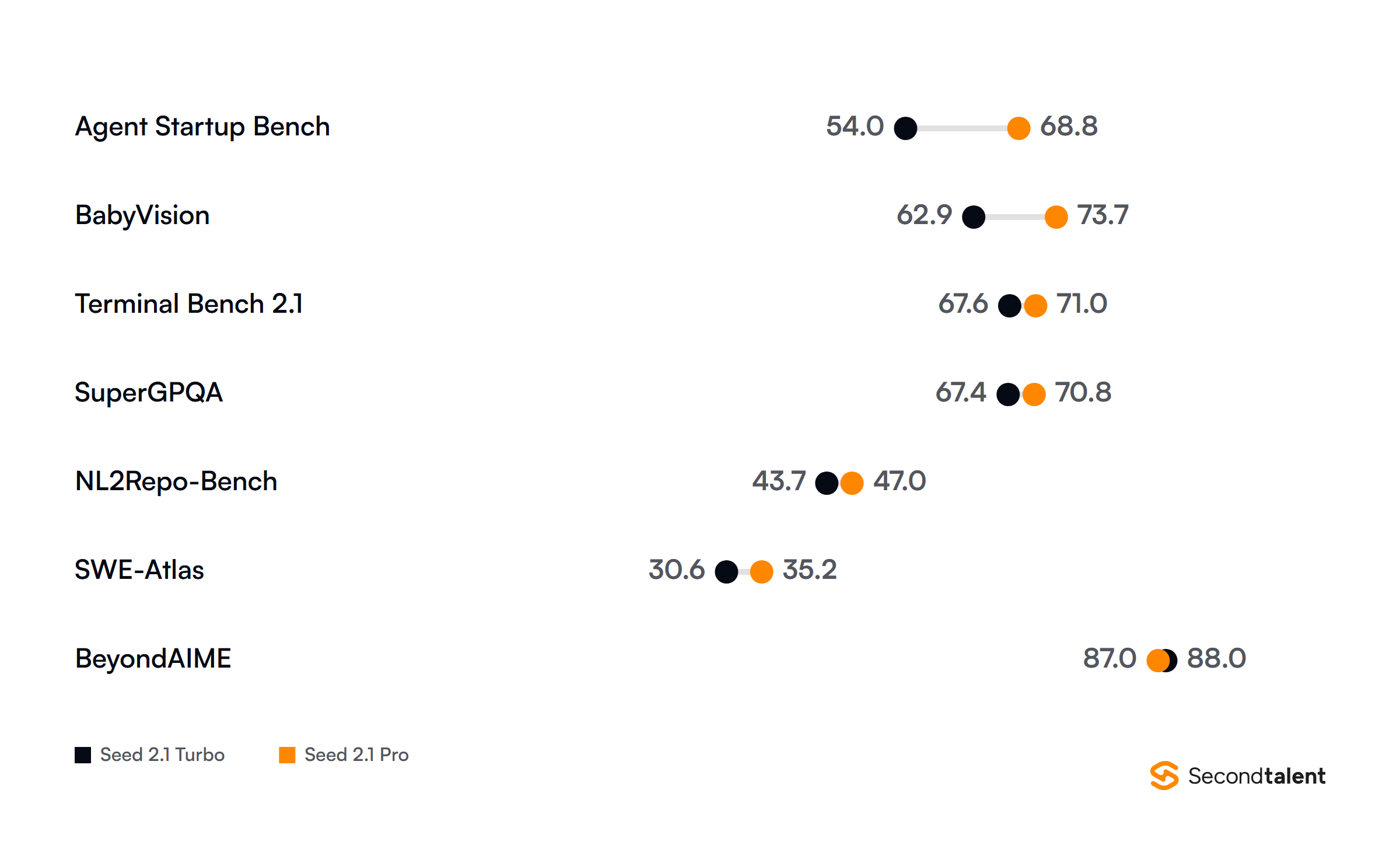
The Seed2.1 model card table from the June release puts Pro ahead of Turbo on six of seven headline tests, with the widest gap on its in-house Agent Startup Bench (68.8 against 54.0) and Turbo one point ahead on the BeyondAIME math set.
On Terminal Bench 2.1, the gap is 3.4 points. Treat these as ByteDance's claims until outside testers publish their own runs.
For a buyer outside China, that chart answers the practical question: the model you can call on BytePlus gives up a few points on coding benchmarks and more on agent and vision tests, at a fraction of Pro's China price.
Doubao pricing compared across the lineup
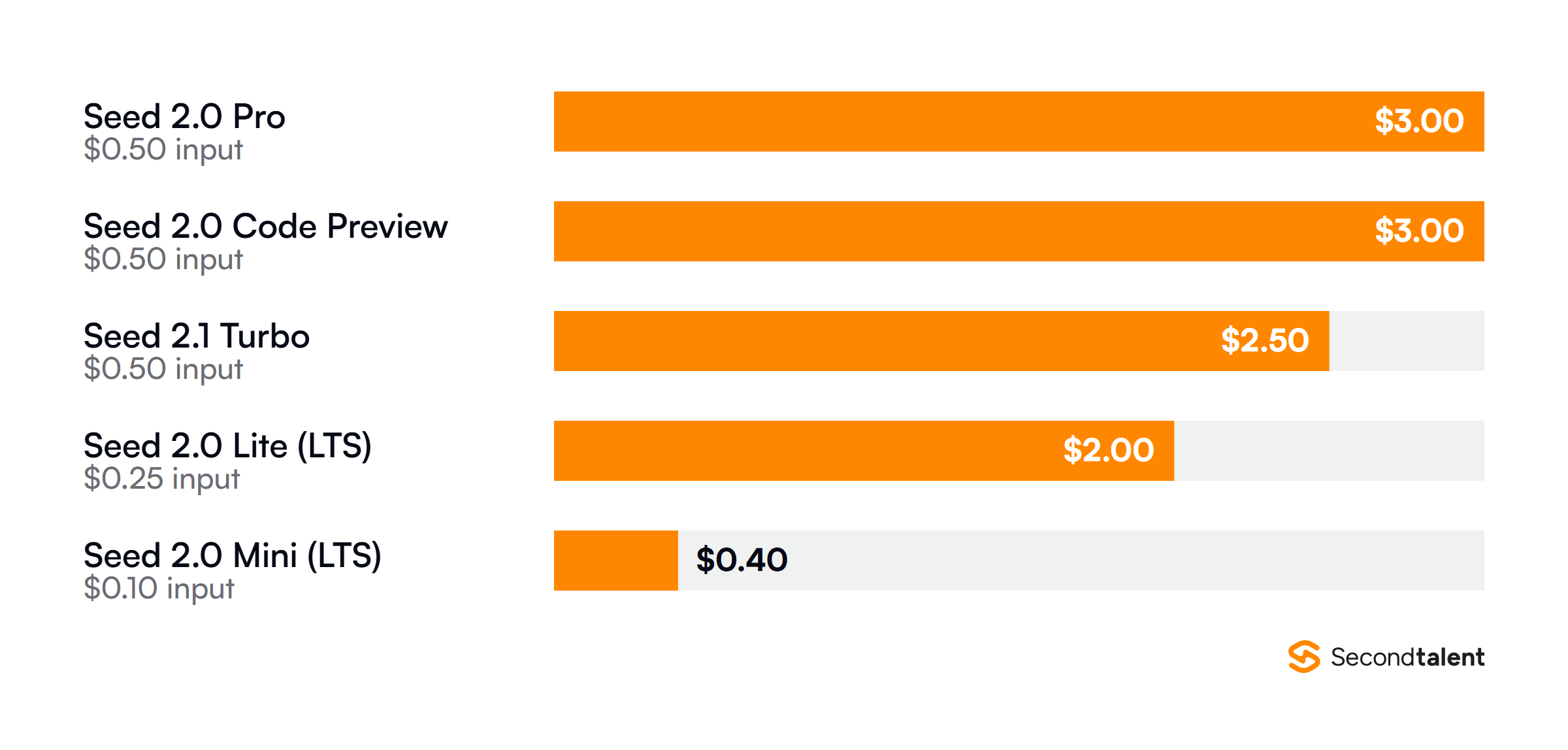
Output tokens drive the bill, and on BytePlus the spread runs from $0.40 per million on Seed 2.0 Mini to $3.00 on Seed 2.0 Pro and Code Preview. Seed 2.1 Turbo sits at $2.50, cheaper than the older Seed 2.0 Pro.
That makes Seed 2.0 Pro hard to justify for new work outside China.
Three billing rules change the real number:
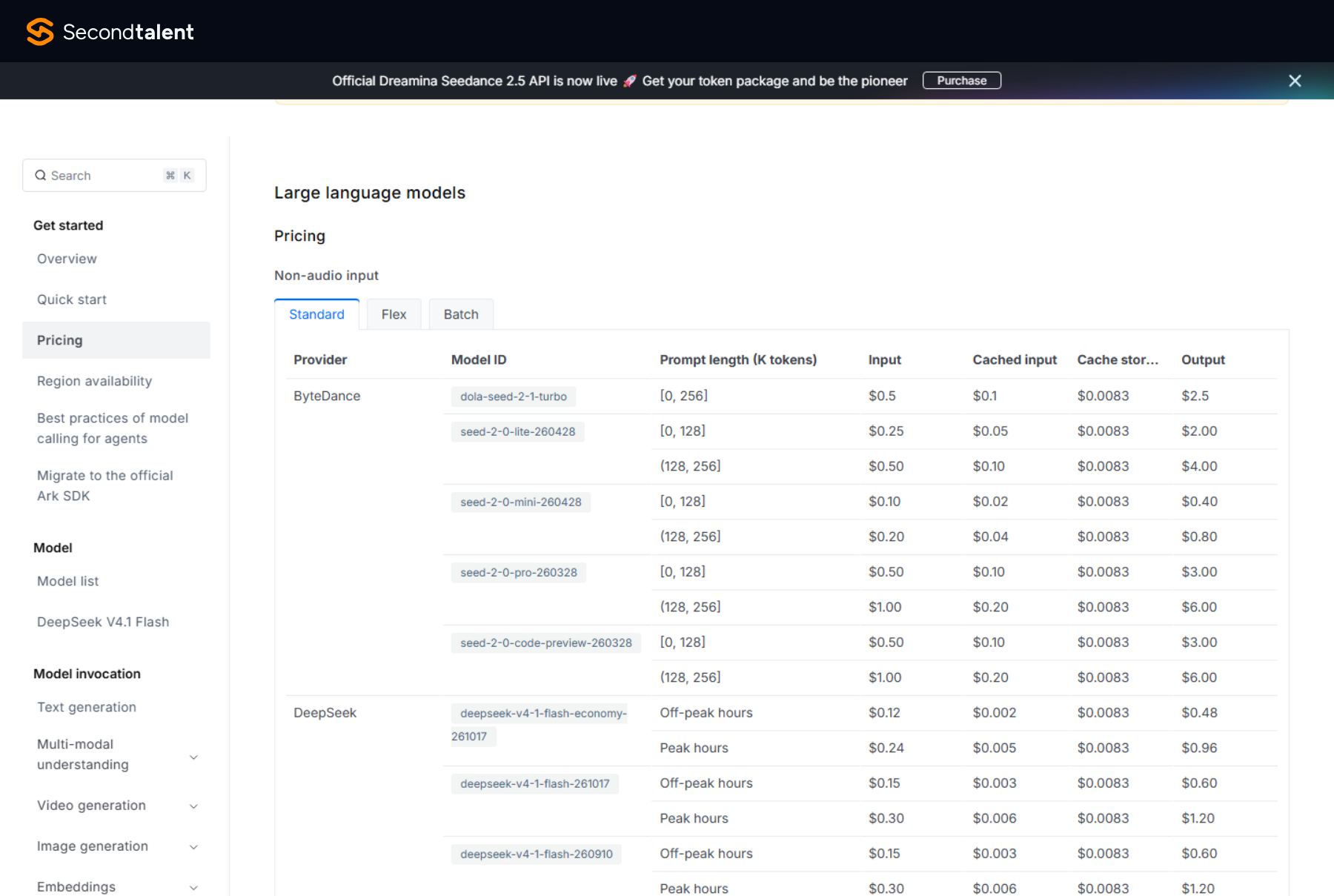
Prompt length tiers. On BytePlus the Seed 2.0 models double in price once a prompt passes 128K tokens: Seed 2.0 Pro goes to $1.00 / $6.00. Volcano Engine splits Seed 2.0 into three tiers (up to 32K, 32K to 128K, 128K to 256K). The Seed 2.1 models charge one flat rate.
Flex tier. Requests sent with service_tier=flex queue on spare capacity at about half price. Seed 2.1 Turbo drops to $0.25 / $1.25.
Cache hits. Cached input on Turbo costs $0.10, a fifth of the normal input rate, plus $0.0083 per million tokens per hour of storage.
BytePlus also sells a Coding Plan for tools such as Claude Code: Lite at $10 a month and Pro at $50 a month.
For one developer running an agent all day, a flat plan can undercut per-token billing; for a product serving customers, the token price is the one to model.
BytePlus ModelArk (international)
5 Seed language models, billed in USD
Context tops out at 256K
Served from ap-southeast-1, plus Seed 2.0 in eu-west-1
Volcano Engine Ark (China)
Full Doubao lineup, billed in CNY
Seed 2.1 Pro, Lite and Evolving at 1,024K
Seed-Evolving and Seed 2.1 Pro are China only
Context windows and output limits
The 1,024K window exists only in China, on Seed 2.1 Pro, Seed 2.1 Lite and Seed-Evolving. Every Seed model on BytePlus stops at 256K, and the Seed 2.0 models cap the prompt itself at 224K to leave room for the answer.
Max output is 256K on the Seed 2.1 models and 128K on Seed 2.0, and on both platforms that limit counts the chain of thought as well as the visible reply.
One default catches new users: the output limit is 4K tokens unless the request sets a higher one. A reasoning model can spend most of 4K thinking, so long answers come back cut off.
Set max_tokens (or the Responses API equivalent) on every call that needs more, and stream anything long.
How deep thinking and reasoning effort work
Deep thinking is on by default on the current Seed models. You switch it off with thinking.type=disabled in the Chat API or reasoning.effort=minimal in the Responses API.
Between those two states, the BytePlus deep thinking guide lists seven reasoning_effort values, from none to max, but the Seed models map them onto four levels: minimal, low, medium and high, with xhigh and max treated as high.
The default is medium, except on Seed-Evolving, which defaults to high.
Agent builders need to know one more rule.
On models that return a thinking summary, the API sends a summary plus an encrypted copy of the full reasoning, and in multi-turn tool calls you must pass that encrypted content back unchanged, or ByteDance says answer quality drops.
The Responses API handles it for you through previous_response_id. Seed 1.8 and some later models also keep reasoning in the context during tool calls, which raises input token counts on long agent runs.
Which Doubao model should you use
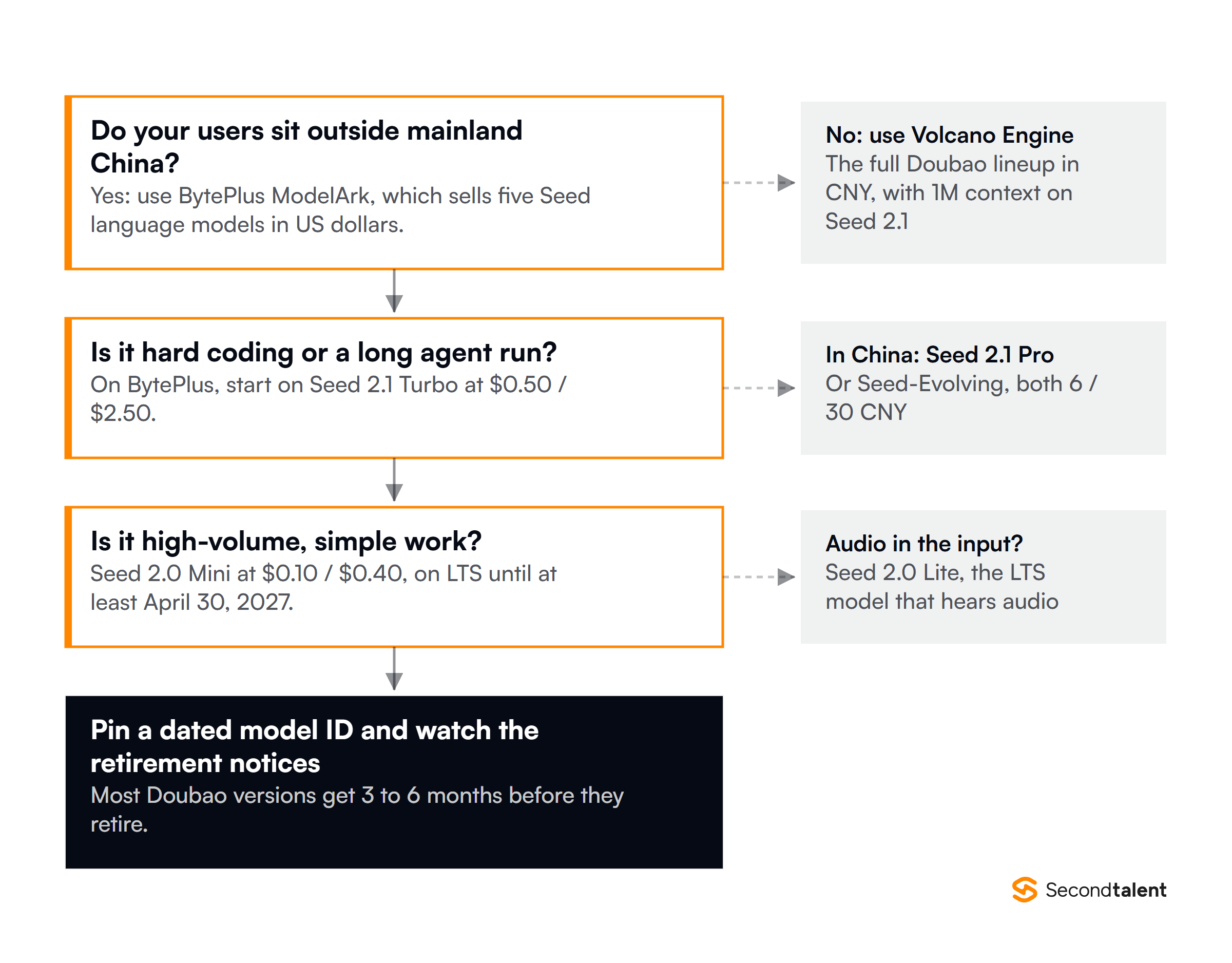
The first question is where your users are, because it decides which models you can buy. Outside China, I would build on Seed 2.1 Turbo for coding and agents, push volume work to Seed 2.0 Mini, and use Seed 2.0 Lite where audio comes in.
Inside China, Seed 2.1 Pro and Seed 2.1 Lite cover most jobs with a 1M window. If you are weighing ByteDance against an open-weights option, our Doubao vs DeepSeek breakdown compares the two on price and access.
Job
Outside China (BytePlus)
Inside China (Volcano Engine)
Coding agent, long multi-step tasks
Seed 2.1 Turbo
Seed 2.1 Pro or Seed-Evolving
Chatbot, support, extraction at volume
Seed 2.0 Mini (LTS)
Seed 2.0 Mini (LTS)
Calls, voice notes, video with sound
Seed 2.0 Lite (LTS)
Seed 2.1 Lite
Whole-repo or long-document reading
Seed 2.1 Turbo (256K)
Seed 2.1 Lite or Pro (1,024K)
Strict JSON output
Seed 2.1 Turbo or Seed 2.0 Lite
Seed 2.1 Lite
Production you cannot re-test often
Seed 2.0 Lite or Mini (LTS)
Seed 2.0 Lite or Mini (LTS)
Self-hosting is not on the menu for the main lineup. ByteDance sells Doubao through its API only; its open-weights release is Seed-OSS-36B-Instruct, a 36B model under Apache 2.0 from August 2025 with a native 512K context.
For other Chinese models you can download, see our guides to Qwen and DeepSeek.
Legacy and retired Doubao models
Doubao versions turn over fast.
Volcano Engine's model retirement notice says a version lives three to six months in most cases, and it runs retirements in batches: quotas shrink first, new endpoints stop a few days later, and on the service end date leftover endpoints move to a named replacement or shut down.
BytePlus runs the same process on its own schedule, so one model can retire on different dates in each cloud.
Older model
Status
Move to
doubao-seed-2-0-pro-260215
Volcano Engine: service ends November 24, 2026
Seed 2.1 Pro; Volcano Engine names the automatic replacement before shutdown
doubao-seed-2-0-code-preview-260215
Volcano Engine: service ends November 24, 2026
Seed-Evolving
doubao-seed-2-0-lite-260215, mini-260215
Volcano Engine: service end set for October 22, 2026
Seed 2.0 Lite or Mini 260428 (LTS)
seed-2-0-lite-260228, seed-2-0-mini-260215
BytePlus: deactivated November 11, 2026
Seed 2.0 Lite or Mini 260428 (LTS)
Seed 1.8, Seed 1.6, Seed 1.6 Flash
Volcano Engine: ended September 21, 2026. BytePlus: November 11, 2026
Seed 2.0 Lite or Mini (LTS)
doubao-seed-code-preview-251028
Volcano Engine: ended September 21, 2026
Seed-Evolving
seed-1-6-code-preview
BytePlus: deactivated November 11, 2026
Seed 2.1 Turbo
Doubao 1.5 Pro, Lite and Vision Pro (32K)
Volcano Engine: ended September 21, 2026
Seed 2.0 Lite or Mini (LTS)
Most migrations take three changes: swap the model ID, then check the thinking and reasoning_effort settings, because defaults and accepted values differ between generations.
Re-test structured output if you move onto Seed 2.0 Pro or Code Preview, which lack it on BytePlus.
Code still on the Bot API or Context API has a fourth job: Volcano Engine says those calls fail after retirement unless you move them to the Responses API.
What this means for hiring
Building on Doubao rewards engineers who can read Chinese vendor docs, track dated model IDs across two clouds, and set reasoning effort and token limits by hand.
Our LLM developer cost guide puts mid-level contract rates at $119 to $185 an hour in the US, against $39 to $94 in Vietnam and $31 to $80 in the Philippines.
Elton Chan is the Co-Founder of Second Talent, a solution that connects global tech leaders with top-tier tech talent across Asia. He specializes in talent solutions and has led Second Talent’s rapid growth since 2024, helping scale its network to over 100,000 pre-vetted developers and earning industry recognition as the #1 in the Global Hiring category on G2.
A long-time entrepreneur with deep roots in digital transformation, Elton previously co-founded Branch8, a Y Combinator–backed e-commerce technology firm, and served as the Founding Chairman of HKEBA, a leading Asia-focused business association driving innovation, digital education, and cross-border collaboration.
His work bridges technology, talent, and business strategy to shape how companies scale in an increasingly remote and digital world.