TL;DR: A senior Java developer in India earns ₹25 to 55 lakh a year, about $26,300 to $57,900, while the US median for software developers was $135,980 in May 2025. By the hour, mid-level freelancers charge $20 to $52 in India and $85 to $135 in the US. For MLOps, ML and AI work the hourly range is $28 to $72 in India against $119 to $185 in the US.
On November 21, 2025, India replaced 29 labor laws with four Labour Codes, and one rule in them changes what a developer costs: wages must now make up at least half of total pay.
Allowances above that line now count toward provident fund and gratuity. Every dollar figure below converts rupees at 94.93 to the dollar, the ECB reference rate for October 20, 2026.
- 1A US company paying an in-house mid-level MLOps engineer spends about $130 to $205 an hour once recruiting, equipment and management are loaded on.
- 2Bengaluru pays developers 15 to 20% above India's national average, and tier-2 cities run 20 to 30% below Bengaluru.
- 3The BLS has no ML engineer title. Its closest match, computer and information research scientists, had a US median of $140,300.
- 4Indian freelancers price about 25% above the equivalent contract rate, to cover bench time, tax and downtime.
India vs US developer salaries by role
A senior AI engineer in India at the top of the band, ₹70 lakh a year, still earns about $73,700, 53% of the US median for the nearest BLS occupation.
The table puts India's mid-level and senior bands from our India developer rate cards next to the US national median from the BLS Occupational Employment and Wage Statistics for May 2025.
Indian figures are total fixed pay in lakh per annum (LPA), where one lakh is ₹100,000, converted at 94.93 rupees to the dollar and rounded to the nearest $100.
| Role | India, mid-level (3 to 6 years) | India, senior (6 to 10 years) | US median, BLS May 2025 |
|---|---|---|---|
| Java developer | ₹12 to 25 LPA ($12,600 to $26,300) | ₹25 to 55 LPA ($26,300 to $57,900) | $135,980 (software developers) |
| Python developer | ₹12 to 24 LPA ($12,600 to $25,300) | ₹24 to 55 LPA ($25,300 to $57,900) | $135,980 (software developers) |
| React developer | ₹11 to 22 LPA ($11,600 to $23,200) | ₹22 to 50 LPA ($23,200 to $52,700) | $135,980 (software developers) |
| Full-stack and general software | ₹12 to 25 LPA ($12,600 to $26,300) | ₹25 to 60 LPA ($26,300 to $63,200) | $135,980 (software developers) |
| Go developer | ₹14 to 28 LPA ($14,700 to $29,500) | ₹28 to 60 LPA ($29,500 to $63,200) | $135,980 (software developers) |
| DevOps engineer | ₹12 to 24 LPA ($12,600 to $25,300) | ₹25 to 55 LPA ($26,300 to $57,900) | $135,980 (software developers) |
| Data engineer | ₹13 to 26 LPA ($13,700 to $27,400) | ₹26 to 58 LPA ($27,400 to $61,100) | $139,500 (database architects) |
| ML and MLOps engineer | ₹14 to 28 LPA ($14,700 to $29,500) | ₹28 to 65 LPA ($29,500 to $68,500) | $140,300 (computer and information research scientists) |
| AI engineer | ₹15 to 30 LPA ($15,800 to $31,600) | ₹30 to 70 LPA ($31,600 to $73,700) | $140,300 (computer and information research scientists) |
The BLS does not split software developers by language or framework, so Java, Python, React, Go, full-stack and DevOps work all sit under one US median.
On the Indian side the spread between roles is real: the senior AI band starts at ₹30 lakh, ₹8 lakh above the start of the senior React band, and tops out ₹20 lakh higher.
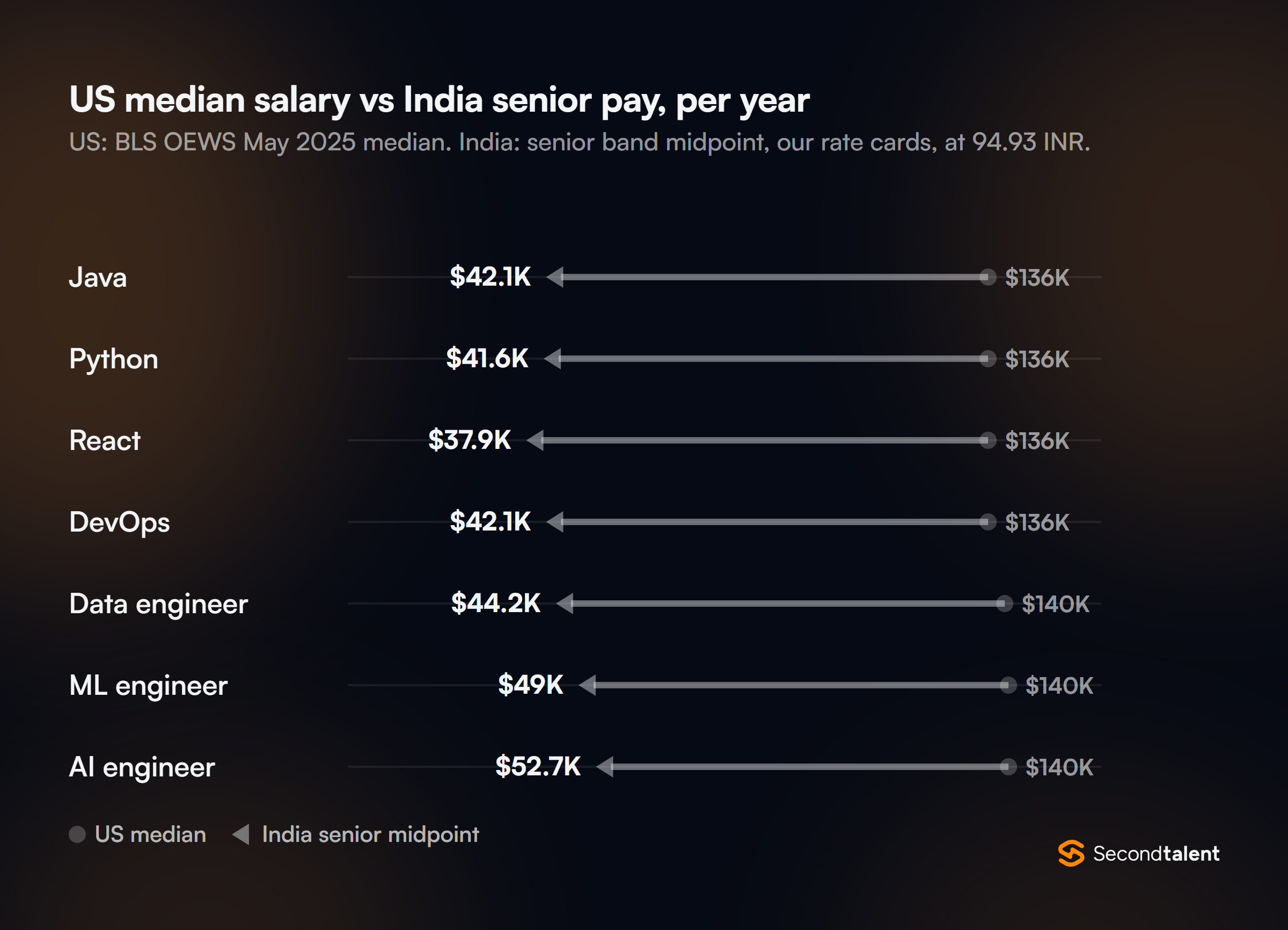
The US median covers every experience level, while the Indian figure in the chart is the midpoint of the senior band only. A US senior sits above the median, so a like-for-like gap is wider still.
Even the 25th percentile for US software developers, $105,210, is above the top of every Indian senior band in the table.
Developer hourly rates: India vs USA
Hourly rates are where most US buyers start, because a freelancer or contractor is the fastest way to test a market.
Our cost-to-hire tracker publishes mid-level freelance ranges for both countries on the same basis, so the comparison below uses one source on both sides.
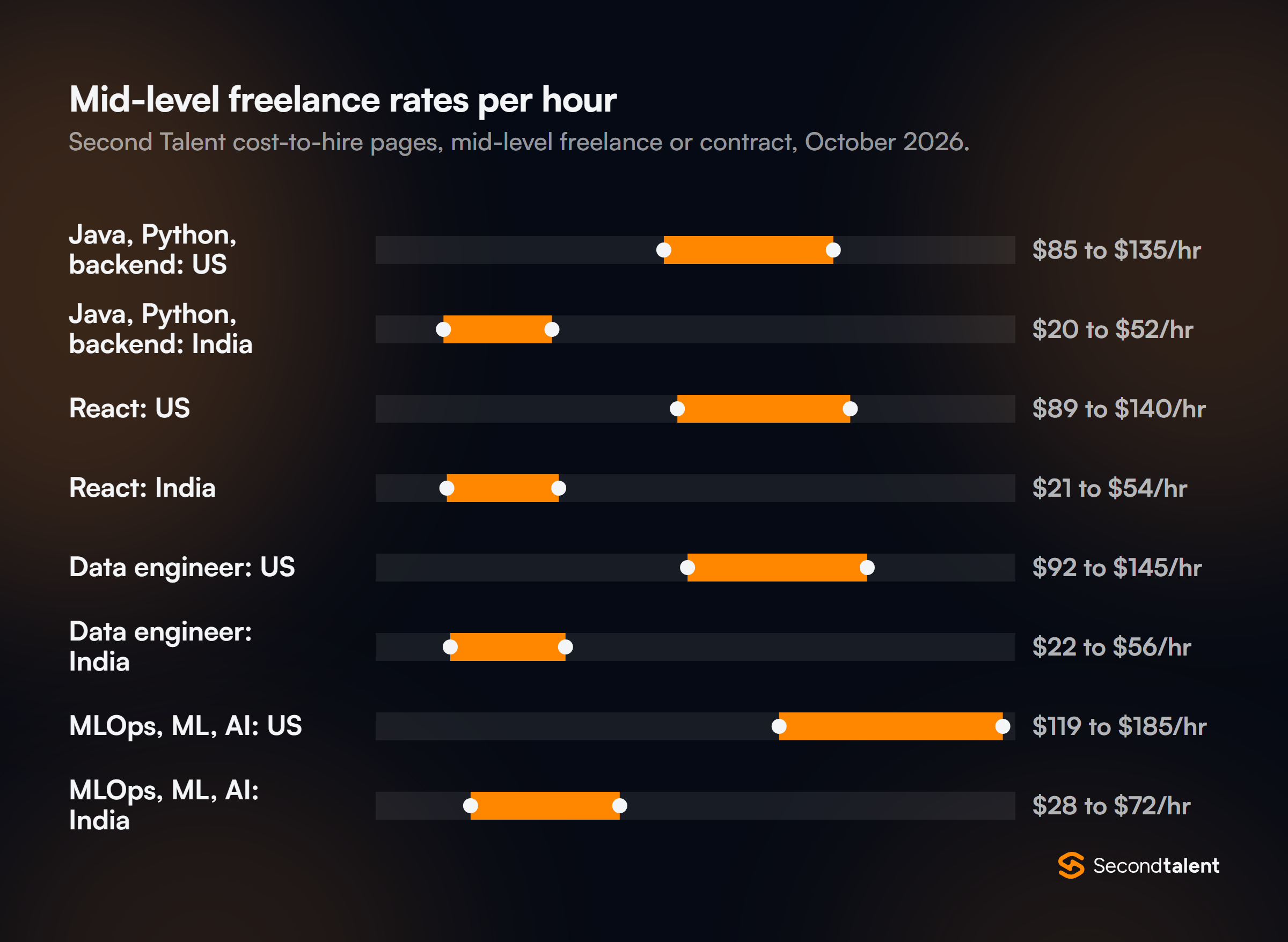
Backend roles in Java, Python and Go share one band in both countries: $85 to $135 an hour for a US freelancer and $20 to $52 in India, per our Java developer cost page. React runs a few dollars higher, and data engineering higher again.
The widest absolute gap is in MLOps, ML and AI, where the top of the US range sits $113 an hour above the top of India's.
Freelance is not the most expensive US option.
The same tracker puts a mid-level US Java developer at $95 to $150 an hour as an in-house employee once you add recruiting, equipment and management, and $165 to $275 an hour through a US agency or dev shop.
India's rates sit below the US floor on every model.
MLOps engineer cost: India vs USA
Both markets price MLOps as AI work, not as DevOps. Our MLOps engineer cost page lists India as the cheapest of the ten markets it tracks. At 160 billable hours a month, the mid-level freelance range works out like this:
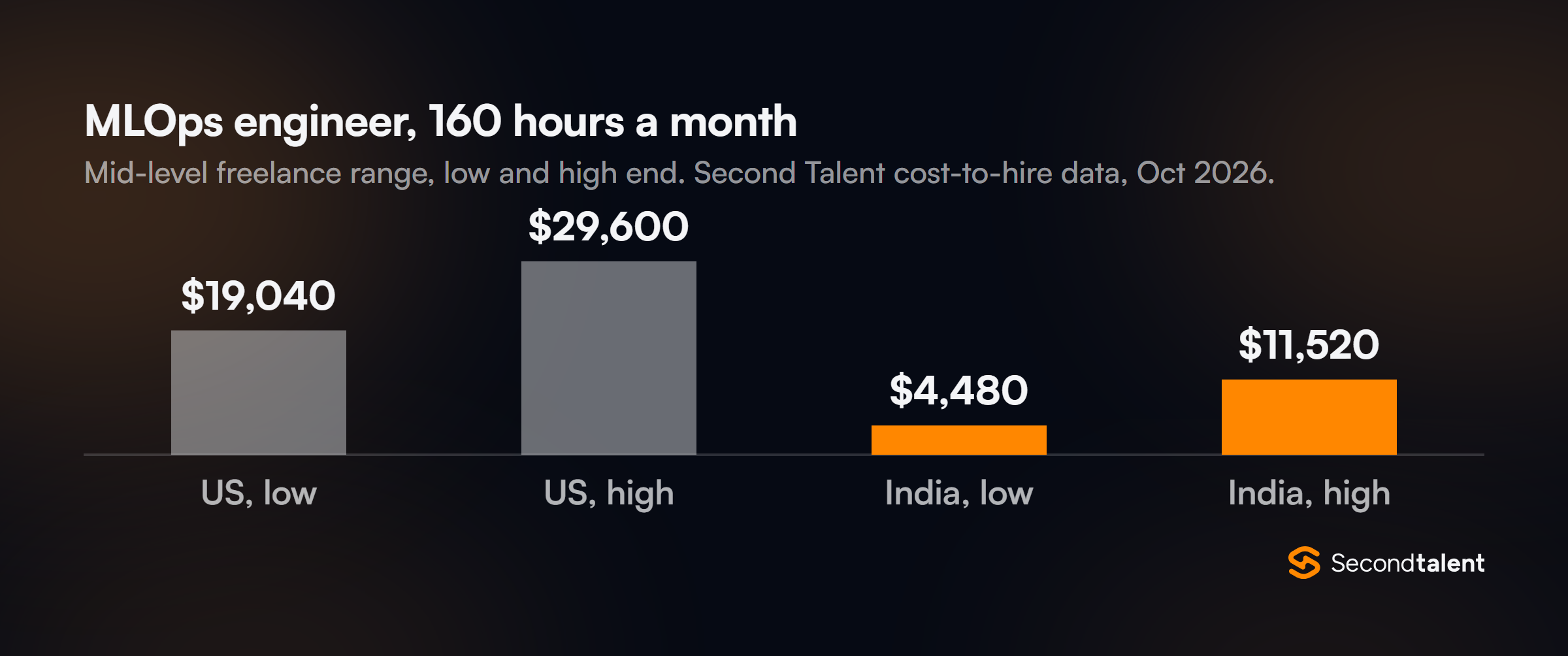
The high end of India's range, $11,520 a month, is still $7,520 below the low end of the US range.
Senior MLOps engineers who run training and serving at scale are the exception: our India machine learning engineer rate card puts them at ₹2,600 to ₹6,500 an hour on local rates and $60 to $100 an hour from international clients.
Budget for that band if the hire will own GPU clusters, model registries and on-call for inference as well as pipelines.
On the US side, the BLS counts MLOps engineers wherever employers file them: as software developers, data scientists ($120,230 median) or computer and information research scientists ($140,300).
The BLS Occupational Outlook Handbook describes the last group as running experiments "frequently using techniques from data science and machine learning", which is why we use it for the ML rows here.
Java developer hourly rate: India vs USA
Our India Java developer rate card calls Java the backbone of Indian enterprise engineering and the deepest senior pool in the country.
It gives every city the same ₹12 to 85 LPA spread, because employer type moves a Java offer more than location does.
- $85 to $135 an hour freelance
- $95 to $150 an hour in-house, fully loaded
- $165 to $275 an hour through an agency
- $26 to $36 an hour mid-level, international clients
- $36 to $55 an hour senior, international clients
- $40 to $75 an hour for banking and payments engineers
The banking premium is worth paying for regulated work. Engineers from Mumbai and Chennai who have built reconciliation and settlement logic under audit price above the general Java band.
The cheaper end of the market carries a different risk: a lot of production Java in India still runs on Java 8 or 11, so a team on Java 21 with records and virtual threads should test for them rather than assume.
Spring Boot is the screen that separates candidates. Almost every CV lists it. Asking how a transaction behaves when it spans two services separates engineers who have run Spring in production from those who have only used it.
How Indian developer pay climbs with seniority
Indian pay more than doubles at each step from junior to mid-level to senior, then rises about two-thirds to lead. AI engineering pulls ahead fastest: the gap to Java is about $2,300 a year at junior level and $18,400 at lead.
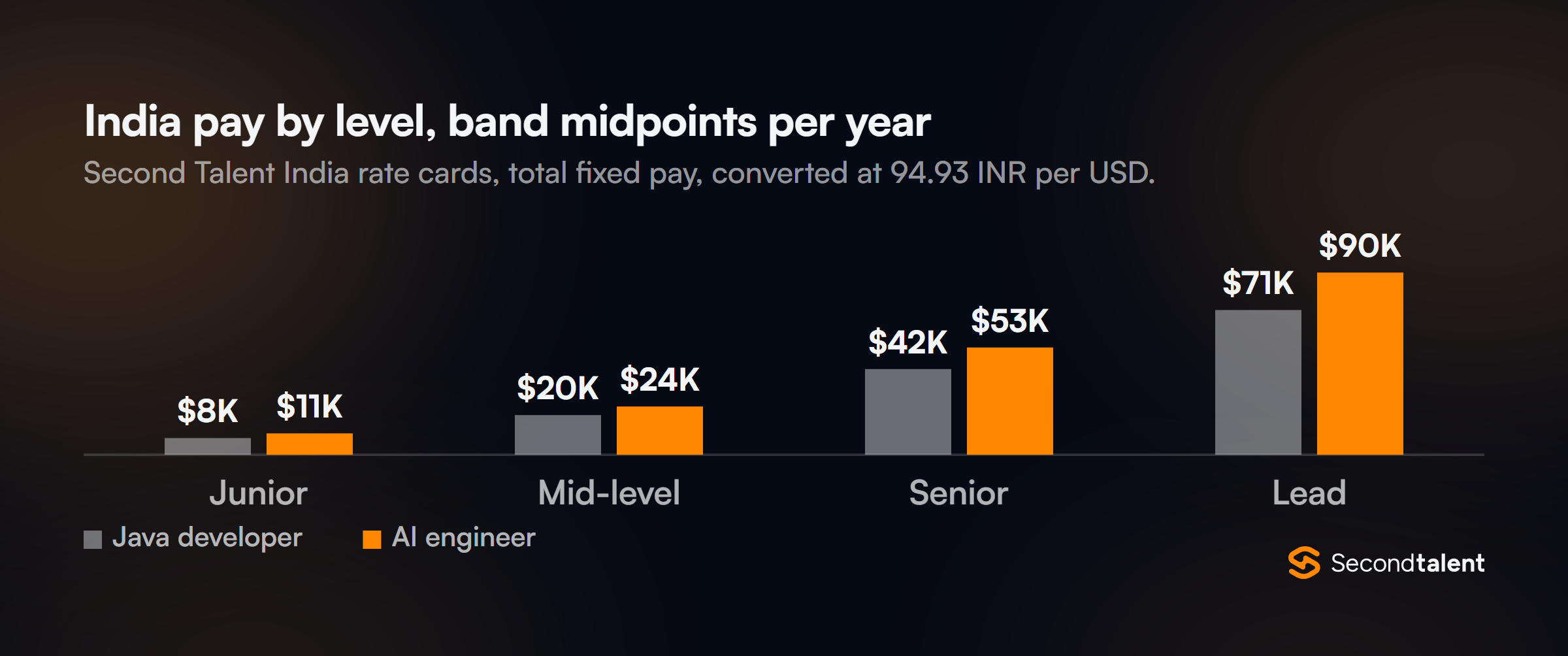
Junior means 0 to 2 years, mid-level 3 to 6, senior 6 to 10 and lead 10 or more, the bands our rate cards use.
The senior band midpoints, $42,100 for Java and $52,700 for AI engineering, sit below the US 10th percentile for software developers, $82,460.
The biggest dollar step comes last: senior to lead adds about $29,000 a year for Java and $36,800 for AI engineering.
Product companies and global capability centers (GCCs) sit at the top of every band.
GCCs are the India offices of foreign companies such as banks and software firms, and they compete for the same senior engineers a US startup wants, so a strong senior candidate often has a GCC offer to beat.
What an employee costs beyond salary
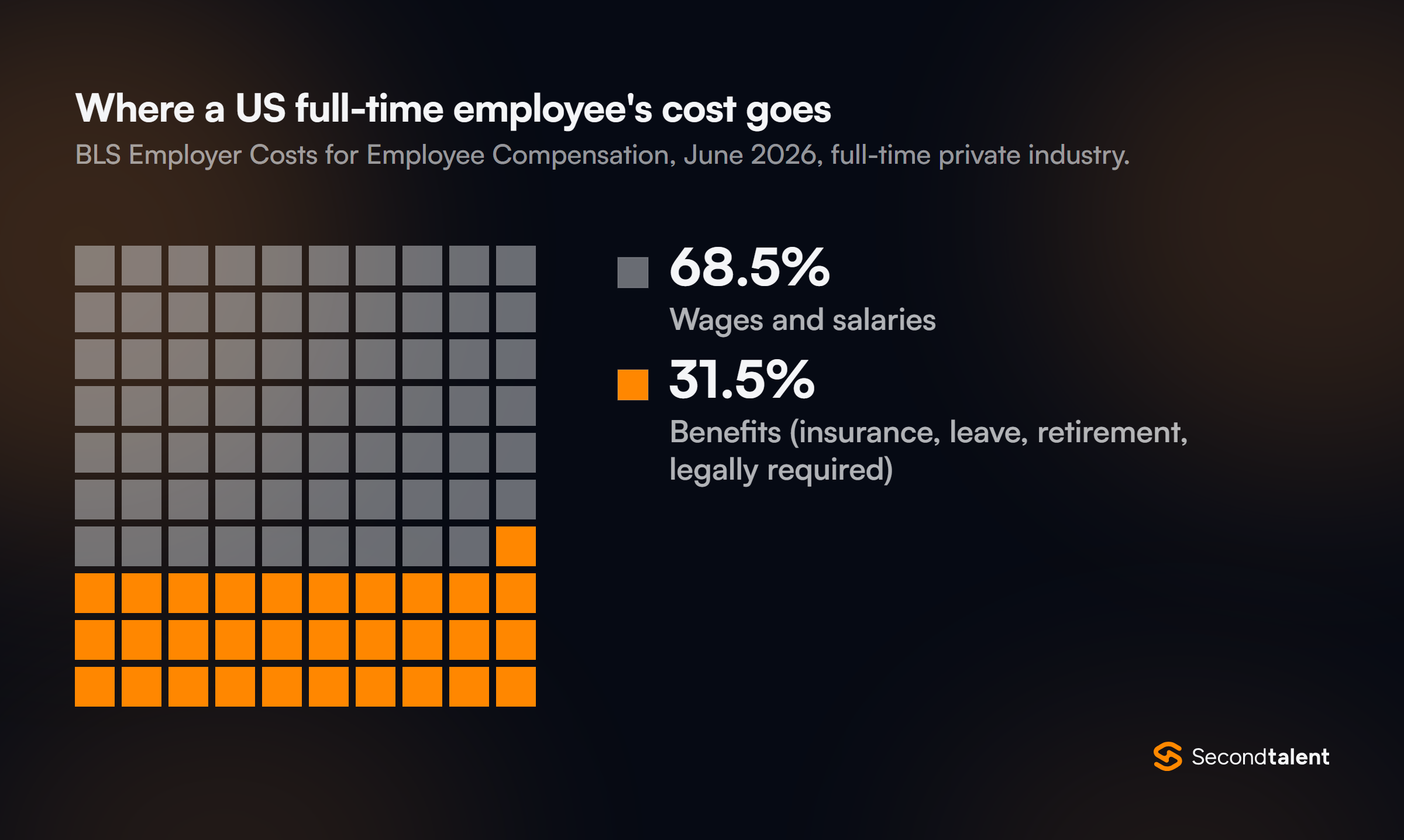
A US salary is about two-thirds of what a full-time employee costs.
In the BLS Employer Costs for Employee Compensation release of September 9, 2026, full-time private industry workers cost $54.00 an hour in June 2026, of which $17.03 was benefits.
India's statutory load is lighter but rising. Our India hiring guide puts employer contributions at about 13%: the 12% employer share of provident fund on basic pay plus admin charges. The Labour Codes widen that base.
The Labour Ministry's FAQ says employers must add any allowances above half of total pay back to wages, and fixed-term employees now earn gratuity after one year of service instead of five.
Law firm Littler expects that "payroll restructuring is inevitable for many employers, as statutory costs may rise due to a larger 'wage' component." Lockton describes the same rule as reshaping take-home pay and gratuity.
For a US company, the practical point is that an Indian offer letter structured before November 2025 may now cost more to run than its headline salary suggests.
Where in India: pay by city
City matters less than employer type, but it still moves a senior offer by a fifth or more. These differences come from our India Java rate card and hold for most backend roles.
Chennai is the city for SaaS and payments engineers who stay put, which suits long-lived systems.
Delhi NCR brings consumer internet and adtech experience with good client-facing communication, though quality varies more, so the technical screen has to stay strict.
Working hours: IST against US time zones
India Standard Time is UTC+5:30 all year and has no daylight saving time, so the overlap with US hours shifts twice a year on the US side. US daylight time runs from March 8 to November 1, 2026, per NIST.
| US start of day | Time in India, until Nov 1, 2026 | Time in India, after Nov 1, 2026 |
|---|---|---|
| 9:00 am Eastern | 6:30 pm | 7:30 pm |
| 9:00 am Central | 7:30 pm | 8:30 pm |
| 9:00 am Pacific | 9:30 pm | 10:30 pm |
An East Coast team gets a workable overlap from a 12:30 pm to 9:30 pm IST shift, which covers 9 am to noon Eastern until November 1. After that, the same three hours need a shift that ends at 10:30 pm IST.
West Coast overlap comes down to one late call, so plan for written handoffs and async code review rather than pairing.
Contractor, EOR or your own entity
The cost figures above assume you can legally pay the developer. A US company has three routes: an Indian subsidiary, an independent contractor agreement, or an employer of record (EOR) that employs the developer in India on your behalf.
A subsidiary only pays off at team scale, so most US startups pick between the other two.
- Contractor. The developer gives you Form W-8BEN instead of a W-9. IRS Publication 515 sources income by where the work is performed, so pay for work done in India is foreign-source income. The risk is Indian law: a contractor who works your hours under your direction can be treated as an employee.
- Employer of record. The EOR's Indian entity is the legal employer and runs provident fund, gratuity, tax and the Labour Code changes. You pay one monthly invoice, usually in US dollars.
Our comparison of EOR, PEO and contractor management covers the trade-offs in more depth, and our EOR service page explains how we employ developers for US companies.
Hire developers in India with Second Talent
We match pre-vetted developers in India within 24 hours, from $23 to $39 USD an hour, billed monthly (160 hours for $3,599 to $5,999), with payroll, compliance and equipment included.
That is 50 to 70% below US in-house cost, and every hire carries a 90-day, one-time replacement guarantee.
Browse Python, full-stack, machine learning and data engineering developers in India, or tell us the role you need to fill.
FAQs
Is it cheaper to hire developers in India than in the Philippines?
India is a little cheaper. Our cost-to-hire tracker puts a mid-level freelance developer on a standard web stack at $20 to $52 an hour in India and $22 to $58 in the Philippines.
Our Philippines vs India comparison covers English, time zones and attrition.
How do I legally hire a developer in India from the US?
Without an Indian entity, either sign a contractor agreement and collect Form W-8BEN, or employ the developer through an employer of record.
Choose an EOR if the developer will work your hours and take daily direction, since Indian law may treat that contractor as an employee.
What salary bands should I set for a Go team across the US and India?
For India, our Go developer rate card gives ₹14 to 28 LPA at mid-level and ₹28 to 60 LPA at senior level.
For the US, BLS pay for software developers runs from $105,210 at the 25th percentile to $171,980 at the 75th, with a median of $135,980.
What does a backend developer cost in India vs the USA?
At mid-level, freelance backend developers charge $20 to $52 an hour in India and $85 to $135 in the US, on our backend developer cost page. Senior backend engineers in India earn ₹25 to 55 LPA on a full-time salary.