

Skip to content

AI Staff Augmentation Services for US Startups [2026 Guide]

Matt Li By Matt Li, Co-Founder and Director 12 min read
AI Staff Augmentation, a Second Talent guide for US startups adding AI engineers.
TL;DR: AI staff augmentation adds vetted AI engineers to your team through a provider that employs them, so you direct the work without a hiring process. It beats a full-time hire when you need the skill within weeks, or for months rather than years. Through Second Talent, an AI engineer from Asia costs $23 to $39 an hour, billed monthly, against about $93 an hour for a median US developer once benefits are counted.

AI engineer topped LinkedIn's 2026 Jobs on the Rise list as the fastest-growing job in the US, and the skills LinkedIn tied to it were LangChain, RAG and PyTorch.

Hiring for it is slow: Gem's 2025 benchmarks put the average time to hire at 41 days, after 20 interviews per hire.

Augmentation skips that search, so the engineer is in your standup and your repo within days.

Key takeaways
  1. 1Code written by someone who is not your employee is not a "work made for hire" under US copyright law, so the IP needs a signed assignment.
  2. 2North Korean IT workers using stolen identities got jobs at more than 100 US companies, per the Justice Department, so identity checks belong in any vendor's vetting.
  3. 366% of developers say AI output is "almost right, but not quite", which makes code review the core skill to test.
  4. 4An augmented engineer from Asia can give a US team 4 to 6 hours of overlap a day, enough for standups and pairing.
What is AI staff augmentation?

AI staff augmentation is a way to add AI and machine learning engineers to your in-house team through an outside provider. The provider recruits, employs and pays the engineer. You assign the work, run the sprint and own the code.

It differs from outsourcing in who holds the steering wheel. An agency takes a scoped project and delivers a result.

An augmented engineer takes tickets from your backlog, joins your Slack and ships into your repo, the same as an employee would.

The general model, its pricing types and the market size are covered in our guide to staff augmentation services.

An AI seat changes three things: the roles, what those roles cost in the US, and the risks that come with engineers who write code alongside AI agents.

When augmentation beats hiring, agencies and freelancers

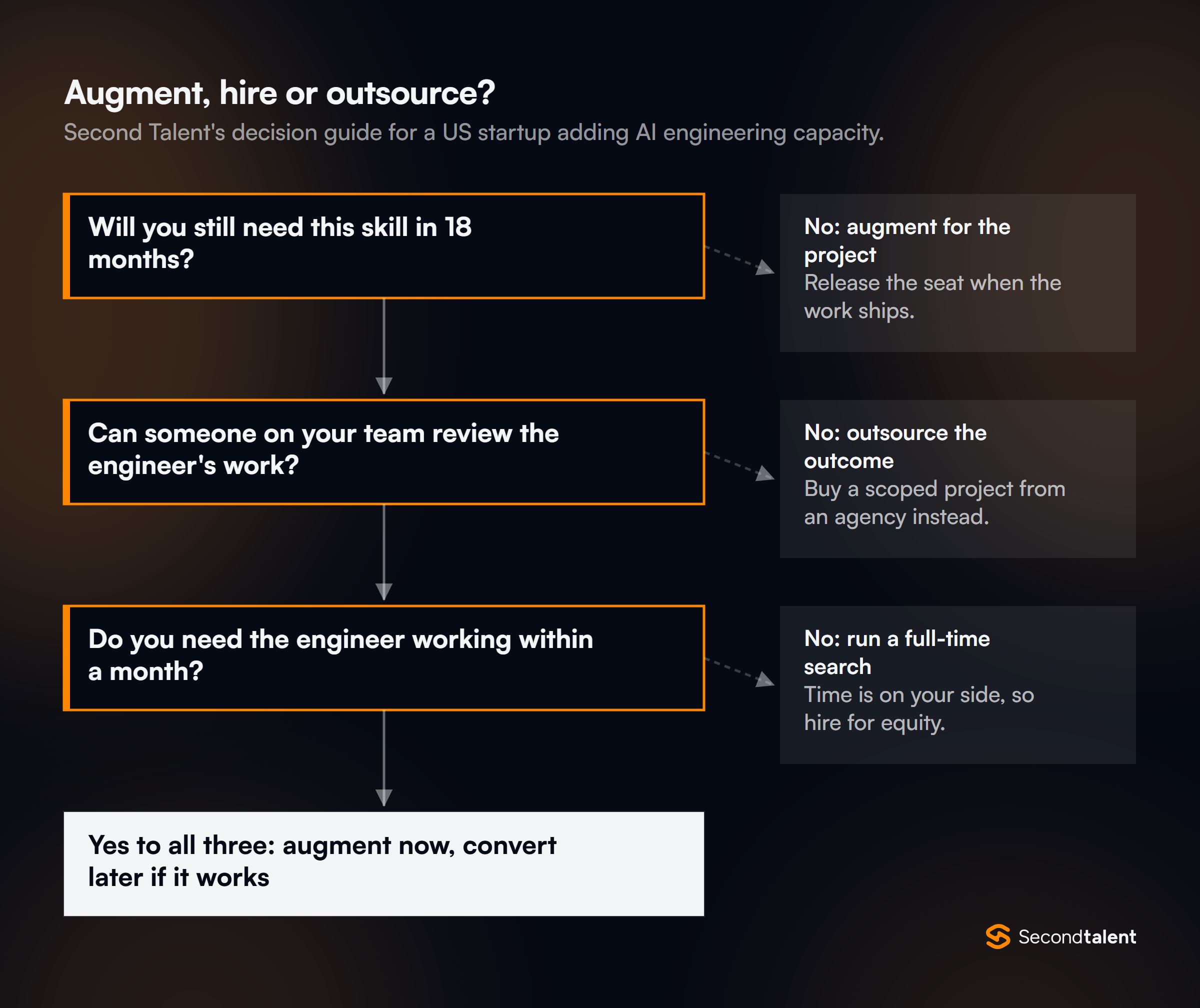
Augmentation wins when two things are true at once: you need the skill inside a month, and someone on your team can review the work. If nobody can review an LLM pipeline, buy the outcome from an agency.

If you can wait three months and the need is permanent, a full-time hire with equity still makes sense.

Flowchart for choosing between augmenting, hiring or outsourcing AI engineering: if the skill is not needed in 18 months, augment for the project; if nobody can review the work, outsource the outcome; if the engineer is not needed within a month, run a full-time search; if yes to all three, augment now and convert later.

The table sets the four options side by side on the points founders ask about most.

Full-time hireStaff augmentationAgency or outsourcingFreelancer
Who directs the workYouYouThe agencyYou, part-time
Time to startWeeks to monthsDaysAfter scopingDays
Employer of recordYouThe providerThe agencyNobody (contractor)
IP ownershipAutomatic for employeesBy contract assignmentBy contractBy contract, often missed
ExitSeverance, morale costNotice to the providerEnd of the statement of workEnd the contract
Best forCore, long-term rolesAdding capacity to a team you runA defined deliverableSmall, separate tasks

Freelancers fit a two-week task, not a model that needs retraining every quarter. Agencies also tend to own the delivery process, which slows a startup that ships daily.

For the longer comparison between a dedicated pod and single augmented engineers, see dedicated team vs augmented team.

Roles AI staff augmentation covers

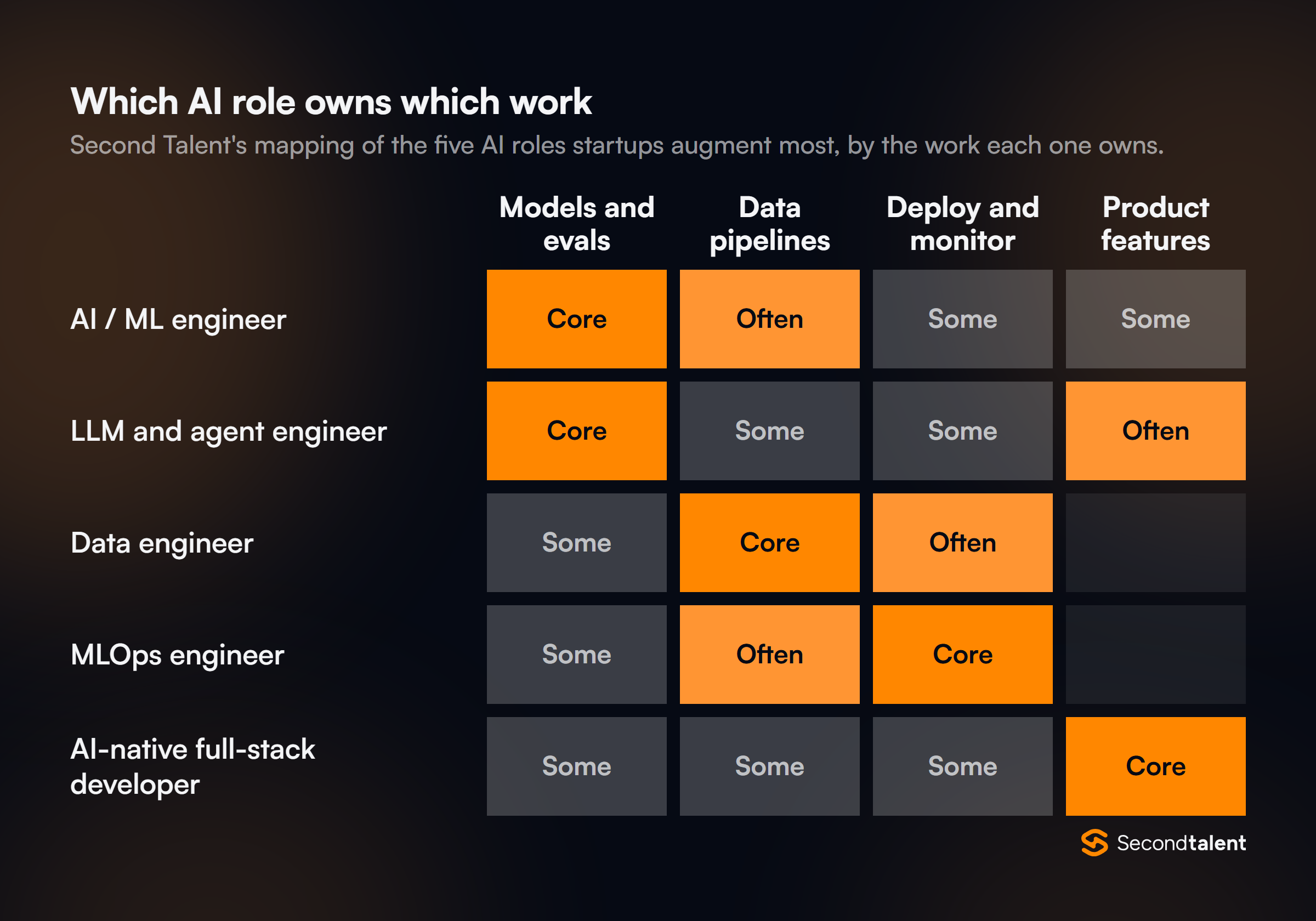
Most startup AI work splits into five seats. The overlap is real: an LLM engineer at a seed-stage company also writes the data loader. The heatmap shows where each role's weight sits.

Heatmap of five AI roles against four kinds of work. AI and ML engineers own models and evals; LLM and agent engineers own models and evals and often product features; data engineers own data pipelines; MLOps engineers own deploy and monitor; AI-native full-stack developers own product features.

AI and machine learning engineers

#1 fastest-growing US job, LinkedIn 2026PyTorch, RAG, evals

They build and tune models, write evaluation sets and decide whether a fine-tune beats a better prompt. Augment one when you have a model in the product and nobody whose job is to measure it.

Profiles: machine learning engineers and AI engineers.

LLM and agent engineers

This is the seat most founders mean by "AI engineer" in 2026. The work is retrieval, tool calling, guardrails and agent loops that call your own APIs. It sits close to product, so these engineers need the most overlap with your team.

See LLM developers and AI agent developers.

Data engineers

Models fail on bad inputs before they fail on bad architecture. A data engineer owns ingestion, cleaning and the warehouse tables your evals read. If your first AI feature stalls on "the data isn't ready", this is the first seat to fill.

MLOps engineers

They own deployment, model versioning, monitoring and inference cost. Most startups add this seat after the second model reaches production, when a bad deploy starts costing real money.

The cost of the seat is broken down on our MLOps engineer cost page.

AI-native full-stack developers

Not every AI seat is a research role. Much of the work is the product around the model: the streaming UI, the auth, the billing for usage. A full-stack developer who works with coding agents every day ships that layer fast.

What "ships with AI agents" should mean

The phrase is on every vendor's site, so test it. Stack Overflow's 2025 Developer Survey shows how common AI tools already are, and how few developers trust them.

50.6%
of professional developers use AI tools daily
31.8%
of professional developers use AI agents at work
46%
distrust the accuracy of AI output, against 33% who trust it
87%
are concerned about the accuracy of AI agents
Source: Stack Overflow 2025 Developer Survey, AI section, fielded May to June 2025.

So using an agent is common. Knowing when its output is wrong is the scarce part. An engineer who ships with agents should be able to show three things in an interview:

  • A pull request where the agent wrote most of the code, and the tests that caught what it got wrong.
  • The rules they give an agent before it touches a codebase: what it may change, what it must not.
  • A case where they threw the agent's output away and wrote it by hand, and why.

We test for these in our vetting, and our AI-native engineer guide lists the habits we look for.

Engagement models

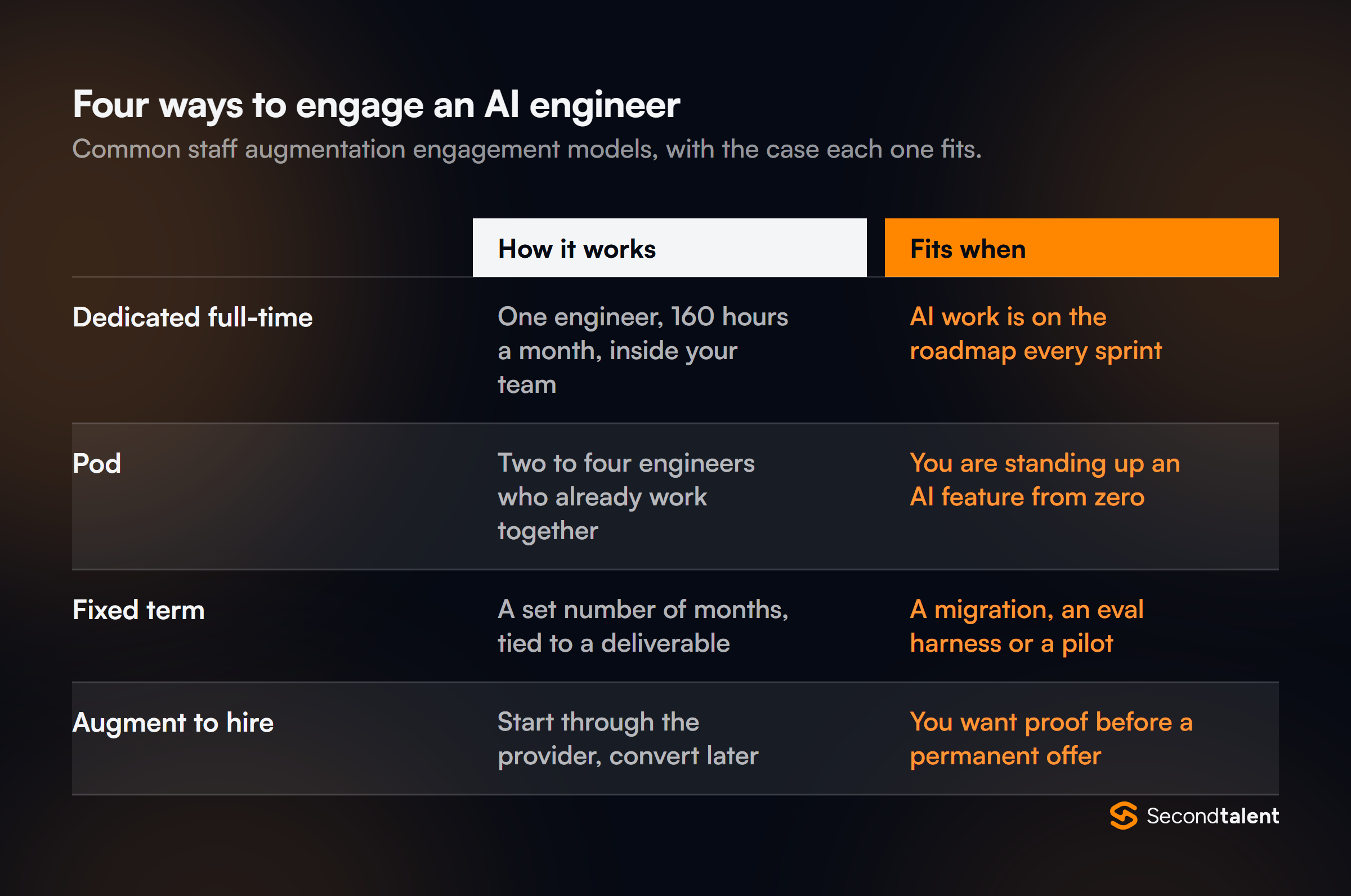
Most AI augmentation runs on one of four models. The billing unit is the same in each: hours per month per engineer. The models differ on headcount, length and whether the seat can turn permanent.

Table of four engagement models: dedicated full-time, one engineer for 160 hours a month; pod, two to four engineers; fixed term tied to a deliverable; augment to hire, start through the provider and convert later.

Dedicated full-time is the default for a startup with AI on the roadmap every sprint. A fixed term suits work with an end date, such as moving from one model provider to another or building an eval harness.

Augment to hire matters most for founders who want to see six months of commits before making a permanent offer.

Ask for the conversion fee in writing before the first invoice.

Cost: US vs remote AI engineers

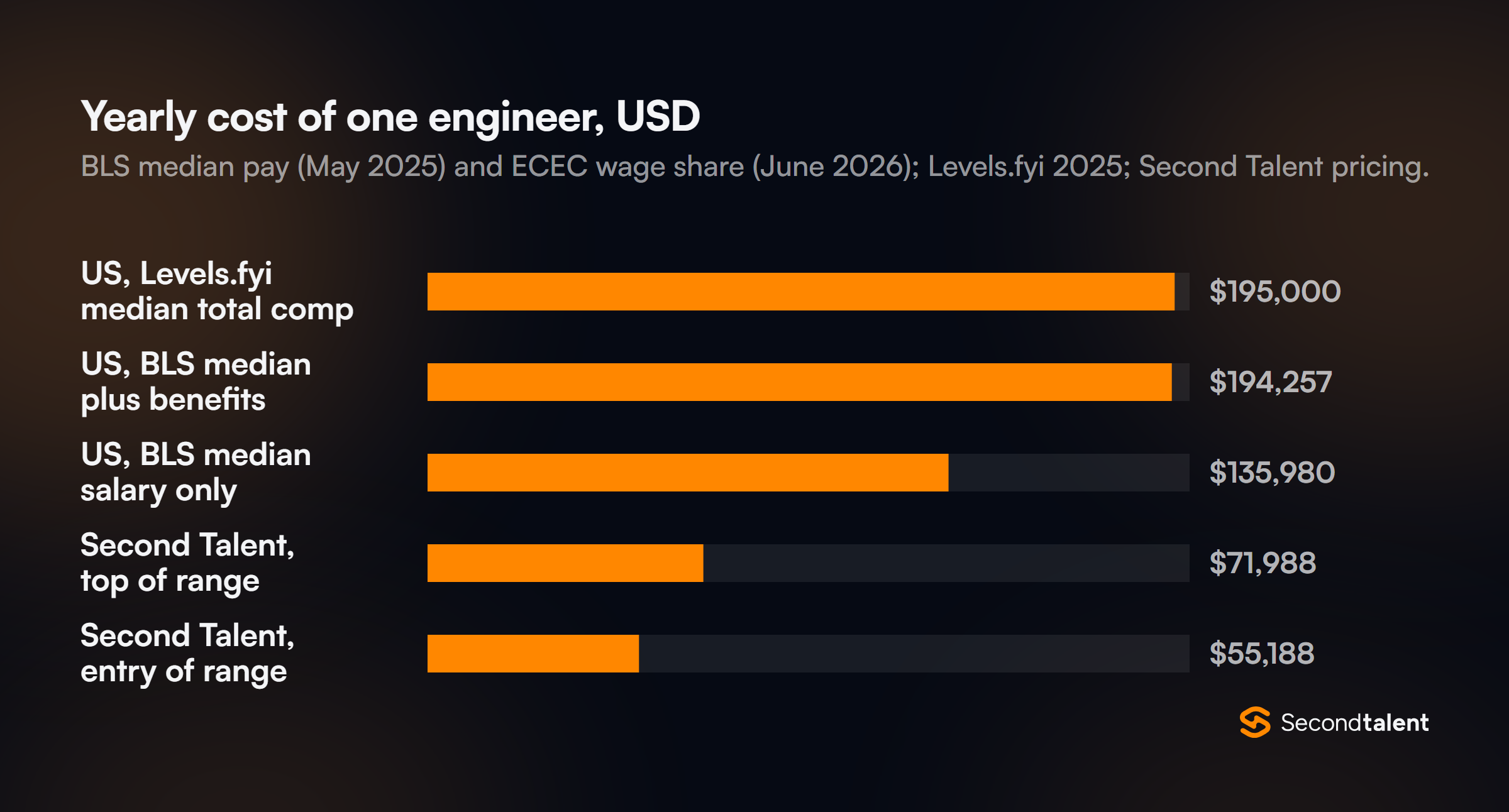
The Bureau of Labor Statistics puts the median US software developer salary at $135,980 (May 2025). Salary is not the cost, though.

In the BLS employer cost survey for June 2026, wages made up 70.0% of private employers' compensation spend, and benefits the other 30.0%.

Gross the median salary up by that share and one developer costs about $194,257 a year.

How the loaded cost is estimated. $135,980 divided by the 70.0% wage share gives $194,257. Benefit costs do not rise in step with pay, so treat it as an estimate for a median earner, not a quote.

AI specialists sit higher: BLS lists computer and information research scientists, the closest category to ML research, at $140,300.

The table converts each figure to an hourly rate (2,080 working hours a year) and a 160-hour month.

EngineerPer hourPer 160-hour monthPer year
US software developer, BLS median salary only$65.38$10,460$135,980
US software developer, salary plus benefits (our estimate)$93.39$14,943$194,257
US computer and information research scientist, BLS median$67.45$10,792$140,300
US software engineer, Levels.fyi median total pay, H2 2025$93.75$15,000$195,000
US freelance AI engineer$119 to $185$19,040 to $29,600n/a
AI engineer from Asia through Second Talent$23 to $39$3,599 to $5,999$43,188 to $71,988

Sources: BLS Occupational Outlook Handbook; BLS Employer Costs for Employee Compensation; the Levels.fyi 2025 pay report; freelance rates from our AI engineer cost guide.

Levels.fyi total pay includes equity and bonus, and skews toward larger tech companies.

Bar chart of the yearly cost of one engineer: US Levels.fyi median total pay $195,000; US BLS median salary plus benefits $194,257; US BLS median salary only $135,980; Second Talent $43,188 to $71,988.

Two costs never show up in a salary line. The first is the search itself: recruiter fees, interview hours and 41 days with the seat empty. The second is the exit.

Ending an augmented engagement is a notice period with the provider, while ending a US employment carries severance and the morale cost of a layoff.

Role-by-role breakdowns are on our LLM developer, data engineer and US hiring cost pages.

How to run augmented AI engineers

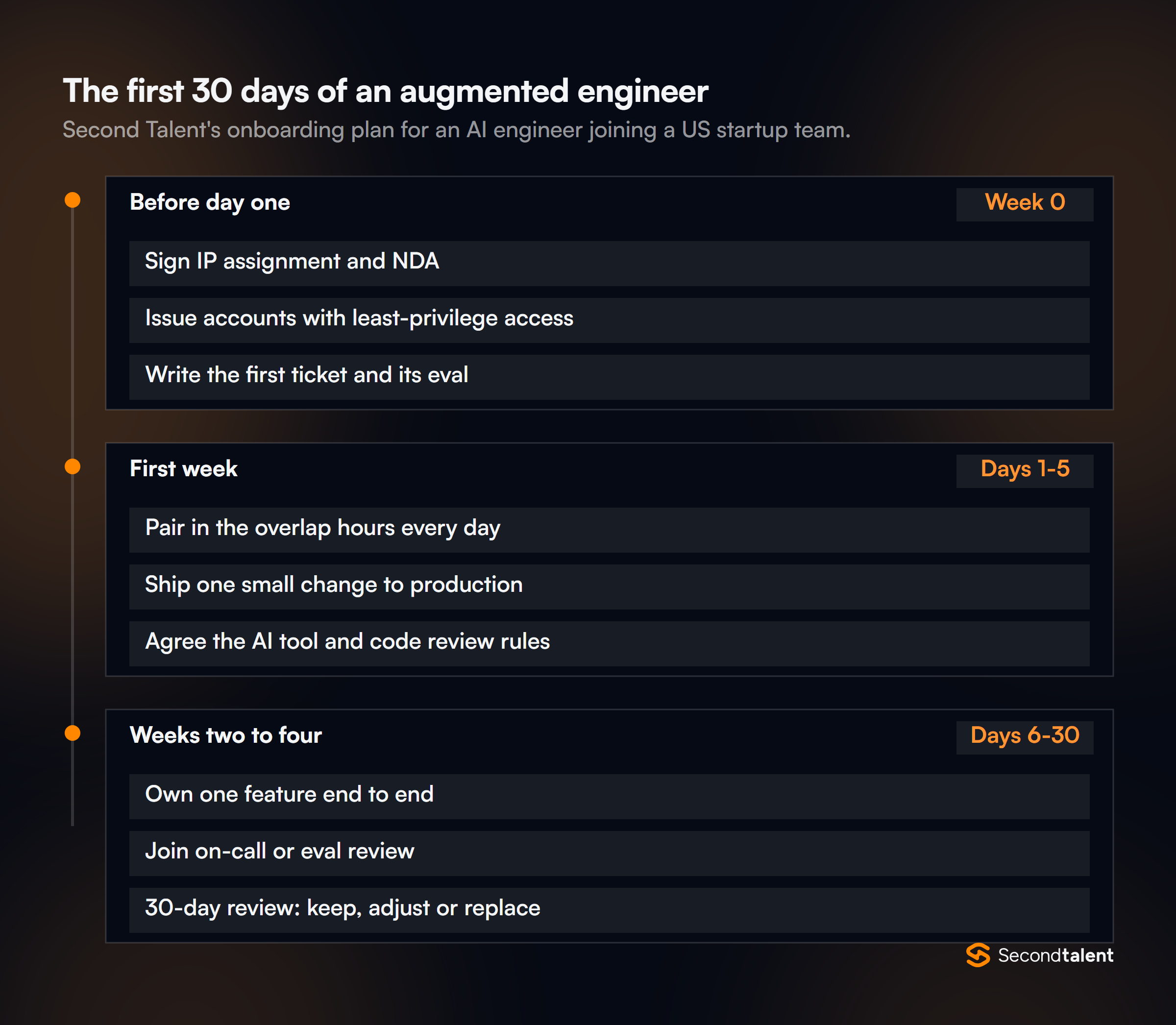
Augmented engineers fail for the same reasons new employees do: no first ticket, no access, no one to ask. The difference is that a provider can replace them, so problems surface faster. The first 30 days decide most engagements.

Roadmap of the first 30 days of an augmented engineer. Before day one: sign IP assignment and NDA, issue least-privilege accounts, write the first ticket and its eval. First week: pair in overlap hours, ship one small change, agree AI tool and review rules. Weeks two to four: own a feature, join on-call or eval review, hold a 30-day review.

Overlap hours

Engineers in Asia can work 4 to 6 hours inside a US working day. Put standups, pairing and design reviews in that window, and leave the rest for focused build time.

An AI engineer whose eval run finishes overnight hands you results by the morning standup. Our US and Asia time zone guide has sample schedules for each US coast.

Security and access

Give access by role, not by default. An LLM engineer needs the prompt repo and a staging key, not the production customer database. Three rules cover most risk:

  • Company-managed accounts and SSO, revoked the day the engagement ends.
  • Masked or synthetic data for development and evals.
  • A written policy on which AI tools may see your code, and on which plan tier.

Contracts and IP

US copyright law defines a "work made for hire" as work by an employee within the scope of employment, or a commissioned work in nine listed categories with a signed agreement. Software written by a contractor fits neither by default.

So the chain has two links: the engineer assigns IP to the provider, and the provider assigns it to you. Ask to see both.

The provider should be the legal employer or contracting party, which keeps IRS worker-classification questions on its side of the line. Have your lawyer read the assignment, confidentiality and non-solicitation clauses before signing.

Risks and how to mitigate them

The worst risk is the rarest one. In June 2025 the Justice Department announced searches of 21 suspected "laptop farms" across 14 states.

Court documents said North Korean IT workers had used the identities of US persons to get remote jobs at more than 100 US companies, causing at least $3 million in damages and legal and remediation costs.

"The North Korean actors were assisted by individuals in the United States, China, United Arab Emirates, and Taiwan, and successfully obtained employment with more than 100 U.S. companies."

US Department of Justice, June 30, 2025

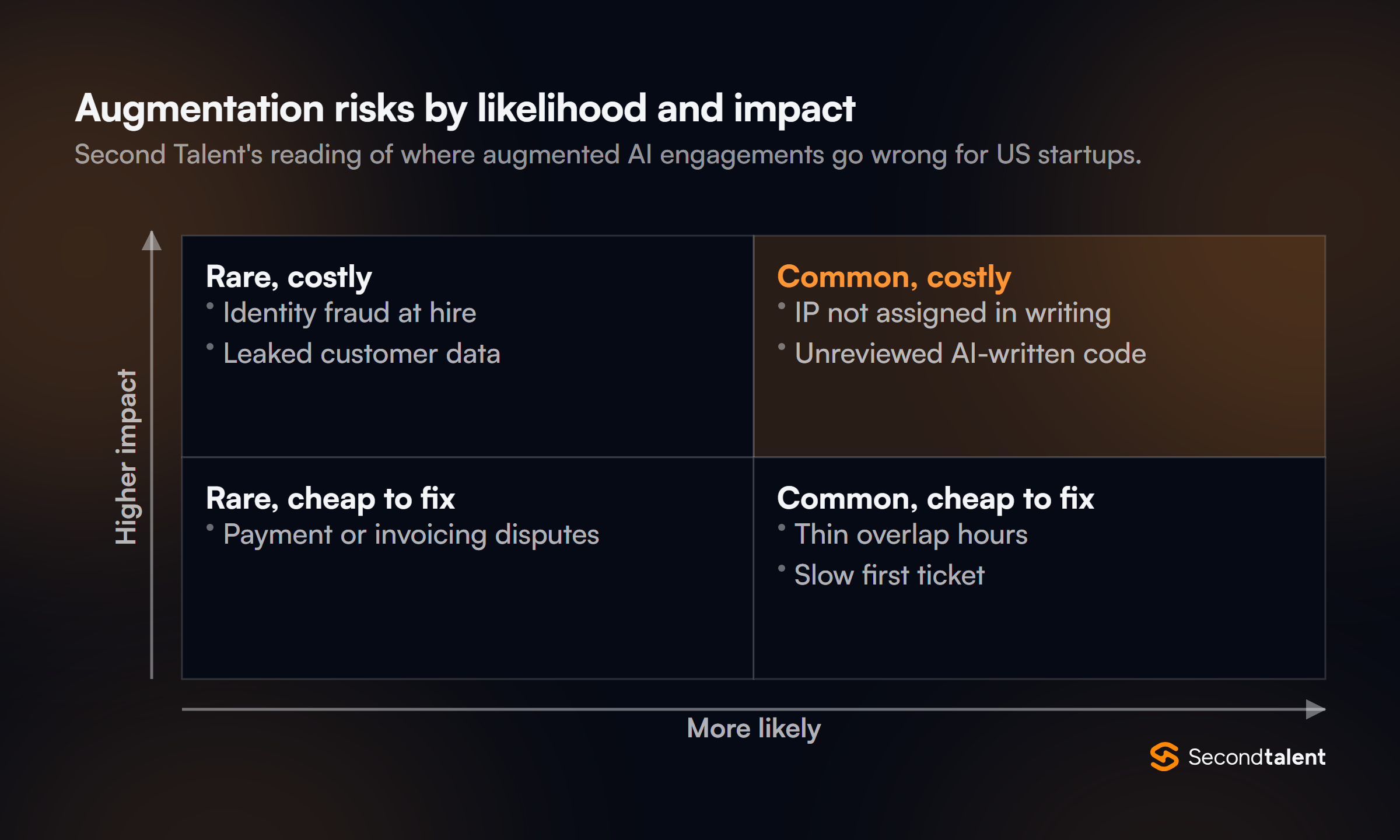
The common risks are cheaper, but they cost more in total because they happen more often.

Two by two matrix of augmentation risks by likelihood and impact. Rare and costly: identity fraud at hire, leaked customer data. Common and costly: IP not assigned in writing, unreviewed AI-written code. Rare and cheap: invoicing disputes. Common and cheap: thin overlap hours, slow first ticket.
  • Identity fraud: require video interviews with the camera on, ID checks matched to payroll, and a device that ships to a verified address.
  • IP gaps: no code is merged before both assignment documents are signed.
  • Unreviewed AI-written code: branch protection and a human reviewer on every merge, the same as for employees.
  • Data leaks: least-privilege access and an AI tool policy from day one.
  • A bad fit: a replacement guarantee with a defined window, written into the contract.

Vendor evaluation checklist

Ask every provider these questions, and get the answers in writing:

  1. How do you verify identity, and at which stage of vetting?
  2. Who is the legal employer, and in which country?
  3. Can I read the IP assignment chain from the engineer to my company?
  4. How do you test AI-assisted coding, and can I see a sample assessment?
  5. How many profiles will I see, and how fast?
  6. How many hours overlap with my time zone, as a contract term?
  7. What is the replacement guarantee, and how long is the window?
  8. What does it cost before I hire anyone?
  9. What is the notice period, and is there a fee to convert the engineer to a full-time hire?
  10. Which AI tools are your engineers allowed to use on client code?

Drop any provider that cannot answer questions 1 and 3 with documents. Our list of platforms to hire AI engineers covers the main options.

Add AI engineers through Second Talent

Second Talent places the top 1% of AI engineers from Asia with US startups. Tell us the seat, and we send a shortlist of 6 to 8 pre-vetted profiles within 24 hours.

Every engineer ships with AI agents from week one and works 4 to 6 hours of US overlap.

Pricing is $23 to $39 an hour, billed monthly: $3,599 to $5,999 for 160 hours, 50-70% below a US hire. It costs $0 until you hire, and every placement carries a 90-day, one-time replacement guarantee. Tell us which AI role you need.

Frequently Asked Questions

How is AI staff augmentation different from regular staff augmentation?

The model is the same; the seats and the risks differ. AI roles need eval, data and model-ops skills that most general developers do not have. They also touch training data and model output, so access and IP terms need more care.

Can I convert an augmented AI engineer to a full-time employee?

Yes, with most providers, after a minimum period and sometimes for a fee. Agree the terms before the engagement starts.

What is the shortest engagement that makes sense?

About three months. The first month goes on onboarding and context, so a shorter engagement spends a third or more of its time on setup.

Get developers who ship with AI agents.

Starts at $23/Hour.

Start Hiring

$0 cost until you hire

Matt Li

Written by

Matt Li is a tech-driven entrepreneur with deep expertise in global talent strategy, digital experience optimization, e-commerce, and Web3 innovation. He is the Co-Founder of Second Talent, a US-based company that connects businesses with top-tier tech professionals worldwide. Since launching the company in 2024, Matt has led its growth by leveraging technology to streamline remote hiring and scale distributed teams. With a background spanning product, operations, and innovation, Matt brings a cross-disciplinary perspective to the evolving digital economy. His work sits at the intersection of global talent, emerging technology, and scalable digital transformation.

More posts by Matt Li →