TL;DR: Decide first whether you need an ML engineer, an AI engineer or an LLM and agent engineer, then screen for RAG, evals and agent work with a paid take-home scored against an eval set. A mid-level AI engineer bills $119 to $185 an hour as a US freelancer, against $29 to $39 an hour for a vetted remote engineer from Asia. Give the hire a production fix in week one and a feature live for all users by day 90.
AI engineer topped LinkedIn's list of the fastest-growing jobs in the US in both 2025 and 2026. The title spreads because it is loose: one startup means a model trainer, the next means someone who wires Claude or GPT into a checkout flow.
The first question we ask on an AI engineer brief is which of those jobs the founder is filling. The answer changes the shortlist more than any skill keyword.
- 1AI-focused software engineers in the US average $245,000 a year in total compensation, according to Levels.fyi.
- 2Benefits make up 30% of total compensation for US private employers, so a salary is never the full cost of an in-house hire.
- 3In a 2025 METR trial, experienced developers were 19% slower with AI tools while believing they were faster. Test how a candidate reviews AI output, not which tools they list.
- 4Gartner projects that 1 in 4 candidate profiles worldwide could be fake by 2028, so a live ID check belongs in the loop.
What does an AI engineer do?
An AI engineer builds product features on top of foundation models.
The job covers calling LLM APIs, connecting models to company data through retrieval, wiring them into agents that use tools, and measuring whether the output is good enough to ship.
Two neighbouring titles get mixed up with it. An ML engineer trains, fine-tunes and serves models. An LLM or agent engineer is the narrowest of the three, a specialist in multi-step systems where the model decides which tool to call next.
The skills overlap more than the titles suggest. Evals, for example, sit near the centre of all three jobs, while training a model is core work for only one of them.
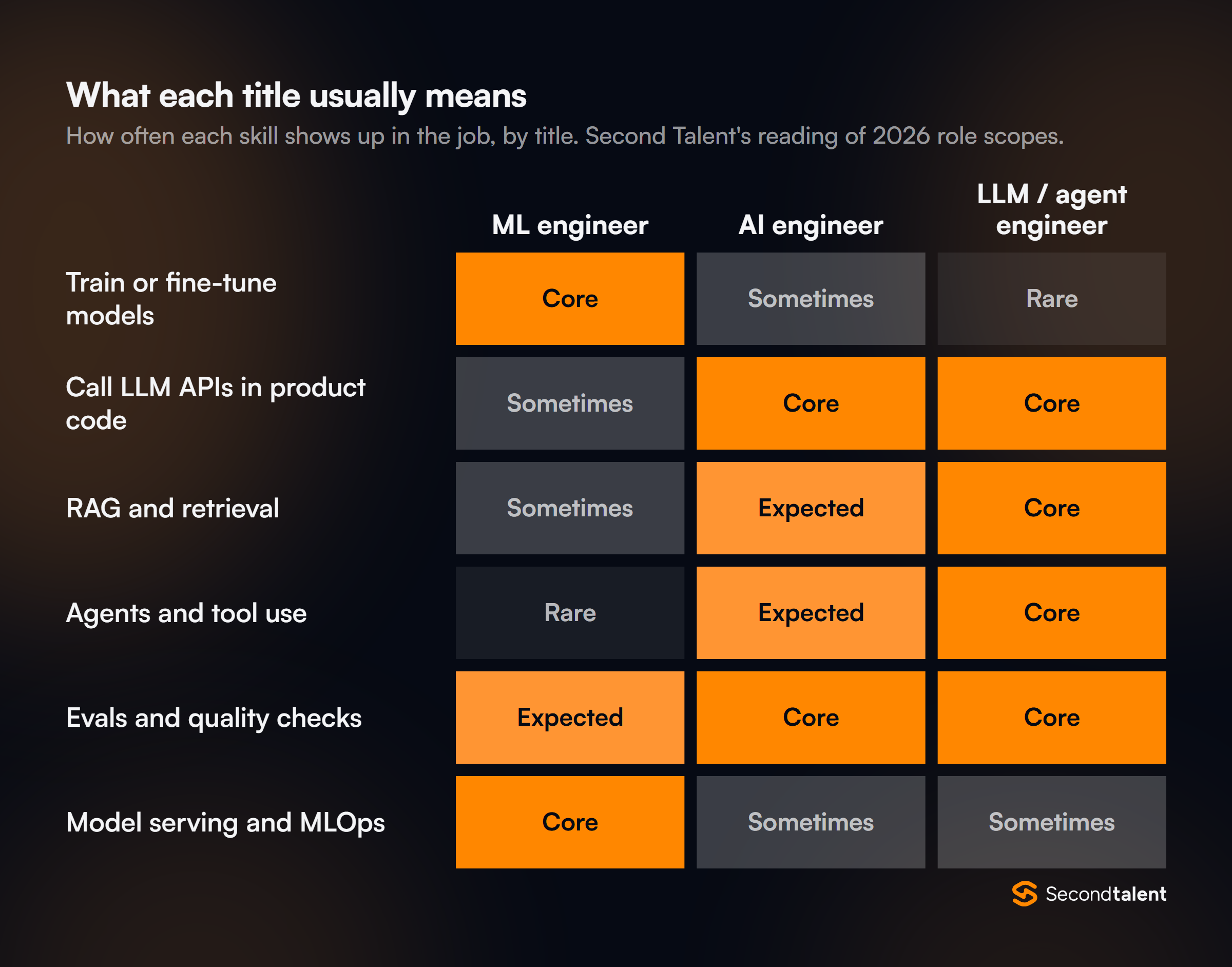
Most US startups before Series B need the middle column. If your product calls OpenAI, Anthropic or Google models and your team will not change the weights, you are hiring an AI engineer.
Hire an ML engineer only when the model itself is the product, and an AI agent developer only when agents fill most of your roadmap.
Anthropic's engineering team draws the line between the two kinds of system this way:
"Workflows are systems where LLMs and tools are orchestrated through predefined code paths. Agents, on the other hand, are systems where LLMs dynamically direct their own processes and tool usage."
Anthropic, Building effective agents, December 19, 2024
The same post advises adding multi-step agentic systems "only when simpler solutions fall short". A candidate who reaches for an agent framework to solve a single-prompt problem is showing you how they will spend your token budget.
Skills to screen for in 2026
The skill that separates good AI engineers in 2026 is catching the answer that is almost right. Stack Overflow's 2025 Developer Survey found high adoption and low trust:
Five skills cover most of what an AI engineer does at a startup. Screen for each with a question that needs a shipped example, not a definition.
LLM APIs and cost control
Every candidate can call an API. The useful ones know what a request costs. Ask for structured outputs, retries with backoff, model routing (a cheap model first, a larger one on failure) and prompt caching.
A good answer to "what did your last feature cost per 1,000 requests?" comes with a number. A weak one comes with the name of a framework.
RAG and retrieval
Retrieval-augmented generation (RAG) is how a model answers from your documents instead of its training data. The hard parts are chunking messy source files, choosing between keyword, vector and hybrid search, and reranking.
Ask how they measured retrieval quality. "Recall at 5 went from 0.6 to 0.85 after we added a reranker" is the shape of a real answer. Our RAG engineer role guide lists the full stack.
Agentic workflows
Agent work means tool calling, state across steps, and recovery when a tool fails or returns junk. Strong candidates also design the stop, where the agent hands a decision to a human.
Ask them to draw an agent they shipped and mark every place it could loop forever.
Evals
An eval is a fixed set of inputs with known good outputs, run on every change to a prompt, model or retrieval setting. It works as the test suite for an AI feature. Ask for an eval that caught a regression before users did.
Candidates who have only judged output by reading it are not ready to own a production feature.
Shipping with AI coding agents
AI coding agents are now part of the job. GitHub's Octoverse 2025 report counted more than 1 million pull requests opened by the Copilot coding agent between May and September 2025.
Speed is not the same thing, though. In METR's randomized trial, 16 experienced open-source developers expected AI to make them 24% faster. On 246 real issues they were 19% slower, and afterwards still believed they had been 20% faster.
Hire the engineer who ships with agents and still reads each diff. Look for small pull requests, tests that run before anyone merges the agent's code, and the habit of rejecting a plausible patch that does not fit the codebase.
Where to find AI engineers, and what each option costs
A US startup has five routes to an AI engineer: an in-house US hire, a US freelancer, a US agency, a nearshore engineer in Latin America, or a remote engineer from Asia, hired directly or through a vetted platform.
They trade speed, cost and how much vetting you do yourself.
| Route | Who vets | Overlap with US hours | Best when |
|---|---|---|---|
| US in-house | You | Full | The role owns core IP and you can wait months |
| US freelancer | You | Full | A scoped prototype of a few weeks |
| US agency | The agency | Full | A fixed project with a fixed budget |
| Nearshore, Latin America | You or a platform | Most of the day | Daily pairing with US product and design |
| Remote from Asia | You or a platform | 4 to 6 hours, shifted | Scaling a team at a lower monthly cost |
Platforms differ more than the table can show. Our comparison of the best platforms to hire AI engineers covers ten of them one by one. Mapped on speed and cost, the routes fall into four groups:
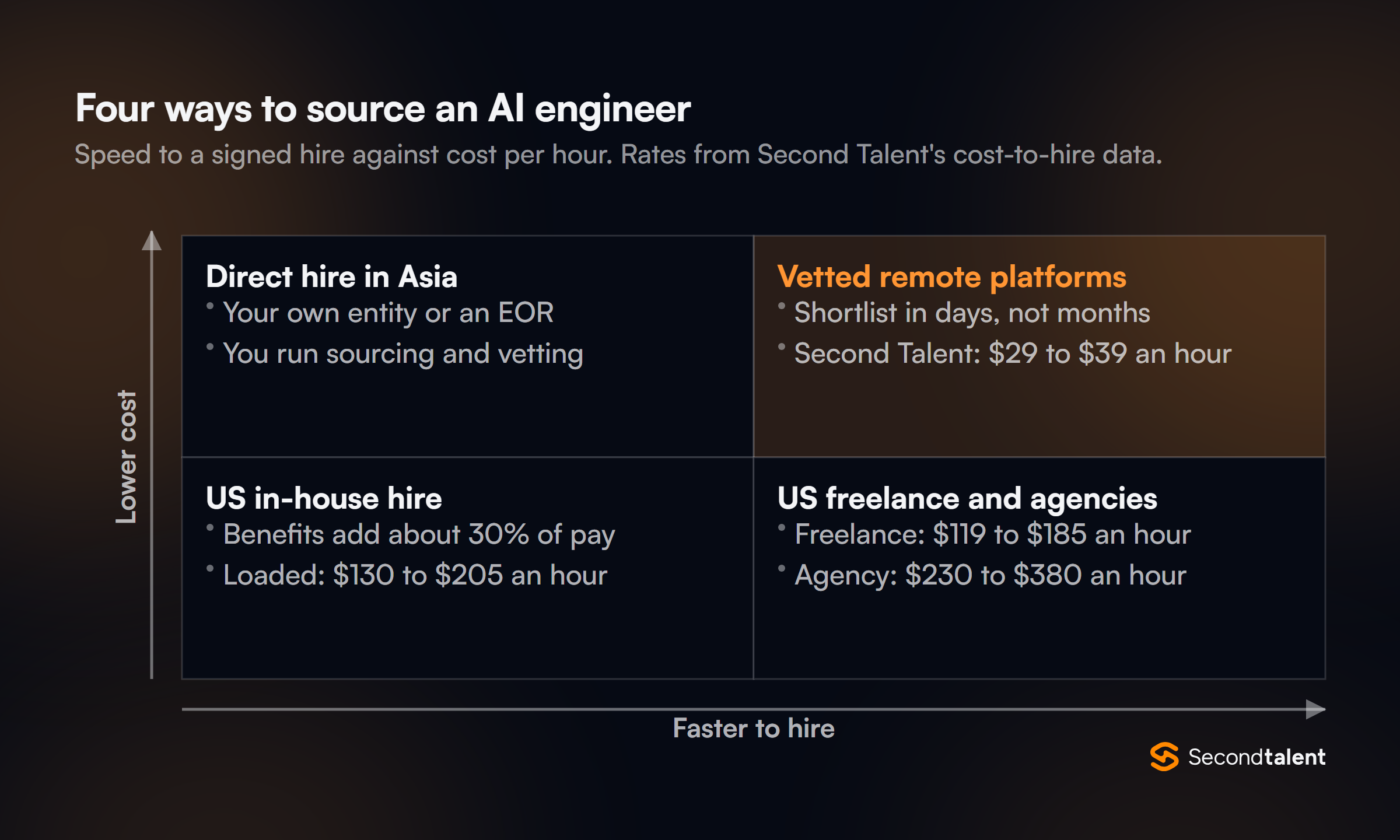
What each route costs per hour
Per hour, a US agency costs eight to ten times a vetted remote engineer from Asia. These are mid-level figures from our AI engineer cost-to-hire data, which loads recruiting, equipment and management time onto the in-house rate.
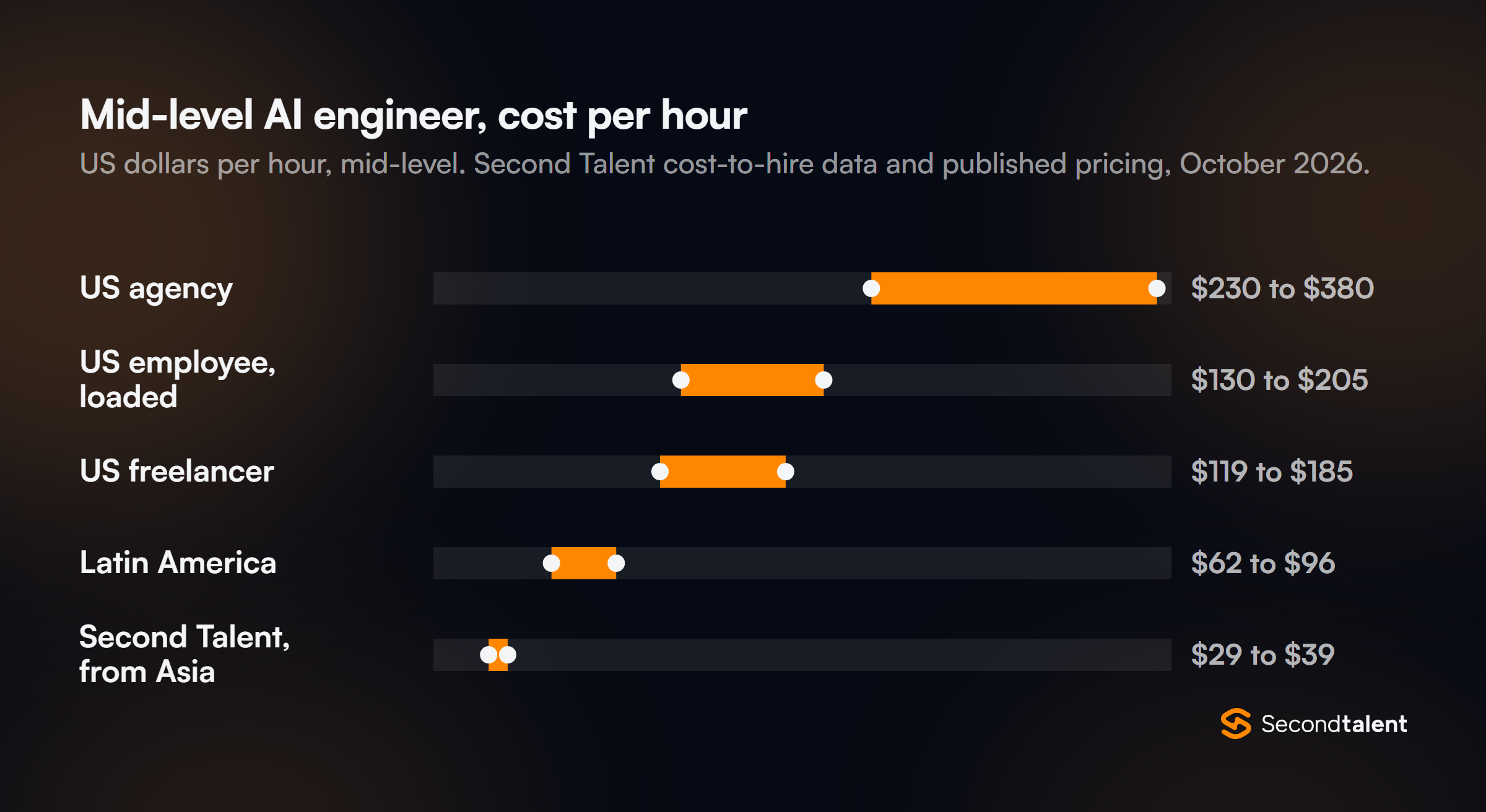
Latin America buys overlap more than savings. Our LATAM vs CEE vs APAC report found employer burden in Brazil running 55 to 70% on top of salary, the heaviest of the markets it covered.
For country-by-country rates across Asia, see the AI engineer rate card by region.
The real cost of a US salary
The Bureau of Labor Statistics has no "AI engineer" category. Its closest match, computer and information research scientists, had a median pay of $140,300 in May 2025, with jobs projected to grow 22% from 2025 to 2035.
Salary is only part of the bill. In the BLS Employer Costs for Employee Compensation release for June 2026, benefits were 30.0% of private-industry compensation and wages 70.0%. On the median salary, that adds about $60,000 a year.
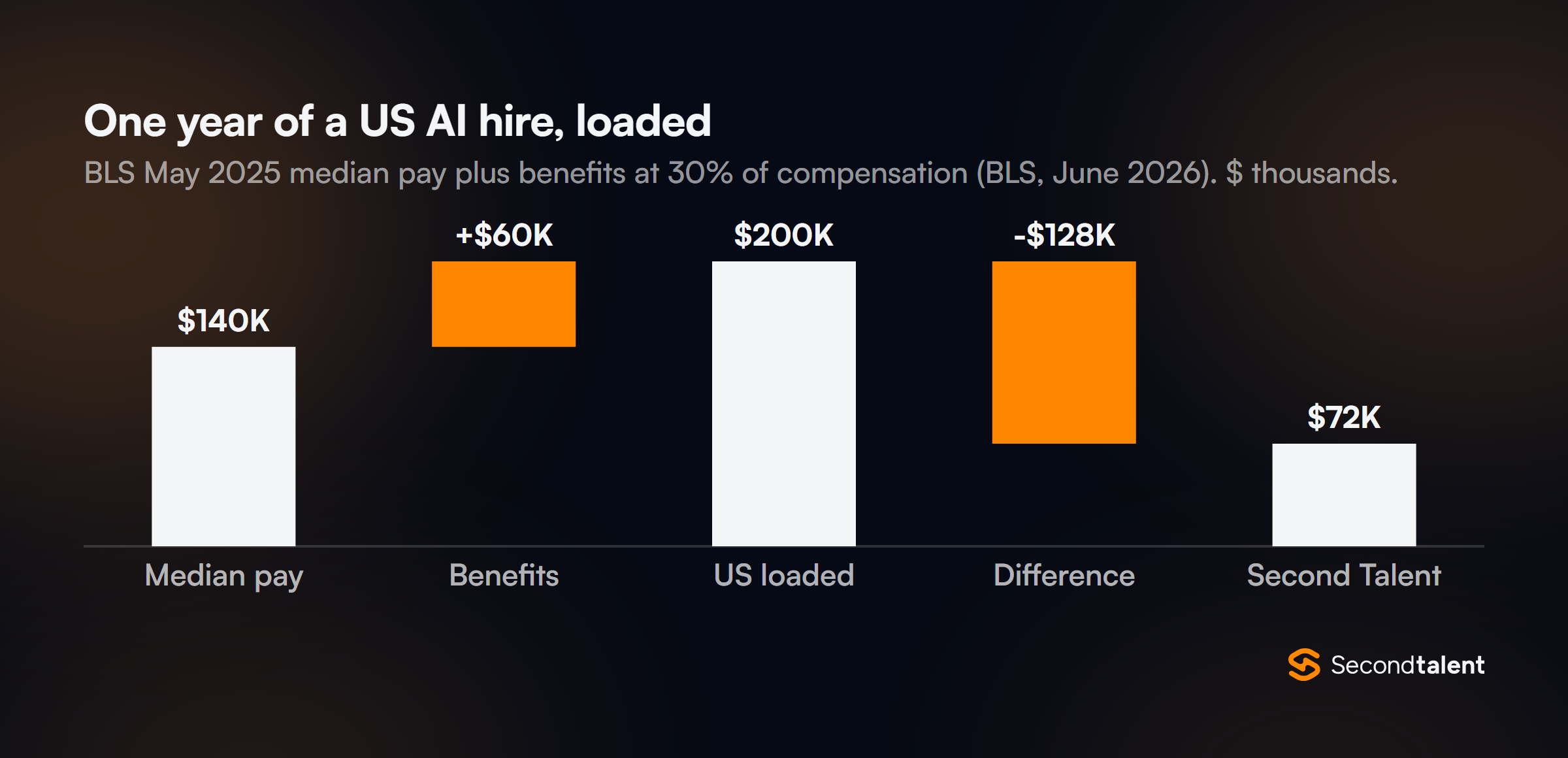
The BLS median is a floor for startups competing with big tech. Levels.fyi's AI engineer compensation report puts AI engineers 11.9% above non-AI engineers at the engineer level, 14.2% at senior and 18.7% at staff.
The Second Talent bar uses the top of our range, $5,999 a month for 160 hours, or $71,988 a year. Our US cost-to-hire page breaks down the same comparison for other roles.
The interview loop and take-home
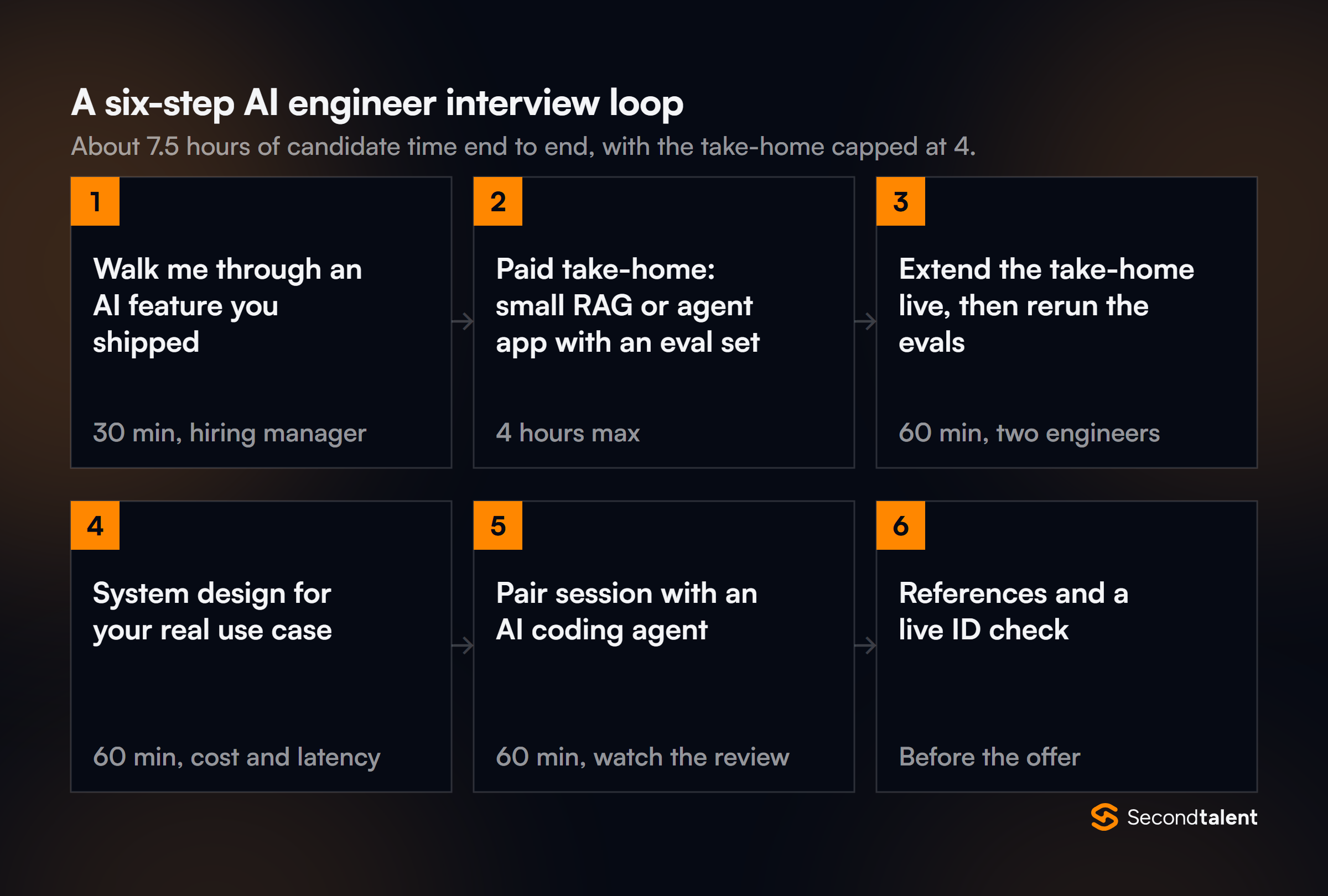
A good AI engineer loop has six steps and asks for about 7.5 hours of the candidate's time. Every step tests something the step before it could not.
The take-home
Pay for it and cap it at 4 hours. Give the candidate 30 to 50 of your own documents (or public ones from your domain) and 20 questions with expected answers. Ask for three things:
- A working retrieval and answer pipeline, in any stack, runnable from a README.
- An eval script that scores all 20 questions and prints accuracy and cost per query.
- A one-page note on the three failures they would fix next, and why.
Give the note the same weight as the code. An engineer who explains why question 14 fails will do the same with your production traffic. Our AI skills evaluation questions work well as prompts for the follow-up.
The live rounds
In step 3, ask for a change to the take-home, such as swapping the model or adding a tool, then rerun the evals. Did the score move, and do they know why?
Step 4 is system design for your real use case, with cost and latency budgets on the whiteboard. The ML system design interview questions cover that round, and the machine learning engineer questions fit when the role leans toward training.
Step 5 is a pair session with an AI coding agent on a small bug in a real repository. Watch the review, not the typing: do they read the generated diff, run the tests and push back on the agent?
Step 6 protects you from a newer risk. HR Dive reported Gartner's projection that 1 in 4 candidate profiles worldwide could be fake by 2028, and 6% of 3,000 candidates in a Gartner survey admitted to interview fraud.
Keep cameras on in every live round and verify ID before the offer.
Red flags in AI engineer candidates
Most weak AI engineering candidates show it in how they talk about quality. These are the patterns that separate a demo builder from someone who can run a feature in production.
- Judges output by reading a few samples
- Cannot say what a request costs
- Reaches for an agent framework for a one-prompt task
- Portfolio is demos with no users
- Pastes coding-agent output without running the tests
- Shows an eval that caught a regression
- Quotes cost and latency per request from memory
- Starts with the simplest design that passes the evals
- Talks about a feature that failed and what they changed
- Rejects a plausible patch that does not fit the codebase
One more flag is title-shaped. A candidate who calls every past role "AI engineer" but only ever trained models in notebooks is an ML engineer, and that is fine if you need one. Check the deliverables, not the titles.
Onboarding in week one
The goal of week one is one small change in production, so access has to be ready on day one. Most stalled AI hires lose their first week to missing API keys, missing eval data or no access to traces.
For a remote hire from Asia, put standup and code review inside the shared hours. Our guide to US and Asia time zone alignment shows which overlap windows work for each US coast.
A 30-60-90 day plan for an AI engineer
Judge each checkpoint against the eval set, not against a demo. A demo shows that a feature can work once. An eval score shows how often it works.
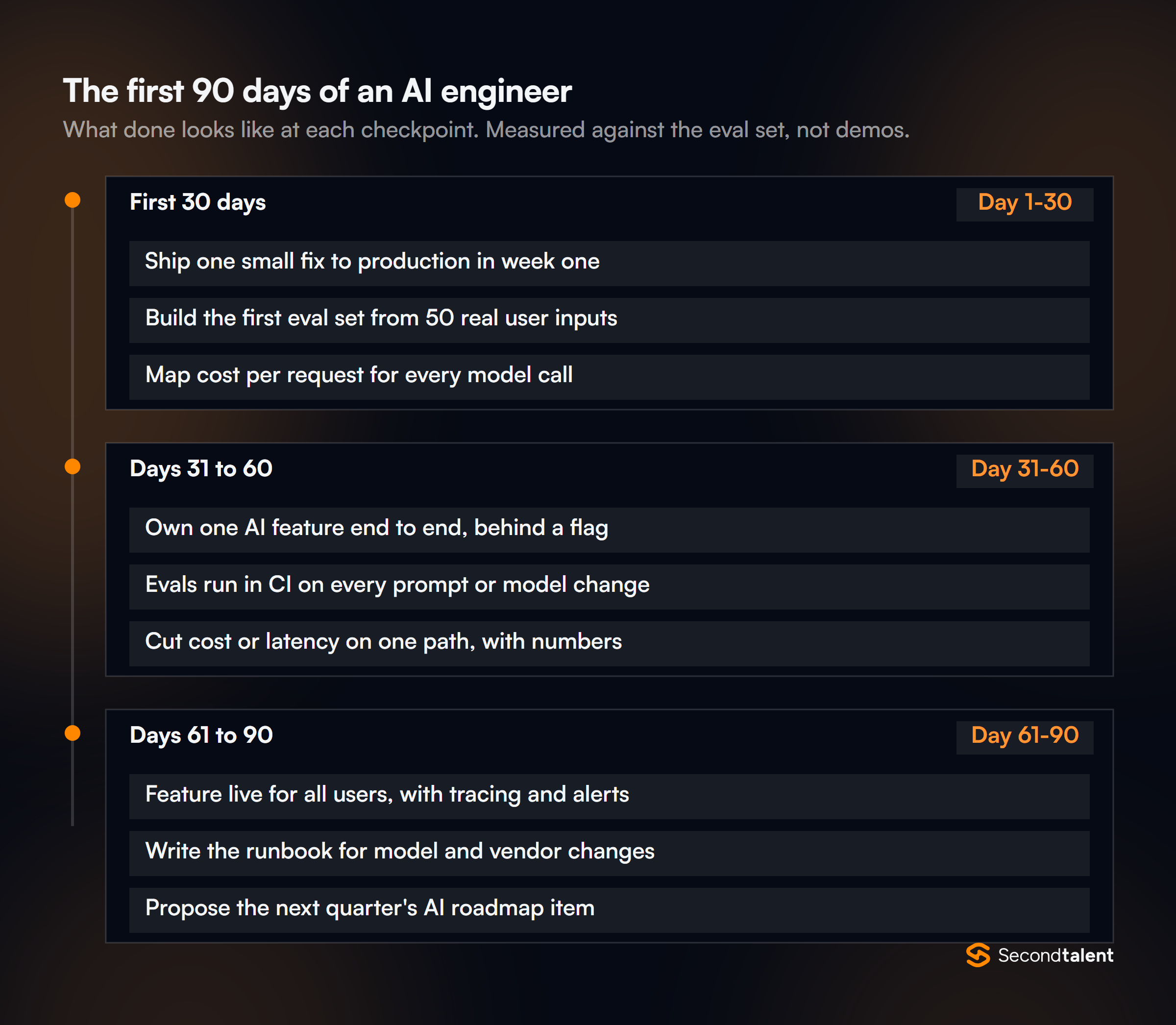
At day 30, the engineer owns an eval set built from real inputs and knows the cost of each model call. A month later that eval runs in CI, so a prompt change that drops quality fails the build.
At day 90, one feature is live for all users, with tracing, alerts and a runbook for the day a model provider changes a version.
If day 30 arrives with no eval set, treat it as the strongest early warning you will get. The engineer is still building demos.
Hire AI engineers from Asia through Second Talent
Second Talent sends you 6 to 8 pre-vetted AI engineers within 24 hours, drawn from the top 1% of applicants. Our engineers ship with AI agents from week one and work 4 to 6 hours of US overlap. Need narrower skills?
We also place LLM engineers.
Pricing is $29 to $39 an hour, billed monthly: $4,599 to $5,999 per 160 hours, 50-70% below a US hire. Every placement carries a 90-day, one-time replacement guarantee, and it costs $0 until you hire.
Tell us what you are building and we will send the shortlist.
Frequently Asked Questions
Should a startup's first AI engineer be senior?
In most cases, yes. The first AI hire sets up the evals, the cost tracking and the review habits everyone after them inherits. A mid-level engineer can do that next to a senior engineer who has done it before, but seldom alone.
Can one of our full-stack engineers become our AI engineer?
In many cases, yes. The model SDKs are ordinary HTTP clients, and a strong full-stack engineer can ship a first AI feature within weeks.
The gap is evals and retrieval quality, so pair the move with the take-home above as a training exercise.
Will senior candidates refuse a take-home?
Some will, which is why you pay for it, cap it at 4 hours and build it on your real problem. Candidates who decline can walk through an equivalent system they shipped, provided they bring the eval results.