
![EOR Pricing Models. EOR Pricing Models Explained: Flat Fee vs Per Employee vs Custom Packages [2026], by Second Talent.](https://www.secondtalent.com/wp-content/uploads/2026/09/pricing-models-explained-flat-fee-vs-per-employee-vs-custom-packages-featured-v2.jpg)
Choosing the right EOR pricing model can save your company thousands of dollars annually while avoiding unexpected costs that derail budget planning.
While most businesses focus on finding the cheapest EOR provider, the pricing structure often matters more than the base rate.
A $199 monthly flat fee might cost more than a 12% percentage model for some companies, while the opposite holds true for others.
Understanding these models and how they align with your specific hiring profile is critical for optimizing costs and avoiding expensive mistakes.
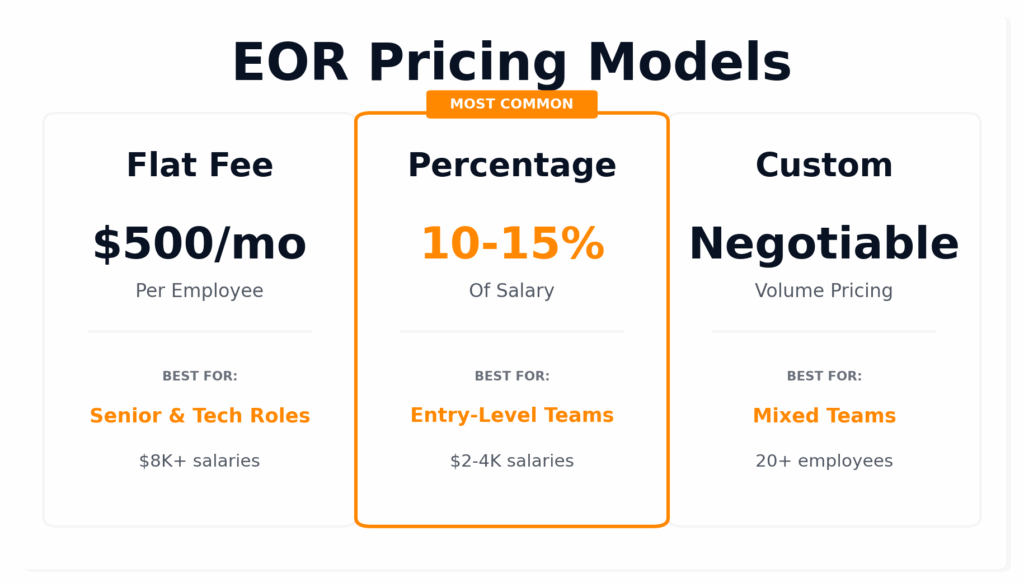
The EOR pricing landscape offers three primary models: flat fee per employee, percentage of salary, and hybrid custom packages. Each structure has distinct advantages, disadvantages, and ideal use cases.
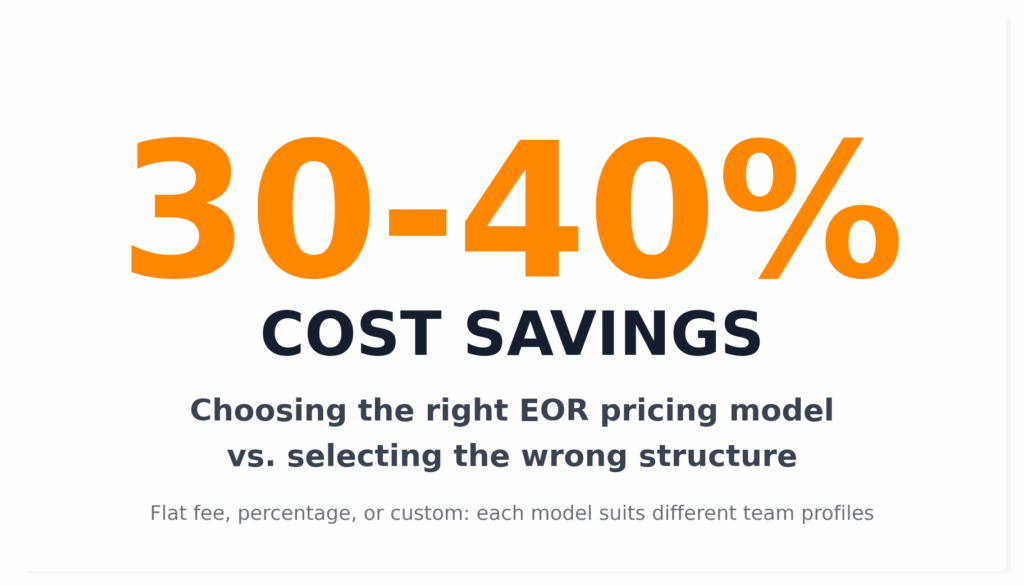
According to 2025 industry data, companies that choose the wrong pricing model overspend by 20-40% compared to those who align their model with their workforce profile.
This comprehensive guide breaks down each model, provides decision frameworks, and offers real-world examples to help you make the optimal choice for your business.
The Flat Fee Model: Predictability and Simplicity
How Flat Fee Pricing Works
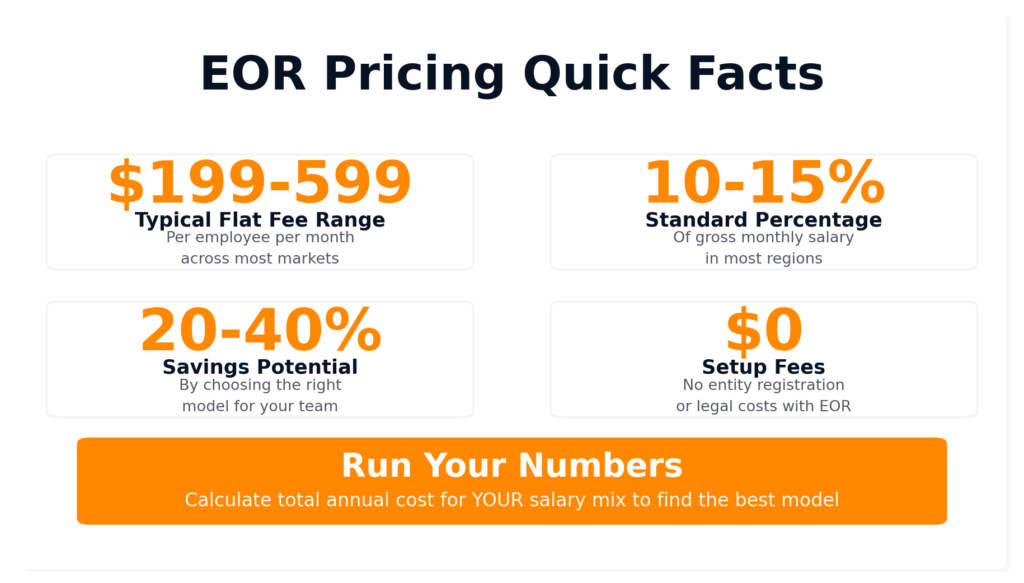
The flat fee model charges a fixed monthly rate per employee regardless of salary level, typically ranging from $300-$1,000 per employee monthly depending on the provider, country, and services included.
This straightforward structure offers maximum predictability, you know exactly what you’ll pay each month regardless of compensation changes, bonuses, or raises.
Best-in-Class Provider Pricing
- Best-in-class providers with strong technology platforms generally charge around $500 per employee monthly
- Premium providers can reach $800-$1,000 for comprehensive services including:
- Dedicated support
- Strategic consulting
Ideal Workforce Profiles for Flat Fee Model
- Companies hiring developers and senior technical talent benefit significantly because:
- Tech salaries often reach $6,000-$12,000 monthly
- A flat $500 fee represents just 4-8% of compensation
- Far more economical than 10-15% percentage models
Startups & Scale-Ups with Salary Growth Plans
- Appreciate flat fee predictability
- If you’re hiring at market rates today but plan to increase compensation 20-30% over two years to retain talent, flat fees protect against corresponding EOR cost increases
| Advantages of Flat Fee Pricing | Disadvantages of Flat Fee Pricing |
|---|---|
| 1. Budget Predictability | 1. Higher Upfront Costs for Entry-Level Roles |
| • Primary advantage of flat fee models | • Can make flat fees uneconomical for certain positions |
| • Financial planning becomes straightforward: multiply headcount by monthly fee, add setup costs for reliable annual budget | • Example: Administrative assistant earning $2,000 monthly with $500 flat fee = 25% effective rate (far higher than most percentage models) |
| • No surprises when giving raises, no calculations around bonus payments, no concern about salary negotiations inflating EOR costs | • Portfolio of 20 employees earning $2,000-$4,000 monthly might cost $10,000 in flat fees vs $6,000-$8,000 under percentage pricing |
| • Certainty extends to multi-year planning: project EOR costs years ahead based solely on hiring projections, not salary forecasts | • For companies hiring primarily junior and mid-level roles in cost-effective markets, flat fees often don’t make financial sense |
| 2. Cost Efficiency for High-Salary Roles | 2. Limited Flexibility as Workforce Composition Changes |
| • Delivers substantial savings | • Requires periodic model reassessment |
| • Example: Senior engineering manager earning $150,000 annually ($12,500 monthly): – Flat $600 monthly fee = $7,200 annually (4.8% of salary) – 12% percentage model = $18,000 annually – Savings: $10,800 per employee | • If you start hiring senior developers (where flat fees excel) but shift to hiring more junior support staff, your once-optimal flat fee arrangement becomes expensive |
| • For companies hiring 10+ senior professionals, savings compound dramatically | • Particularly problematic for startups pivoting business models or workforce strategiesCompanies with evolving workforce profiles may find themselves locked into suboptimal pricing if committed to long-term flat fee contracts |
| • Math becomes even more favorable for executive-level hires earning $200,000+ annually | • Particularly problematic for startups pivoting business models or workforce strategies |
| 3. Simplicity in Administration | 3. Potential for Overpayment in Low-Cost Markets |
| • Reduces overhead | • Makes geographic location critical |
| • No complex calculations each payroll cycle | • Hiring in Vietnam or Philippines where excellent developers earn $3,000-$4,000 monthly means $500 flat fee = 12.5-16.7% of compensation |
| • No verification of percentage calculations against varying salary components | • Percentage models charging 10-12% would be more cost-effective |
| • No disputes about whether bonuses or stock grants affect EOR fees | • For companies focused exclusively on cost-efficient markets, flat fees may not optimize savings despite other advantages |
| • Saves finance team time and reduces potential for billing errors | |
| • Makes provider comparisons easier, comparing apples to apples across vendors |
The Percentage-Based Model:
How Percentage Pricing Works
Percentage-based models calculate fees as a portion of each employee’s gross monthly salary, typically ranging from 8-20% depending on the provider, country, and compliance complexity. The most common range is 10-15% for standard markets.
Industry benchmarks show that competitive markets like Poland or Mexico might see 8-12% rates, while complex jurisdictions like France or Brazil push fees to 15-18%.
Some premium providers charge 18-20% for markets with extensive compliance requirements.
Natural Scaling with Compensation Structure
- Model scales naturally with your compensation structure
- Example of proportional relationship:
- Employee earning $3,000 monthly at 12% pays $360 in EOR fees
- Employee earning $8,000 monthly pays $960 in EOR fees
- Percentage remains constant while absolute costs adjust to compensation levels
- EOR costs track directly with payroll expenses, when salaries increase 10%, EOR costs increase 10%
- This alignment creates a consistent cost structure as a percentage of revenue for growing companies
What’s Included in Percentage Calculations
- Percentage models typically apply to base salary, though specifics vary by provider
- Some include bonuses and commissions in the calculation basis, while others exempt these variable compensation elements
- Equity grants, stock options, and non-cash benefits usually aren’t included
- Always clarify exactly what’s included in the percentage calculation: differences in scope can significantly impact total costs
- Request examples showing how various compensation elements affect your final fees
Advantages of Percentage-Based Pricing
Cost efficiency for lower salaries makes percentage models ideal for companies hiring entry-level and mid-level roles in cost-effective markets.
An employee earning $2,500 monthly at 12% costs just $300 in EOR fees: substantially less than $500-$600 flat fees.
For businesses building customer success teams, administrative staff, or junior technical roles in markets like Vietnam or the Philippines, percentage models optimize costs significantly.
Natural Scaling with Business Growth
- Aligns EOR costs with revenue for many companies
- SaaS businesses and service companies often structure compensation as a percentage of revenue or contribution margin
- When EOR costs also scale as percentages, the entire employment cost structure remains proportional to business performance
- This alignment means EOR expenses don’t become disproportionately expensive as the company grows, provided salary levels remain relatively stable
Fairness Across Diverse Salary Bands
- Provides consistency when hiring across wide compensation ranges
- Example: A company employing customer support representatives at $2,000 monthly and senior engineers at $10,000 monthly pays proportional EOR fees under percentage models
- While absolute fees differ ($240 vs $1,200 at 12%), the effective rate remains constant
- This proportionality can simplify:
- Internal cost allocation
- Departmental budgeting where different functions have dramatically different compensation levels
Lower Initial Commitment for Market Testing
- Makes percentage models attractive when expanding into new geographies with uncertain hiring volumes
- You don’t need to:
- Negotiate volume discounts
- Commit to minimum fees
- The first employee costs the same percentage as the hundredth, providing flexibility to test markets with small teams
- If the market doesn’t work out, your EOR expenses scale down naturally with reduced headcount
Disadvantages of Percentage-Based Pricing
Escalating costs with salary growth create a compounding expense problem over time. Every raise, promotion, and market adjustment increases your EOR fees proportionally.
A team of 20 employees receiving 15% annual raises sees EOR costs increase 15% annually too, compounding to 52% higher costs over three years even with stable headcount.
This escalation becomes particularly painful for high-growth startups aggressively increasing compensation to retain talent in competitive markets.
Hybrid and Custom Models: Balancing Flexibility and Optimization
Understanding Hybrid Pricing Structures
Hybrid models combine elements of both flat fee and percentage approaches, attempting to capture advantages of each while mitigating disadvantages.
The most common hybrid structure features a base monthly fee per employee plus a smaller percentage of salary.
For example, a provider might charge $200 monthly base plus 5% of salary. This creates a floor cost protecting the provider while capping maximum fees relative to pure percentage models.
Other hybrid variants use flat fees with percentage adjustments above certain salary thresholds.
Hybrid Models (Base Fee + Percentage)
- Appeal to companies with diverse workforce compositions spanning junior to senior roles
- Base fee covers fundamental compliance and administrative costs while percentage component ensures fairness across salary bands
- Example pricing structure:
- Customer service representative earning $2,500 monthly pays $325 total ($200 base + $125 percentage)
- Senior developer earning $8,000 monthly pays $600 total ($200 base + $400 percentage)
- This structure provides more balanced economics than either pure model alone
Custom Enterprise Packages
- Represent the most sophisticated pricing approach
- Designed specifically for larger deployments or complex requirements
- Bespoke arrangements might include:
- Tiered pricing (first 20 employees at one rate, next 30 at a reduced rate)
- Geography-specific pricing (different models for different countries)
- Service-level variations (premium pricing for priority support, standard pricing for self-service)
When Hybrid Models Make Sense
Diverse salary ranges across your workforce make hybrid models particularly valuable.
If you’re hiring customer success teams at $2,500-$3,500 monthly alongside engineering teams at $7,000-$10,000 monthly, neither pure model optimizes costs across both groups.
Hybrid pricing creates middle-ground economics that prevents overpaying for junior roles while avoiding excessive costs for senior talent.
This balanced approach simplifies provider selection by finding one pricing structure that works reasonably well for all hiring profiles.
Growing Companies with Evolving Hiring Profiles
- Benefit from hybrid flexibility
- Startups often begin hiring senior practitioners who can operate autonomously, then expand to larger teams with more junior members over time
- Hybrid pricing accommodates this evolution without requiring model switches or renegotiation as workforce composition changes
- Structure remains fair and economical through different growth phases
- Reduces need for pricing reviews and contract amendments
Multi-Country Expansion with Varying Market Dynamics
- Makes custom packages optimal
- Example scenario: Company hiring in both Western Europe (high salaries, complex compliance) and Southeast Asia (lower salaries, streamlined processes) faces dramatically different economics in each market
- Custom packages can specify:
- Percentage pricing for Asian markets
- Flat fees for European markets
- Benefits:
- Optimizes costs regionally while consolidating under a single provider relationship
- Balances global consistency with local economic realities through geographic optimization
Negotiating Custom Packages
Volume creates leverage for custom package negotiation. Providers become flexible on pricing structures when dealing with commitments of 20+ employees or multi-country expansion plans.
Don’t accept standard published pricing if you represent significant revenue potential.
Instead, propose a custom structure aligned with your specific needs, perhaps flat fees for roles above $6,000 monthly and percentage pricing below that threshold.
Providers willing to customize pricing demonstrate partnership orientation beyond transactional relationships.
Decision Framework: Choosing Your Optimal Model
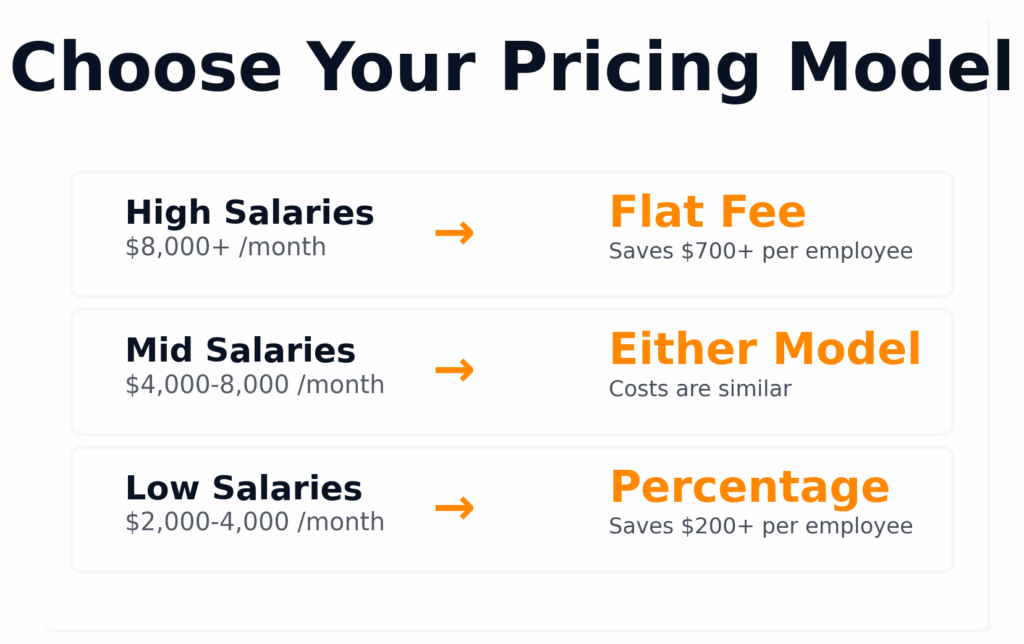
Selecting the right pricing model requires analyzing your specific situation across multiple dimensions. The following table provides a decision framework based on common scenarios:
| Your Situation | Recommended Model | Why It Works | Watch Out For |
|---|---|---|---|
| Hiring primarily senior technical talent ($8K+ monthly salaries) | Flat Fee | Effective rate stays under 7%, avoids escalation with raises | If you shift to hiring more junior roles, model becomes expensive |
| Building customer success or support teams ($2K-$4K salaries) | Percentage | Keeps costs proportional; 10-12% beats most flat fees | Costs rise with any salary increases or promotions |
| Mixed team (junior + senior roles across wide salary range) | Hybrid | Base fee + percentage balances costs across salary bands | More complex to compare across providers; verify calculation examples |
| Hiring 1-5 employees, testing new market | Percentage | No volume commitments needed; easy to scale down if market doesn’t work | Less negotiating leverage; may pay higher effective rates |
| Hiring 20+ employees across multiple countries | Custom Package | Volume justifies customization; can optimize per market | Requires careful negotiation; compare total cost across models |
| Planning aggressive salary growth (20%+ annual increases) | Flat Fee | Isolates EOR costs from compensation inflation | Higher upfront costs; ensure provider offers volume discounts |
| Hiring exclusively in low-cost markets (Asia, Eastern Europe) | Percentage | Lower absolute salaries make percentages economical | As local markets mature, salaries rise and percentages become expensive |
| Hiring executives and C-level roles ($15K+ monthly) | Flat Fee (with caps) | Percentage models create exorbitant costs at executive salary levels | Negotiate reasonable flat fee rates; don’t accept standard $800-1000 pricing |
Running the Numbers:
Build a Detailed Spreadsheet Analysis
- The only way to know definitively which model optimizes costs is running detailed calculations across your actual or projected hiring profile
- Build a spreadsheet listing:
- Each role you plan to hire
- Their location
- Expected monthly salary
- Calculate total annual EOR costs under each pricing model using actual provider quotes
- This analysis often reveals surprising results that contradict intuitive assumptions about which model is cheapest
Practical Example 1: Developer-Heavy Workforce (Flat Fee Wins)
- Company plans to hire 15 employees across three salary bands:
- 5 customer success representatives at $2,800 monthly
- 7 mid-level developers at $5,500 monthly
- 3 senior engineers at $9,500 monthly
- Total monthly payroll: $90,900
- Flat fee model at $500 per employee:
- Monthly cost: $7,500 (15 employees × $500)
- Annual cost: $90,000
- Percentage model at 11% of salary:
- Monthly cost: $9,999 ($90,900 × 11%)
- Annual cost: $119,988
- Result: Flat fee saves nearly $30,000 annually because higher-salary developers dominate the workforce mix
Practical Example 2: Support-Heavy Workforce (Percentage Model Wins)
- Same company with different composition:
- 10 customer success at $2,800 monthly
- 3 mid-level developers at $5,500 monthly
- 2 senior engineers at $9,500 monthly
- Total monthly payroll: $63,000
- Flat fee at $500:
- Monthly cost: $7,500 (15 employees × $500)
- Annual cost: $90,000
- Percentage at 11%:
- Monthly cost: $6,930 ($63,000 × 11%)
- Annual cost: $83,160
- Result: Percentage model now saves nearly $7,000 annually because the workforce skews toward lower-salary roles
- Key Takeaway: This demonstrates why workforce composition critically determines optimal model selection
Run Sensitivity Analysis for Future Scenarios
- Model different scenarios to understand long-term cost implications:
- Salaries increase 15% annually
- Shift hiring emphasis between junior and senior roles
- Headcount grows faster than expected
- Understanding how different scenarios affect costs under each model reveals which pricing structure provides the best combination of:
- Current optimization
- Future flexibility
Cost Comparison Table: Real-World Examples
The following table illustrates total annual EOR costs across different pricing models for various workforce scenarios, helping visualize how model selection impacts your budget:
| Workforce Profile | Total Annual Payroll | Flat Fee ($500/mo) | Percentage (11%) | Hybrid ($250 + 6%) | Best Model |
|---|---|---|---|---|---|
| 5 senior developers @ $10K/mo | $600,000 | $30,000 | $66,000 | $51,000 | Flat Fee (saves $21K+) |
| 10 support staff @ $2.5K/mo | $300,000 | $60,000 | $33,000 | $48,000 | Percentage (saves $15K+) |
| 3 seniors @ $10K + 7 mid @ $5K/mo | $780,000 | $60,000 | $85,800 | $76,800 | Flat Fee (saves $16K+) |
| 8 mid-level @ $4.5K/mo | $432,000 | $48,000 | $47,520 | $49,920 | Percentage (marginal) |
| 5 junior @ $3K + 5 senior @ $9K/mo | $720,000 | $60,000 | $79,200 | $73,200 | Flat Fee (saves $13K+) |
| 2 executives @ $18K + 3 mid @ $6K/mo | $648,000 | $30,000 | $71,280 | $53,880 | Flat Fee (saves $23K+) |
These examples demonstrate clear patterns. Flat fees dramatically outperform percentage models when workforce includes high-salary employees, particularly at $8,000+ monthly compensation.
Percentage models excel for teams concentrated in the $2,000-$4,000 salary range. Hybrid models provide middle-ground economics but rarely beat the optimal pure model for specific workforce profiles.
The key lesson: analyze your actual hiring profile rather than selecting a model based on general principles.
Tips for Optimizing Your Chosen Model
Tips for Optimizing Your Chosen Model
Once you’ve selected a pricing model, several strategies maximize value regardless of which structure you choose.
1. Negotiate Volume Tiers Even for Small Initial Deployments
- Start negotiations based on future growth potential, not just current needs
- Example approach:
- Starting with 5 employees but projecting 20 within 18 months
- Negotiate rates based on that future volume of 20 employees
- Providers value growth potential and will often extend volume pricing upfront in exchange for commitment to hire through them as you scale
- Structure agreements with automatic rate reductions as headcount thresholds trigger
- This locks in better economics from day one while providing clear incentives for the provider to support your growth
2. Bundle Multiple Countries Under Unified Pricing
- Leverage multi-country hiring for better rates and simplification
- If you’re hiring in three or more countries, negotiate consolidated pricing across all markets rather than separate contracts per country
- Benefits of bundling:
- Providers prefer managing customers holistically and will often offer better overall rates for multi-country commitments
- Simplifies administration by creating single points of contact
- Unified billing rather than managing multiple provider relationships
- Creates stronger negotiating position and streamlines ongoing management
3. Lock in Pricing for 2-3 Years
- Protect against rate increases and ensure budget predictability
- Market context: With inflation and cost pressures, EOR pricing tends to increase 3-8% annually at renewal
- Negotiate multi-year pricing locks in exchange for commitment, ensuring:
- Budget predictability over the contract term
- Protection against market rate increases
- Important safeguards:
- If committing to longer terms, include reasonable escape clauses for service quality issues or major business changes
- Securing fixed pricing provides substantial value in rising rate environments
4. Build Salary Bands Into Hybrid Models
- Create precision optimization for your specific compensation architecture
- If negotiating custom pricing, propose specific hybrid structures optimized for your needs
- Example salary band structure:
- Percentage pricing for salaries under $4,000 monthly
- Flat fees for salaries above $7,000 monthly
- Blended rate for the $4,000-$7,000 band
- This granular approach ensures optimal pricing across all salary levels
- Trade-off: Requires more complex billing administration, but delivers maximum cost efficiency
5. Regular Competitive Benchmarking
- Ensure ongoing optimization and prevent overpaying
- EOR pricing evolves as markets mature and competitors enter
- Best practice: Annual benchmarking against market rates ensures you’re not overpaying relative to current offerings
- Action steps:
- If your provider’s pricing has become uncompetitive, use data from competitive quotes to negotiate rate reductions
- Consider switching providers if significant savings are available
- Reality check: Many companies continue with suboptimal pricing simply because they don’t regularly assess alternatives
- Regular assessment protects against pricing drift and ensures you maintain competitive advantage
Retry
Conclusion: Making Your Optimal Choice
Selecting the right EOR pricing model fundamentally impacts your international employment costs, potentially creating 20-40% cost differences compared to suboptimal choices.
Flat fee models deliver superior value for companies hiring senior talent with high salaries, particularly in technical roles where compensation exceeds $8,000-$10,000 monthly.
The predictability and protection against salary-driven cost escalation make flat fees ideal for companies planning aggressive compensation growth or hiring primarily at senior levels.
Percentage-based models optimize costs for companies building teams in lower salary bands, typically under $4,000-$5,000 monthly.
Entry-level and mid-level roles in cost-effective markets like Vietnam, Philippines, and Eastern Europe benefit from percentage pricing that keeps EOR costs proportional to moderate compensation levels.
The scalability and flexibility of percentage models also suit companies with uncertain hiring volumes or those testing new markets with small initial teams.
Remember that the right model today may become suboptimal tomorrow as your business evolves. Commit to annual pricing reviews that reassess your model against current workforce realities and market alternatives.
Stay informed about provider innovations and new entrants offering different pricing approaches.
The goal isn’t finding the perfect model for all time but rather maintaining ongoing optimization as your international hiring needs mature.
With thoughtful selection, strategic negotiation, and regular optimization, your EOR pricing model becomes a cost advantage rather than an unavoidable expense.