TL;DR: Eight providers cover Singapore well: AYP Group, Second Talent, Omni HR, Multiplier, Deel, Remote, Papaya Global and Pebl (formerly Velocity Global).
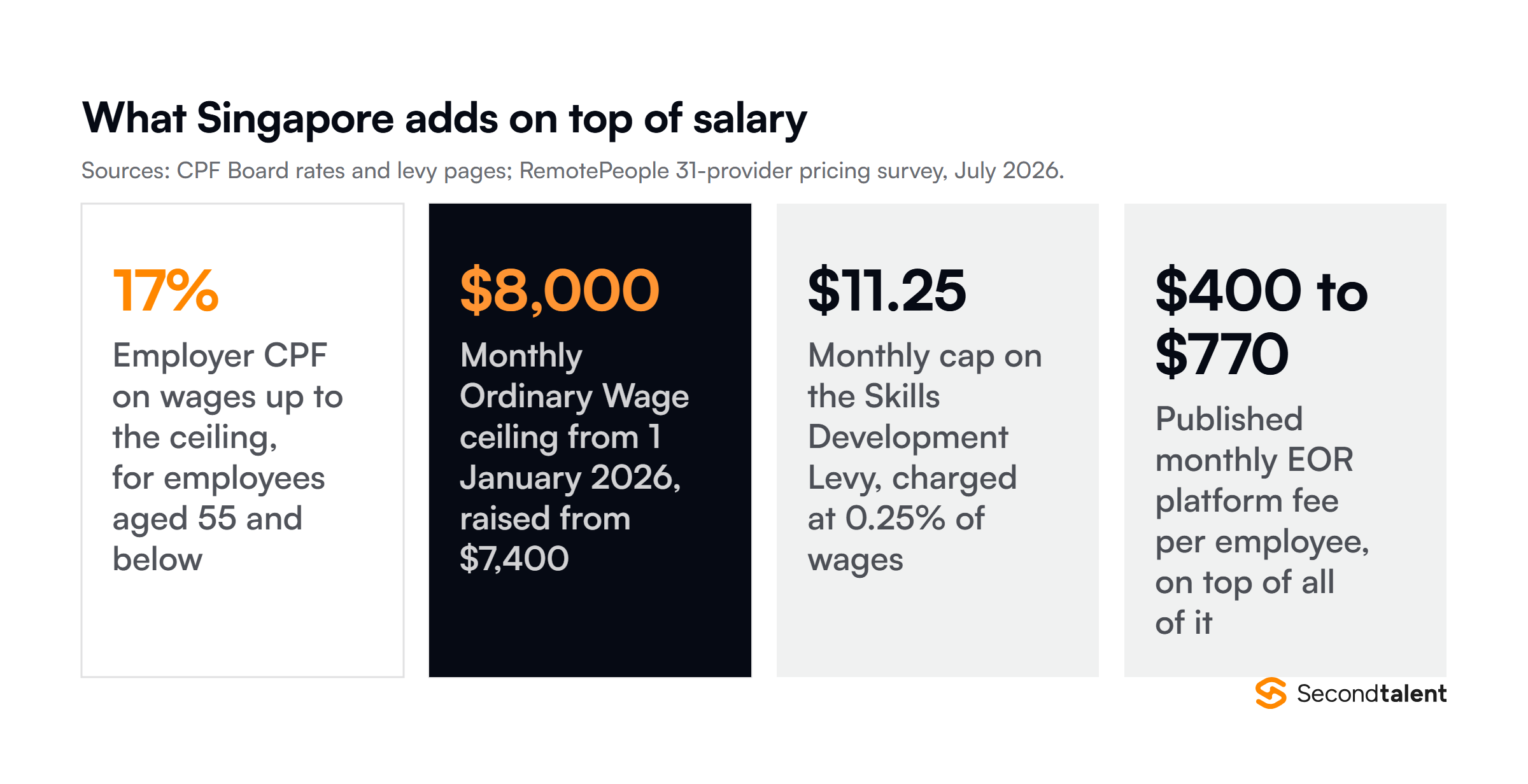
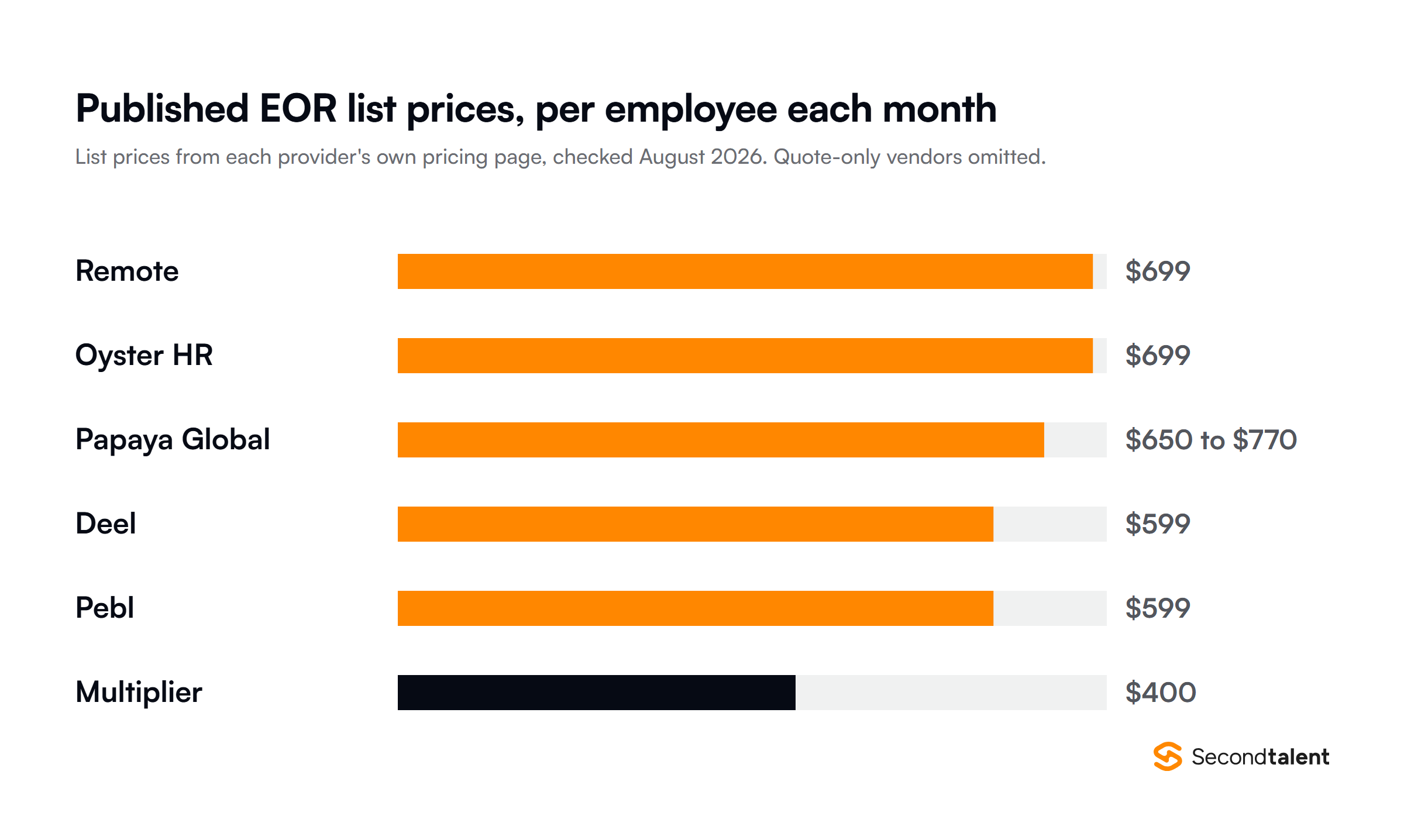
Published platform fees run $400 to $770 per employee each month, and on top of that Singapore charges 17% employer CPF up to an $8,000 monthly wage ceiling plus the Skills Development Levy.
One rule decides most shortlists before price does: since July 2024 the Ministry of Manpower has barred EOR providers from sponsoring work passes for staff who work for an overseas company.
If your Singapore hire needs an Employment Pass, an EOR is the wrong instrument.
I run international employment at Second Talent, and we employ staff across nine APAC markets including Singapore. Buyers arrive asking which provider is cheapest.
The first question I ask back is whether the person they want to hire holds a Singapore passport or a pink identity card.
That answer decides whether an EOR can help at all. This guide ranks the eight providers worth shortlisting, prices what a Singapore employee costs in full, and covers the work pass rule that most vendor comparison pages still get wrong.
Second Talent places pre-vetted developers in Singapore full-time, with first profiles in 24 hours.
Quick comparison
| Provider | Type | Strongest in | Published price |
|---|---|---|---|
| AYP Group | Singapore-headquartered | Owned entities across 14 APAC markets | On request |
| Second Talent | APAC-native | Sourcing and employment in one contract | On request |
| Omni HR | Singapore-headquartered | EOR bundled with a full HRIS | On request |
| Multiplier | Singapore-founded | Lowest published fee, self-serve onboarding | From $400 |
| Deel | Global major | Integrations and contractor conversion | $599 |
| Remote | Global major | Owned entities and IP assignment | $699 |
| Papaya Global | Global major | Payroll analytics at enterprise scale | $650 to $770 |
| Pebl | Global major | Country count and executive hires | Around $599 |
The five things that decide this
- Confirm the hire’s status first. Citizens and PRs can go through an EOR, foreign nationals needing a pass cannot.
- Ask each provider to name the Singapore entity on the contract and confirm it owns that entity.
- Budget $400 to $770 in platform fees, plus 17% employer CPF up to $8,000 a month and the 0.25% levy.
- Price your 2027 budget against the higher CPF and work pass thresholds, not today’s.
- Plan the exit to your own entity at around five to eight employees. Singapore makes that switch cheap.
What is your Singapore hiring situation?
Pick the closest one for a straight answer.
Your hire is a Singapore citizen or permanent resident, so no work pass is involved and an EOR can employ them. Contract, CPF registration and payroll setup run in parallel, and five to ten business days is the normal timeline. See how our Singapore EOR works
MOM barred EOR providers from sponsoring work passes for staff of overseas companies in July 2024. You need your own Singapore entity, or a hire in a market where an EOR still works. Model EOR against your own entity
The platform fee is the small half. Add 17% employer CPF up to the $8,000 monthly ceiling, the Skills Development Levy, and any benefits you promise above statutory minimums. Run the numbers in the EOR cost calculator
Singapore is often the first market, then Vietnam, the Philippines or Indonesia follow. Running four EOR contracts multiplies the admin without improving compliance. See our nine APAC markets
The 8 best EOR providers in Singapore
Ranked for buyers hiring in Singapore rather than for global coverage: AYP Group, Second Talent, Omni HR, Multiplier, Deel, Remote, Papaya Global, and Pebl.
Providers headquartered in the region lead this list because they hold their own Singapore entity and answer inside Singapore business hours.
Singapore hosts more than 7,000 multinational companies, which is why almost every EOR platform sells here. Selling here and employing well here are different things.
What separates EOR providers in Singapore
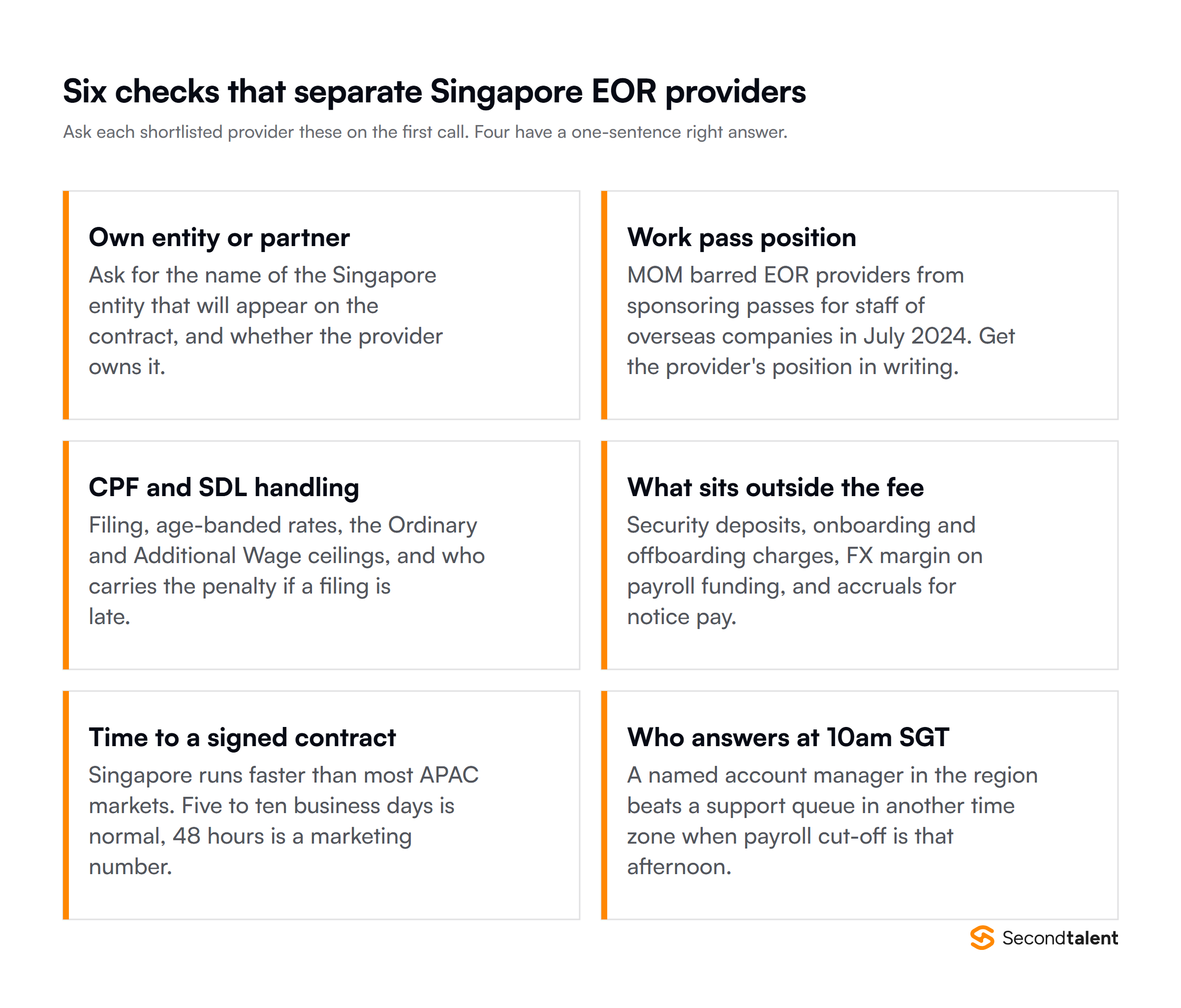
Entity ownership and the work pass position separate them. Everything else on a vendor comparison page, from dashboard screenshots to country counts, moves the decision far less than those two answers.
A provider either holds a registered Singapore entity and puts your employee on its own payroll, or it signs a local partner and resells that arrangement under its own brand.
Singapore is a market most global platforms do own, so the more useful follow-up is what happens in Vietnam, Indonesia and the Philippines when you expand.
The one email that shortens a shortlist
“Name the Singapore entity that will appear on my employee’s contract, confirm you own it, and confirm in writing whether you will sponsor an Employment Pass for this role.” A provider with a Singapore entity and a clear MOM position answers in three lines. Anything longer is a redirect to coverage maps.
The 8 best EOR providers in Singapore, reviewed
1. AYP Group
AYP Group is the strongest Singapore-headquartered specialist. It runs employer of record services across 14 APAC markets with local teams in each, which removes the third-party agent layer that global platforms rely on elsewhere in Asia.
Key services: employer of record, PEO and co-employment, payroll outsourcing, work permit and visa applications, CPF and Skills Development Levy filing, and HR advisory across Singapore, Malaysia, Thailand, the Philippines, Vietnam, Indonesia, India, China, Hong Kong, Taiwan, Japan, South Korea and Australia.
- Pros: a Singapore head office and Singapore employment specialists, so CPF and MOM questions get answered by someone who files these returns weekly.
- Flat-rate pricing with a public cost calculator, which is rare among quote-only regional providers.
- Visa and work permit handling in-house for clients who do hold a Singapore entity.
- Cons: no coverage outside APAC, so a US or European hire needs a second vendor.
- Software is lighter than the venture-funded platforms, and the headline price is not published.
2. Second Talent
Second Talent combines employer of record in Singapore with vetted technical hiring, so one partner sources the employee and then employs them.
Contracts, CPF registration, payroll and onboarding run in-house, and we hold a 92% talent retention rate across 200 or more client companies.

Key services: employer of record in Singapore, China, Hong Kong, Indonesia, Malaysia, the Philippines, Taiwan, Thailand and Vietnam, plus technical sourcing and vetting, Singapore employment contracts, payroll, CPF and levy filing, benefits enrolment, and ongoing HR support on one monthly invoice.
- Pros: sourcing and employment sit under one contract, which removes the handoff between a recruiter and an EOR.
- Most roles are matched within 24 hours, and employment starts inside 5 to 10 business days.
- Engineering and technical depth rather than general payroll administration, backed by a 4.9 average client rating.
- Cons: nine markets is a narrower list than the global majors offer.
- Built around technical and professional hiring, so high-volume frontline roles fit less well.
- Pricing is quoted per role and market rather than published as a flat platform fee.
Why we place ourselves at #2
AYP covers more APAC markets on its own entities, so it takes the top slot on coverage alone. We earn second place on a different axis: most teams hiring in Singapore still need to find the engineer, and pairing sourcing with employment saves a handoff and a second contract.
Teams that already hold a signed candidate get less from that, and should weigh the list on price and coverage instead.
Tell us the role and the market and we will come back with candidates and the full employment cost in one view.
3. Omni HR
Omni HR is a Singapore-headquartered HR platform that added employer of record on top of a full HRIS. It covers 10 or more APAC markets plus the US and UK and quotes 5 to 7 business days to onboard a first employee.
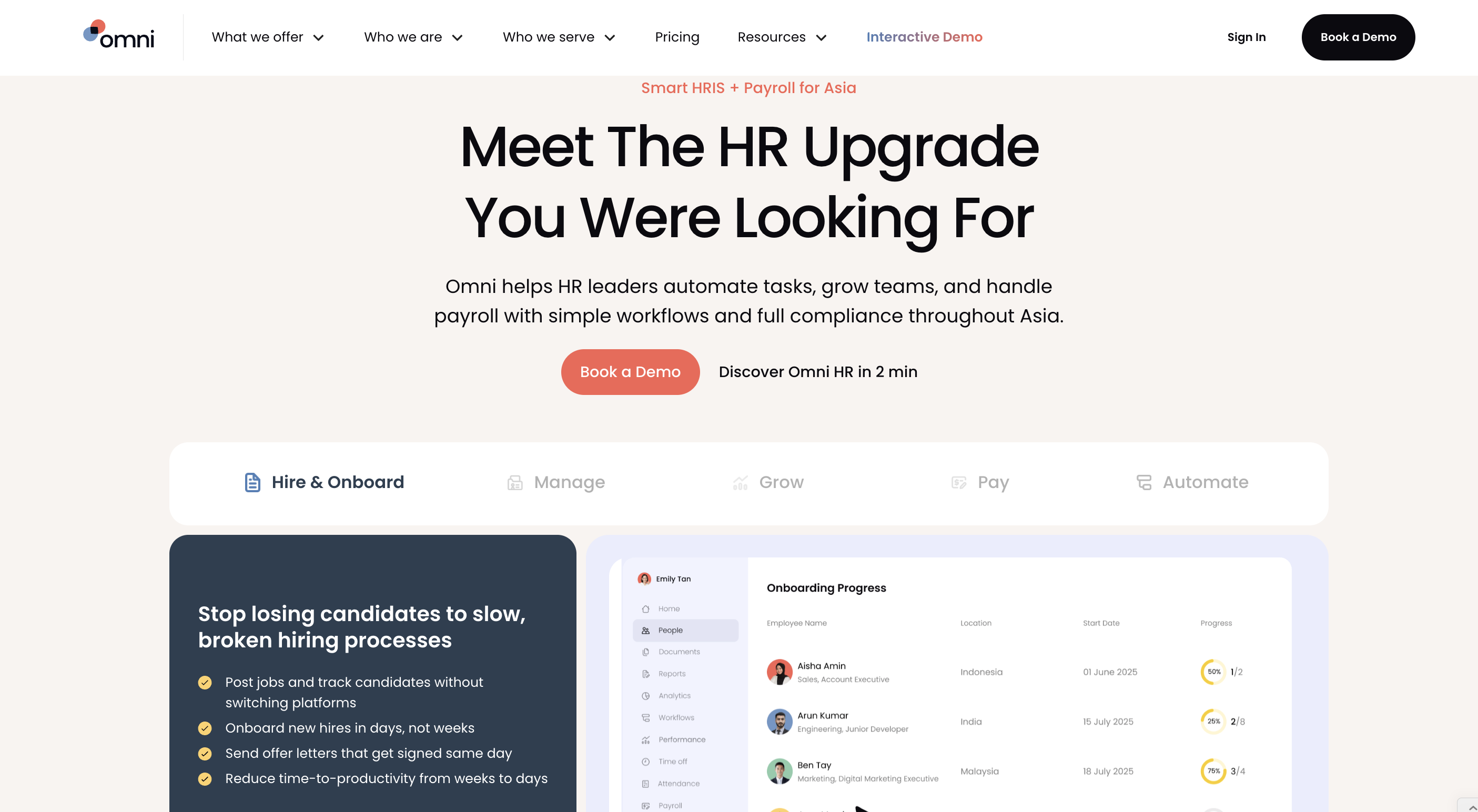
Key services: employer of record, a full HRIS with employee database and self-service portal, onboarding workflows, leave and time-off management, expense processing, performance management, document management with e-signature, and workforce analytics across countries.
- Pros: one system for both employment and day-to-day people management, so you skip a second HRIS purchase.
- Built in Singapore for Asian markets, so leave types and statutory fields match local practice out of the box.
- Strong fit for a company whose first ten employees sit across Singapore, Malaysia and Hong Kong.
- Cons: EOR is the newer half of the product, and the country list is shorter than the global platforms.
- No published EOR price, so budgeting needs a call.
4. Multiplier
Multiplier started in Singapore and prices at roughly $400 per employee each month, the lowest published figure among the eight.
That combination makes it the usual starting point for APAC startups that want self-serve software without enterprise pricing.

Key services: employer of record, contractor management and payments, global payroll in 120 or more currencies, benefits administration, equipment provisioning for remote hires, and expense management through a self-serve dashboard.
- Pros: the lowest published list price of any provider on this list, and volume tiers cut it further above 50 employees.
- Singapore origin, so support hours line up with the working day here.
- Fast self-serve onboarding for straightforward local hires.
- Cons: entity ownership varies by market, so confirm it country by country before you sign a regional deal.
- Benefits packages are thinner than what Deel or Remote assemble in the same country.
5. Deel
Deel publishes $599 per EOR employee each month and runs its own Singapore entity, covering CPF, income tax reporting and MOM obligations.
It is the widest product on the list, with contractor management at $49 a month and a US PEO product alongside the EOR.

Key services: employer of record, contractor management and contractor of record, global payroll, immigration support in markets where the client holds an entity, equipment provisioning, and more than 100 integrations with HR and finance systems.
- Pros: published pricing, the deepest integration catalogue, and 24-hour support with named account managers on larger accounts.
- One platform handles both contractors and employees, which suits a team converting freelancers to staff.
- Cons: support is a queue rather than a Singapore specialist unless you buy at scale.
- Onboarding in Singapore typically runs closer to two weeks than the 48 hours the category advertises.
6. Remote
Remote owns its Singapore entity and lists $699 per employee each month, having raised its EOR price from $599 during 2026.
Its intellectual property and invention assignment terms are the strongest of the eight, which matters for engineering hires.
Key services: employer of record on owned entities, global payroll at $29 per employee each month, contractor management, benefits administration, equipment logistics, and intellectual property assignment built into every employment contract.
- Pros: owned entities rather than partners in most markets it sells, including Singapore.
- The clearest IP and invention assignment terms in the category, worth reading before you hire engineers through anyone else.
- Self-service onboarding that a small team can run without an implementation project.
- Cons: now the joint most expensive published price on this list after the 2026 increase.
- Support runs on a global rota, so an urgent CPF question can wait out a time zone.
7. Papaya Global
Papaya Global sits at the enterprise end, with published EOR pricing of $650 to $770 per employee each month depending on tier. Its strength is payroll analytics across a large multi-country estate rather than a first Singapore hire.
Key services: employer of record, global payroll and payments, contractor management, workforce spend analytics, and a compliance engine that consolidates payroll data across countries into one reporting view.
- Pros: the reporting depth finance teams ask for once headcount spreads across five or more countries.
- A dedicated customer success manager on every account, with round-the-clock support.
- Cons: the most expensive tier on this list, and hard to justify for two Singapore employees.
- Currency markups and benefits add-ons sit outside the headline fee, so the quote needs itemising.
8. Pebl (formerly Velocity Global)
Pebl is the company that used to be Velocity Global. It rebranded on 9 September 2025, keeping existing contracts, pricing and support teams unchanged. Any comparison page still listing Velocity Global as a separate option is out of date.

Key services: employer of record across 185 or more countries, global payroll, contractor management, immigration and mobility support, executive hiring, and an AI assistant that answers country compliance questions inside the platform.
- Pros: the widest country footprint of the eight, and immigration capability for clients who do hold their own entity.
- Experience with senior placements where equity and complex compensation structures are involved.
- Published list pricing around $599 per employee each month for the standard tier.
- Cons: premium positioning that costs more than it returns on a junior Singapore role.
- The 2025 rename still confuses procurement records and reference checks.
Three more providers reach Singapore and suit narrower cases: Oyster HR at $699 a month for small distributed teams, Rippling for buyers who want HR and IT provisioning in one workflow, and Links International for enterprises that want in-country payroll depth across Greater China as well.
What an EOR costs in Singapore
Budget $400 to $770 per employee each month for the platform fee, and treat that as the smaller half of the bill.
Published prices across the wider market span $199 to $1,200 across 31 providers, with most deals landing between $400 and $700.
Singapore’s statutory layer carries the larger number. Employer CPF runs at 17% for employees aged 55 and below, and from 1 January 2026 it applies to Ordinary Wages up to $8,000 a month, raised from $7,400.
The annual salary ceiling stays at $102,000.
The Skills Development Levy adds 0.25% of monthly wages on every employee, foreign staff included, capped at $11.25 a month. It is small, and it is the line employers forget most often.
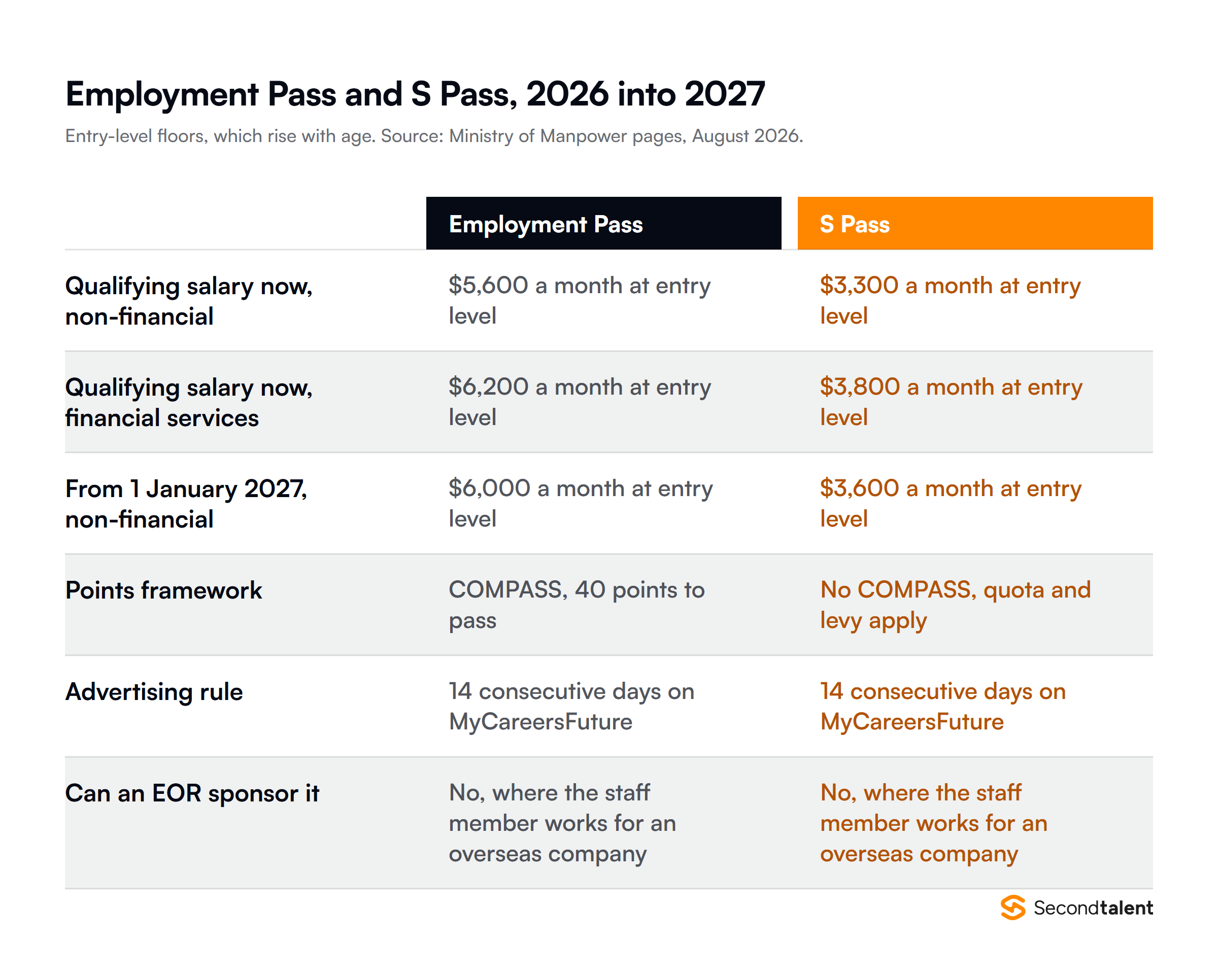
Two changes land on 1 January 2027. Employer CPF rises half a percentage point for employees aged above 55 to 65, and both work pass salary floors move up. Price a multi-year budget against the 2027 numbers, not today’s.
Our EOR cost calculator totals salary, employer contributions and the platform fee for a Singapore role, and the EOR pricing breakdown explains what sits inside each line.
For statutory detail beyond CPF and the levy, the Singapore payroll, benefits and tax guide goes deeper.
Watch the charges outside the headline fee.
Security deposits of one to two months’ salary, onboarding and offboarding charges, foreign exchange margin on payroll funding, and accruals for notice pay all appear in Singapore contracts, and few providers publish any of them.
The work pass rule that changes the shortlist
An EOR cannot sponsor a Singapore work pass for someone who works for an overseas company. MOM clarified this on 9 July 2024, and it removes the single most common reason companies shop for an EOR here.
The reasoning is that a work pass belongs to a Singapore-registered employer that benefits from the work.
An EOR holding the contract while an overseas company directs the role breaks that link, and MOM treats the sponsorship as a legal violation.
Hiring Singapore citizens and permanent residents through an EOR remains permissible, as Singapore firm PK Wong & Nair sets out, subject to ordinary employment and payroll compliance.
The restriction applies only to foreign nationals who need a pass.
The advertising rule bites for the same reason.
Before filing an Employment Pass or S Pass, an employer must advertise the role for at least 14 consecutive days on MyCareersFuture, and employer access there needs Corppass, which needs a Singapore entity.
Our guide to job boards for hiring in Singapore covers how that plays out in practice.
Ask before you sign, not after
Several EOR vendors still market Singapore work pass sponsorship on their country pages. Ask for the position in writing and name the July 2024 MOM clarification in the email. If the answer is vague, the risk of a rejected or withdrawn pass sits with your hire, not with the vendor’s marketing team.
What a Singapore EOR onboarding runs through
Five to ten business days, start to finish, for a local hire with documents ready. The providers advertising 24 or 48 hours are counting from the moment every document lands, which is rarely the moment you sign.
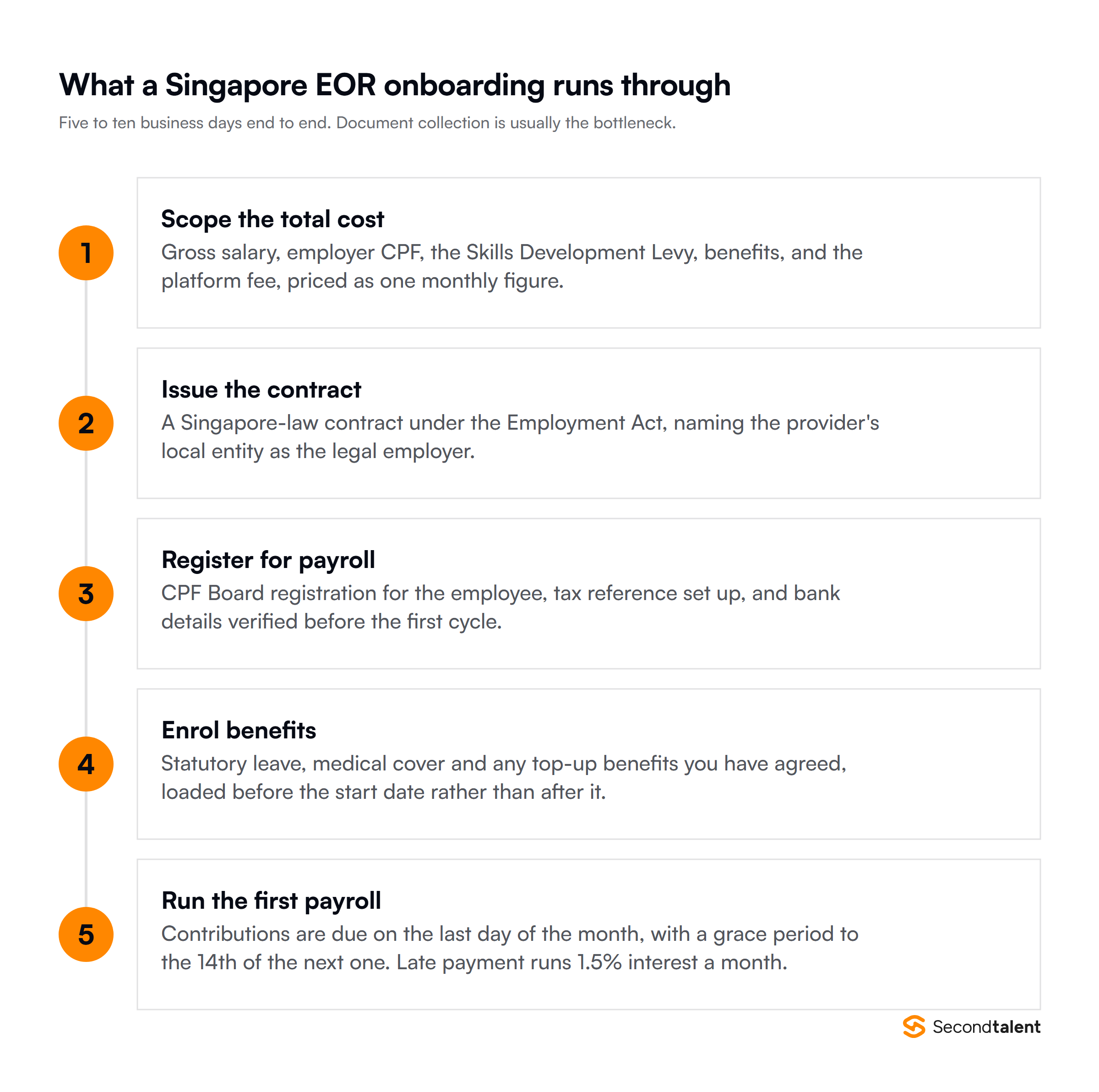
The contract itself is the fastest part. The Employment Act sets notice periods, leave entitlements and salary payment rules, so a competent provider generates the contract from a template the same day.
Payroll timing is where a weak provider shows itself. CPF contributions fall due on the last day of the month with a grace period to the 14th of the next one, and late payment carries 1.5% interest a month.
Ask who absorbs that if the filing slips.
EOR or your own Singapore entity?
Use an EOR up to roughly five to eight employees, then open your own entity.
Singapore is the market where that crossover comes earliest in APAC, because incorporation is trivial: $315 in ACRA fees and about 15 minutes for a straightforward application.
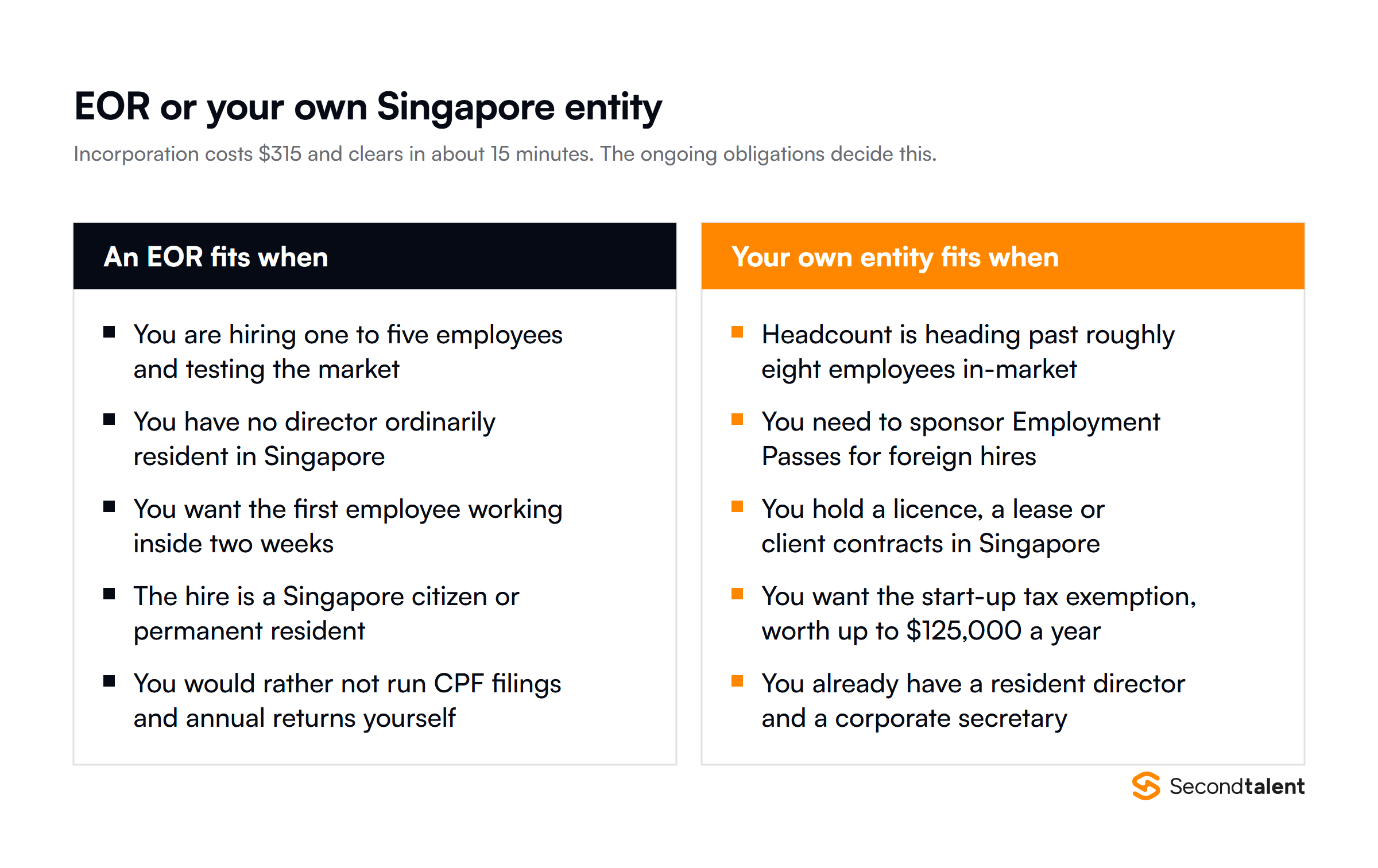
The barrier is what comes after registration. Every Singapore company needs at least one director ordinarily resident in Singapore and a corporate secretary appointed within six months, plus annual returns and tax filings.
Per-employee fees push you across the line inside a year. At $600 a month, ten employees cost $72,000 a year in platform fees alone, which funds a nominee director, a corporate secretary and a local payroll bureau several times over.
An entity also unlocks the start-up tax exemption, which exempts 75% of the first $100,000 and 50% of the next $100,000 of chargeable income for the first three years of assessment.
The EOR versus entity calculator models the crossover for a specific headcount.
Picking the right provider for your Singapore hire
Start with the hire, not the vendor. A Singapore citizen or PR opens all eight options, and the choice then comes down to whether you value the lowest fee, the deepest software, or a partner who also finds the person.
For a wider field before you sign, Anywherer’s EOR Singapore roundup covers 13 more providers, most of them smaller local firms.
A foreign national who needs a pass closes the EOR route, and the honest answer is to incorporate or hire elsewhere in the region.
Our guide to EOR across Asia and the Malaysia provider list cover the neighbouring markets where the rules differ.
Second Talent runs employer of record across nine APAC markets and pairs it with vetted technical hiring, so one partner sources the engineer and employs them.
If you need the person as well as the paperwork, tell us the role and we will come back with candidates and the full Singapore cost.
Frequently asked questions
What is an employer of record in Singapore?
An employer of record is a company that legally employs staff on your behalf in Singapore when you have no local entity.
It holds the employment contract, runs payroll, files CPF and the Skills Development Levy, and you direct the day-to-day work.
Singapore permits the arrangement for citizens and permanent residents. It carries a specific limit for foreign nationals, covered below.
Can an EOR sponsor an Employment Pass in Singapore?
No, where the employee will work for an overseas company with no Singapore presence. MOM clarified on 9 July 2024 that EOR providers may not apply for work passes in that situation, and doing so is a legal violation.
Companies in that position need their own Singapore entity, a representative office, or a hire who already holds the right to work here. This is a change from what many EOR marketing pages still claim.
What is the difference between an EOR and a PEO in Singapore?
An EOR becomes the legal employer, so you need no Singapore entity. A PEO works as a co-employment arrangement, which requires you to already hold a registered Singapore entity.
The practical test is whether you have a company here. No entity means EOR. An entity plus a wish to outsource HR admin means PEO.
How long does onboarding take through a Singapore EOR?
Five to ten business days for a local hire. Contract issue takes hours, CPF registration and bank verification take the rest, and missing identity or address documents cause most of the delay.
Is CPF included in the EOR fee?
No. The EOR files and remits CPF, then bills the 17% employer contribution on to you alongside salary and the platform fee. Treat any quote that folds CPF into a single flat number as one that needs itemising.
Which EOR provider is cheapest in Singapore?
Multiplier, at roughly $400 per employee each month, is the lowest published price among the eight.
Quote-based regional providers sometimes come in below that at volume, so ask for a written quote before assuming the published figure is the floor.