Behind every successful AI system lies meticulously labeled training data. But who ensures that this data is accurately annotated for complex, specialized domains?
AI Training Data Annotators are the skilled professionals who create high-quality labeled datasets that power machine learning systems across industries.
They’re the quality craftspeople whose careful work enables AI to understand everything from medical images to legal documents with precision and reliability.
What is an AI Training Data Annotator?
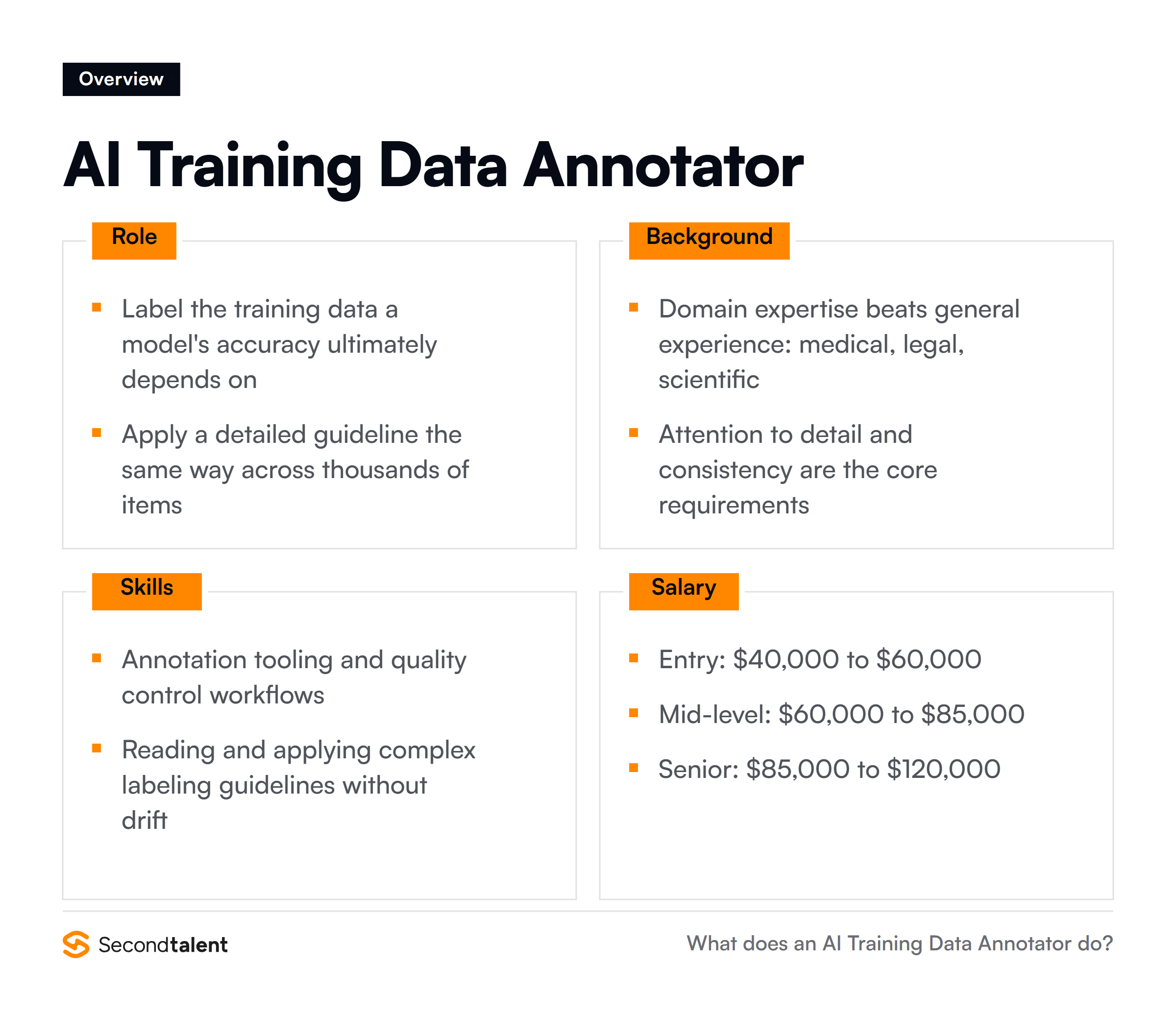
An AI Training Data Annotator specializes in creating high-quality labeled datasets for machine learning applications, particularly in complex domains requiring specialized knowledge. They combine domain expertise with technical understanding to annotate data accurately, consistently, and efficiently for training sophisticated AI systems.
These professionals work across various data types including images, text, audio, video, and structured data, applying their expertise to create training datasets that enable AI systems to learn patterns, make predictions, and perform complex tasks. They focus on quality, consistency, and scalability in data annotation processes.
AI Training Data Annotation Job Market and Career Opportunities
The AI training data annotation market is experiencing significant growth, projected to reach $8.2 billion by 2030, driven by the increasing demand for high-quality training data across industries. The explosion of AI applications in specialized domains is creating opportunities for skilled annotators with domain expertise.
Average Salary Ranges:
- Entry-level AI Data Annotator: $40,000 – $60,000
- Mid-level AI Data Annotator: $60,000 – $85,000
- Senior AI Data Annotator: $85,000 – $120,000
- Principal AI Data Annotator: $120,000 – $180,000+
Major employers include AI companies, healthcare organizations, autonomous vehicle companies, legal technology firms, research institutions, and specialized data annotation companies. The growing need for domain-specific AI systems is creating opportunities across all industries.
Essential AI Training Data Annotation Skills and Qualifications
Core Knowledge Areas:
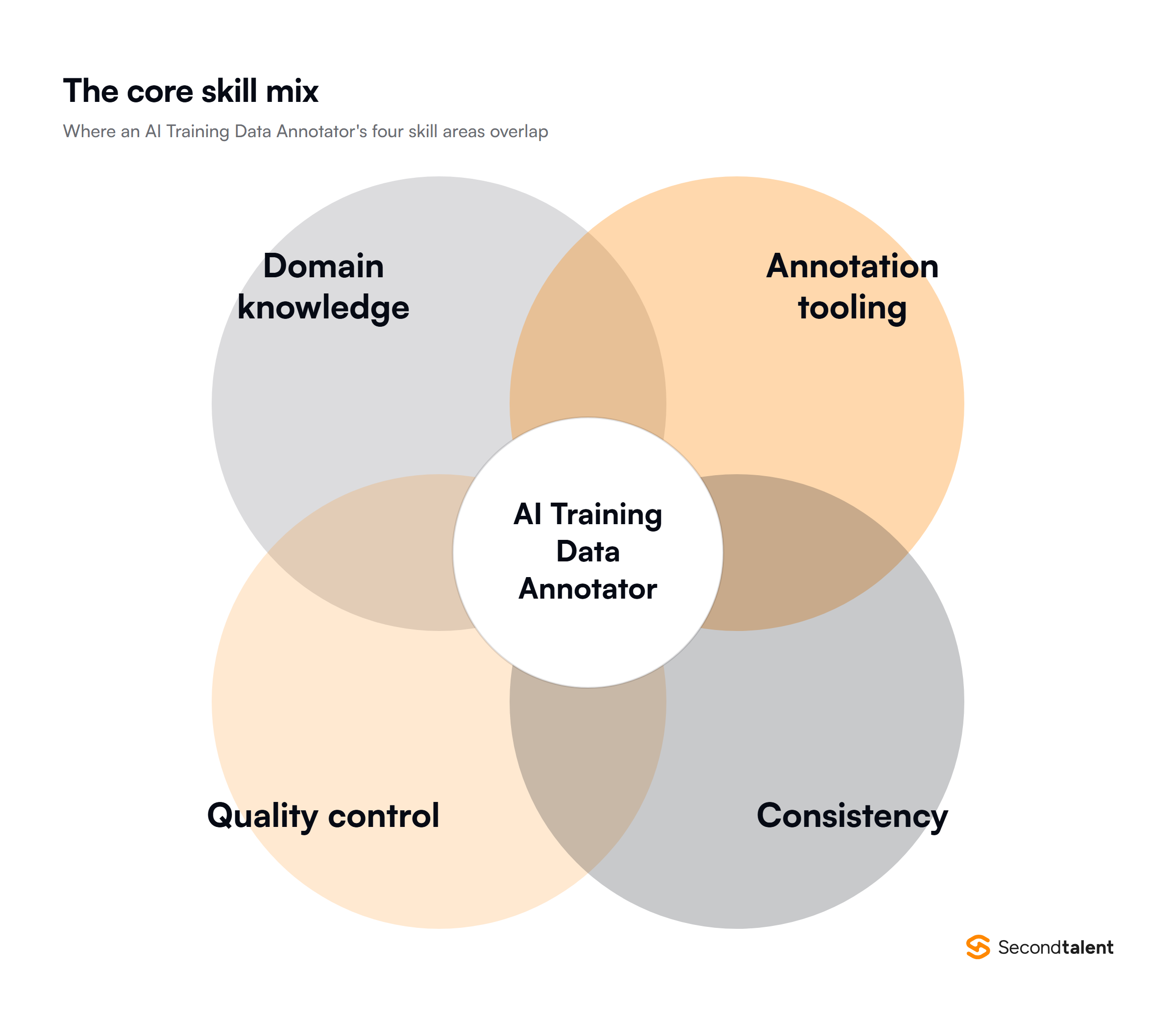
- Domain expertise in specific fields (medical, legal, scientific, etc.)
- Machine learning fundamentals and model requirements
- Data annotation methodologies and best practices
- Quality assurance and validation techniques
- Annotation tools and platforms
- Data privacy and security considerations
Technical Competencies:
- Proficiency with annotation software and platforms
- Understanding of annotation schemas and guidelines
- Inter-annotator agreement and consistency measurement
- Batch processing and workflow optimization
- Quality control and error detection
- Data management and organization
Educational Background: AI Training Data Annotators come from diverse backgrounds, often with specialized expertise in their annotation domain. Medical annotators may have healthcare backgrounds, legal annotators may have law degrees, and scientific annotators may have research experience in relevant fields.
AI Training Data Annotation Career Paths and Specializations
Career Progression:
Data Annotator → Senior Data Annotator → Lead Data Annotator → Annotation Team Manager → Head of Data Operations
Specialization Areas:
- Medical Image Annotation: Labeling medical scans, pathology images, and clinical data
- Legal Document Annotation: Annotating contracts, case law, and regulatory documents
- Scientific Data Annotation: Labeling research data, scientific literature, and experimental results
- Autonomous Vehicle Annotation: Labeling sensor data, traffic scenes, and driving scenarios
- Natural Language Annotation: Annotating text for sentiment, entities, and semantic relationships
AI Training Data Annotation Tools and Technologies
Annotation Platforms:
- Labelbox for computer vision and NLP annotation
- Scale AI for various annotation tasks
- Supervisely for image and video annotation
- Prodigy for text annotation and active learning
- CVAT for computer vision annotation
Quality Assurance Tools:
- Inter-annotator agreement calculation tools
- Annotation quality monitoring systems
- Batch validation and review platforms
- Error detection and correction workflows
- Performance tracking and analytics
Domain-Specific Tools:
- Medical image annotation platforms (3D Slicer, ITK-SNAP)
- Legal document review and annotation systems
- Scientific data annotation and curation tools
- Audio and speech annotation platforms
- Video annotation and temporal labeling tools
Building Your AI Training Data Annotation Portfolio
Essential Portfolio Components:
- Annotation Projects: Examples of high-quality annotated datasets in your domain
- Quality Metrics: Documentation of annotation accuracy and consistency
- Process Documentation: Detailed annotation guidelines and procedures
- Domain Expertise: Evidence of specialized knowledge in your annotation area
- Tool Proficiency: Demonstrated expertise with relevant annotation platforms
Project Ideas:
- Create a high-quality medical image dataset for rare disease detection
- Annotate legal contracts for automated clause extraction
- Label scientific literature for knowledge extraction systems
- Annotate audio data for speech recognition in specialized domains
- Create training data for autonomous vehicle perception systems
AI Training Data Annotation Methodology and Best Practices
Annotation Process:
- Understand model requirements and use cases
- Develop clear annotation guidelines and schemas
- Establish quality control and validation procedures
- Implement consistent annotation workflows
- Monitor and improve annotation quality over time
Quality Assurance:
- Establish inter-annotator agreement benchmarks
- Implement multi-stage review processes
- Create automated quality checks and validation
- Maintain annotation consistency across team members
- Document and address annotation challenges and edge cases
Efficiency Optimization:
- Leverage active learning and smart annotation tools
- Implement batch processing and workflow automation
- Use pre-annotation and model-assisted labeling
- Optimize annotation interfaces and user experience
- Balance speed and quality in annotation processes
Future of AI Training Data Annotation Careers
The AI training data annotation field is evolving rapidly as AI systems become more sophisticated and specialized. Key trends shaping the future include:
Emerging Opportunities:
- Multi-modal annotation combining text, images, and audio
- Real-time annotation for streaming data and live systems
- Specialized annotation for emerging AI domains
- Annotation for AI safety and alignment research
- Cross-lingual and cross-cultural annotation projects
Industry Growth Areas:
- Healthcare organizations developing medical AI systems
- Legal technology companies building AI-powered legal tools
- Autonomous vehicle companies training perception systems
- Scientific research institutions creating AI-powered discovery tools
- Content platforms developing recommendation and moderation systems
Getting Started as an AI Training Data Annotator
Immediate Action Steps:
- Develop expertise in a specific domain (medical, legal, scientific, etc.)
- Learn about machine learning and AI system requirements
- Practice with annotation tools and platforms
- Study annotation best practices and quality standards
- Build a portfolio of high-quality annotation work
Professional Development:
- Pursue domain-specific certifications and training
- Attend AI and machine learning conferences
- Join professional communities in your annotation domain
- Contribute to open-source annotation projects
- Seek internships or projects with AI companies
Learning Resources:
- Domain-specific textbooks and research papers
- Machine learning courses focusing on data requirements
- Annotation platform documentation and tutorials
- Quality assurance and validation methodologies
- Industry best practices and case studies
The AI training data annotation field offers an opportunity to play a crucial role in AI development while leveraging domain expertise. As AI systems become more sophisticated and specialized, skilled annotators with deep domain knowledge will be essential for creating the high-quality training data that powers next-generation AI applications.
Whether you’re coming from a specialized professional background looking to apply your expertise to AI development, or seeking to develop annotation skills in a particular domain, AI training data annotation provides an opportunity to contribute to the advancement of artificial intelligence through careful, expert data curation.
Data Annotator FAQs
What is a data annotator?
A data annotator (also called an AI annotator or data annotation specialist) labels images, text, audio, and video so that machine learning models can learn from it. AI training data annotation is the foundation of supervised learning and directly determines model quality.
What does a data annotation specialist do? (Job description)
A data annotator job description includes labeling and tagging data according to guidelines, maintaining annotation quality and consistency, reviewing edge cases, and giving feedback to improve labeling instructions. Senior AI annotators often manage quality assurance and annotation workflows.
What skills does an AI data annotator need?
Key data annotator skills include attention to detail, consistency, domain understanding, and familiarity with annotation tools. Strong AI annotation specialists also understand how labeling decisions affect model performance and can handle ambiguous cases reliably.
What tools do data annotators use?
Common AI data annotation tools include Labelbox, Label Studio, CVAT, and SuperAnnotate. Data annotation specialists use these platforms to label text, images, bounding boxes, segmentation masks, and audio for machine learning teams.
How much do data annotators earn?
Rates vary widely by complexity and specialization. Hiring skilled data annotators and AI annotation specialists remotely across Asia is a cost-effective way to scale high-quality labeling for machine learning projects.
Related Roles
Explore related roles you can hire on Second Talent: Behavioral Data Scientist, AI Data Pipeline Engineer, Data Pipeline Engineer.
Second Talent connects you with pre-vetted data annotators and AI annotation specialists across Asia in as little as 24 hours, with no upfront cost.