The result that made reinforcement learning from human feedback famous was a small model beating a large one. In OpenAI’s InstructGPT paper, evaluators preferred answers from a 1.3 billion parameter model trained on human feedback over answers from the 175 billion parameter GPT-3, despite the model having 100 times fewer parameters.
About 40 contractors, hired through Upwork and Scale AI, supplied the judgments behind that result. An RLHF specialist does the same work as a profession rather than a side task. The job is to make human judgment consistent enough to train on, at a scale that now supports companies with over $1 billion in annual revenue.
What is an RLHF Specialist?
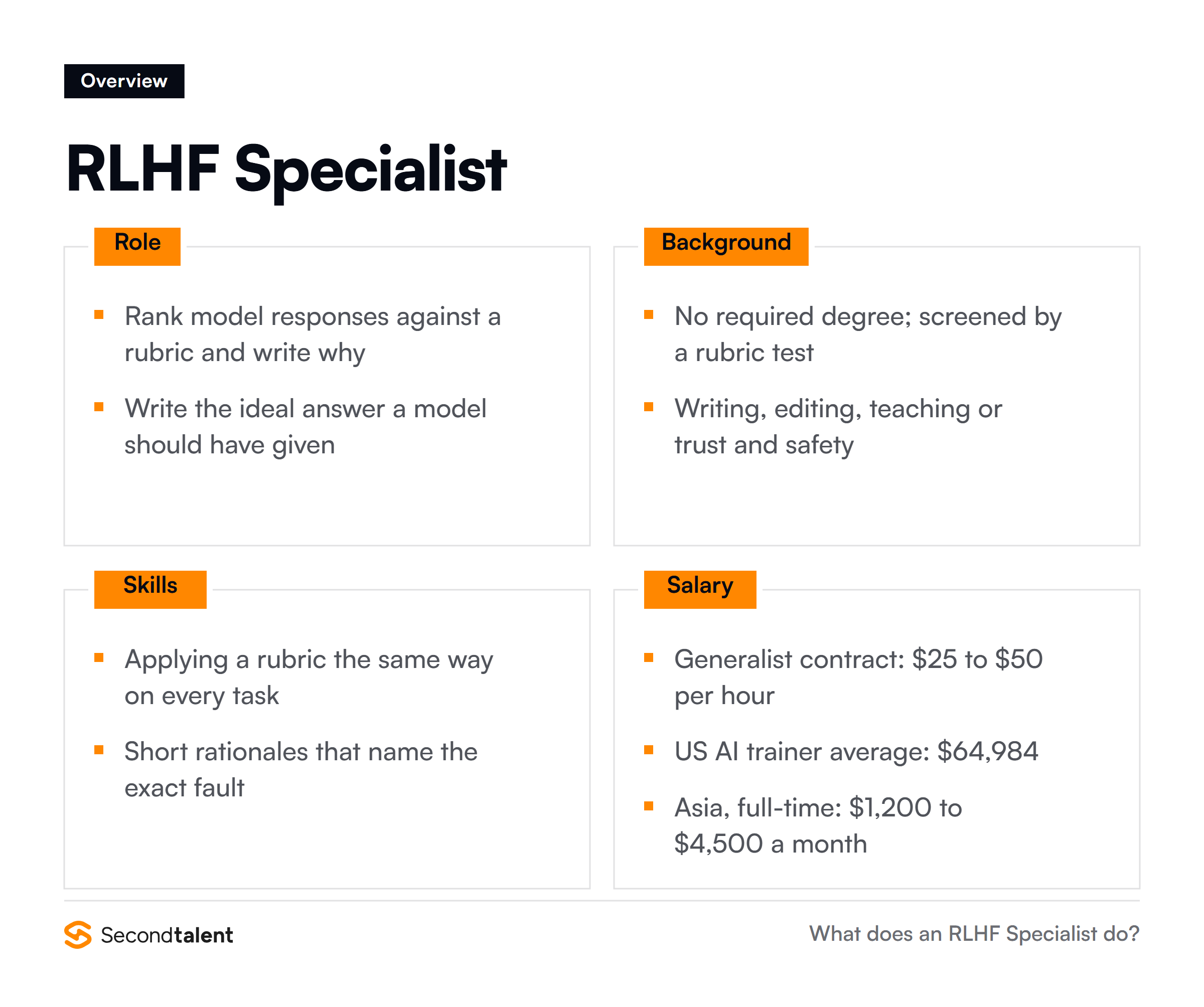
An RLHF specialist produces the human preference data that teaches a language model which answers are better. The core task is comparison: reading two or more responses to the same prompt, choosing the better one against a rubric, and writing down why.
Those judgments train a reward model, which then steers the language model during reinforcement learning. Newer methods such as Direct Preference Optimization (DPO) skip the separate reward model and the reinforcement learning loop, but they still train on pairs of preferred and rejected answers. Whatever the algorithm, the preference data has to come from somewhere.
Most RLHF specialists do more than rank. Typical work includes:
- Preference ranking: ordering several responses, often on a graded scale rather than a simple pick
- Written rationales: explaining each judgment so it can be audited and, increasingly, trained on
- Ideal responses: writing or rewriting the answer a model should have given, for supervised fine-tuning
- Safety review: flagging harmful, biased or policy-breaking output and writing a safe alternative
- Rubric feedback: reporting cases the guidelines do not cover, before the gap spreads into the data
The scale can be large. Meta’s Llama 2 paper describes over 1 million binary comparisons collected from annotators applying its guidelines, each marked as significantly better, better, slightly better, or negligibly better.
RLHF Specialist Job Market and Pay
The human data business is now large enough to report in billions. Meta put $14.3 billion into Scale AI in June 2025 for a 49 percent non-voting stake, CNBC reported, citing a Scale spokesperson.
Reuters reported that Surge AI took in over $1 billion of revenue in 2024. TechCrunch reported in July 2026 that Mercor’s gross annualized run rate had crossed $2 billion.
The mix of work is shifting, though. In September 2025 xAI cut 500 generalist AI tutors, about a third of its annotation team, and said it would grow its specialist tutor team tenfold. Generalist preference work still exists at volume, but the best-paid projects increasingly want a specialty or a proven quality record.
Contract rates published by platforms and employers (checked September 2026):
- DataAnnotation, generalist: $25 to $50 per hour
- Outlier, English generalist: up to $15 per hour, globally
- Handshake AI, AI Evaluation Specialist: up to $40 per hour
- xAI, AI Tutor, Humanities: $35 to $75 per hour
- Alignerr: $80 per hour average pay, as stated on its site, with listed roles from $40 to $120 per hour
As a salary, ZipRecruiter puts the average US AI trainer at $64,984 a year in September 2026, with the middle half between $41,500 and $74,000. Google’s generalist raters, employed through the contractor GlobalLogic, started at $16 an hour and super raters at $21, according to workers who spoke to The Guardian.
Salaried roles that manage the work:
- xAI, Human Data Manager: $100,000 to $186,000 base
- OpenAI, Program Manager, Human Data: $207,000 to $230,000 plus equity
- Anthropic, Data Operations Manager, Human Data: $270,000 to $365,000
Across Asia, full-time dedicated RLHF specialists hired through Second Talent typically cost $1,200 to $4,500 a month, from strong writers on a first preference-data project to senior reviewers who write guidelines and run calibration.
Essential RLHF Specialist Skills and Qualifications
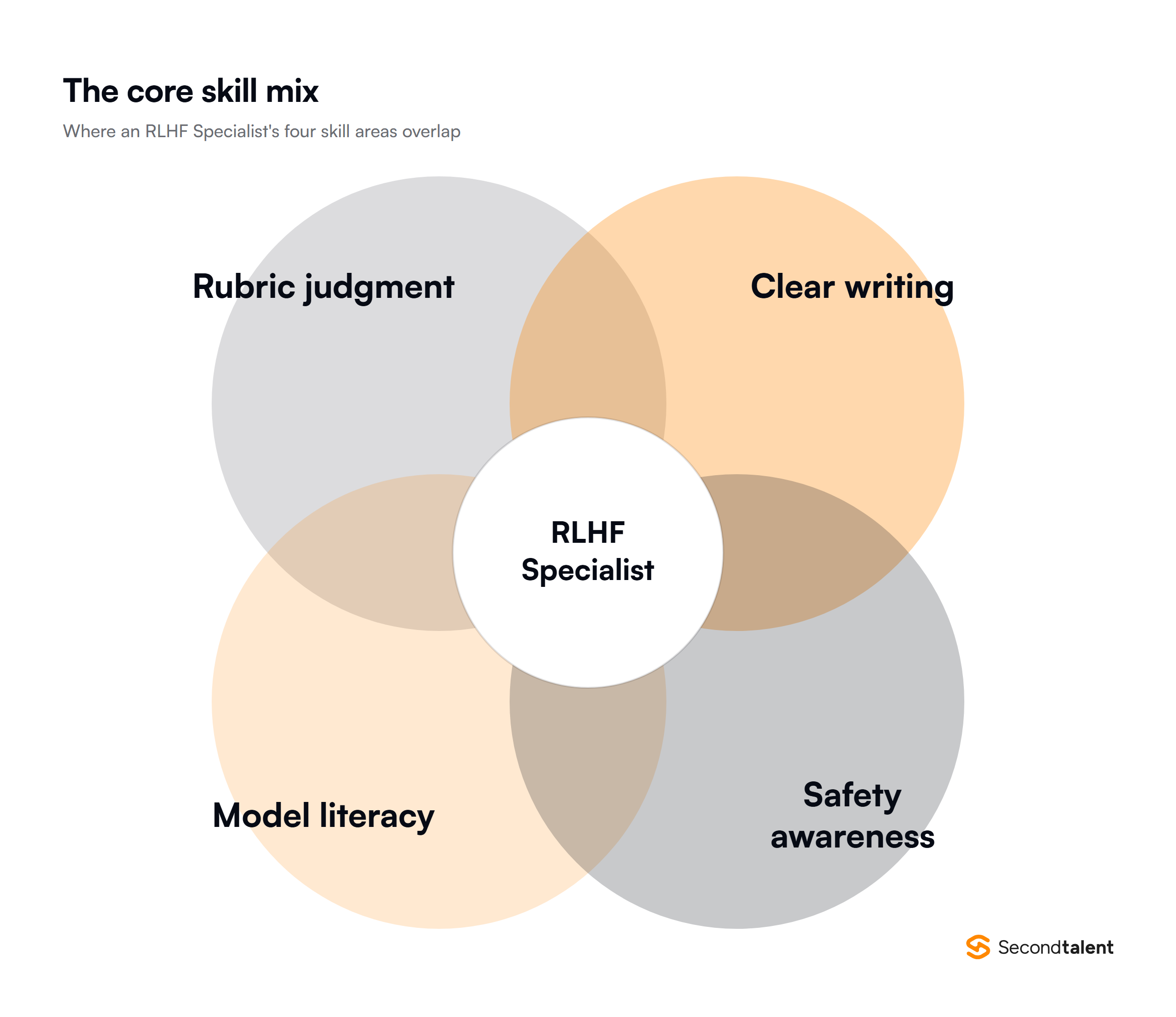
Judgment and Consistency:
- Applying a rubric the same way on the thousandth task as on the first, which is harder than it sounds over long projects
- Separating a response that is correct from one that merely sounds confident
- Noticing when a rule does not fit a case, and saying so instead of guessing
Writing:
- Short, specific rationales that name the exact problem with the weaker answer
- Ideal responses that match the requested tone, length and format without padding
- Plain explanations of edge cases for the team that maintains the guidelines
Model Literacy:
- A working grasp of how preference data trains a model, so you understand why a sloppy ranking matters
- Familiarity with common model failures: sycophancy, hedging, verbose non-answers and invented facts
- Awareness of reward hacking, where a model learns to please the rater rather than help the user
Safety Awareness: Most projects include content policy work, so specialists need to recognize harmful, biased or manipulative output and write a refusal or safe alternative that is still useful.
Background: There is no required degree. Strong candidates often come from writing, editing, teaching, research, law, or support work, where careful reading and clear explanation are daily habits. Screening is by test rather than credentials: OpenAI screened InstructGPT’s labelers with a soft cutoff of 75 percent agreement on comparisons.
RLHF Specialist Career Paths and Progression
Common Routes In:
- From writing and editing: strong on rationales and ideal responses, and quick to spot weak prose
- From teaching and tutoring: used to grading against a rubric and explaining a mark
- From content moderation or trust and safety: already fluent in policy judgment, a natural fit for safety preference work
- From data annotation: a common step up, trading volume for judgment and higher rates
Progression Within the Role:
- Rater: ranking and rating responses against an established rubric
- Senior specialist: writing ideal responses, handling hard cases, and reviewing other raters
- Quality lead: running calibration, maintaining gold tasks, and tracking agreement across the team
- Guideline owner: writing and revising the rubric itself with the research team
Where It Leads: Experienced specialists move into human data program management and data operations, the salaried roles that run vendors and campaigns at model labs. Others specialize into a field and become domain expert trainers, or move toward AI safety auditing and red-teaming.
How RLHF Data Is Quality-Checked
Preference data is noisy by nature, because reasonable reviewers disagree. The quality work is about keeping that disagreement honest rather than random.
Agreement rates. The published numbers show how hard this is. InstructGPT’s training labelers agreed with each other 72.6 percent of the time. Anthropic’s helpful and harmless assistant paper reported only about 63 percent average agreement between its researchers and its crowdworkers. That is why teams measure consistency constantly rather than assuming it.
Gold tasks and calibration. Teams seed known-answer items into the queue, score each rater against them, and hold calibration sessions where the group discusses the tasks it split on. The output is a sharper rubric, not just a score.
Small, dedicated teams. Anthropic found that roughly 20 crowdworkers produced about 80 percent of its data, and that it was easier to get very high-quality work from contractors paid by the hour than by the task. Many labs now prefer dedicated specialists over anonymous crowd queues for the same reason.
Tools. Open-source tools such as Label Studio ship pairwise preference and response-grading templates, and Argilla supports preference datasets on the Hugging Face Hub. Large programs usually run on a vendor platform such as Scale AI’s or Labelbox’s, or on an in-house interface, as OpenAI built for InstructGPT.
RLHF Specialist vs Adjacent Roles
Several job titles describe overlapping work, and the boundaries matter when hiring or applying.
RLHF Specialist vs AI Evaluator & Trainer: The evaluator title is the broader one. It covers rating output and also designing the evaluation suites that catch regressions over time. An RLHF specialist concentrates on producing training data, meaning preference pairs, rationales and demonstrations, at a steady quality bar across long projects.
RLHF Specialist vs AI Training Data Annotator: Annotation labels data with a clear right answer, such as boxes on images or tags on text. Preference work judges open-ended output, where two good answers can differ and the reviewer has to justify the choice.
RLHF Specialist vs Coding AI Trainer and Domain Expert AI Trainer: The specialist trainers do preference work too, but only in a field where correctness takes expertise to check, such as code, medicine or law. An RLHF specialist works on general tasks: writing, reasoning, advice, tone and safety.
RLHF Specialist vs AI Alignment Researcher: Researchers design the methods and decide what the preference data should capture. Specialists produce it, and their feedback on the guidelines is often how researchers learn the rubric is wrong.
How to Become an RLHF Specialist
- Read a public preference dataset such as Anthropic’s HH-RLHF on Hugging Face, and judge a few dozen pairs yourself before looking at the chosen answer
- Practice writing rationales in two or three sentences that name the specific fault, not a general impression
- Rewrite weak model answers into ideal ones, keeping to a stated length and tone
- Apply to platforms that assess by task, and treat the qualification test as the real interview
- Track your quality scores, then use a strong record to reach dedicated roles, higher-rate projects, or a specialty
Expect assessments rather than interviews at the start. Second Talent’s vetting for dedicated RLHF specialists begins with a guideline test on tasks with known answers, scored for agreement, with every rationale read by a reviewer. The candidates who pass are usually the ones who flag the ambiguous task rather than forcing an answer.
Future of the RLHF Specialist Role
The obvious question is whether AI feedback will replace human raters. The research says partly. Anthropic’s Constitutional AI used AI labels for harmlessness but kept human labels for helpfulness. Google’s RLAIF study found AI feedback nearly matched human feedback on summarization, 71 percent against 73 percent in win rate, but human evaluators judged every one of those results.
So routine comparisons are the most exposed. Judgment on hard, ambiguous or high-stakes cases, the design and repair of rubrics, and the human evaluation that checks whether AI feedback worked are all moving the other way.
Expect the role to split. One branch becomes quality and guideline work, fewer raters with more responsibility. The other becomes specialization by field or language, where the xAI shift and the growth of expert marketplaces point.
Generalists with a strong agreement record and clear writing can move into either branch, and the move is usually worth making before the routine work thins out.
Frequently Asked Questions
What does an RLHF specialist do?
An RLHF specialist compares model responses, chooses the better one against a rubric, and writes a rationale for each judgment. Most also write ideal responses for fine-tuning, review output for safety, and report gaps in the guidelines. The data trains a reward model or feeds a method such as DPO, which teaches the model to prefer answers like the ones reviewers chose.
How much do RLHF specialists earn?
Published contract rates for generalist preference work run from up to $15 per hour globally on Outlier to $25 to $50 per hour on DataAnnotation, and xAI posts $35 to $75 per hour for humanities tutors. ZipRecruiter puts the average US AI trainer salary at $64,984. Full-time dedicated RLHF specialists in Asia typically cost $1,200 to $4,500 a month.
Do you need a degree to become an RLHF specialist?
No degree is required for general preference work. Employers and platforms screen with a task-based test that measures agreement with known answers and the quality of written rationales. A degree or professional background matters for specialist projects in fields such as medicine, law, mathematics or code.
Will AI feedback replace RLHF specialists?
Partly. Research such as Constitutional AI and Google’s RLAIF study shows AI feedback can replace some human labels, especially for routine comparisons. Both still relied on humans, for helpfulness labels or for evaluating the results. Demand is shifting toward specialists who handle hard cases, maintain rubrics and check AI-generated feedback.
What is the difference between RLHF and DPO?
RLHF trains a separate reward model on human preferences, then uses reinforcement learning to optimize the language model against it. DPO skips the reward model and the reinforcement learning step and trains directly on preferred and rejected pairs. Both need the same kind of human preference data, so the specialist’s work is the same either way.
How quickly can Second Talent place an RLHF specialist?
We send a shortlist of pre-vetted RLHF specialists within 24 hours of receiving your brief, covering the model, task types, guidelines and expected volume. Every candidate passes a guideline test with known answers, a writing sample and reference checks, and most clients have a specialist working within a week.
Related Roles
Explore related roles you can hire on Second Talent: AI Evaluator & Trainer, Coding AI Trainer, Domain Expert AI Trainer, Multilingual AI Trainer, AI Training Data Annotator, AI Alignment Researcher, AI Content Moderator.