TL;DR: Web developers in Malaysia earn $2,090 to $5,040+ a month working for international clients on our full-stack rate card, the second-lowest range of the five markets compared. The closest US benchmarks, the BLS medians for web developers and software developers, were $92,650 and $135,980 a year in May 2025.
On 3 December 2025 the React team disclosed CVE-2025-55182, a React Server Components flaw rated CVSS 10.0 that reached Next.js and React Router. A web developer in Malaysia who ships React for you should know which of your apps pulled in the vulnerable packages and which patch closed the hole.
Key takeaways
- Laravel 13 requires PHP 8.3, and PHP 8.2 loses security support at the end of this year.
- Vue 2 has received no security or browser compatibility fixes since its end of life at the close of 2023.
- Malaysia's statutory overtime rate stops at RM4,000 a month, less than half the floor of our card's international-client range.
- A 5 pm to 2 am shift in Kuala Lumpur gives a New York team five live hours in summer and four in winter.
What Web Developers Earn in Malaysia Working for International Clients
Malaysia's floor sits $810 above the Philippines and $180 below Indonesia. We publish no web developer card for Malaysia, so its row uses our Malaysia full-stack developer card, the closest match to React, Vue.js and Laravel work.
The figures are what developers in each market earn working directly for foreign companies, before any employer or platform costs.
| Market |
Monthly pay working for international clients (USD) |
| Malaysia |
$2,090-$5,040+ |
| Philippines |
$1,280-$3,190+ |
| Indonesia |
$2,270-$5,670+ |
| Vietnam |
$2,320-$5,800+ |
| Thailand |
$3,020-$6,350+ |
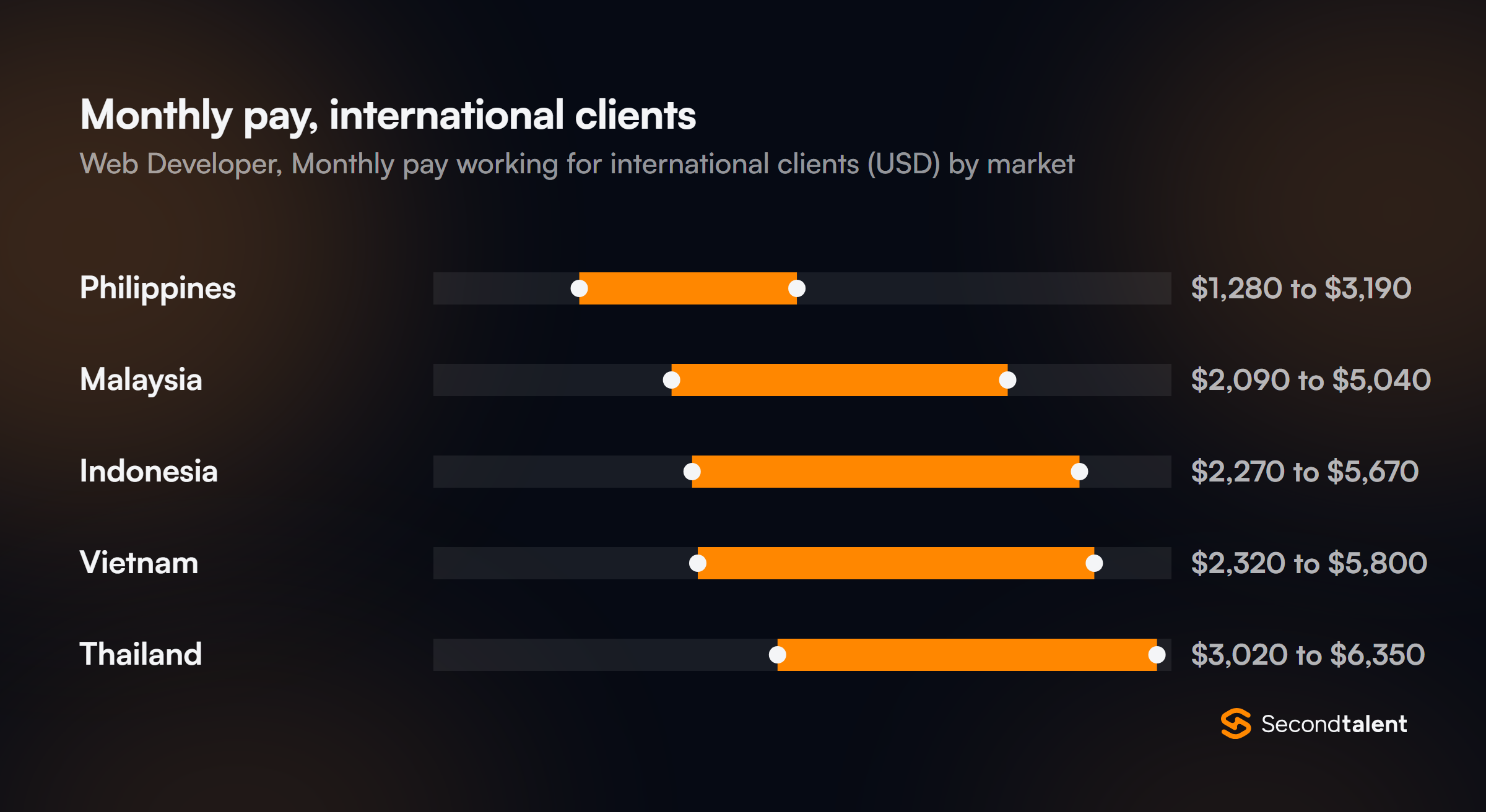
Monthly ranges from the Remote (Working for International Clients) figures on our rate cards for Malaysia, the Philippines, Indonesia, Vietnam and Thailand, converted at ExchangeRate-API mid-market rates for 14 September 2026.
The Malaysia card quotes RM8,500 to RM20,500+ a month. Our Malaysia WordPress developer card quotes the same ringgit range, so a CMS-heavy brief lands in the same place.
Through Second Talent you pay one monthly fee that bundles salary, payroll taxes, statutory contributions and our service fee, quoted per role and market. Our pricing page explains the monthly subscription.
US Pay Benchmark for Web Developers
Web developers map to two BLS occupations. Web Developers (SOC 15-1254) covers engineers who build and maintain sites, while Software Developers (15-1252) fits a developer who owns a React or Laravel application end to end.
| BLS OEWS, May 2025, national |
Web Developers (15-1254) |
Software Developers (15-1252) |
| Median annual |
$92,650 |
$135,980 |
| 10th percentile, monthly |
$4,010 |
$6,870 |
| 25th percentile, monthly |
$5,350 |
$8,770 |
| Median, monthly |
$7,720 |
$11,330 |
| 75th percentile, monthly |
$10,520 |
$14,330 |
| 90th percentile, monthly |
$13,520 |
$17,890 |
Monthly figures are the annual wages on the BLS OEWS profiles for 15-1254 and 15-1252 divided by 12, rounded to the nearest $10.
The gap between the two medians is $3,610 a month. Pick the column that matches the job: marketing sites and CMS work sit in the first, product applications with their own back end in the second.
Salary is only part of the US cost. In the BLS Employer Costs for Employee Compensation release for June 2026, wages and salaries made up 68.5% of employer compensation costs for full-time private industry workers, and benefits the other 31.5%.
Time Zone Overlap: Kuala Lumpur Against ET, CT and PT
Malaysia runs on UTC+8 year round and does not change its clocks. US daylight time lasts from 8 March to 1 November 2026, per NIST, and each switch moves the gap by an hour.
The arithmetic: 5:00 pm in Kuala Lumpur is 09:00 UTC, which is 5:00 am in New York under EDT (UTC-4), 4:00 am in Chicago under CDT and 2:00 am in San Francisco under PDT. A nine-hour shift from there ends at 2:00 am in Kuala Lumpur, 2:00 pm in New York.
| Kuala Lumpur shift (UTC+8) |
ET overlap (EDT / EST) |
CT overlap (CDT / CST) |
PT overlap (PDT / PST) |
Hours between 10 pm and 6 am |
| 9 am-6 pm |
0 / 0 |
0 / 0 |
0 / 0 |
0 |
| 2 pm-11 pm |
2 / 1 |
1 / 0 |
0 / 0 |
1 |
| 5 pm-2 am |
5 / 4 |
4 / 3 |
2 / 1 |
4 |
| 8 pm-5 am |
8 / 7 |
7 / 6 |
5 / 4 |
7 |
Overlap counts the clock hours of each nine-hour shift, meal break included, that fall inside a 9 am to 5 pm US day.
Web work has fixed moments that need a live developer: a production deploy, a checkout bug during a US sale, a design review with marketing. A daytime Kuala Lumpur developer can still ship a staged release that your team approves in its morning.
Section 60A of Malaysia's Employment Act 1955 caps normal hours at eight a day and 45 a week. The one and a half times overtime rate in section 60A(3) does not apply to employees earning more than RM4,000 a month under the Act's First Schedule, and our Malaysia card starts at RM8,500. Put late-shift pay in the contract if you want it.
We fix the shift before the offer, which is how our placements get 4-6 hours of daily overlap with US hours.
Web Developer Skills to Screen For
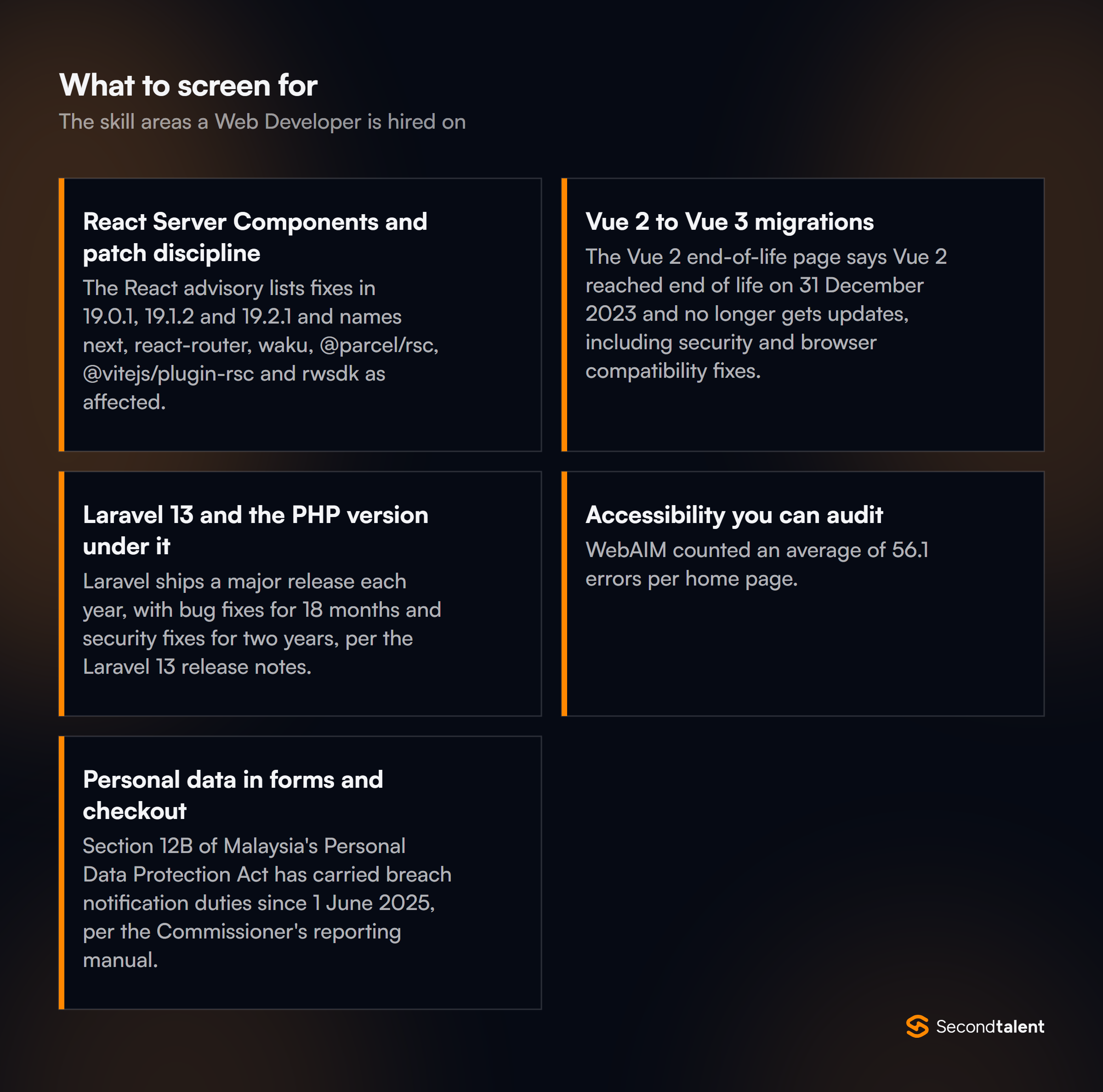
The WebAIM Million found detected WCAG 2 failures on 95.9% of the top one million home pages in February 2026, up from 94.8% a year earlier. Framework knowledge is easy to list on a CV, so each check below asks for evidence from a real site.
React Server Components and patch discipline
The React advisory lists fixes in 19.0.1, 19.1.2 and 19.2.1 and names next, react-router, waku, @parcel/rsc, @vitejs/plugin-rsc and rwsdk as affected. Ask the candidate how they found out, how long the patch took to reach production, and how they check a lockfile for a vulnerable transitive package.
Vue 2 to Vue 3 migrations
The Vue 2 end-of-life page says Vue 2 reached end of life on 31 December 2023 and no longer gets updates, including security and browser compatibility fixes. It warns that Vue 3 contains breaking changes. If your product still runs Vue 2, ask for a migration the candidate finished and the dependency that held it back longest.
Laravel 13 and the PHP version under it
Laravel ships a major release each year, with bug fixes for 18 months and security fixes for two years, per the Laravel 13 release notes. Laravel 13 arrived on 17 March 2026, requires PHP 8.3 and adds a first-party AI SDK for text generation, tool-calling agents and embeddings. Laravel 12's bug fixes ended on 13 August 2026, with security fixes until 24 February 2027.
The PHP supported versions page ends security support for PHP 8.2 on 31 December 2026. Ask the candidate to plan the Laravel and PHP upgrade for a site on 12 and 8.2, in order.
Accessibility you can audit
WebAIM counted an average of 56.1 errors per home page. Low-contrast text appeared on 83.9% of pages and missing image alt text on 53.1%. Give the candidate one of your templates and a screen reader, and ask for the three fixes they would ship first.
Personal data in forms and checkout
Section 12B of Malaysia's Personal Data Protection Act has carried breach notification duties since 1 June 2025, per the Commissioner's reporting manual. The manual counts a breach affecting more than 1,000 data subjects as significant harm. Ask where the candidate's last contact form stored submissions, who could read them and when the site deleted them.
Contractor or Employer of Record in Malaysia
Software is not one of the nine categories of commissioned work that can be "work made for hire" under 17 U.S.C. § 101, and a transfer must be in writing and signed under § 204(a).
Malaysia's Copyright Act 1987 treats computer programs as literary works. Section 26(2) deems copyright in a commissioned work transferred to the client, and in a work made in the course of employment to the employer, unless an agreement excludes or limits the transfer.
Section 27(3) requires any assignment to be in writing. One signed assignment should name the code, themes, components and design files.
IRS Publication 515 says the place where services are performed determines the source of the income, so a web developer in Kuala Lumpur earns foreign-source income. A foreign individual gives the payer Form W-8BEN to certify foreign status.
The Employment (Amendment) Act 2022 added section 101C. Without a written contract of service, a prosecution under the Act presumes employment where another party controls the manner or hours of work, provides the tools, or makes regular payments that form most of the worker's income.
A full-time contractor on your laptop, in your standups and paid monthly meets three of those tests. Our Employer of Record service becomes the legal employer, with the details on our Malaysia EOR page and contribution rules in our Malaysia payroll guide. This is a summary, not legal advice.
|
Independent contractor |
Employer of Record |
| Legal employer |
None; the developer invoices you |
The EOR's Malaysian entity |
| US paperwork |
Form W-8BEN from the developer |
Service agreement with the EOR |
| IP |
Written assignment of code, themes and design files (sections 26 and 27) |
Employer's copyright under section 26(2), passed to you through the EOR agreement |
| Local labor law |
Section 101C presumption if you set hours and supply tools |
Employment Act hours, leave and public holidays apply |
| Pay currency |
Agreed in the contract, often USD |
Local payroll run by the EOR |
English Level and Working Norms in Malaysia
Malaysia scores 581 on the EF English Proficiency Index 2025, 24th of 123 countries and regions and 93 points above the global average of 488. Its IT job-function score is 590, per EF's Malaysia page.
Writing scores 584 and speaking 534. That split suits web work, where tickets, pull requests and copy changes travel in writing. Add one live call to the assessment for a developer who will sit in front of your marketing team.
Two festivals drive most leave. The Holidays Act 1951 schedule sets Hari Raya Puasa at two days and Chinese New Year at two days outside Kelantan and Terengganu. Under section 60D of the Employment Act, employees get 11 paid gazetted holidays a year, five of them named in the Act, including National Day and Malaysia Day.
Thanksgiving on 26 November 2026 is a working day in Malaysia, so a Kuala Lumpur developer can cover your storefront while your US team is off.
Web Developer Hiring Process in Malaysia
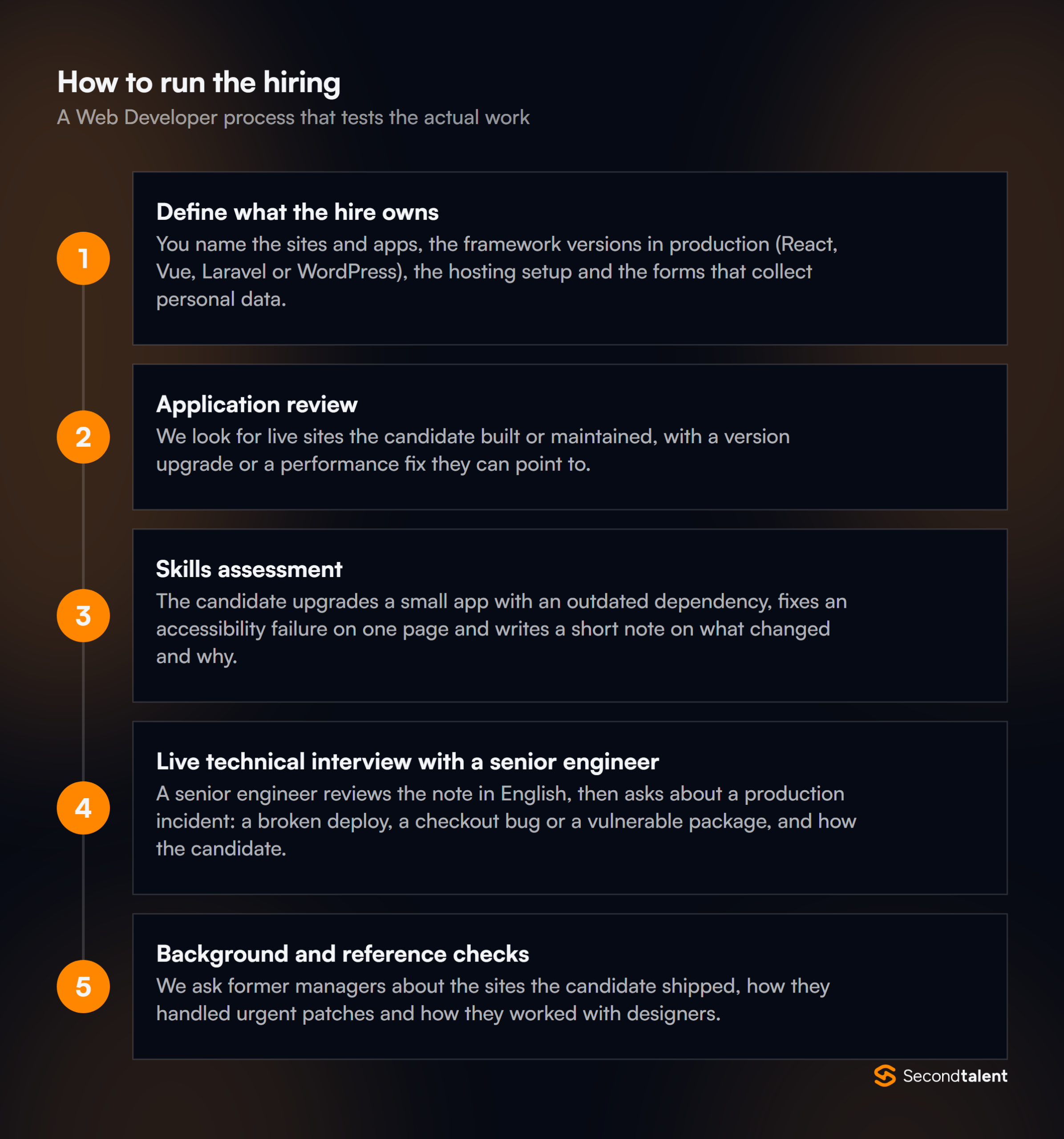
Second Talent's vetting covers stages 2 to 5 before you see a profile.
Stage 1: Define what the hire owns
You name the sites and apps, the framework versions in production (React, Vue, Laravel or WordPress), the hosting setup and the forms that collect personal data. Add the Kuala Lumpur shift from the table above.
Stage 2: Application review
We look for live sites the candidate built or maintained, with a version upgrade or a performance fix they can point to. A portfolio of templates with no production history does not pass.
Stage 3: Skills assessment
The candidate upgrades a small app with an outdated dependency, fixes an accessibility failure on one page and writes a short note on what changed and why.
Stage 4: Live technical interview with a senior engineer
A senior engineer reviews the note in English, then asks about a production incident: a broken deploy, a checkout bug or a vulnerable package, and how the candidate rolled back.
Stage 5: Background and reference checks
We ask former managers about the sites the candidate shipped, how they handled urgent patches and how they worked with designers. You then choose the contractor or EOR route above.
Hire Web Developers from Malaysia with Second Talent
We shortlist 6-8 candidates within 24 hours from 100,000+ pre-vetted engineers, accepting only the top 1% of applicants. Web developers from Malaysia come with $0 upfront, no lock-in and 4-6 hours of daily overlap with US hours. We handle contracts, payroll and equipment, with compliant EOR contracts in Malaysia.
Our pricing page sets out the monthly subscription, and our web developer hiring page compares the other markets we hire from.