TL;DR: FPT Software is the only company on this list that owns the hardware its AI runs on. For model and agent work at mid-market prices, TMA Solutions, CMC Global and KMS Technology field the deepest AI benches. If your bottleneck is labelled training data rather than software, only DIGI-TEXX and NashTech publish an operation that does it.
FPT runs its own AI factory on NVIDIA HGX hardware in Vietnam and Japan, serving 43 cloud services to more than 18,000 users. No other Vietnamese supplier owns compute at that scale. The rest compete on a narrower question: is AI a service line bolted onto a software business, or the thing they sell?
- 1Two of the ten publish a data-labelling operation. DIGI-TEXX runs it with 1,200+ employees in more than 30 processing languages; everyone else stops at the model.
- 2KMS Technology bought a Polish AI consultancy, Addepto, in December 2025 rather than train the capability in Vietnam.
- 3Neurond’s advertised 20 years of experience is Orient Software’s history, not the AI unit’s. Orient launched Neurond as its data and AI arm.
- 4SmartDev and Neurond publish no headcount at all, so with those two the team size has to be pinned down in the contract.
The 10 AI Outsourcing Companies in Vietnam, Compared
| Company | What it is | Published scale | Strongest for |
|---|---|---|---|
| FPT Software | Enterprise IT with its own GPU capacity | 33,000+ employees, 1,100+ clients | AI programmes that need infrastructure too |
| TMA Solutions | Engineering house with an AI centre | 4,000 engineers, 700 in AI and data | Computer vision, telecom, embedded AI |
| CMC Global | Staged AI programme, consultancy first | 3,000+ certified engineers | Regulated enterprises, Japan and Korea |
| NashTech | UK company, Vietnamese delivery | 2,000+ engineers, 5 delivery centres | Model work and data labelling together |
| KMS Technology | Product engineering plus a bought-in AI arm | 1,100+ people, 5 offices | Software products and private equity portfolios |
| Rikkeisoft | Japan-first outsourcer with an agent suite | 2,000+ employees, 1,500+ projects | Japanese-market delivery, AI inside the SDLC |
| SotaTek | Product studio, AI beside blockchain | 1,500+ employees, 25 countries | Venture-backed products and Web3 teams |
| SmartDev | Fixed-length AI programmes, Swiss group | Not published | Smaller companies buying a first AI step |
| Neurond AI | AI-only arm of Orient Software | Not published, 50+ implementations | Prototypes, LLM work, MLOps |
| DIGI-TEXX | German-invested data operation | 1,200+ employees, 30+ languages | Annotation, labelling and document data |
The 10 AI Outsourcing Companies, One by One
1. FPT Software: the only one that owns the compute
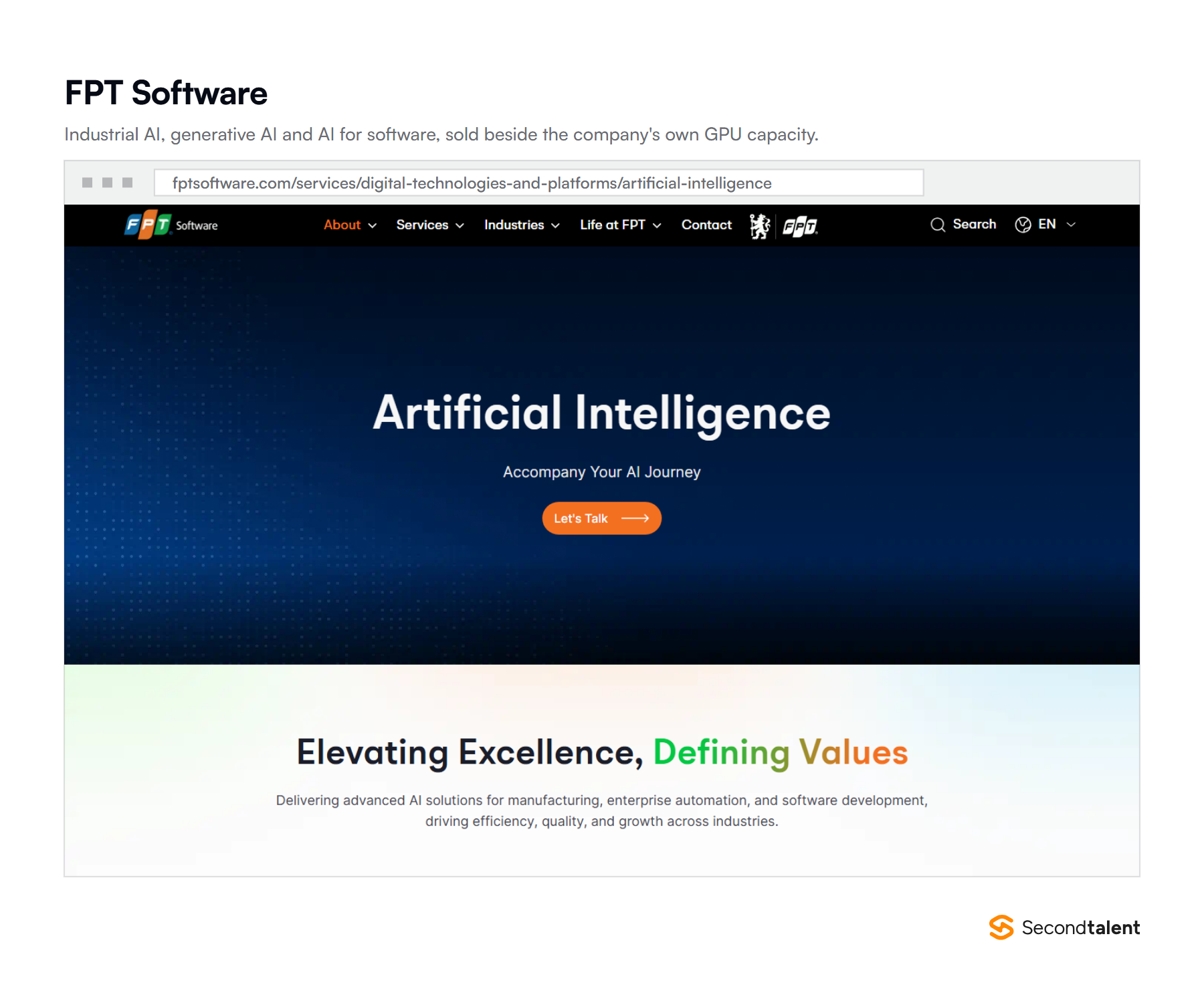
FPT Software is for enterprises that want the AI programme and the hardware under it in one contract. Its AI Factory announcement of March 26, 2026 moved the platform from HGX H100 and H200 systems to B300, across sites in Vietnam and Japan. FPT reports the factory has processed 1,100 billion tokens and fine-tuned more than 70 models, at about 70% utilisation.
The services side sells three things off that base. CodeVista is a multi-agent assistant that sits in the IDE, which FPT says cuts development time by 60%. I2 handles quality control and predictive maintenance in factories, with monitoring cut to one or two seconds.
The third is generative AI for back-office work. One case study describes procurement and supply chain assistants at a German chemical producer, where request handling fell from days to two to five minutes.
FPT is a founding member of the AI Alliance and partners with Landing AI on computer vision. Its Chief AI Officer sits on Constellation Research’s AI 150 list. FPT Software puts its own bench at 33,000 employees, with 1,100 customers and an average satisfaction score of 94.94 out of 100. The same scale advantage shows up in our guide to software development outsourcing companies in Vietnam, where FPT sits alone at the top for general engineering too.
- Best for: manufacturing, BFSI and enterprise programmes that need GPU capacity and a delivery team from the same supplier.
- Watch out: no published rates, and the AI Factory is a separate product from the services engagement.
- Published scale: 33,000 employees globally and 1,100+ customers, on FPT Software’s own about page. The 54,000 figure quoted elsewhere covers all of FPT Corporation.
2. TMA Solutions: the largest dedicated AI and data bench
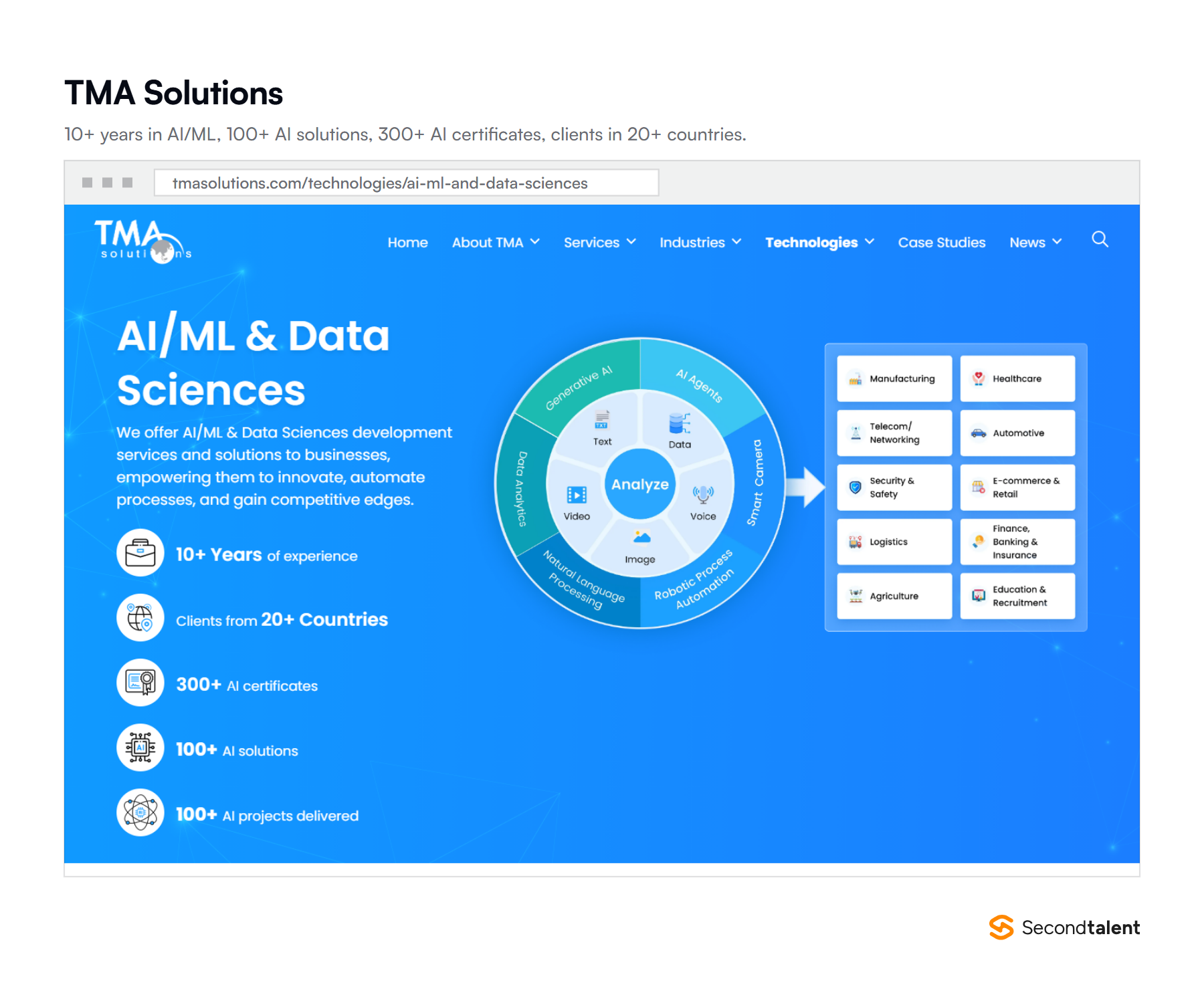
Seven hundred of TMA’s 4,000 engineers work in big data, analytics and AI or machine learning, which is the largest AI bench any Vietnamese company puts a number on. That matters most for vision and signal work, where the model is only useful once it runs on a camera, a line or a network.
Its AI and data sciences page claims ten years in the field, 100 AI solutions built, 100 projects delivered and 300 AI certificates held. An AI Center and an AI Agent Factory sit behind them.
The stack is what you would expect from a firm doing edge deployment. TensorFlow and PyTorch sit alongside NVIDIA DeepStream and Metropolis, with Azure OpenAI and AWS SageMaker for the cloud side.
Robotic process automation and edge AI round out the menu. TMA has run out of Quang Trung Software City in Ho Chi Minh City since 1997. It holds CMMI, ISO 9001 and ISO 27001, and has been a Microsoft Gold Partner since 2007.
Telecom is its deepest vertical, and the AI page lists eleven industries built off that base, from automotive and agriculture to smart buildings.
- Best for: computer vision, OCR, edge AI and telecom or manufacturing systems.
- Watch out: the AI page carries no case-study numbers, so ask for outcomes from the two or three projects closest to yours.
- Published scale: 4,000 engineers, clients in 30 countries, 700 developers in big data, analytics and AI.
3. CMC Global: AI sold as a four-stage programme
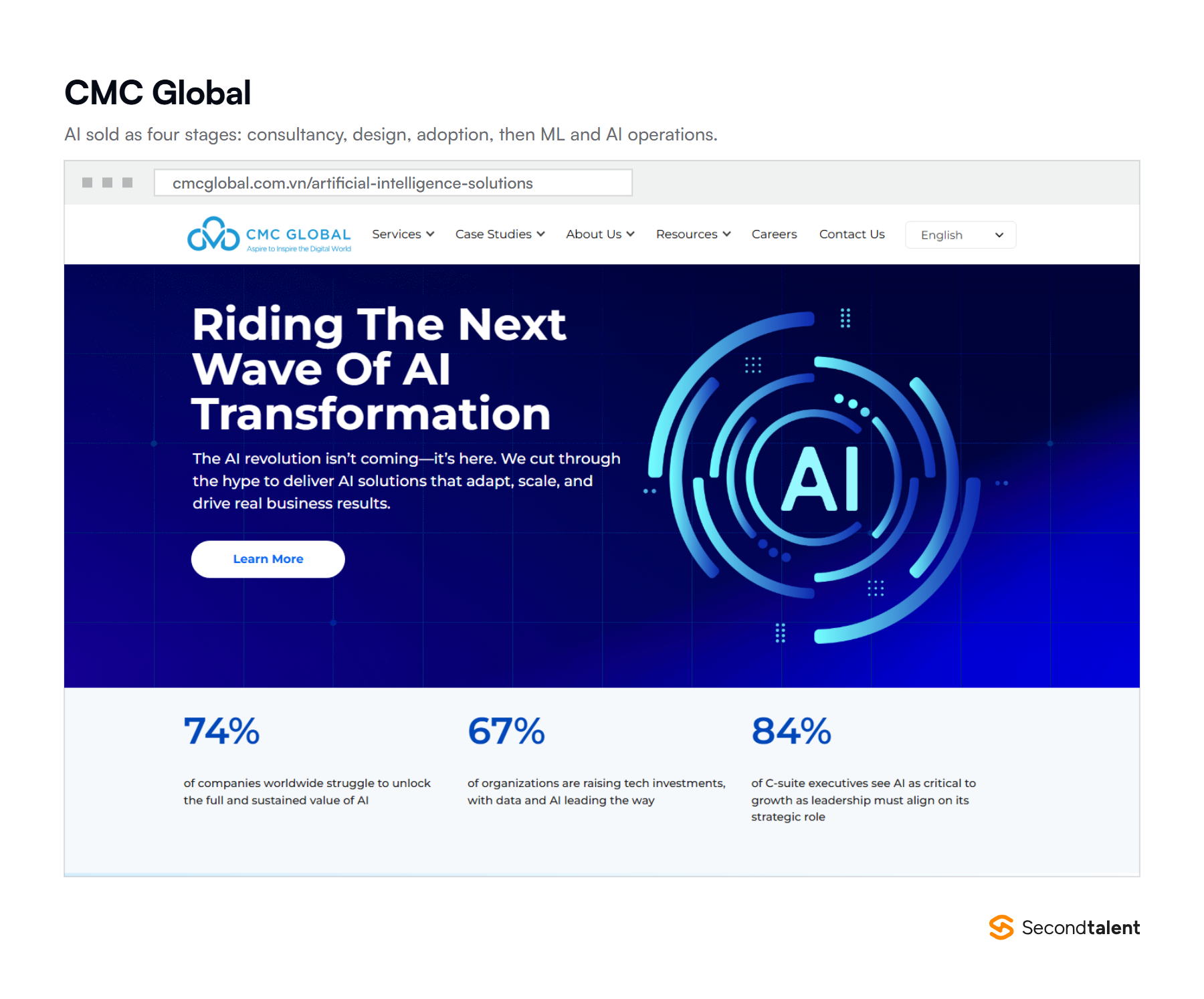
CMC Global suits a compliance-heavy buyer who wants a programme with stages and sign-offs rather than a squad of engineers. Its AI page breaks the work into consultancy, design, adoption and ML operations, and the sub-services under each are the unglamorous ones that decide whether a pilot survives: a data readiness audit, a regulatory and ethical review, secure AI environment design, then live model monitoring and automated retraining.
Delivery covers audio processing, computer vision, NLP and data science. Banking dominates the case studies: one built an AI data platform for an Asian bank, and a document automation project claims 80% digitalisation with half the manual work removed. CMC also ships its own products, among them a chatbot, a social listening tool and an identity document reader.
Samsung SDS has been the largest shareholder in parent company CMC Corporation since 2019. That is why the Korean desk is real rather than a phone number.
Offices in Tokyo, Seoul and Singapore back the same corridor. The certification list runs to CMMI Level 5, ISO 27001, ISO 20000 and PCI-DSS, alongside AWS Advanced Tier status and 35 named partners. CMC also prices four ways: project-based, staff augmentation, hybrid and results-based, which is more flexibility than most of this list advertises.
- Best for: banks, insurers and enterprises that need governance evidence with the model.
- Watch out: the AI pages carry no client names, and the site footer still reads 2023 in places.
- Published scale: 3,000+ certified engineers, 300+ global clients, 30+ countries.
4. NashTech: model work and data labelling on a UK contract
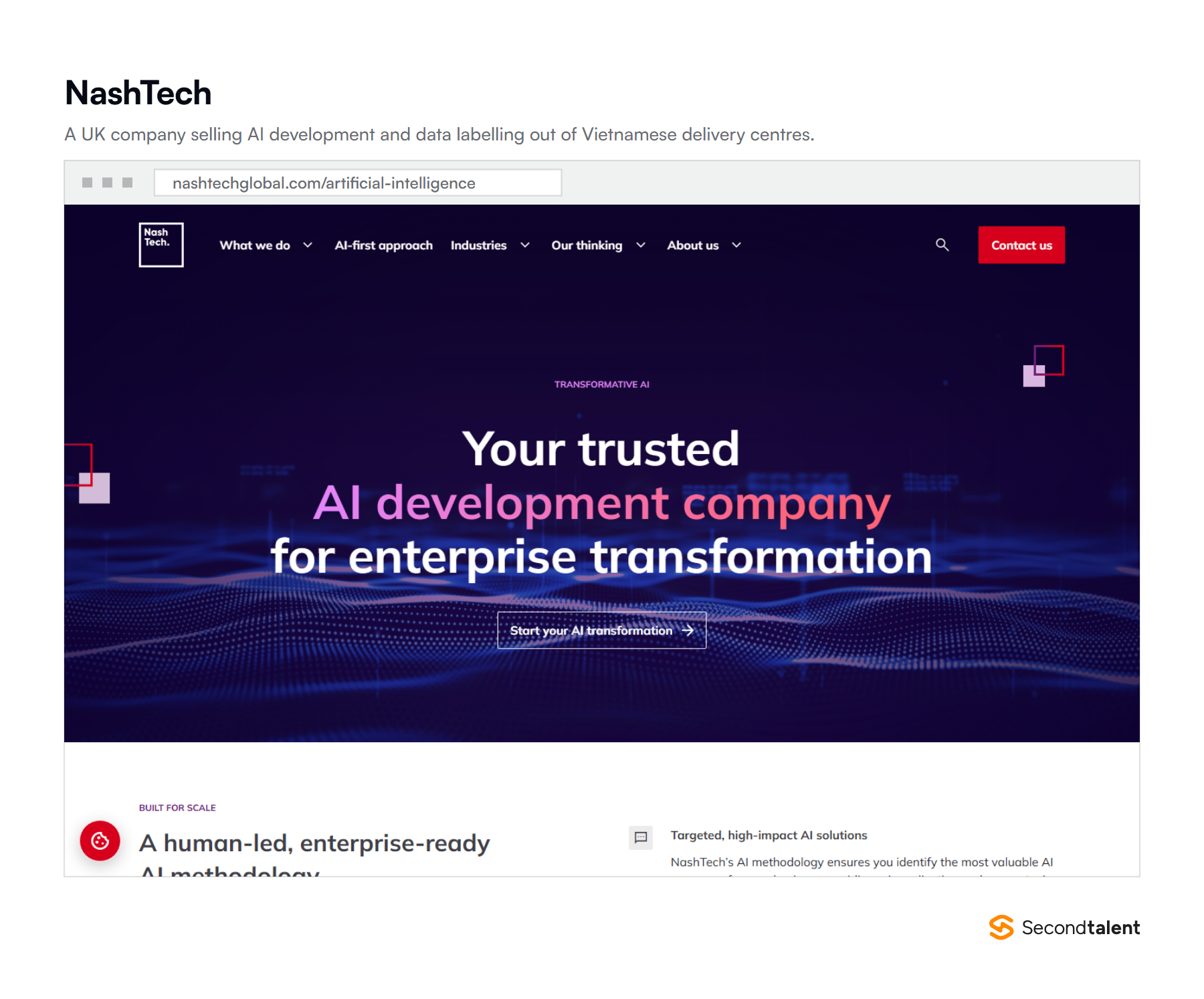
NashTech is the only company here that sells the model and the training data behind it under one agreement. Its data practice lists AI data labelling and annotation next to data platforms and analytics, with agentic systems sold on top. A project that starts with messy documents does not need a second supplier halfway through.
You sign with a British company. NashTech keeps its head office in the UK and opened its first Vietnamese delivery centre in 2000, later taking over Alcatel Lucent’s research and development centre in the country. Its own timeline claims the first CMMI Level 5 v2.0 appraisal in Vietnam. It publishes a client net promoter score of 63 and a 4.9 Clutch rating, which is more disclosure than most of this list offers. The partner stack is the data engineer’s one: Databricks and Confluent next to Microsoft, Google Cloud Premier and AWS.
The bench is 2,000-plus engineering experts across five delivery centres, so Vietnam is a large part of the total rather than all of it. Weighing that against a local firm is a market question as much as a vendor one. Our comparison of the Philippines, Vietnam and Indonesia covers how the three differ on cost and English.
- Best for: European buyers who want a local contract, and projects where data preparation is half the work.
- Watch out: headcount is group-wide across Vietnam, India and Costa Rica, so confirm where your team sits.
- Published scale: 2,000+ engineering experts, 5 delivery centres, 26+ years.
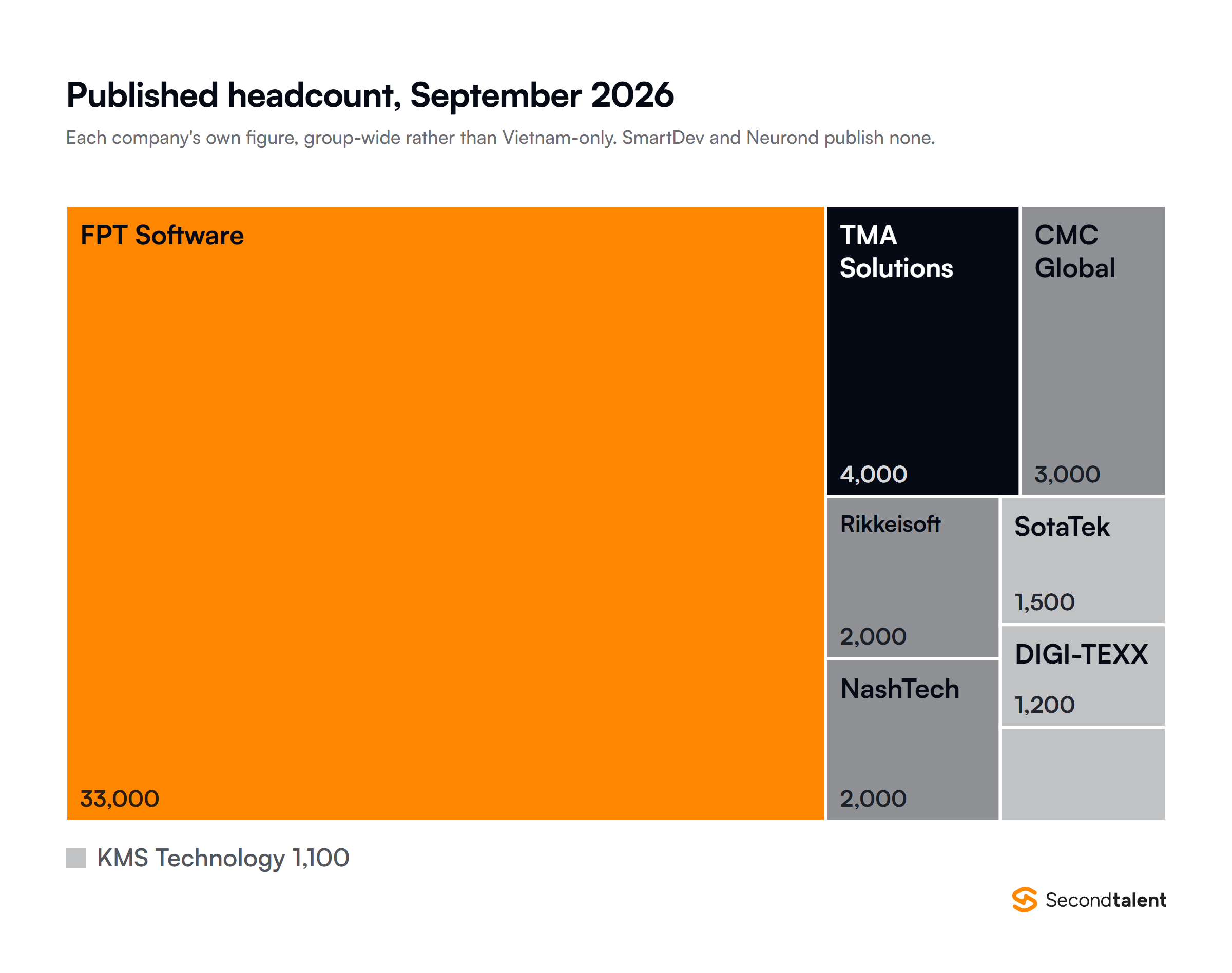
The chart is the reason a ranking by size stops being useful after the first row. FPT Software is eight times the size of the next company on it. The six firms between 1,100 and 3,000 people are close enough that the choice comes down to what they specialise in, not how many badges they can field.
5. KMS Technology: it bought its AI capability
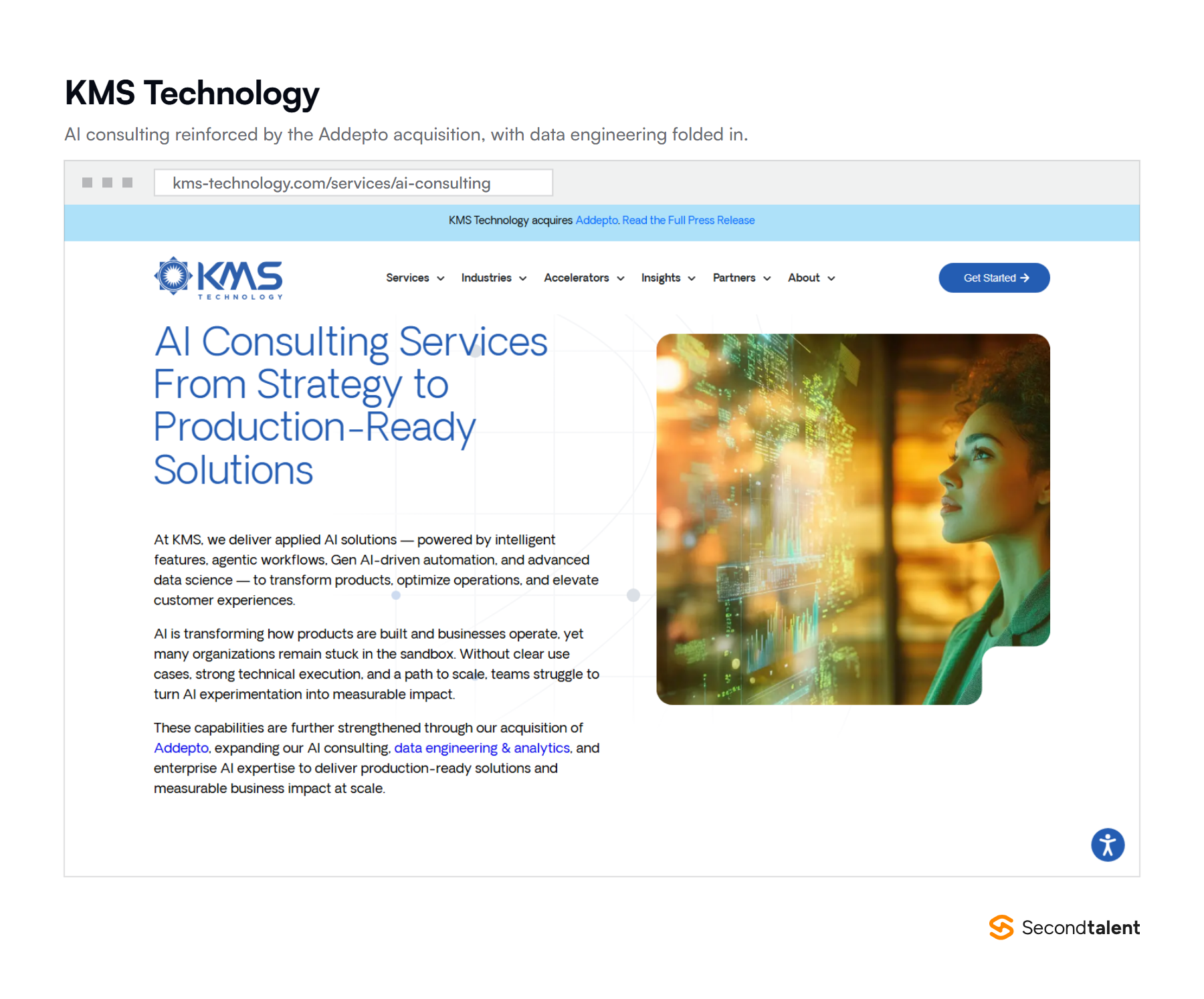
KMS Technology took the shortcut. In December 2025 it announced it had acquired Addepto, a Polish consultancy with seven years behind it in AI and data. That team now delivers alongside the Vietnamese engineers. Nine months on, the acquisition banner still runs across the top of the KMS site, which tells you how central it is to the pitch.
The offer around it is more concrete than most. Velox, its own AI orchestration platform, connects agents and project context into human-in-the-loop workflows across the software lifecycle.
Four fixed-scope engagements sit underneath: a five-in-five AI workshop, a proof-of-concept development workshop, an AI readiness assessment and a data pipeline assessment. Each is a way to test the team before committing to a build.
KMS is a US company with 17 years behind it and 1,100-plus people across five offices in Vietnam, Mexico, Poland and the United States.
Its client list skews to software product companies and private-equity-backed vendors. That is the tell for how it works: a product engineering partner that added AI, rather than a body shop that renamed its data team.
- Best for: software companies embedding AI features, and portfolio companies under a PE deadline.
- Watch out: the strongest AI people came with Addepto and sit in Poland, not Vietnam.
- Published scale: 1,100+ people, 5 offices, 17+ years.
6. Rikkeisoft: an agent suite sold as tooling
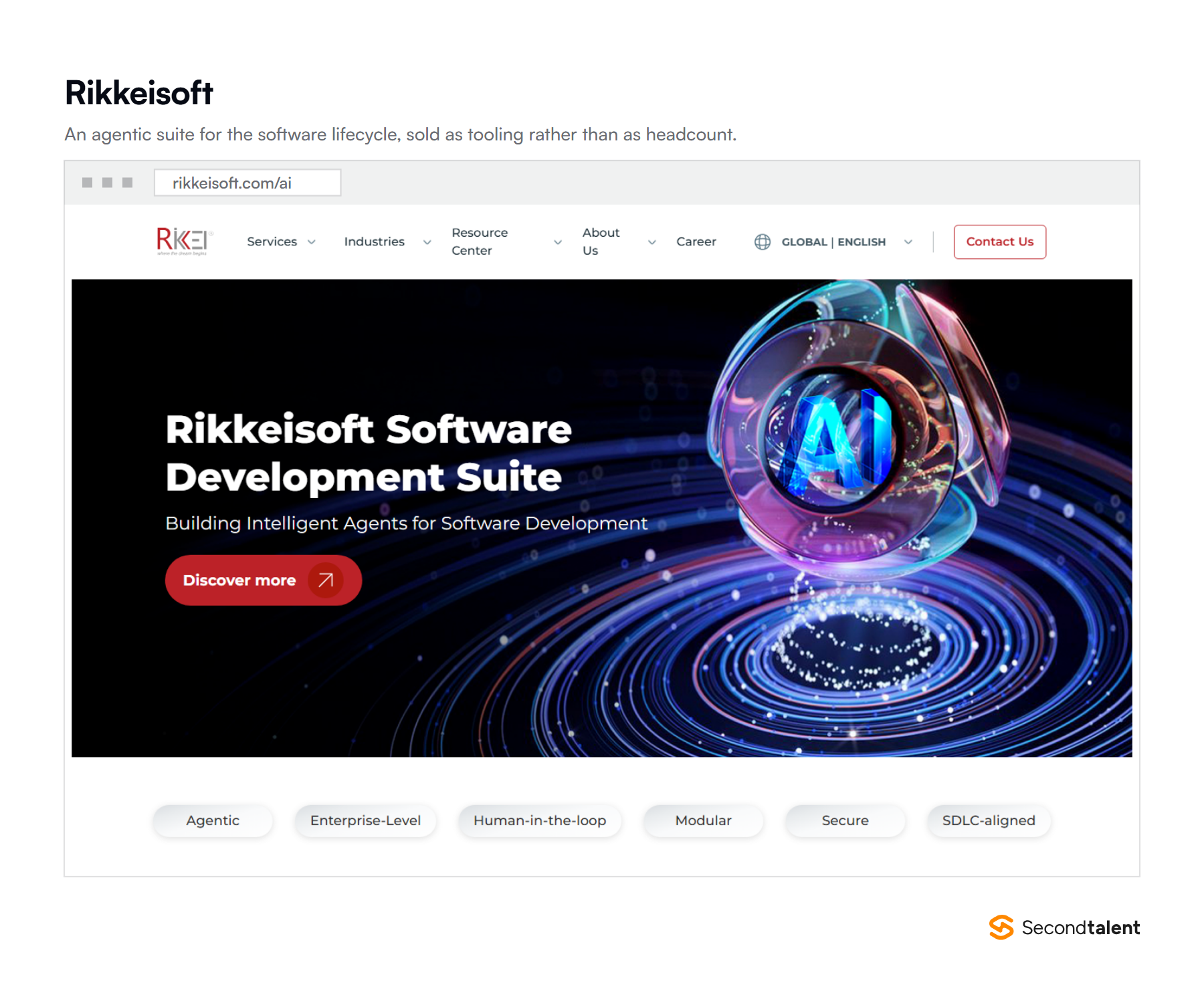
Rikkeisoft has stopped selling AI as a service and started selling it as a product. Its Software Development Suite is a set of agents covering planning, design, development, testing, deployment and maintenance, described as modular, human-in-the-loop and enterprise-grade. The numbers on that page are its own and carry no methodology: 42% faster delivery, 35% less defect leakage and coverage of the full lifecycle.
The group behind it grew out of the Japanese market. Founded in Hanoi in 2012, Rikkeisoft passed 2,000 employees in 2024, signed a partnership with Sumitomo Corporation the same year, and set up RKSoft in South Korea.
Its US arm, RKTech, has since invested in Entropy, an American IT services firm, to reach Latin American engineers. Around the AI suite sit cloud, data science, low-code, Salesforce and SAP practices, so the agents land in a stack the same vendor already runs.
Rikkei Japan earned a Great Place to Work certification in June 2025, and in December that year the group signed an alliance with Vinova. Staff turnover decides whether your team stays intact for a two-year build, so those signals carry more weight than the suite’s percentages. Treat those as a starting point for a conversation about measurement.
- Best for: Japanese and Korean delivery, and teams that want AI applied to their own development process.
- Watch out: the productivity figures are unaudited vendor claims. Ask what baseline they were measured against.
- Published scale: 2,000+ global employees, 1,500+ projects, 700+ clients.
7. SotaTek: AI next to a blockchain practice
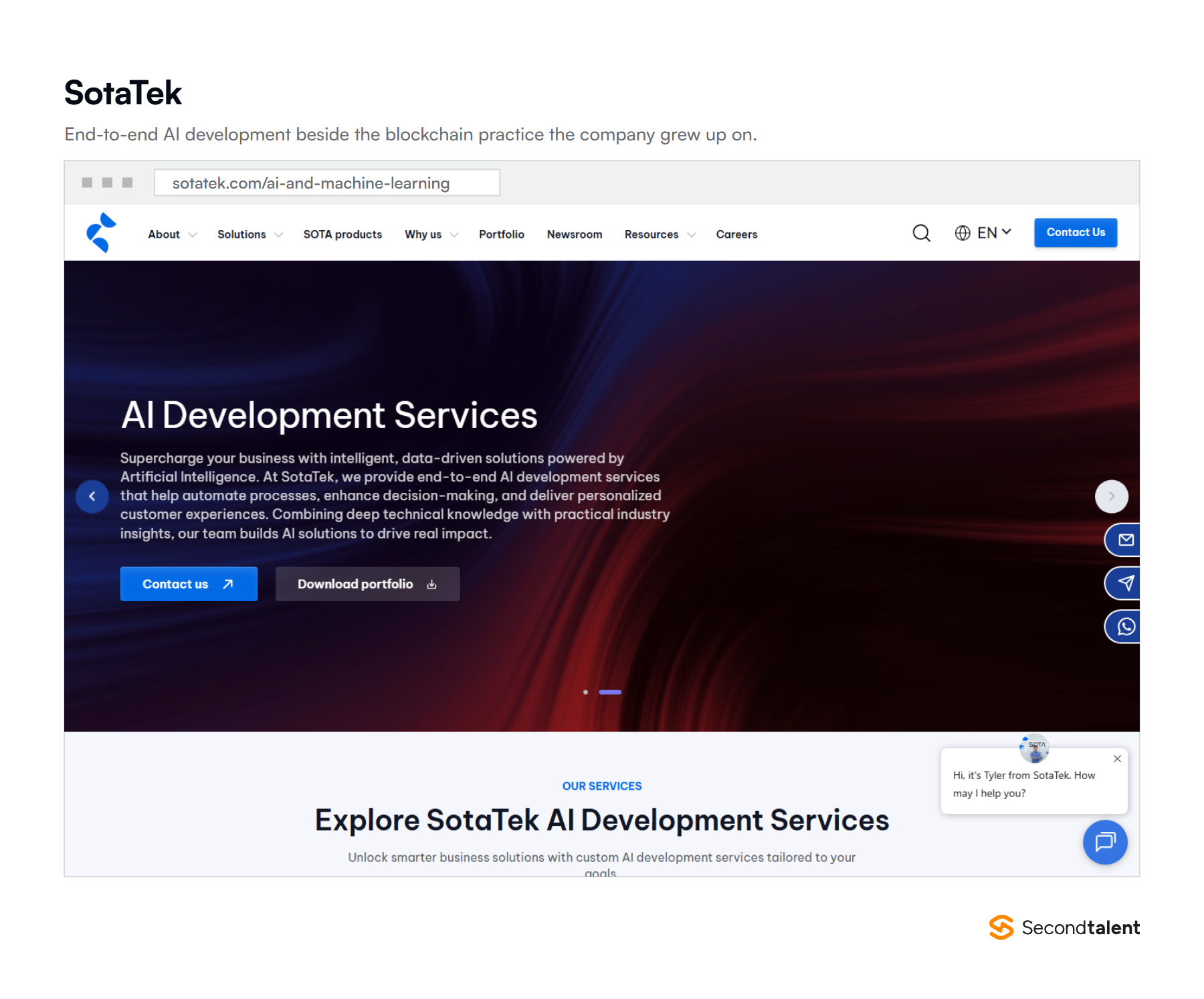
SotaTek suits funded product teams that ship fast and change direction often. Seven founders started it in Hanoi on August 11, 2015. It now runs to more than 1,500 employees and 500 delivered projects for partners in 25 countries, among them Klaytn, Megazone Cloud and Yogiyo.
The blockchain heritage shapes the AI work rather than competing with it, because the same clients who wanted token infrastructure in 2021 now want agents and recommendation systems.
SotaTek sells end-to-end AI development and also ships its own products, two of which, Saydi and NoteX, took Sao Khue awards in 2026. Owning products of its own is the difference between a team that has shipped an AI feature and one that has only staffed them.
Its overseas expansion followed the money: Tokyo and Osaka in 2019, Sydney in 2023, Singapore in 2024. The group holding company dates from 2021, the year SotaTek reports revenue growth above 300%. That spread makes it one of the easier firms here to meet in person outside Vietnam, which counts when the specification is still moving.
- Best for: startups and scale-ups, Web3-adjacent products, fast prototypes.
- Watch out: a generalist bench, so name the AI engineers you are getting before signing.
- Published scale: 1,500+ employees, 500+ projects, partners in 25 countries.
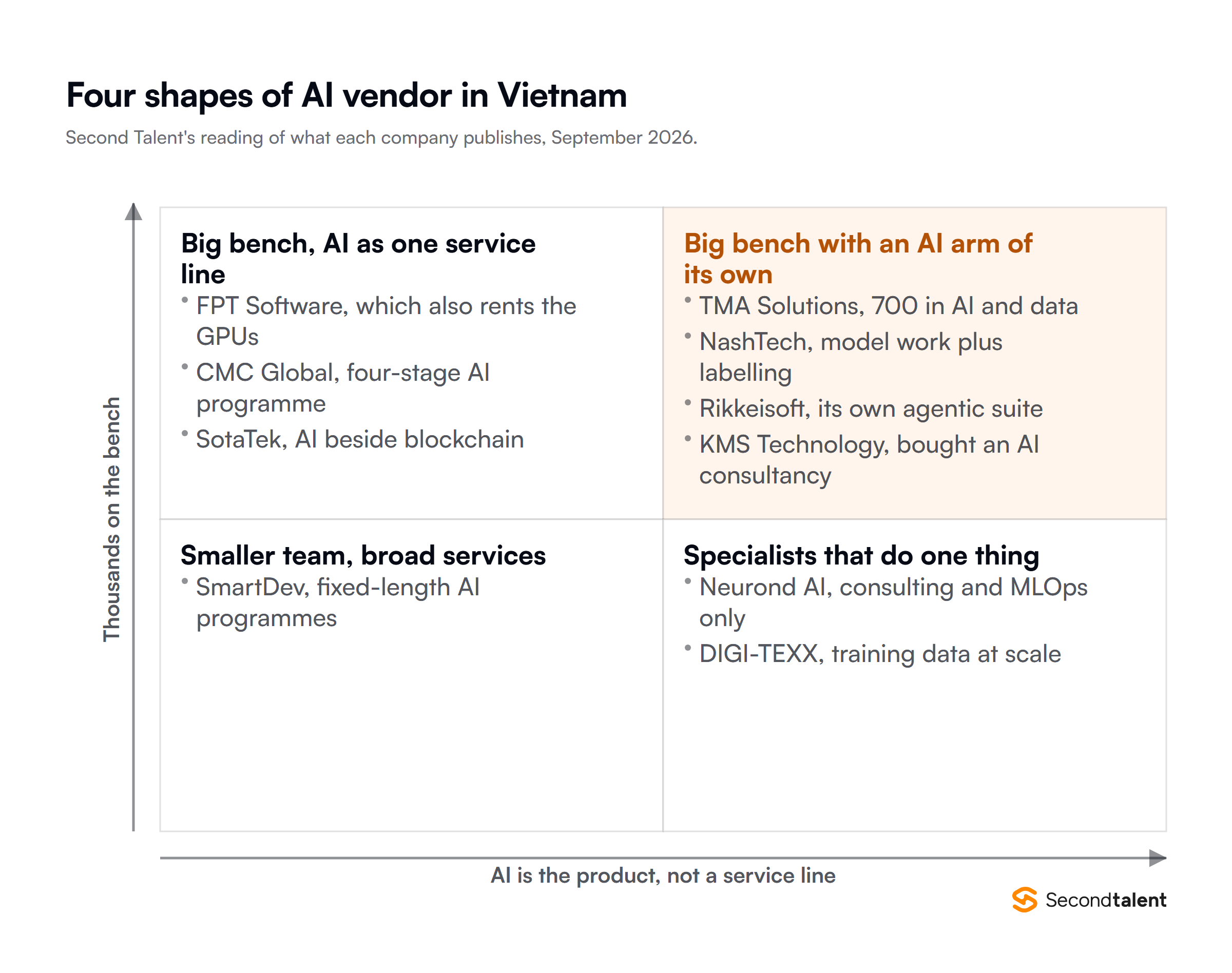
Two questions sort the ten faster than any ranking: how big is the bench, and is AI the product or one service line among twenty? Companies in the top-right quadrant run an AI unit with its own name, budget and tooling. The ones on the left will staff your project from the pool that also handles their Java work.
8. SmartDev: fixed-length AI programmes for smaller buyers
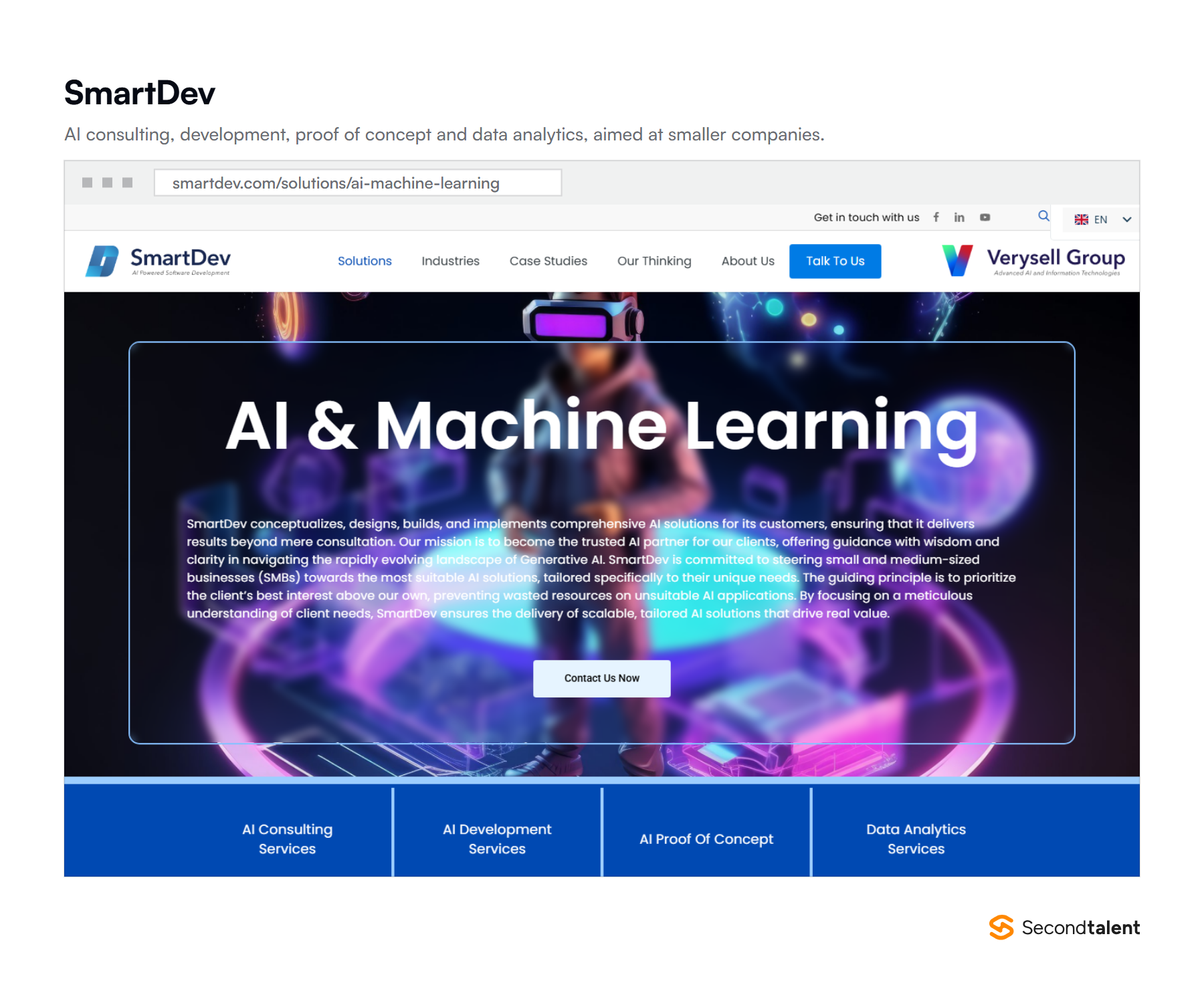
SmartDev packages the first step, which is the hardest thing for a smaller buyer to price. It sells a three-week AI discovery programme and a ten-week AI product factory. The commitment is a date rather than a monthly team rate, and there is a deliverable to cancel against.
The published case studies match that scale: invoice processing, CV parsing for recruitment screening, a recommendation and matching system for a food and beverage business. Its own page says the firm aims at small and medium businesses, and steers them away from AI that does not fit. Few vendors write that down.
SmartDev belongs to Verysell Group, a Swiss-headquartered company operating in 16 countries since 1990, whose current focus is software outsourcing, fintech and AI. SmartDev’s own offices run from Da Nang and Hanoi to Singapore, London, Nyon and Kampala.
Named specialists front the AI practice, among them a professor with 19 years in high tech. The site publishes no headcount, though, which is the main thing to pin down before you sign.
- Best for: small and mid-sized companies buying a scoped pilot instead of a team.
- Watch out: no published headcount and no named AI platform of its own.
- Published scale: not disclosed. Verysell Group operates in 16 countries.
9. Neurond AI: Orient Software’s AI arm, and nothing else
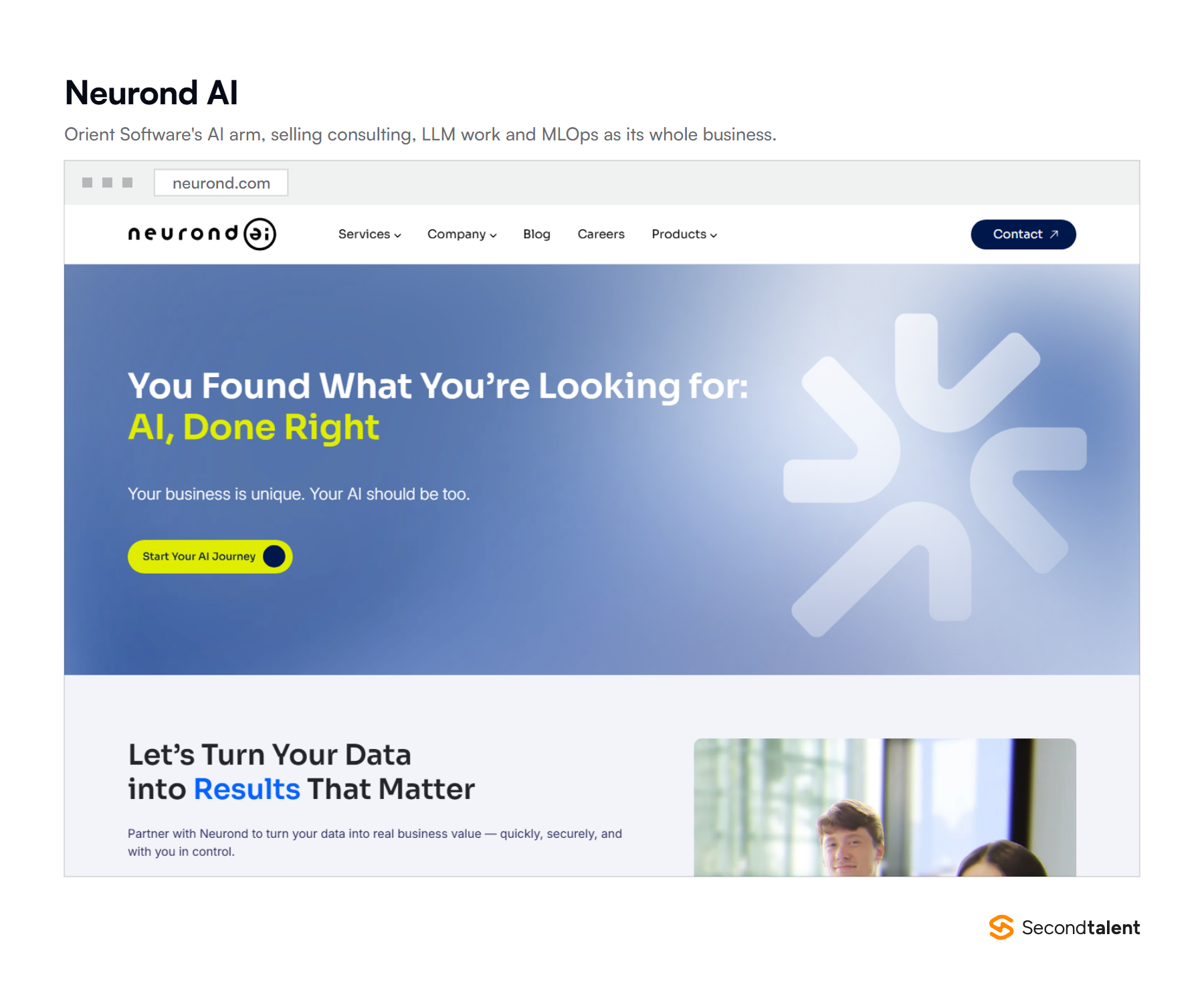
Neurond puts an average of 15 days on the clock for a first AI prototype, which is the most specific delivery promise anyone on this list publishes.
Everything it sells is AI: consulting, LLM development, custom agents, data engineering, MLOps and a data maturity assessment, plus its own CV parser, DrParser. Microsoft Dynamics 365 and Power Platform work sits beside it for companies already in that stack.
The 20 years of experience on its homepage belongs to its parent. Orient Software, founded in 2005 and serving 200-plus global clients, launched Neurond as its specialised data and AI arm during its Da Nang expansion. That is a benefit rather than a red flag: the AI unit sits on an engineering company that can ship the software around the model.
Published outcomes are narrow and checkable. A fish welfare system counts fish and detects stress at better than 95% accuracy. Document processing removed 80% of manual invoice extraction for a fintech lender, and a self-hosted chat assistant went to the design firm Atlas. Offices run from Da Nang to Ho Chi Minh City, Hanoi, Hue and Singapore.
- Best for: a fast prototype, an LLM feature, or MLOps on a model you already have.
- Watch out: no headcount published, and the bench depth comes from Orient rather than Neurond.
- Published scale: 50+ AI implementations, 98% client satisfaction, 8-year average client relationship.
10. DIGI-TEXX: training data, not software
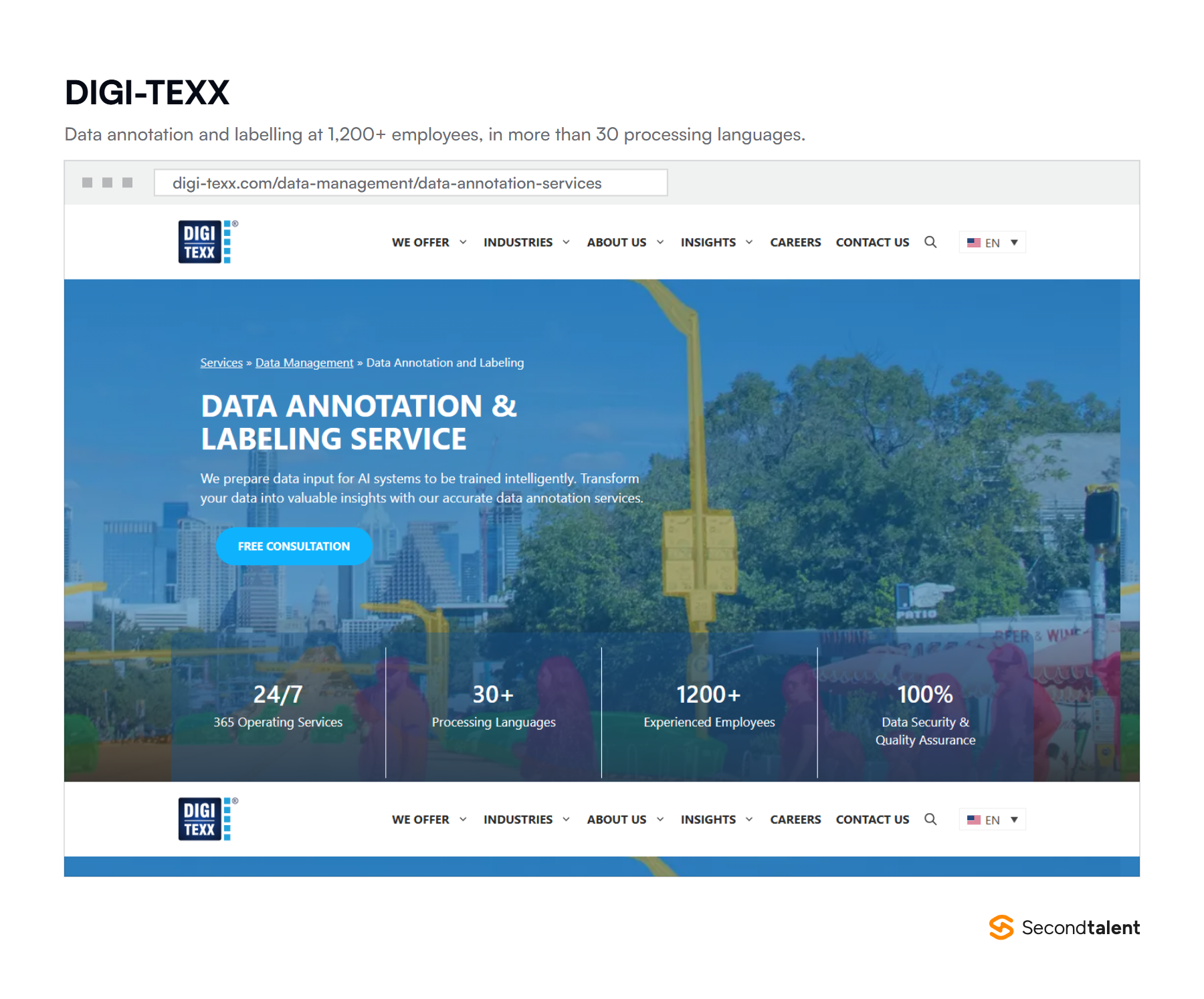
DIGI-TEXX does the part of AI work the other nine leave to you. Its annotation and labelling service runs on a 24-hour cycle with more than 1,200 employees and more than 30 processing languages. The work covers bounding boxes, segmentation, transcription, entity labelling and documents. Three in-house tools carry it: DIGI-Scan for capture, DIGI-Xtract for OCR extraction and DIGI-Vault for document management.
The published projects are the useful evidence: vehicle annotation for traffic monitoring, image processing for a virtual try-on model, and generating user behaviour datasets to train an AI agent. Those are three different data types with three different quality problems, which is a better signal than a page of logos.
DIGI-TEXX has called itself the first fully German-invested BPO in Vietnam since 2003. It works from Quang Trung Software City and Binh Phu in Ho Chi Minh City, plus an innovation centre in Can Tho, and holds ISO 27001:2022 and ISO 9001:2015. FamilySearch, Manulife and the International Labour Organization appear among its clients.
European buyers tend to check that paperwork before the price. Our comparison of annotation outsourcing and in-house teams sets out the maths against building the function yourself.
- Best for: labelled datasets, document extraction and content moderation at volume.
- Watch out: it does not build models, so pair it with one of the nine above.
- Published scale: 1,200+ employees, 30+ processing languages, three operation centres.
What This Work Costs, and What Changed This Year
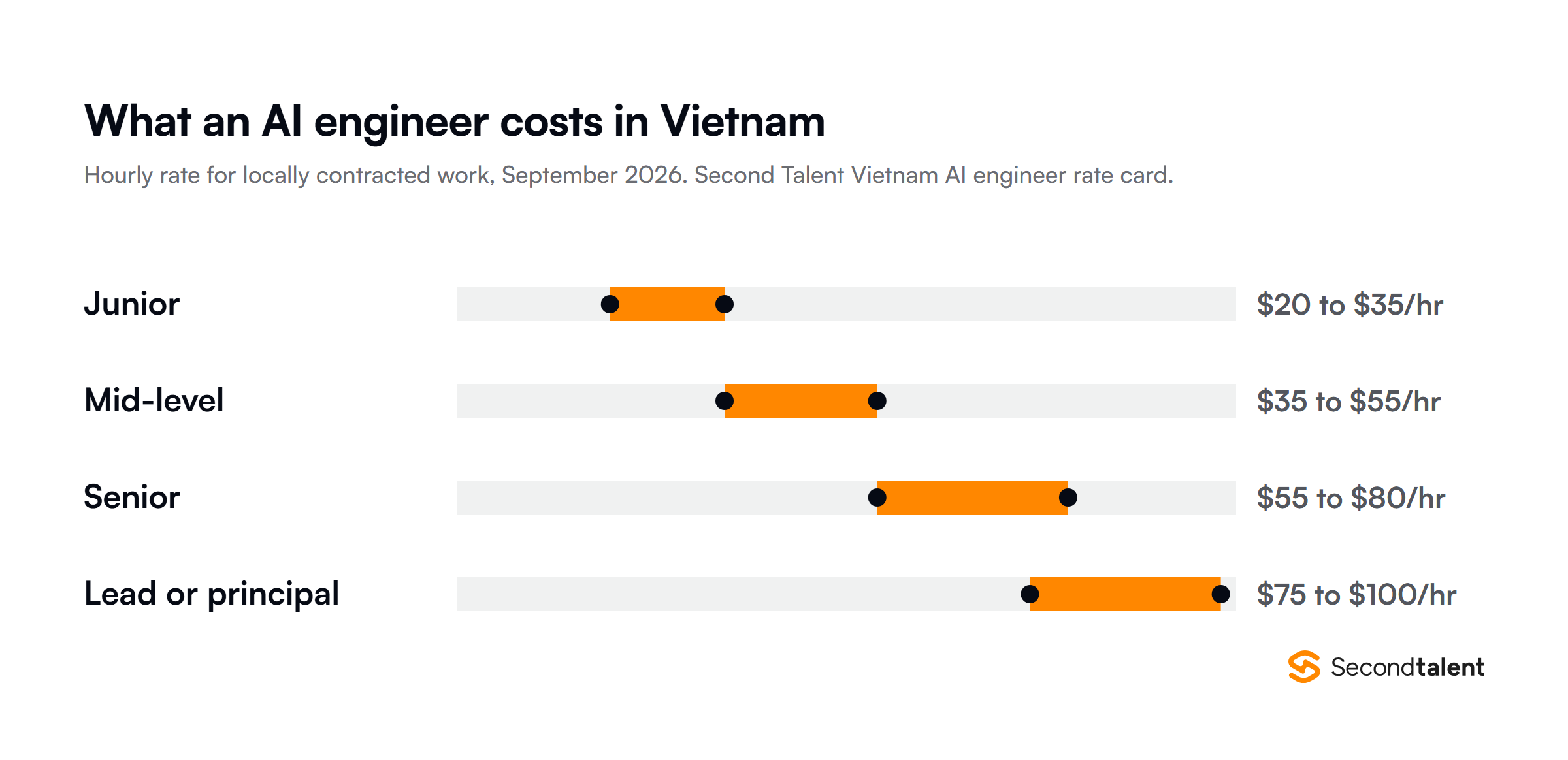
None of these firms publishes a rate card, so the floor under any quote is what the engineers themselves cost. Our Vietnam AI engineer rate card puts mid-level work at $35 to $55 an hour and senior work at $55 to $80, with leads reaching $100. A vendor quote sits above that band because it carries management, QA and the bench.
Supply is the pressure on those numbers. TopDev’s market reporting put Vietnam’s 2025 requirement near 700,000 IT workers against a workforce closer to 530,000, with the gap widest in the specialisms these vendors sell. Policy has followed. The Law on Digital Technology Industry took effect on January 1, 2026, and Decision 982/QD-TTg set a 2030 target of $55 billion in yearly digital technology exports.
The practical effect is that a good AI team is the scarcest resource inside these companies. So ask two questions on the first call. Which named engineers will you get, and what happens to your project when a larger client asks for them?
When Hiring the Engineers Beats Hiring the Vendor
A project with a fixed end date suits a vendor. Ongoing AI work often does not, because the knowledge that makes year two cheaper leaves with the delivery team. We built Second Talent for that case: AI engineers in Vietnam hired as your own staff, at a monthly cost you can set against the rate bands above. Our Vietnam employer of record carries the employment if you have no entity there.
If the work is training data rather than engineering, we run that as a managed service through data annotation outsourcing. And if you want the full cost picture before you talk to anyone, our cost to hire in Vietnam breakdown covers salary, contributions and the fees on top. Tell us what you are building and we will send profiles within 24 hours.
Frequently Asked Questions
Which is the largest AI outsourcing company in Vietnam?
FPT Software, by a wide margin. FPT Software reports 33,000 employees globally and runs its own GPU infrastructure. Its parent, FPT Corporation, is larger still at around 54,000 people. TMA Solutions has the largest bench given over to AI and data, at 700 of its 4,000 engineers.
How much does it cost to outsource AI development to Vietnam?
Expect a vendor rate above the local engineering rate, which runs $35 to $55 an hour for mid-level AI work and $55 to $80 for senior. Annotation and data preparation price per unit or per seat instead, well below any Western equivalent.
Can a Vietnamese company label training data as well as build models?
Two of the ten publish both. DIGI-TEXX is an annotation specialist with 1,200-plus employees, and NashTech sells data labelling next to its AI development. With the other eight, expect to bring the labelled dataset yourself or contract a second supplier.
Do you need a Vietnamese entity to work with these companies?
No. All ten take contracts from foreign clients, and four let you sign outside Vietnam: NashTech in the UK, KMS in the United States, SmartDev through Verysell in Switzerland, SotaTek in Singapore or Japan. You need an entity or an employer of record only if you hire the engineers yourself.
Which of these suits a startup rather than an enterprise?
SmartDev for a scoped pilot with a fixed end date, Neurond for a prototype in about two weeks, SotaTek for a product team that expects the specification to change. The enterprise firms will take the work, but their process assumes a programme that runs for years.

![How to Hire Developers in Asia Remotely. How to Hire Developers in Asia Remotely from the USA [2026], by Second Talent.](https://www.secondtalent.com/wp-content/uploads/2026/09/hire-developers-in-asia-remotely-featured-v2-768x403.jpg)
![Workplace Diversity Statistics. Top 100+ Workplace Diversity Statistics [2026], by Second Talent.](https://www.secondtalent.com/wp-content/uploads/2026/09/workplace-diversity-statistics-featured-v2-768x403.jpg)