
Southeast Asia has become a leading region for global tech talent, with the Philippines, Vietnam, and Indonesia standing out as top choices for companies seeking skilled, scalable, and cost-effective development teams.
While each country offers significant advantages, they also come with distinct challenges that can impact hiring strategy and long-term success.
Philippines vs Vietnam vs Indonesia at a glance
The short version: the Philippines is the easiest to work with, Vietnam has the deepest engineering skill and costs the most, and Indonesia is the cheapest with the largest long-term pool.
Every figure below is explained in the sections that follow.
| Philippines | Vietnam | Indonesia | |
|---|---|---|---|
| Talent pool | Over 1.3 million IT-BPO workers, the most mature ecosystem in the region | Growing fast, but concentrated in the major cities | 275 million people and the largest long-term pool, with accessible talent concentrated in Jakarta |
| Graduates a year | 190,000 STEM | 50,000 IT | About 150,000 STEM, and rising |
| Junior developer Monthly, USD | $530 to $890 | $800 to $1,300 | $430 to $670 |
| Mid-level developer Monthly, USD | $890 to $1,600 | $1,300 to $2,300 | $670 to $1,098 |
| Senior developer Monthly, USD | $1,600 to $2,800 | $2,300 to $3,800 | $1,098 to $1,700 |
| Cost trend | Predictable, 5% to 8% a year | Salary pressure, 10% to 11% a year, with premiums for AI skills | Lowest costs overall, though Jakarta approaches Vietnamese levels |
| English | An official language, fluent written and spoken | Varies: good in the tech hubs, weaker across the wider pool | The biggest hurdle, and strongest in Jakarta’s startup scene |
| Technical strengths | Full-stack web, mobile, and cloud on AWS and Azure | Algorithms, Java enterprise, mobile, game development, and growing AI and data science | Android, e-commerce and fintech, Go and microservices, DevOps |
| Work culture | Closest to Western norms, direct, with a strong client focus | Values hierarchy and group harmony, so disagreement is voiced less readily | Relationship and consensus led, making decisions slower but more inclusive |
| Business environment | The most straightforward: a US-modelled legal system and strong IP protection | Needs local expertise, with bureaucratic registration and strong government backing | The most complex, with multi-jurisdiction rules and foreign ownership limits |
| Time zone | The most flexible, and night shifts matching US hours are common | Suits Asia-Pacific hours, so US overlap takes planning | Similar to Vietnam, with less appetite for working off-hours |
| Best for | Client-facing teams where English is critical, and the easiest entry to the region | Deep engineering and specialised technical skills | Cost optimisation, mobile and consumer products, and Southeast Asian market entry |
Which market fits your hiring needs?
Select your situation below.
You need developers who can communicate seamlessly with US/UK clients. Philippines developers offer 92% English proficiency and cultural alignment with Western work styles. Average senior dev rate: $2,500-4,000/month. View Philippines rates →
Your priority is deep technical skills over communication. Vietnam produces 50,000+ IT graduates annually with strong expertise in Java, Python, and AI/ML. Save 15-20% vs Philippines rates. Compare Vietnam costs →
You’re scaling fast and need volume. Indonesia offers 600,000+ tech professionals in a rapidly growing market. Ideal for mobile and full-stack teams at competitive rates. Explore Indonesia hiring →
You want access to all three markets without setting up entities. Our Employer of Record service lets you hire across Southeast Asia in days, not months, with full compliance. Get EOR pricing →
Market Overview
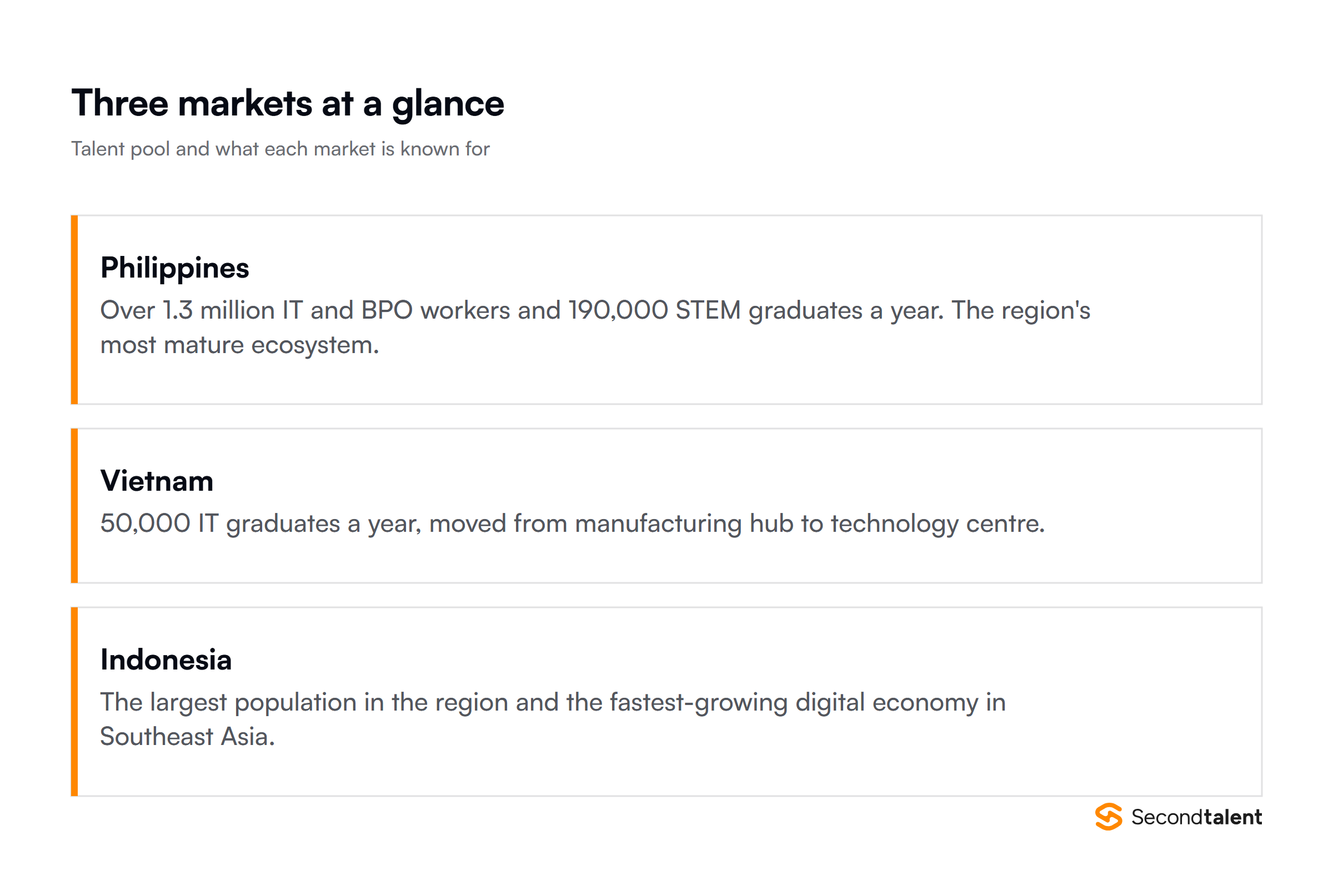
The Philippines has long been the region’s outsourcing leader, leveraging strong English proficiency and cultural alignment with Western markets.
With over 1.3 million IT-BPO workers and 190,000 STEM graduates annually, it offers the most mature talent ecosystem in Southeast Asia.
Vietnam has rapidly evolved from a manufacturing hub to a technology powerhouse, producing 50,000 IT graduates yearly.
Global tech giants like Samsung and Intel have established significant R&D centers, validating the country’s technical capabilities.
The government’s focus on becoming a regional tech leader drives continuous improvement in education and infrastructure.
Indonesia presents the largest market opportunity with 275 million people and a booming digital economy.
While historically overlooked for tech talent, Indonesia’s startup ecosystem has exploded, creating a new generation of tech-savvy professionals.
The country produces approximately 150,000 STEM graduates annually, with numbers growing rapidly.
Language and Communication
Philippines
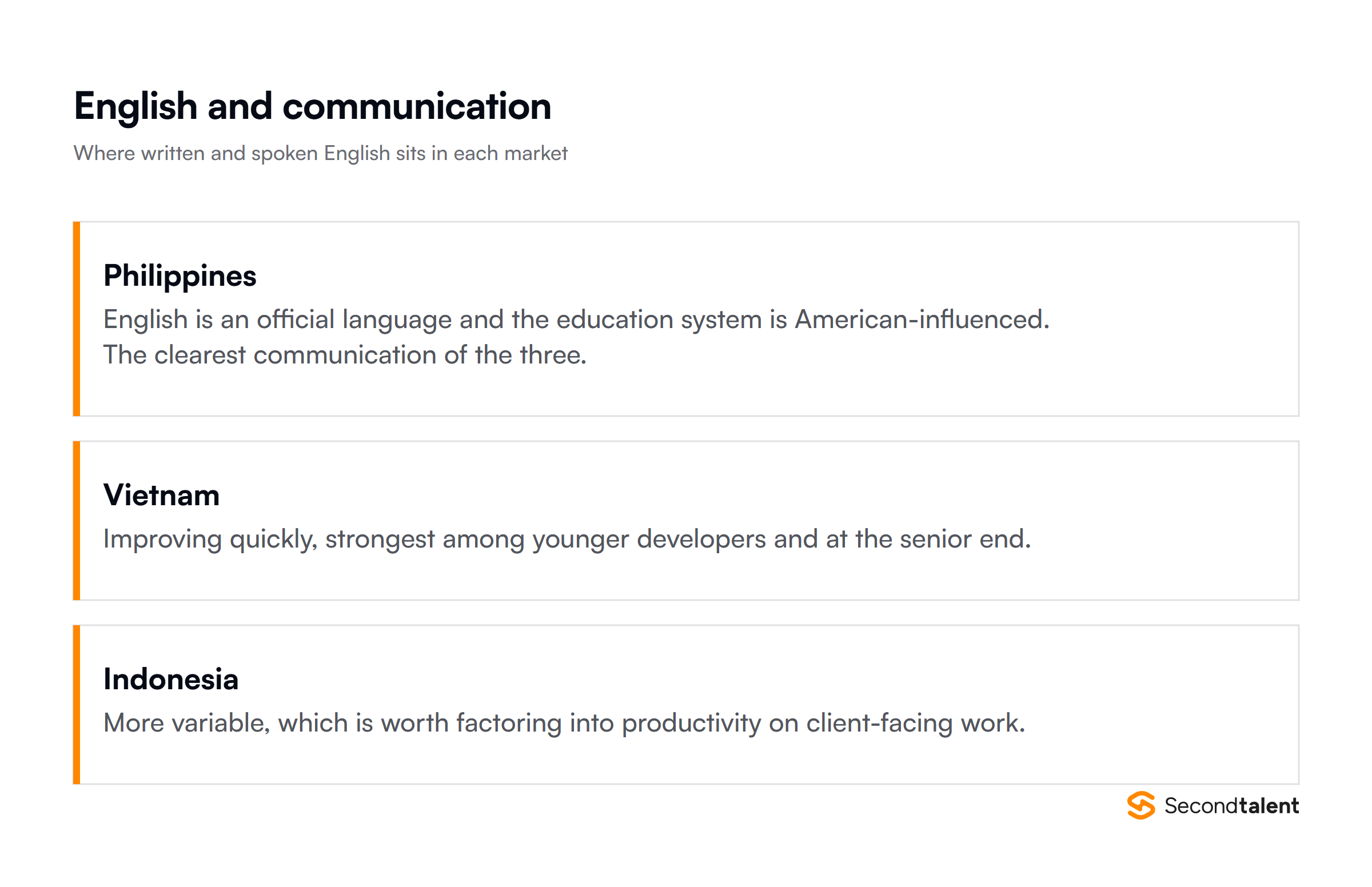
English proficiency remains the Philippines’ strongest advantage. With English as an official language and an American-influenced education system, Filipino developers typically communicate fluently in both written and spoken English.
This extends beyond basic communication to include understanding Western business culture, idioms, and working styles. Code documentation, technical discussions, and client interactions flow naturally without language barriers.
Vietnam
Vietnamese English proficiency varies significantly. Developers in major tech hubs who have worked for international companies often have good English skills, but the broader talent pool may struggle with complex technical discussions.
Companies typically need to invest in English training or implement structured communication processes.
Technical competence often outweighs communication challenges, but additional time for clarification and documentation should be expected.
Indonesia
English proficiency poses the most significant challenge in Indonesia. While Jakarta’s startup ecosystem produces English-speaking talent, the broader developer population has limited English skills.
Many companies successfully work with Indonesian developers by using local technical leads as communication bridges or investing heavily in language training.
The massive talent pool makes this investment worthwhile for companies willing to address the language gap.
Technical Skills and Expertise
Philippines
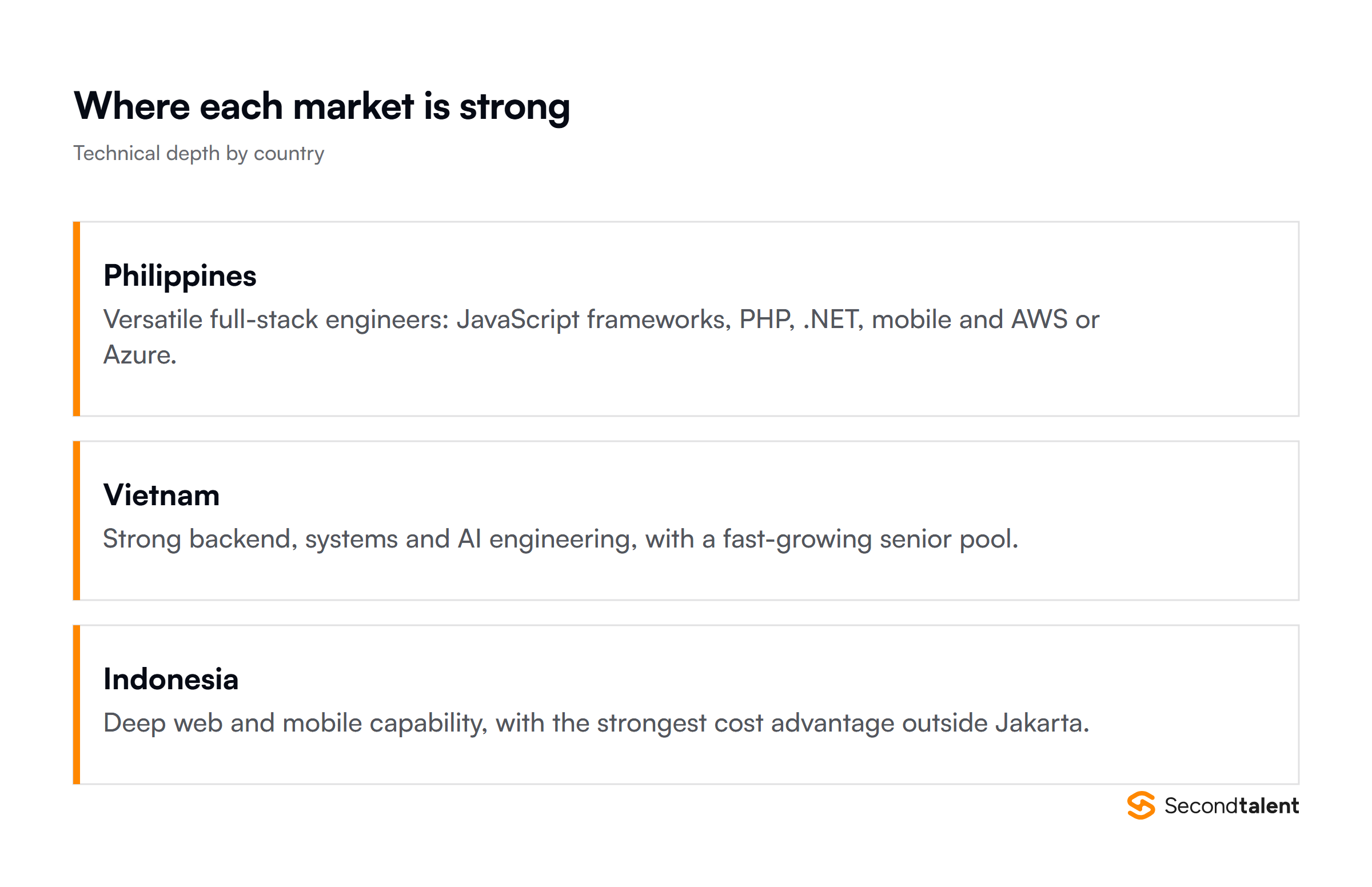
Filipino developers excel as versatile full-stack engineers comfortable with various technologies.
Strengths include web development (JavaScript frameworks, PHP, .NET), mobile development (iOS and Android), and cloud technologies (AWS and Azure).
The BPO industry’s influence means many developers also understand business processes and client service. However, cutting-edge specializations like AI, ML, or blockchain may have smaller talent pools compared to general development skills.
Vietnam
Vietnamese developers typically demonstrate exceptional mathematical and algorithmic skills, reflecting the education system’s emphasis on technical fundamentals.
Popular expertise includes Java enterprise development, mobile app development, game development (a surprising specialty), and growing capabilities in AI and data science.
Vietnamese developers often excel at complex technical challenges but may need encouragement to think creatively or challenge requirements.
Indonesia
Indonesia’s massive domestic market has created developers specialized in building for scale and mobile-first experiences.
Strengths include Android development (driven by local market demand), e-commerce and fintech solutions, Go and microservices architecture, and DevOps and cloud infrastructure.
The startup ecosystem produces developers comfortable with rapid iteration and modern development practices, though depth of experience in enterprise technologies may be limited.
Cost Considerations
Philippines
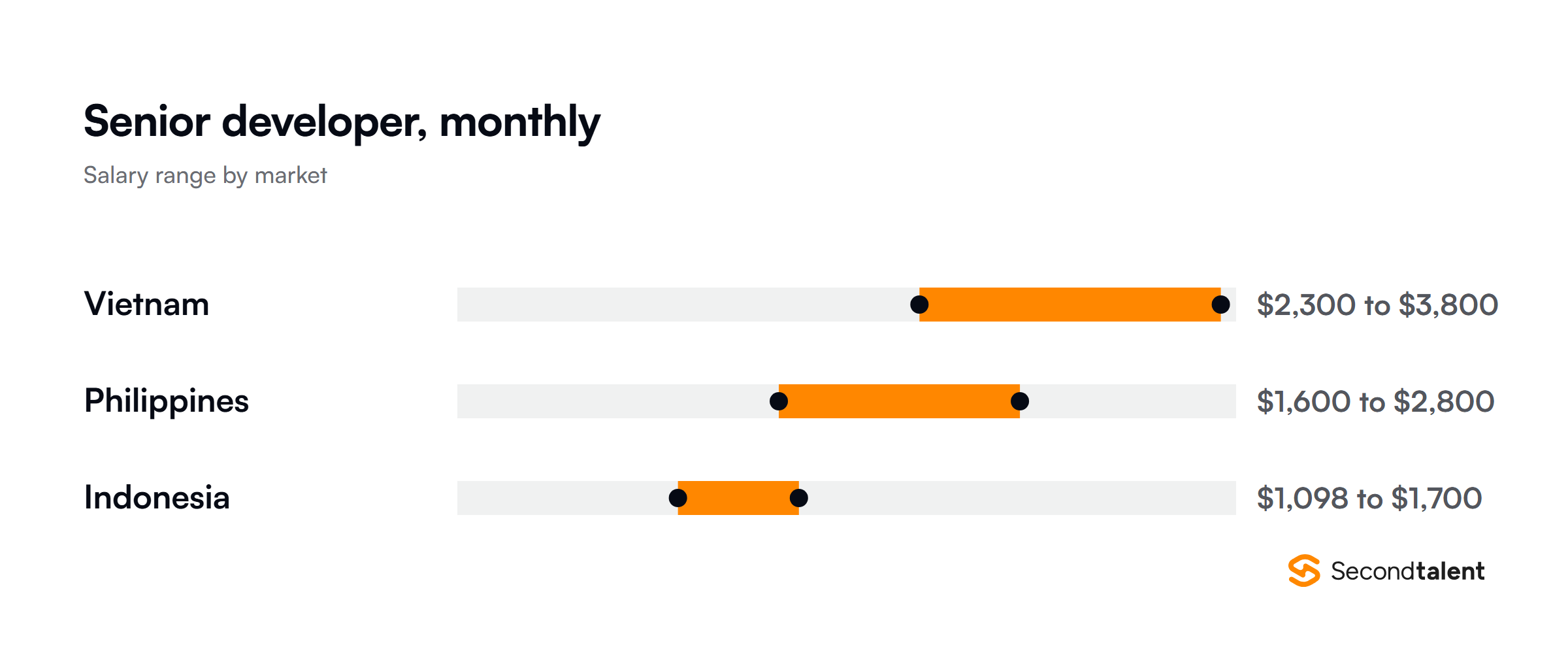
Monthly salary ranges:
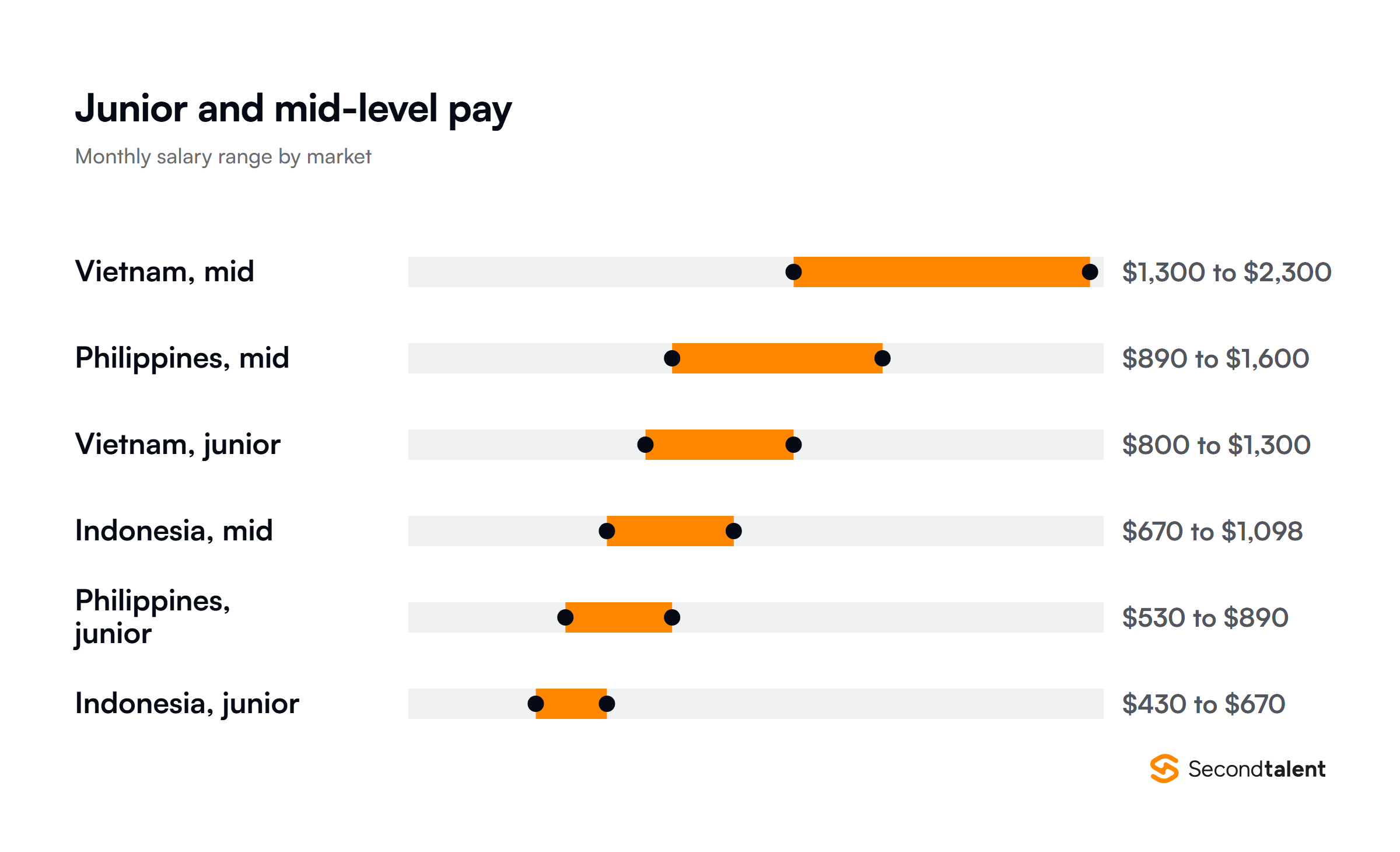
- Junior developers: $530–890
- Mid-level developers: $890–1,600
- Senior developers: $1,600–2,800
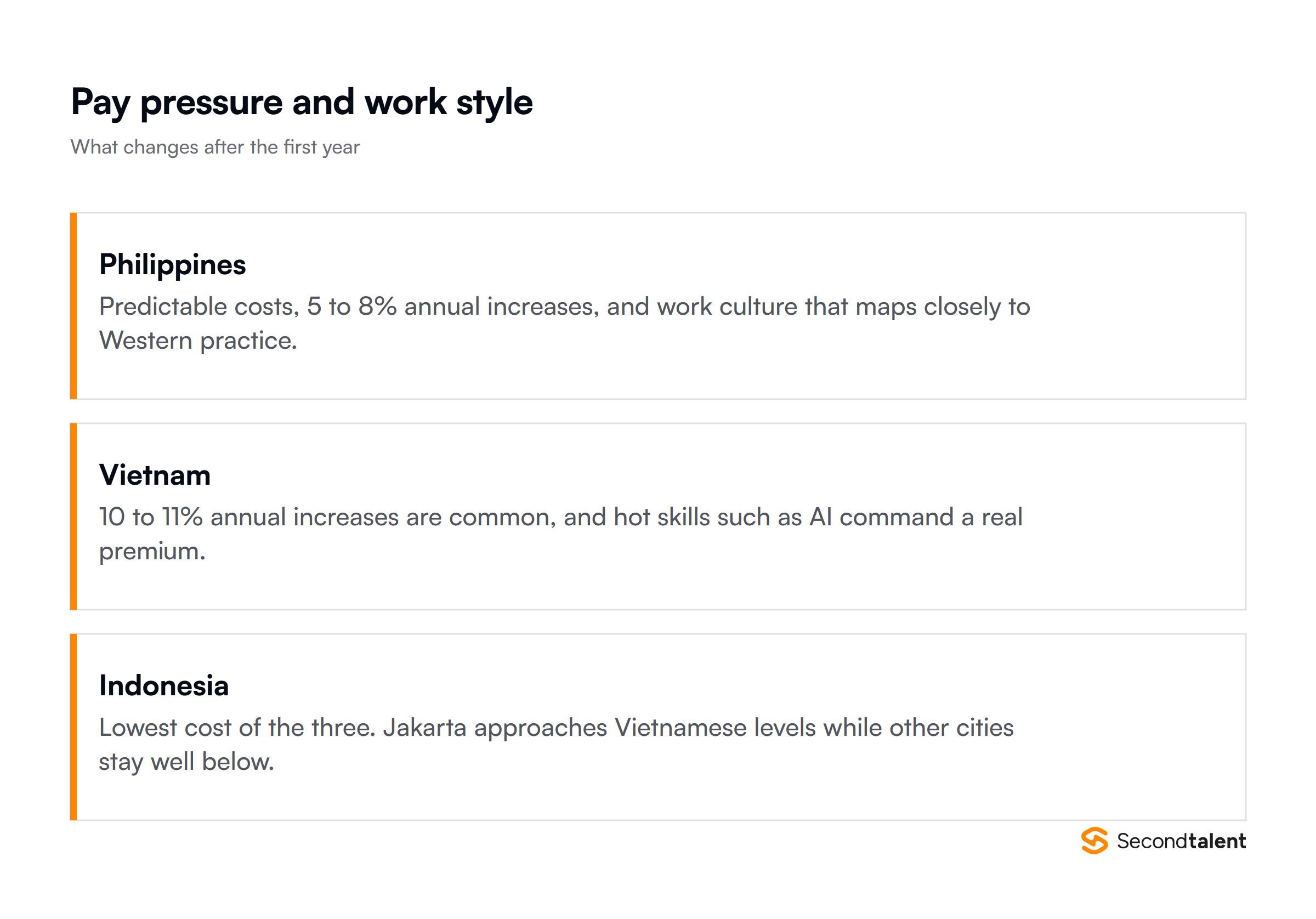
The Philippines offers predictable costs with moderate annual increases (5–8%). The mature market means fewer surprises but also less room for cost optimization.
Vietnam
Monthly salary ranges:
- Junior developers: $800–1,300
- Mid-level developers: $1,300–2,300
- Senior developers: $2,300–3,800
Vietnam’s rapid growth creates salary pressure, particularly for experienced developers. Annual increases of 10–11% are common. Hot skills like AI command significant premiums.
Indonesia
Monthly salary ranges:
- Junior developers: $430–670
- Mid-level developers: $670–1,098
- Senior developers: $1,098–1,700
Indonesia offers the lowest costs, but potential productivity differences due to language barriers and infrastructure challenges should be factored in.
Jakarta salaries approach Vietnamese levels, while other cities remain significantly cheaper.
Cultural Fit and Work Style
Philippines
Filipino work culture aligns closely with Western practices. Professionals are comfortable with direct communication, flat organizational structures, and agile methodologies.
The service-oriented culture means strong client focus but sometimes reluctance to push back on unrealistic requirements. Work-life balance expectations mirror Western norms, making integration into global teams seamless.
Vietnam
Vietnamese culture values hierarchy, face-saving, and group harmony. Developers may hesitate to voice disagreements or admit confusion. Creating psychological safety requires intentional effort.
However, younger developers increasingly adopt global work styles. Strong work ethic and dedication to quality often offset communication style differences.
Indonesia
Indonesian culture prioritizes relationships and consensus-building. Decision-making can be slower but more inclusive. Religious considerations (primarily Islam) affect scheduling and workplace practices.
The startup ecosystem has created a subset of developers comfortable with Western work styles, but traditional values remain strong outside major tech hubs.
Infrastructure and Business Environment
Philippines
The Philippines offers the most straightforward business environment for Western companies:
- Established BPO industry with clear regulations
- Multiple options for legal structures
- Robust internet infrastructure in major cities
- Familiar legal system based on the U.S. model
- Strong IP protection relative to regional standards
Vietnam
Vietnam’s business environment requires more navigation:
- Complex regulations requiring local expertise
- Improving but bureaucratic company registration
- Excellent internet infrastructure in tech hubs
- Growing IP protection, though enforcement varies
- Strong government support for tech sector development
Indonesia
Indonesia presents the most complex business environment:
- Regulatory complexity across multiple jurisdictions
- Foreign ownership restrictions in some sectors
- Variable infrastructure quality outside Jakarta
- Improving but inconsistent IP protection
- Massive domestic market creating unique opportunities
Talent Availability and Scalability
Philippines
The Philippines offers the most extensive English-speaking tech talent pool in the region. Universities produce consistent graduates, and the mature industry means experienced developers are available.
Scaling teams from five to 500 is feasible without major structural changes. However, competition from established BPO players can make hiring challenging for specific skills.
Vietnam
Vietnam’s talent pool is expanding quickly but remains concentrated in major cities. Competition for experienced developers is fierce, making scaling challenging for specialized roles.
The education system’s focus on technology ensures a steady graduate supply, though English proficiency limits the immediately available pool for international teams.
Indonesia
Indonesia’s population of 275 million represents enormous potential, but accessible talent is concentrated in Jakarta and a few other cities.
The rapid digitalization creates new developers quickly, though experience levels lag behind those in the Philippines and Vietnam. Companies that invest in training and development can tap into a virtually unlimited talent pool.
Time Zone Considerations
Philippines
Filipinos’ familiarity with working across time zones provides maximum flexibility. Many developers are willing to work night shifts to align with U.S. hours, while others prefer regular hours for Asia-Pacific coverage.
Vietnam
Vietnam’s time zone works well for companies in the Asia-Pacific region but requires planning for U.S. collaboration. Developers generally prefer regular working hours, making real-time collaboration with Western teams more difficult.
Indonesia
Indonesia’s time zone presents similar challenges to Vietnam for Western companies. The emphasis on work-life balance means developers are less likely to work off-hours compared to those in the Philippines.
Which Country Is Right for You?
Each of these markets offers unique advantages depending on your company’s goals, team structure, and long-term strategy.
While there’s no one-size-fits-all answer, aligning your priorities with the strengths of each country will help you make a more effective decision. Here’s a quick guide to choosing the market that best fits your needs:
Choose the Philippines if:
- English communication is critical
- You need cultural alignment with Western practices
- You’re building customer-facing or client service teams
- You require flexible time zone coverage
- You want the easiest entry into Southeast Asian talent
Choose Vietnam if:
- Technical excellence is your primary concern
- You’re building products requiring strong engineering
- You can invest in communication infrastructure
- Your team works primarily in Asia-Pacific time zones
- You want access to specialized technical skills
Choose Indonesia if:
- Cost optimization is crucial
- You’re targeting the Southeast Asian market
- You can invest in training and development
- You’re building mobile or consumer-focused products
- You want first-mover advantage in an emerging market
Conclusion
There is no universal best choice among the Philippines, Vietnam, and Indonesia for talent sourcing. Each country offers distinct advantages that align with different business needs and strategies.
The Philippines provides the smoothest entry with minimal friction, Vietnam offers exceptional technical talent with some communication challenges, and Indonesia presents the highest risk-reward ratio with massive long-term potential.
Success in any market requires a commitment to understanding local culture, investing in team development, and adapting management practices to fit the local context.
Companies that treat Southeast Asian talent sourcing as a strategic partnership rather than a cost-saving measure consistently achieve better outcomes, regardless of the country they choose.
Consider starting with a small pilot team in your selected market, learning from the experience, and scaling based on real-world results.
These markets evolve quickly, but the opportunity to build high-performing teams remains consistent across the region.
Need tech talent from these countries?
Second Talent can help you hire top tech professionals from Malaysia, Vietnam, Singapore, Hong Kong, and Indonesia. We connect you with the top 1% of remote developers so you can hire faster, with zero hassle.

![Countries With the Highest Software Engineer Salaries. Top 10 Countries With the Highest Software Engineer Salaries [2026], by Second Talent.](https://www.secondtalent.com/wp-content/uploads/2026/09/countries-with-highest-software-engineer-salaries-featured-v2-768x403.jpg)