TL;DR: FPT Software is the only Vietnamese firm at global scale; TMA Solutions, CMC Global, NashTech and KMS Technology hold the 1,000 to 4,000 engineer band. The six smaller firms sell embedded teams and vertical builds.
Decide whether you are buying a delivered project, a team inside your process, or an employee you keep.
TopDev counts about 530,000 IT workers in Vietnam against a 2025 requirement near 700,000. That gap moves the question from price to supply.
I place engineers across nine Asian markets, and Vietnam is where vendor marketing sits furthest from what the vendors publish.
If you would rather hire directly, Second Talent matches you with pre-vetted developers in Vietnam at 50 to 70% below US hiring costs, with first profiles in 24 hours.
Quick comparison of the ten companies
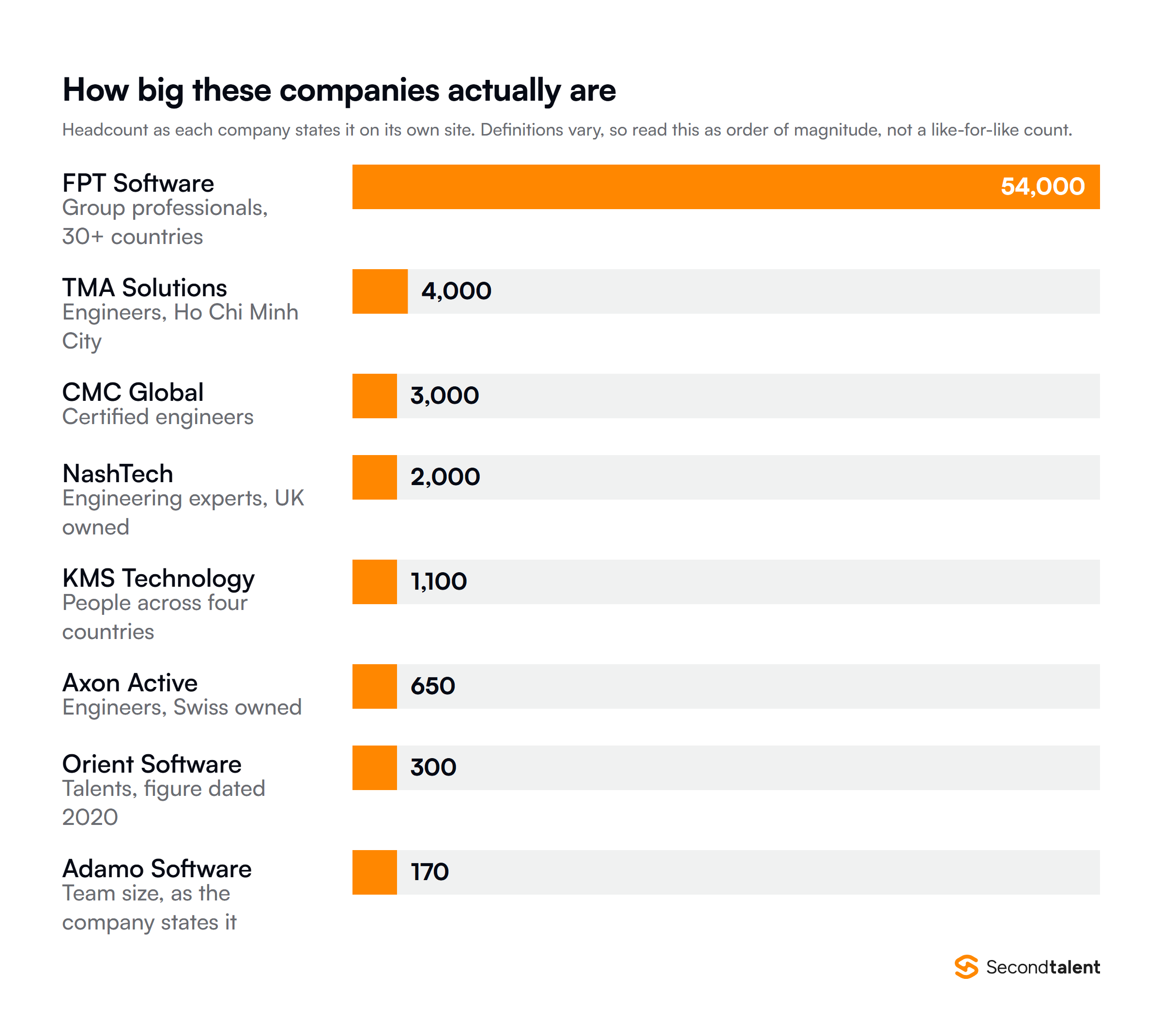
Sizes below are as each company states them on its own site in September 2026. Definitions differ between firms, so read them as order of magnitude rather than a like-for-like count.
| Company | HQ | Founded | Stated size | Best fit for |
|---|---|---|---|---|
| FPT Software | Hanoi | 1999 | 54,000+ across 30+ countries | Multi-year enterprise programmes |
| TMA Solutions | Ho Chi Minh City | 1997 | 4,000 engineers | Telecom, embedded, test automation |
| CMC Global | Hanoi | 2017 | 3,000+ certified engineers | Cloud migration and managed services |
| NashTech | London, UK | 2000 in Vietnam | 2,000+ engineering experts | Regulated work needing audit trails |
| KMS Technology | United States | 2009 | 1,100+ people, 5 offices | Product engineering for software firms |
| Rikkeisoft | Hanoi | 2012 | Headcount not published | Japan-market offshore delivery |
| Axon Active | Ho Chi Minh City | 2009 | 650+ engineers, 80+ teams | Long-run embedded agile teams |
| Savvycom | Hanoi | 2009 | Headcount not published | Fintech and healthcare products |
| Orient Software | Ho Chi Minh City | 2005 | 300+ talents, dated 2020 | Australia and New Zealand time zones |
| Adamo Software | Hanoi | 2018 | 170 (company stated) | Travel, hospitality, healthcare verticals |
- 1EF puts Vietnam at 500 on its English index, ranked 64th, which is the moderate band and sits behind Malaysia at 581 and the Philippines at 569. Test the people, not the country.
- 2Two of the ten publish no current headcount, and one blocks automated access to its own site, so ask those three for client references instead of reading a profile.
- 3A mid-level full-stack developer in Vietnam bills $28 to $68 an hour freelance. Vendor rates sit above that band, and the gap buys bench cover and delivery management.
- 4Vietnam’s Law on Digital Technology Industry has been in force since 1 January 2026, and its five-year income tax exemption reaches qualifying personnel in designated zones and projects, not every developer on your team.
The 10 software development outsourcing companies in Vietnam
The size gap at the top of this list is the most useful fact in it.
FPT Software is larger than the other nine put together and then some, which buys bench depth on a programme that doubles in scope and costs you speed on a six-person build. A 300-person firm inverts both.
1. FPT Software: the only Vietnamese firm operating at global scale
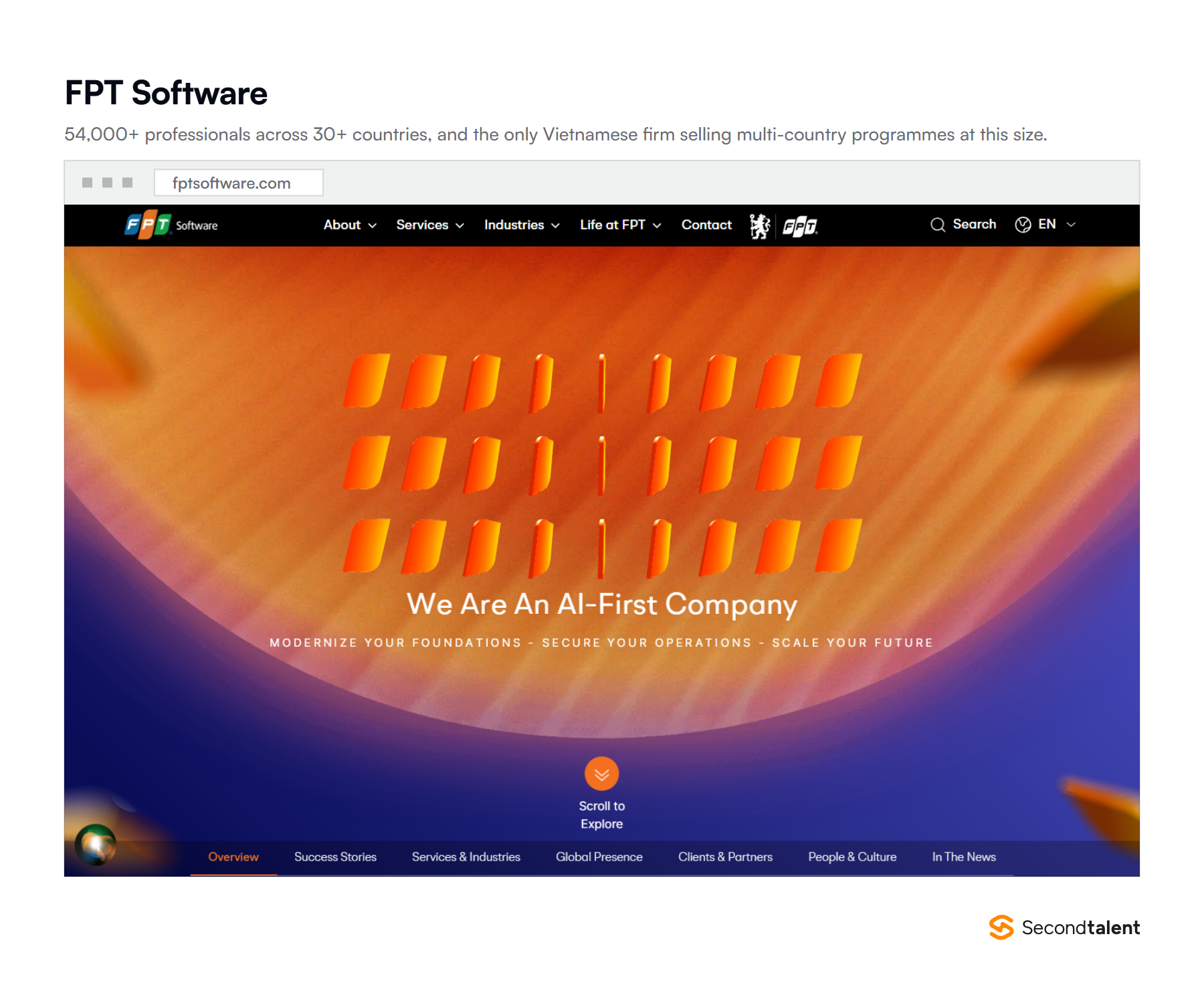
Pick FPT Software when the work is a multi-country programme with a procurement function attached, and when you need the vendor to still be standing in five years.
Nothing else in Vietnam competes at that shape, and comparing FPT with the rest of this list on day rate misses what you would be buying.
In May 2026 the company reported more than 54,000 professionals across over 30 countries, 1,100 clients including 130 Fortune Global 500 companies, and 2025 group revenue of VND 70.1 trillion.
Overseas IT services revenue grew 13.7% that year. Its about page adds detail the press releases skip.
The customer satisfaction score averages 94.94 out of 100, the engineering pool holds 7,900 certified experts, and FPT claims the top spot for IT services in the Fortune 500 Southeast Asia ranking.
Deal sizes show who FPT built the commercial model for. Its largest contract to date is a $256 million, five-year AI-enabled transformation programme.
Separate deals run to $225 million in the US, $115 million in Germany and $110 million in Singapore.
FPT also put capital behind the AI label rather than a slide about it. Its AI Factory reports processing over 1,100 billion tokens and fine-tuning more than 70 models, at about 70% utilisation.
- Best for: regulated, multi-country programmes that need onshore, offshore and nearshore staffing under one contract.
- Watch out for: the procurement weight that makes a $250 million programme safe is pure friction on a $200,000 build.
- Published scale: 54,000+ professionals, 30+ countries, 1,100 clients (company newsroom, May 2026).
2. TMA Solutions: telecom and embedded depth you cannot assemble quickly
Bring TMA Solutions in when the system touches a network: 5G, IoT, automotive, or the test automation estate underneath them.
This is the oldest firm on the list, running since 1997, with six overseas offices covering the USA, Canada, Germany, Japan, Australia and Singapore.
The shape of that headcount beats the size of it. TMA puts about 2,000 people on telecom, 5G and automotive, 700 on healthcare, 600 on finance and insurance, and 400 on e-commerce, retail and logistics.
That is a domain structure, not a general pool. It is why TMA keeps appearing on telecom infrastructure work most offshore vendors cannot staff.
The certifications line up behind that focus: CMMI Level 5, TL 9000, ISO 9001:2015 and ISO/IEC 27001:2022. TL 9000 is telecom-specific and expensive to hold.
Firms keep it because carrier customers insist, which tells you who TMA’s repeat buyers are before you open a case study. TMA also runs a standalone testing centre and separate IoT and robotics units.
A QA-heavy programme therefore does not borrow engineers from a delivery team that is already busy.
- Best for: network software, embedded work and large QA programmes where domain knowledge beats raw headcount.
- Watch out for: a consumer product team may find the process weight of a carrier-grade shop heavier than it needs.
- Published scale: 4,000 engineers, clients in 30 countries, one Vietnamese delivery base (company about page).
3. CMC Global: cloud migration and the Japan and Korea corridor

CMC Global suits the buyer whose problem is an ageing estate that has to keep running while it moves.
Cloud and managed services are the centre of gravity here: AWS and Azure migration, data and analytics, process automation, legacy modernisation and testing.
Read its milestone page before a first call. CMC Global started in 2016 as a 50-person division of CMC Corporation, incorporated in March 2017, and opened a Yokohama branch five months later.
The Japanese office came before the Ho Chi Minh City one, which arrived in July 2019.
Today it states 3,000+ certified engineers and 300+ global clients, with offices in Japan, Singapore, Malaysia, South Korea, the US and Germany.
Vietnam’s Sao Khue award first went to CMC Global in April 2019, in the IT outsourcing category.
That Japan-first history shows up in how CMC works. North Asian enterprise buyers expect documentation, change control and a slower approval cadence, and this team grew up delivering into that cadence.
It holds CMMI Level 5, ISO 9001:2015 and ISO 27001:2013, and sits inside a listed parent group, which is where its balance sheet comes from.
- Best for: cloud migration, managed services and North Asian clients who want a Vietnamese cost base with local account cover.
- Watch out for: this is a delivery shop, not a product discovery partner. Decide what to build before you engage.
- Published scale: 3,000+ certified engineers, 300+ clients, 30+ countries (company about page).
4. NashTech: Vietnamese delivery under a UK contract
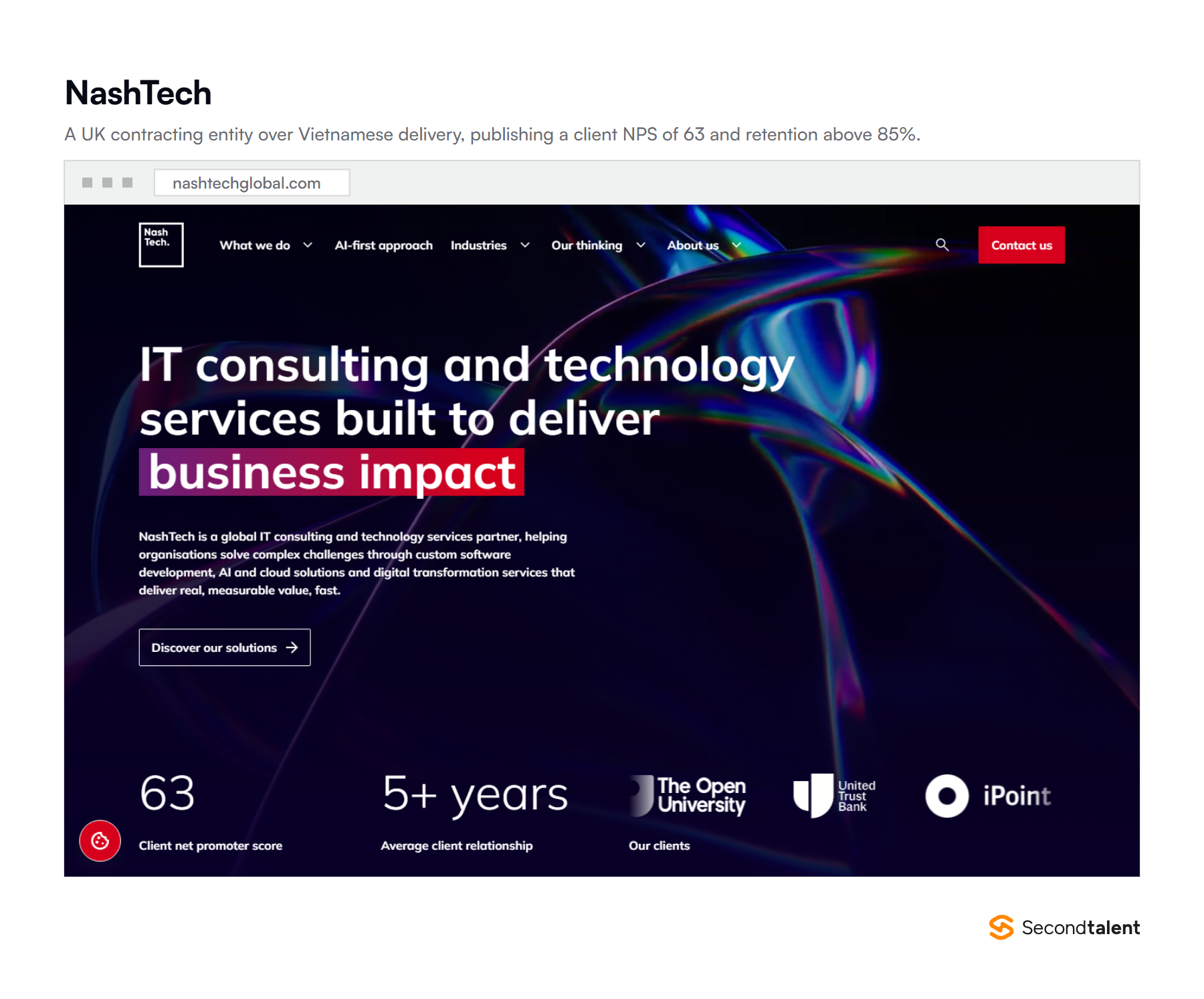
NashTech is the answer when your legal or procurement team has a view about jurisdiction. You contract with a UK entity; the engineers sit in Ho Chi Minh City, Hanoi and Da Nang.
For a European buyer that removes a whole category of argument about contract law and data handling, and it costs more than contracting a Vietnamese entity.
NashTech has been building in Vietnam since 2000 and took investment from PAG in 2024.
It publishes two numbers most vendors keep quiet, a client net promoter score of 63 and employee retention above 85%, next to 2,000+ engineering experts across five global delivery centres.
Press on the retention figure. Over a three-year programme, re-teaching your domain to a fresh squad each year costs more than any rate difference you negotiated at the start.
NashTech publishes an employee net promoter score of 51 next to it. It also names its leadership down to country level, so you have someone to escalate to who is not your account manager.
NashTech was also the first company in Vietnam to reach CMMI Level 5 v2.0, in 2019, and holds ISO 27001, ISO 9001 and ISTQB Platinum Partner status.
That last credential means quality assurance here is a practice with its own qualifications rather than a phase bolted onto the end of a sprint.
- Best for: regulated or audited work where the contracting entity, the evidence trail and QA maturity are part of the decision.
- Watch out for: UK contracting adds a margin. If jurisdiction is not a constraint for you, you are paying for something you do not need.
- Published scale: 2,000+ engineering experts, 5 delivery centres, 26+ years of operation (company about page).
5. KMS Technology: product engineering built for software companies
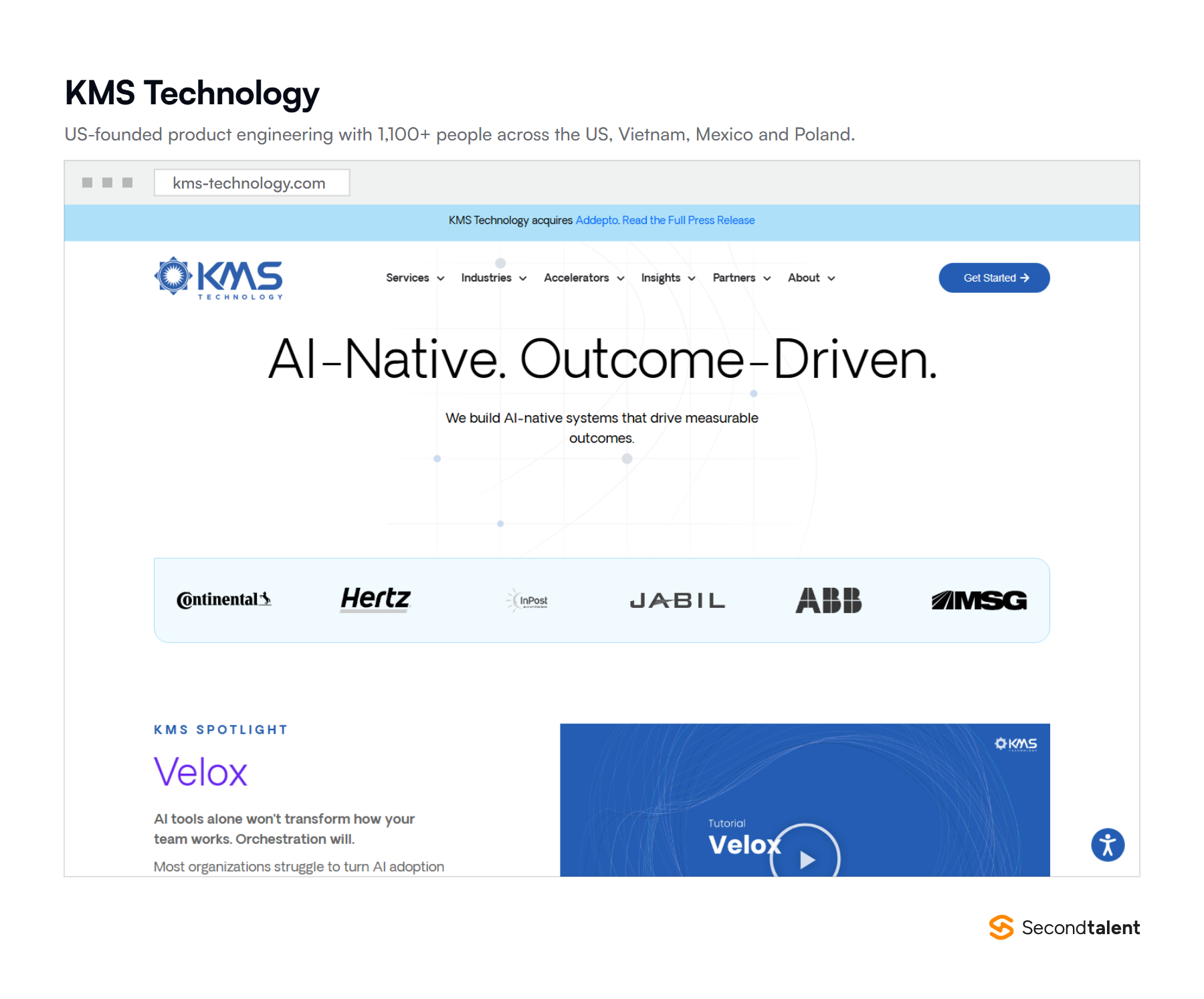
KMS Technology sells to software companies rather than to enterprises buying IT.
If you sell a product and need engineers who think in roadmaps, release trains and support load instead of statements of work, this is the closest fit on the list.
Its structure explains that positioning. A US founding team started KMS in 2009 and opened its first delivery hub in Ho Chi Minh City. Da Nang followed in 2019, as headcount passed a thousand.
It now states 1,100+ people across five offices in the US, Vietnam, Mexico and Poland.
It has also been buying. KMS acquired Software Allies in 2023 for nearshore delivery out of Mexico, took a strategic investment led by Sunstone Partners in 2024, and picked up the Polish AI and data firm Addepto in 2025.
KMS sells its own software alongside the services, which is rare for a firm with a Vietnamese delivery base.
Velox, its AI orchestration platform, wires agents and project context into human-in-the-loop workflows across the delivery lifecycle. A vendor that ships product on a schedule knows what release pressure feels like.
The Vietnamese operation took the Sao Khue software award ten years running to 2021. The group has been Great Place to Work certified since 2022.
- Best for: independent software vendors, digital health platforms and any team whose deliverable is a product rather than a project.
- Watch out for: delivery now spans three continents. Ask where your specific engineers sit and which office owns the account.
- Published scale: 1,100+ people, 5 offices in 4 countries, founded 2009 (company about page).
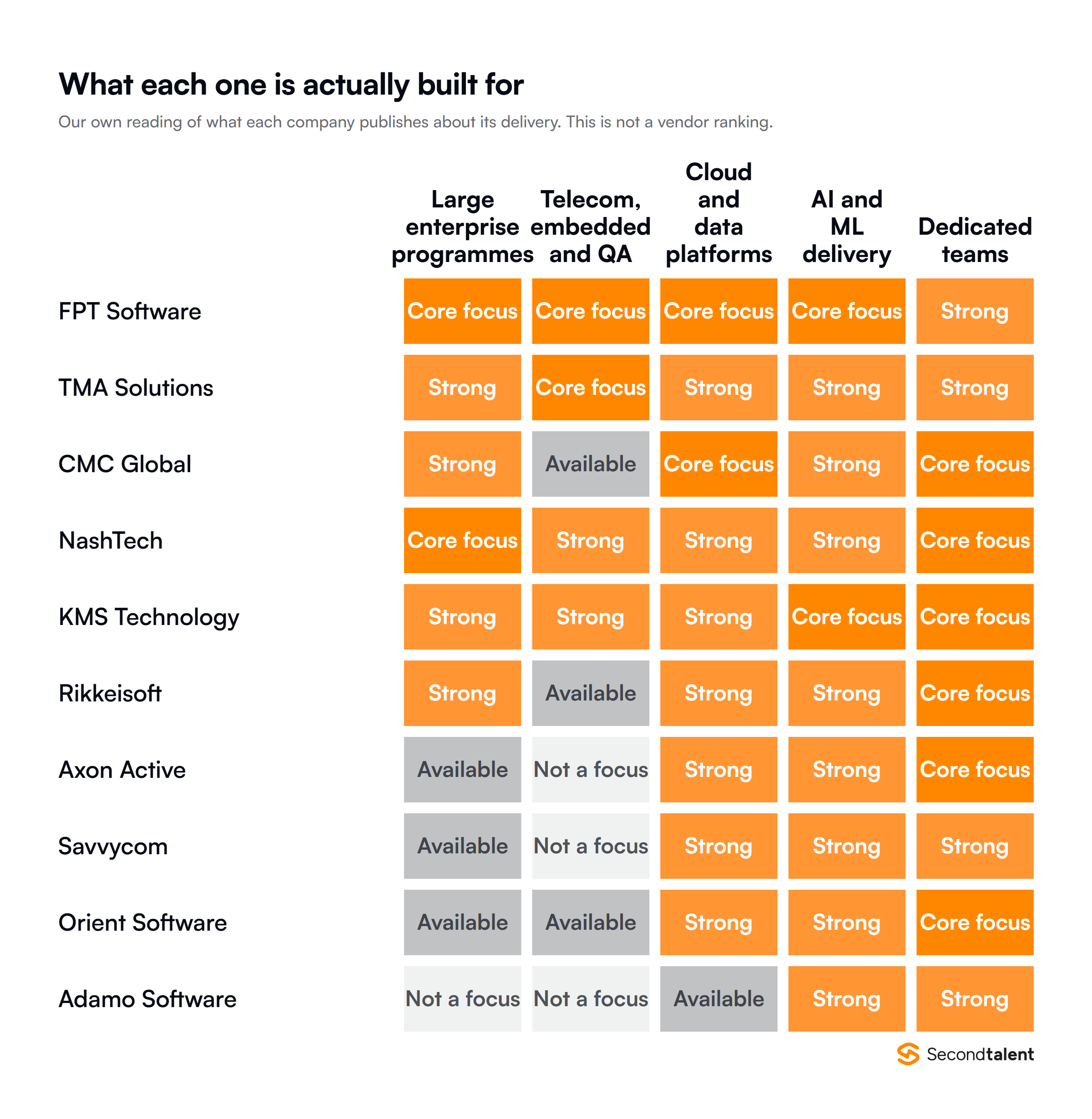
Those first five cover most of the enterprise-scale work leaving Europe, Japan and the US for Vietnam. The five below sell something different, and the grid below shows where each of the ten puts its people.
6. Rikkeisoft: built for the Japanese market, now pushing into the US
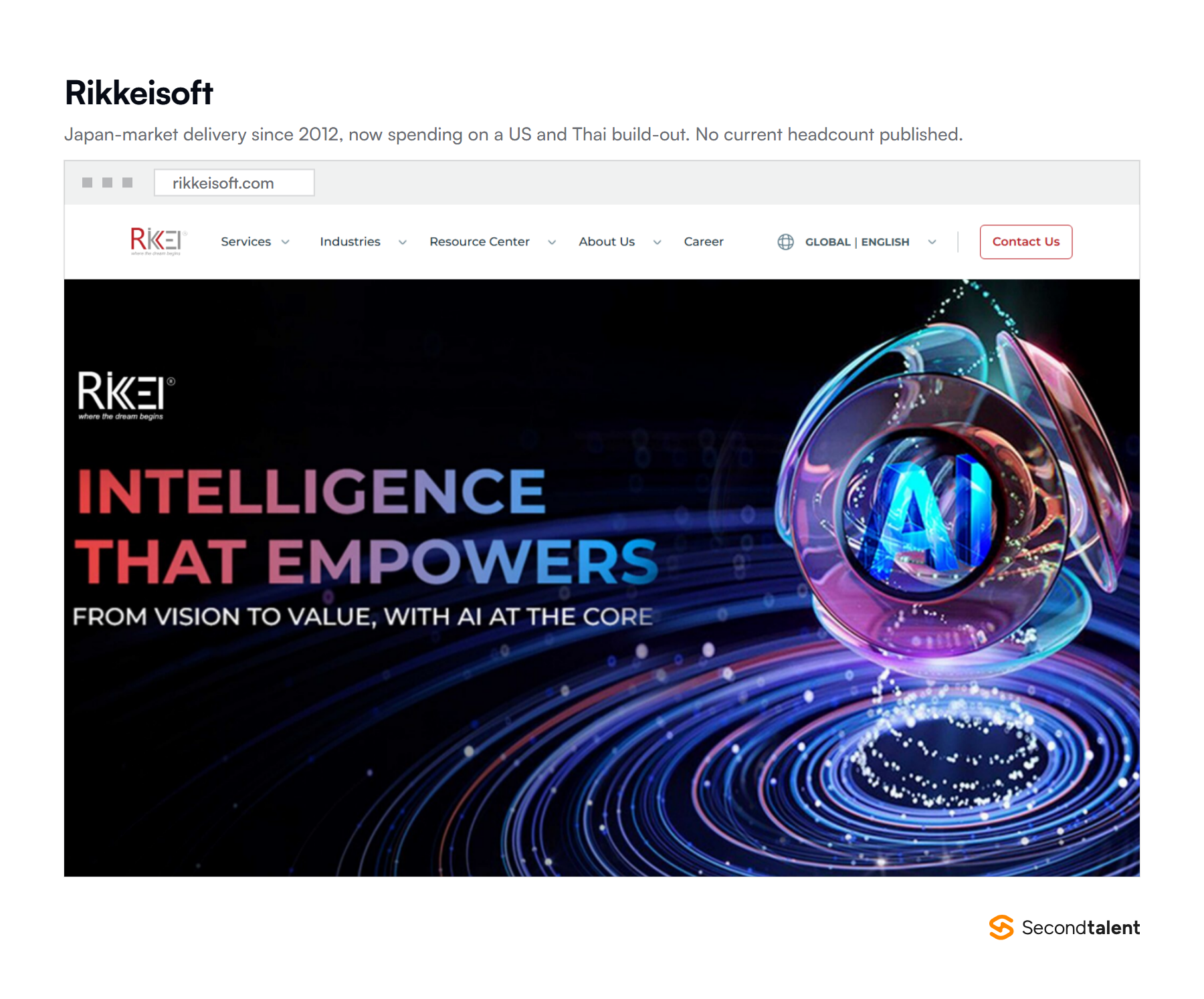
Japanese client work has been the core of Rikkeisoft since graduates returning from Japan founded it in Hanoi in 2012, and that heritage shows up in working style rather than in a service catalogue: specification-first delivery, documentation discipline, and patience with the review cycles Japanese enterprise buyers run.
Its milestone page counts more than 1,500 projects and 700 clients, and the group keeps spending on expansion. Rikkei Japan took a Great Place to Work certification in June 2025.
Rikkei Thailand signed an alliance with Vinova that December, and RKTech bought a stake in the US firm Entropy for access to Latin American engineers.
The 2023 plan to invest up to $30 million in the United States by 2026 is that same strategy pointed west.
Rikkeisoft publishes no current headcount. Several data vendors will sell you one. I have left the field empty rather than print an estimate next to nine self-reported figures, because the two do not carry the same weight.
A North American buyer should also know the US operation is young. Rikkeisoft built its delivery reflexes for Tokyo.
- Best for: Japanese and Korean programmes, and buyers who value written specifications over rapid iteration.
- Watch out for: no published headcount, and a US operation still being built out.
- Published scale: 1,500+ projects, 700+ clients, 13+ years (company milestone page).
7. Axon Active: Swiss-owned, and it shows in the contract
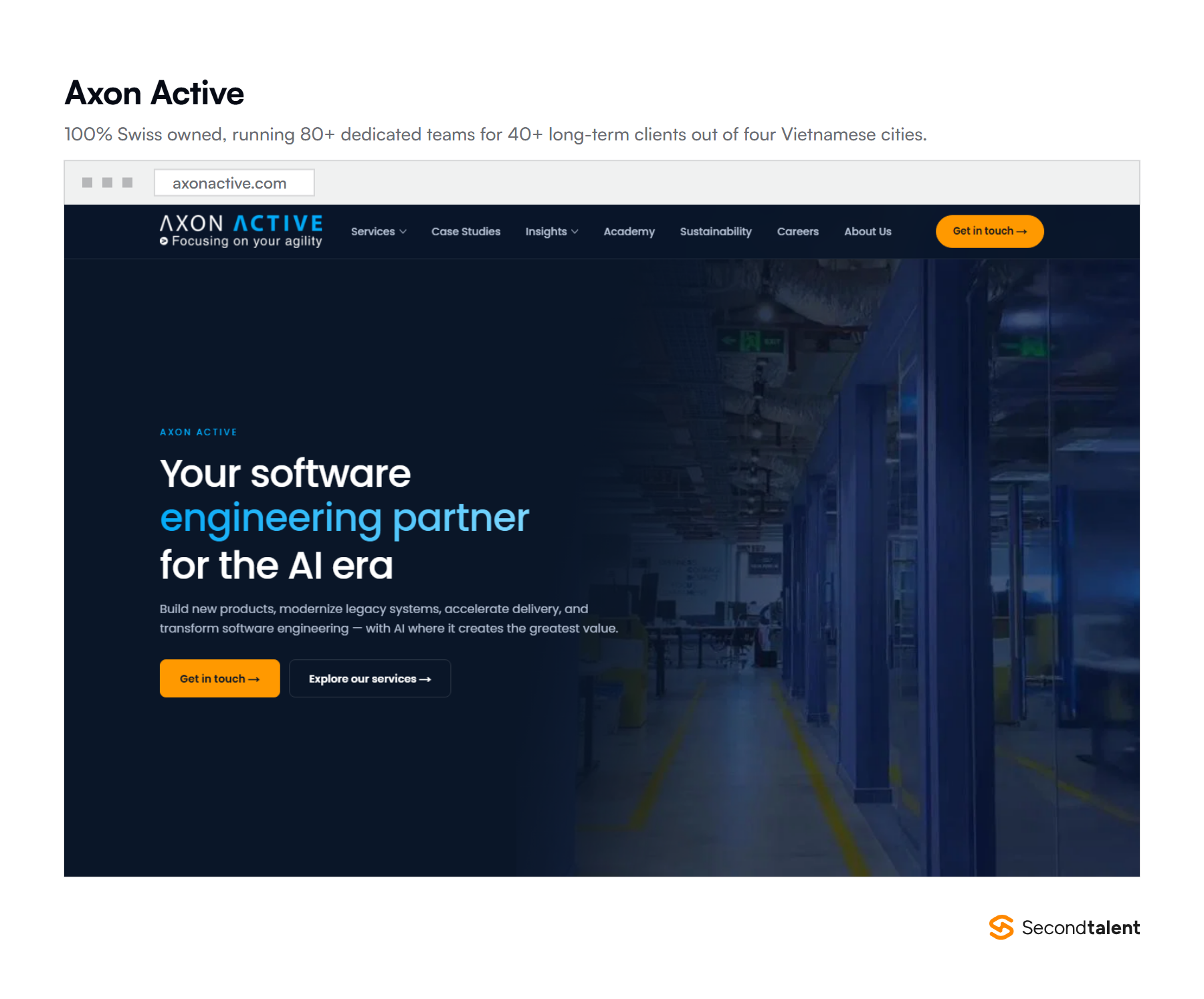
Axon Active exists because a Swiss digital agency could not hire fast enough at home.
Markus Baur went looking for an engineering market in 2008, built a first team in Vietnam that year, and founded the company in Ho Chi Minh City in early 2009.
It is still 100% Swiss owned, with 650+ engineers running 80+ dedicated teams for 40+ long-term clients.
Eighty teams against forty clients is the ratio to stop on. The average client runs more than one team, and has done for years.
Plenty of offshore relationships end inside eighteen months, so a client book that concentrates rather than churns tells you something no certification does.
Axon Active has also put a decade into the local engineering community rather than only recruiting from it.
Its Scrum Breakfast has run monthly since 2012, and DevDay Da Nang, launched in 2015 with 800 attendees, now draws more than 3,000 a year.
Delivery sites cover Ho Chi Minh City, Thu Duc, Da Nang and Can Tho, with San Francisco and Lucerne on the client side.
- Best for: long-running agile teams embedded in your process, above all for European product companies.
- Watch out for: the dedicated-team model is close to all Axon Active sells. A fixed-price scoped project is the wrong shape for it.
- Published scale: 650+ engineers, 80+ teams, 40+ long-term clients, 17+ years (company about page).
8. Savvycom: fintech and healthcare product work
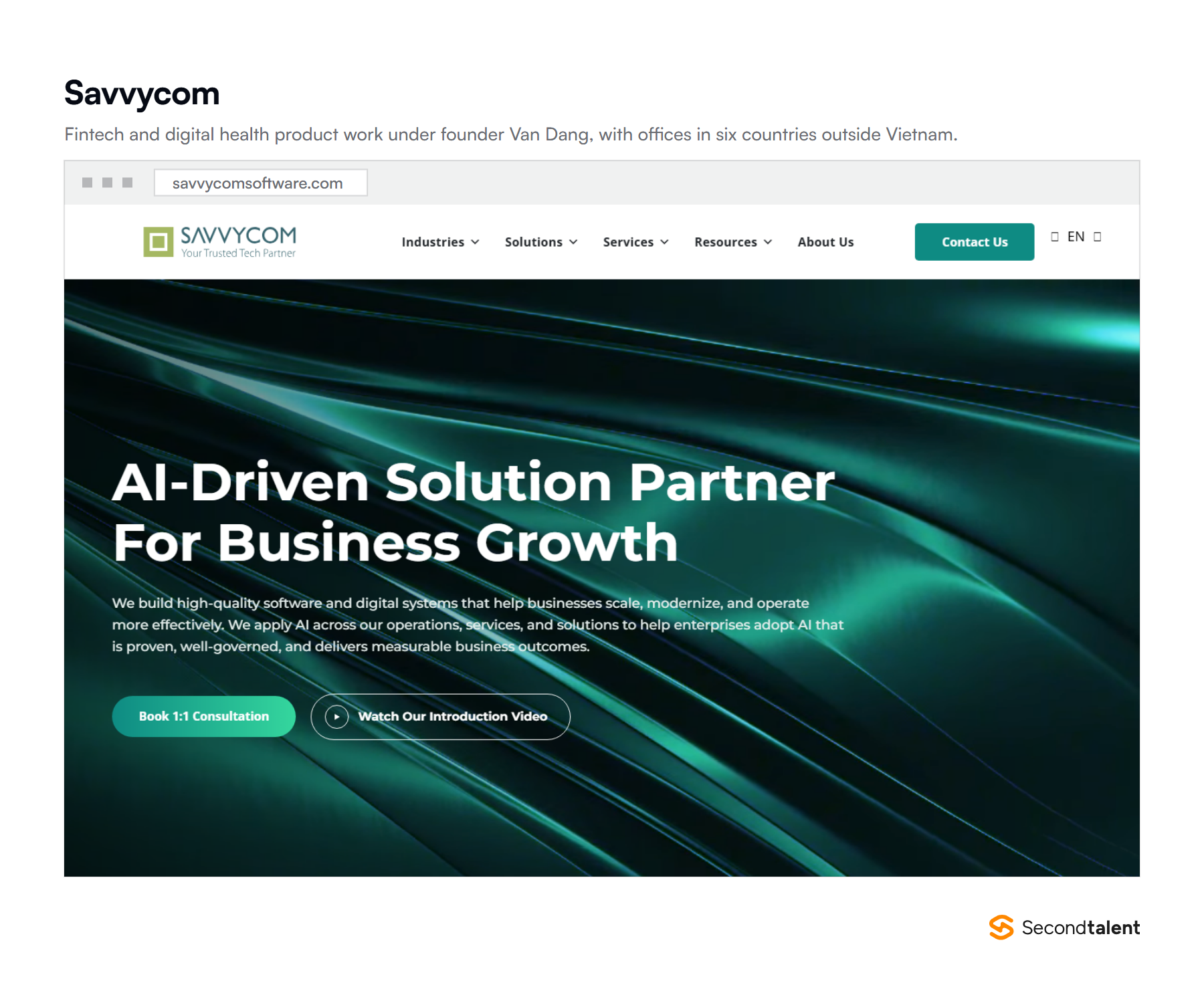
Choose Savvycom for regulated consumer products in banking and health, where the build has to survive a compliance review as well as a launch.
Work clusters in finance, healthcare, education, retail and manufacturing, with digital banking the recurring thread.
Van Dang founded the company in 2009 after a computer science degree at the University of Sydney and roles in research, project management and consulting.
She is vice president of the VNITO Alliance and a Distinguished Fellow of Asia Society Australia, and she took the AusCham Businesswoman of the Year award in 2023. The firm is on Vietnam’s Top 10 Digital Tech Companies list.
Offices run through the USA, Korea, Australia, Thailand, Japan and Singapore, and Savvycom Japan has had its own chief executive since 2025.
The executive team includes a Chief AI Officer who also sits on RMIT University Vietnam’s advisory board, which is a clearer signal of direction than any services page.
Savvycom’s healthcare and EHR work is where that focus shows up in practice. Like Rikkeisoft, it publishes no current headcount, so it is absent from the size chart above.
- Best for: fintech and digital health products that need domain-aware engineers rather than generalists.
- Watch out for: no published headcount, so pin down team size and seniority in writing before you sign.
- Published scale: founded 2009, offices in six countries outside Vietnam (company about page).
9. Orient Software: twenty years of Australia and New Zealand delivery
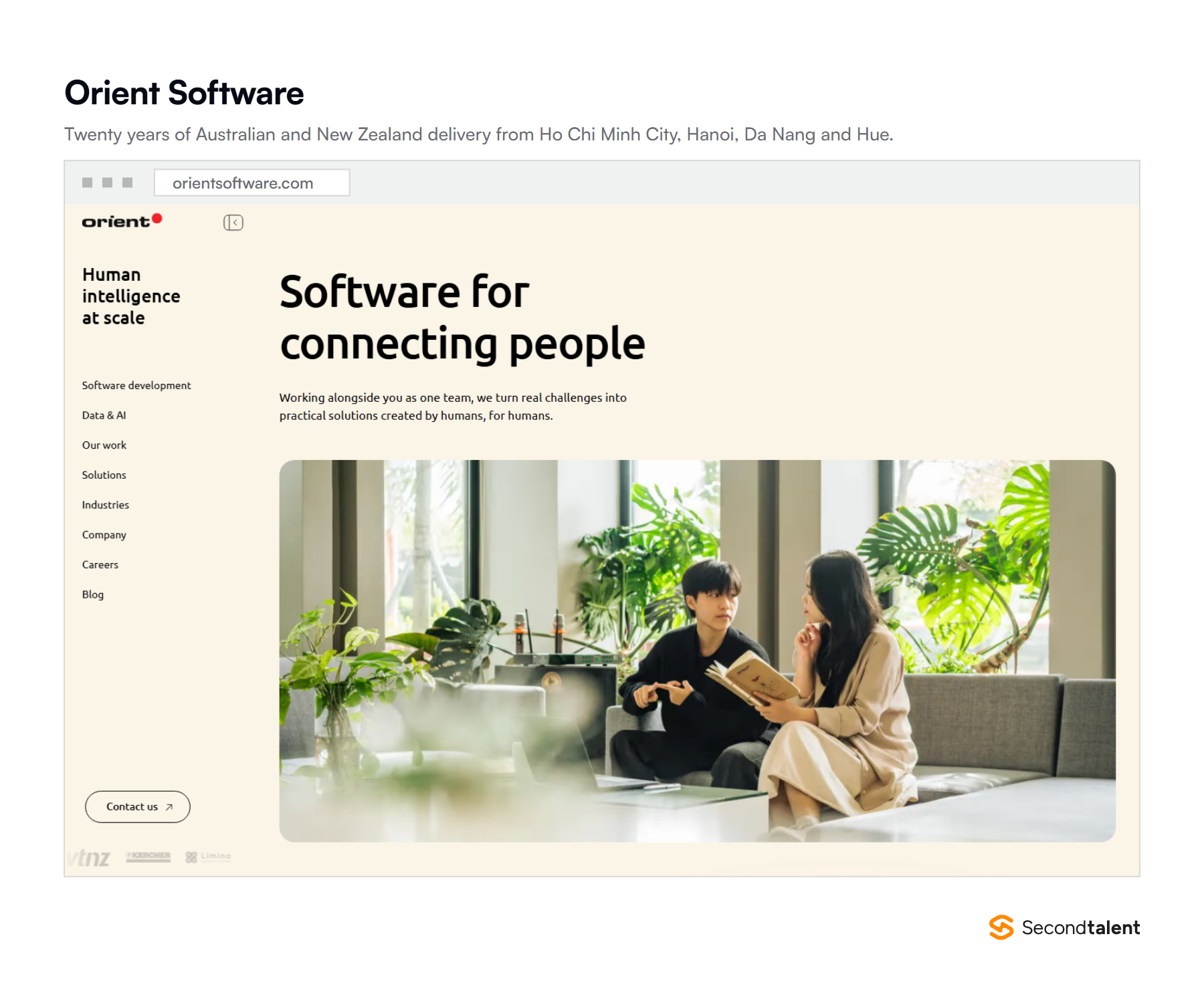
If your head office is in Sydney, Melbourne or Auckland, Orient Software has already solved the problems you are about to hit. Vietnam runs three to four hours behind eastern Australia, close enough for a shared working day.
Two decades of ANZ clients have shaped how Orient contracts and communicates.
It started in 2005 with six people and now works from Ho Chi Minh City, Hanoi, Da Nang and Hue.
The published client list leans the way you would expect: Netwealth, Wotif, Plenti, VTNZ and Marketplacer, with DEKRA and Kärcher on the European side.
Co-founder Øyvind Forsbak still runs the company as chief executive alongside chairwoman Nhung Nguyen. That is a long tenure in an industry where leadership turns over with each investor.
The CTO, Son Nguyen, holds a masters and a doctorate in computer science from the University of Missouri.
One caveat on size. The most recent team figure Orient publishes is 300+, dated 2020, and its about page was mid-rebuild when I checked in September 2026. Treat that number as a floor and ask for a current one on the first call.
- Best for: Australian and New Zealand companies that want same-day-overlap delivery without a Manila or Bangalore night shift.
- Watch out for: the published headcount is five years old, so verify current capacity before you plan a ramp.
- Published scale: 300+ talents as of 2020, four Vietnamese offices, founded 2005 (company site).
10. Adamo Software: a vertical specialist, not a general vendor
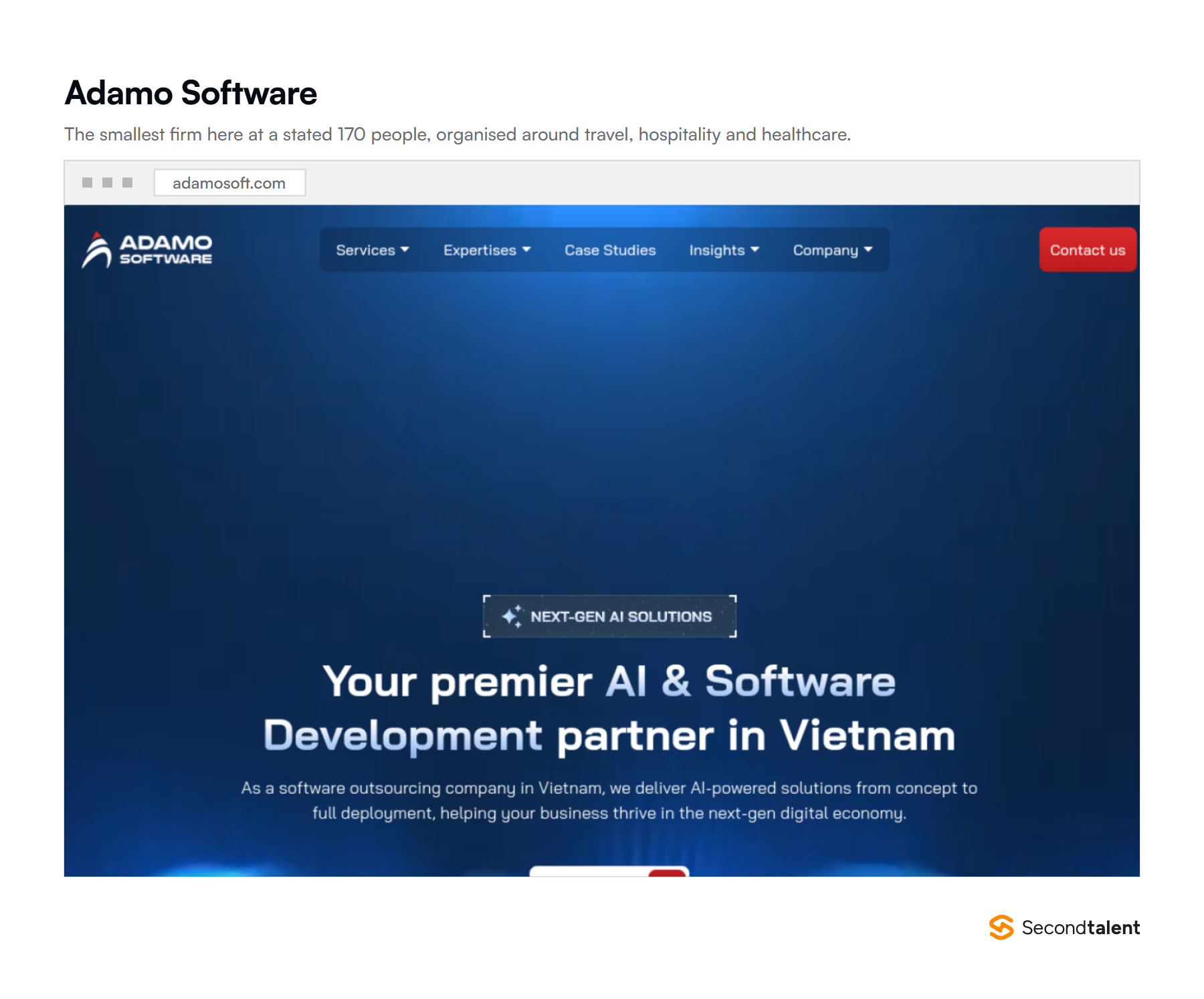
Adamo Software takes a vertical-first position instead of competing as a general offshore vendor.
Its site organises everything around six industries: travel and hospitality first, then healthcare, logistics, food and beverage, retail and finance. AI and machine learning sit inside those domains rather than on a separate services page.
Adamo says it started in Hanoi in 2018 and runs a team of around 170, with clients across Australia, the UK, Europe and Singapore, plus an Australian entity and a Singapore base. That sentence credits Adamo for each claim on purpose.
The site blocks automated access, so I could not check it the way I checked the other nine.
Hard bot protection is common and proves nothing either way. It does mean client references carry more weight here than a published profile.
At about 170 people, Adamo is the smallest company on this list by a wide margin, which is why a scale-first ordering puts it last. For a travel platform that is a feature, since you get senior attention and domain fluency.
For anything that needs surge capacity next quarter it is a risk you should price.
- Best for: travel, hospitality and healthcare platforms that want a small team fluent in one industry.
- Watch out for: smallest team here, and public claims that cannot be checked from outside.
- Published scale: around 170 people, founded 2018 (company stated, unverified).
What Vietnamese engineering actually costs
A mid-level full-stack developer in Vietnam bills $28 to $68 an hour as a freelancer, and a machine learning engineer $39 to $94. Those are our own figures from the Vietnam rate card, current to September 2026.
Vendor rates sit above that band, and they should: a vendor carries bench cost, delivery management, QA and the risk that a project runs long.
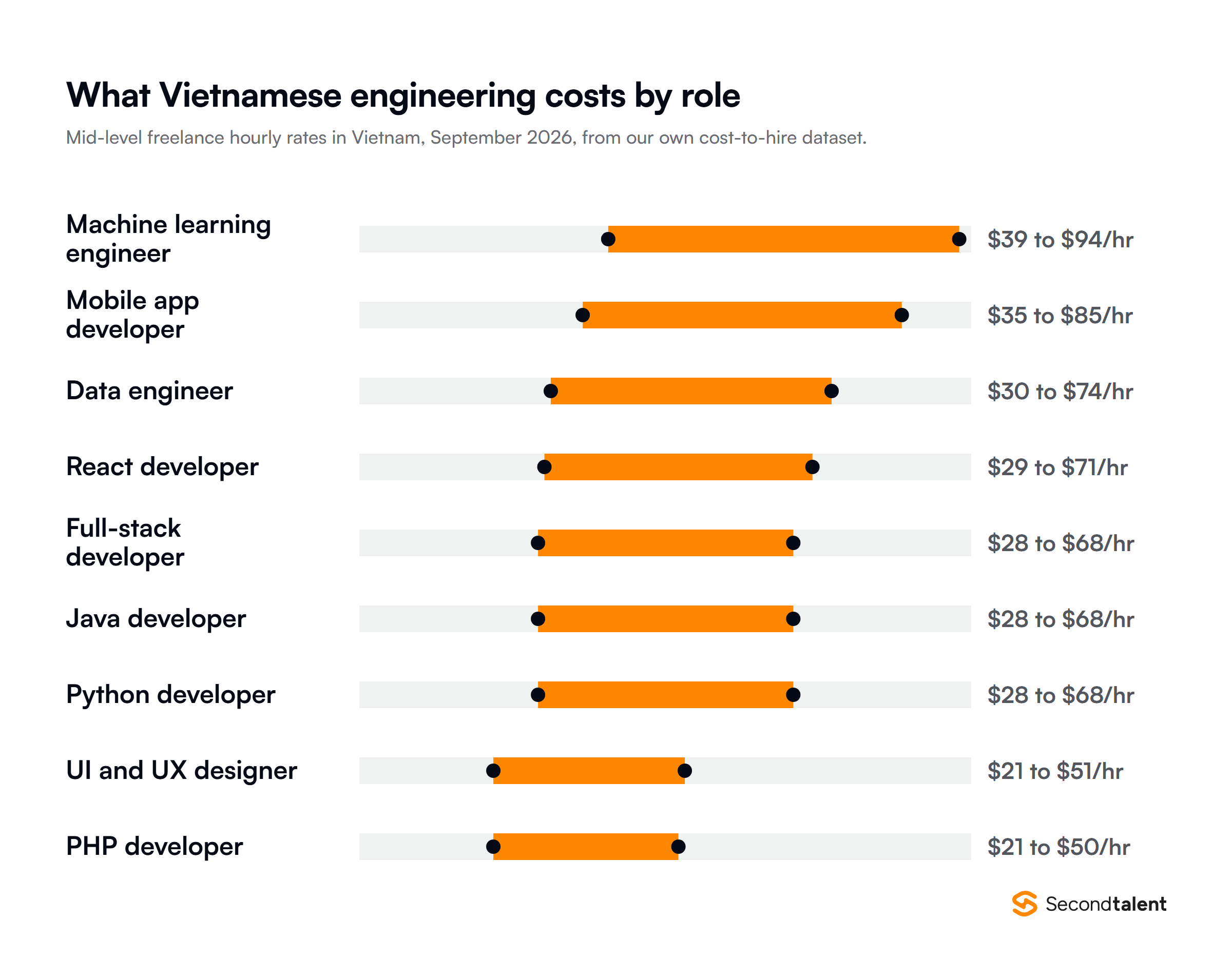
Use ITviec’s report as the sanity check on any quote. If the maths implies an engineer salary far below that senior band, ask who they plan to put on your account.
Our breakdown of the true cost of outsourcing to Vietnam goes past the day rate.
Two policy moves are reshaping the supply side, and both affect what these vendors look like in three years.
The digital technology law and Decision 982 push the same direction: higher-value work sold abroad. FPT is the only firm here within reach of that billion-dollar tier.
For buyers, competition for the same 530,000 engineers sharpens, and the International Trade Administration’s read of Vietnamese ICT agrees that demand is outrunning supply. Rates here are not going to fall.
The English claim, checked
Vietnamese outsourcing guides assert high English proficiency almost as a formality. EF’s own index puts Vietnam at 500, ranked 64th, against a global average of 488.
That is the moderate band, behind Malaysia at 581 and the Philippines at 569.
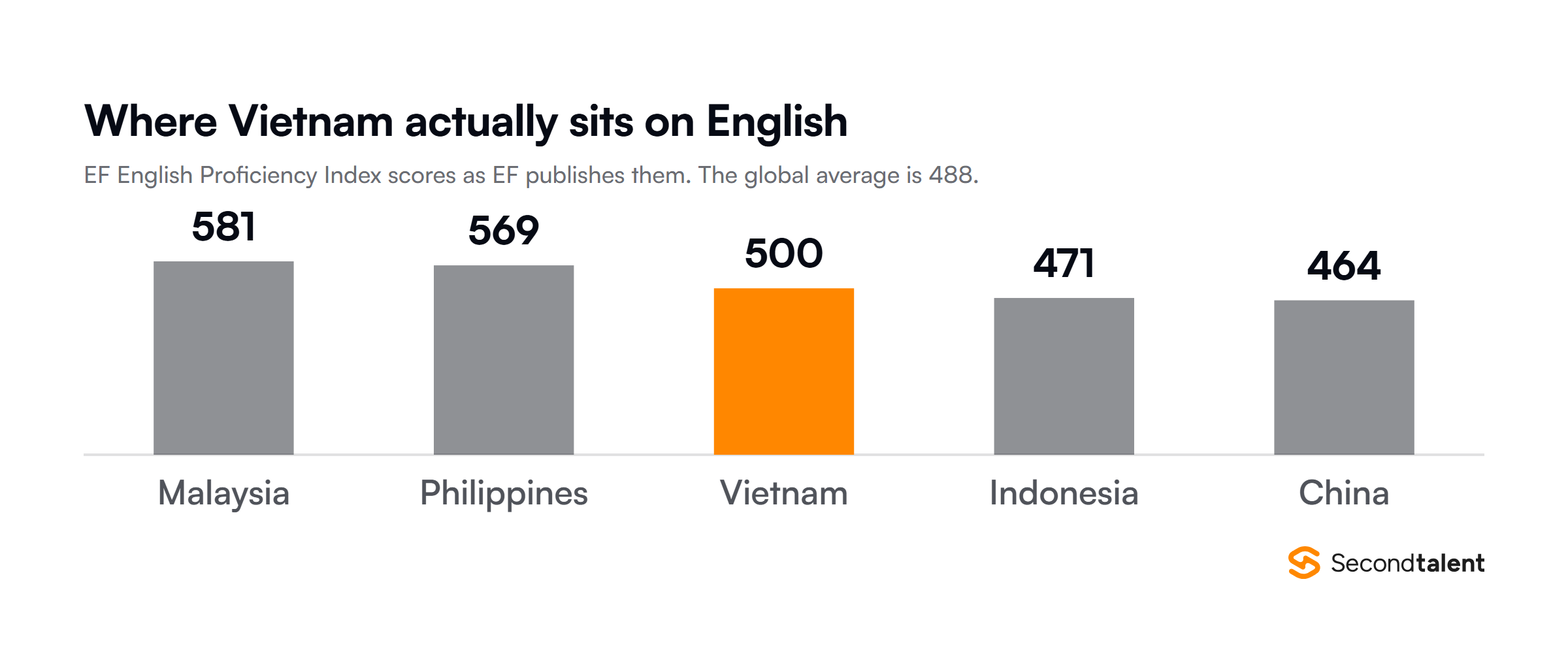
A national average says little about a shortlist. These ten firms screen for English because their clients are foreign, so their engineers sit above it.
The risk concentrates in conversation-heavy roles: business analysts, product owners, anyone running discovery workshops with your customers.
Our comparison of the Philippines, Vietnam and Indonesia works through where each market is stronger.
Pick the engagement model before you pick the vendor
The disappointing engagements I have seen failed on the purchase, not on vendor quality. The buyer bought one thing and needed another, which is easy to do when ten firms describe three different products in almost the same words.
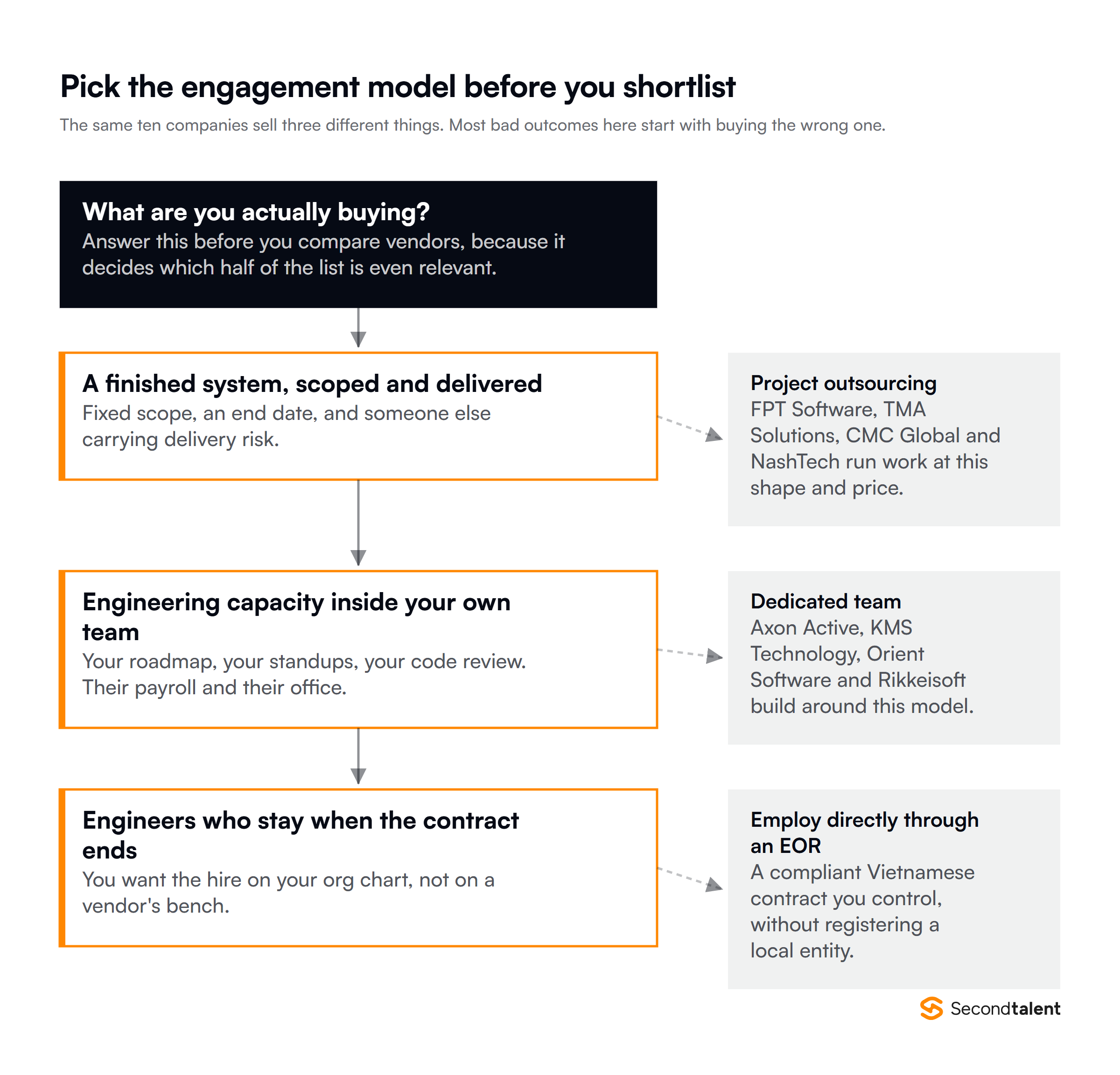
- The vendor employs the engineers and sells you their output
- Scope changes become commercial negotiations
- The team, and what it learned about your system, leaves at renewal
- The engineer sits on your org chart and your payroll
- Needs a Vietnamese entity, or an employer of record instead
- Institutional knowledge stays when the project ends
Project outsourcing hands over a scoped system with an end date, and the vendor carries delivery risk.
A dedicated team gives you engineers who follow your roadmap while the vendor employs them, so their incentive is utilisation and yours is outcomes. Direct employment, through a local entity or an employer of record, keeps the person.
The common failure is buying a dedicated team when you needed employees: two years on, the engineers who know your system best sit on someone else’s payroll, and your position at renewal is weak.
How to run the selection
Choosing a partner takes more than scanning a digital portfolio and comparing day rates.
Five checks separate a shortlist that works from one that looks good on paper, and our buyer framework for evaluating staffing companies goes deeper on each.
- Ask who sits on your team. Names, seniority, current allocation. A firm of 4,000 engineers can still put three juniors and a shared tech lead on your account.
- Check the certification against the work. CMMI Level 5 means an audited process exists somewhere in the company. Ask which delivery unit was assessed.
- Test English on the roles where it bites. Interview the business analyst and the tech lead, not the account manager who hands you over after signing.
- Ask about attrition on your account, not company-wide. The blended number hides whether the person who wrote your authentication layer will be there in a year.
- Settle code and environment ownership on day one. Repository, cloud accounts and CI are yours from the first commit, or you negotiate for them later from a weak position.
Want a wider view before you commit to the country? We cover the same ground for software development outsourcing in the Philippines.
When outsourcing is the wrong answer
Each company above answers a specific question well. None of them answers the question plenty of buyers arrive with: how do you build a permanent engineering team in Vietnam without opening a Vietnamese entity?
That is the gap we work in. Second Talent recruits and vets the engineer, then employs them in-country on your behalf, so the hire lands on your team rather than a vendor’s bench.
You keep the person; we carry payroll, statutory contributions and compliance. Start with hiring developers in Vietnam or the developer rate card.
Frequently asked questions
How much does it cost to outsource software development to Vietnam?
Freelance rates run $28 to $68 an hour for a mid-level full-stack developer and $39 to $94 for a machine learning engineer, current to September 2026.
Vendor rates sit above these because they include bench cost, delivery management and quality assurance. Our Vietnam cost-to-hire page breaks the ranges down by role.
What is the difference between outsourcing and an EOR in Vietnam?
With outsourcing, the vendor employs the engineers and sells you their output, and the relationship ends when the contract does.
With an employer of record, we recruit the engineer for you and employ them on your behalf, so they sit on your team and stay. Outsourcing suits defined projects; an EOR suits a team you intend to keep.
Which Vietnamese outsourcing company is best for a startup?
Orient Software, Axon Active and Adamo Software fit better at startup scale, because they price for smaller teams and decide faster. KMS Technology is the pick if you are shipping a product rather than a project.
Company figures are as each company publishes them on its own website, checked in September 2026. Market statistics are attributed to TopDev, EF Education First, ITviec and the International Trade Administration at the point of use.
Rate ranges are Second Talent’s own analysis. Private-company headcounts are self-reported and unaudited.