

TL;DR: AI is costing jobs in 2026, mostly by slowing hiring rather than through mass layoffs. US employers named AI in 120,136 announced job cuts from January to September, about 21% of the total, yet Yale's Budget Lab finds no clear sign of AI disruption across the labor market as a whole. The losses fall on workers aged 22 to 25 in AI-exposed jobs, whose employment is 19% below trend.
In February, Jack Dorsey told Block's shareholders he was "reducing Block by nearly half, from over 10,000 people to just under 6,000," because "intelligence tools have changed what it means to build and run a company."
The stock closed 17% higher the next day.
Most employers are not copying him: in the New York Fed's September surveys, 61% of the region's service firms used AI, and 4% had laid anyone off because of it.
- 1Goldman Sachs estimates AI cut US payroll growth by about 16,000 jobs a month over the past year.
- 26.1 million US workers are both highly exposed to AI and poorly placed to adapt, and 86% of them are women.
- 3The BLS projects office and administrative support to lose 752,100 jobs by 2035, while data scientist jobs grow 34.6%.
- 4Workers with AI skills earn a 62% wage premium on PwC's 2026 count.
How Many Jobs Has AI Cut in 2026?
July 2026 set the record. US employers announced 10,970 job cuts that month with AI as the stated reason, a third of all cuts, and from March to July AI was the most-cited reason every month.
Since 2023, AI has been named in 184,538 cut announcements through July, according to Challenger, Gray & Christmas.
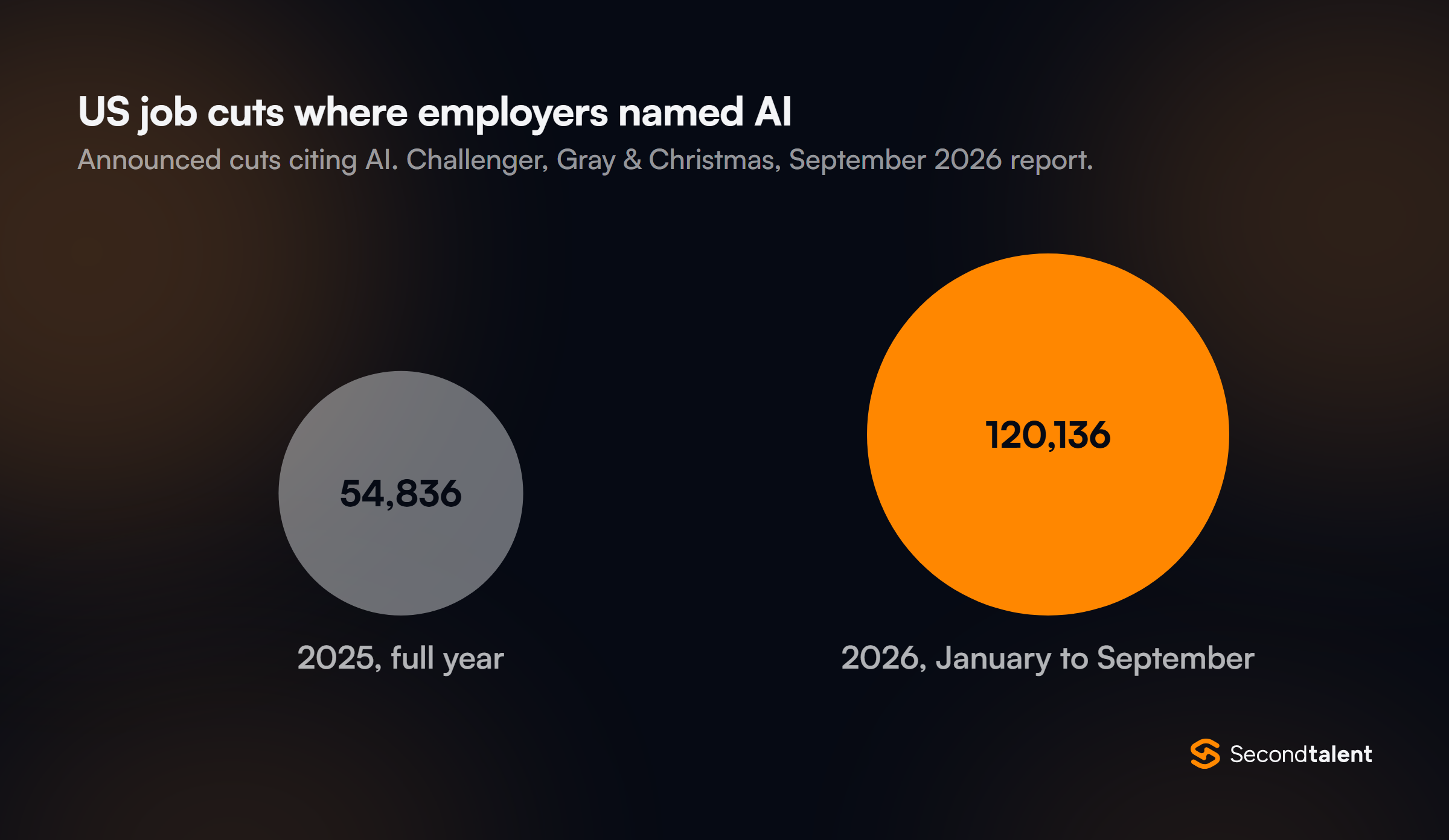
August broke the run. AI dropped to the fourth most-cited reason with 3,462 cuts, Challenger's August report shows, and in September it slipped to fifth with 3,961 cuts, about 9% of the month's total.
It is still the top reason for the year, cited in 120,136 cuts through September, according to the September report.
Total announced cuts of 573,195 through September are 39% lower than in the same months of 2025, so AI is a bigger share of a smaller number.
The companies that tied cuts to AI in their own words:
Salesforce's case shows the mechanism. Benioff said on a podcast that half of its support conversations now run through AI agents, and that "I need less heads," Fortune reported.
Agents like these run multi-step tasks with little human input, and as agentic AI development advances, more companies are redesigning workflows around them instead of adding AI to old processes.
Amazon's October memo named AI; its second round of about 16,000 cuts in January 2026 did not, citing layers and bureaucracy instead.
Goldman Sachs puts the whole effect in payroll terms. Its economists estimate AI reduced US monthly payroll growth by roughly 16,000 jobs over the past year and raised unemployment by 0.1 percentage point.
Roles where AI assists workers added about 9,000 jobs a month. Goldman adds that the true net effect is probably smaller, because the estimate leaves out data center construction and demand created by higher productivity.
As facilities scale to meet AI compute demand, data center recruiters are hiring engineers and operations specialists to staff the new sites. For cuts across the tech industry alone, see our tech layoffs statistics.
Young Workers Are Taking the Hit
Experienced workers in AI-exposed jobs show no employment gap at all. The damage sits almost entirely with people aged 22 to 25, according to Stanford's Digital Economy Lab, which tracks millions of workers through ADP payroll records.
- Employment up about 10%, Nov 2022 to Jun 2026
- Bottom three of five exposure groups
- Employment down about 11% over the same period
- Top two of five exposure groups
The gap has widened with each revision of the paper: 13% on data to July 2025, 16% to September 2025, and 19% in the August 2026 update.
The authors find it works through fewer hires rather than firings, and it is concentrated in jobs where AI automates the work instead of assisting it. They also report "no evidence of widespread, economy-wide job displacement."
Software is the sharpest case. By September 2025, employment of software developers aged 22 to 25 was nearly 20% below its late-2022 peak.
SignalFire's 2026 State of Talent report puts new-graduate hiring at the largest tech firms about 65% below 2019, while their engineering hiring overall is down only 11%.
The entry-level jobs that survive are harder to get. PwC's 2026 barometer found AI-exposed entry-level roles are 7 times more likely to ask for senior-level skills.
Those "seniorised" roles grew 35% since 2019, while other entry-level roles shrank 10%.
The New York Fed's graduate tracker shows the result: recent college graduates had an unemployment rate of about 5.6% in the second quarter of 2026, against 4.1% for all workers, and 42% of them worked in jobs that do not need a degree.
We cover what this means for engineering careers in the future of software development jobs.
Which Jobs AI Threatens Most
Interpreters and translators have the highest AI applicability of any US occupation, and dredge operators the lowest.
Microsoft Research scored occupations by how often people used Bing Copilot to do their work tasks, and how well it did them, across 200,000 conversations.
| Most AI-applicable | Score | Least AI-applicable | Score |
|---|---|---|---|
| Interpreters and translators | 0.49 | Dredge operators | 0.00 |
| Historians | 0.46 | Pile driver operators | 0.00 |
| Writers and authors | 0.45 | Bridge and lock tenders | 0.00 |
| Sales representatives of services | 0.45 | Orderlies | 0.00 |
| Customer service representatives | 0.41 | Roofers | 0.01 |
Exposure is not the same as risk. Brookings counted 37.1 million US workers in highly exposed jobs, then asked who could land on their feet, using savings, age, skills and the local job market.
About 26.5 million score well on that capacity to adapt. The 6.1 million who do not are concentrated in clerical work:
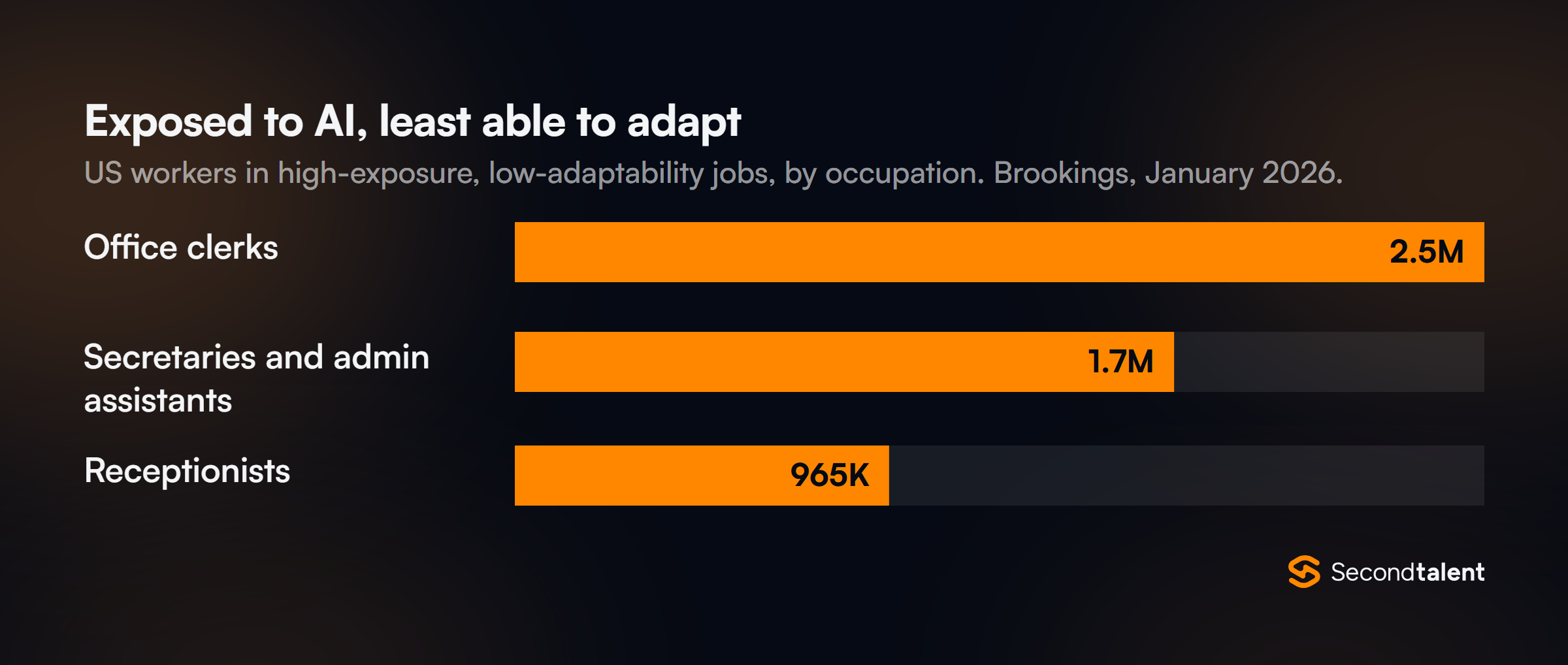
Workers in this group score low because of limited savings, older age, few local job options or narrow skill sets, the Brookings study found. 86% of them are women.
Government projections now point the same way. The Bureau of Labor Statistics 2025 to 2035 projections, released in August, expect office and administrative support to shrink 4.0%, or 752,100 jobs, while total employment grows 3.5%.
The release says generative AI "may limit demand" in arts, design, entertainment and media jobs. For the first time, BLS also published AI exposure categories for 831 occupations, with the warning that they are not employment forecasts.
Outside the US, the IMF's 2024 estimate still anchors the debate: almost 40% of global employment is exposed to AI, rising to about 60% in advanced economies, where about half of exposed jobs may gain from it rather than lose.
Why There Is No Mass Unemployment Yet
Economy-wide data does not show an AI shock. Yale's Budget Lab, which last updated its tracker on October 14, concludes that its analysis of AI exposure "does not yet clearly indicate an AI-related labor market footprint."
The mix of occupations is not changing in ways that line up with AI, and measures of AI use show no link to changes in employment or unemployment.
Employer surveys explain part of the gap between the headlines and the data. AI use has more than doubled in two years among businesses the New York Fed surveys:
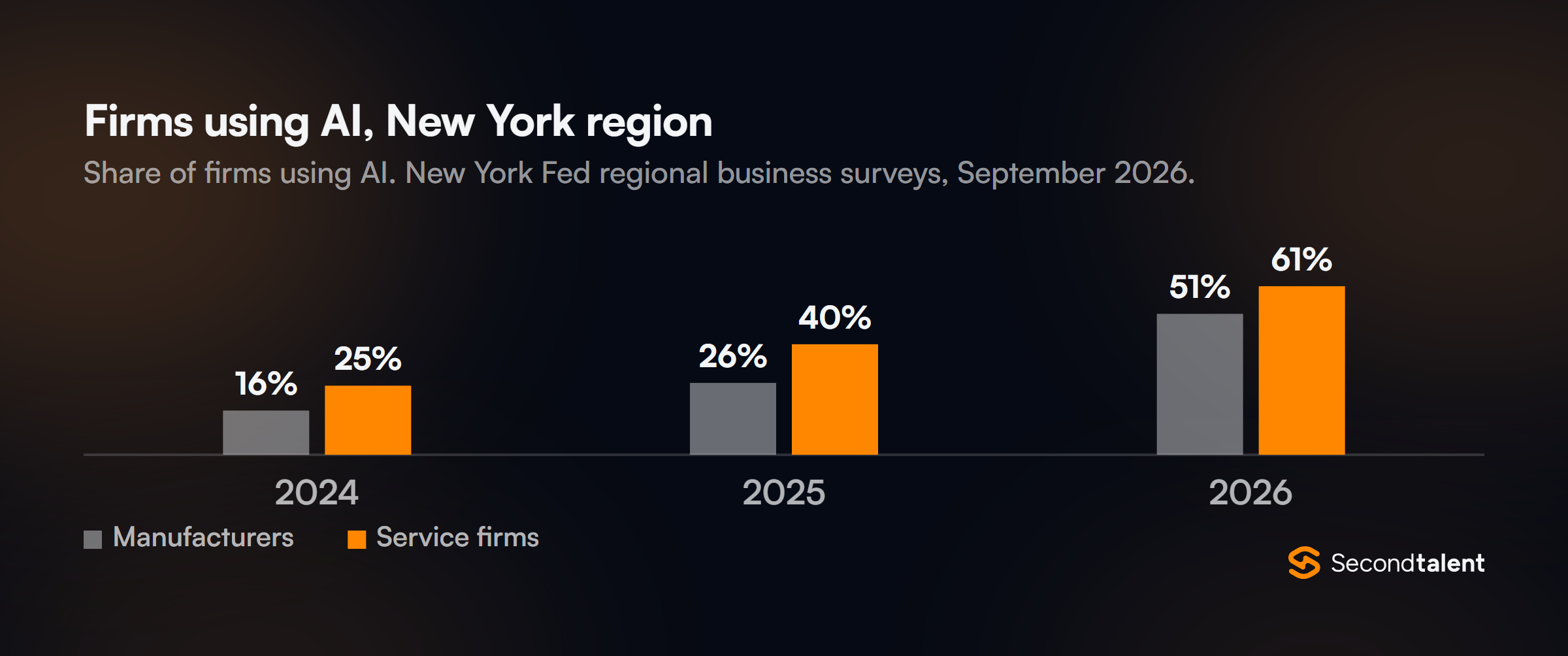
Yet only 4% of service firms and none of the manufacturers had laid workers off because of AI in the previous six months. Hiring moved both ways: 15% of service firms hired fewer people because of AI and 13% hired more.
The Fed's economists wrote that "existing workers are much more likely to be retrained than replaced by AI."
Alongside AI fluency, some workers are pivoting into regulated, client-facing roles where human presence and licensure still drive value.
Pursuing online real estate coursework, from state-approved pre-licensing to continuing education, offers a fast, flexible path to recognized credentials and income resilience.
"Churn across occupations, AI exposure among the unemployed, and usage data all remain flat, lie within historical ranges, or continue along pre-AI trends."
The Budget Lab at Yale, September 2026 update
Some signals do point at AI. A St. Louis Fed analysis found that occupations with more AI exposure saw larger rises in unemployment from 2022 to 2025, with computer and math jobs among the steepest.
The authors call it a correlation, not proof of cause. Taken together with Stanford's results, the picture is of AI slowing entry into exposed jobs while people already in them stay put.
How people use AI matters here. In Anthropic's January 2026 Economic Index, 52% of Claude.ai conversations augmented a person's work and 45% automated a task outright.
Business API traffic leans toward automation, which is where job effects would show first. Our AI in the workplace statistics track adoption by role and company size.
The Jobs AI Is Creating
AI engineer is the fastest-growing job in the US on LinkedIn's Jobs on the Rise 2026 list, with AI consultant and strategist second.
LinkedIn told CNBC that AI job postings rose 156% from 2024 to 2025, that the median AI role pays $177,000 against $80,000 for other roles, and that Gen Z makes up more than two-thirds of hires into AI engineer and forward-deployed engineer jobs.
That last figure cuts against the entry-level story above. Young workers are shut out of the jobs AI does, and hired into the jobs that build it.
AI requirements are spreading well beyond tech. Indeed's AI tracker shows the share of US job postings that mention AI tripling since ChatGPT launched:
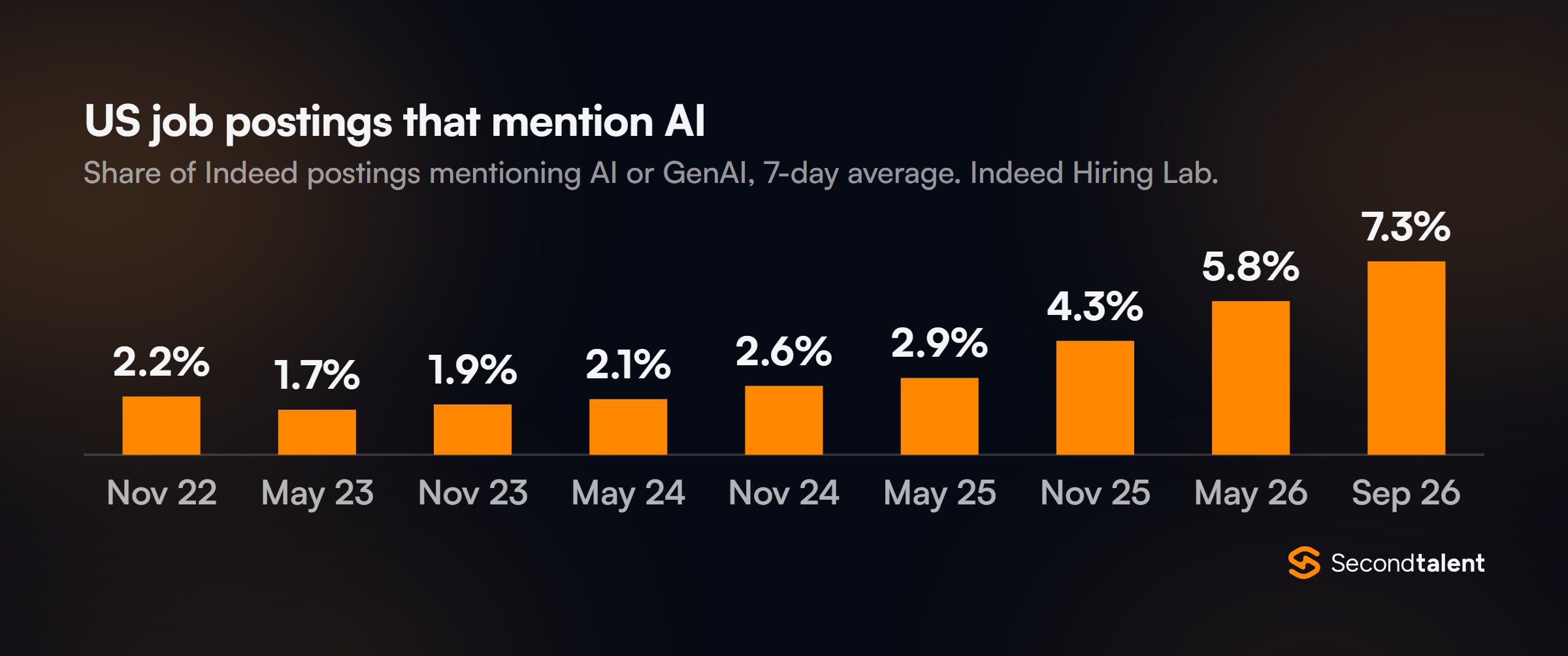
The share barely moved for two years, then climbed steeply from mid-2025 and reached 7.3% at the end of September 2026. In the UK it is higher still, at 9.9% of postings.
Indeed's Hiring Lab also found that roles with AI in the title drove 37% of the growth in US software postings from May 2025 to May 2026.
Pay follows the demand. PwC's 2026 Global AI Jobs Barometer, built on more than a billion job ads in 27 countries, found jobs requiring AI skills grew 69%, roughly eight times the 9% of the market as a whole.
The most AI-exposed companies grew headcount 52% from 2018 to 2025, against 36% at the least exposed. Our guide to the most in-demand AI skills and salary ranges breaks the premium down by skill.
Over five years, the World Economic Forum still expects more jobs to be created than lost. Its employer survey projects:
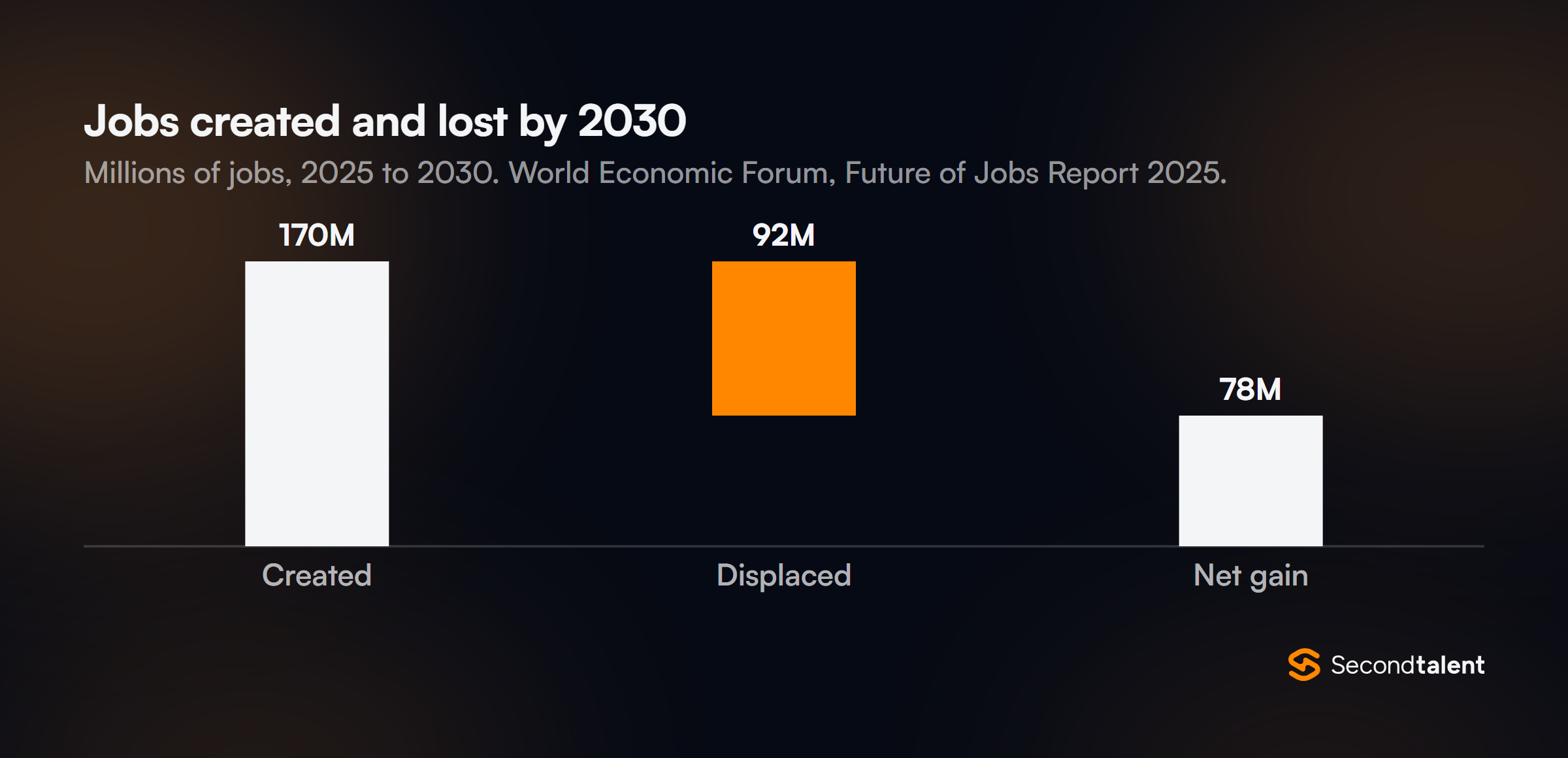
AI and information processing alone account for 11 million of the new jobs and 9 million of the lost ones, the Future of Jobs Report 2025 finds.
The bigger shift is in skills: employers expect 39% of core skills to change by 2030, and if the world's workforce were 100 people, 59 would need training. The report estimates 11 of those 59 are unlikely to get it.
In the US, the BLS projects data scientist jobs to grow 34.6% by 2035 and computer and information research scientists 21.8%. Software developers, testers and QA analysts together grow 10%, with about 106,100 openings a year.
The tech-specific picture, including postings and pay by level, is in our tech job market trends report.
AI and Jobs in Asia
The Philippine outsourcing industry cut its own forecast in July.
The IT and Business Process Association of the Philippines dropped its 2028 targets from $59 billion in revenue and 2.5 million workers, and CEO Jack Madrid said the new scenarios factor in AI disruption, BusinessWorld reported.
India's largest IT services firm shrank in its last financial year.
TCS announced in July 2025 that it would cut about 2% of its workforce, more than 12,000 roles, and ended March 2026 with 584,519 staff, Business Today reported, while still planning about 40,000 fresher hires.
In Vietnam, exposure is concentrated in the cities. Hanoi, Ho Chi Minh City and Da Nang hold 24.3% of employment but 38.0% of AI-exposed jobs, and only 1.8% of all jobs fall in the highest exposure tier, the ILO found.
Women are more exposed than men, 24.1% against 17.8%, the same pattern Brookings found in the US.
Singapore does not count AI job losses separately. The Ministry of Manpower told Parliament in January that business restructuring has made up 60% to 70% of retrenchments since 2024.
The companies building engineering hubs in the region are covered in our lists of global capability centers in the Philippines and in Vietnam.
Hiring for the Roles AI Is Creating
The jobs growing fastest, AI engineers and senior engineers who build with AI, are the most expensive to hire in the US.
We place vetted developers from Asia, including machine learning engineers, at 50% to 70% below US cost for the same seniority. Tell us what you are building and we will send profiles within 24 hours.
Frequently Asked Questions
Will AI take my job?
For most workers, not yet. The strongest effect so far is fewer hires of 22 to 25 year olds into AI-exposed jobs, while experienced workers in the same jobs show no loss.
Jobs that are mostly writing, translating, customer support or clerical work carry the most exposure.
How many jobs will AI replace by 2030?
Goldman Sachs estimated in 2023 that generative AI could expose the equivalent of 300 million full-time jobs worldwide to automation. Exposure means part of the work can be automated, not that the job disappears.
Are companies really replacing workers with AI?
A few are, openly, in customer support and corporate roles. Most are not: in the New York Fed's 2026 surveys, firms were far more likely to retrain staff than to cut them because of AI.