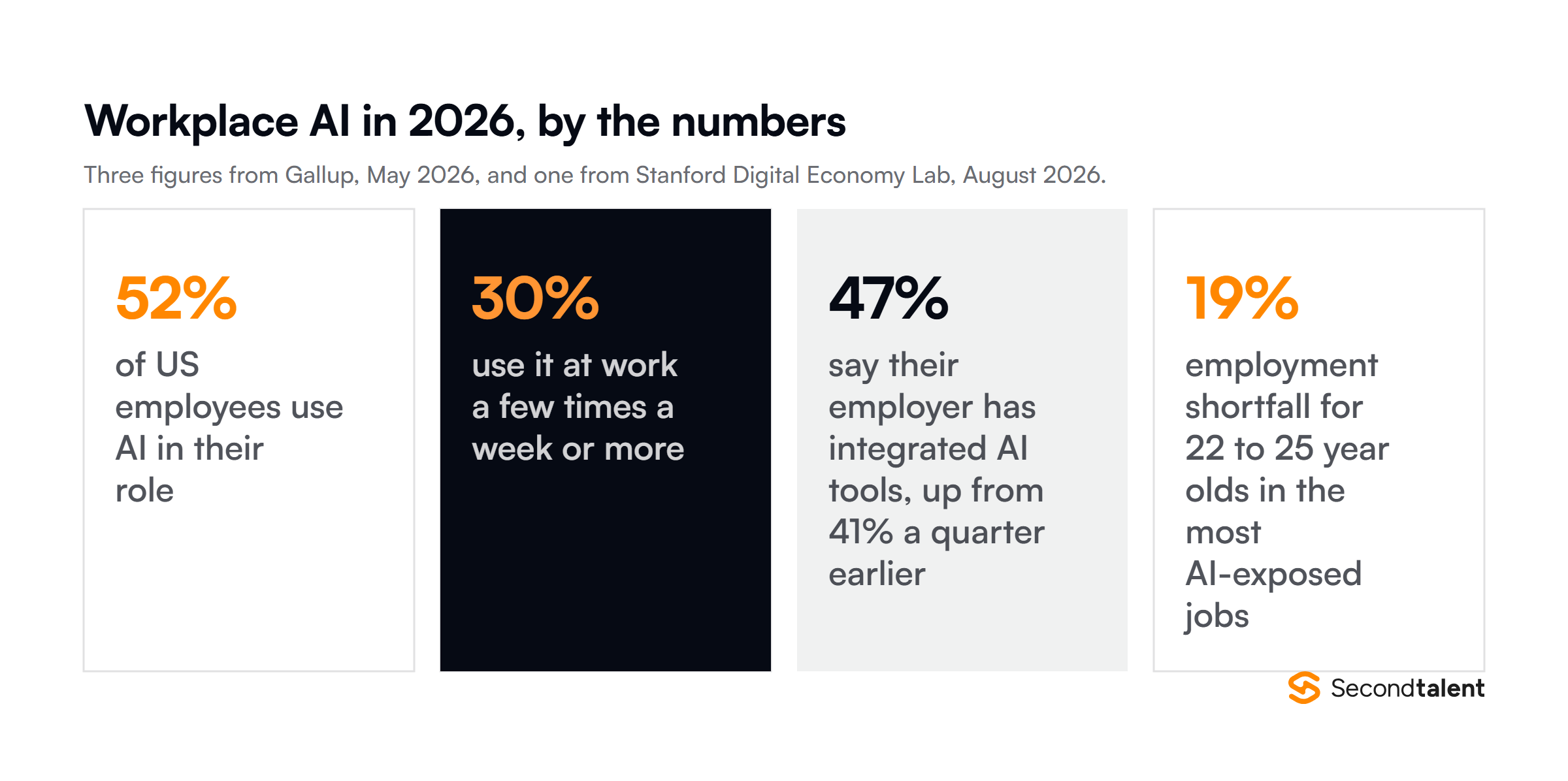
TL;DR: 52% of US employees now use AI in their role and 30% use it a few times a week or more, according to Gallup's May 2026 workforce study. The adoption question is settled. Breadth of use is what still varies. Employees who use AI for one or two things report a positive productivity impact 45% of the time. Those using it for seven or more report it 90% of the time. Microsoft's 2026 data says organizational factors explain about two thirds of the impact employees report, against a third for anything the individual does.
Most workplace AI statistics you will find still answer a 2024 question: how many companies have started using this. That number stopped being interesting once it cleared half the workforce.
The more useful question, once the licences are bought, is why two teams on the same tools report such different results. The 2026 research answers it, and the answer is not the tool.
Every figure on this page names the study behind it, the population it surveyed and when it was fielded. Where two credible sources disagree, both are printed. Where a widely repeated number turned out to be misattributed, the correction is in the text.
AI in the Workplace: The 2026 Headline Numbers
Read the population column before quoting any of these. A survey of large-enterprise executives and a random sample of employed adults are measuring different things, and the gap between them is where most bad AI statistics come from.
| Metric | Figure | Who was surveyed | Source |
|---|---|---|---|
| US employees who use AI in their role | 52% | 22,573 employed US adults | Gallup, May 2026 |
| Use AI at work a few times a week or more | 30% | 22,573 employed US adults | Gallup, May 2026 |
| Use AI at work daily | 15% | 22,573 employed US adults | Gallup, May 2026 |
| Say their employer has integrated AI tools | 47% | 22,573 employed US adults | Gallup, May 2026 |
| Organizations using AI in at least one function | Nearly 9 in 10 | 1,719 executives across 97 nations | McKinsey, August 2026 |
| Report improved individual productivity | 80% | 1,719 executives across 97 nations | McKinsey, August 2026 |
| Employees who hide their AI use | 57% | 48,000 respondents, 47 countries | KPMG and University of Melbourne, 2025 |
| Security incidents involving shadow AI | 43% | 602 breached organizations | IBM, 2026 |
| Expect AI to cut US jobs over 20 years | 71% | 3,488 US adults | Pew Research Center, June 2026 |
| Employment shortfall, ages 22 to 25 in AI-exposed roles | About 19% | ADP payroll records | Stanford Digital Economy Lab, August 2026 |
Key takeaways: 1. Half the US workforce uses AI, and frequent use is still climbing quarter on quarter. 2. The productivity gain tracks how many jobs an employee gives AI, not whether they have access. 3. Two thirds of the reported impact comes from the employer, not the employee. 4. Governance has fallen behind use: shadow AI now appears in 43% of security incidents. 5. Aggregate employment has not moved, but hiring for 22 to 25 year olds in exposed roles has.
How Many Employees Actually Use AI at Work?
52% of US workers use AI in their role, 30% use it a few times a week or more and 15% use it daily. Those figures come from Gallup’s Q2 2026 workforce study, fielded 6 to 20 May 2026 with 22,573 employed US adults and a margin of error of plus or minus 0.9 points.
The quarterly series is the useful part. In Q1 2026, fielded three months earlier with 23,717 employees, the same measures read 50%, 28% and 13%. Gallup’s headline figure counts any use in the role, down to a few times a year, so read it as reach rather than intensity. Frequent use has risen in each of the last three quarterly readings.
Organizational adoption moved faster than personal use over the same three months. 47% of employees say their employer has integrated AI tools to improve productivity, efficiency or quality, up from 41% in Q1. Another 20% do not know either way, which is its own finding about internal communication.
- 52% of US employees use AI in their role, up from 50% one quarter earlier (Gallup, May 2026).
- 30% use AI at work a few times a week or more, up from 28% (Gallup, May 2026).
- 15% use AI at work daily, up from 13% (Gallup, May 2026).
- 47% say their organization has integrated AI tools, up from 41% (Gallup, May 2026).
- 20% do not know whether their organization has integrated AI tools (Gallup, May 2026).
- Nearly nine in ten organizations report regular AI use in at least one business function (McKinsey State of AI, fielded May to June 2026, 1,719 respondents across 97 nations).
The enterprise-level and employee-level numbers describe different populations, which is why 47% and “nearly nine in ten” sit in the same table without contradicting each other. We took that measurement problem apart in detail in our enterprise AI adoption statistics.
What Do Employees Use AI For?
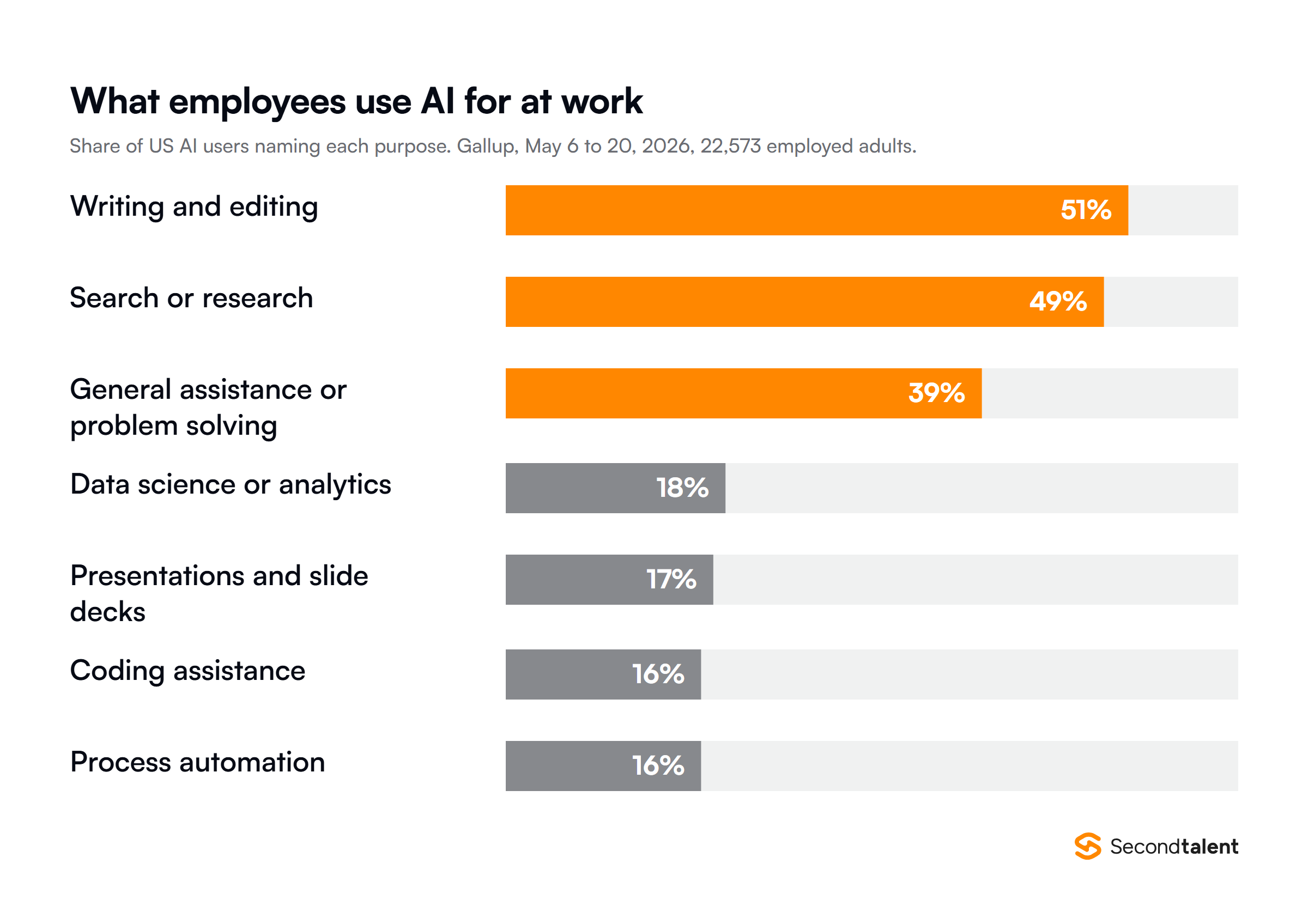
Writing and editing leads at 51% of US AI users, followed by search or research at 49% and general assistance or problem solving at 39%. The specialist uses sit far lower: data science or analytics 18%, presentations 17%, coding assistance 16% and process automation 16%.
The ranking inverts when you ask about results. Among Gallup’s respondents, the two least common uses report the highest positive productivity impact: coding assistance and process automation both at 77%, against 68% for writing and editing and 65% for search.
Anthropic’s usage telemetry shows the same split from the other side. Its January 2026 Economic Index, covering 13 to 20 November 2025, classified 52% of consumer conversations as augmentation and 45% as automation. On the enterprise API, roughly three quarters of traffic was automation. Employees collaborate with AI; the systems their employer builds hand work over to it.
Breadth of Use Predicts the Gain, Not Adoption
Gallup sorted AI users by how many distinct purposes they use AI for, then asked about productivity impact.
Employees using AI for one or two purposes reported a positive impact 45% of the time. At three or four purposes it was 66%, at five or six 78%, and at seven or more 90%.
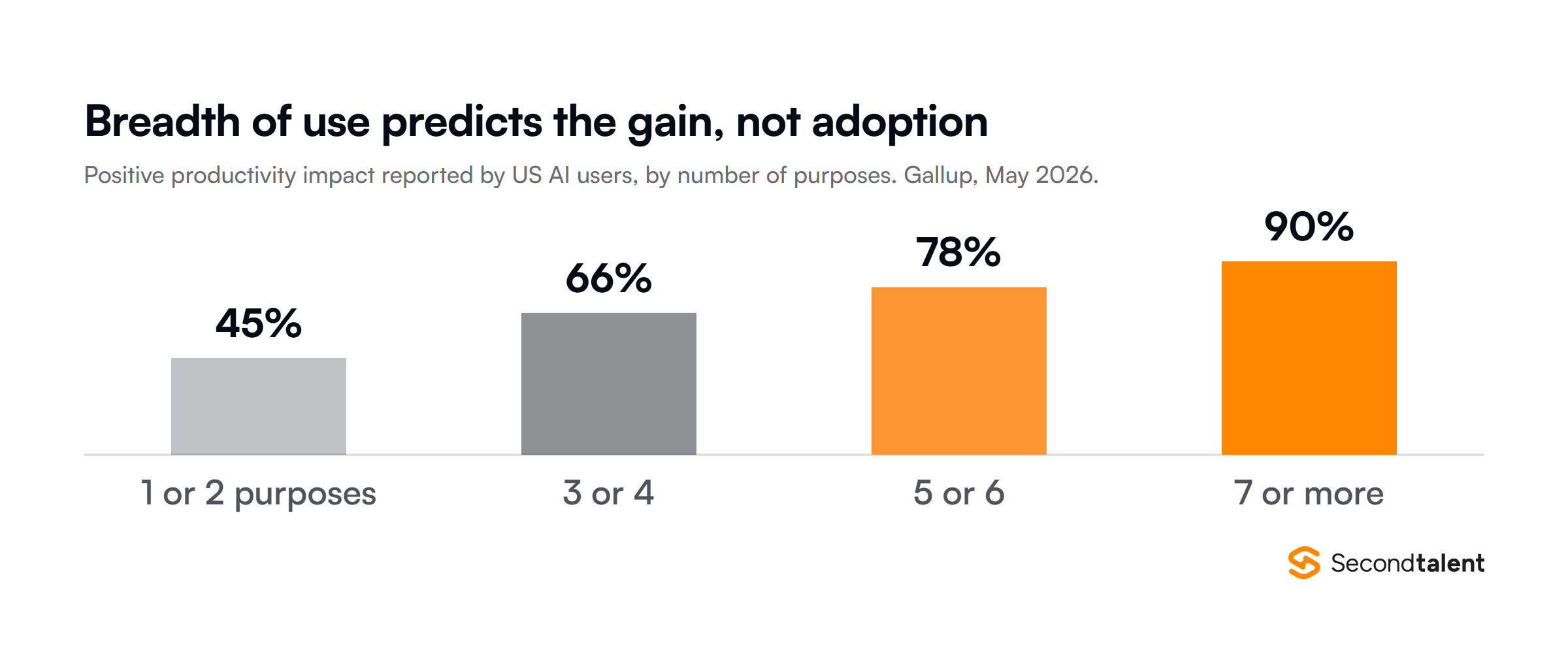
A licence count tells you nothing about which end of that curve your team sits on. Two companies can both report that 90% of staff have access while their employees report a positive productivity impact at 45% and 90% respectively.
Key insight: If you measure one thing about AI in your company this quarter, measure how many distinct jobs each team gives it rather than how many seats you bought. Seat count is the metric every vendor reports and the only one in Gallup's data that does not predict the outcome.
What Decides Whether Workplace AI Pays Off
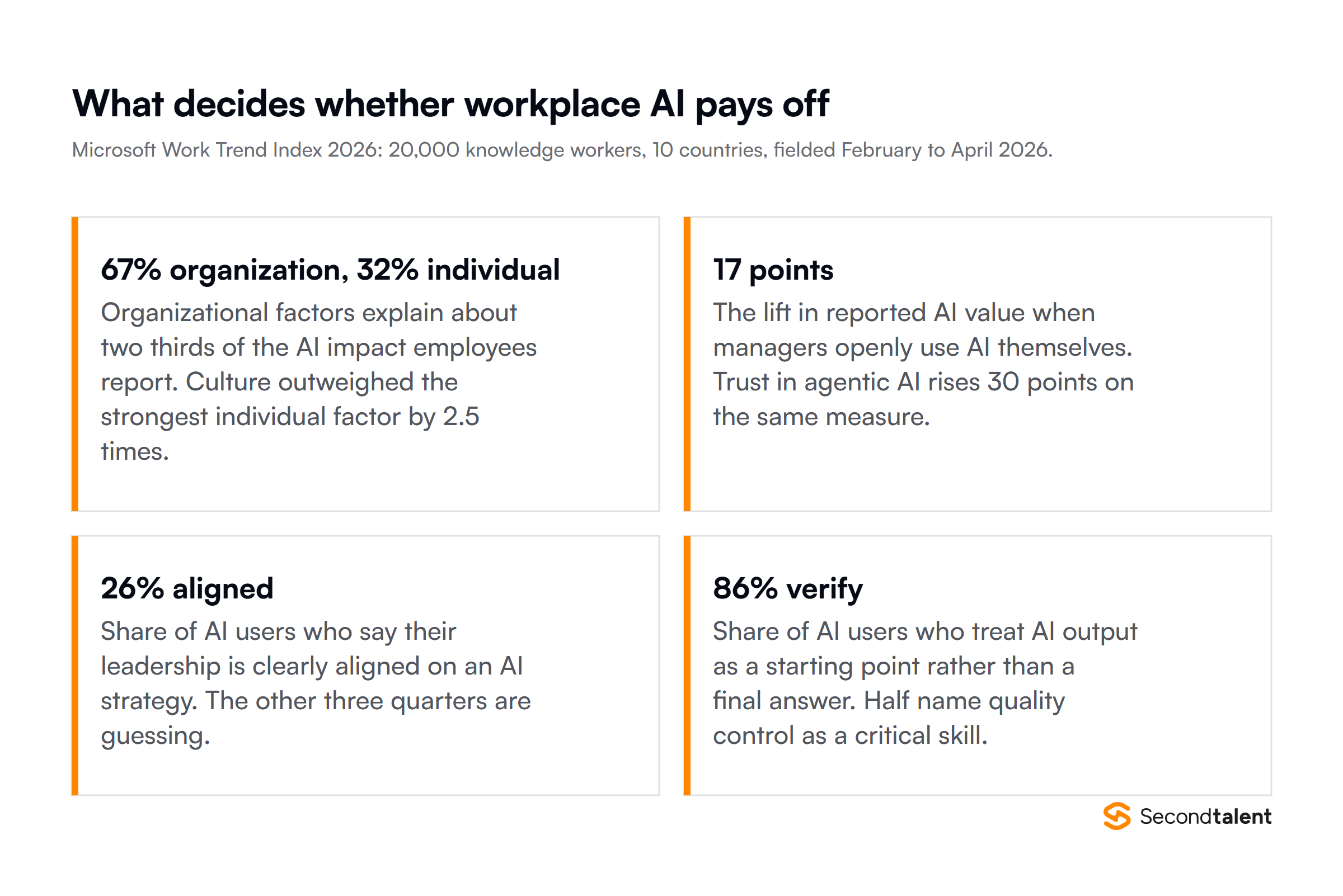
The employer decides most of it. Microsoft’s 2026 Work Trend Index, published 5 May 2026 from a survey of 20,000 knowledge workers across 10 countries, modelled 29 variables against the AI impact employees reported. Organizational factors accounted for about 67% of it and individual factors about 32%. Culture outweighed the strongest individual factor by 2.5 times.
- 66% of AI users say AI lets them spend more time on high-value work, and 58% say they are producing work they could not have produced a year ago.
- Reported AI value rises 17 points when managers openly use AI themselves, and trust in agentic AI rises 30 points on the same measure.
- 26% of AI users say their leadership is clearly aligned on an AI strategy.
- 86% of AI users treat AI output as a starting point rather than a final answer. 50% name quality control of AI output as a critical skill and 46% name critical thinking.
- Active agents in Microsoft 365 grew 15 times year on year, and 18 times in large enterprises.
Gallup’s CHRO roundtable, which surveyed 102 Fortune 500 CHROs between 10 February and 16 March 2026, found the same constraint from the top. 99% called AI important to their organization’s strategy, and 50% said they were not confident in their managers’ ability to guide employees on using it.
Among employees in AI-adopting organizations, 25% said their workplace culture had worsened and 24% said it had improved. Where managers actively supported AI use, 31% reported an improvement, against 21% where they did not.
Trust, Hidden Use and the Accuracy Problem
The largest study of employee AI behaviour remains the KPMG and University of Melbourne global study. It covers 48,000 respondents across 47 countries, fielded November 2024 to January 2025 and published April 2025. No 2026 edition exists, so treat these as the most recent global baseline rather than a current-year reading.
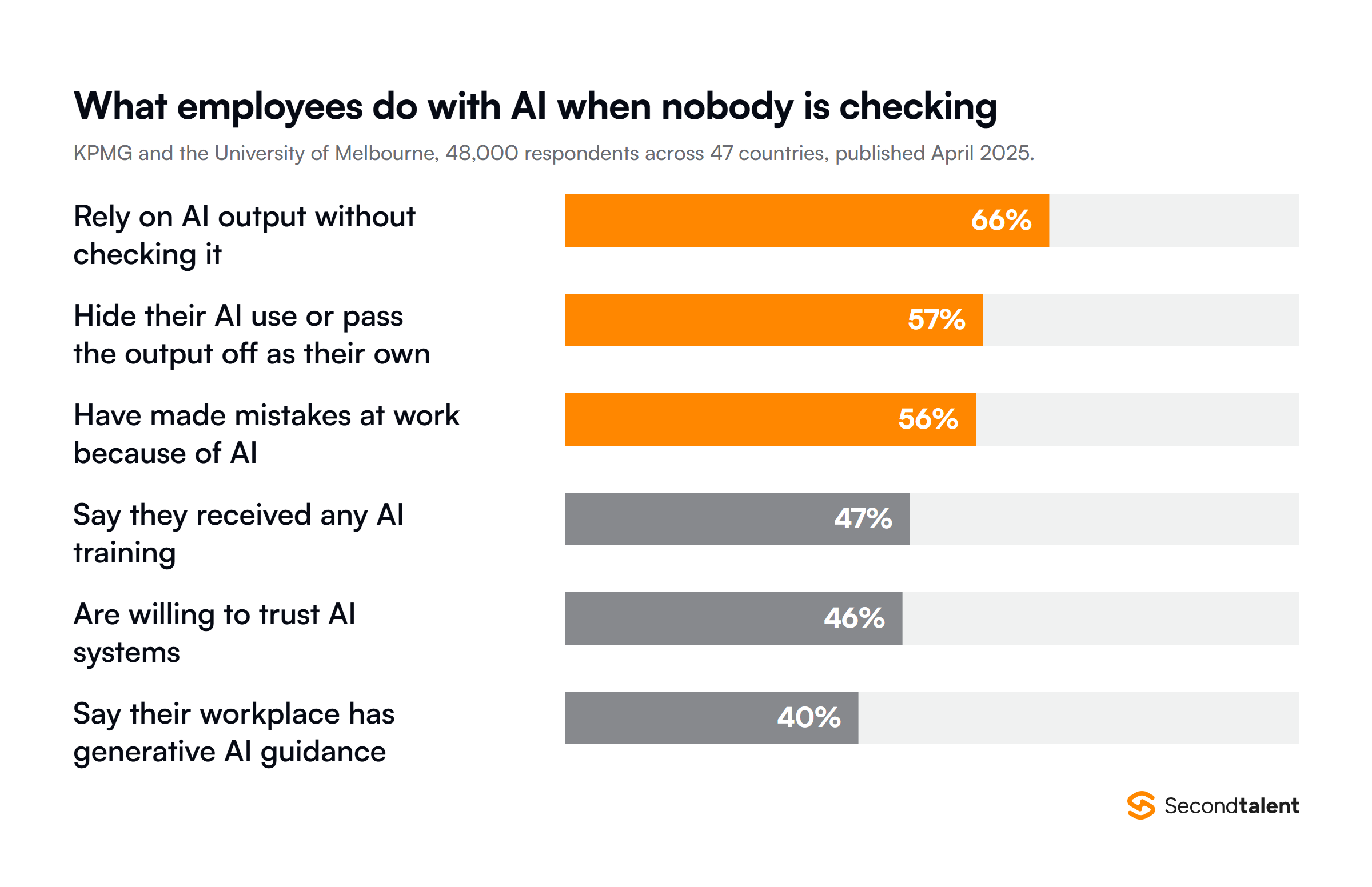
- 66% rely on AI output without evaluating its accuracy.
- 57% of employees hide their AI use or present AI-generated work as their own.
- 56% say they have made mistakes in their work because of AI.
- Almost half admit to using AI in ways that contravene company policy.
- 47% say they have received AI training, and 40% say their workplace has generative AI guidance at all.
- 46% are willing to trust AI systems, while 66% already use AI regularly.
Two of these figures circulate widely in the wrong form. Secondary summaries frequently print 57% for the accuracy figure and 59% for the mistakes figure. KPMG’s own release says 66% and 56%. If you are citing this study in a board pack, take the numbers from the press release rather than from a round-up.
Shadow AI and the Security Cost of Ungoverned Use
Hidden AI use has a price, and IBM has now measured it. The 2026 Cost of a Data Breach Report, covering 602 breached organizations across 17 industries and 16 countries between March 2025 and February 2026, put shadow AI in 43% of security incidents. The previous edition put it at 20%.
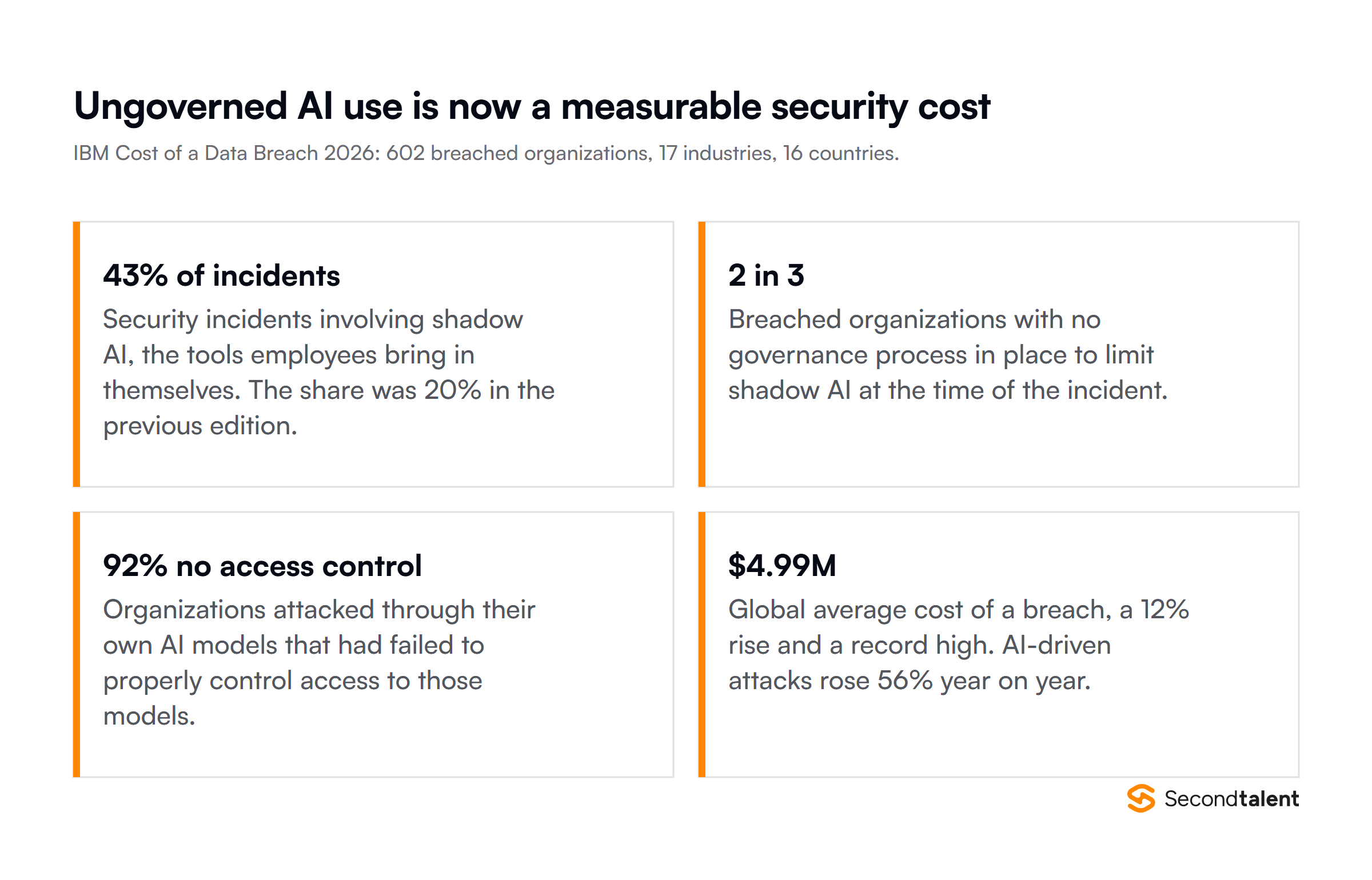
More than two thirds of breached organizations had no governance process in place to limit shadow AI. Among organizations attacked through their own AI models, 92% had failed to properly control access to them.
The global average breach cost reached $4.99 million, a 12% rise and a record high, and IBM recorded a 56% year-on-year increase in AI-driven attacks led by deepfake impersonation and AI-enabled malware.
One number needs care: the roughly $6 million figure that appears in coverage of this report is the average cost of an AI model inversion attack specifically, not the average breach. We have written more on where these failures start in our AI tool security vulnerability statistics.
AI Skills, Training and Workforce Readiness
Training is where the employee-side and employer-side studies agree. 47% of employees globally say they have received AI training. On the employer side, Gallup’s CHROs report that 57% now provide AI training for managers, 62% have set up centres of excellence or internal AI champions, and 78% encourage peer learning.
The demand side is well documented. The World Economic Forum’s Future of Jobs Report 2025 surveyed over 1,000 employers representing more than 14 million workers. It found that 39% of workers’ existing skill sets will be transformed or outdated over 2025 to 2030, with AI and big data the fastest-growing skills.
85% of employers plan to prioritise upskilling, 70% expect to hire staff with new skills and 40% plan to reduce staff whose skills become less relevant. That report is the January 2025 edition and there is no 2026 edition, whatever relabelled versions of these figures claim.
For engineering specifically, GitHub’s own controlled study of 95 professional developers found the Copilot group completed the task 55% faster, 1 hour 11 minutes against 2 hours 41 minutes. That figure is regularly misattributed to McKinsey, which never published it.
Many organizations now run this through a formal learning platform rather than ad hoc lunch sessions, using tools such as Kallidus training management software to schedule programmes and track which teams have actually completed them.
AI in Hiring and HR
HR teams have adopted AI for drafting long before they trusted it to act. Culture Amp’s 2026 AI in HR study surveyed 264 HR professionals in May 2026 and published on 22 July. Drafting work dominates: 86% use AI for content creation, 83% for brainstorming and 81% for information synthesis. Only 39% had moved AI into HR operations automation, and 34% into agentic workflow support.
It is a small sample of 264 respondents, so read it as a directional picture of one professional community rather than a population estimate.
Confidence in the same community has slipped over the year. Belief that AI will meaningfully improve how work gets done fell from 86% in 2025 to 77% in 2026, and only 24% said they were comfortable deploying agentic AI systems.
On the demand side, Indeed Hiring Lab counted 822 distinct AI-touched job titles in the US in Q1 2026. That is 8.3% of all job titles, about one in twelve, up from 264 titles and 2.6% in Q1 2022. 63% of those US titles now sit outside tech occupations. Germany reached 4.2%, France 3.3%, the UK 2.7%, the Netherlands 2.2% and Spain 2.3%.
If you are budgeting for those roles, our developer rate card and cost-to-hire benchmarks carry current monthly rates by market, and we compare the two hiring profiles in AI-native versus traditional engineers.
What the Employment Data Actually Shows
No study has found economy-wide displacement. The Stanford Digital Economy Lab’s August 2026 update, built on ADP payroll records rather than survey responses, states that plainly as its first finding.
Its second finding is narrower. Employment among workers aged 22 to 25 in highly AI-exposed occupations now sits about 19% below where it would be had it kept pace with similarly aged workers in less-exposed roles. The shortfall was 15% in July 2025.
The adjustment is running through reduced hiring rather than separations, and it shows up in employment rather than in base pay. The authors are explicit that these are descriptive patterns rather than causal estimates, that the gaps shrink once education is accounted for, and that no single study settles the question.
Employer expectations run ahead of employer behaviour. McKinsey’s August 2026 survey found 39% of respondents expecting AI-related headcount declines in the coming year, against 14% who reported an actual decline in the previous one.
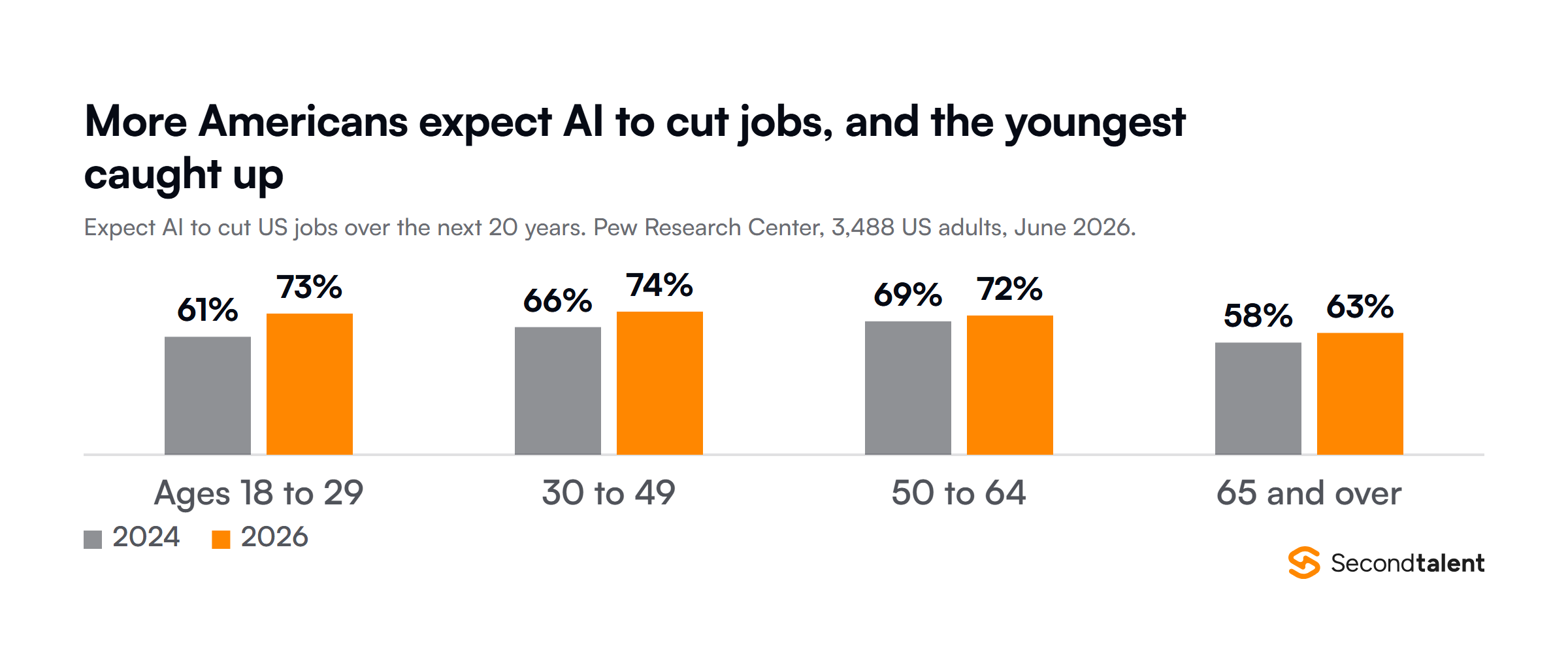
Public opinion has moved further than either. Pew Research Center, surveying 3,488 US adults between 22 and 28 June 2026, found 71% expect AI to lead to fewer US jobs over the next 20 years, up from 64% in 2024. Among adults under 30 the figure is 73%, up from 61% two years earlier.
Sentiment moved with it. 52% of Americans now say AI makes them more concerned than excited, against 37% in 2021, and among adults under 30 that share reached 55% for the first time.
Stanford’s 2026 AI Index puts a number on the expert and public divide: 73% of AI experts expect a positive impact on how jobs get done, against 23% of the public, a 50-point gap.
APAC Uses AI More Than the Global Average, and Worries More
Most workplace AI research is US-weighted, which understates how far ahead parts of APAC are. BCG surveyed over 4,500 employees across nine APAC markets against a global control group in July 2025 and published in October 2025.
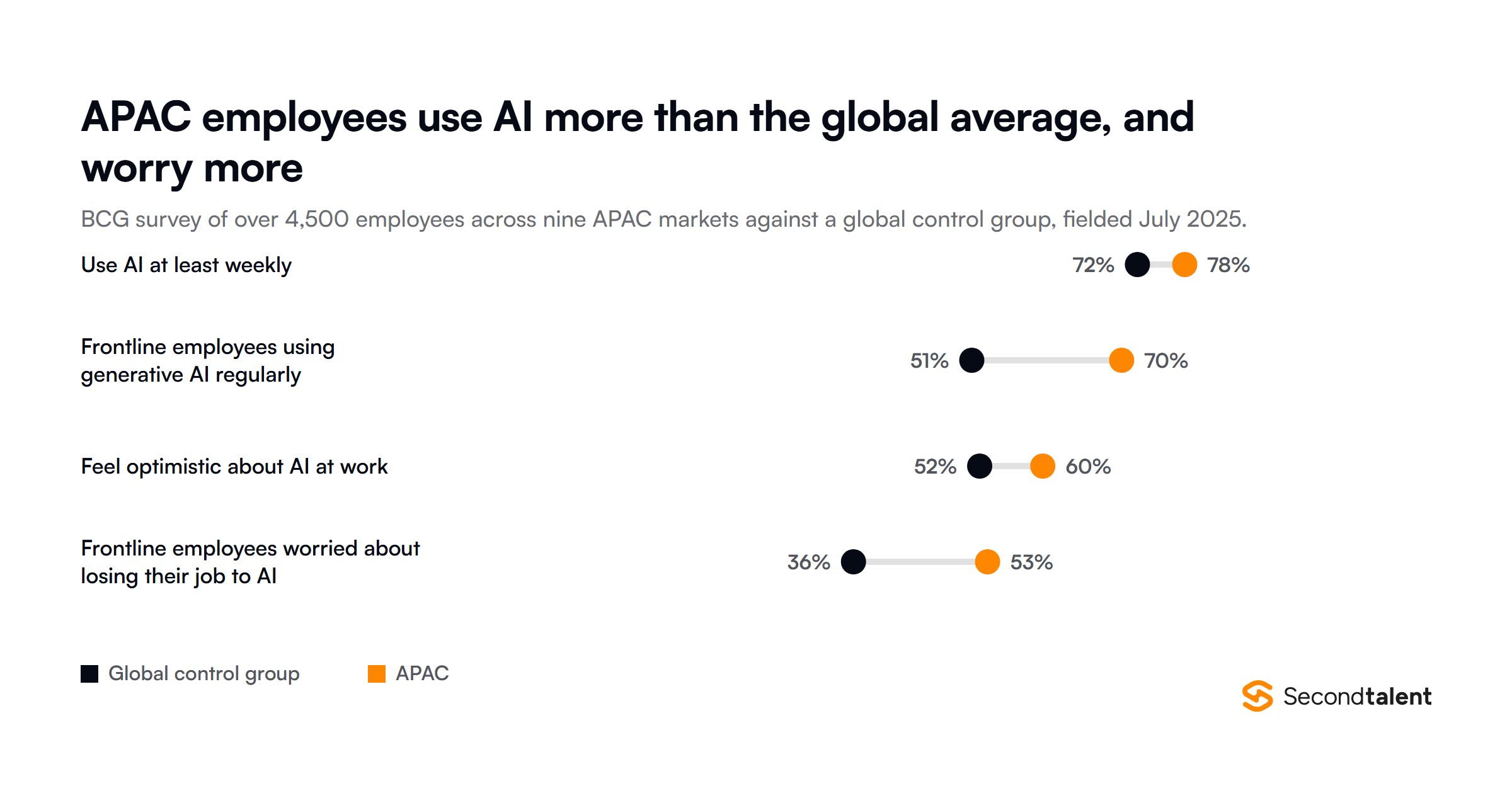
- 78% of APAC respondents use AI at least weekly, against 72% globally.
- 70% of APAC frontline employees use generative AI regularly, against 51% globally.
- India leads the region at 92% adoption; Japan trails at 51%.
- 60% of APAC respondents feel optimistic about AI at work, against 52% globally.
- 53% of APAC frontline employees worry about losing their job to AI, against 36% globally.
- 58% would use AI without company approval, and 35% would bypass restrictions to do so.
- 57% say their organization is redesigning workflows around AI.
Higher use with higher anxiety and thinner governance is a specific management problem, and the spread inside the region is wide: India at 92% adoption against Japan at 51%. Our AI trends in Singapore breakdown covers one market in depth.
What’s your AI hiring challenge?
Select your situation below.
You need developers who already know TensorFlow, PyTorch, and production AI systems. Our AI engineers in Southeast Asia cost 50-70% less than US hires and start in 2-4 weeks. No long recruiting cycles. Browse AI engineers →
You’re expanding your AI capabilities but hiring is slow and expensive. We source full-stack, backend, and data engineers who integrate AI tools into real products. Average time-to-hire: 3 weeks across Vietnam, Philippines, and Singapore. See full-stack AI rates →
You need budget clarity before committing to AI hires. Our rate card shows exact salaries for AI/ML engineers, data scientists, and DevOps across 5 Southeast Asian markets. Senior AI devs start at $3,500/month in Vietnam. View APAC salary data →
You want offshore AI developers but worry about contracts, payroll, and compliance. Our EOR service handles employment law, benefits and taxes, so you focus on building AI products. Fully compliant in 10+ countries. Get EOR pricing →
Workload, Culture and the Cost of Doing This Badly
Time saved does not automatically become time back. Microsoft found 65% of workers fear falling behind if they do not adapt to AI, while 45% said it feels safer to focus on current goals than to redesign how work gets done.
Only 13% said their employer rewards them for reinventing work with AI when the results miss targets. Employers are asking for redesign without covering the cost of a redesign that fails.
Gallup’s Q1 2026 data shows the disruption is real and uneven. 27% of employees in AI-adopting organizations reported disruptive changes at work, against 17% elsewhere. 23% reported layoffs or a reduction in their department, against 16% elsewhere. 34% reported hiring or expansion, against 28% elsewhere. AI-adopting organizations are more volatile in both directions.
Job security worry tracks that. 18% of all employees say elimination of their job within five years is very or somewhat likely, rising to 23% among those in AI-adopting organizations. Set against that, 65% report AI improved their productivity or efficiency, and 16% called the effect extremely positive.
Small operational fixes carry more of this than most AI strategies do. Meeting-heavy teams get a share of their week back from tools that handle the admin, and AI meeting notes are one of the cheaper places to start. Shared internal resources tend to follow, and some teams use services like QRNow to put documents, onboarding material and event check-ins behind a dynamic QR code rather than another portal login.
What This Means If You Are Hiring in 2026
Four things follow from the data above, and each of them is a decision rather than a trend.
- Measure breadth, not seats. Track the number of distinct tasks each team uses AI for. Gallup’s curve runs from 45% to 90% positive impact across that range, and nothing else in the 2026 data moves the number as far.
- Make managers use it visibly. Microsoft measured a 17-point lift in reported AI value where managers openly use AI, and half of Fortune 500 CHROs say their managers cannot yet guide anyone on it.
- Write the policy before the incident. 40% of employees globally say their workplace has generative AI guidance, and shadow AI now appears in 43% of security incidents. Those two numbers are the same problem, and closing it is the whole job of AI governance services: an approved tool list, a record of which models see company data, and a named owner who reviews it.
- Hire for the verification skill. 86% of AI users already treat output as a starting point and 50% call quality control a critical skill. Test for it in interviews rather than assuming it.
Three roles clear these bars: AI and machine learning engineers, agentic AI specialists, and data engineers who can put governance around what the rest of the company already does informally. We hire them across nine APAC markets, either as a direct placement or through our employer of record service where you do not have a local entity.
Final Words
The 2026 statistics describe a workforce that has finished adopting AI and has barely started organising around it. Half of US employees use it, a third use it weekly, and the companies seeing real gains are the ones that changed manager behaviour, training and policy rather than the ones that bought the most licences.
The uncomfortable figures sit on the governance side. Two thirds of employees do not check what AI gives them, 57% hide that they used it, and 43% of security incidents now involve unapproved tools. None of that is a technology problem, and none of it gets solved by another pilot.
We will refresh this page as each of these studies publishes its next edition. Gallup reports quarterly, IBM and Microsoft annually, and the Stanford payroll series updates through the year.
FAQs
How many employees use AI at work in 2026?
52% of US employees use AI in their role, 30% use it a few times a week or more and 15% use it daily, according to Gallup’s May 2026 study of 22,573 employed US adults. Globally, BCG found 78% of APAC employees and 72% of a global control group using AI at least weekly in July 2025.
What do employees use AI for most at work?
Writing and editing at 51% of AI users, search or research at 49% and general assistance or problem solving at 39%. Coding assistance and process automation are far less common at 16% each, yet both report the highest positive productivity impact at 77%.
Does AI actually make employees more productive?
It depends on breadth of use. 45% of employees using AI for one or two purposes report a positive productivity impact, rising to 90% for those using it for seven or more. McKinsey found 80% of organizations reporting improved individual productivity, and GitHub’s controlled study measured developers completing a task 55% faster with Copilot.
How many employees hide their AI use from their employer?
57% of employees hide their AI use or present AI-generated work as their own, and almost half admit to using AI in ways that contravene company policy. Both figures come from the KPMG and University of Melbourne study of 48,000 respondents across 47 countries.
What is shadow AI and how common is it?
Shadow AI is any AI tool employees bring into work without approval. IBM found it involved in 43% of security incidents in its 2026 report, up from 20% a year earlier, and more than two thirds of breached organizations had no process in place to limit it.
Is AI taking jobs?
Not across the economy so far. Stanford’s August 2026 payroll analysis found no economy-wide displacement. Employment for 22 to 25 year olds in highly AI-exposed occupations sits about 19% below the comparable trend, and the adjustment is running through reduced hiring rather than layoffs. 71% of US adults expect AI to cut jobs over the next 20 years.
How many employees have received AI training?
47% of employees globally say they have received AI training and 40% say their workplace has any generative AI guidance. On the employer side, 57% of Fortune 500 CHROs report providing AI training for managers, while 50% are not confident their managers can guide employees on AI use.

![Singapore AI Companies Leading Southeast Asia. Top 10 Singapore AI Companies Leading Southeast Asia [2026], by Second Talent.](https://www.secondtalent.com/wp-content/uploads/2026/09/singapore-ai-companies-featured-v2-768x403.jpg)