
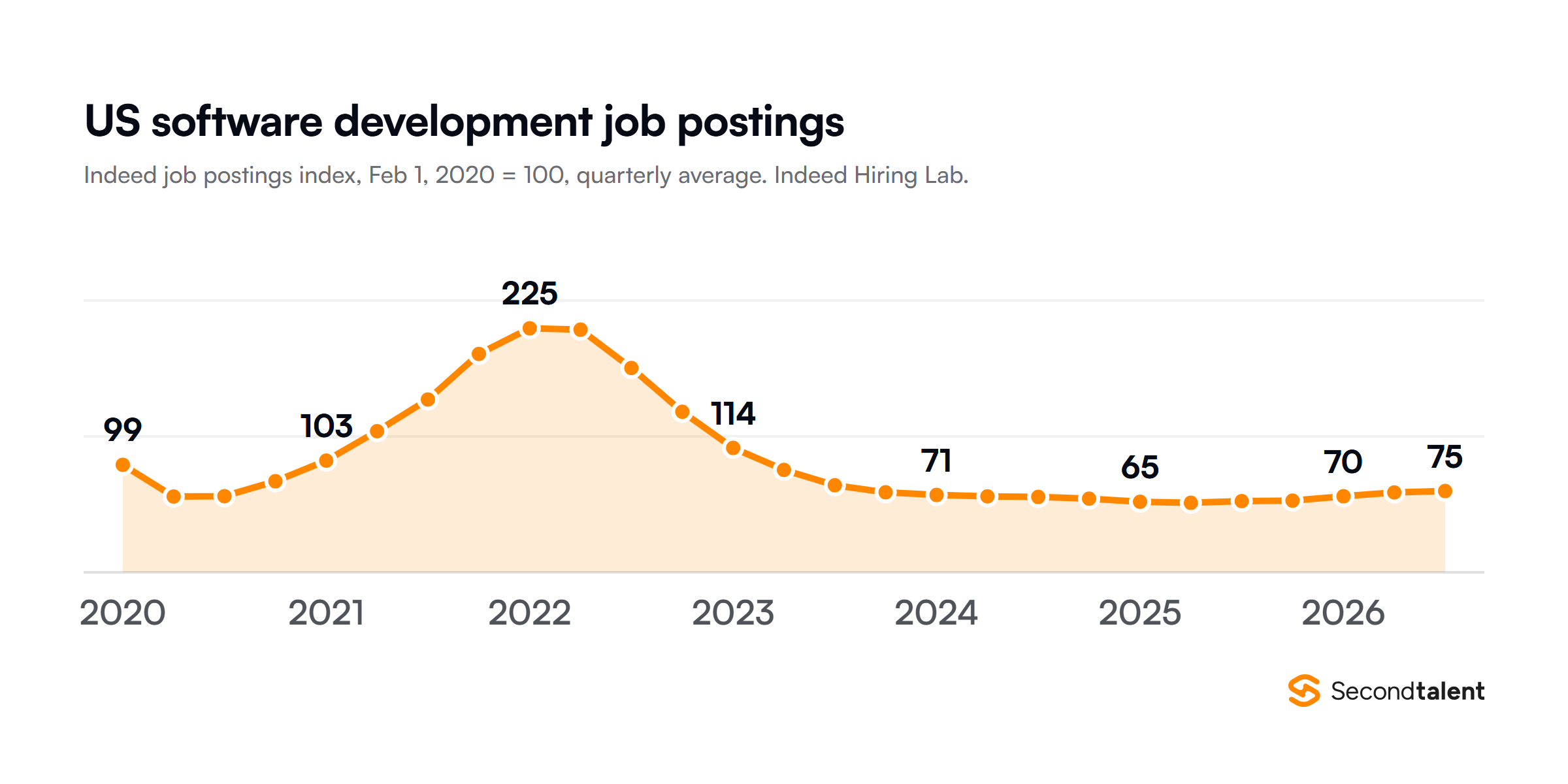
TL;DR: Software engineering jobs are recovering in 2026, from a low base: US software development postings on Indeed are up 18% on a year ago but still 24% below February 2020. The BLS projects 10% employment growth from 2025 to 2035. The squeeze falls on entry-level developers, while experienced engineers are holding up.
Computer engineering graduates had the second-highest unemployment rate of 74 college majors in the New York Fed’s latest data, 7.8%, even though they earn the highest starting pay, $90,000. Computer science was fourth, at 7%.
- 1Employment of 22 to 25 year olds in the most AI-exposed jobs is 19% below trend, while experienced workers show no gap.
- 2Four of the five weakest job sectors on Indeed are tech, while mechanical engineering postings are 60% above their pre-pandemic level.
- 3The BLS expects computer programmer jobs to shrink 7% while data scientist jobs grow 35%.
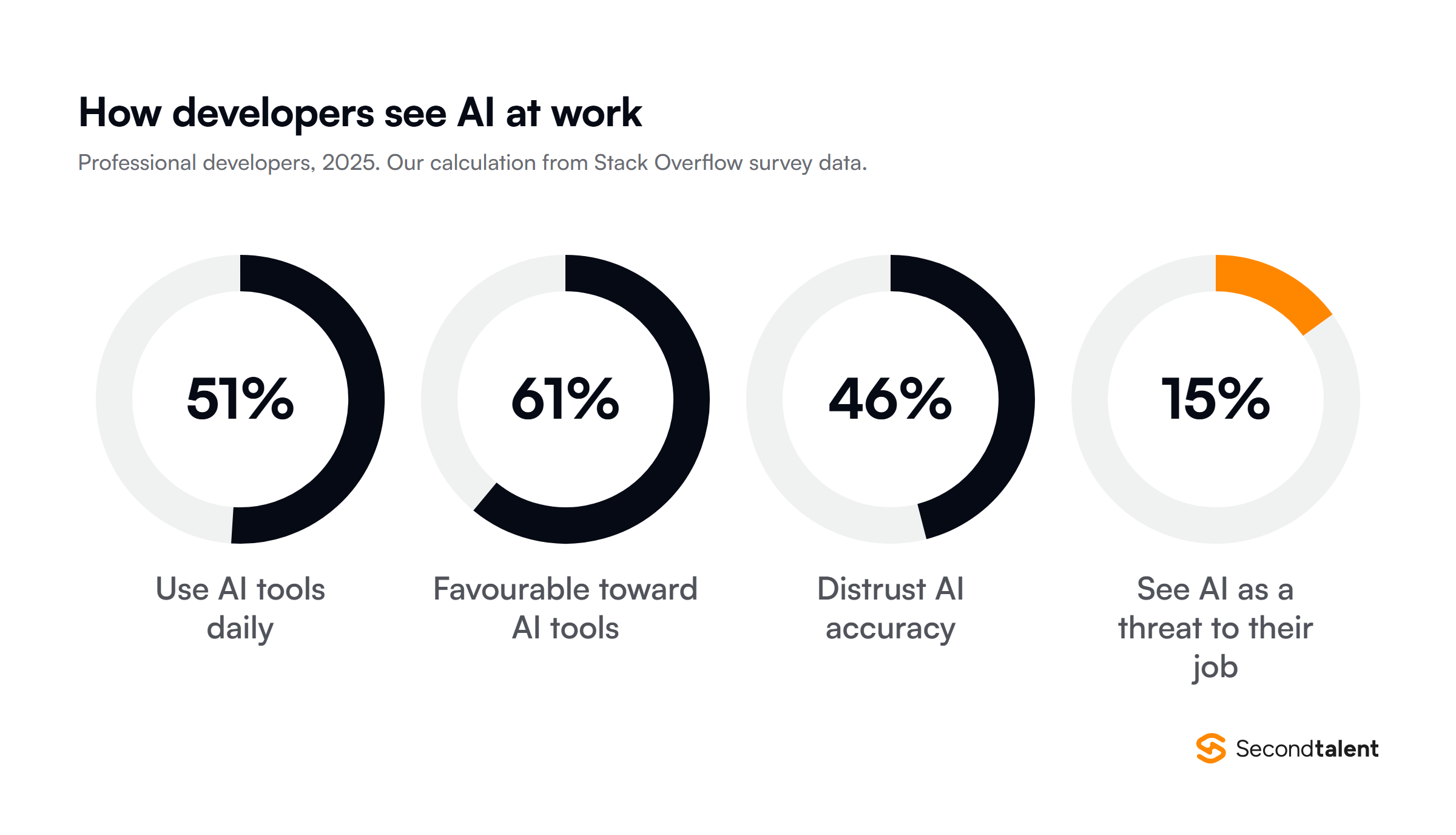
- 4Half of professional developers use AI tools daily, and only 15% see AI as a threat to their job.
Is the Software Engineering Job Market Growing in 2026?
Yes, from a low base. Indeed’s index of US software development job postings stood at 76.1 on September 4, 2026, where February 2020 is 100. A year earlier it was 64.4, and it bottomed at 61.1 in May 2025.
The fall came from an unusual high. Postings reached 233.8 in February 2022, more than double their pre-pandemic level, then fell for more than three years, to the May 2025 low.
The index has risen for five straight quarters since then, from a quarterly average of 63.9 to 74.7.
Fresh listings are recovering faster than the total: Indeed’s index of new software postings was 86.9 on the same day, against 76.1 for all open ones. The data is public in Indeed Hiring Lab’s job postings tracker.
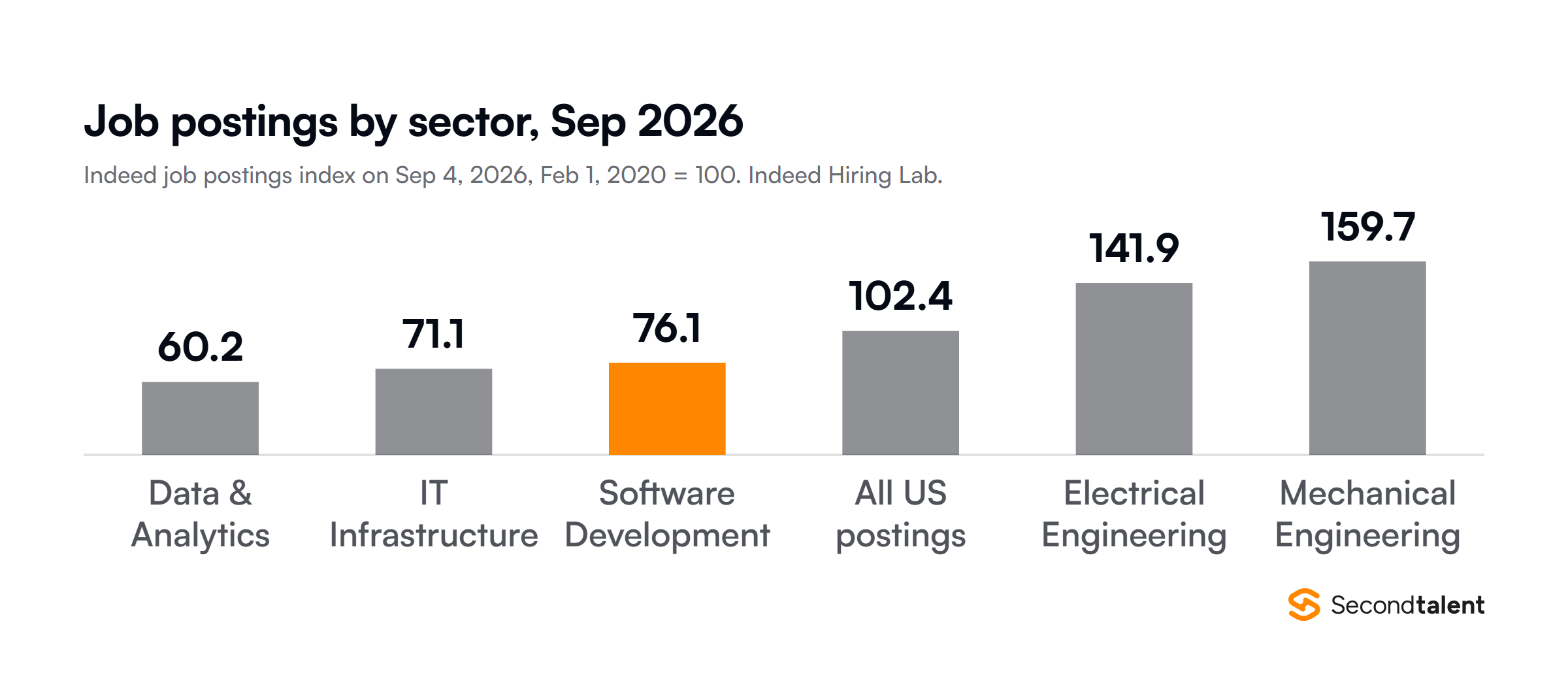
The rest of the job market has already recovered, with all US postings at 102.4. Software is the fifth-weakest of the 47 sectors Indeed tracks. Only data and analytics, media and communications, and two IT sectors sit below it.
Engineering outside software is booming:
The long-run count of jobs is still growing. The US Bureau of Labor Statistics puts employment of software developers, QA analysts and testers at:
BLS names software for AI, the Internet of Things and robotics as the drivers of that growth. Software publishers pay developers the most, a median $164,550, ahead of manufacturing at $136,330 and finance and insurance at $135,460.
Layoffs have not stopped, though: our tech layoffs tracker counts 128,536 tech workers laid off at 299 companies between January 1 and September 10, 2026.
Challenger, Gray & Christmas counts 155,126 announced US tech job cuts through August, up 52% on a year earlier.
What Is Happening to Entry-Level Developer Jobs?
They are shrinking relative to everything else.
Employment of 22 to 25 year olds in the occupations most exposed to AI is about 19% below where it would be had it kept pace with less-exposed jobs, according to the Stanford Digital Economy Lab’s August 2026 update, based on ADP payroll data.
Software engineering is in that group: TIME’s coverage of the first version of the study named it alongside marketing and customer service, with a 16% relative decline at the time.
Experienced workers in the same jobs show no comparable gap, and the declines cluster where AI automates tasks rather than assists with them.
Graduate data shows the same pressure. In the New York Fed’s figures for recent graduates aged 22 to 27, the two best-paid majors have some of the worst unemployment:
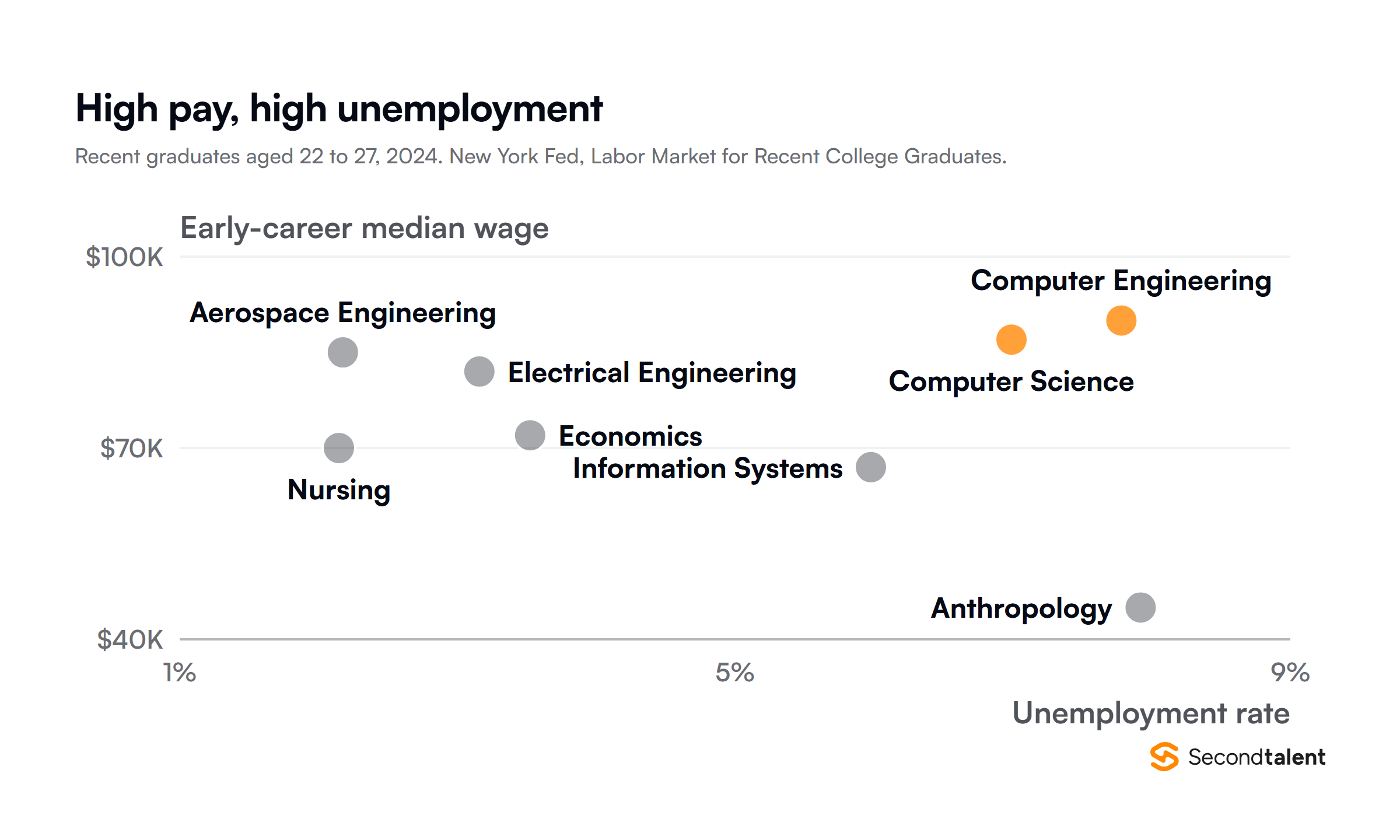
Most graduates who find work land degree-level jobs. Computer engineering has the fourth-lowest underemployment of the 74 majors, at 15.8%, and computer science ranks ninth, at 19.1%, against an average of 38.5%.
Pay also climbs well: by ages 35 to 45, computer engineering graduates earn a median $131,000 and computer science graduates $120,000.
The seniority gap shows in pay too. In our analysis of Stack Overflow’s 2025 survey, US developers with under five years of experience earn a median $94,000, and those with ten or more earn $170,000.
Which Software Roles Will Grow Through 2035?
The roles closest to data, security and research grow fastest, and the one defined by writing code to a specification shrinks.
BLS projects data scientist jobs to grow 35% from 2025 to 2035 and computer programmer jobs to fall 7%, against 3% for all occupations.
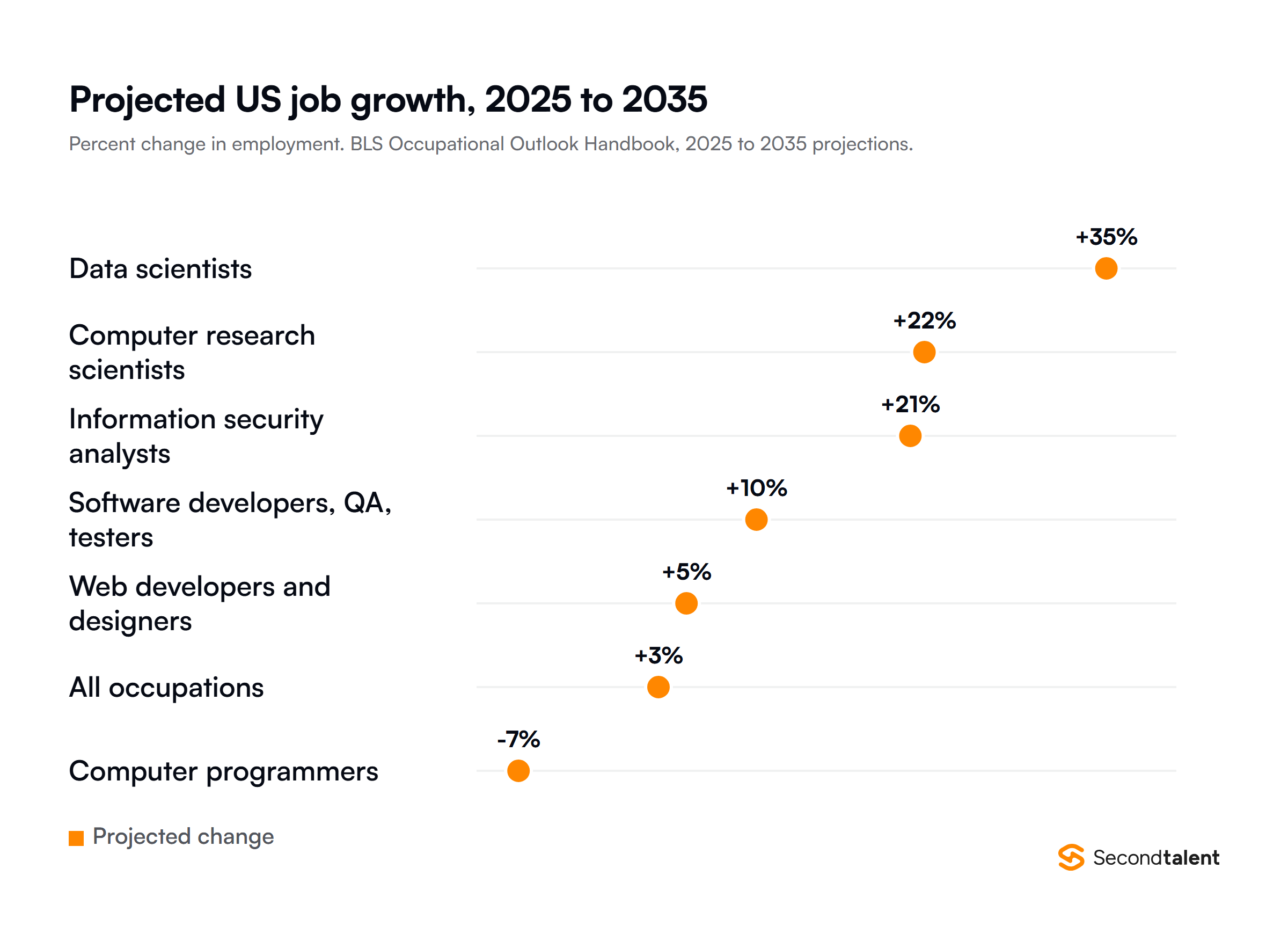
The fast-growing roles start from small bases. There are 275,600 data scientists and 192,900 information security analysts in the US, against 1,905,400 software developers, QA analysts and testers.
In absolute terms, software development still has by far the most openings: BLS expects 106,100 a year, against 24,800 for data scientists.
Pay splits along the same lines inside software. Software QA analysts and testers earn a median $104,300 and web developers $92,650, both well below the $135,980 for software developers, and web development grows only 5% over the decade.
The three fastest-growing roles, data scientists, security analysts and research scientists, add 41,800 openings a year between them, fewer than half of software development’s 106,100.
Developers earn more than $35,000 above programmers. The BLS definitions explain the split: programmers write and test code, while developers design the applications that code runs in.
Our AI skills and salaries guide shows which tools pay most within these roles.
Is AI Replacing Software Engineers?
Not across the board, and developers do not expect it to. In our analysis of Stack Overflow’s 2025 survey data, half of professional developers use AI tools daily, yet only 15% see AI as a threat to their current job.
Juniors are the heaviest users and no more worried than veterans. 55.9% of developers with under five years use AI tools daily, against 43.9% of those with 20 or more.
The same 14.6% of each group see AI as a threat to their job. That contrasts with the payroll data above, where the younger group is the one losing ground.
Developers like the tools more than they trust them: 61% are favorable toward AI tools and 20% unfavourable. 46% distrust the accuracy of AI tools and 32% trust it, and only 2.7% trust it highly.
Agents, which take multi-step actions on their own, are still a minority habit: about a third of professional developers use them at work at all.
The productivity evidence is still moving. METR, a research group that ran a randomized controlled trial on AI tools and experienced developers, has reported two results:
- 16 experienced open-source developers, 246 real tasks
- 19% slower with AI tools allowed
- The same developers believed AI made them 20% faster
- Developers are “likely” sped up by early 2026
- Estimated 18% faster, with a wide margin of error
- Many developers refused to work without AI, which biases the estimate down
For developers newly recruited to the 2026 study, METR’s estimate was smaller, about 4% faster, again with a wide margin. Sources: METR’s 2025 study and 2026 update.
Our analysis of how much software is written by AI covers the share of code AI already produces.
Which Skills Employers Are Asking For
AI skills, above all. They now appear in 2.5% of US job postings, up 55% in a year, and Python was the most requested specialized skill, in 258,674 postings, according to Lightcast’s data for the Stanford AI Index 2026.
Postings asking for agentic AI, systems that plan and act on their own, went from 0.06% to 0.23% of all postings in a year.
Employers pay for those skills. PwC’s 2026 AI Jobs Barometer, which covers more than a billion job ads in 27 countries, puts the wage premium for AI skills at 62%, up from 57% a year earlier.
Jobs that require AI skills grew 69%, against 9% for the job market as a whole.
The same gap shows among developers themselves. US developers who use AI agents at work daily earn a median $175,000 in the Stack Overflow data, against $141,000 for those with no plans to use them.
Part of that is seniority, but among developers with ten or more years the gap holds, at $187,000 against $156,000.
Where Software Developer Growth Is Happening
Largely outside the US. India overtook the US in 2025 as the largest base of contributors to public and open source projects on GitHub, and it is on track to have the most developer accounts by 2030.
Our ranking of countries with the most software developers covers the full count.
The worldwide developer population is still growing, at a lower rate. SlashData estimates 48.4 million developers in the third quarter of 2025, and its growth rate fell to 10% in the latest twelve months, from 21% the year before.
AI hiring is spreading the same way.
Singapore now has the highest share of job postings asking for AI skills in the world, at 4.77%, followed by Hong Kong at 3.5%, Luxembourg at 3.4% and Spain at 3.3%, with the US at 2.6%, according to Lightcast’s data for the Stanford AI Index.
Hiring Senior Engineers in 2026
We place pre-vetted senior engineers across nine Asian markets and match candidates within 24 hours, at $23 to $39 an hour, billed monthly. See how we hire developers, or tell us the role and we will send vetted profiles.
FAQs
Is computer science still worth studying in 2026?
For long-run pay, yes: computer science graduates earn a median $120,000 by mid-career. The first job is the hard part, with 7% unemployment among recent graduates in 2024.
Will AI replace junior developers?
Not wholesale, but junior roles are where the change shows first. Young workers in AI-exposed jobs are 19% below trend in the Stanford payroll data, while experienced workers show no gap.
Which programming roles are declining?
Computer programmers, the role that writes code to someone else’s design. BLS projects 8,100 fewer programmer jobs by 2035, a 7% fall. The 4,400 openings a year it still expects all come from people retiring or changing careers.